



Text version
Hormone-Informed Care for Women With Psychosis
A potentially protective effect of estrogen against psychosis has long been described across scientific and epidemiologic studies. You may recall this phenomenon from the female-specific second peak of schizophrenia incidence, timed later in life around perimenopause as estrogen levels decline.
So how should this knowledge affect your clinical decision making? How does estrogen interact with standard treatment of psychosis? And when should it be the treatment? A recent review published in Lancet Psychiatry shined some light on the role of ovarian hormones in psychosis and offers recommendations for how to incorporate this information into practice and offer hormone-informed care.
Download PDF and other files
Perimenstrual Psychosis Exacerbation Differs From PMDD
The authors of this study conducted a narrative review in which they set out to describe the relationship between the menstrual cycle and psychotic symptoms, the ways in which ovarian hormones can both influence and be influenced by antipsychotic treatments, and the role of estrogen-based treatments in psychosis management. A few of their points really jumped out at me.
The authors described that psychotic symptoms tend to worsen and hospitalization risk increases during the perimenstrual phase. The perimenstrual phase encompasses a four- to six-day period of the late luteal phase and early follicular phase, when both estrogen and progesterone are at their lowest levels. In lay terms, I would describe this to patients as the few days before and after the start of their period.
Notably, this pattern of exacerbation is different from the one classically observed and taught for premenstrual dysphoric disorder (PMDD). In PMDD, mood symptoms are worse in the luteal phase, and the start of the follicular phase with menses brings relief, often almost immediately.
Track Symptoms Prospectively Across Cycles
For patients with suspected symptom fluctuation with the menstrual cycle, the authors recommend prospective symptom tracking across two to three menstrual cycles using tools like the Daily Record of Severity of Problems (DRSP). The DRSP doesn’t actually have a category for psychotic symptoms specifically, so you and the patient would have to add one.
I agree with this recommendation, and I would emphasize that when you interpret the data, persistence of psychosis exacerbation during the early days of the menstrual cycle would affirm your hypothesis rather than undermine it.
Download PDF and other files
Hormone Levels Rarely Guide Treatment
I’m often asked about the utility of getting hormone levels for these patients as part of the assessment. On the basis of this review, and aligned with my clinical experience, the answer is generally no. In psychosis, as in other menstrual cycle-related mood exacerbations, symptom exacerbation seems more related to an individual’s sensitivity to hormone fluctuation than to abnormal absolute concentrations.
While estrogen levels have been shown in some studies to be lower in premenopausal women with psychosis than in healthy controls, this finding isn’t clearly independent from higher rates of using prolactin-raising antipsychotics, and it wouldn’t affect my clinical decision making.
Prolactin-Sparing Antipsychotics Preferred First Line
While I wouldn’t recommend getting hormone blood levels to develop the treatment plan, I do think that patients may benefit from a treatment strategy that minimizes estrogen suppression and fluctuation.
Prolactin-sparing antipsychotics like aripiprazole are preferred as first line for women with non-affective psychosis in international consensus guidelines due to their overall side effect profile. As this review highlights, they also have the added benefit of being less likely to precipitate hypoestrogenic symptoms and menstrual irregularities.
Assessing for and treating hyperprolactinemia is important. The authors recommend switching to a prolactin-sparing agent or augmenting with adjunctive low-dose aripiprazole if hyperprolactinemia develops, rather than just decreasing the dose of the existing medication.
Download PDF and other files
Estrogen Inhibits CYP1A2 Metabolism
Another important takeaway from the review is that the metabolism of several antipsychotics is affected by estrogen levels. Estrogen, including the ethinyl estradiol contained in combined oral contraceptives, has a strong inhibitory effect on CYP1A2 that can lead to higher plasma levels of clozapine, olanzapine, and potentially asenapine.
If a patient is taking clozapine, olanzapine, or asenapine, be sure that your medical history includes questions about reproductive stage, menstrual cycle regularity, and contraceptive type. Reevaluate for any changes in this information over time.What the interaction with estrogen implies in practical terms is that within an individual, the same daily dose of these antipsychotics might result in decreased plasma levels at times when their estrogen levels decrease. For example:
- During the perimenstrual phase of the menstrual cycle
- During menopause
- After stopping a combined oral contraceptive or hormone replacement therapy
Clinically, if previously well-managed symptoms reemerge in these contexts, consider the possibility that the dose has effectively decreased and may need to be raised to maintain the same plasma level. Conversely, it’s recommended to initiate clozapine at half the typical starting dose in women taking combined oral contraceptives, in order to minimize the risk of side effects.
That said, the authors note that there are less formal data supporting a need for antipsychotic dose adjustments during the hormone-free interval of an oral contraceptive. I agree that lowering the antipsychotic dose during those days doesn’t appear clinically necessary for most patients, and more complicated regimens may affect adherence.
When Hormones Become the Treatment
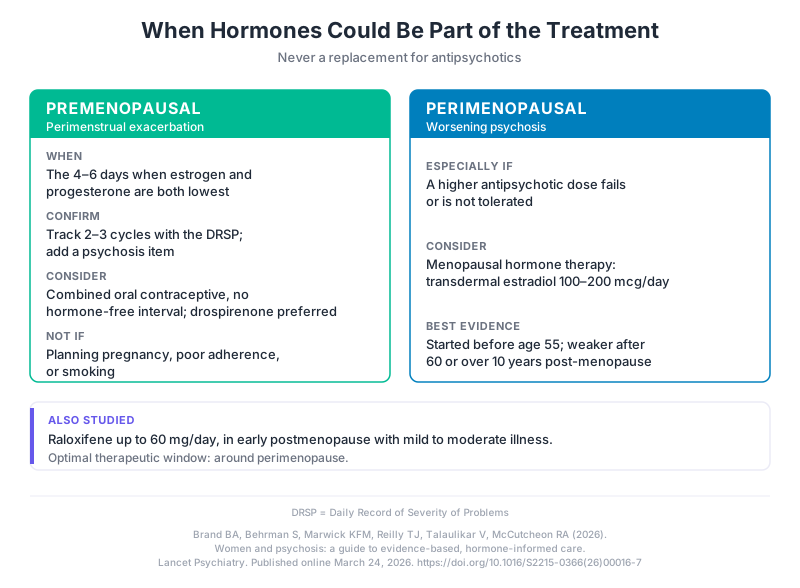
While these points all address how hormones may interact with treatment, a common question is when or whether hormones should be the treatment. The authors highlight that estrogen-based treatments are not a standard component of care for women with psychosis. Certainly, estrogen-based treatments should not be replacing the role of antipsychotics, but there are a few clinical scenarios where incorporating hormonal treatment into the plan could be considered.
Download PDF and other files
Combined Oral Contraceptives for Premenopausal Women
For women who are premenopausal and experience perimenstrual exacerbations of symptoms, a combined oral contraceptive used without a hormone-free interval may be helpful in those who are sensitive to hormonal fluctuations. In these cases, I tend to recommend drospirenone-containing preparations.
Not all patients will be appropriate candidates for this approach. Two examples are if the patient hopes to conceive in the near future, or alternatively wants to avoid pregnancy but finds it difficult to adhere to daily medications. Most IUDs and other long-acting contraceptive options are progesterone-based and wouldn’t be expected to confer a potential benefit in the same way.
If the patient’s contraception goals are not aligned with combined oral contraceptive use, I prioritize contraception. Another commonly encountered contraindication you should have on your radar is cigarette smoking, which increases the cardiovascular risks posed by oral contraceptives.
Menopausal Hormone Therapy in Perimenopause
For women who are perimenopausal and experiencing worsening of psychotic symptoms, menopausal hormone therapy could be considered. This is especially true if increasing the dose of their antipsychotic isn’t tolerated or isn’t effective, or if they’re experiencing other symptoms that may benefit from menopausal hormone therapy, like hot flushes.
The review emphasizes that the strongest data for benefit in psychosis comes from trials that initiated use before age 55 and used transdermal estradiol patches of 100 to 200 mcg per day. Data is less compelling in women who are over 60 years old or more than 10 years past their last menstrual period.
Raloxifene, an estrogen agonist in the brain and bones that was originally approved for osteoporosis treatment, also has some data suggesting that doses of up to 60 mg per day may be helpful in cases of women in early postmenopause with mild to moderate illness. Overall, these findings indicate an optimal therapeutic window around perimenopause, which aligns with other benefits observed for menopausal hormone therapy.
Download PDF and other files
Hormone-Informed Without Prescribing Hormones
I’ll end by saying that you don’t need to begin prescribing hormonal treatments on your own in order to be hormone informed in your case conceptualization and treatment planning. When you and a patient think that they may benefit from an estrogen-based treatment, collaborating with the patient’s obstetrician or primary care physician is a great place to start.
Abstract
Women and psychosis: a guide to evidence-based, hormone-informed care
Bodyl A Brand, PhD, Sophie Behrman, MRCPsych, Katie F M Marwick, MRCPsych PhDc ∙ Thomas J Reilly, MRCPsych, Prof Iris E C Sommer, MD PhD, Vikram Talaulikar, MD PhDd, et al.
Psychosis is associated with sex differences that are rarely considered in routine care. Oestrogen exerts protective effects, with symptom exacerbation and increased relapse risk occurring during low-oestrogen states, such as perimenstruation, postpartum, and menopause transition. Antipsychotic pharmacokinetics and response vary by sex and hormonal status, with premenopausal women requiring lower doses, and postmenopausal women showing reduced treatment efficacy. Antipsychotic-induced hyperprolactinaemia can suppress endogenous oestrogen, compounding both mental and physical health risks. Despite this, treatment guidelines remain largely sex neutral. This Review outlines the role of ovarian hormones in psychosis and offers practical considerations to support the first steps towards implementing hormone-informed care, providing a conceptual framework to guide clinical decision making with the aim of improving outcomes for women with psychosis across the lifespan. Key recommendations include thorough assessment of hormonal status, sex-specific prescribing, and the judicious use of oestrogen-based interventions such as hormonal contraception, hormone therapy, and oestrogen receptor modulators.
Download PDF and other files
Reference
Brand, B. PhD, Behrman, S. MRCPsych, Marwick, K. MRCPsych PhD, Reilly, T. MRCPsych, Prof Sommer, I. M.D. PhD, Talaulikar, V. M.D. PhD, et al. (2026). Women and psychosis: a guide to evidence-based, hormone-informed care. The Lancet Psychiatry; 13, 508-521.
