



Text version
GLP-1 Agonists for Antipsychotic-Induced Weight Gain
For this Quick Take today, let us look at glucagon-like peptide-1 (GLP-1) agonists for the management of antipsychotic-induced weight gain in patients with schizophrenia. The basis for our discussion is a systematic review and meta-analysis by Sampaio Sobral and colleagues in Brazil, published in Schizophrenia Research. I thought this was a good point in time to review this drug class, as the clinical use of the GLP-1 agonists has revolutionized the management of, first, diabetes and subsequently of obesity.
Download PDF and other files
Twenty Years From Exenatide to Semaglutide
Let me remind you that the GLP-1 agonists have actually been around for a while, exenatide being the first GLP-1 agonist approved in 2005, so over 20 years ago. However, it was really in 2021 that the GLP-1 agonists took off, including the question of whether we as psychiatrists should prescribe them for patients with schizophrenia.
You should ask: what happened in 2021? That was the year the next-generation GLP-1 agonist semaglutide was approved for weight management, not just for diabetes, bringing the GLP-1 agonists out of the shadows, so to speak, beyond diabetes care. It also really reminds us that the arc of progress in Medicine can be quite long.
Eight Randomized Trials, 523 Patients
Importantly for us as psychiatrists, we have enough clinical trial experience with GLP-1 agonists in the form of randomized trials in schizophrenia that we can pause and take stock, as this systematic review and meta-analysis by Sampaio Sobral and colleagues have done.
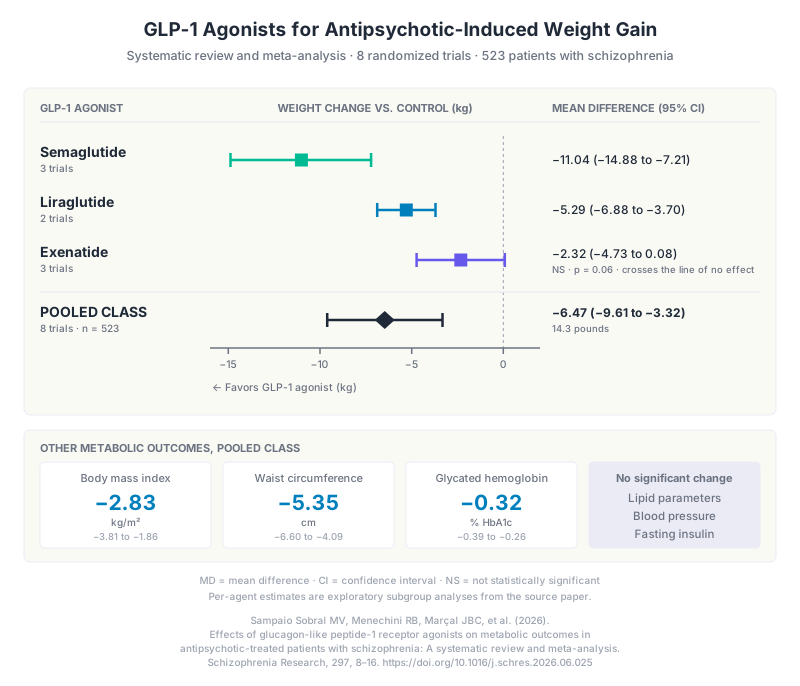
For this review, they ended up with eight randomized studies totaling 523 patients with schizophrenia who were treated with antipsychotics and who received one of three GLP-1 agonists (exenatide, liraglutide, or semaglutide) versus placebo or standard of care.
Download PDF and other files
Weight Reduction of 6.47 kg
Leaving aside, as I always do, the technical details of this meta-analysis, let me give you the three key points:
- As a class, the GLP-1 agonists were effective in reducing body weight. For the overall group, the reduction was 6.47 kg (14.3 pounds).
- The reduction was not even across the three GLP-1 agonists studied. The strongest effect was for semaglutide, followed by liraglutide, with exenatide having the least effect.
- The metabolic benefits extended beyond weight loss, but not to lipids or blood pressure. For those variables, the time of treatment in the clinical trials may simply have been too short.
Limitations
I would emphasize three main limitations that were not addressed by this meta-analysis.
Newer Agents Not Yet Studied
First, this meta-analysis is a bit dated, as newer, even more potent dual GLP-1 agonists could not be included, for the simple reason that they have not been studied yet in this population. Examples are tirzepatide, or the most recently approved oral non-peptide GLP-1 agonist, orforglipron.
Exenatide is actually no longer available, as the company made the business decision to discontinue its production. It was not a decision based on safety or efficacy, but as the first drug it basically could no longer compete, since it required up to twice daily injections.
Patient Selection and Mortality Unknown
Second, we also do not quite know if the benefit is greatest for high-risk patients, or if the benefit applies to any antipsychotic-induced weight gain. Many studies preferentially included patients on metabolically high-risk antipsychotics, specifically olanzapine or clozapine.
And third, we don’t really know if the findings, while encouraging, will translate into reduced mortality down the road, the all-important outcome for patients. For that, we will need much larger long-term studies. However, there is a biological probability or rationale that they should bend the mortality curve, so I’m cautiously optimistic here.
Download PDF and other files
Implementation May Be the Hardest Part
I suspect that this class of drugs has the potential to revolutionize weight management for patients with schizophrenia, but a lot of work needs to be done over the next decade, including developing algorithms for step care and patient selection. There is also the clinically vexing question of how to improve overall diet and exercise in this population, as a GLP-1 injection or pill alone may not be sufficient, or at least not as effective as it could be.
However, the most difficult issue in my opinion may very well be one of implementation and dissemination. Who is going to do what in your healthcare system with regard to GLP-1 agonists? What is the role of you, the psychiatrist or the nurse practitioner?
Are you going to prescribe the GLP-1 agonist yourself, or are you going to rely on collaborative care arrangements? New workflows will need to be created, and that’s always an uphill battle.
Effective as a Class, Details Pending
This is my clinical bottom line based on this meta-analysis: the GLP-1 agonists as a group are effective medications to reduce weight gain associated with antipsychotics, but a lot of details remain to be clarified in future studies, particularly with newer GLP-1 agonists and long-term studies examining hard endpoints like cardiovascular mortality. While there is a pooled class effect, there are efficacy differences between GLP-1 agonists.
I think this is an exciting time, since we finally have a tool to address the metabolic situation for our patients with schizophrenia on antipsychotics, to do this effectively, and to potentially reduce the increased cardiovascular mortality that our medications contribute to.
Let me add that I think it is a moral imperative, in the spirit of distributive justice, for our field to get this right, to make sure our patients with schizophrenia benefit from medical progress such as the GLP-1 agonists represent, just like their peers without a psychiatric illness.
Download PDF and other files
Abstract
Effects of glucagon-like peptide-1 receptor agonists on metabolic outcomes in antipsychotic-treated patients with schizophrenia: A systematic review and meta-analysis
Milene Vitória Sampaio Sobral, Rodrigo Bettanim Menechini, Jordana Belgamasco Cavalcanti Marçal, Anna Victoria de Vasconcelos, Letícia Hanna Moura da Silva Gattas Graciolli, Rafaela Correia Maciel, Amanda Monteiro, Wellgner Fernandes Oliveira Amador & Thaísa Aparecida de Souza Acuia
Background
Individuals with schizophrenia have markedly increased cardiometabolic morbidity, largely attributable to antipsychotic-induced weight gain, insulin resistance, and dyslipidemia, particularly with clozapine- and olanzapine-based regimens. This systematic review and meta-analysis evaluated the efficacy and safety of glucagon-like peptide-1 receptor agonists (GLP-1RAs) in antipsychotic-treated patients with schizophrenia.
Methods
PubMed, Embase, and the Cochrane Central Register of Controlled Trials were searched from inception to September 16, 2025 for randomized clinical trials comparing GLP-1RAs with placebo or standard care. The review followed Preferred Reporting Items for Systematic Reviews and Meta-Analyses guidelines and was prospectively registered in PROSPERO (CRD420251177261). Random-effects models were used to pool mean differences (MDs) and risk ratios (RRs).
Results
Eight randomized clinical trials including 523 participants were analyzed. GLP-1RAs significantly reduced body weight (MD −6.47; 95% CI, −9.61 to −3.32), body mass index (MD −2.83; 95% CI, −3.81 to −1.86), waist circumference (MD −5.35; 95% CI, −6.60 to −4.09), and glycated hemoglobin levels (MD −0.32; 95% CI, −0.39 to −0.26) compared with placebo or standard care. Exploratory subgroup analyses suggested marked differences across individual agents: exenatide showed a smaller and non-significant reduction in body weight, liraglutide showed a significant moderate reduction, and semaglutide showed the largest reduction. No significant effects were observed for fasting insulin, lipid parameters, or blood pressure. Gastrointestinal adverse events were more frequent with GLP-1RAs.
Conclusions
In this systematic review and meta-analysis, GLP-1RAs were associated with clinically meaningful improvements in anthropometric and glycemic outcomes in antipsychotic-treated patients with schizophrenia, with acceptable tolerability primarily characterized by gastrointestinal adverse events.
Abbreviations
BMI, Body mass index; CI, Confidence interval; CENTRAL, Cochrane Central Register of Controlled Trials; GLP-1, Glucagon-like peptide-1; GLP-1 RAs, Glucagon-like peptide-1 receptor agonists; GRADE, Grading of Recommendations, Assessment, Development, and Evaluations; HbA1c, Glycated hemoglobin; HDL-C, High-density lipoprotein cholesterol; LDL-C, Low-density lipoprotein cholesterol; MD, Mean difference; PRISMA, Preferred Reporting Items for Systematic Reviews and Meta-Analyses; PROSPERO, International Prospective Register of Systematic Reviews; RCT, Randomized clinical trial; RR, Risk ratio; RoB 2, Risk of Bias 2 tool
Reference
Sampaio Sobral, M., Menechini, R., Cavalcanti Marçal, J., De Vasconcelos, A., da Silva Gattas Graciolli, L., Correia Maciel, R., Monteiro, A., Oliveira Amador, W. & de Souza Acuia, T. (2025). Effects of glucagon-like peptide-1 receptor agonists on metabolic outcomes in antipsychotic-treated patients with schizophrenia: A systematic review and meta-analysis. Schizophrenia Research, Volume 297, Pages 8-16, ISSN 0920-9964.
