



Text version
Real-World Effectiveness of Bipolar Maintenance Therapies
Consider 28-year-old Maria, recently hospitalized during a manic episode with additional diagnoses of generalized anxiety and possible PTSD. She is now much improved and has come to see you for outpatient followup.
What’s the best medication to accompany elements of the several bipolar-specific psychotherapies to help her prevent further mood episodes? What’s better, a mood stabilizer or an antipsychotic? Which ones?
A hint, to be revealed: the best one is one of the least often used.
Network meta-analyses of randomized trials offer comparisons between treatments, so that’s one place to look for an answer. But the randomized trials on which those analyses are based often have very narrow enrollment criteria, excluding patients with multiple so-called comorbidities or suicidal ideation like Maria. Alternatively, there are real-world observational studies examining outcomes in large populations, with no exclusion criteria and potentially more applicable to your patients.
So let’s look at this new nationwide cohort study from Dr. Yasuyuki Okumura and colleagues. They looked at hospitalization rates among people with a bipolar diagnosis in the entire country of Japan over 10 years.
Patients served as their own controls, so those who were never on a medication, or on the same one throughout the entire period, were excluded. For everyone else, the likelihood of hospitalization was examined by comparing when they were on the medication of interest versus when they were not, including taking something else.
It’s a rough measure, but having a sample of over 300,000 and a long period of observation allows us to see possible signals above the noise of medication changes.
Download PDF and other files
Long-Acting Injectables Led, With Caveats
To visualize the results, imagine apples falling from a tree. Most will land near the trunk. So let’s start with the widest outlier, in this case the medication with the largest reduction in hospitalizations compared to when the patient was taking anything else or nothing.
In this new study, those farthest apples are the long-acting injectables. You might think, yep, I knew it, injectables solved the adherence problem.
But remember, we’re looking at a comparison within each individual patient’s experience. We’re comparing when they were on an injectable versus when they were on anything else.
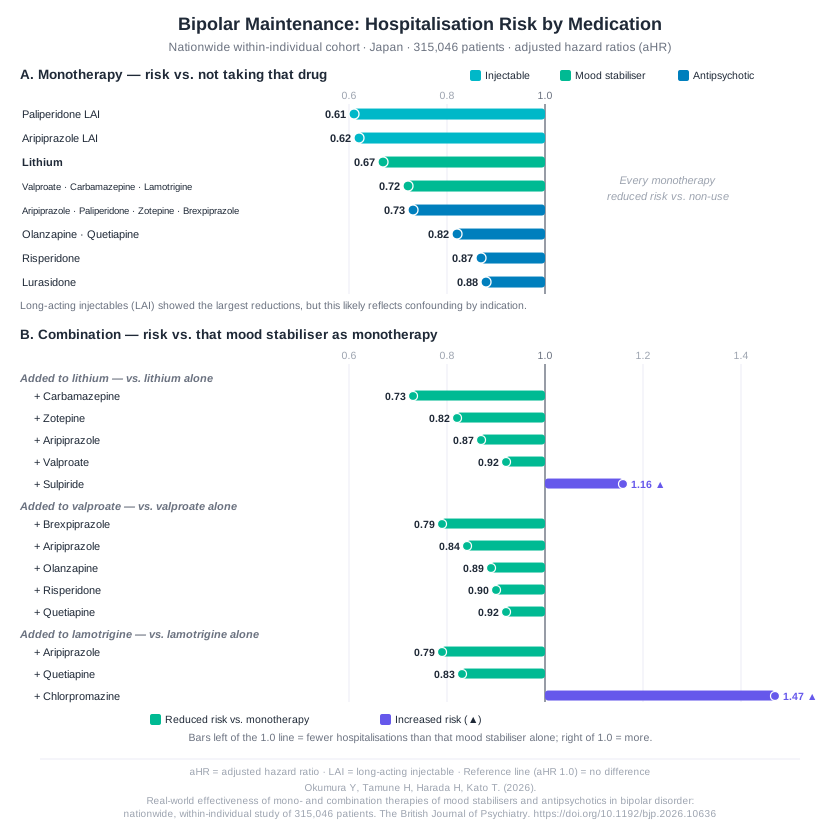
So this is a subset of patients who were likely to have had problems on oral medications. For that group, switching to an injectable could have an especially powerful effect on hospitalization rates. In epidemiology, this is called confounding by indication.
Ranking the Oral Antipsychotics
Well, how about the oral apples? Which of them is farthest from the trunk? There are a lot of antipsychotics to compare, so I’ll lump them into three groups.
- Aripiprazole, paliperidone, zotepine, and brexpiprazole: Their hazard ratio (the likelihood of hospitalization relative to when the patient was taking anything else) was 0.73, suggesting a roughly 25% reduction in the risk of hospitalization for these four agents.
- Olanzapine and quetiapine, with a hazard ratio of 0.82. Not quite as good.
- Risperidone at 0.87, a yet smaller difference in hospitalization risk.
You could speculate that bipolar treatment has improved in the time between the introduction of these older meds such that the newer ones looked better not because the medication is better, but because treatment overall is better. Well, maybe. But in terms of this study, it’s a pretty notable difference: a 25% reduction in hospitalization versus 20% with the older olanzapine and quetiapine.
I’ve not included haloperidol and a bunch of other antipsychotics that are far less widely used. None stick out as better.
How about lurasidone, recently generic? Perhaps its poor showing, 0.88, about like risperidone, is because it’s so new that it would only be used after a bunch of other treatments failed, such that patients receiving it represent a harder-to-treat population. That’s confounding by indication again.
Download PDF and other files
Lithium Outperformed Every Antipsychotic
Meanwhile, I hope you’re hanging on to see how the mood stabilizers did. The answer: lithium was better than any oral antipsychotic, with a hazard ratio of 0.67. Remember aripiprazole and that group at 0.73, just over a 25% risk reduction. Lithium at 0.67 is a 33% risk reduction, better than any oral antipsychotic.
How about the rest of the mood stabilizers? Valproate, carbamazepine, and even lamotrigine monotherapy were the same as aripiprazole, at 0.72.
Some Combinations Outperformed Monotherapy
Lastly, medication combinations were also studied. Of these, valproate plus aripiprazole was better than valproate alone, with a hazard ratio of 0.84, and lithium plus aripiprazole was better than lithium alone, at 0.87.
But again, such combinations would likely follow a failed trial of monotherapy, inflating the apparent value of dual relative to single medications. The authors also point out the risk of additional adverse events, such as extrapyramidal symptoms, akathisia, weight gain, and prolactin elevation.
Download PDF and other files
Bottom Line for Clinical Practice
In conclusion, this study is just another way of looking for what might be best for maintenance treatment in patients living with bipolar like Maria. I hope the results will make you think. Here are two main findings from my view.
- First, for the prevention of hospitalization among people with a bipolar diagnosis, lithium was better than any oral antipsychotic; and any mood stabilizer, even lamotrigine, was as good. I know it’s just one study, but don’t forget that the 2023 Canadian Network for Mood and Anxiety Treatments (CANMAT) guidelines for bipolar disorder, for maintenance treatment in bipolar I, lamotrigine monotherapy was first line, albeit fourth after lithium, quetiapine, and valproate. And of course, the latter is not a candidate for most reproductive-aged women.
- My second main finding: for relapse prevention among the antipsychotics, the newer, more expensive ones and those that often cause metabolic syndrome, like olanzapine and quetiapine, did not outperform aripiprazole.
So what to suggest for Maria, in addition to the bipolar-specific psychotherapy components? If she came out of the hospital on an antipsychotic and a mood stabilizer, this new study supports cautious tapering to the mood stabilizer alone, even if it’s lamotrigine.
If she’s on an antipsychotic alone, should Maria stick with what has worked, or try to transition to a medication with lower long-term risks? For that shared decision, a personal understanding of Maria’s circumstances is needed.
What are her fears, her hopes, her supports, and her risks should she relapse? Neither a network meta-analysis nor a cohort study can tell you that.
Abstract
Real-world effectiveness of mono- and combination therapies of mood stabilisers and antipsychotics in bipolar disorder: nationwide, within-individual study of 315 046 patients
Yasuyuki Okumura, Hidetaka Tamune, Hiroyuki Harada & Tadafumi Kato
Background
Real-world evidence on pharmacotherapy for bipolar disorder remains limited; in particular, the effectiveness of combination therapies that are widely used in clinical practice has not been systematically assessed.
Aims
To assess the effectiveness of mono- and combination therapy with mood stabilisers and antipsychotics in preventing psychiatric hospitalisation.
Method
This population-based cohort study used a within-individual design and data from the National Database of Health Insurance Claims and Specific Health Check-ups of Japan. Patients aged ≥20 years, with a primary diagnosis of bipolar disorder treated in psychiatric settings between 1 April 2013 and 31 March 2022, were included. Follow-up continued until 31 May 2023. Exposures included monotherapy with mood stabilisers or antipsychotics, and combination therapy involving (a) lithium plus another mood stabiliser or (b) lithium, valproate or lamotrigine plus a commonly prescribed antipsychotic. The primary outcome was time to psychiatric hospitalisation. Adjusted hazard ratios (aHRs) with 95% confidence intervals were estimated using stratified Cox regression.
Results
Among 315 046 patients (median follow-up 7.1 years), 83 621 (26.5%) experienced psychiatric hospitalisation. Monotherapy with lithium (aHR 0.67 [0.66–0.68]), valproate (aHR 0.71, 95% CI 0.70–0.73), lamotrigine (aHR 0.72, 95% CI 0.69–0.75) and carbamazepine (aHR 0.74, 95% CI 0.70–0.78) was associated with reduced hospitalisation compared with non-use of any mood stabilisers. Antipsychotic monotherapy with 15 agents, including aripiprazole (aHR 0.73, 95% CI 0.70–0.75) and zotepine (aHR 0.74, 95% CI 0.69–0.79), was also associated with reduced risk compared with non-use of any antipsychotics. Combination therapy with lithium plus carbamazepine (aHR 0.73, 95% CI 0.64–0.83), zotepine (aHR 0.82, 95% CI 0.72–0.93), aripiprazole (aHR 0.87, 95% CI0.82–0.92) or valproate (aHR 0.92, 95% CI 0.87–0.97) was associated with further reductions in hospitalisation risk compared with lithium monotherapy.
Conclusions
This large, population-based study showed that monotherapy and combination therapy with mood stabilisers and antipsychotics varied in their effectiveness in preventing psychiatric hospitalisation. These findings may inform treatment decisions in the clinical management of bipolar disorder.
Download PDF and other files
Reference
Okumura, Y., Tamune, H., Harada, H. & Kato, K. (2026). Real-world effectiveness of mono- and combination therapies of mood stabilisers and antipsychotics in bipolar disorder: nationwide, within-individual study of 315 046 patients. The British Journal of Psychiatry. Published online 2026:1-9.
