



Text version
Antipsychotic and SSRI Combination: Increased Cardiac Risk?
When it comes to the risk of ventricular arrhythmias and sudden cardiac death with psychiatric medications, there’s a lot of conflicting evidence. It seems like every month there’s a new study indicating that a specific agent or class of agents may or may not be associated with an increased risk of these adverse cardiac outcomes. Many of these studies seem to contradict each other in terms of which agents might be of greatest risk.
The mixed literature makes it nearly impossible to risk stratify individual agents. Over the years, the most consistent signals for an increased risk of ventricular arrhythmia or sudden cardiac death among psychiatric medications have come from antipsychotics. But even that literature is very heterogeneous, with some studies suggesting significantly increased risk and others demonstrating little to no increased risk.
As an example, a few months ago we reviewed a study disputing the lore that IV Haldol increases the risk for similar events. Antidepressants, and especially SSRIs, represent even more of a mixed bag. Today, we’re going to look at the latest study attempting to answer the question of whether a specific class of medications — or in this case a combination of two classes — might be associated with serious adverse cardiac outcomes.
Download PDF and other files
A Two-Country Claims Cohort
Today’s study was published recently in JAMA Network Open. It’s a cohort study using insurance claims data from both the United States and Taiwan. That means it’s subject to some of the limitations we’ve discussed before regarding claims data, which relies on accurate diagnostic and billing codes for illnesses and outcomes.
Adults were eligible for inclusion if they initiated an antipsychotic while having no prescriptions for SSRIs in the past year. Once enrolled, they were monitored for SSRI initiation over the following one-year period.
I won’t dive too deeply into the methods, but the authors used something called a sequential target trial emulation in order to decrease immortal time bias, which can be a confounder in observational studies like this one. Essentially, if they had just compared SSRI initiators to non-initiators without using that study design, there would be a bias toward showing a protective effect of SSRIs.
Who Initiated an SSRI in the Different Cohorts
Of those individuals starting an antipsychotic during the study period, about 15% to 17% initiated an SSRI within one year. This amounted to 53,000 people in the US and about 25,000 in Taiwan. The mean age of included patients was 47 years in the US and 51 years in Taiwan, so these were relatively younger people.
Interestingly, 51% of the patients in the Taiwanese cohort had a diagnosis of depression compared to only 15% in the US. The authors partly account for this by noting that reimbursement in Taiwan is more closely linked to documenting an approved indication for the medication. They imply that the relatively low rates of depression codes in the US may reflect incomplete coding, but I would suspect that it may also reflect more off-label use.
I mention this because I’m very curious to know the psychiatric indications for the combination of antipsychotics and SSRIs in the other 85% of Americans. One could imagine that some alternative indications like insomnia or anxiety, for example, may carry their own risks for adverse cardiac outcomes.
Download PDF and other files
SSRIs Raised Arrhythmia Risk
The major finding of this study is that the prescription of an SSRI within one year of antipsychotic initiation increased the risk for ventricular arrhythmia or sudden cardiac death by 50% in the US and by more than 200% in Taiwan, compared to individuals who were prescribed antipsychotics but not started on an SSRI within that first year.
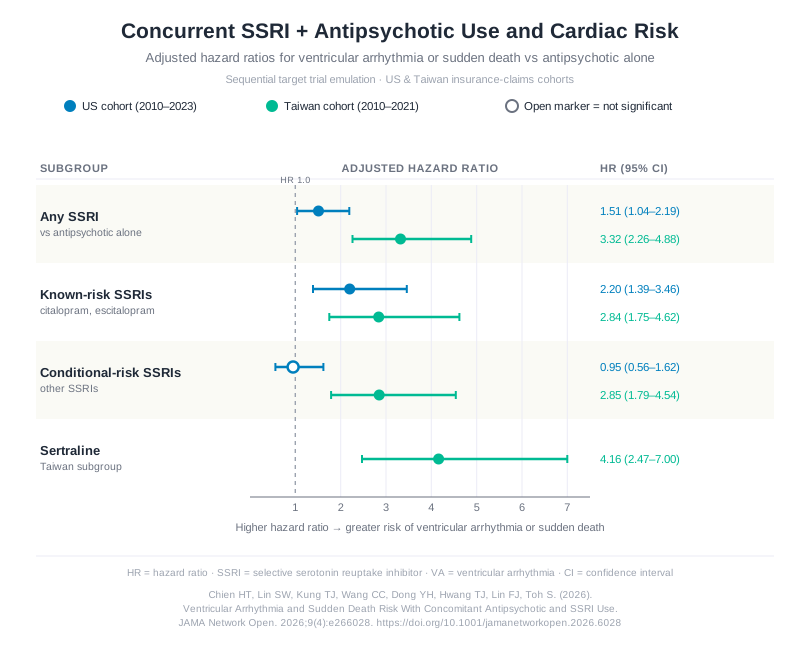
For citalopram and escitalopram specifically, which the authors considered high-risk antidepressants, the adjusted hazard ratios were 2.20 in the US and 2.84 in Taiwan.
An interesting finding is that the US results were driven primarily by citalopram and escitalopram. In Taiwan, the other SSRIs labeled conditional risk agents in the study actually showed a stronger association with increased adverse cardiac outcomes, appearing to be primarily driven by sertraline. We’ll come back to that. In both countries, patients under the age of 65 appeared to be more vulnerable to the impact of SSRIs on risk.
SSRIs Carried Lower Risk Than TCAs
The authors also ran analyses with tricyclics and SNRIs as control groups, as well as looking at carditis as an outcome. Carditis, to be clear, would not be expected to be an outcome associated with these medications, so it was used as a negative control outcome.
- TCA use was associated with greater risk than SSRIs in the US.
- Risk for SNRIs was imprecise.
- There was no association of antipsychotics and SSRIs with an increased risk of carditis, as expected.
Download PDF and other files
Key Limitations to Consider
Before we jump to practical takeaways, let’s consider some of the limitations of the study.
First, overall rates of ventricular arrhythmia or sudden cardiac death were extremely low, between 0.1% and 0.2% in all subgroups. In fact, among SSRI initiators there were less than 100 events total, which really limits precision and is a major challenge in general for studies assessing such very rare outcomes.
Second, claims data is notoriously challenging as a means of diagnosing sudden cardiac death, with lots of cases missed and others probably misclassified.
Third, the hazard ratio in the US group barely reached significance, and a separate intention-to-treat analysis for the US group was non-significant. Both of these suggest that these results should be interpreted with caution.
Fourth, while the authors attempted to control for various kinds of biases, there’s a lot of potential confounding here including confounding by indication. Patients who get prescribed an antipsychotic alone are by definition different from patients who get prescribed both an antipsychotic and an SSRI. The latter group is likely to have more severe psychiatric illness, which as alluded to earlier may itself convey extra risk.
Finally, there’s also a ton of information we don’t know about these patients because of the reliance on claims data, including other cardiac risk factors and even whether they continued on the antipsychotic at the time of SSRI initiation.
Polypharmacy and Cumulative Risk
So how do we incorporate this study into our practice? I think my major takeaway is that we still have a lot of uncertainty about the actual cardiac risk of many of the medications we prescribe, even as we gain more granular information about, for example, their propensity to lengthen the QTc interval.
It does serve for me as a good reminder that polypharmacy likely increases the risk for adverse outcomes. Again, studies in this regard on cardiac outcomes specifically are mixed, but many do show an increased risk when multiple psychiatric medications, either from the same class or from different classes, are combined. This makes some sense given both pharmacokinetic and pharmacodynamic effects.
For prescribers, it highlights the importance of checking for potential drug-drug interactions when adding medications to a patient’s regimen, and considering the cumulative effect that multiple agents may have on things like the QTc interval.
Download PDF and other files
Citalopram Showed the Highest Risk
In general, I don’t think this study really changes my practice or my notions about which agents or classes of agents carry the most risk for adverse cardiac outcomes. I would still consider SSRIs to be relatively safe in that regard. As expected, they had a lower risk than TCAs here, and they couldn’t really be compared to SNRIs because of low numbers in that latter group.
For individual agents, I would still consider citalopram the worst offender. Here it was combined with escitalopram, which I would argue is unfair to escitalopram, and the risk was greater with those agents than with other SSRIs, at least in the US cohort, which again is not unexpected.
The weirdest finding here is that association of sertraline driving the increased risk in the Taiwanese cohort. To me, that’s probably some sort of noise. It flies in the face of every other study involving sertraline, which has otherwise consistently been shown to be safe and is the most studied antidepressant in cardiac populations.
Practical Takeaway: Tailoring Choices to Cardiac Risk
So what about the patient sitting in front of you who needs both an SSRI and an antipsychotic for their major depression with psychosis? Think about their overall cardiac risk factors.
If they have multiple risk factors, think about using an SSRI that is better studied and has more consistent safety data. Consider whether it makes sense to check a baseline EKG and a follow-up at steady state after the addition of the new agent. Consider also that untreated or undertreated major depression with psychosis almost certainly carries with it its own cardiac risks.
On the other hand, consider the patient with mild insomnia and anxiety who has a history of ventricular arrhythmia and an AICD implanted. Think about whether there are safer alternatives than combination therapy with an antipsychotic and an SSRI. Consider medications that carry no risk of ventricular arrhythmias, like most sedative-hypnotics, or think about CBT.
Download PDF and other files
Bottom Line: Don’t Overweight Rare Cardiac Risks
At the end of the day, I do worry that we have become too focused on the potential cardiac effects of our medications given how rare these events are. As more of these studies come out regarding SSRIs, my biggest fear is that we will repeat as a field what we have consistently done with so many other classes of medications: become hyperfocused on a single potential side effect and allow that to outweigh the great therapeutic benefit these medications can convey for our patients. It happened with MAOIs, it happened with TCAs, it happened with lithium, it happened with typical antipsychotics, and it’s playing out right now with benzodiazepines.
We risk throwing the baby out with the bathwater if we start to avoid SSRIs in patients who might really benefit because of small signals that they might increase cardiac risk. For the average patient, that’s unlikely to be clinically meaningful. And as I often have to remind my cardiology colleagues, depression can also be a fatal illness.
At the same time, common sense usually wins the day. Think carefully about your risk-benefit or risk-risk analysis, and think medically as well as psychiatrically. For those patients who truly have an increased cardiac risk, consider what safer alternatives might exist.
Abstract
Ventricular Arrhythmia and Sudden Death Risk With Concomitant Antipsychotic and SSRI Use
Hsiu-Ting Chien, PhD; Shu-Wen Lin, PharmD; Te-Jung Kung, MS; Chi-Chuan Wang, PhD; Yaa-Hui Dong, PhD; Tzung-Jeng Hwang, MD; Fang-Ju Lin, PhD & Sengwee Toh, ScD.
Importance Antipsychotics and selective serotonin reuptake inhibitors (SSRIs) are each associated with increased risk of ventricular arrhythmia or sudden death. Their concurrent use may further elevate this risk; however, clinical evidence remains limited.
Objective To evaluate the risk of ventricular arrhythmia or sudden death in patients concurrently prescribed an antipsychotic and an SSRI.
Design, Setting, and Participants This cohort study used a sequential target trial emulation method to analyze insurance claims data from health insurance databases in the US (2010-2023) and Taiwan (2010-2021). Eligible patients (adults initiating an antipsychotic with no SSRI use in the prior year) were included and assessed weekly for SSRI initiation from weeks 1 to 52 following antipsychotic initiation. Fifty-two weekly trials were emulated to assess the 1-year ventricular arrhythmia or sudden death risk following SSRI initiation in patients newly treated with antipsychotics. A per-protocol approach with inverse probability weighting and adjustment for time-varying covariates was applied.
Exposures SSRI initiation within 52 weeks after antipsychotic initiation, with patients classified weekly as SSRI initiators or noninitiators.
Main Outcomes and Measures The outcome of interest was incident ventricular arrhythmia or sudden death. Hazard ratios (HRs) with 95% CIs were estimated using weighted pooled logistic regression models with robust variance estimators.
Results Overall, 307 818 unique patients in the US cohort (4 370 289 person-trials; mean [SD] age, 46.6 [18.8] years; 2 764 180 female [61.2%]) and 191 080 unique patients in the Taiwan cohort (2 150 639 person-trials; mean [SD] age, 51.0 [18.3] years; 1 184 464 female [55.1%]) met the eligibility criteria. In the adjusted cohorts, 52 825 US patients (17.2%) and 25 203 Taiwanese patients (14.7%) initiated SSRIs. The adjusted HRs for concurrent antipsychotic and SSRI use vs antipsychotic alone were 1.51 (95% CI, 1.04-2.19) in the US and 3.32 (95% CI, 2.26-4.88) in Taiwan. For high-risk SSRIs, citalopram and escitalopram, the adjusted HRs were 2.20 (95% CI, 1.39-3.46) and 2.84 (95% CI, 1.75-4.62), respectively. Sensitivity analyses supported robustness of primary findings, and positive and negative control analyses suggested limited residual confounding.
Conclusions and Relevance In this cohort study of adults initiating antipsychotics in the US and Taiwan, SSRI initiation in antipsychotic users was associated with an increased risk of ventricular arrhythmia or sudden death. Although rare, the potential severity of these events supported the need for cautious use of this combination.
Download PDF and other files
Reference
Chien, H.; Lin, S.; Kung, T.; Wang, C.; Dong, Y.; Hwang, T. et al. (2026). Ventricular Arrhythmia and Sudden Death Risk With Concomitant Antipsychotic and SSRI Use. JAMA Netw Open; 9(4):e266028.
