



Text version
Ashwagandha, Melatonin, and Their Combination for Sleep
Today I’ll be presenting a recent randomized clinical trial comparing ashwagandha, melatonin, and their combination for improving sleep quality in adults with sleep disturbances.
Sleep problems are extremely common and affect a large proportion of adults. Prescription sleep medications can be effective, but they may carry side effects or lead to dependence. As a result, many patients seek natural alternatives.
Two of the most commonly used supplements are melatonin, which primarily helps regulate the body’s sleep-wake cycle, and ashwagandha, an herbal supplement felt to reduce stress and anxiety. Although both have shown promise individually, there has been very little high-quality research comparing them or evaluating whether combining them provides additional benefit. This study attempted to answer that question.
Download PDF and other files
Methodology: A Four-Arm Trial Design
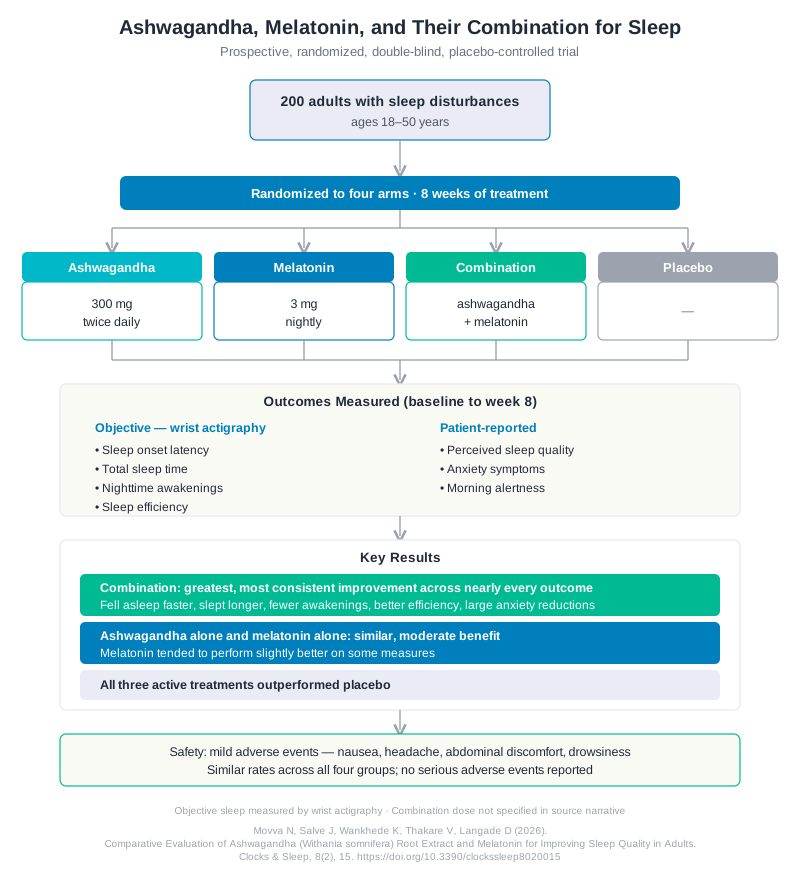
This was a prospective, randomized, double-blind, placebo-controlled trial, which represents a strong clinical research design. The investigators enrolled 200 adults between 18 and 50 years of age who had sleep disturbances. Participants were randomly assigned to one of four groups for eight weeks:
- Ashwagandha alone, 300 mg twice daily
- Melatonin alone, 3 mg nightly
- Ashwagandha plus melatonin
- Placebo
Importantly, neither the participants nor the investigators knew which treatment each person received until the study ended. The researchers looked at several measures of sleep. They objectively measured sleep using an activity monitor worn by participants that estimated how long it took to fall asleep, total sleep time, nighttime awakenings, and overall sleep efficiency.
They also collected patient-reported outcomes, including perceived sleep quality, anxiety symptoms, and morning alertness. This combination of objective and subjective measures strengthened the study, because improvements were not based solely on patients’ impressions.
Combination Therapy Produced Greatest Improvement
The overall conclusion is straightforward: all three active treatments worked better than placebo. However, the combination of ashwagandha plus melatonin consistently produced the greatest improvement. Compared with placebo, patients receiving the combination fell asleep faster, slept longer, woke up less during the night, had better sleep efficiency, reported better overall sleep quality, and experienced large reductions in anxiety scores.
Patients taking ashwagandha alone and those taking melatonin alone also improved, and their benefits were generally similar to one another, although melatonin tended to perform slightly better on some measures. The combination therapy, however, produced the largest and most consistent improvement across nearly every outcome measured.
Download PDF and other files
Tolerability: Mild Side Effects Across All Groups
One of the reassuring aspects of the study was safety. Side effects were generally mild and occurred at similar rates in all four groups. The most commonly reported problems were mild nausea, headache, abdominal discomfort, and occasional drowsiness. Importantly, no serious adverse events were reported, and no treatment group had a significantly worse safety profile than placebo.
Why This Study Is Clinically Useful
There are several reasons this paper is clinically useful:
- It uses a rigorous randomized, double-blind, placebo-controlled design.
- The sample size of 200 participants is reasonably large for a supplement study.
- The investigators measured both objective sleep data and patient-reported outcomes.
- The dropout rate was relatively low, suggesting good adherence to treatment.
Download PDF and other files
Limitations to Keep in Mind
Despite these strengths, several limitations should be kept in mind. The study lasted only eight weeks, so we don’t know whether these benefits persist with longer-term treatment. Participants were relatively young adults, ages 18 to 50, so the findings may not apply to older adults, who often have different causes for insomnia.
The study also focused on people with general sleep disturbances rather than patients with chronic insomnia diagnosed according to formal psychiatric or sleep medicine criteria. Finally, because ashwagandha is a dietary supplement, product quality and standardization can vary outside of a controlled clinical trial, making it difficult to assume that all commercial products would produce identical results.
Interpretation for Clinical Practice
From a practical standpoint, this study suggests that both melatonin and ashwagandha appear to be reasonable, well-tolerated options for adults with mild to moderate sleep disturbance. The most interesting finding is that combining the two supplements produced better results than either one alone, suggesting they may work through complementary mechanisms: melatonin helping to regulate circadian rhythm, while ashwagandha may reduce stress-related arousal. That said, this is only one study, and while the results are encouraging, larger and longer-term trials will be needed before recommending the combination as a standard treatment for insomnia.
Download PDF and other files
Bottom Line
In summary, this well-designed randomized clinical trial found that ashwagandha, melatonin, and especially the combination of both significantly improved sleep quality compared with placebo over eight weeks, while maintaining an excellent safety profile. Although these findings are promising, additional long-term studies in more diverse patient populations are still needed before these supplements can be routinely recommended as first-line therapy for chronic sleep disturbances.
Abstract
Comparative Evaluation of Ashwagandha (Withania somnifera) Root Extract and Melatonin for Improving Sleep Quality in Adults: A Prospective, Randomized, Double-Blind, Placebo-Controlled Study
Navya Movva; Jaising Salve; Kalpana Wankhede; Vaishali Thakare & Deepak Langade
Ashwagandha, a revered herb in Ayurvedic medicine for over 3000 years, is recognized for its potential benefits in regulating sleep and supporting overall vitality. This study evaluated the comparative effects of Ashwagandha root extract (ARE) and melatonin (MLT) on sleep quality in adults. In this prospective, randomized, double-blind, placebo-controlled trial, 200 men and women aged 18–50 years were randomized to receive ARE (300 mg twice daily; n = 50), MLT (3 mg/day; n = 50), a combination of ARE (600 mg/day) and MLT (3 mg/day; n = 50), or placebo (n = 50) for eight weeks. The primary outcome was the change in sleep onset latency (SOL) from baseline to week eight, measured by actigraphy. Secondary outcomes included actigraphy-based changes in total sleep time (TST), wake after sleep onset (WASO), and sleep efficiency (SE), as well as subjective measures such as the Pittsburgh Sleep Quality Index (PSQI) and the Hamilton Anxiety Scale (HAM-A). At week eight, SOL was significantly reduced across treatment groups, with the ARE–MLT (p < 0.0001) combination showing the greatest improvement. The combination group also demonstrated significant improvements in TST (p < 0.0001), WASO (p < 0.0001), and SE (p < 0.0001), whereas ARE and MLT monotherapy produced moderate but comparable benefits. Inferential analyses confirmed statistically significant improvements in objective and subjective sleep measures (p < 0.0001). Safety analyses indicated that mild adverse events occurred across all groups, with no clinically significant between-group differences. Overall, both Ashwagandha and melatonin improved sleep disturbances in adults, with combination therapy producing the most consistent and pronounced benefits.
Keywords:
Ashwagandha; Withania somnifera; melatonin; sleep disturbance; HAM-A; PSQI
Download PDF and other files
Reference
Movva, N.; Salve, J.; Wankhede, K.; Thakare, V. & Langade, D. (2026). Comparative Evaluation of Ashwagandha (Withania somnifera) Root Extract and Melatonin for Improving Sleep Quality in Adults: A Prospective, Randomized, Double-Blind, Placebo-Controlled Study. Clocks & Sleep; 8(2):15.
