



Text version
Clozapine Rechallenge After Neutropenia
For today’s Quick Take, let me discuss clozapine rechallenge following an episode of neutropenia thought to be caused by clozapine. This is a clinical dilemma you may already have faced yourself.
You are treating a patient with clozapine who develops neutropenia, usually early in the course of treatment, so you take him off clozapine as recommended by prescribing guidelines. Hopefully the patient did not develop complications like an overwhelming infection, since you were able to stop clozapine before a prolonged period of agranulocytosis developed. The neutrophils recover, and now you face the question of whether you can rechallenge the patient — or whether you need to go back to a medication regimen that was not really that effective, which was the reason for clozapine in the first place.
A clinical variant of this scenario is the chronic patient with schizophrenia on an ineffective antipsychotic regimen whom you inherit, as we say in the United States. You finally convince him to try clozapine, only to learn from a family member as you discuss the plan: “He was already on clozapine many years ago, and we were told he should never receive it again because his white blood cells dropped.” How do you approach your decision making?
Download PDF and other files
A UK Rechallenge Cohort
This is where the publication I want to discuss comes in, an observational, retrospective cohort study. Oloyede and colleagues used data from the Central Non-Rechallenge Database (CNRD) in the United Kingdom to analyze the outcomes of patients who were registered in this database and then rechallenged with clozapine. To be registered on the CNRD, a patient must have had consecutive white blood cell (WBC) or absolute neutrophil count (ANC) values below a certain threshold.
Skipping over the statistical details, here is what I think is the main finding. The authors had 4719 patients registered on the CNRD, meaning they had been suspected of having clozapine-associated neutropenia. Of that original cohort, 435 patients (9% of everyone registered on the CNRD) met the study criteria and formed the rechallenge cohort analyzed.
Most Rechallenges Succeeded
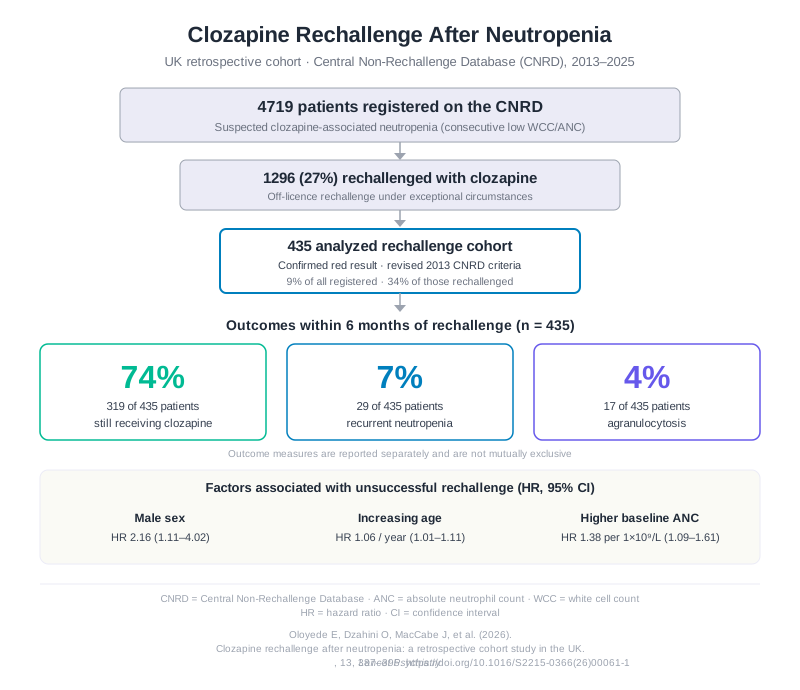
In this rechallenge cohort:
- 29 patients (7%) were re-registered on the CNRD within six months, having had another episode of neutropenia
- 17 patients (4%) had agranulocytosis based on a laboratory threshold
- 74% were still receiving clozapine six months after reinitiation
An unsuccessful rechallenge was associated with male sex, increasing age, and a higher baseline absolute neutrophil count.
Put differently, the guideline-driven automatic cessation of clozapine was unnecessary in the majority of patients. Clozapine may not have played a major role in the low WBC or ANC count, and the rechallenge was unproblematic.
Download PDF and other files
When Clozapine Is the Culprit
Now, hold your horses. We cannot overlook that a small number of patients in this cohort did develop agranulocytosis after rechallenge, suggesting that clozapine was causative in those patients. Let me put these results into a clinical context.
Clozapine-associated neutropenia is believed to be a fairly acute immune reaction that happens at the beginning of treatment, during the first six months. These are the textbook cases, where I believe we should put clozapine-induced neutropenia as the diagnosis, and where a rechallenge carries very significant risk given the immune mechanism. I would only consider a retrial if the psychiatric circumstances are dire, as the recurrence risk is very high.
Other Causes of Neutropenia
Keep in mind that there are many other reasons for neutropenia in a patient on clozapine that have nothing to do with an immune reaction to clozapine, or what I call clozapine toxicity. A major reason for a low WBC or ANC value is a constitutionally low white blood cell count, or benign ethnic neutropenia (BEN).
In addition, stable patients on long-term clozapine treatment who develop neutropenia may be in a completely different category. For such patients I would definitely want a hematology consultation, to make sure clozapine is actually the culprit before concluding that the patient had clozapine-induced neutropenia.
In one study of about 100 cases of apparent clozapine-induced severe neutropenia, the authors could confirm clozapine as the culprit in only 20% of cases. That means clozapine was unnecessarily implicated and stopped in 80% of cases, consistent with the study we just discussed. In that cohort, benign ethnic neutropenia was one reason, again suggesting that a simple threshold-based stopping of clozapine, without clinical context, is often not necessary.
Download PDF and other files
A Relative, Not Absolute, Contraindication
Here is the clinical bottom line. A history of neutropenia associated with clozapine is not an absolute contraindication to trying clozapine again; but let’s be honest, it is a relative contraindication. So you do not want to be cavalier about it.
As opposed to simply using inflexible laboratory cutoffs, the decision to rechallenge needs to take into account individual factors and an attempt at risk stratification. That means trying to determine whether you are dealing with actual clozapine-induced severe neutropenia as opposed to other causes of a low neutrophil count.
Don’t Withhold Clozapine Out of Fear
Regardless of the likely cause, as the responsible physician I would only offer a clozapine retrial if the medical monitoring can be done in a way that minimizes any risks. You have to be able to catch another episode of neutropenia early.
Let me add that a retrial should also be offered when appropriate, given the unique efficacy of clozapine for treatment-resistant schizophrenia. It should not simply be ruled out because of the fear that something could happen, particularly if the diagnosis of clozapine-induced neutropenia is unclear. Shying away from a clozapine retrial could mean that your patient remains, psychiatrically speaking, severely ill.
If the diagnosis of clozapine-induced severe neutropenia — the textbook case — is indeed correct, the relapse risk may be unacceptably high. I would not want to manage a rechallenge under these circumstances by myself, without the help of Hematology and without complete buy-in from the patient and his or her family. In any case, the decision to rechallenge if there was a question of clozapine-induced severe neutropenia requires shared decision making, including the involvement of other people, particularly family members.
Download PDF and other files
Abstract
Clozapine rechallenge after neutropenia: a retrospective cohort study in the UK
Ebenezer Oloyede, DPhil; Olubanke Dzahini, MS; Prof James MacCabe, PhD; Cecilia Casetta, MD; Dominic Oliver, PhD; Prof Sukhi Shergill, PhD; Prof Dan Siskind, PhD; Prof Philip McGuire, PhD; Eromona Whiskey, PhD & Prof David Taylor, PhD.
Background
Clozapine is contraindicated in patients with a history of neutropenia suspected to be clozapine-induced agranulocytosis. Under exceptional circumstances, patients may be rechallenged with clozapine under an off-licence agreement. The evidence regarding clozapine rechallenge after suspected clozapine-induced neutropenia remains sparse and conflicting. In this observational study, we aimed to review the outcomes of patients rechallenged with clozapine using data from the two largest clozapine manufacturers in the UK.
Methods
We analysed data of patients in the UK and Ireland rechallenged on clozapine after they registered on the Central Non-Rechallenge Database (CNRD), provided by the Clozaril Patient Monitoring Service and Zaponex Treatment Access System, between Jan 1, 2013, and Dec 12, 2025. Unsuccessful rechallenge was defined as re-registration on the CNRD within 6 months. We calculated incidence proportion and incidence rates of severe neutropenia (agranulocytosis) using both threshold-based and pattern-based criteria. Demographic characteristics, details of each clozapine trial, and factors associated with unsuccessful rechallenge were examined. People with lived experience were not involved in the research or writing of this study.
Findings
Of the 4719 patients registered on the CNRD, 1296 (27%) were rechallenged on clozapine, of whom 435 (34%) patients met the revised CNRD criteria. The cohort was predominantly male (278 [64%] male patients vs 157 [36%] female patients), with a median age of 34 years (IQR 25–46) at clozapine initiation, and was ethnically diverse: 321 (74%) White patients, 70 (16%) Black patients, 30 (7%) Asian patients, and 14 (3%) patients of other ethnicities. Median duration of follow-up was 2·2 years (IQR 0·5–4·9) or 1336 person-years. Within 6 months of rechallenge, 29 (7%) patients were re-registered on the CNRD having had a further neutropenic episode, and 87 (20%) patients had less than 6 months of rechallenge follow-up. Unsuccessful rechallenge within 6 months was associated with higher baseline absolute neutrophil count (hazard ratio [HR] 1·38 per 1 × 10⁹/L [95% CI 1·09–1·61]), male sex (HR 2·16 [95% CI 1·11–4·02]), and increasing age (HR 1·06 per year [95% CI 1·01–1·11]).
Interpretation
Clozapine rechallenge can be successful in a select group of patients after mandated clozapine cessation for suspected clozapine-induced neutropenia.
Reference
Oloyede, E.; Dzahini, O.; MacCabe, J.; Casetta, C.; Oliver, D.; Shergill, S. et al. (2026). Clozapine rechallenge after neutropenia: a retrospective cohort study in the UK. The Lancet Psychiatry; 13(5):387-395.
