Slides and Transcript
Slide 1 of 15
Antipsychotics for Borderline Personality Disorder, from Sedation to Partial Agonism.
References:
- Paul S. Links, M.D., F.R.C.P.C.
Slide 2 of 15
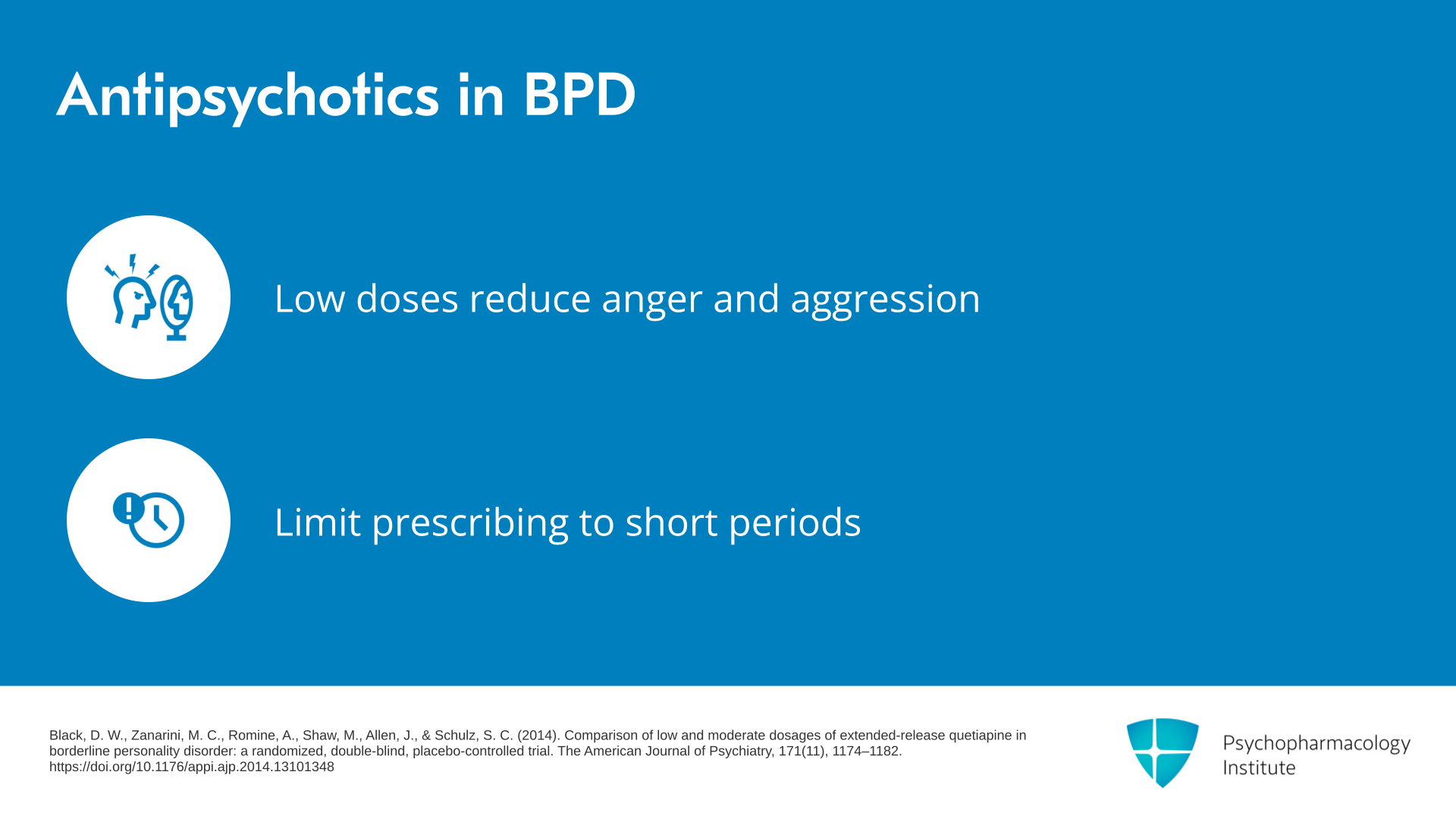
So as an introduction, antipsychotic medication can be useful in the management of patients with borderline personality disorder. Low-dose antipsychotics may lessen anger, impulsive aggression and the cognitive perceptual symptoms that patients experience when they’re symptomatic, but they should be prescribed for limited time periods, for example, maybe eight weeks.
References:
- Black, D. W., Zanarini, M. C., Romine, A., Shaw, M., Allen, J., & Schulz, S. C. (2014). Comparison of low and moderate dosages of extended-release quetiapine in borderline personality disorder: a randomized, double-blind, placebo-controlled trial. The American Journal of Psychiatry, 171(11), 1174–1182. https://doi.org/10.1176/appi.ajp.2014.13101348
Free Files
Download PDF and other files
Success!
Check your inbox, we sent you all the materials there.
Slide 3 of 15
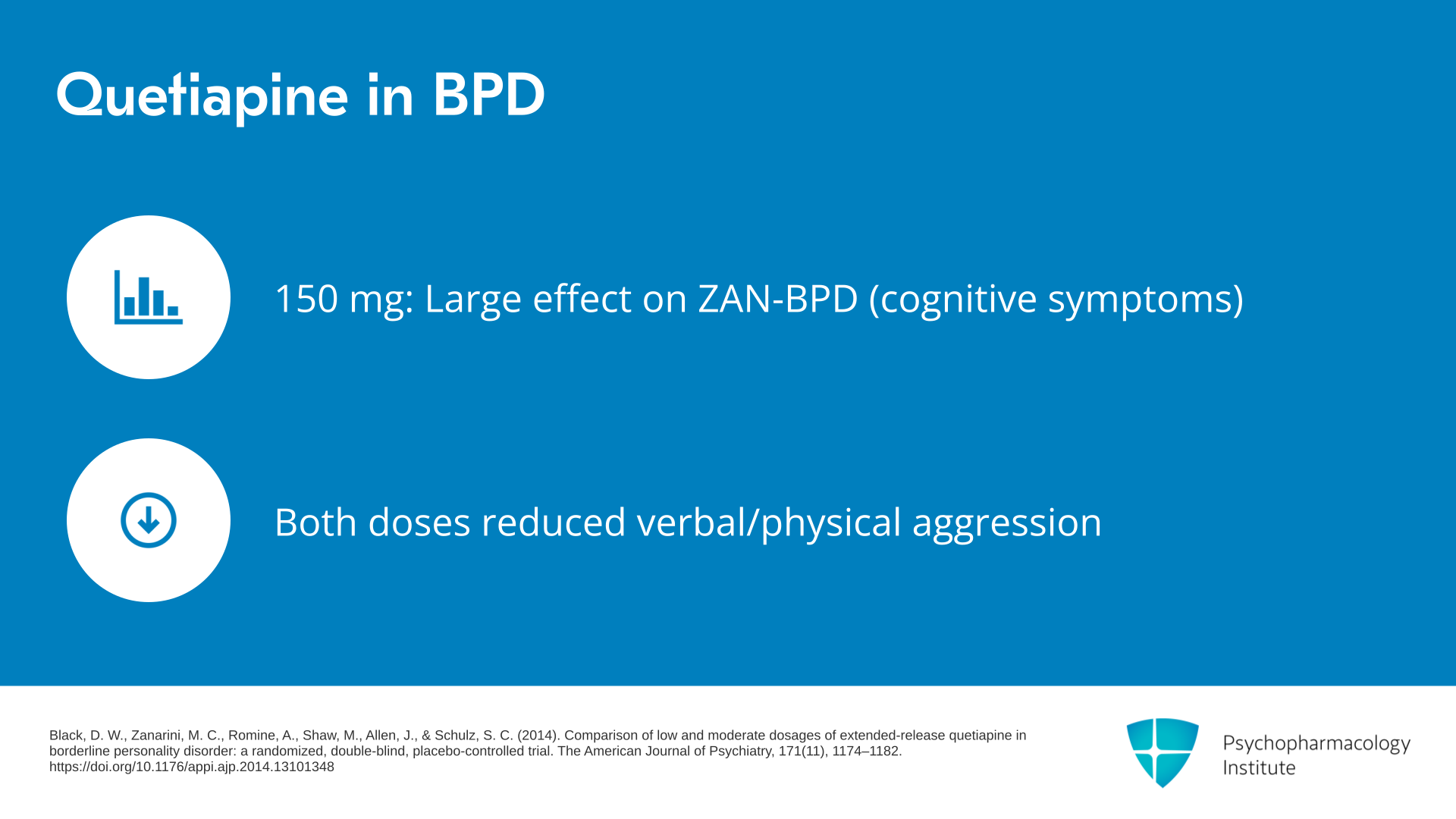
This comes from research by Black et al. They studied quetiapine in borderline personality disorder. They looked at extended-release quetiapine versus placebo in a large randomized controlled trial for eight weeks. They found large effect size for low-dose quetiapine, that is 150 mg a day, on what’s called the ZAN-BPD which is a scale of borderline features and it was helpful for those borderline features especially the cognitive component. The moderate dose which was 300 mg a day was not differentiated from placebo although both quetiapine doses were good for secondary outcomes like verbal and physical aggression.
References:
- Black, D. W., Zanarini, M. C., Romine, A., Shaw, M., Allen, J., & Schulz, S. C. (2014). Comparison of low and moderate dosages of extended-release quetiapine in borderline personality disorder: a randomized, double-blind, placebo-controlled trial. The American Journal of Psychiatry, 171(11), 1174–1182. https://doi.org/10.1176/appi.ajp.2014.13101348
Slide 4 of 15
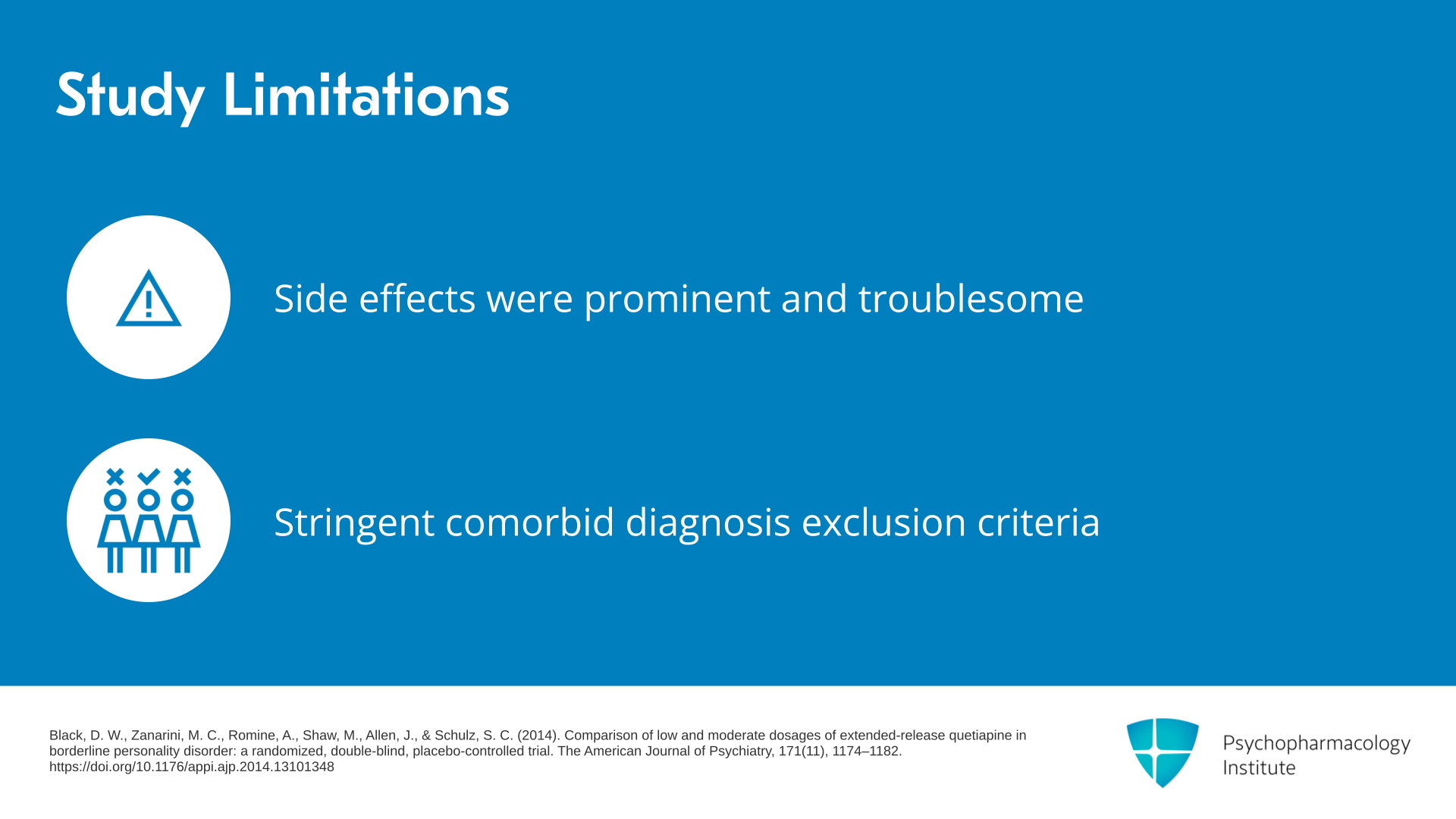
As you would expect, side effects were prominent and troublesome and the other sort of critique of this study is they did have rather stringent exclusion criteria for comorbid diagnoses. But it did demonstrate that low-dose quetiapine in this case was useful for borderline symptoms.
References:
- Black, D. W., Zanarini, M. C., Romine, A., Shaw, M., Allen, J., & Schulz, S. C. (2014). Comparison of low and moderate dosages of extended-release quetiapine in borderline personality disorder: a randomized, double-blind, placebo-controlled trial. The American Journal of Psychiatry, 171(11), 1174–1182. https://doi.org/10.1176/appi.ajp.2014.13101348
Free Files
Download PDF and other files
Success!
Check your inbox, we sent you all the materials there.
Slide 5 of 15
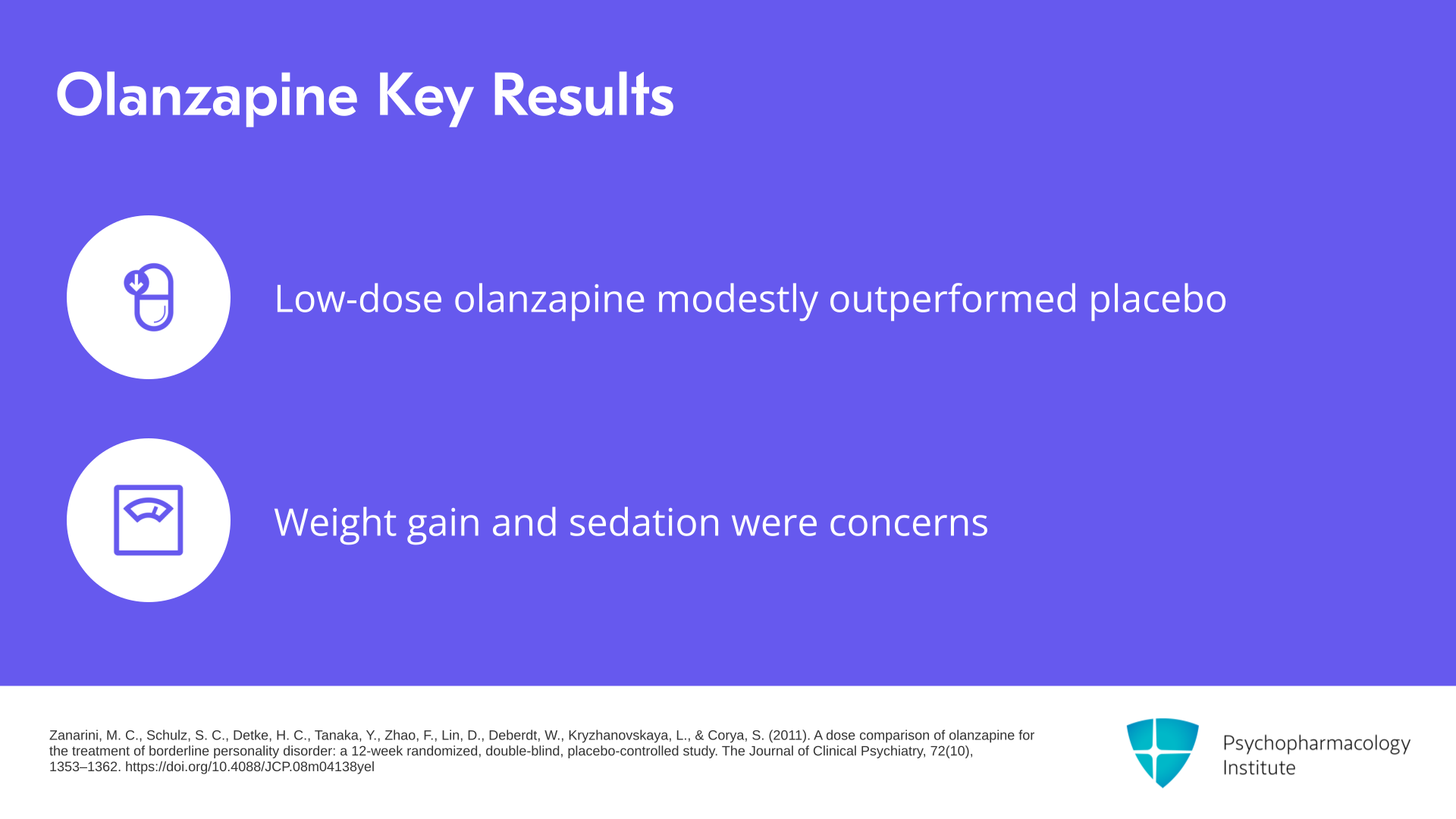
Zanarini in 2011 did a study of olanzapine with really similar findings. They were measuring the same ZAN-BPD measure which gets at borderline features. Olanzapine at low doses of 5 to 10 mg a day showed a modest advantage over placebo in the borderline psychopathology. But the caution is again side effects were common including weight gain and sedation which really can affect our use of these medications.
References:
- Zanarini, M. C., Schulz, S. C., Detke, H. C., Tanaka, Y., Zhao, F., Lin, D., Deberdt, W., Kryzhanovskaya, L., & Corya, S. (2011). A dose comparison of olanzapine for the treatment of borderline personality disorder: a 12-week randomized, double-blind, placebo-controlled study. The Journal of Clinical Psychiatry, 72(10), 1353–1362. https://doi.org/10.4088/JCP.08m04138yel
Slide 6 of 15
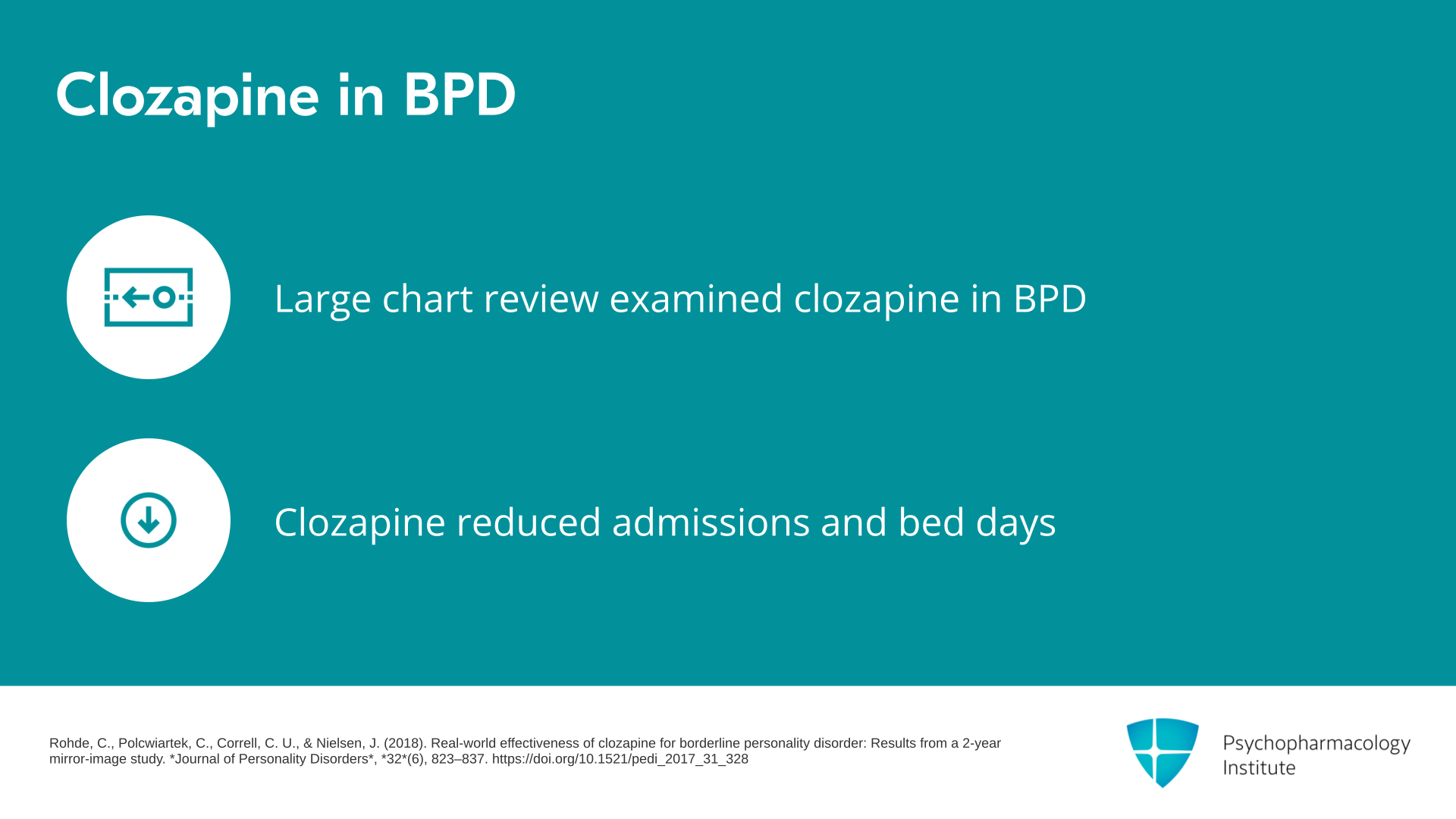
Clozapine has been studied in borderline personality disorder. There’s been a large sort of chart review or administrative data of patients with borderline personality disorder and their exposure to clozapine. So this included patients who would have borderline personality disorder plus bipolar disorder and psychotic disorders but they also separated out what they called the specific borderline personality disorder patients. And what they found was that being exposed to clozapine reduced the psychiatric admissions, reduced sort of all admissions and reduced the number of psychiatric bed days. And this was found both in the large group and in the specific borderline personality disorder group.
References:
- Rohde, C., Polcwiartek, C., Correll, C. U., & Nielsen, J. (2018). Real-world effectiveness of clozapine for borderline personality disorder: Results from a 2-year mirror-image study. *Journal of Personality Disorders*, *32*(6), 823–837. https://doi.org/10.1521/pedi_2017_31_328
Free Files
Download PDF and other files
Success!
Check your inbox, we sent you all the materials there.
Slide 7 of 15
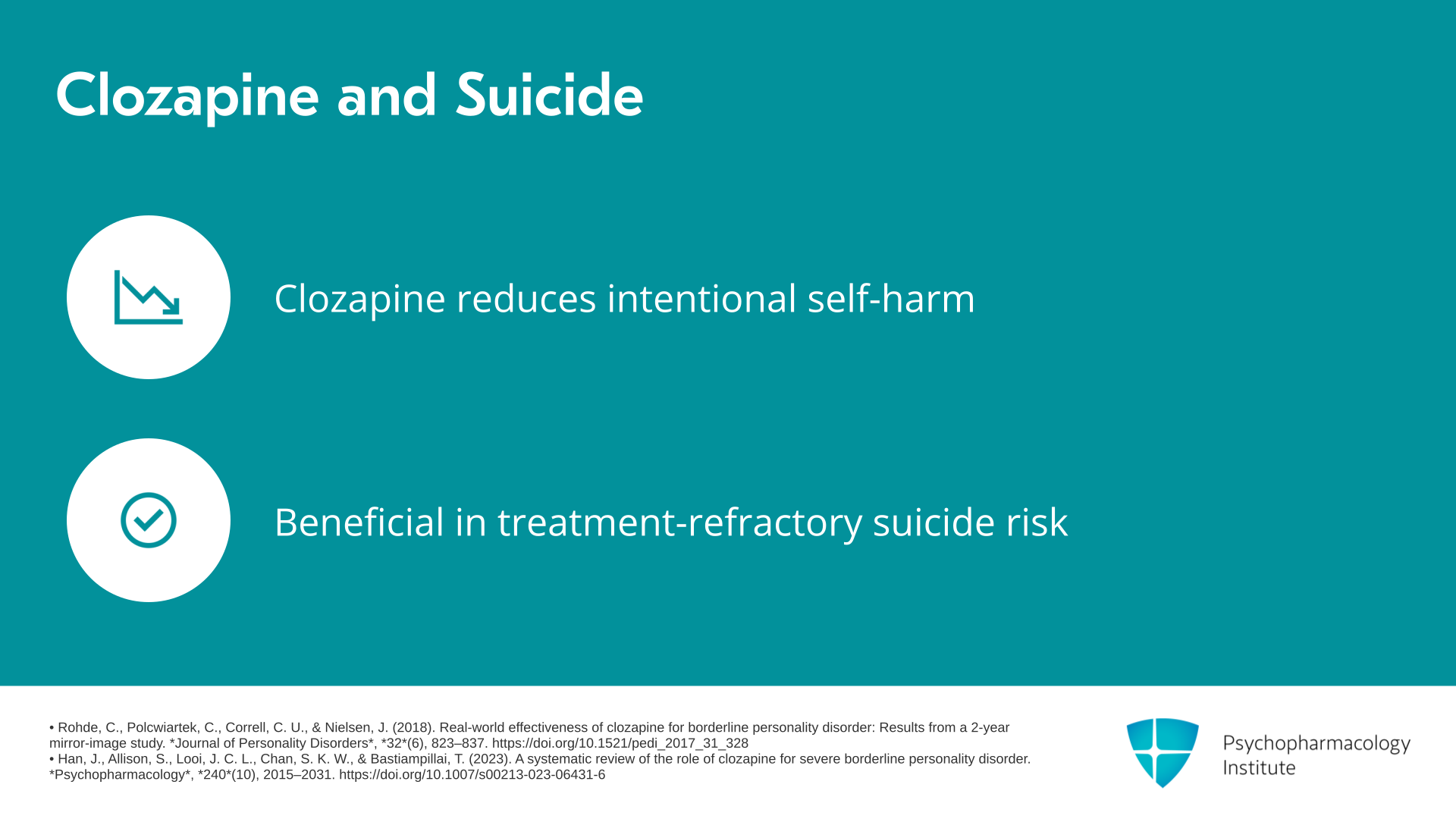
They also showed that the number of patients with intentional self-harm or overdoses decreased significantly if they were exposed to clozapine. Now, there’s also been a systematic review of clozapine and it did seem to have some value in patients who were treatment refractory with suicide risk.
References:
- Rohde, C., Polcwiartek, C., Correll, C. U., & Nielsen, J. (2018). Real-world effectiveness of clozapine for borderline personality disorder: Results from a 2-year mirror-image study. *Journal of Personality Disorders*, *32*(6), 823–837. https://doi.org/10.1521/pedi_2017_31_328
- Han, J., Allison, S., Looi, J. C. L., Chan, S. K. W., & Bastiampillai, T. (2023). A systematic review of the role of clozapine for severe borderline personality disorder. *Psychopharmacology*, *240*(10), 2015–2031. https://doi.org/10.1007/s00213-023-06431-6
Slide 8 of 15
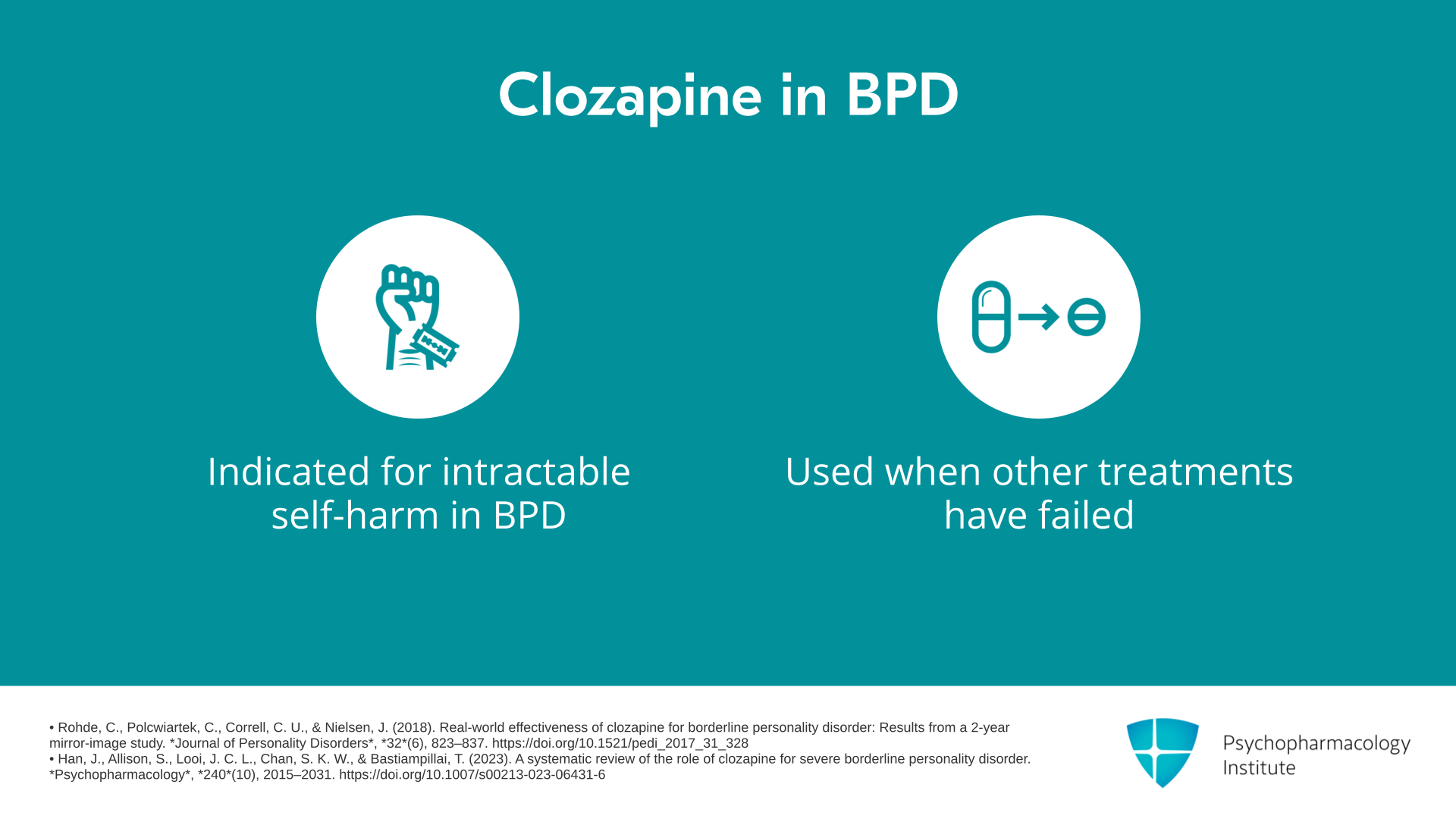
So my experience is that I have recommended or prescribed clozapine in this situation where a hospitalized patient with borderline personality disorder is experiencing intractable and dangerous self-harm behavior so much to the point that patient can’t be discharged or released from hospital. In these cases, other approaches have failed and because of the patient’s escalating self-harm behavior clozapine was attempted and can prove to be effective in that kind of extreme circumstance.
References:
- Rohde, C., Polcwiartek, C., Correll, C. U., & Nielsen, J. (2018). Real-world effectiveness of clozapine for borderline personality disorder: Results from a 2-year mirror-image study. *Journal of Personality Disorders*, *32*(6), 823–837. https://doi.org/10.1521/pedi_2017_31_328
- Han, J., Allison, S., Looi, J. C. L., Chan, S. K. W., & Bastiampillai, T. (2023). A systematic review of the role of clozapine for severe borderline personality disorder. *Psychopharmacology*, *240*(10), 2015–2031. https://doi.org/10.1007/s00213-023-06431-6
Free Files
Download PDF and other files
Success!
Check your inbox, we sent you all the materials there.
Slide 9 of 15
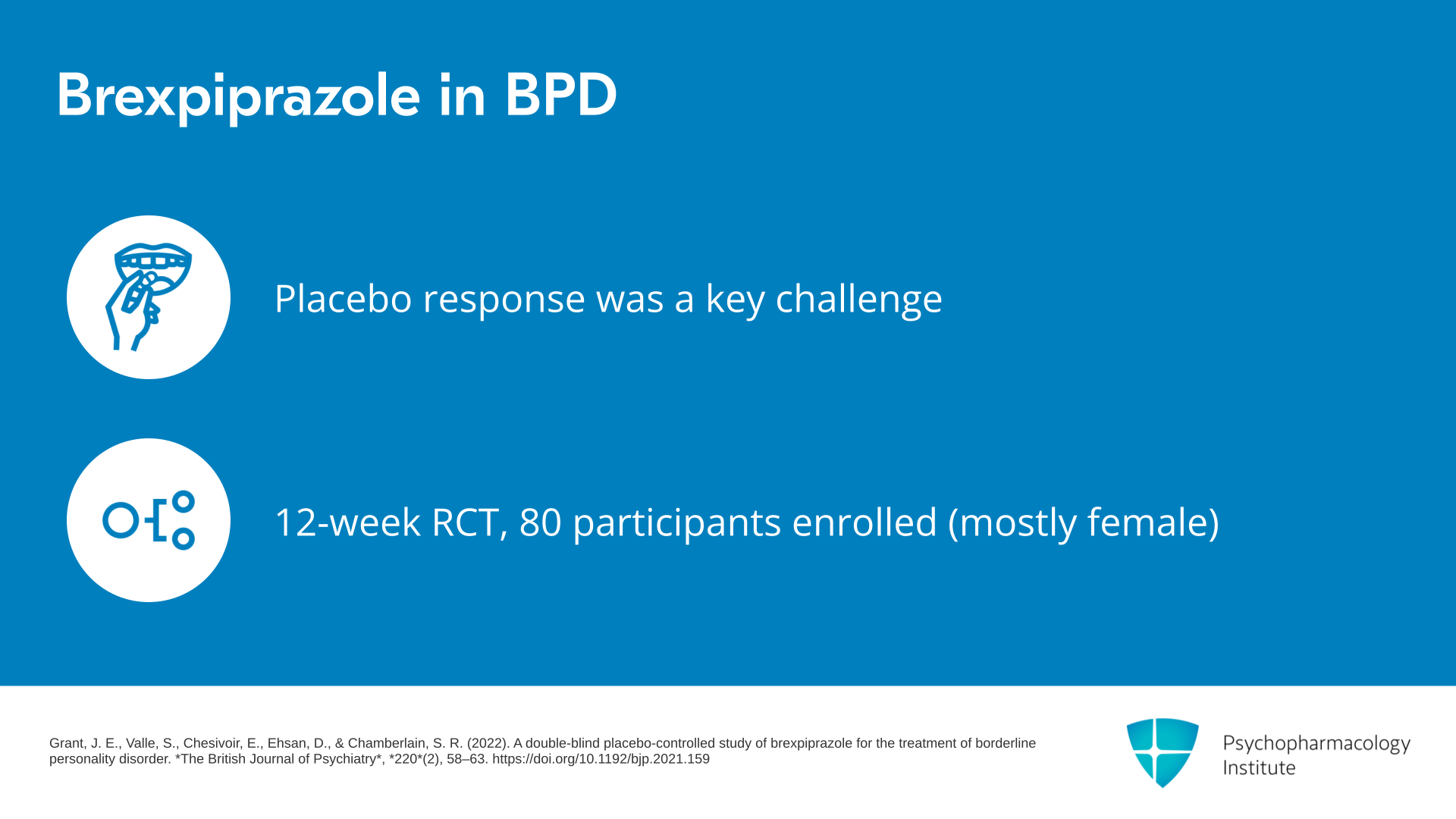
I wanted to mention a randomized controlled trial of brexpiprazole in the treatment of borderline personality disorder to make a specific point about the difficulties with placebo response. So this was a study where they looked at the efficacy and safety of brexpiprazole versus placebo and it was an RCT of 12 weeks’ duration. And they had 80 participants that they were involved with the study. And like many studies, the majority of participants were female. The primary outcome was the ZAN-BPD which gets at borderline psychopathology but they did look at other secondary outcomes.
References:
- Grant, J. E., Valle, S., Chesivoir, E., Ehsan, D., & Chamberlain, S. R. (2022). A double-blind placebo-controlled study of brexpiprazole for the treatment of borderline personality disorder. *The British Journal of Psychiatry*, *220*(2), 58–63. https://doi.org/10.1192/bjp.2021.159
Slide 10 of 15
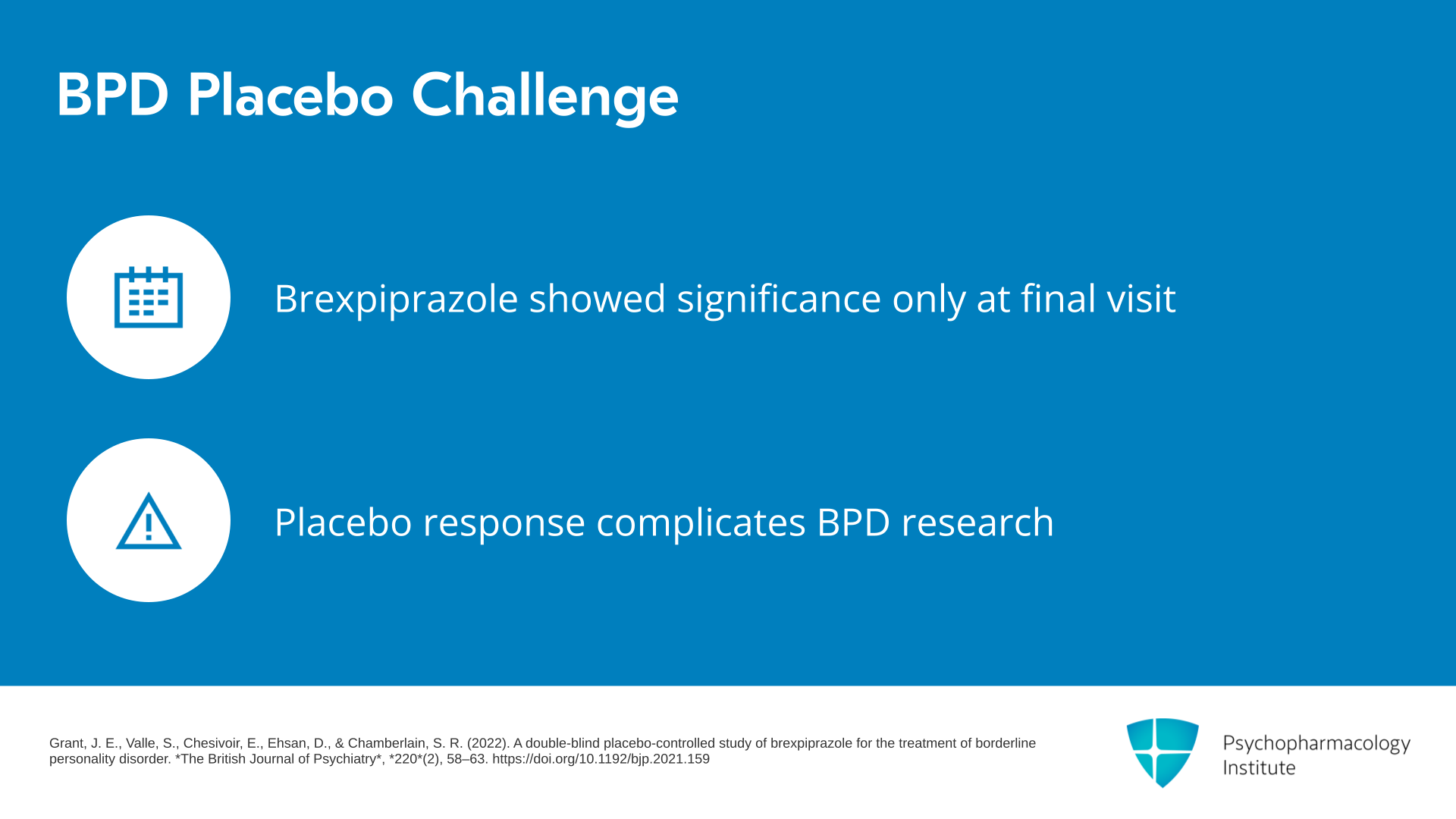
What they found was brexpiprazole had a significant effect on borderline symptoms versus placebo but the significance was only found at the final visit of the study. And this is an example of where they couldn’t differentiate it from placebo until this final examination probably because of the robust placebo response. And this tends to be a characteristic of psychopharmacology research in borderline patients. They have a robust placebo response and it’s very hard to prove if a medication is effective.
References:
- Grant, J. E., Valle, S., Chesivoir, E., Ehsan, D., & Chamberlain, S. R. (2022). A double-blind placebo-controlled study of brexpiprazole for the treatment of borderline personality disorder. *The British Journal of Psychiatry*, *220*(2), 58–63. https://doi.org/10.1192/bjp.2021.159
Free Files
Download PDF and other files
Success!
Check your inbox, we sent you all the materials there.
Slide 11 of 15
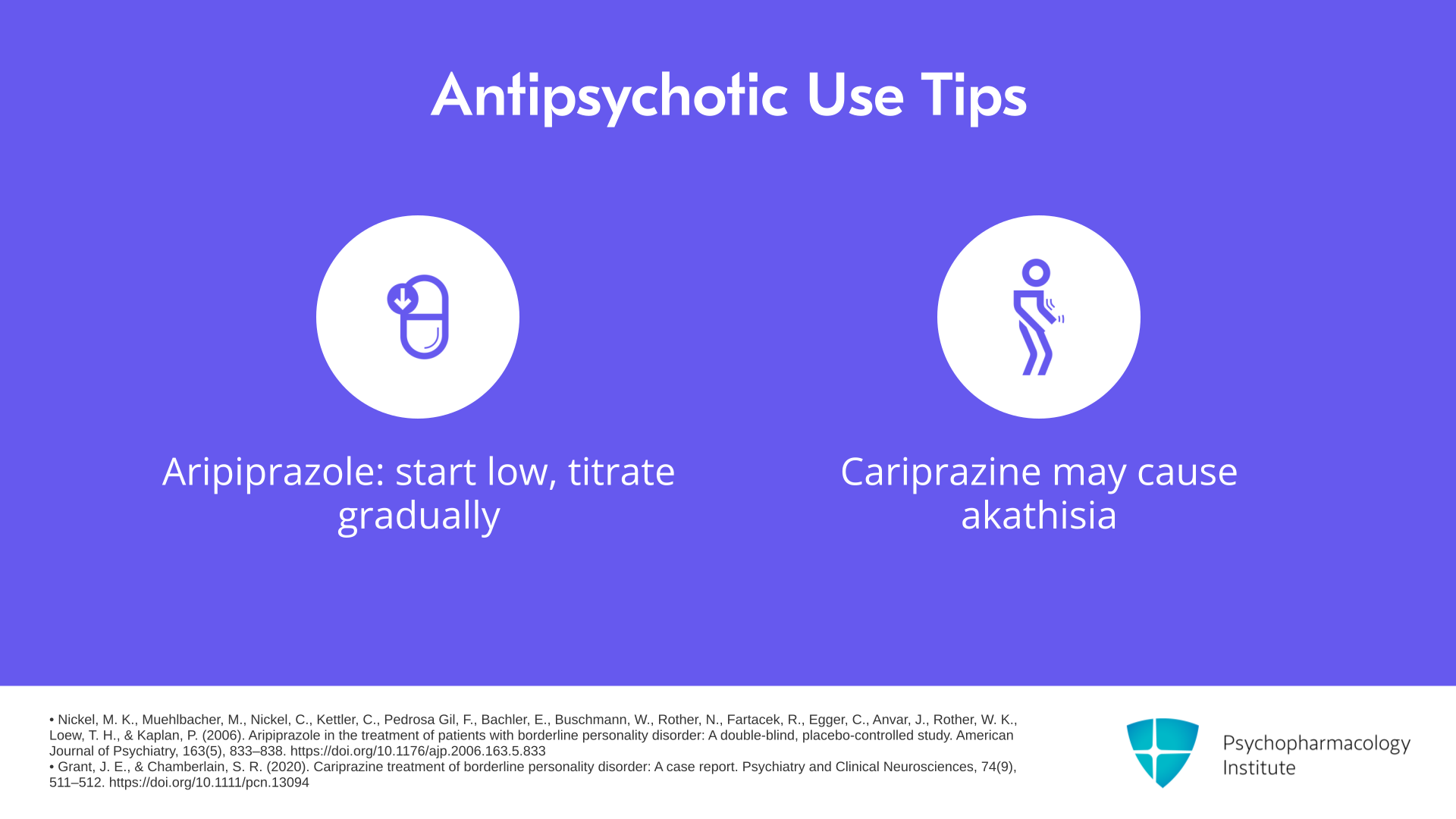
Some of the antipsychotic medications that I have used fairly frequently in borderline patients as an example is aripiprazole. In a symptomatic borderline patient, I might start at 1 or 2 mg a day and gradually increase the dose depending on the patient’s response up to a maximum of 10 mg a day depending on the benefits versus side effects. Cariprazine, when I’ve used it, sometimes I’ve had trouble with the patient experiencing akathisia on cariprazine.
References:
- Nickel, M. K., Muehlbacher, M., Nickel, C., Kettler, C., Pedrosa Gil, F., Bachler, E., Buschmann, W., Rother, N., Fartacek, R., Egger, C., Anvar, J., Rother, W. K., Loew, T. H., & Kaplan, P. (2006). Aripiprazole in the treatment of patients with borderline personality disorder: A double-blind, placebo-controlled study. American Journal of Psychiatry, 163(5), 833–838. https://doi.org/10.1176/ajp.2006.163.5.833
- Grant, J. E., & Chamberlain, S. R. (2020). Cariprazine treatment of borderline personality disorder: A case report. Psychiatry and Clinical Neurosciences, 74(9), 511–512. https://doi.org/10.1111/pcn.13094
Slide 12 of 15
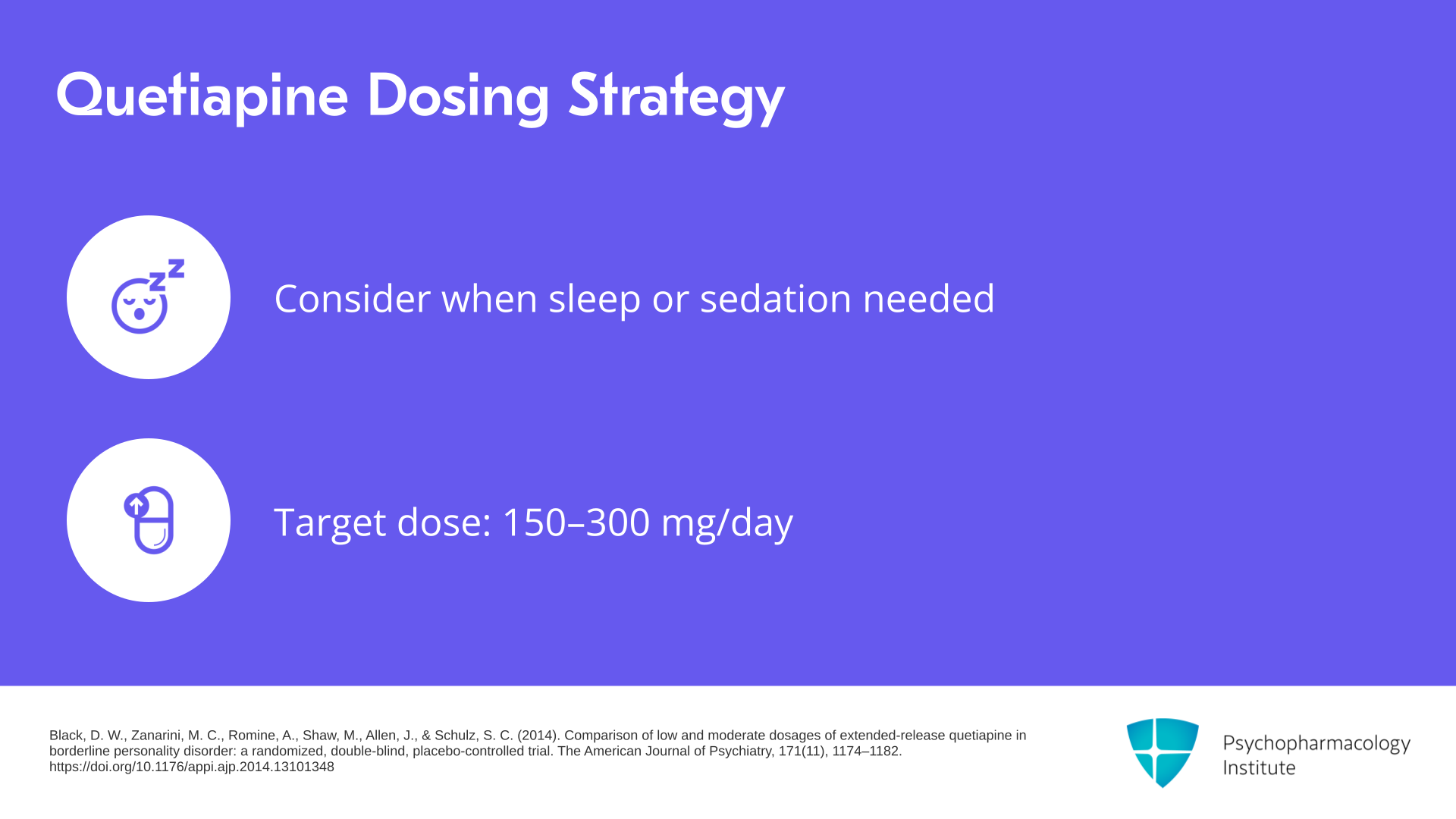
I’ve used quetiapine in a patient where they were maybe more interested in help with sleep or sedation. I might start at 25 mg at night and slowly titrate the dose into this dose range of 150 to 300 mg a day, again depending on the benefits versus side effects.
References:
- Black, D. W., Zanarini, M. C., Romine, A., Shaw, M., Allen, J., & Schulz, S. C. (2014). Comparison of low and moderate dosages of extended-release quetiapine in borderline personality disorder: a randomized, double-blind, placebo-controlled trial. The American Journal of Psychiatry, 171(11), 1174–1182. https://doi.org/10.1176/appi.ajp.2014.13101348
Free Files
Download PDF and other files
Success!
Check your inbox, we sent you all the materials there.
Slide 13 of 15
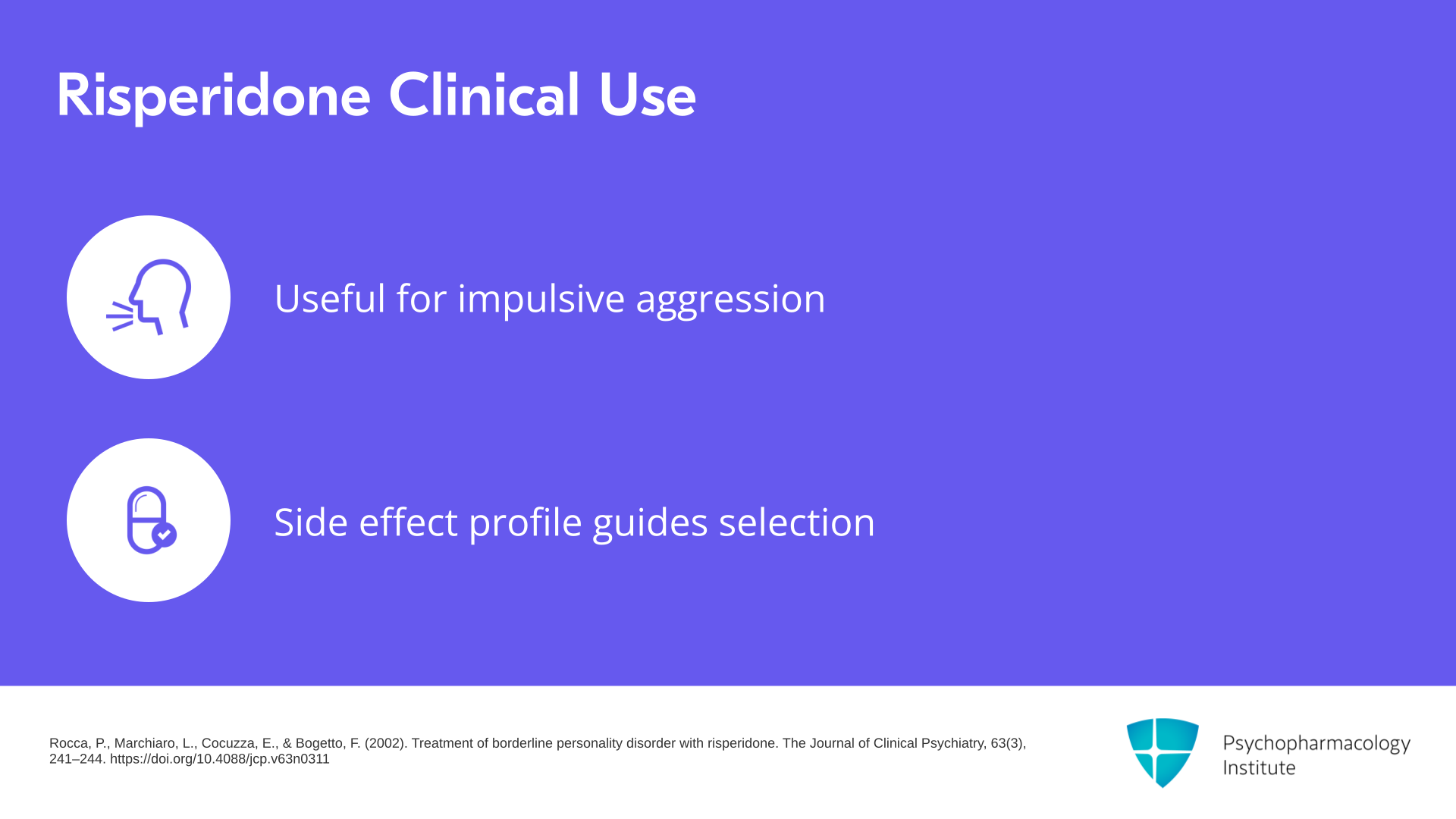
Risperidone has been helpful in my clinical experience where a patient has a considerable impulse of aggressiveness. I find that risperidone can be useful for that starting at a low dose of 0.25 mg q.h.s. and going up to a maximum dose of 3 mg a day, again depending on benefits versus side effects. When prescribing an antipsychotic medication, I primarily select the medication based on the side effect profile.
References:
- Rocca, P., Marchiaro, L., Cocuzza, E., & Bogetto, F. (2002). Treatment of borderline personality disorder with risperidone. The Journal of Clinical Psychiatry, 63(3), 241–244. https://doi.org/10.4088/jcp.v63n0311
Slide 14 of 15
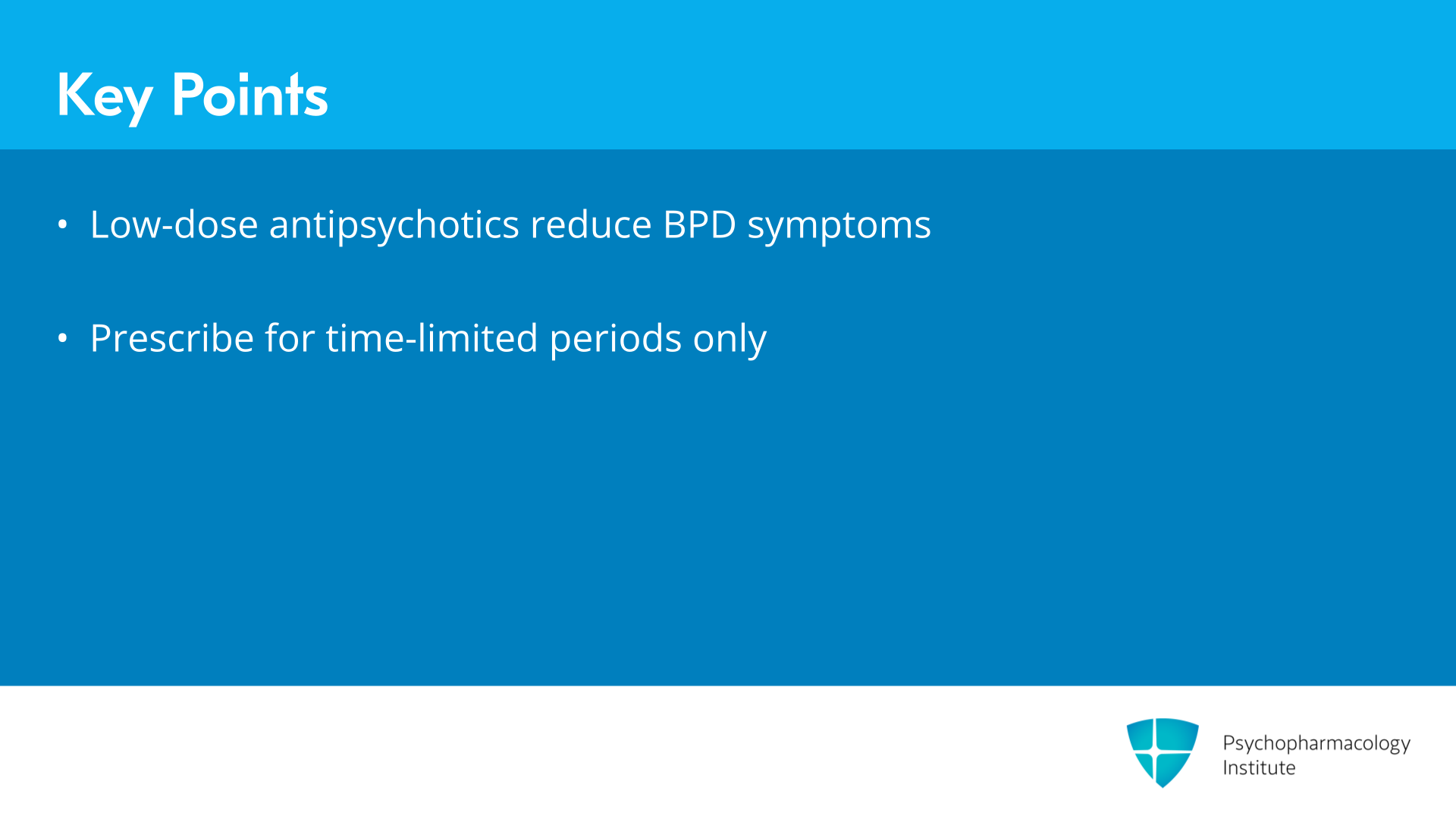
So the key points in this section are: Low-dose antipsychotics can be helpful for lessening anger, impulsive aggression and the cognitive perceptual symptoms of borderline personality disorder. I recommend prescribing for time limited periods.
Free Files
Download PDF and other files
Success!
Check your inbox, we sent you all the materials there.
Slide 15 of 15
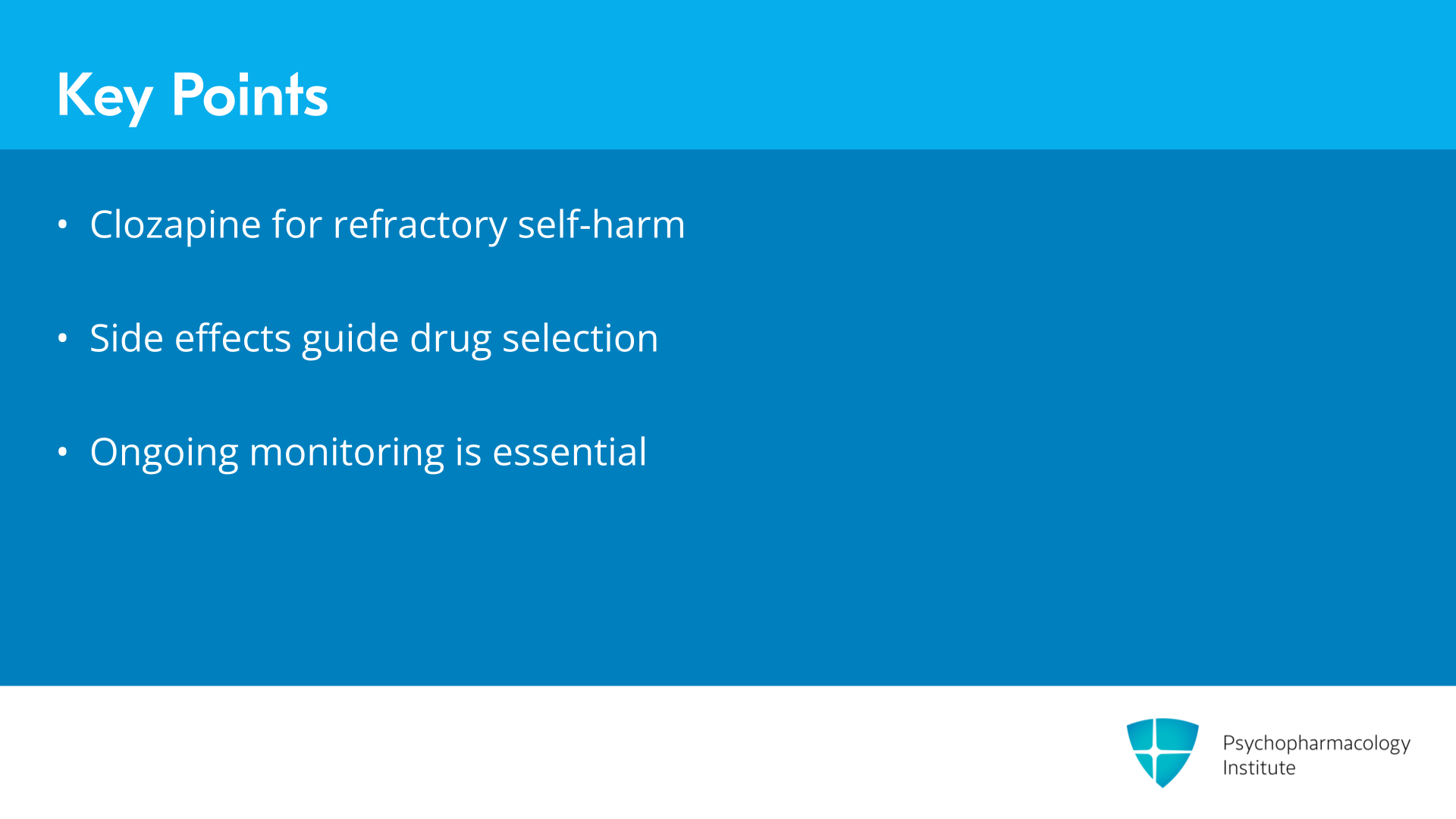
Clozapine perhaps has a role in the patient with very intractable dangerous self-harm behavior when everything else has been unsuccessful. The side effect profile can be a rationale for selecting the antipsychotic. And of course, monitoring the side effects and outcomes would be necessary when prescribing antipsychotics.