
Slides and Transcript
Slide 1 of 18
In this section, we’ll talk about the special case of switching patients to xanomeline/trospium or Cobenfy.
References:
- Brian Miller, M.D., Ph.D., M.P.H.
Slide 2 of 18
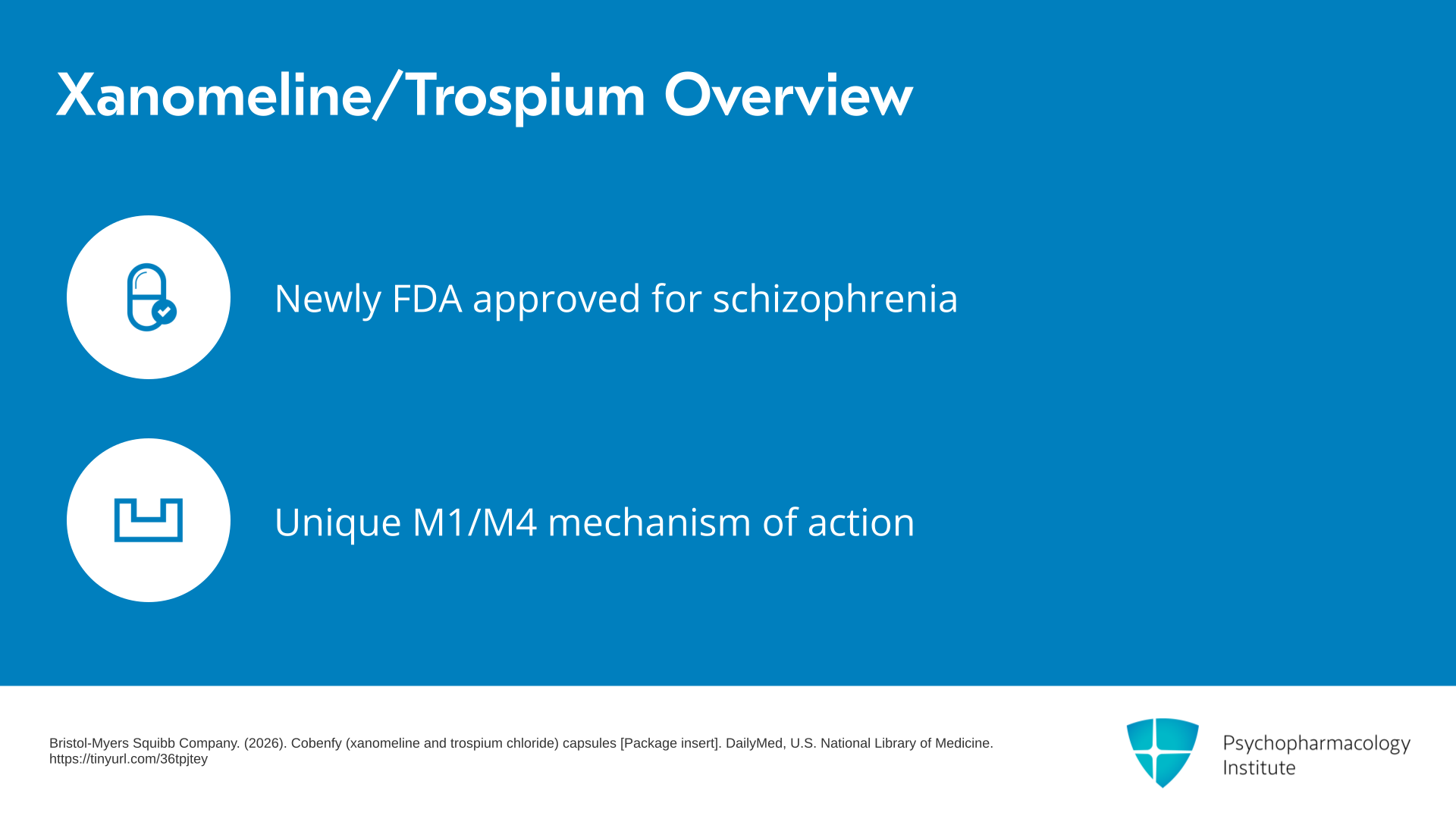
Xanomeline/trospium has a unique mechanism of action. Cobenfy is newly FDA approved for adults with schizophrenia but only as monotherapy. So the related studies had patients washout of their prior medication before starting it. So xanomeline is a muscarinic M1/M4 agonist together with trospium which is a peripheral muscarinic M1/M4 antagonist.
References:
- Bristol-Myers Squibb Company. (2026). Cobenfy (xanomeline and trospium chloride) capsules [Package insert]. DailyMed, U.S. National Library of Medicine. https://tinyurl.com/36tpjtey
Free Files
Download PDF and other files
Success!
Check your inbox, we sent you all the materials there.
Slide 3 of 18
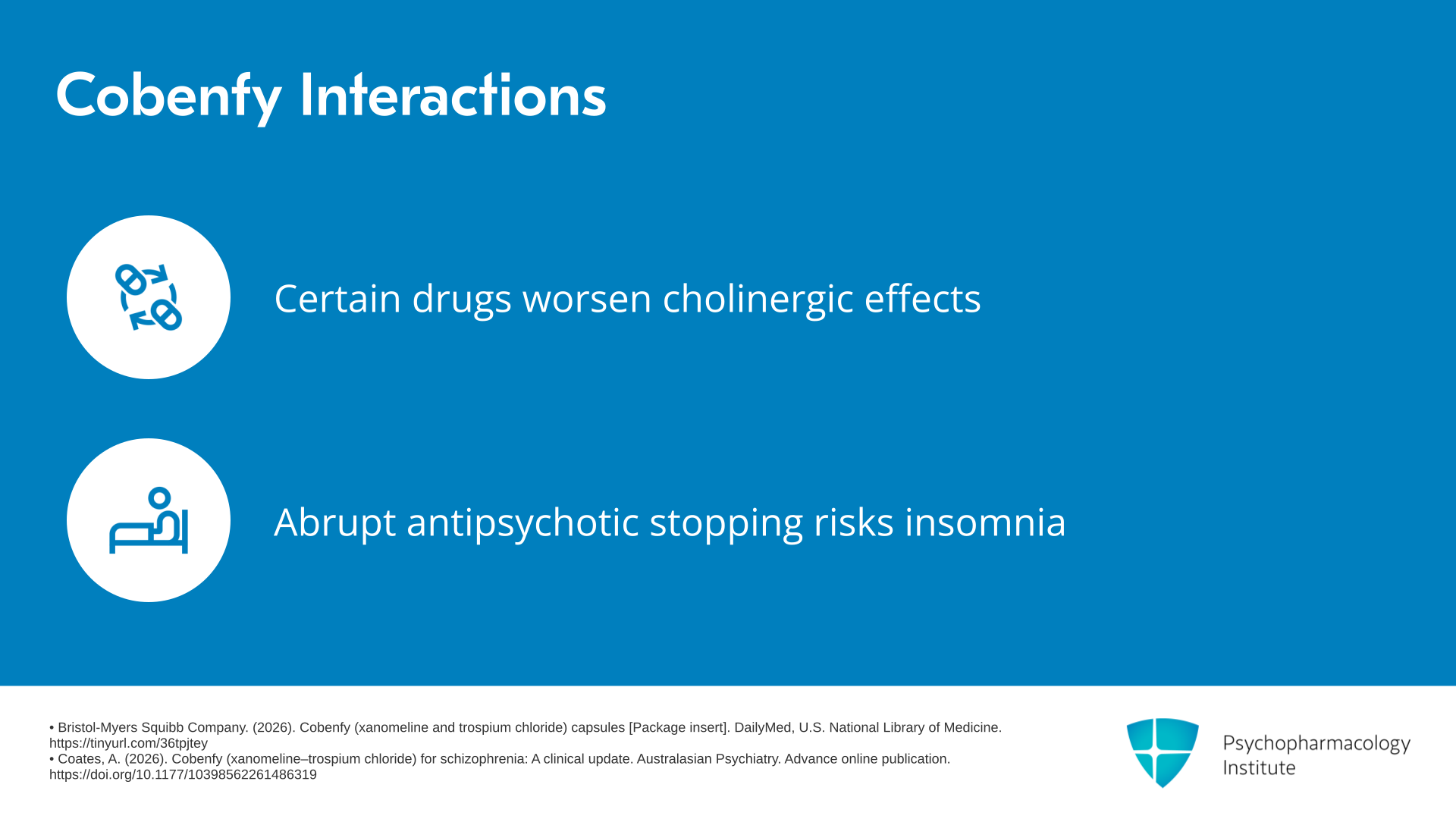
So antihistamines, anticholinergics and antipsychotics with high muscarinic affinity such as clozapine and olanzapine can exacerbate the cholinergic adverse effects of Cobenfy, including dry mouth, constipation, urinary retention and blurry vision. Some antipsychotics are sedating and so abruptly stopping them can precipitate insomnia and agitation.
References:
- Bristol-Myers Squibb Company. (2026). Cobenfy (xanomeline and trospium chloride) capsules [Package insert]. DailyMed, U.S. National Library of Medicine. https://tinyurl.com/36tpjtey
- Coates, A. (2026). Cobenfy (xanomeline–trospium chloride) for schizophrenia: A clinical update. Australasian Psychiatry. Advance online publication. https://doi.org/10.1177/10398562261486319
Slide 4 of 18
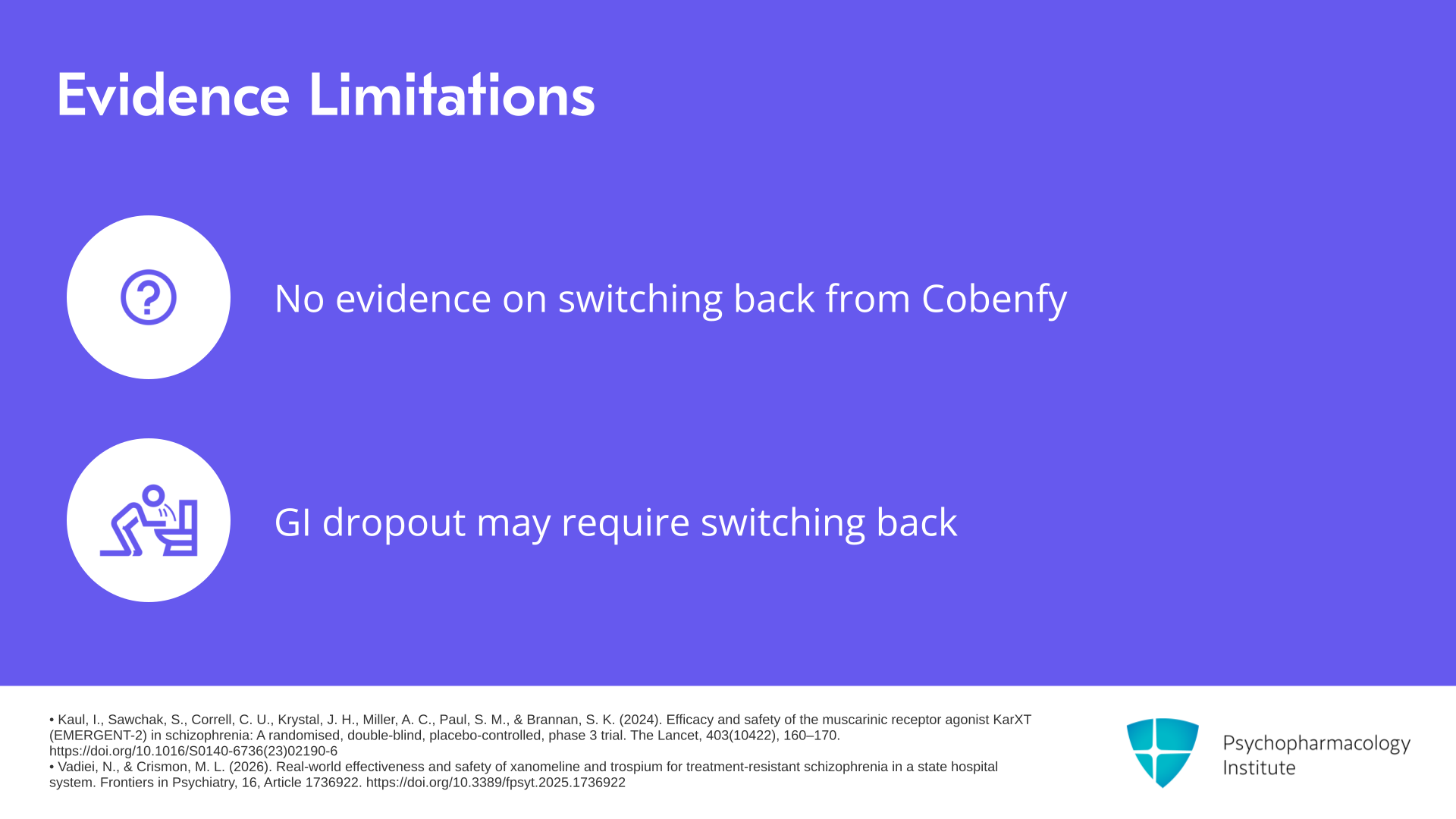
What are the limits of our evidence? Well, there’s no published evidence on switching patients from Cobenfy back to a conventional D2 blocking antipsychotic. There’s no trial, no protocol, and no characterization of any discontinuation syndrome after stopping this agent. But given the front-loaded GI dropout, some patients may require switching back from Cobenfy to a conventional antipsychotic. And clinicians need to know that they’re navigating this without data.
References:
- Kaul, I., Sawchak, S., Correll, C. U., Krystal, J. H., Miller, A. C., Paul, S. M., & Brannan, S. K. (2024). Efficacy and safety of the muscarinic receptor agonist KarXT (EMERGENT-2) in schizophrenia: A randomised, double-blind, placebo-controlled, phase 3 trial. The Lancet, 403(10422), 160–170. https://doi.org/10.1016/S0140-6736(23)02190-6
- Vadiei, N., & Crismon, M. L. (2026). Real-world effectiveness and safety of xanomeline and trospium for treatment-resistant schizophrenia in a state hospital system. Frontiers in Psychiatry, 16, Article 1736922. https://doi.org/10.3389/fpsyt.2025.1736922
Free Files
Download PDF and other files
Success!
Check your inbox, we sent you all the materials there.
Slide 5 of 18
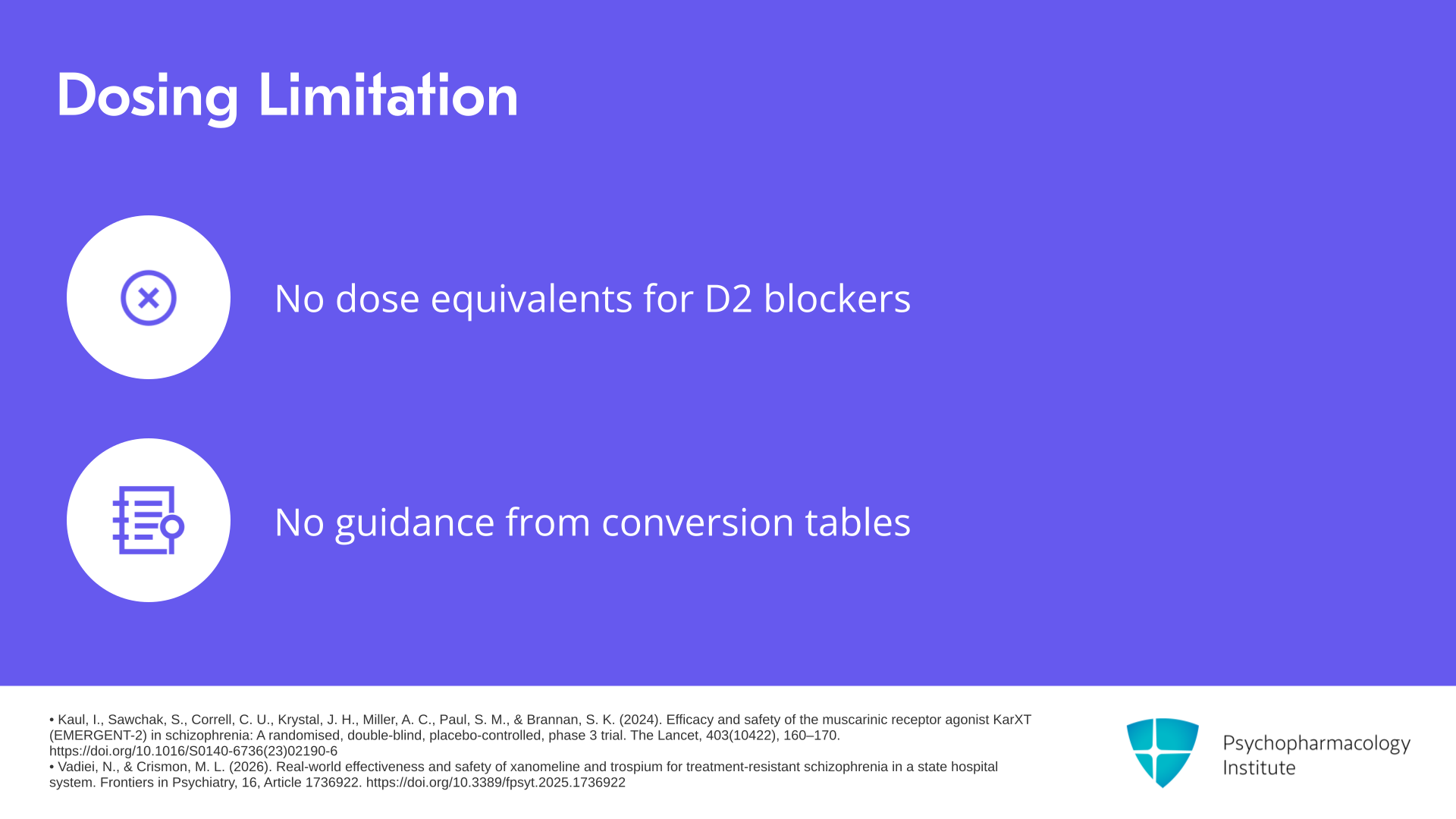
Another important limitation is that there are no dose equivalents to any D2 blocking antipsychotic that is definable. Xanomeline does not block D2 receptors. So cross-titration cannot be guided by dose conversion tables at all.
References:
- Kaul, I., Sawchak, S., Correll, C. U., Krystal, J. H., Miller, A. C., Paul, S. M., & Brannan, S. K. (2024). Efficacy and safety of the muscarinic receptor agonist KarXT (EMERGENT-2) in schizophrenia: A randomised, double-blind, placebo-controlled, phase 3 trial. The Lancet, 403(10422), 160–170. https://doi.org/10.1016/S0140-6736(23)02190-6
- Vadiei, N., & Crismon, M. L. (2026). Real-world effectiveness and safety of xanomeline and trospium for treatment-resistant schizophrenia in a state hospital system. Frontiers in Psychiatry, 16, Article 1736922. https://doi.org/10.3389/fpsyt.2025.1736922
Slide 6 of 18
The cross-titration protocol is a consensus panel report that was funded by Bristol Myers Squibb, based on the panelists’ collective experience with about 200 Cobenfy-treated patients. It is expert opinion plus trial protocol extrapolation, not comparative dosing evidence. But it is currently the only published consensus protocol of its kind. So the panel’s own limitation statement says its recommendations should be interpreted with appropriate caution.
References:
- Melnick, I., Crown, E. C., Zinzuvadia, M., & Halassa, M. M. (2025). Real-world implementation of xanomeline-trospium in schizophrenia: A consensus panel report. Journal of Clinical Psychiatry, 86(4), Article hxtachi2509. https://doi.org/10.4088/JCP.hxtachi2509
Free Files
Download PDF and other files
Success!
Check your inbox, we sent you all the materials there.
Slide 7 of 18
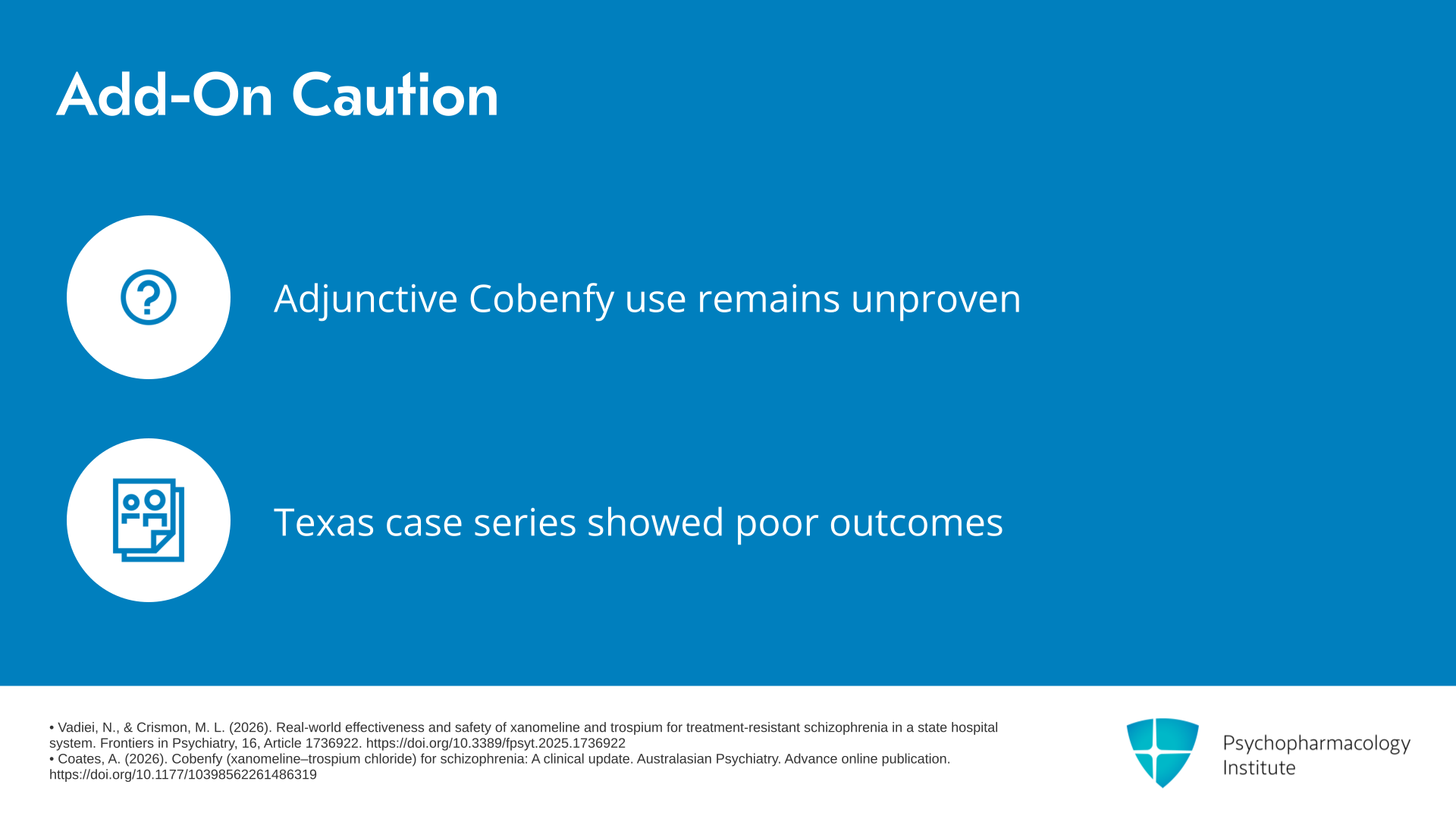
Another limitation is that adjunctive Cobenfy, that is Cobenfy in adjunct to other dopamine-blocking antipsychotics, is unproven. The recent ARISE trial of Cobenfy added to atypical antipsychotics missed its primary endpoint, but currently exists only as a press release, not a publication. So in terms of real-world caution, in a Texas state hospital series of 20 treatment-resistant patients where Cobenfy was added on top of anticholinergic antipsychotics, so 75% of these patients remained on either clozapine, olanzapine or quetiapine, 70% discontinued Cobenfy by a median 1.8 months and no patient meaningfully improved. And so this small series illustrates the pharmacologic point that additive anticholinergic burden undermines the drug. So switch properly rather than stacking antipsychotics.
References:
- Vadiei, N., & Crismon, M. L. (2026). Real-world effectiveness and safety of xanomeline and trospium for treatment-resistant schizophrenia in a state hospital system. Frontiers in Psychiatry, 16, Article 1736922. https://doi.org/10.3389/fpsyt.2025.1736922
- Coates, A. (2026). Cobenfy (xanomeline–trospium chloride) for schizophrenia: A clinical update. Australasian Psychiatry. Advance online publication. https://doi.org/10.1177/10398562261486319
Slide 8 of 18
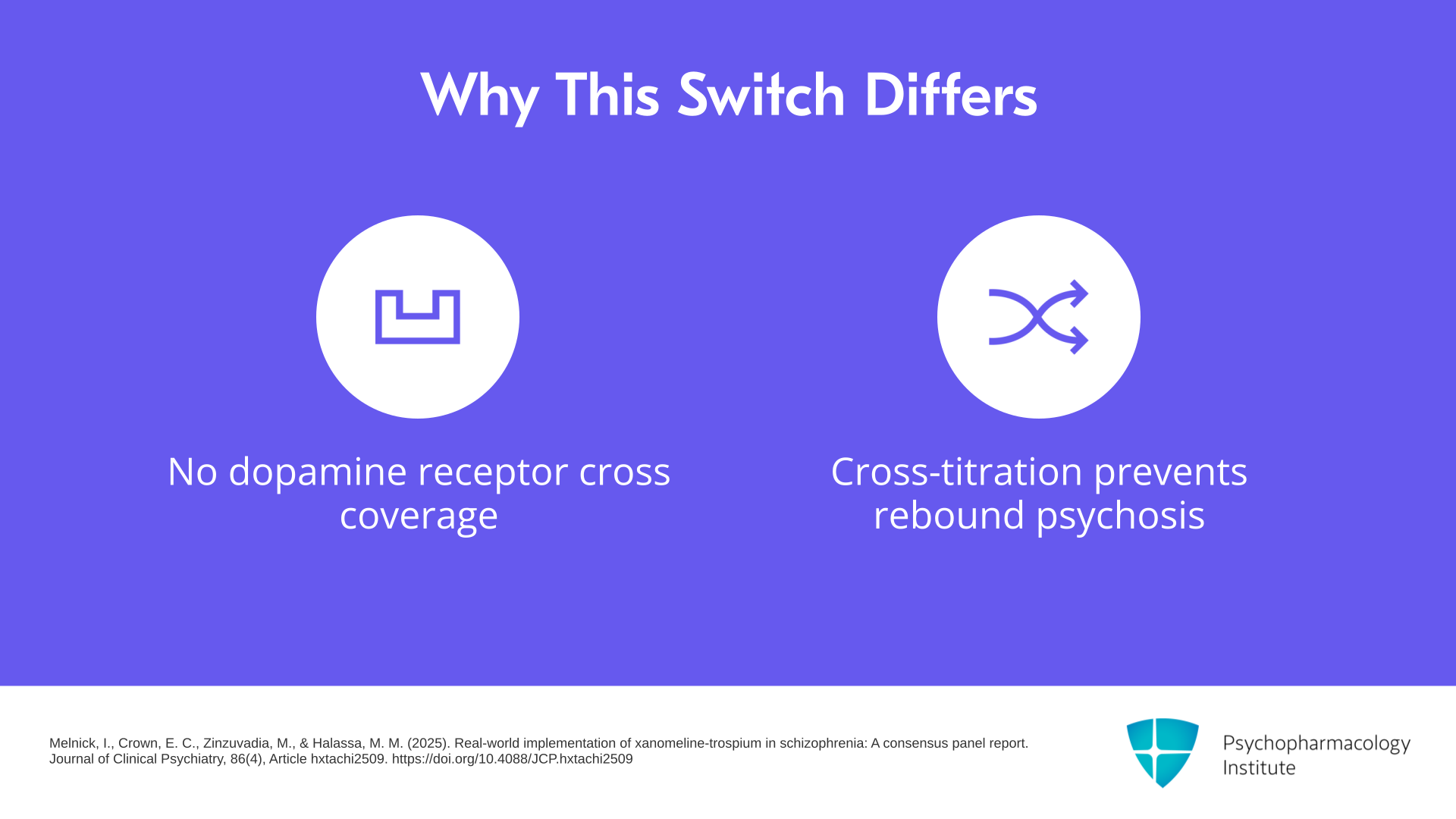
So why is this switch different? Well, Cobenfy is the first muscarinic-based therapy for schizophrenia. Again, it’s an M1/M4 agonist with a peripheral M1/M4 antagonist. It does not block D2. So during the switch, the incoming drug provides no dopamine receptor cross coverage. So the outgoing antipsychotic taper carries all of the relapse protection which makes the tapering plan, not the titration of the new drug, the safety critical half of the switch. So a clinician-guided cross-titration is strongly preferred over abrupt discontinuation of the prior antipsychotic which could be associated with dopamine hypersensitivity and rebound psychosis.
References:
- Melnick, I., Crown, E. C., Zinzuvadia, M., & Halassa, M. M. (2025). Real-world implementation of xanomeline-trospium in schizophrenia: A consensus panel report. Journal of Clinical Psychiatry, 86(4), Article hxtachi2509. https://doi.org/10.4088/JCP.hxtachi2509
Free Files
Download PDF and other files
Success!
Check your inbox, we sent you all the materials there.
Slide 9 of 18
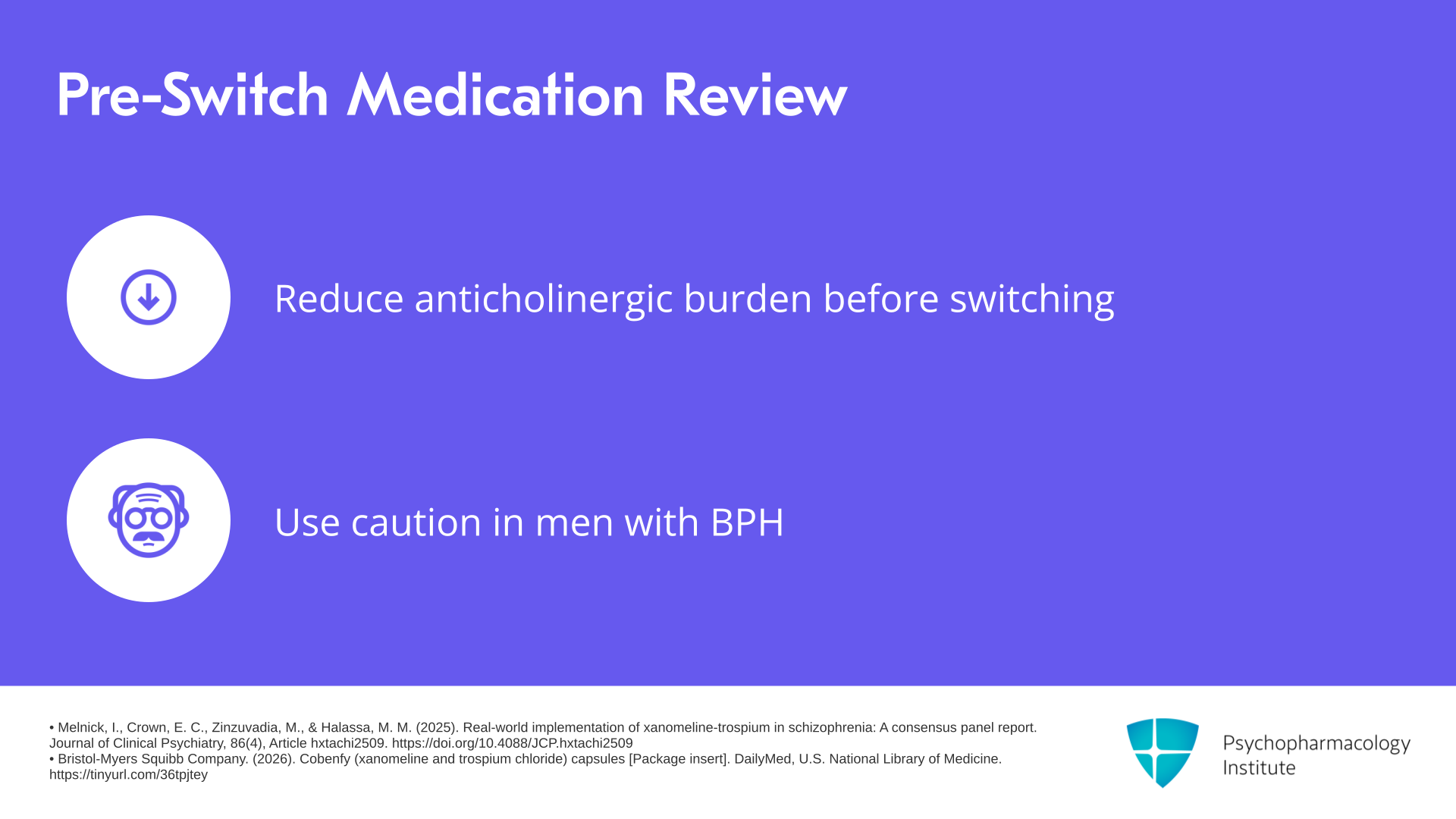
So before starting the switch, review all medications and reduce anticholinergic burden wherever possible. So for example, discontinue diphenhydramine for insomnia in favor of an orexin receptor agonist. Review benztropine and potentially any other bladder or COPD agents. And importantly, Cobenfy may not be appropriate for men over 50 with BPH because of urinary retention risk.
References:
- Melnick, I., Crown, E. C., Zinzuvadia, M., & Halassa, M. M. (2025). Real-world implementation of xanomeline-trospium in schizophrenia: A consensus panel report. Journal of Clinical Psychiatry, 86(4), Article hxtachi2509. https://doi.org/10.4088/JCP.hxtachi2509
- Bristol-Myers Squibb Company. (2026). Cobenfy (xanomeline and trospium chloride) capsules [Package insert]. DailyMed, U.S. National Library of Medicine. https://tinyurl.com/36tpjtey
Slide 10 of 18
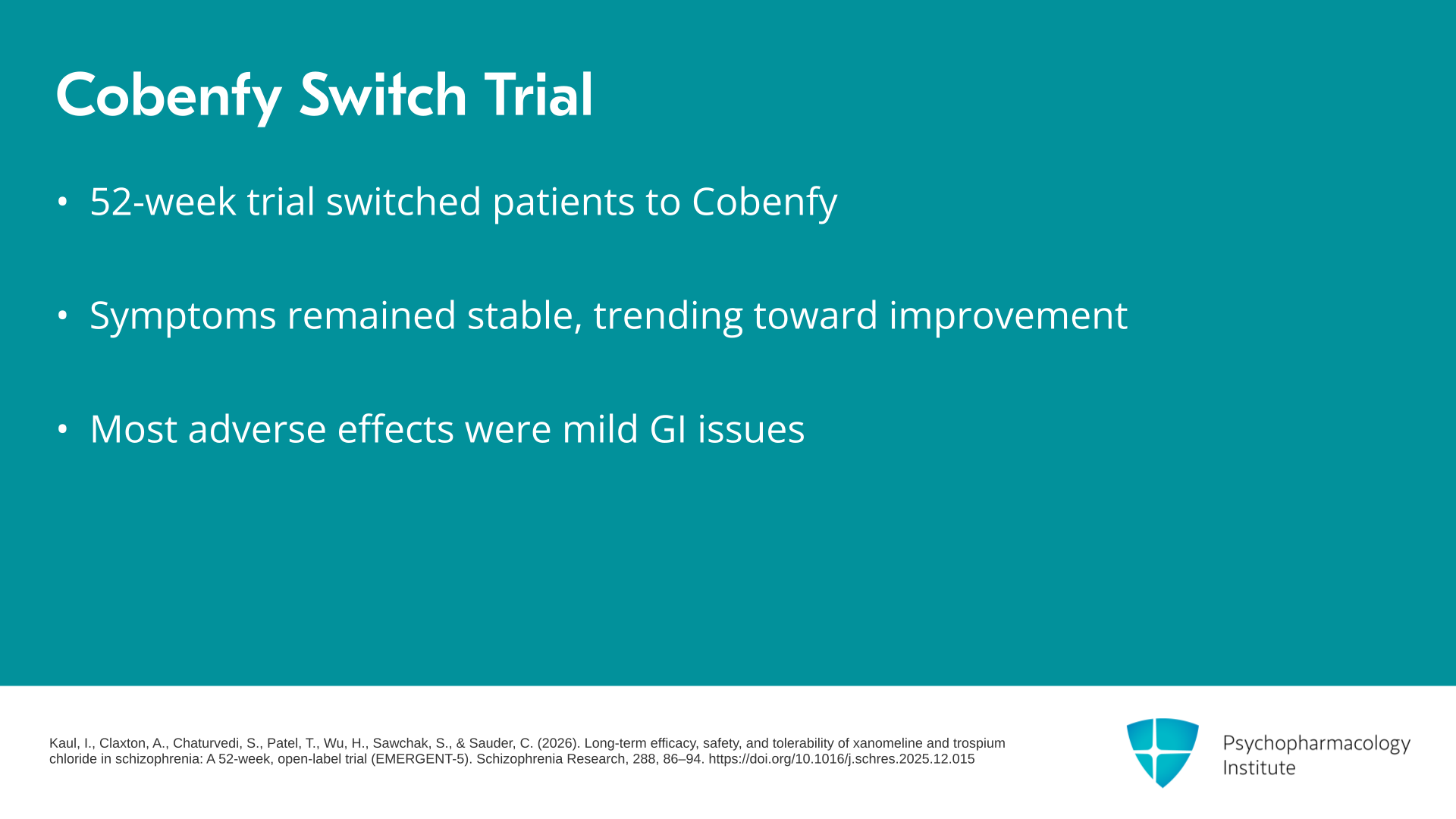
So what’s the evidence for switching to Cobenfy? Well, the EMERGENT-5 trial which was a 52-week open label study had 566 stable adults with schizophrenia switched from their prior antipsychotic to Cobenfy monotherapy. Symptoms remained stable and trended towards improvement over the 52 weeks. Over 80% had at least one treatment-emergent adverse effect primarily GI and primarily mild to moderate in severity including nausea, vomiting, constipation, dry mouth and dyspepsia. About 6% experienced severe adverse events and just under half of the subjects completed the full 52 weeks.
References:
- Kaul, I., Claxton, A., Chaturvedi, S., Patel, T., Wu, H., Sawchak, S., & Sauder, C. (2026). Long-term efficacy, safety, and tolerability of xanomeline and trospium chloride in schizophrenia: A 52-week, open-label trial (EMERGENT-5). Schizophrenia Research, 288, 86–94. https://doi.org/10.1016/j.schres.2025.12.015
Free Files
Download PDF and other files
Success!
Check your inbox, we sent you all the materials there.
Slide 11 of 18
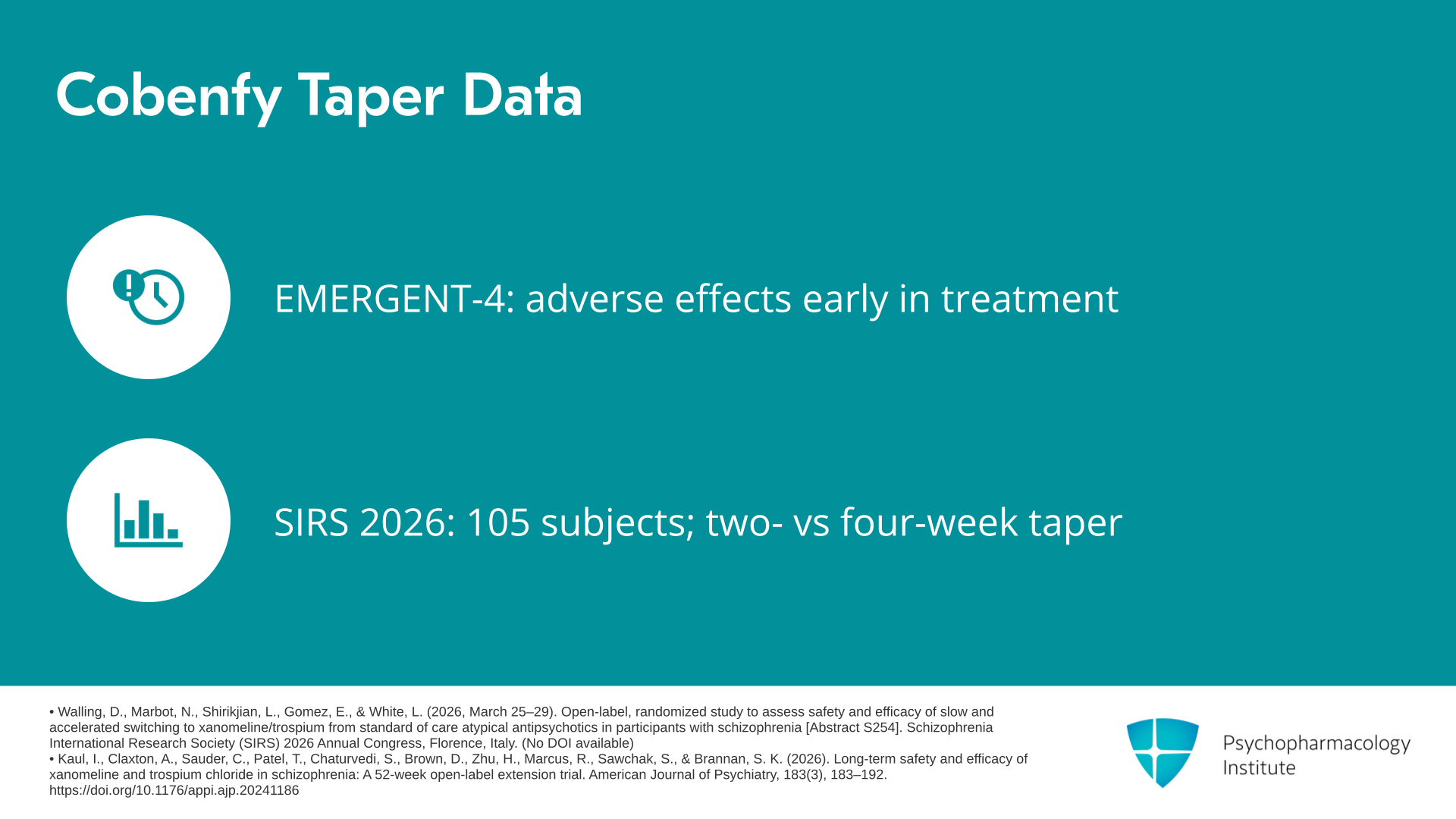
In the smaller EMERGENT-4 extension study with 152 patients, adverse effects were concentrated in the first two weeks. Recently, an unpublished phase 4 outpatient study that was presented at the SIRS 2026 Conference with 105 subjects compared two- versus four-week tapering of the oral atypical antipsychotic while uptitrating Cobenfy and found symptom stability with both. The adverse event discontinuation rate was 3.8% with the two-week taper versus 1.9% with the four-week taper. Importantly, this is a conference presentation and press release, so this finding supports feasibility but should not yet be cited as evidence.
References:
- Walling, D., Marbot, N., Shirikjian, L., Gomez, E., & White, L. (2026, March 25–29). Open-label, randomized study to assess safety and efficacy of slow and accelerated switching to xanomeline/trospium from standard of care atypical antipsychotics in participants with schizophrenia [Abstract S254]. Schizophrenia International Research Society (SIRS) 2026 Annual Congress, Florence, Italy. (No DOI available)
- Kaul, I., Claxton, A., Sauder, C., Patel, T., Chaturvedi, S., Brown, D., Zhu, H., Marcus, R., Sawchak, S., & Brannan, S. K. (2026). Long-term safety and efficacy of xanomeline and trospium chloride in schizophrenia: A 52-week open-label extension trial. American Journal of Psychiatry, 183(3), 183–192. https://doi.org/10.1176/appi.ajp.20241186
Slide 12 of 18
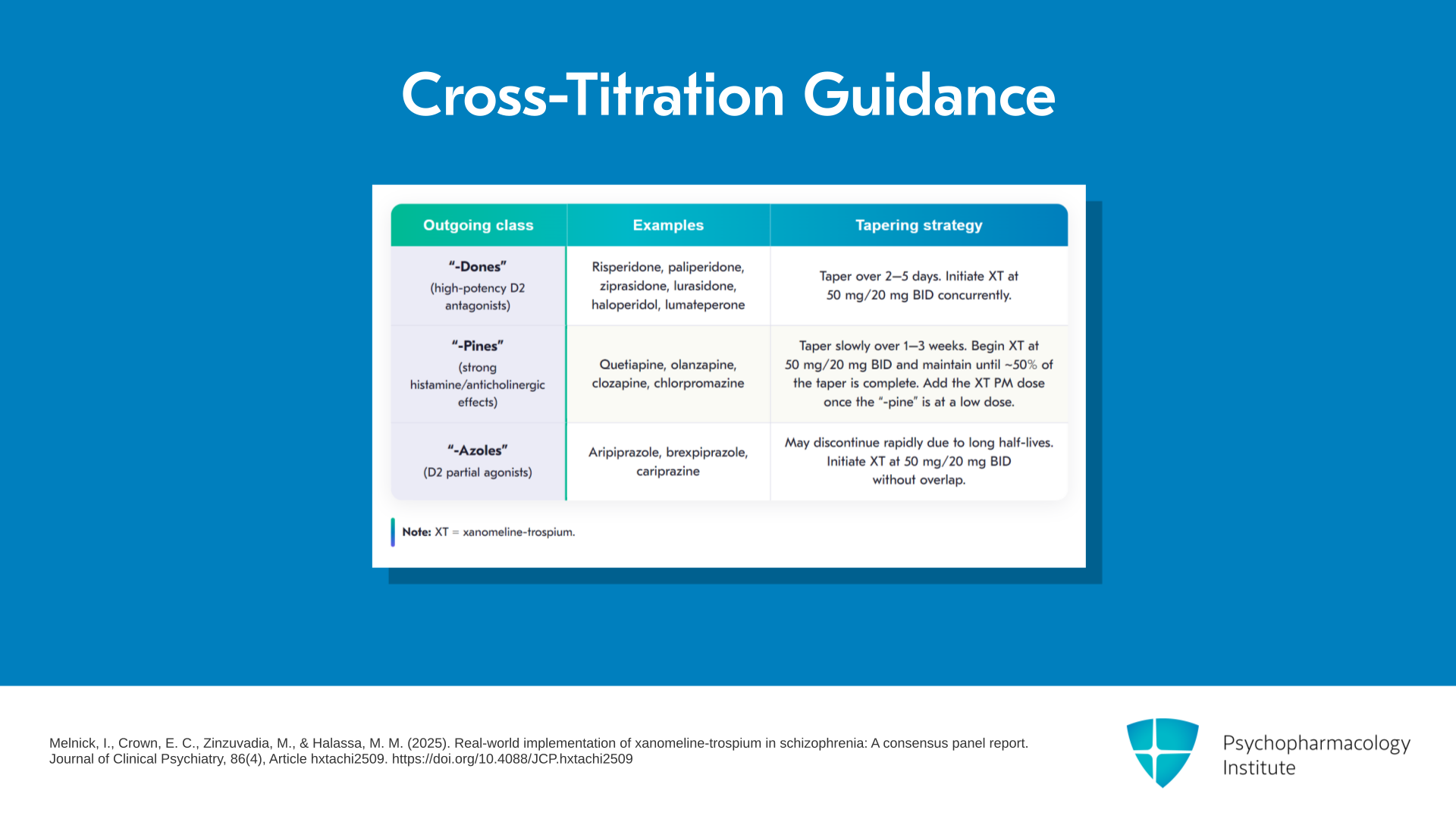
How do we cross-titrate by class of the outgoing antipsychotic? So per the 2025 consensus panel, we start Cobenfy at 50/20 twice daily same day that the patient is seen in clinic while tapering the existing antipsychotic according to its pharmacologic class. And so you can see here in the table presented that based on the so-called -pines, -dones and -pips families, you can view the recommended tapering strategy.
References:
- Melnick, I., Crown, E. C., Zinzuvadia, M., & Halassa, M. M. (2025). Real-world implementation of xanomeline-trospium in schizophrenia: A consensus panel report. Journal of Clinical Psychiatry, 86(4), Article hxtachi2509. https://doi.org/10.4088/JCP.hxtachi2509
Free Files
Download PDF and other files
Success!
Check your inbox, we sent you all the materials there.
Slide 13 of 18
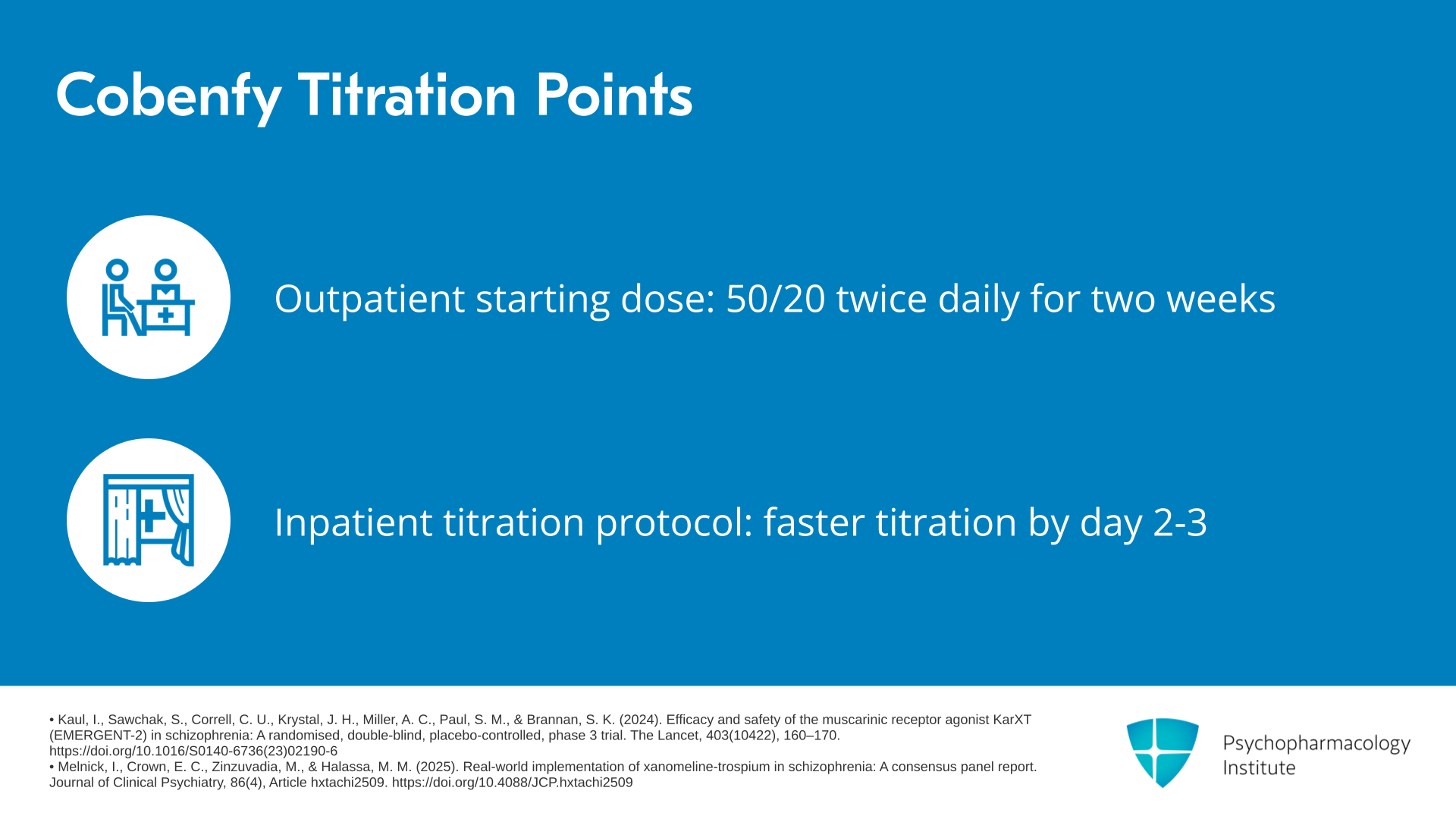
So let’s talk about Cobenfy titration and practical points. On an outpatient basis, we start 50/20 twice a day for two weeks, follow up at the end of week 2. You can then increase to 100/20 twice a day at weeks 3 to 4 if well tolerated and then up to the 125/30 twice a day maximum dose at week 4 or later if clinically indicated. While most patients stabilize on either 100/20 or 125/30, some patients do well on the starting dose. On an inpatient basis, we can escalate more quickly to either the 100/20 or 125/30 by day 2 or 3 of hospitalization similar to the EMERGENT trial protocol.
References:
- Kaul, I., Sawchak, S., Correll, C. U., Krystal, J. H., Miller, A. C., Paul, S. M., & Brannan, S. K. (2024). Efficacy and safety of the muscarinic receptor agonist KarXT (EMERGENT-2) in schizophrenia: A randomised, double-blind, placebo-controlled, phase 3 trial. The Lancet, 403(10422), 160–170. https://doi.org/10.1016/S0140-6736(23)02190-6
- Melnick, I., Crown, E. C., Zinzuvadia, M., & Halassa, M. M. (2025). Real-world implementation of xanomeline-trospium in schizophrenia: A consensus panel report. Journal of Clinical Psychiatry, 86(4), Article hxtachi2509. https://doi.org/10.4088/JCP.hxtachi2509
Slide 14 of 18
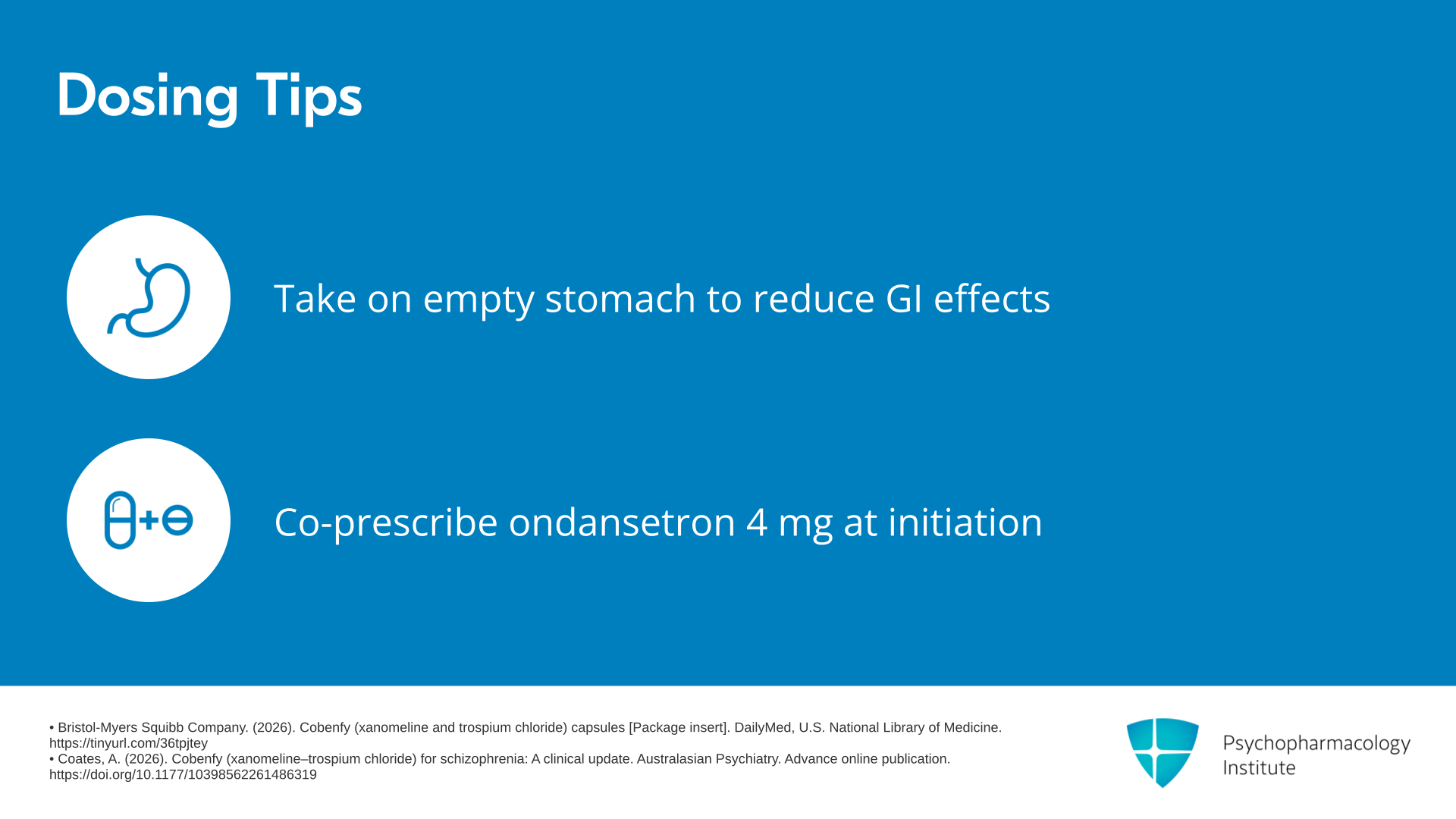
Cobenfy should be taken on an empty stomach because food interferes with trospium absorption and increases the likelihood of GI side effects. You can co-prescribe a 14-day supply of ondansetron 4 mg at initiation of Cobenfy with instructions to dose after 30 minutes if symptoms persist. And of course, we want to avoid other dopamine antagonists, antiemetics such as metoclopramide.
References:
- Bristol-Myers Squibb Company. (2026). Cobenfy (xanomeline and trospium chloride) capsules [Package insert]. DailyMed, U.S. National Library of Medicine. https://tinyurl.com/36tpjtey
- Coates, A. (2026). Cobenfy (xanomeline–trospium chloride) for schizophrenia: A clinical update. Australasian Psychiatry. Advance online publication. https://doi.org/10.1177/10398562261486319
Free Files
Download PDF and other files
Success!
Check your inbox, we sent you all the materials there.
Slide 15 of 18
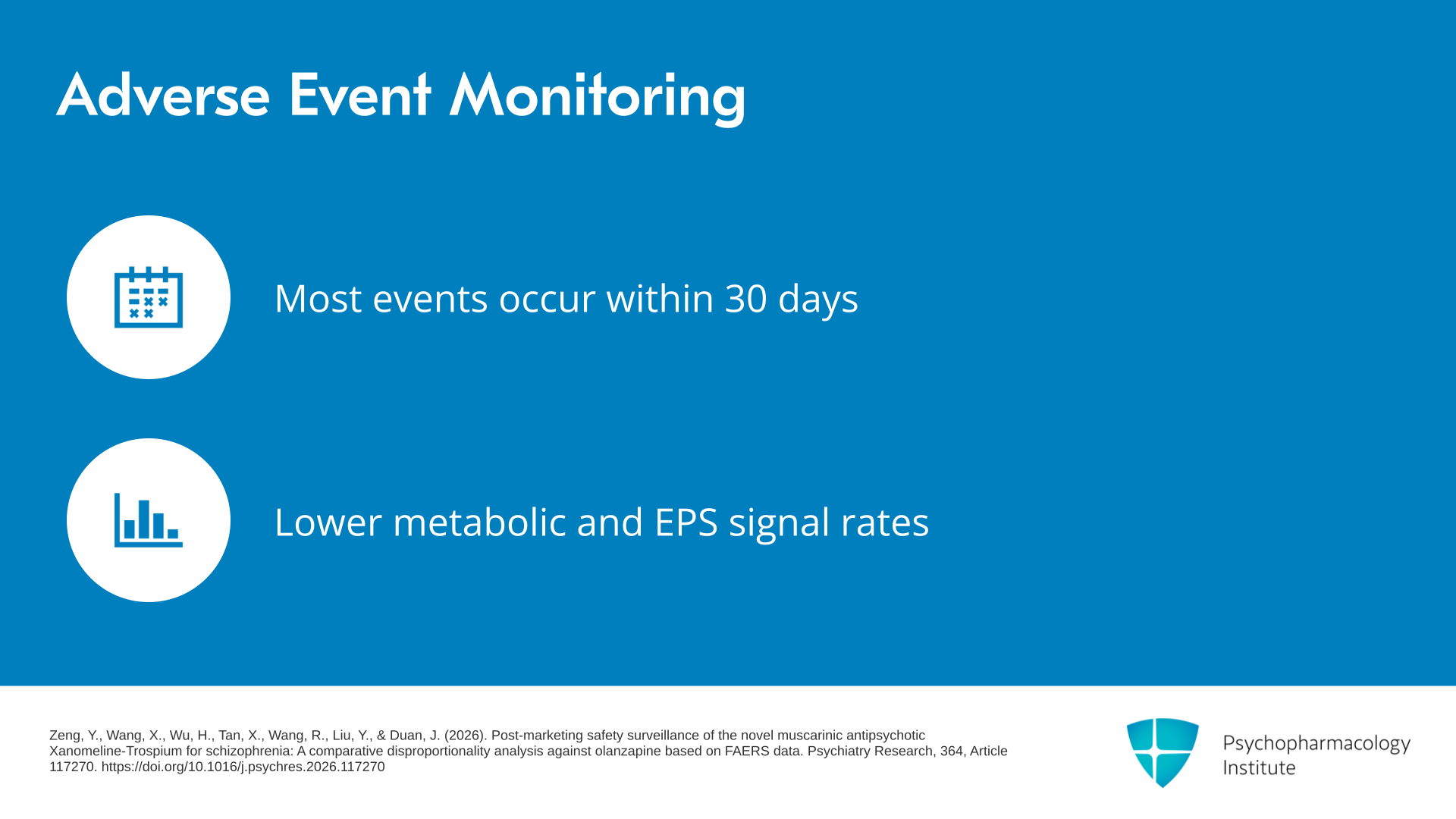
So in terms of the monitoring window, in adverse event post marketing surveillance, 87% of adverse events occurred within 30 days of initiation of Cobenfy with a median onset of just under seven days. So the cross-taper period is also the adverse event window. Compared to olanzapine, Cobenfy shows lower metabolic and EPS reporting signals but higher signals for gastrointestinal and autonomic signals. So again, important caveat here is these disproportionality analyses show reporting signals but not the incidence of these adverse effects.
References:
- Zeng, Y., Wang, X., Wu, H., Tan, X., Wang, R., Liu, Y., & Duan, J. (2026). Post-marketing safety surveillance of the novel muscarinic antipsychotic Xanomeline-Trospium for schizophrenia: A comparative disproportionality analysis against olanzapine based on FAERS data. Psychiatry Research, 364, Article 117270. https://doi.org/10.1016/j.psychres.2026.117270
Slide 16 of 18
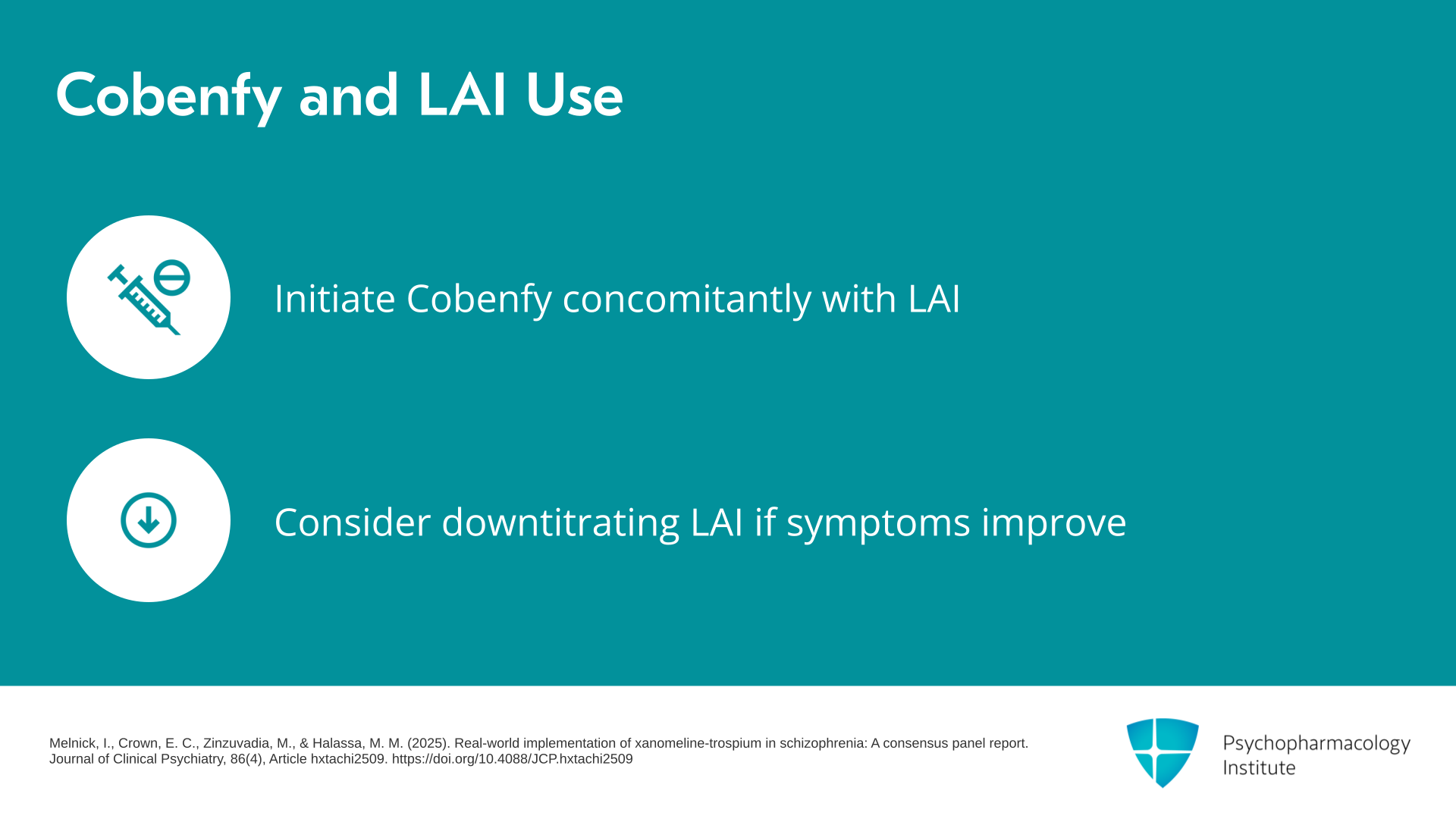
So for patients who are on maintenance LAIs, the panel recommends initiating Cobenfy concomitantly with the LAI rather than stopping the injectable. If symptoms improve once the patient reaches the maintenance dose of Cobenfy, then downtitration of the LAI can be considered through shared decision making. Panelists estimate that as much as 50% of such patients are well managed on Cobenfy 100/20 plus a low dose of an atypical antipsychotic. In other words, Cobenfy may be antipsychotic dose sparing reducing cumulative D2 blockade and this of course is relevant to metabolic burden and also EPS and tardive dyskinesia risks, but again this estimate is based on the panelists’ clinical experience, not clinical trial data.
References:
- Melnick, I., Crown, E. C., Zinzuvadia, M., & Halassa, M. M. (2025). Real-world implementation of xanomeline-trospium in schizophrenia: A consensus panel report. Journal of Clinical Psychiatry, 86(4), Article hxtachi2509. https://doi.org/10.4088/JCP.hxtachi2509
Free Files
Download PDF and other files
Success!
Check your inbox, we sent you all the materials there.
Slide 17 of 18
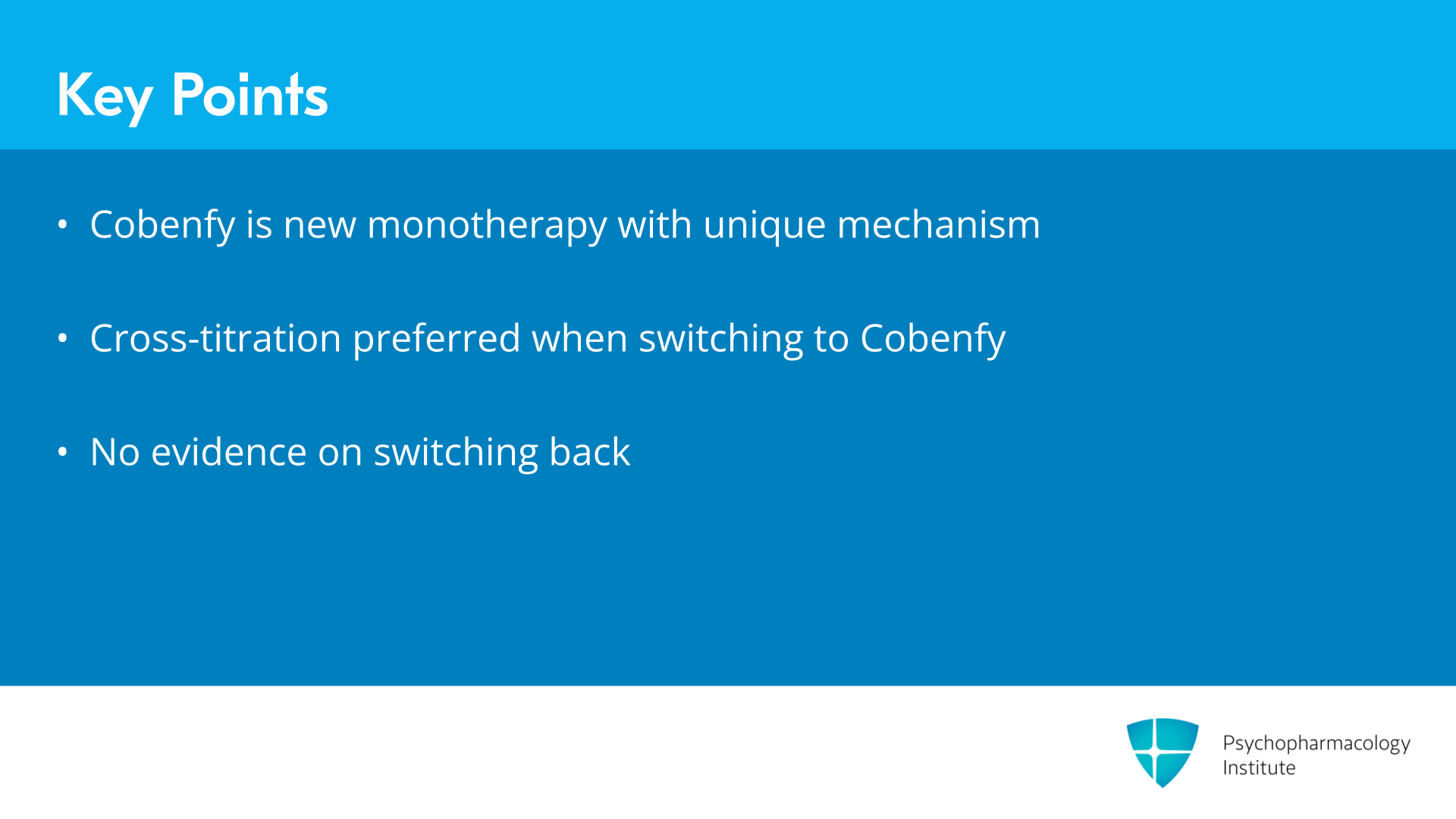
Here are the key points for this section. Cobenfy is newly approved monotherapy for schizophrenia with a unique mechanism of action. However, studies had participants washout of their prior antipsychotic first. When switching to Cobenfy, a clinician-guided cross-titration is strongly preferred over abrupt discontinuation of the prior antipsychotic. There’s no published evidence on switching from Cobenfy back to conventional D2 receptor antagonist antipsychotics.
Slide 18 of 18
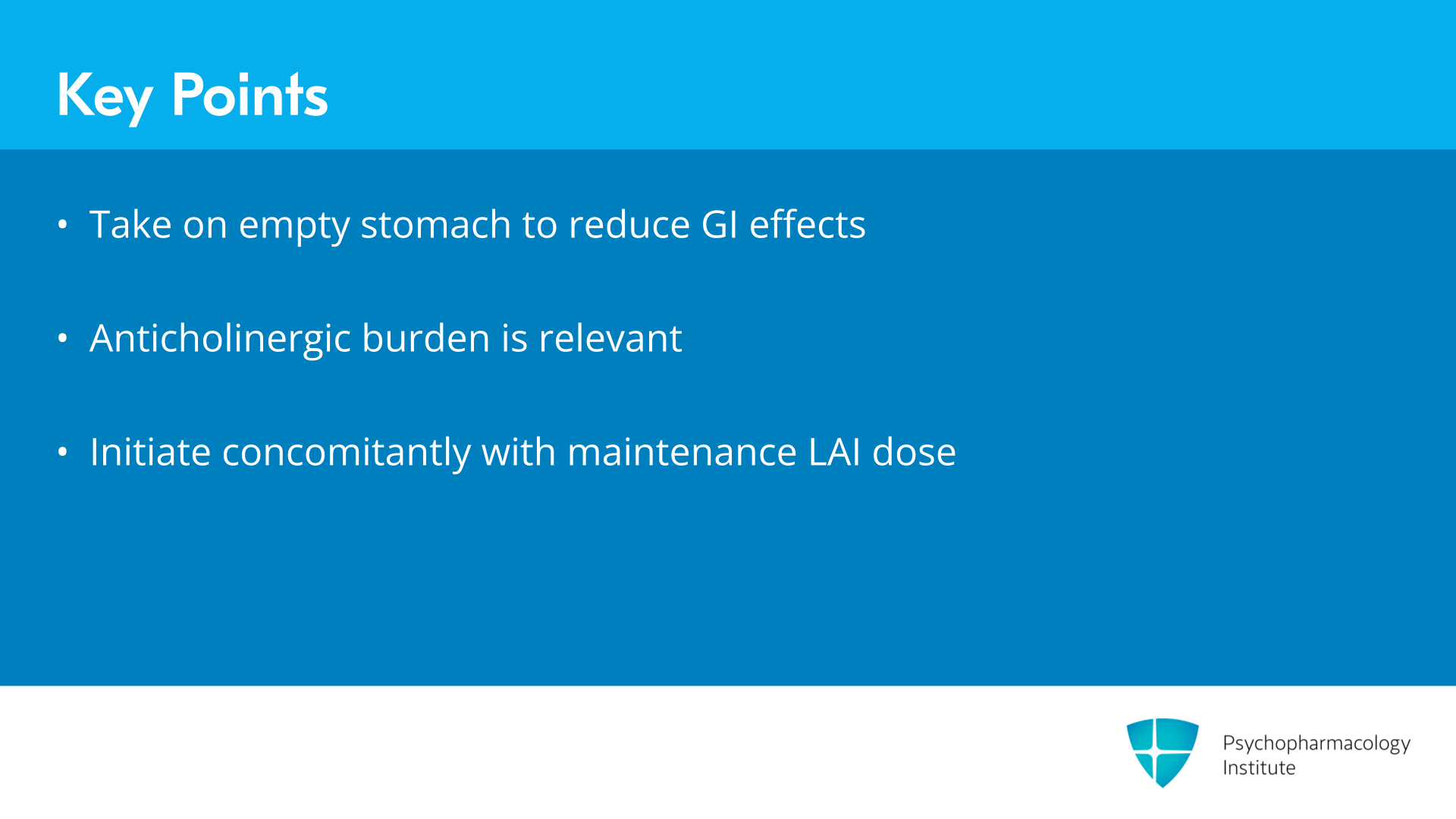
Cobenfy should be taken on an empty stomach to reduce GI side effects. And anticholinergic burden is particularly relevant to treatment with Cobenfy. For patients on a maintenance LAI dose, Cobenfy should be initiated concomitantly with the LAI rather than stopping the injectable.
Free Files
Download PDF and other files
Success!
Check your inbox, we sent you all the materials there.