
Slides and Transcript
Slide 1 of 16
In this section, we’ll talk about switching from long-acting injectable to oral antipsychotics as well as switching between two different long-acting injectable antipsychotics.
References:
- Brian Miller, M.D., Ph.D., M.P.H.
Slide 2 of 16
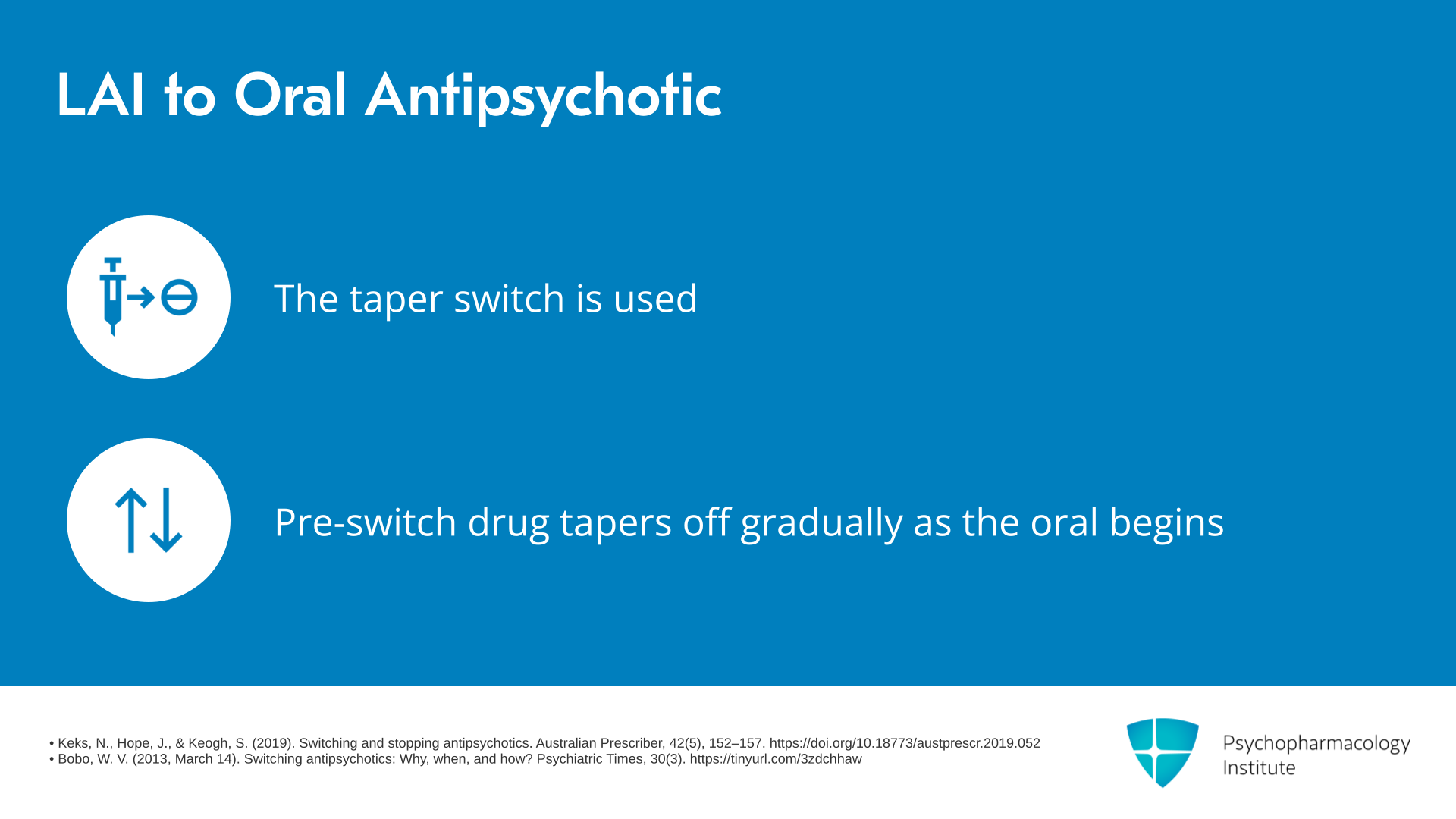
So as we begin, let’s consider first the switch from long-acting injectable to an oral antipsychotic. In a sense, this approach is encapsulated by the taper switch. So for example, if a patient is taking haloperidol decanoate 150 mg monthly and we’re switching them to 15 mg of olanzapine, in essence, this is the taper switch because after the period of the last injection of haloperidol decanoate, that pre-switch antipsychotic is going to naturally taper off gradually as the injection medication is metabolized, and the patient is then immediately started on oral olanzapine and that’s continued as the long-acting injectable antipsychotic is metabolized.
References:
- Keks, N., Hope, J., & Keogh, S. (2019). Switching and stopping antipsychotics. Australian Prescriber, 42(5), 152–157. https://doi.org/10.18773/austprescr.2019.052
- Bobo, W. V. (2013, March 14). Switching antipsychotics: Why, when, and how? Psychiatric Times, 30(3). https://tinyurl.com/3zdchhaw
Free Files
Download PDF and other files
Success!
Check your inbox, we sent you all the materials there.
Slide 3 of 16
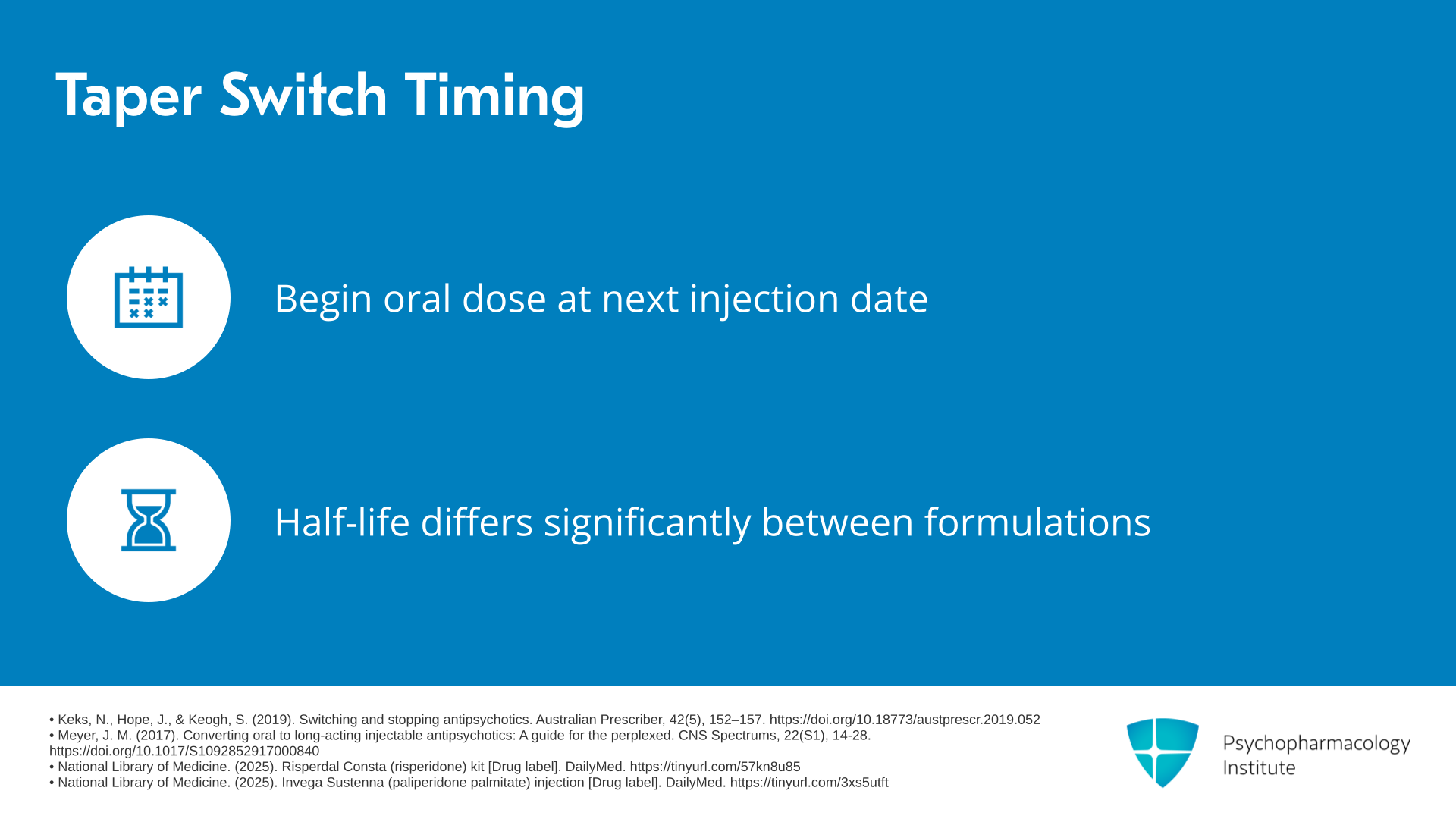
Now, an important question here, is this phenomenon of the taper switch happens by itself the whole story? And I would argue no. So what’s new is the precision about the timing. So clinicians should start the oral antipsychotic on the date that the next injection would’ve been due, and then calibrate expectations to the pre-switch antipsychotic’s pharmacokinetics which importantly can vary widely. So for example, Risperdal Consta has a half-life of just three to six days once release ends. Whereas, monthly and six-month formulations of paliperidone palmitate have a much longer half-life, maybe even over a month for the one-month form and approximately five months for the six-month form.
References:
- Keks, N., Hope, J., & Keogh, S. (2019). Switching and stopping antipsychotics. Australian Prescriber, 42(5), 152–157. https://doi.org/10.18773/austprescr.2019.052
- Meyer, J. M. (2017). Converting oral to long-acting injectable antipsychotics: A guide for the perplexed. CNS Spectrums, 22(S1), 14-28. https://doi.org/10.1017/S1092852917000840
- National Library of Medicine. (2025). Risperdal Consta (risperidone) kit [Drug label]. DailyMed. https://tinyurl.com/57kn8u85
- National Library of Medicine. (2025). Invega Sustenna (paliperidone palmitate) injection [Drug label]. DailyMed. https://tinyurl.com/3xs5utft
Slide 4 of 16
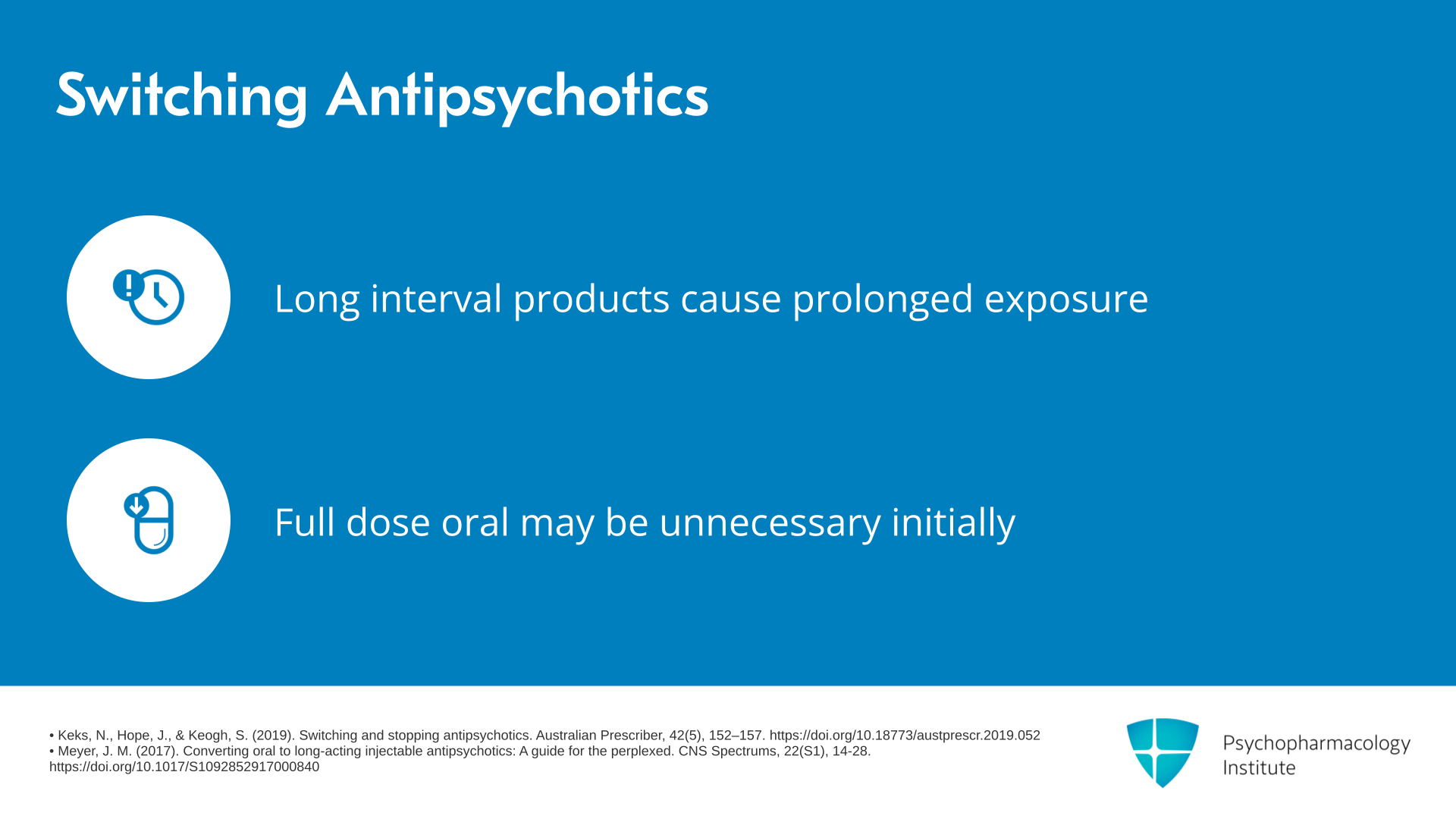
So the practical implication here is, when administering long interval products, greater than a month, meaningful drug exposure can persist for months. So sometimes, early post switch adverse effects may be related to the pre-switch antipsychotic. And so in some cases for some patients, full dose oral antipsychotic may be unnecessary in the initial phase of the switch.
References:
- Keks, N., Hope, J., & Keogh, S. (2019). Switching and stopping antipsychotics. Australian Prescriber, 42(5), 152–157. https://doi.org/10.18773/austprescr.2019.052
- Meyer, J. M. (2017). Converting oral to long-acting injectable antipsychotics: A guide for the perplexed. CNS Spectrums, 22(S1), 14-28. https://doi.org/10.1017/S1092852917000840
Free Files
Download PDF and other files
Success!
Check your inbox, we sent you all the materials there.
Slide 5 of 16
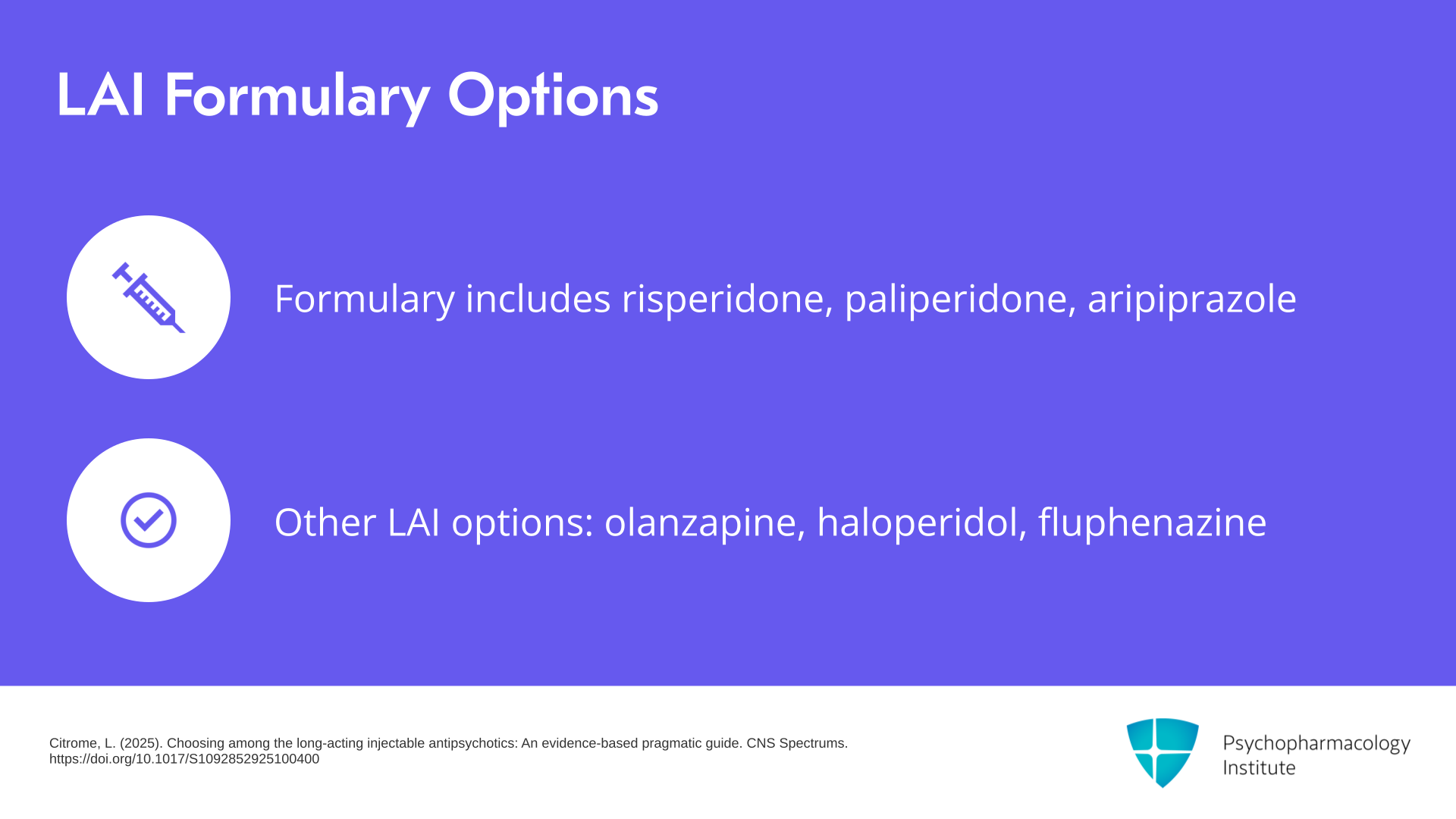
Let’s talk now about switching between two different LAIs. So as the number of options increases, there is certainly a need to have data on safety and outcomes switching between these different long-acting formulations. So in the United States, our current LAI formulary includes multiple formulations of risperidone and its generics, Invega and multiple formulations of paliperidone, multiple formulations of aripiprazole. We have olanzapine long acting and haloperidol and fluphenazine decanoate.
References:
- Citrome, L. (2025). Choosing among the long-acting injectable antipsychotics: An evidence-based pragmatic guide. CNS Spectrums. https://doi.org/10.1017/S1092852925100400
Slide 6 of 16
An important point to mention here is Perseris, a formulation of risperidone, the marketing for Perseris ceased in July of 2024. That was a business decision. And the availability of Perseris effectively ended in May, with the last lots expiring around October 2026. So patients still on Perseris will need a transition plan.
References:
- National Library of Medicine. (2025). Perseris (risperidone) kit [Drug label]. DailyMed. https://tinyurl.com/mv4r74mt
Free Files
Download PDF and other files
Success!
Check your inbox, we sent you all the materials there.
Slide 7 of 16
So, since 2023, there is an operational reference that covers LAI to LAI switches drug by drug, including some scenarios that aren’t addressed by prescribing information. More recently, a 2025 expert consensus adds some concrete transition recommendations and oral overlap durations for major products. So while this literature is young, it’s usable and some product labels now encode several transitions directly.
References:
- Højlund, M., & Correll, C. U. (2023). Switching to long-acting injectable antipsychotics: Pharmacological considerations and practical approaches. Expert Opinion on Pharmacotherapy, 24(13), 1463–1489. https://doi.org/10.1080/14656566.2023.2228686
- Kane, J. M., Agid, O., Castle, D. J., Citrome, L., Fagiolini, A., Kishimoto, T., Larrauri, C. A., Leucht, S., Rubio, J. M., Sajatovic, M., Schooler, N., & Correll, C. U. (2025). The use of long-acting injectables for people with schizophrenia: Consensus panel recommendations for overcoming barriers and implementing treatment. Neurology and Therapy, 14(6), 2551–2581. https://doi.org/10.1007/s40120-025-00838-3
Slide 8 of 16
As a general rule, this type of switching from one LAI to another mimics the abrupt switch, that would be to stop the pre-switch long-acting injectable and replace that with the first dose of the new LAI when the patient would be due for their next injection, keeping in mind of course the need that we’ve again established tolerability with the oral form of the new antipsychotic.
References:
- Miller, B. J., Claxton, A., Du, Y., Weiden, P. J., & Potkin, S. G. (2019). Switching patients with schizophrenia from paliperidone palmitate to aripiprazole lauroxil: A 6-month, prospective, open-label study. Schizophrenia Research, 208, 44–48. https://doi.org/10.1016/j.schres.2019.01.038
Free Files
Download PDF and other files
Success!
Check your inbox, we sent you all the materials there.
Slide 9 of 16
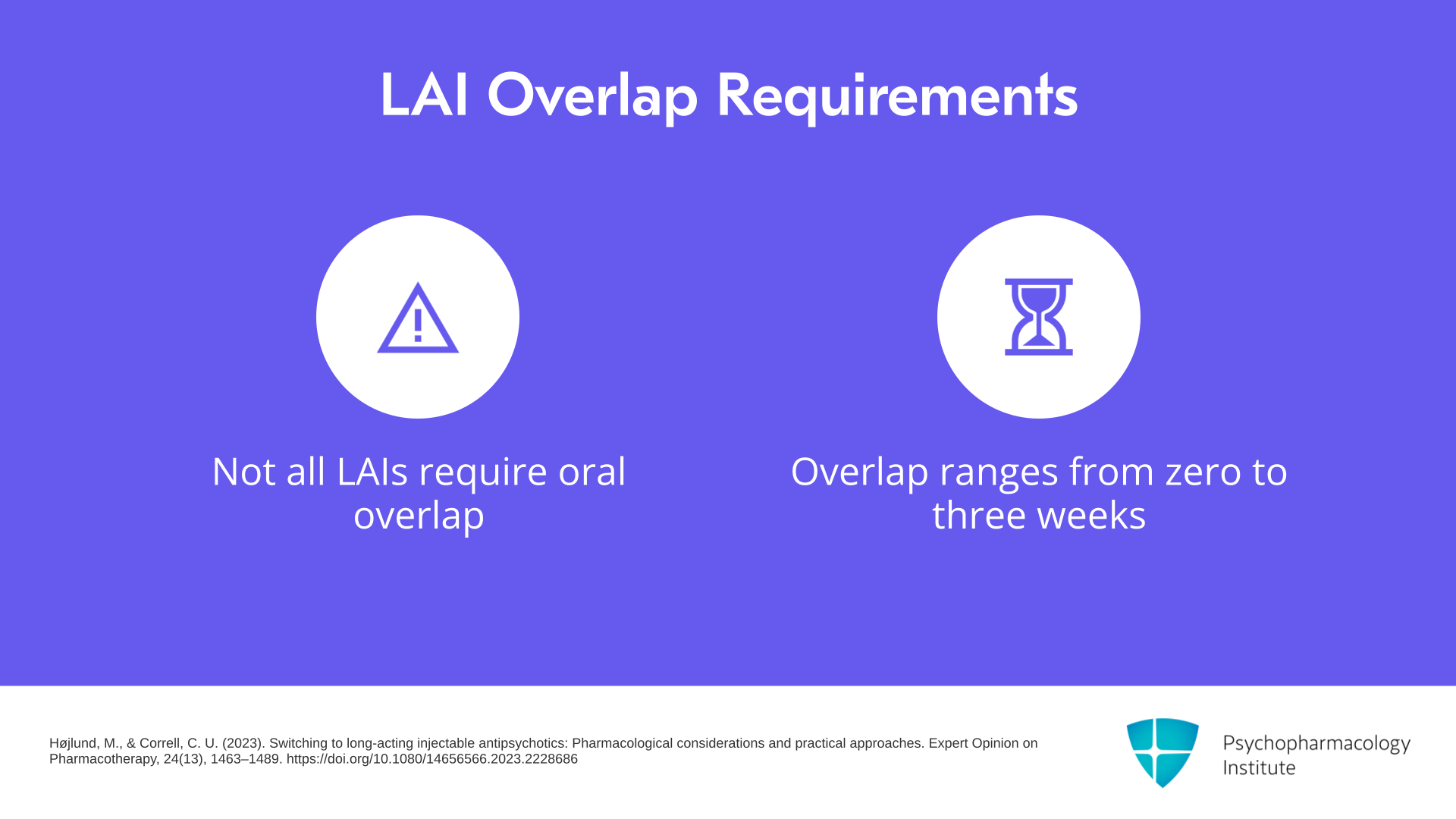
Let’s revisit this issue of, do all long-acting injectable starts and transitions still require a period of oral antipsychotic lead-in or overlap? The answer here is no. The oral overlap requirement is now very product-specific and can range from zero to up to three weeks. Again, though, establishing tolerability with the oral antipsychotic at least briefly, especially if the patient is naïve to it, is the universal precaution.
References:
- Højlund, M., & Correll, C. U. (2023). Switching to long-acting injectable antipsychotics: Pharmacological considerations and practical approaches. Expert Opinion on Pharmacotherapy, 24(13), 1463–1489. https://doi.org/10.1080/14656566.2023.2228686
Slide 10 of 16
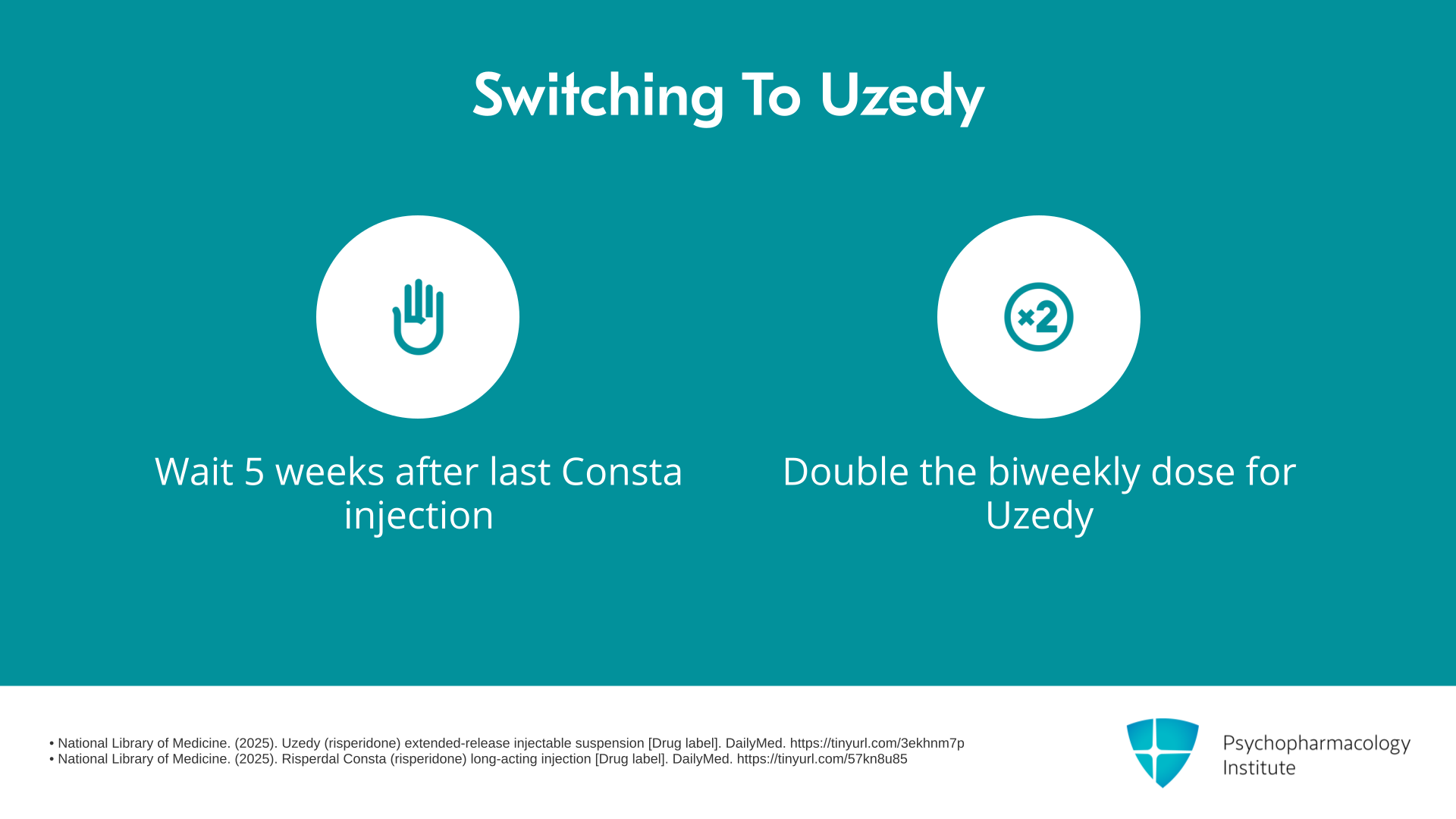
So let’s talk about some specific scenarios. How do I move a patient between the different risperidone LAIs? So when moving from biweekly Risperdal Consta type to a subcutaneous Uzedy, we want to give the first Uzedy dose no sooner than five weeks after the last biweekly injection. That’s a label requirement. And we double the dose. So if we’re giving 25 mg every two weeks of risperidone Consta, we would double that to 50 mg monthly. Similarly, 37.5 doubles to 75 mg and 50 to 100 mg monthly. Importantly, there’s no oral bridge that’s needed.
References:
- National Library of Medicine. (2025). Uzedy (risperidone) extended-release injectable suspension [Drug label]. DailyMed. https://tinyurl.com/3ekhnm7p
- National Library of Medicine. (2025). Risperdal Consta (risperidone) long-acting injection [Drug label]. DailyMed. https://tinyurl.com/57kn8u85
Free Files
Download PDF and other files
Success!
Check your inbox, we sent you all the materials there.
Slide 11 of 16
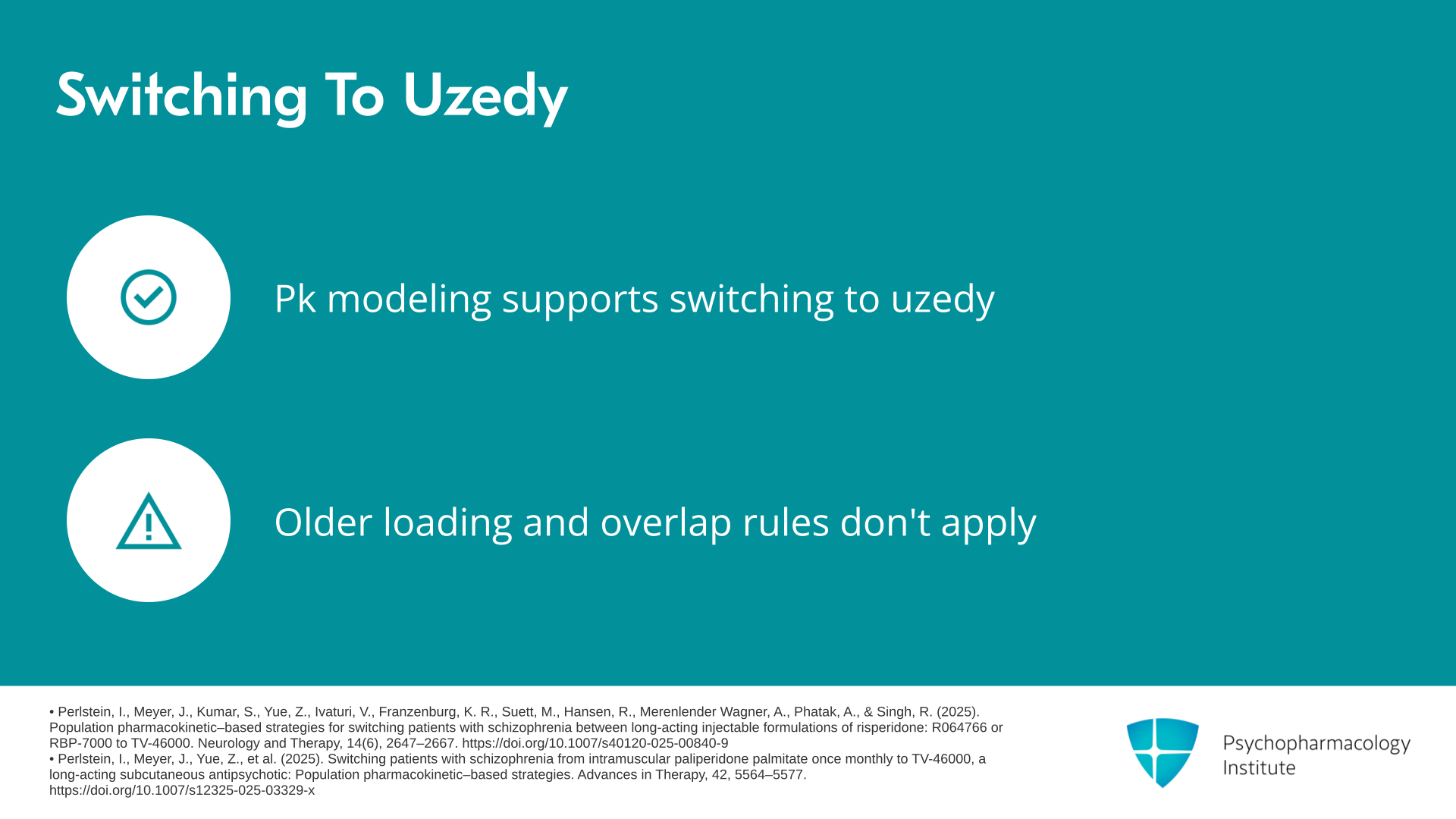
So interestingly, population pharmacokinetic modeling supports these transitions explicitly including switching from Perseris, which we mentioned now is discontinued, to Uzedy but also from paliperidone palmitate one-month formulation to Uzedy. So this Risperdal Consta-era logic that we have a three-week release lag and need a three-week period of oral overlap does not transfer to newer formulations. So Uzedy needs no loading dose and no oral supplementation.
References:
- Perlstein, I., Meyer, J., Kumar, S., Yue, Z., Ivaturi, V., Franzenburg, K. R., Suett, M., Hansen, R., Merenlender Wagner, A., Phatak, A., & Singh, R. (2025). Population pharmacokinetic–based strategies for switching patients with schizophrenia between long-acting injectable formulations of risperidone: R064766 or RBP-7000 to TV-46000. Neurology and Therapy, 14(6), 2647–2667. https://doi.org/10.1007/s40120-025-00840-9
- Perlstein, I., Meyer, J., Yue, Z., et al. (2025). Switching patients with schizophrenia from intramuscular paliperidone palmitate once monthly to TV-46000, a long-acting subcutaneous antipsychotic: Population pharmacokinetic–based strategies. Advances in Therapy, 42, 5564–5577. https://doi.org/10.1007/s12325-025-03329-x
Slide 12 of 16
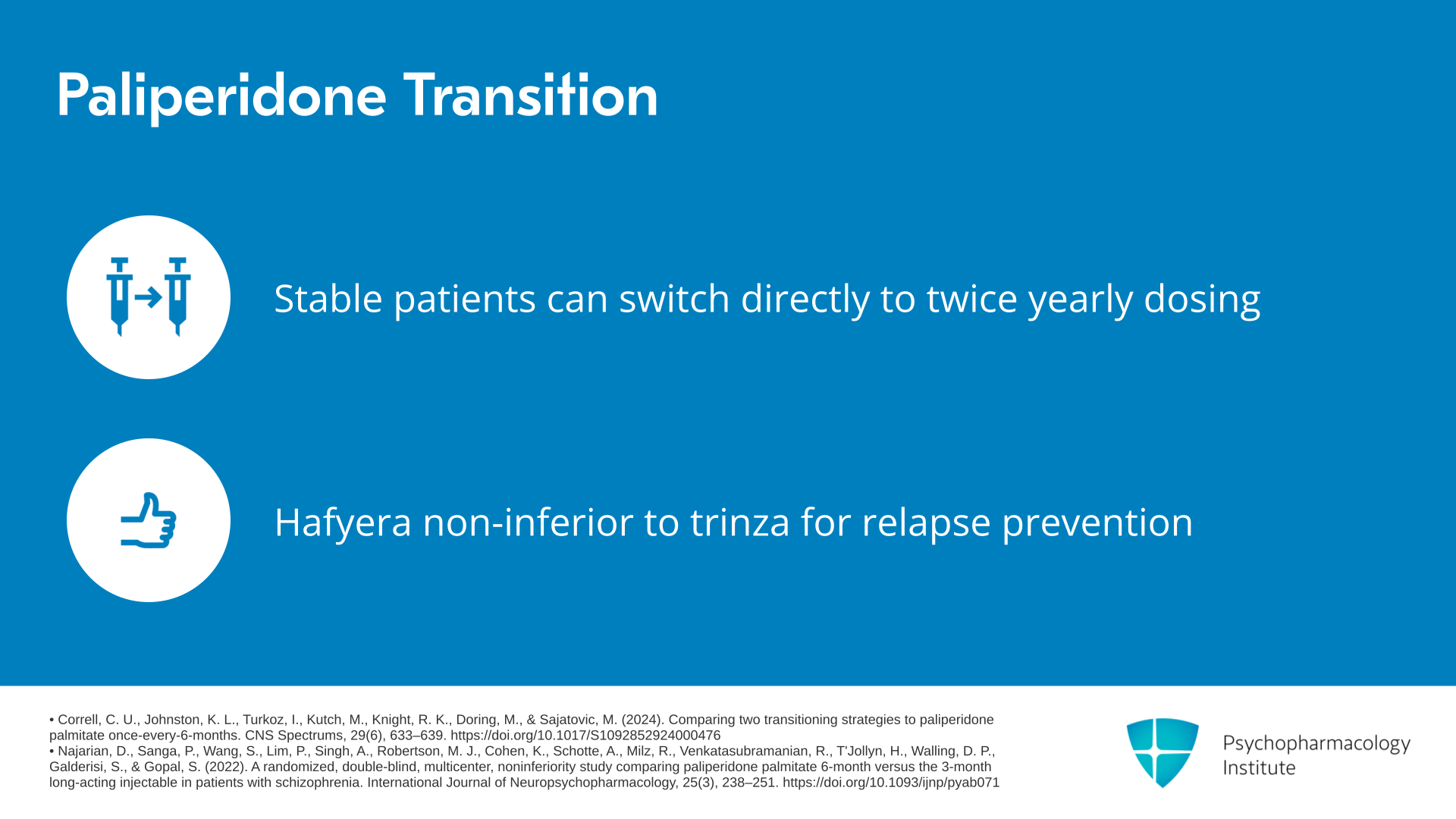
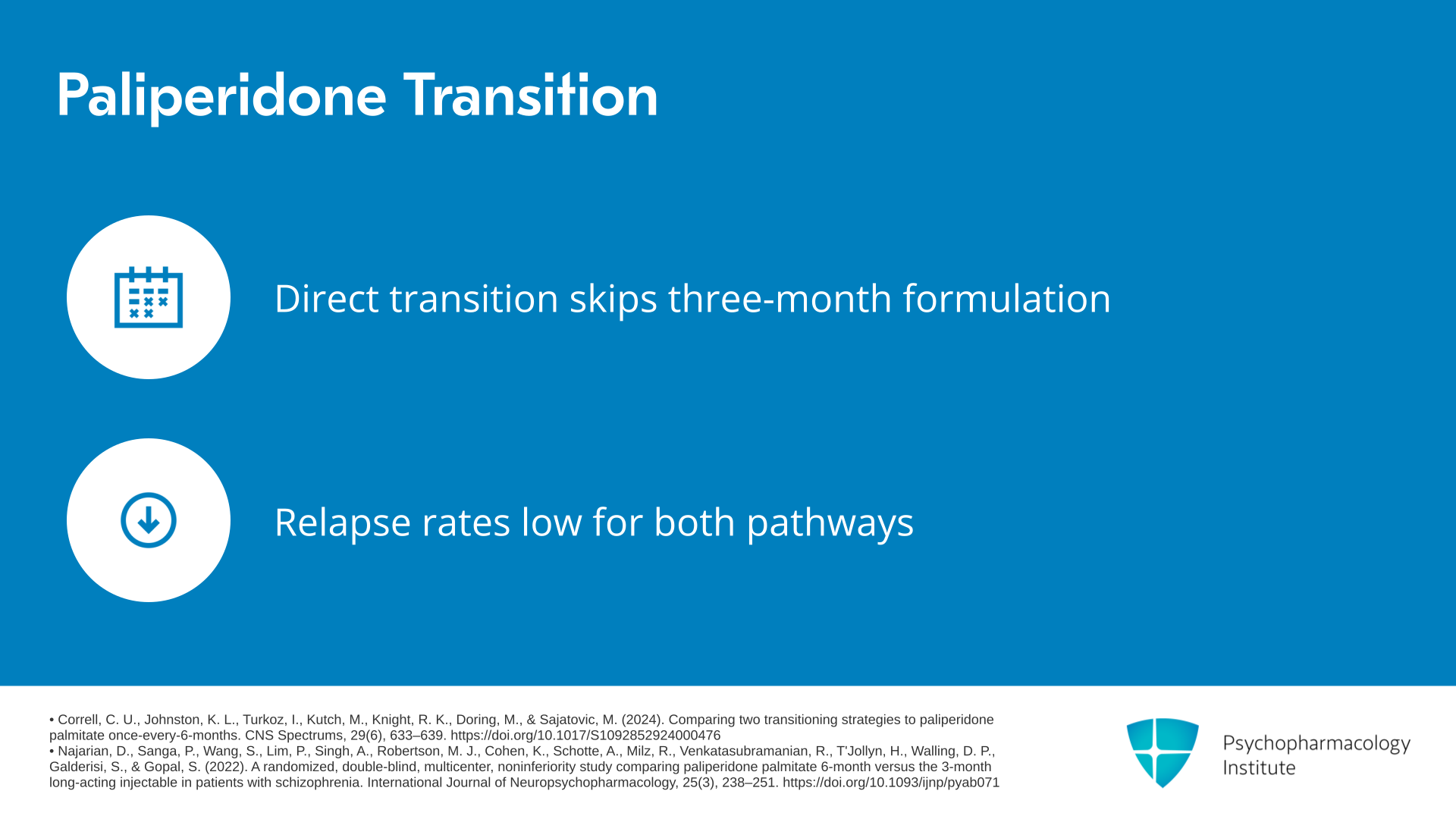
So another important clinical scenario would be, can a stable patient go directly from monthly to twice yearly paliperidone? And the short answer here is yes. So the six-month formulation of paliperidone palmitate, Hafyera was not inferior to paliperidone palmitate three months, Trinza for relapse prevention over a 12-month period.
References:
- Correll, C. U., Johnston, K. L., Turkoz, I., Kutch, M., Knight, R. K., Doring, M., & Sajatovic, M. (2024). Comparing two transitioning strategies to paliperidone palmitate once-every-6-months. CNS Spectrums, 29(6), 633–639. https://doi.org/10.1017/S1092852924000476
- Najarian, D., Sanga, P., Wang, S., Lim, P., Singh, A., Robertson, M. J., Cohen, K., Schotte, A., Milz, R., Venkatasubramanian, R., T'Jollyn, H., Walling, D. P., Galderisi, S., & Gopal, S. (2022). A randomized, double-blind, multicenter, noninferiority study comparing paliperidone palmitate 6-month versus the 3-month long-acting injectable in patients with schizophrenia. International Journal of Neuropsychopharmacology, 25(3), 238–251. https://doi.org/10.1093/ijnp/pyab071
Free Files
Download PDF and other files
Success!
Check your inbox, we sent you all the materials there.
Slide 13 of 16
So patients can transition to six months directly from the one-month formulation without first routing through the three-month formulation. Importantly, relapse rates were equally low for either pathway between 7% and 8% and both groups had been stabilized on the prior formulation for at least four months.
References:
- Correll, C. U., Johnston, K. L., Turkoz, I., Kutch, M., Knight, R. K., Doring, M., & Sajatovic, M. (2024). Comparing two transitioning strategies to paliperidone palmitate once-every-6-months. CNS Spectrums, 29(6), 633–639. https://doi.org/10.1017/S1092852924000476
- Najarian, D., Sanga, P., Wang, S., Lim, P., Singh, A., Robertson, M. J., Cohen, K., Schotte, A., Milz, R., Venkatasubramanian, R., T'Jollyn, H., Walling, D. P., Galderisi, S., & Gopal, S. (2022). A randomized, double-blind, multicenter, noninferiority study comparing paliperidone palmitate 6-month versus the 3-month long-acting injectable in patients with schizophrenia. International Journal of Neuropsychopharmacology, 25(3), 238–251. https://doi.org/10.1093/ijnp/pyab071
Slide 14 of 16
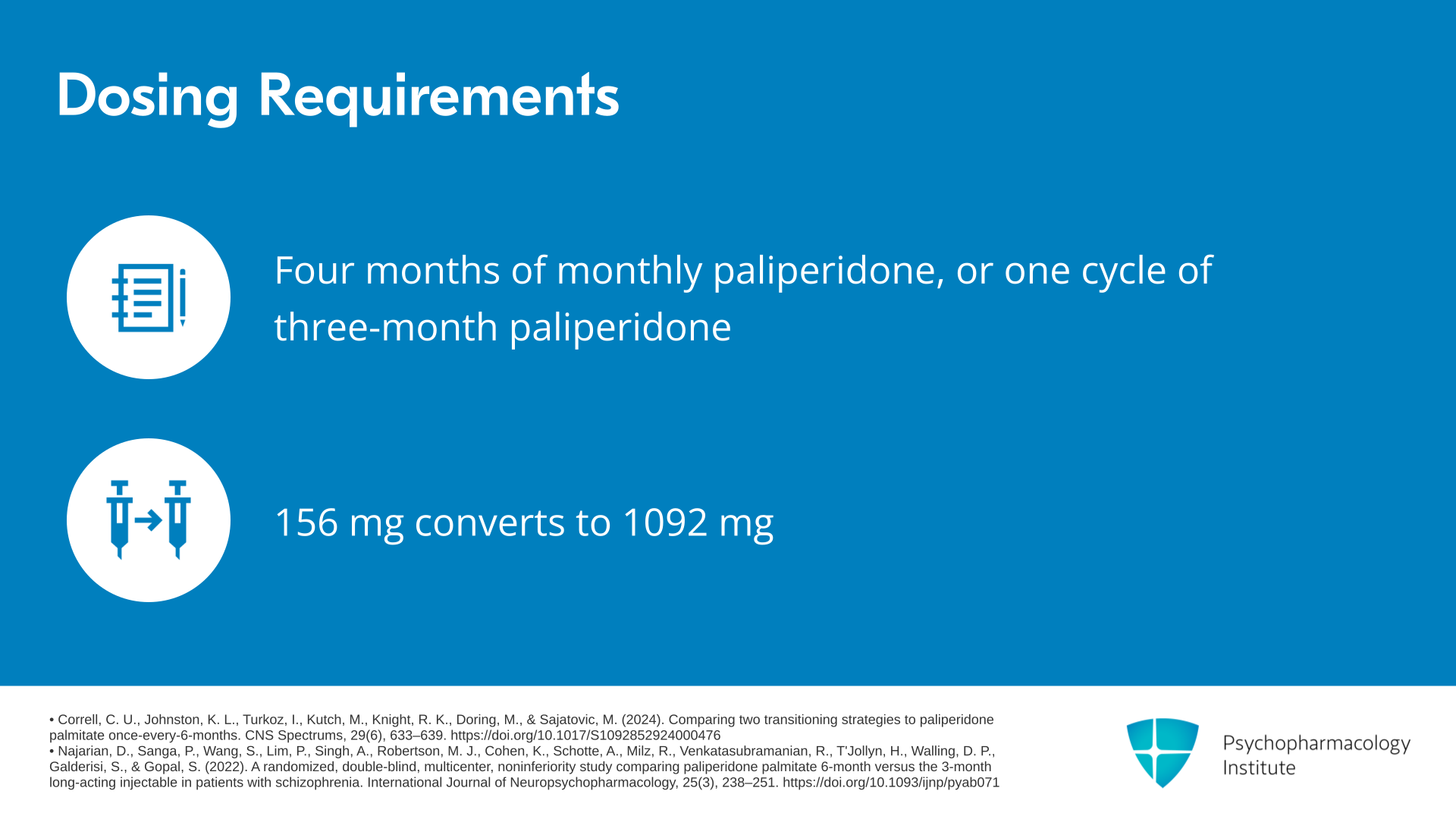
So what are the label requirements there? At least four months of adequate one-month paliperidone palmitate with the last two doses at the same strength or one cycle of three-month paliperidone palmitate. So the conversion here is one-month paliperidone palmitate 156 would convert to 1092 of the six-month formulation, 234 mg of the one-month converts to 1560 mg of the six-month, both by gluteal injection only.
References:
- Correll, C. U., Johnston, K. L., Turkoz, I., Kutch, M., Knight, R. K., Doring, M., & Sajatovic, M. (2024). Comparing two transitioning strategies to paliperidone palmitate once-every-6-months. CNS Spectrums, 29(6), 633–639. https://doi.org/10.1017/S1092852924000476
- Najarian, D., Sanga, P., Wang, S., Lim, P., Singh, A., Robertson, M. J., Cohen, K., Schotte, A., Milz, R., Venkatasubramanian, R., T'Jollyn, H., Walling, D. P., Galderisi, S., & Gopal, S. (2022). A randomized, double-blind, multicenter, noninferiority study comparing paliperidone palmitate 6-month versus the 3-month long-acting injectable in patients with schizophrenia. International Journal of Neuropsychopharmacology, 25(3), 238–251. https://doi.org/10.1093/ijnp/pyab071
Free Files
Download PDF and other files
Success!
Check your inbox, we sent you all the materials there.
Slide 15 of 16
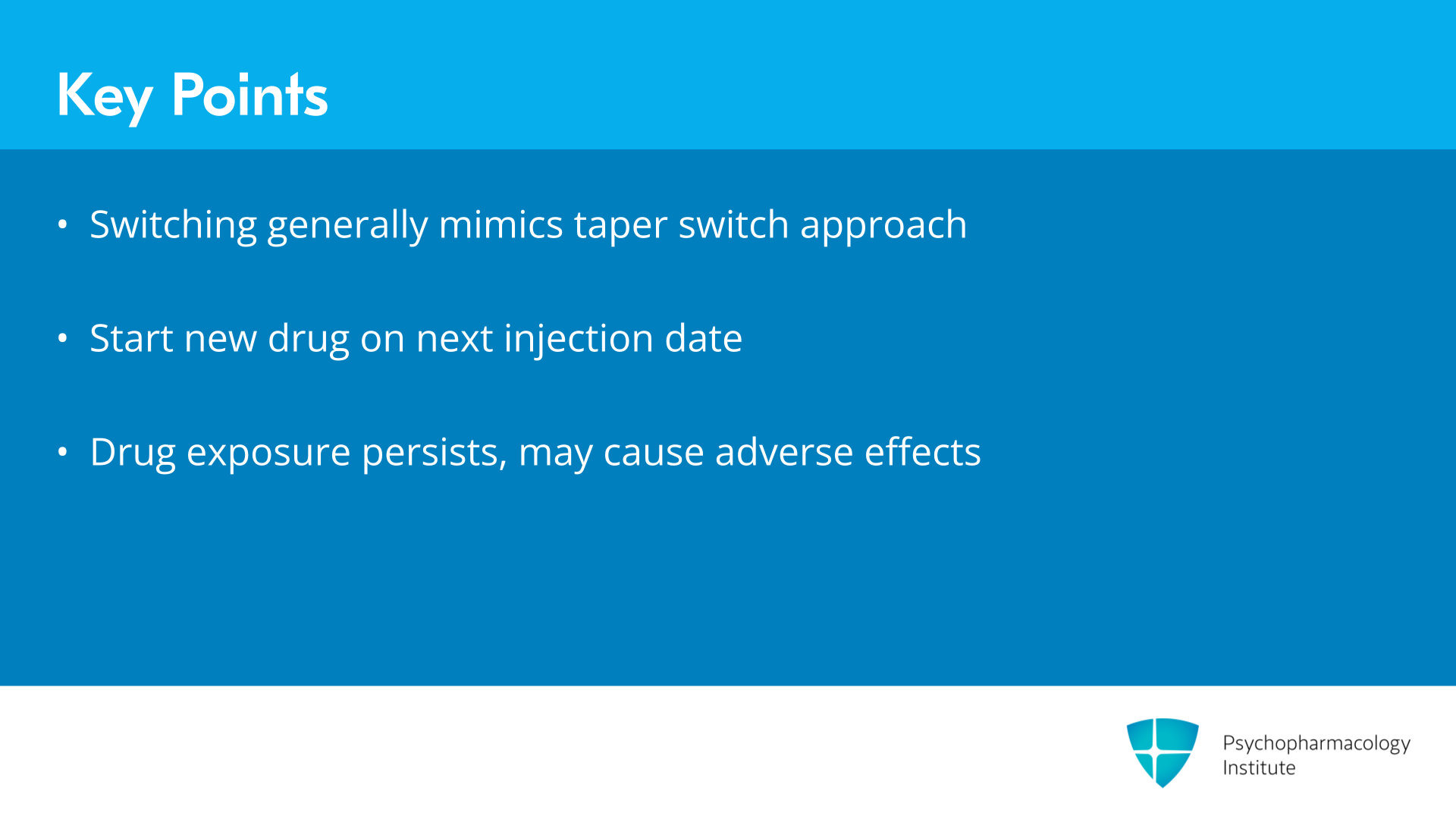
Here are the key points for this section. Switching from a long-acting injectable antipsychotic to something else generally mimics the taper switch. Start the new antipsychotic on the date that the next injection would’ve been due. Importantly, after long interval products, meaningful drug exposure can persist for months which may contribute to early post switch adverse effects and full dose oral antipsychotics may initially be unnecessary.
Slide 16 of 16
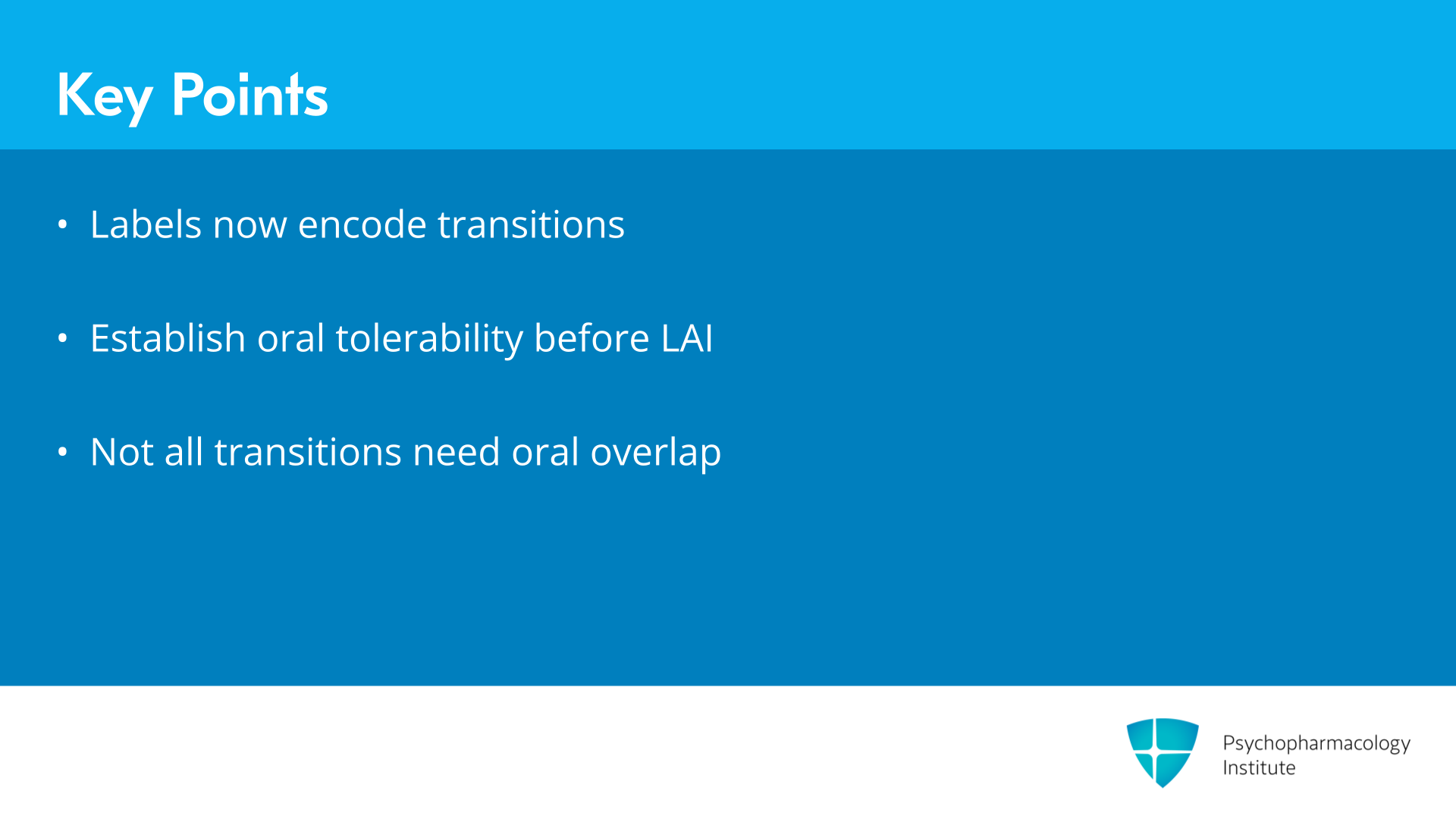
Although the literature is new, some product labels now encode several transitions directly. Again, always establish tolerability with the oral form of the new agent first before starting its LAI counterpart. And not all LAI starts and transitions require lead-in or oral overlap.
Free Files
Download PDF and other files
Success!
Check your inbox, we sent you all the materials there.