
Slides and Transcript
Slide 1 of 22
How do we actually find these patients? Let me give you a two-step screening approach.
References:
- João P. De Aquino, M.D.
Slide 2 of 22
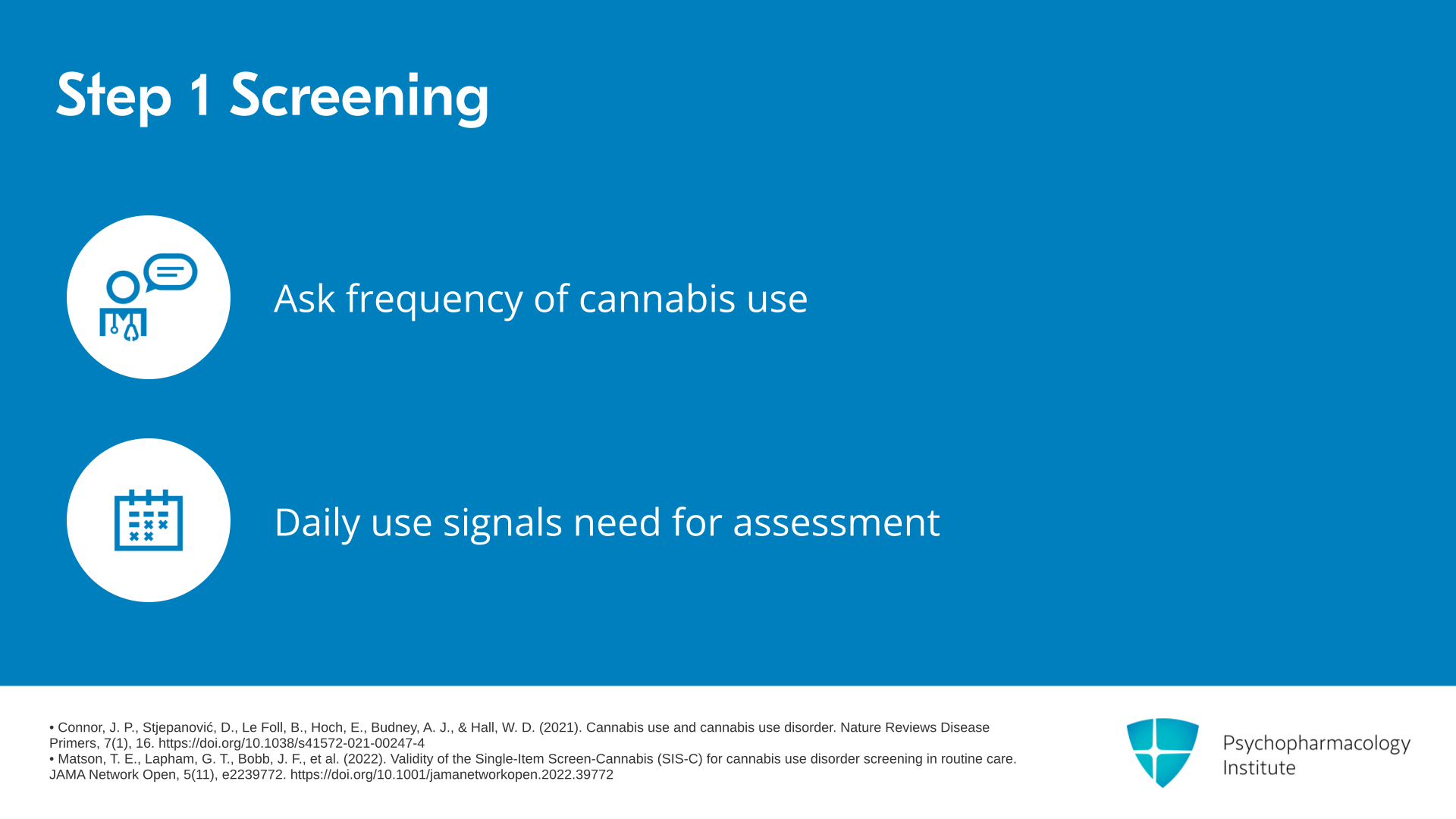
Step 1 is a single question. In the past year, how many days per week did you use cannabis? That’s it. One question. It’s low burden. It’s non-judgmental. And frequency is one of the strongest proxies we have for CUD risk. Daily use, every day or near daily is a meaningful threshold. A patient who uses daily should trigger a more complete assessment. Now, frequency alone is not a diagnosis. Someone can use daily without meeting criteria for CUD but it tells you who needs a closer look.
References:
- Connor, J. P., Stjepanović, D., Le Foll, B., Hoch, E., Budney, A. J., & Hall, W. D. (2021). Cannabis use and cannabis use disorder. Nature Reviews Disease Primers, 7(1), 16. https://doi.org/10.1038/s41572-021-00247-4
- Matson, T. E., Lapham, G. T., Bobb, J. F., et al. (2022). Validity of the Single-Item Screen-Cannabis (SIS-C) for cannabis use disorder screening in routine care. JAMA Network Open, 5(11), e2239772. https://doi.org/10.1001/jamanetworkopen.2022.39772
Free Files
Download PDF and other files
Success!
Check your inbox, we sent you all the materials there.
Slide 3 of 22
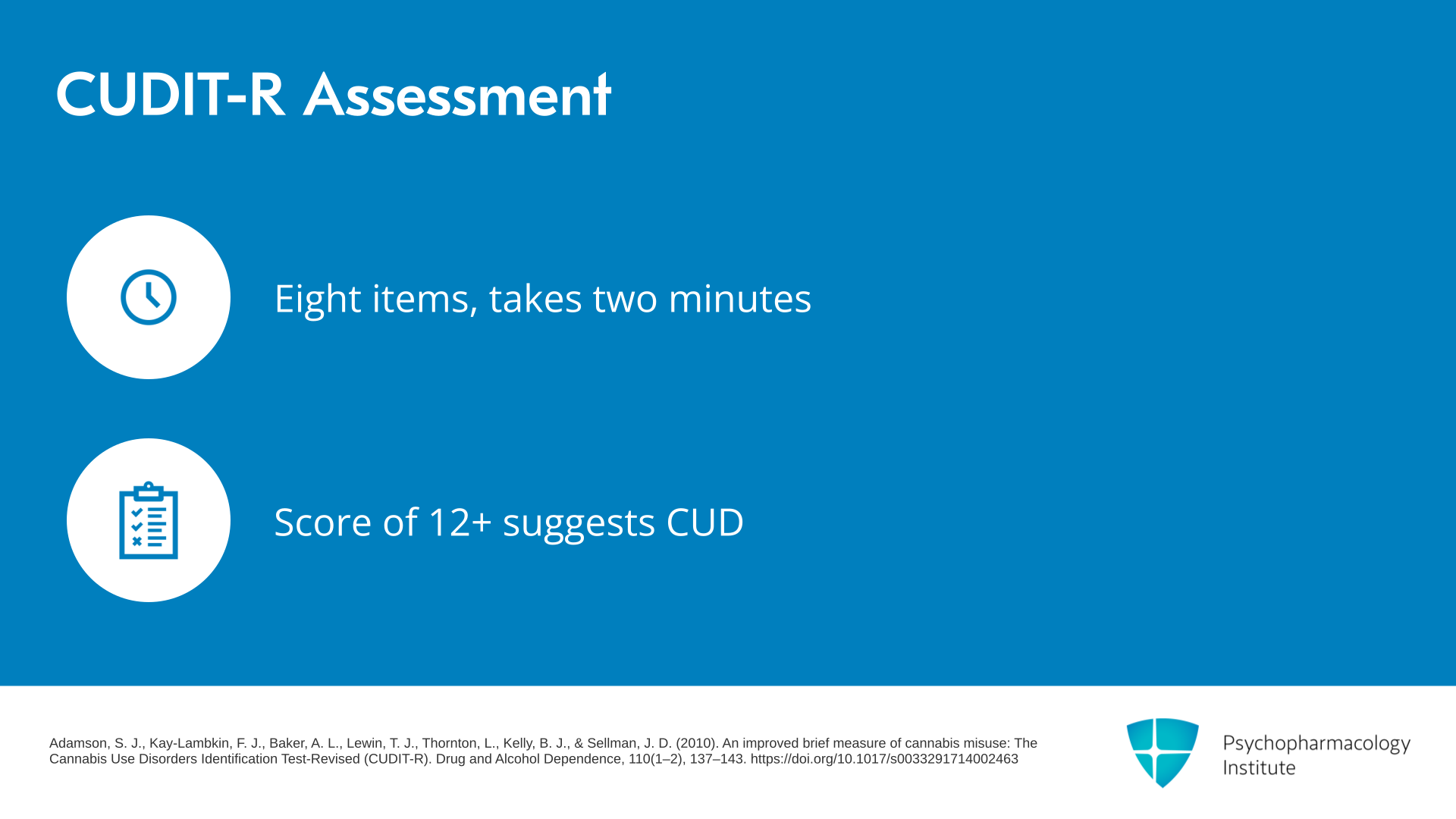
Step 2, for patients who screen positive on frequency or in any setting where you have more time, it’s the CUDIT-R, that’s the Cannabis Use Disorder Identification Test – Revised. It’s eight items. It takes about two minutes and it has good sensitivity and specificity. A score of 12 or above is associated with likely cannabis use disorder. Adamson and colleagues validated this instrument in 2010 and it has since been used extensively in research and clinical settings. I encourage you to add it to your intake forms or at a minimum have it available for followup when patients screen positive on the frequency question.
References:
- Adamson, S. J., Kay-Lambkin, F. J., Baker, A. L., Lewin, T. J., Thornton, L., Kelly, B. J., & Sellman, J. D. (2010). An improved brief measure of cannabis misuse: The Cannabis Use Disorders Identification Test-Revised (CUDIT-R). Drug and Alcohol Dependence, 110(1–2), 137–143. https://doi.org/10.1017/s0033291714002463
Slide 4 of 22
One more thought on screening context. Don’t limit this to addiction clinics, psychiatric outpatient clinics, primary care clinics, emergency departments, pain management clinics. Patients with CUD present everywhere. The question has to be asked broadly.
References:
- Connor, J. P., Stjepanović, D., Le Foll, B., Hoch, E., Budney, A. J., & Hall, W. D. (2021). Cannabis use and cannabis use disorder. Nature Reviews Disease Primers, 7(1), 16. https://doi.org/10.1038/s41572-021-00247-4
- Matson, T. E., Lapham, G. T., Bobb, J. F., et al. (2022). Validity of the Single-Item Screen-Cannabis (SIS-C) for cannabis use disorder screening in routine care. JAMA Network Open, 5(11), e2239772. https://doi.org/10.1001/jamanetworkopen.2022.39772
Free Files
Download PDF and other files
Success!
Check your inbox, we sent you all the materials there.
Slide 5 of 22
Once a patient screens positive, here’s what I want you to know about them. I think of this as a structural assessment template, not an interrogation, but a purposeful conversation. First, route and product. Smoked flower, vaporized flower, vaporized concentrates, edibles, dabbing – these are very different pharmacological exposures. Concentrates can contain 70% to 90% THC. An edible has delayed, prolonged absorption that patients routinely underestimate. I cannot assess severity of use without knowing what the patient is actually using.
References:
- Connor, J. P., Stjepanović, D., Le Foll, B., Hoch, E., Budney, A. J., & Hall, W. D. (2021). Cannabis use and cannabis use disorder. Nature Reviews Disease Primers, 7(1), 16. https://doi.org/10.1038/s41572-021-00247-4
- Bidwell, L. C., Ellingson, J. M., Karoly, H. C., YorkWilliams, S. L., Hitchcock, L. N., Tracy, B. L., Klawitter, J., Sempio, C., Bryan, A. D., & Hutchison, K. E. (2020). Association of naturalistic administration of cannabis flower and concentrates with intoxication and impairment. JAMA Psychiatry, 77(8), 787-796. https://doi.org/10.1001/jamapsychiatry.2020.0927
Slide 6 of 22
Second, potency awareness. Many patients genuinely don’t know the THC percentage of what they’re using. Some do particularly those who shop at dispensaries. If someone is regularly using concentrates, I treat that as a high exposure scenario even if their frequency sounds modest.
References:
- Radparvar, S. (2024). Clinical evaluation of the cannabis-using patient: A moving target. The Permanente Journal, 28(4), 77–86. https://doi.org/10.7812/tpp/24.088
- Bidwell, L. C., Ellingson, J. M., Karoly, H. C., YorkWilliams, S. L., Hitchcock, L. N., Tracy, B. L., Klawitter, J., Sempio, C., Bryan, A. D., & Hutchison, K. E. (2020). Association of naturalistic administration of cannabis flower and concentrates with intoxication and impairment. JAMA Psychiatry, 77(8), 787-796. https://doi.org/10.1001/jamapsychiatry.2020.0927
Free Files
Download PDF and other files
Success!
Check your inbox, we sent you all the materials there.
Slide 7 of 22
Third, timing and pattern. Morning use is a particularly important flag. It often signals tolerance and compulsion. Evening use to sleep is the other common pattern. Midday use at work is risky use criterion.
References:
- Radparvar, S. (2024). Clinical evaluation of the cannabis-using patient: A moving target. The Permanente Journal, 28(4), 77–86. https://doi.org/10.7812/tpp/24.088
- Connor, J. P., Stjepanović, D., Le Foll, B., Hoch, E., Budney, A. J., & Hall, W. D. (2021). Cannabis use and cannabis use disorder. Nature Reviews Disease Primers, 7(1), 16. https://doi.org/10.1038/s41572-021-00247-4
Slide 8 of 22
Fourth, reasons for use. This is the key to motivational counseling. If someone is using it for sleep, you need to address sleep alternatives. If it’s anxiety, that’s a treatment target. If it’s pain, that’s a very different conversation. The why shapes everything else.
References:
- Radparvar, S. (2024). Clinical evaluation of the cannabis-using patient: A moving target. The Permanente Journal, 28(4), 77–86. https://doi.org/10.7812/tpp/24.088
- Connor, J. P., Stjepanović, D., Le Foll, B., Hoch, E., Budney, A. J., & Hall, W. D. (2021). Cannabis use and cannabis use disorder. Nature Reviews Disease Primers, 7(1), 16. https://doi.org/10.1038/s41572-021-00247-4
Free Files
Download PDF and other files
Success!
Check your inbox, we sent you all the materials there.
Slide 9 of 22
Fifth, quit history. What’s happened in previous attempts? How long did they make it? What caused them to go back: withdrawal, a stressful event, social pressure? This tells you where the vulnerabilities are.
References:
- Radparvar, S. (2024). Clinical evaluation of the cannabis-using patient: A moving target. The Permanente Journal, 28(4), 77–86. https://doi.org/10.7812/tpp/24.088
- Connor, J. P., Stjepanović, D., Le Foll, B., Hoch, E., Budney, A. J., & Hall, W. D. (2021). Cannabis use and cannabis use disorder. Nature Reviews Disease Primers, 7(1), 16. https://doi.org/10.1038/s41572-021-00247-4
Slide 10 of 22
Six, co-use. Cannabis and tobacco co-use is nearly universal in people who use cannabis heavily. Alcohol co-use is also very common. Stimulant co-use can occur. This matters for the treatment plan. In the NESARC-III study, roughly half of people who used cannabis in the past year met criteria for tobacco use disorder. Also, around half of people who used cannabis in the past year met criteria for an alcohol use disorder, comparable in magnitude to tobacco though the clinical texture differs since alcohol co-use tends to be more episodic and tobacco more continuous.
References:
- National Institute on Alcohol Abuse and Alcoholism. (2014). National Epidemiologic Survey on Alcohol and Related Conditions-III (NESARC-III) [Data set]. U.S. Department of Health and Human Services, National Institutes of Health. https://tinyurl.com/4jj79swm
Free Files
Download PDF and other files
Success!
Check your inbox, we sent you all the materials there.
Slide 11 of 22
Stimulants, real but an order of magnitude less common and concentrated in younger cohorts in prescription stimulant use rather than cocaine or methamphetamine. These numbers are relatively soft. Co-use is defined inconsistently across studies. Same period, same day and same product use get pooled together. And most population surveys don’t distinguish them.
References:
- Fossos-Wong, N., Kilmer, J. R., Sokolovsky, A. W., Lee, H. Y., Jackson, K. M., & White, H. R. (2021). Patterns, consequences, and motives in simultaneous use of prescription stimulant medication with alcohol and marijuana. Substance Use & Misuse, 56(13), 1972-1981. https://doi.org/10.1080/10826084.2021.1963983
Slide 12 of 22
And finally, medications. Cannabis can interact with CYP liver enzymes and can affect drug levels. Here are some of them. Warfarin: THC and CBD both inhibit CYP2C9. There are case reports of INR levels above 10 with bleeding. Valproic acid plus CBD: Transaminase elevation does occur even when valproic levels are normal so trending the valproic level won’t warn you. Check the LFTs.
References:
- Damkier, P., Lassen, D., Christensen, M. M. H., Madsen, K. G., Hellfritzsch, M., & Pottegård, A. (2019). Interaction between warfarin and cannabis. Basic & Clinical Pharmacology & Toxicology, 124(1), 28–31. https://doi.org/10.1111/bcpt.13152
- Jazz Pharmaceuticals, Inc. (2026, May 29). Epidiolex (cannabidiol) oral solution [Package insert]. DailyMed, National Library of Medicine. https://tinyurl.com/558fbay9
Free Files
Download PDF and other files
Success!
Check your inbox, we sent you all the materials there.
Slide 13 of 22
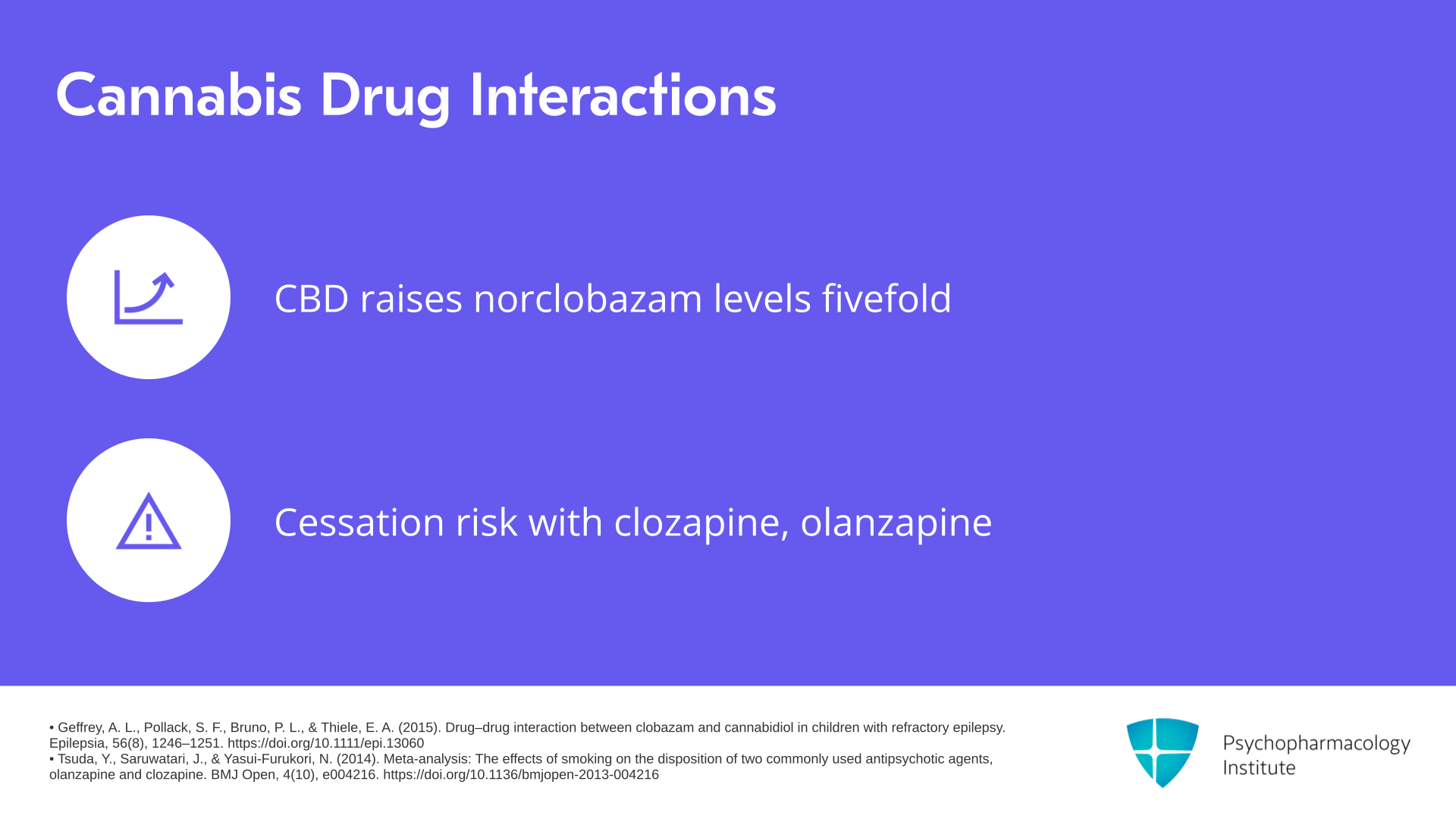
Clobazam: CBD inhibits CYP2C19. The active metabolite, norclobazam, rises up to fivefold. Clozapine and olanzapine: This a high-yield interaction in Psychiatry and one of the most often missed because the danger in the interaction is cessation, not initiation. Smoked cannabis induces CYP1A2 through combustion. Product levels sit artificially low while the patient is smoking, and rise roughly 50% in the two to four weeks after they stop.
References:
- Geffrey, A. L., Pollack, S. F., Bruno, P. L., & Thiele, E. A. (2015). Drug–drug interaction between clobazam and cannabidiol in children with refractory epilepsy. Epilepsia, 56(8), 1246–1251. https://doi.org/10.1111/epi.13060
- Tsuda, Y., Saruwatari, J., & Yasui-Furukori, N. (2014). Meta-analysis: The effects of smoking on the disposition of two commonly used antipsychotic agents, olanzapine and clozapine. BMJ Open, 4(10), e004216. https://doi.org/10.1136/bmjopen-2013-004216
Slide 14 of 22
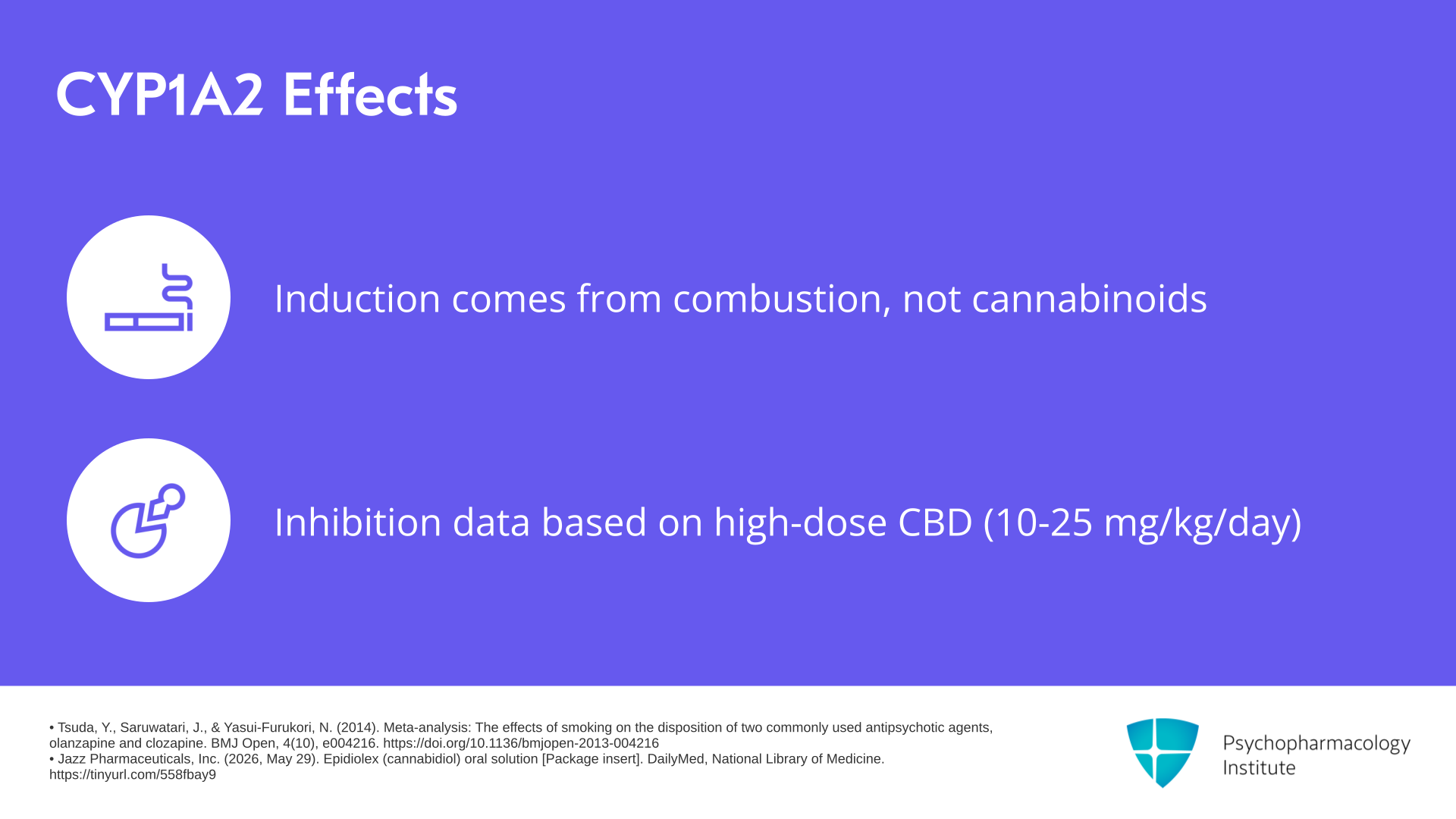
One important point. The CYP1A2 induction is driven by combustion, not by cannabinoids so it applies at ordinarily recreational exposure and applies equally to tobacco. In the inhibition data, clobazam, warfarin, and the rest come overwhelmingly from pharmaceutical CBD at 10 to 25 mg/kg/day. Extrapolating that table wholesale if someone is smoking flower overstates the case.
References:
- Tsuda, Y., Saruwatari, J., & Yasui-Furukori, N. (2014). Meta-analysis: The effects of smoking on the disposition of two commonly used antipsychotic agents, olanzapine and clozapine. BMJ Open, 4(10), e004216. https://doi.org/10.1136/bmjopen-2013-004216
- Jazz Pharmaceuticals, Inc. (2026, May 29). Epidiolex (cannabidiol) oral solution [Package insert]. DailyMed, National Library of Medicine. https://tinyurl.com/558fbay9
Free Files
Download PDF and other files
Success!
Check your inbox, we sent you all the materials there.
Slide 15 of 22
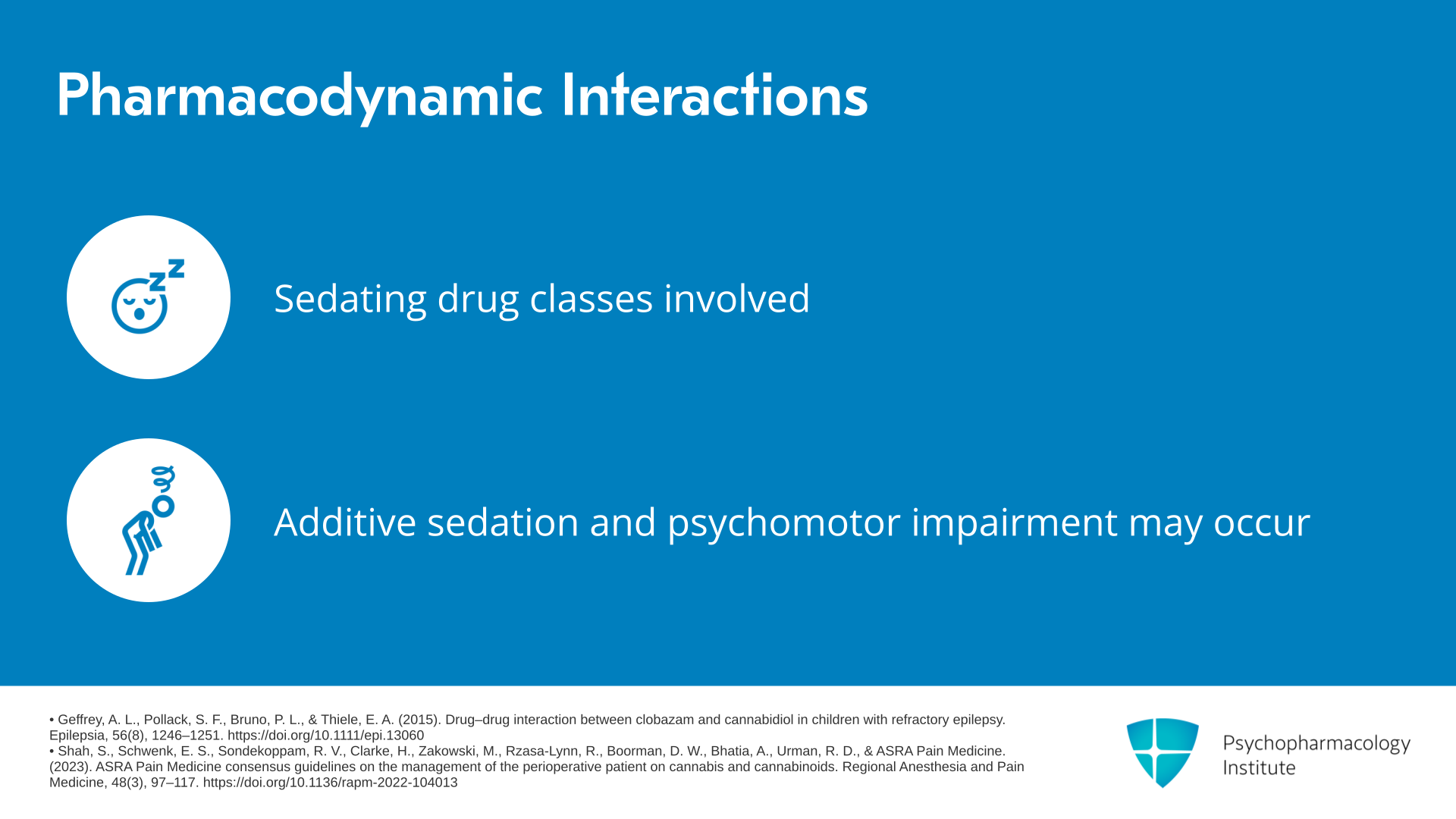
On the pharmacodynamics side, the list is shorter, and the mechanism is simpler: benzodiazepines, opioids, gabapentinoids, Z-drugs, alcohol, muscle relaxants, and sedating antihistamines. Additive sedation and psychomotor impairment can occur.
References:
- Geffrey, A. L., Pollack, S. F., Bruno, P. L., & Thiele, E. A. (2015). Drug–drug interaction between clobazam and cannabidiol in children with refractory epilepsy. Epilepsia, 56(8), 1246–1251. https://doi.org/10.1111/epi.13060
- Shah, S., Schwenk, E. S., Sondekoppam, R. V., Clarke, H., Zakowski, M., Rzasa-Lynn, R., Boorman, D. W., Bhatia, A., Urman, R. D., & ASRA Pain Medicine. (2023). ASRA Pain Medicine consensus guidelines on the management of the perioperative patient on cannabis and cannabinoids. Regional Anesthesia and Pain Medicine, 48(3), 97–117. https://doi.org/10.1136/rapm-2022-104013
Slide 16 of 22
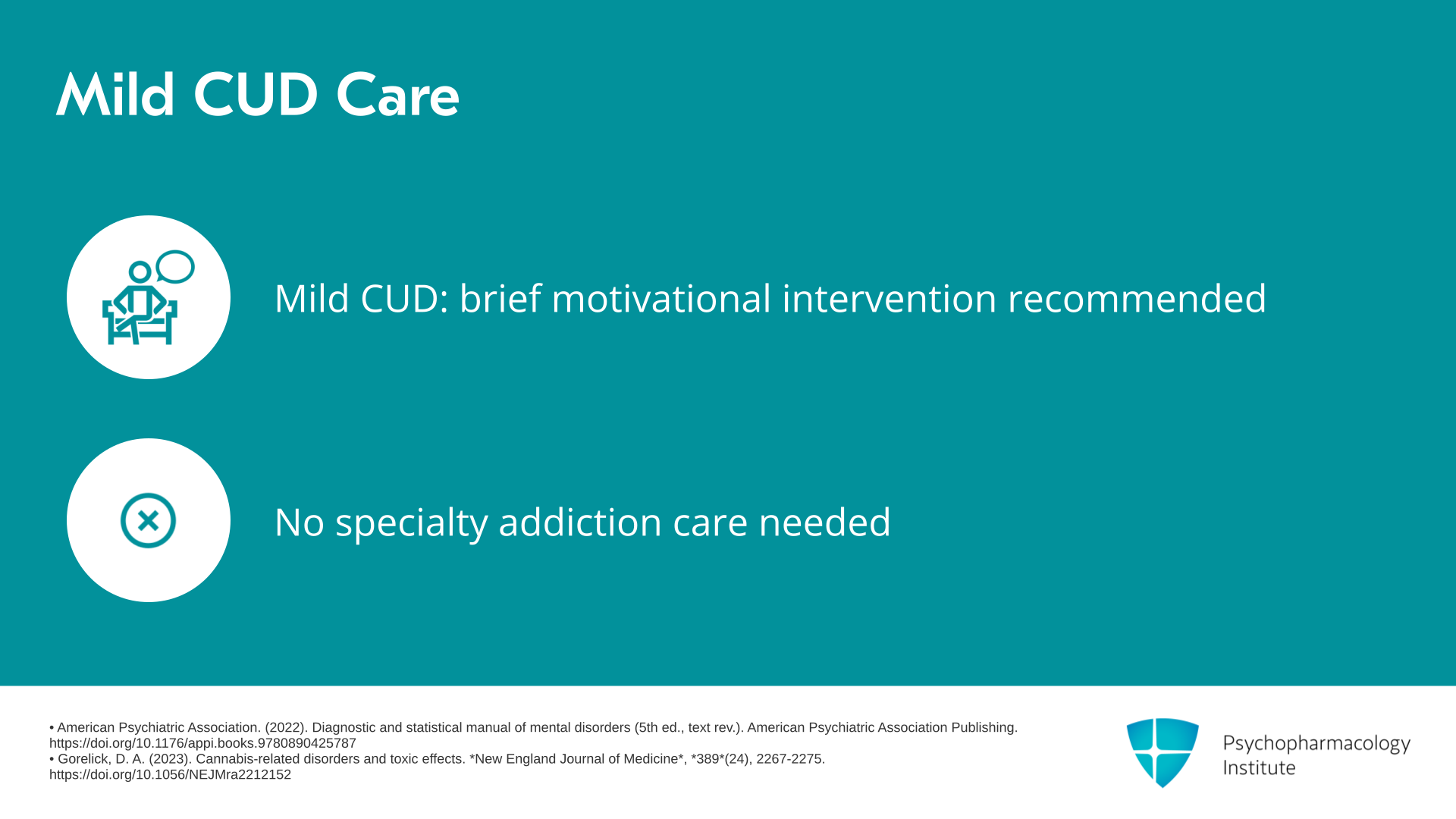
Let me close this section with a framework for translating severity into care intensity. Mild CUD, 2 to 3 criteria, is appropriate for brief motivational intervention in a primary care or outpatient psychiatric setting. This patient may benefit from a few sessions of motivational enhancement therapy or cognitive behavioral therapy. It may not need a specialty addiction care.
References:
- American Psychiatric Association. (2022). Diagnostic and statistical manual of mental disorders (5th ed., text rev.). American Psychiatric Association Publishing. https://doi.org/10.1176/appi.books.9780890425787
- Gorelick, D. A. (2023). Cannabis-related disorders and toxic effects. *New England Journal of Medicine*, *389*(24), 2267-2275. https://doi.org/10.1056/NEJMra2212152
Free Files
Download PDF and other files
Success!
Check your inbox, we sent you all the materials there.
Slide 17 of 22
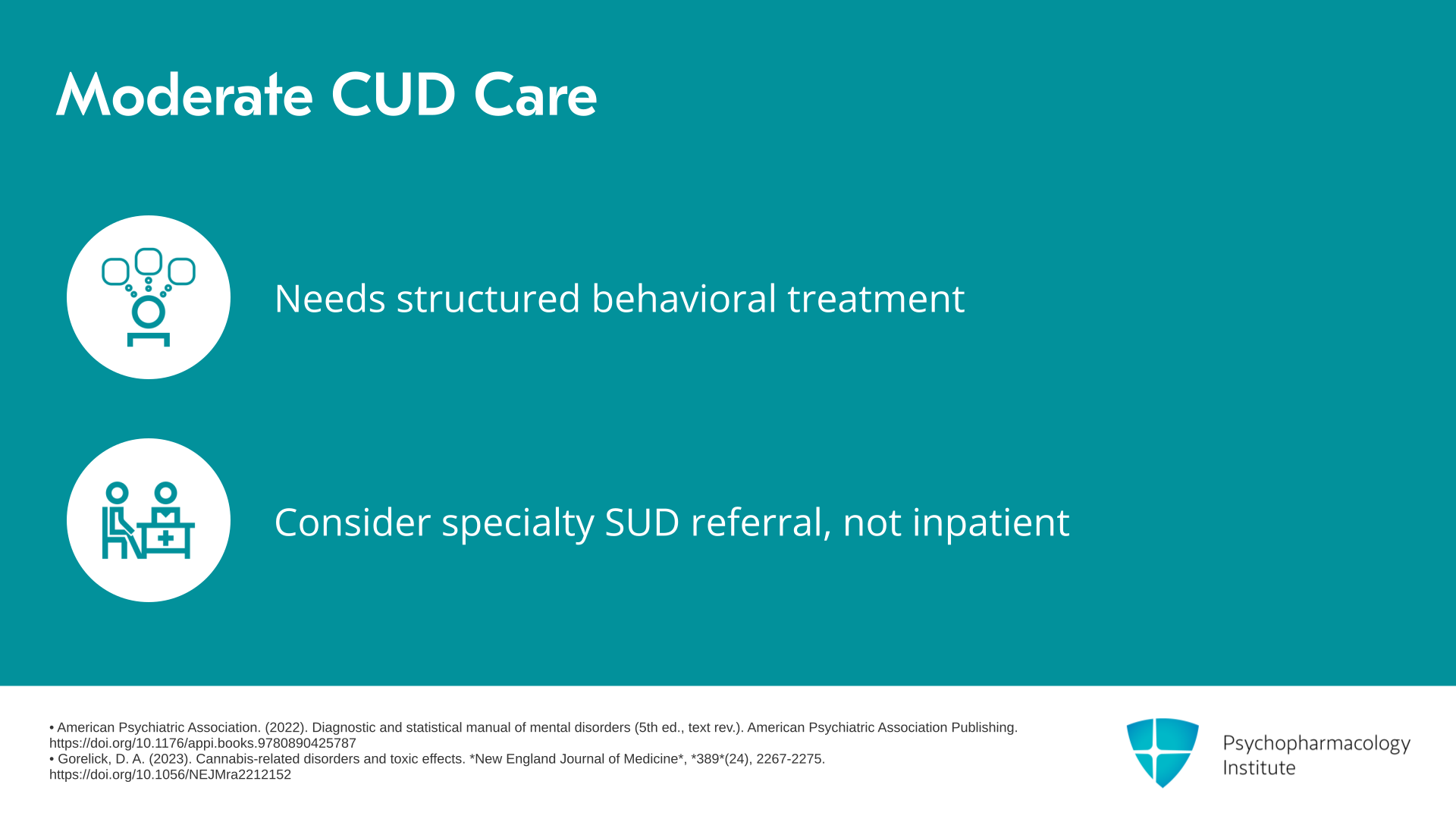
Moderate CUD, 4 to 5 criteria. This patient should have a structured behavioral treatment, motivational enhancement therapy combined with CBT, with contingency management added when available. This is often a good candidate for specialty SUD referral though not necessarily inpatient.
References:
- American Psychiatric Association. (2022). Diagnostic and statistical manual of mental disorders (5th ed., text rev.). American Psychiatric Association Publishing. https://doi.org/10.1176/appi.books.9780890425787
- Gorelick, D. A. (2023). Cannabis-related disorders and toxic effects. *New England Journal of Medicine*, *389*(24), 2267-2275. https://doi.org/10.1056/NEJMra2212152
Slide 18 of 22
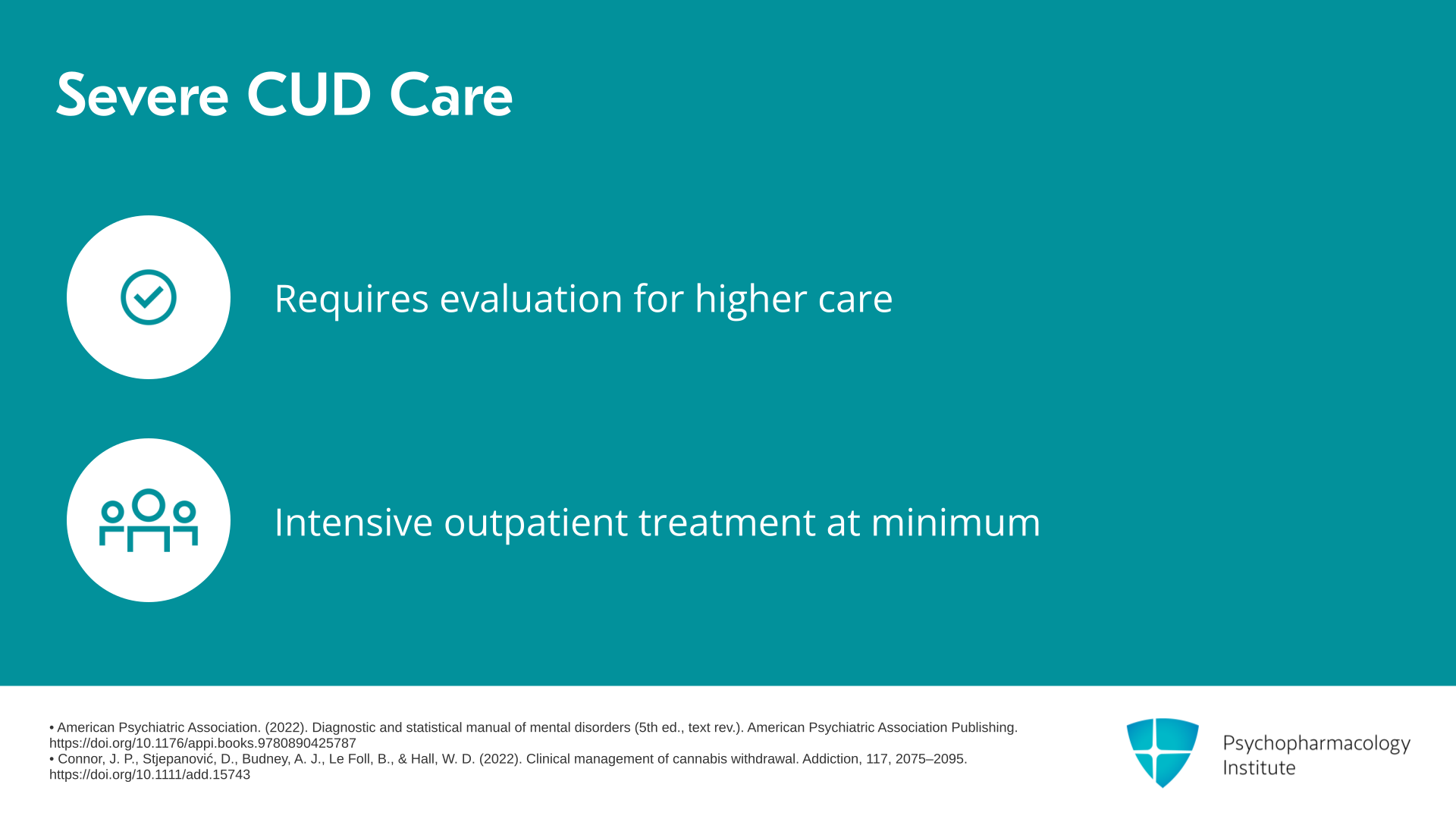
Severe, 6 or more criteria. This warrants evaluation for high level of care. Not everyone with severe CUD needs an inpatient treatment but intensive outpatient treatment at a minimum and the threshold for residential evaluation is lower.
References:
- American Psychiatric Association. (2022). Diagnostic and statistical manual of mental disorders (5th ed., text rev.). American Psychiatric Association Publishing. https://doi.org/10.1176/appi.books.9780890425787
- Connor, J. P., Stjepanović, D., Budney, A. J., Le Foll, B., & Hall, W. D. (2022). Clinical management of cannabis withdrawal. Addiction, 117, 2075–2095. https://doi.org/10.1111/add.15743
Free Files
Download PDF and other files
Success!
Check your inbox, we sent you all the materials there.
Slide 19 of 22
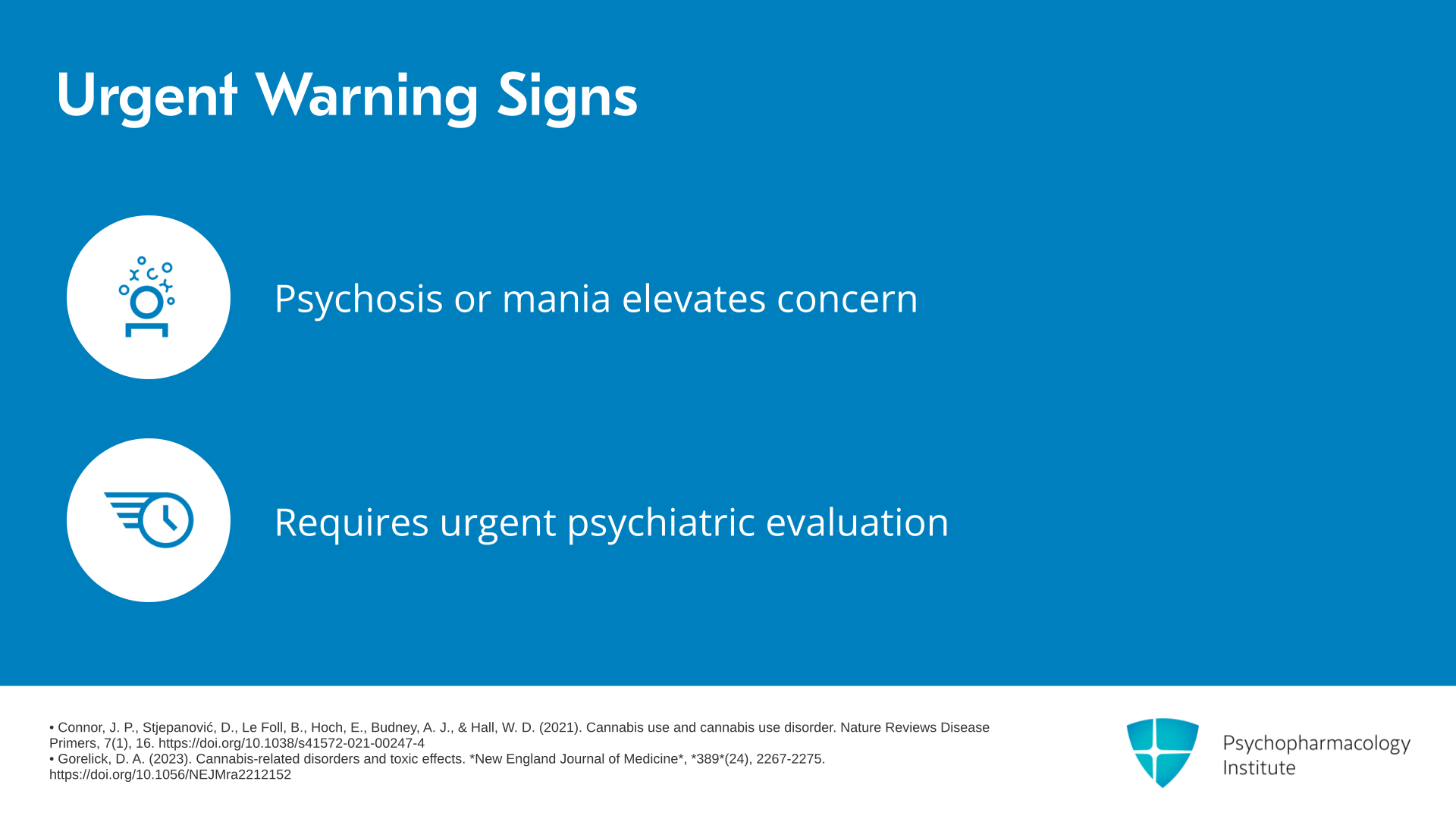
Now, regardless of severity level, there are clinical situations that should immediately elevate your concern. Psychosis or mania: If cannabis use is in the context of a psychotic episode or a manic episode, you cannot wait for the patient to self-motivate through stages of change. That can warrant an urgent psychiatric evaluation.
References:
- Connor, J. P., Stjepanović, D., Le Foll, B., Hoch, E., Budney, A. J., & Hall, W. D. (2021). Cannabis use and cannabis use disorder. Nature Reviews Disease Primers, 7(1), 16. https://doi.org/10.1038/s41572-021-00247-4
- Gorelick, D. A. (2023). Cannabis-related disorders and toxic effects. *New England Journal of Medicine*, *389*(24), 2267-2275. https://doi.org/10.1056/NEJMra2212152
Slide 20 of 22
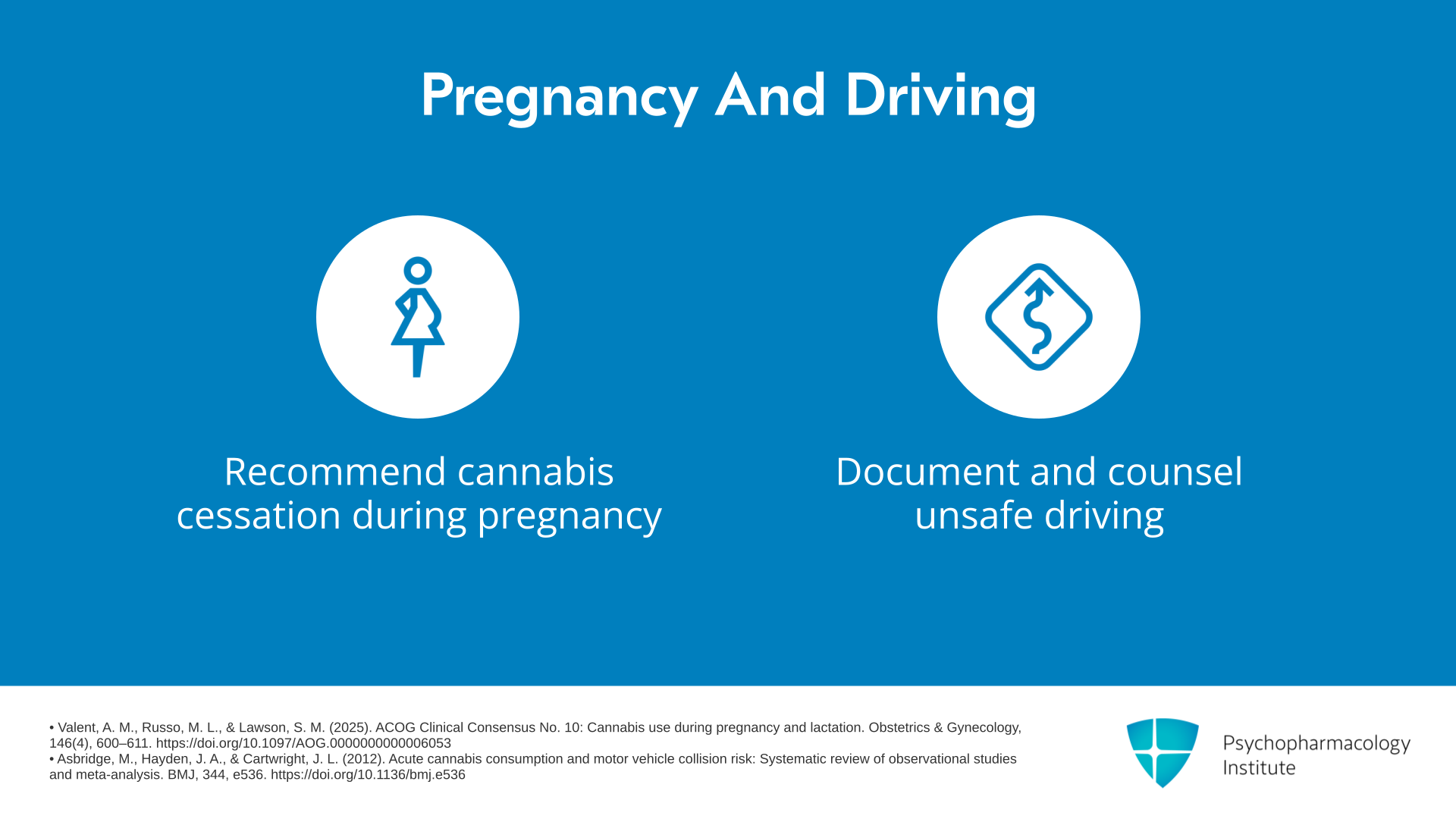
Pregnancy: The data on fetal effects of cannabis exposure are concerning enough that cessation should be strongly recommended and actively supported with OB involvement. Unsafe driving: Document it. Counsel it explicitly. Consider a safety contract. This can have medico-legal implications as well.
References:
- Valent, A. M., Russo, M. L., & Lawson, S. M. (2025). ACOG Clinical Consensus No. 10: Cannabis use during pregnancy and lactation. Obstetrics & Gynecology, 146(4), 600–611. https://doi.org/10.1097/AOG.0000000000006053
- Asbridge, M., Hayden, J. A., & Cartwright, J. L. (2012). Acute cannabis consumption and motor vehicle collision risk: Systematic review of observational studies and meta-analysis. BMJ, 344, e536. https://doi.org/10.1136/bmj.e536
Free Files
Download PDF and other files
Success!
Check your inbox, we sent you all the materials there.
Slide 21 of 22
Cannabis hyperemesis syndrome, or CHS, which I’ll discuss in detail later. The only definitive treatment is cannabis cessation. Managing the acute presentation without addressing the cause leads to recurrence.
References:
- Loganathan, P., Gajendran, M., & Goyal, H. (2024). A comprehensive review and update on cannabis hyperemesis syndrome. Pharmaceuticals, 17(11), 1549. https://doi.org/10.3390/ph17111549
Slide 22 of 22
Some key points to summarize. Screen in two steps. One, the frequency question. How many days per week? Then consider assessment tools such as the CUDIT-R for anyone who screens positive. And ask what and how, not just whether. Route, product and potency change the exposure more than frequency does. Ask everywhere. CUD presents in primary care, psychiatry, pain clinics and the ED, not just in addiction settings.
Free Files
Download PDF and other files
Success!
Check your inbox, we sent you all the materials there.