
Text version
Antipsychotic Choice, Sex, and Hyperprolactinemia Risk
Elevated prolactin levels are a well-known potential side effect of antipsychotic medications. Hyperprolactinemia is associated with infertility, sexual dysfunction, and osteoporosis. Needless to say, it’s a side effect our patients usually prefer to avoid.
So how can we decrease the likelihood of this side effect emerging, and mitigate it when it occurs? Should our approach be different for female patients than for male patients? A recent study published in Psychoneuroendocrinology offers new data on the relationship between antipsychotics and hyperprolactinemia and supports the existence of sex-specific treatment considerations.
Download PDF and other files
Testing Dose Against Drug Selection
The authors conducted a retrospective observational study in which they gathered antipsychotic prescribing data and serum prolactin levels from 251 adult, non-pregnant patients at a tertiary medical center. They aimed to identify whether higher prolactin levels were better explained by the overall antipsychotic dose or by the specific antipsychotic selected, and whether female patients were more susceptible to this side effect than male patients.
To do so, they converted all antipsychotic prescriptions to a common dose-equivalent scale and categorized each antipsychotic as prolactin-sparing, low risk, or high risk for inducing hyperprolactinemia. They then tested for relationships between dose, risk category, patient sex, and prolactin levels using a generalized linear model.
Prolactin Thresholds and Risk Categories
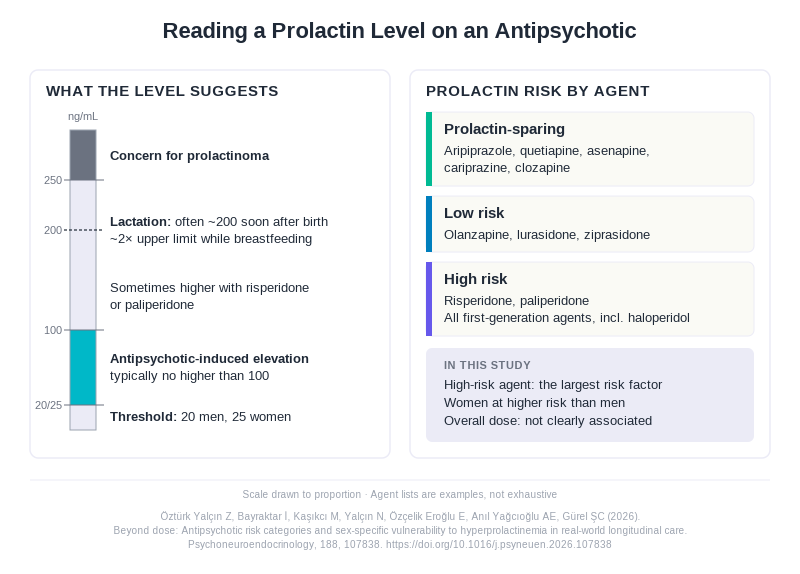
Before we get into the results, let’s take a moment for some level setting about what you’d expect to find when you order a prolactin level. Remind your patients that it’s a fasting blood sample, obtained at least two hours after waking up. The threshold for an elevated prolactin is 20 ng/mL for men and 25 ng/mL for women.
Antipsychotics are grouped into three categories of prolactin risk, which are typically considered to include:
- Prolactin-sparing: aripiprazole, quetiapine, asenapine, cariprazine, and clozapine
- Low risk: olanzapine, lurasidone, and ziprasidone
- High risk: risperidone and paliperidone, plus all first-generation antipsychotics, including haloperidol
When prolactin is elevated secondary to antipsychotic use, it’s still typically no higher than 100 ng/mL, although higher values are sometimes reported for risperidone and paliperidone. At levels higher than 250 ng/mL, you’re concerned about a prolactinoma.
Download PDF and other files
Women at Higher Risk of Hyperprolactinemia
Turning to the results, the authors described that even after accounting for the higher threshold for declaring hyperprolactinemia in women, a larger proportion of women than men demonstrated elevated prolactin levels. Female patients appeared to be at higher risk of developing hyperprolactinemia, both across the dataset overall and when prescribed a high-risk antipsychotic. This finding is consistent with previous reports in the literature indicating that female sex is a risk factor for hyperprolactinemia, and it adds to that accumulating body of evidence.
Drug Choice Mattered More Than Dose
A major takeaway from this study is that overall antipsychotic dose was not clearly associated with prolactin levels. Instead, the authors found a medication selection effect: prescribing a medication in the high-risk category was the largest risk factor for a high prolactin level.
This finding makes the case that hyperprolactinemia can’t be attributed solely to cumulative dopamine receptor blockade. Rather, it is driven more by the pharmacodynamic properties of individual medications and by patient-level vulnerability to the side effect.
What this means clinically is that if symptoms of hyperprolactinemia emerge on a given medication, just decreasing the dose is unlikely to resolve the issue. And since you’re hopefully already prescribing the lowest effective dose to keep your patient well, decreasing the antipsychotic dose further introduces the risk of destabilizing the patient without compelling hope of benefit. I would instead favor switching antipsychotics or adding on a medication to mitigate the side effect.
Download PDF and other files
Aripiprazole Finding Likely Reflects Confounding
That brings us to the most surprising finding from the paper: individuals co-prescribed aripiprazole did not demonstrate lower prolactin levels. I suspect this is best explained by confounding by indication.
In this study, we aren’t given a picture of prolactin levels before and after these individuals were prescribed aripiprazole. The authors do note that for many individuals with repeated measurements, prolactin levels trended downward.
My suspicion is that when prolactin levels were high, patients were more often prescribed aripiprazole, as this is a common management strategy to mitigate hyperprolactinemia. In other words, the high prolactin levels may have been causing the aripiprazole prescribing, rather than the other way around. Given the extensive evidence base for aripiprazole as a strategy for lowering prolactin levels, this finding won’t be changing my clinical practice at this time.
Take into Consideration Lactation and Other Causes
I had a few other thoughts as I was reading this paper. Earlier, I mentioned another condition that can cause hyperprolactinemia: a prolactinoma. But prolactinomas aren’t the only other reason your patient might have a high prolactin level.
Notably, while the study excluded pregnant women, it did not exclude lactating women. And fun fact: up to 3% of US adult women are lactating on any given day. While this number is low enough that it probably doesn’t influence the research findings here too much, it’s high enough to be on your radar clinically.
Crucially, it highlights the importance of asking the right questions when we see an abnormal laboratory result, and of considering the clinical context. Prolactin in lactating women is often in the 200 ng/mL range soon after birth and can remain elevated, usually at double the upper limit of normal, for as long as they’re breastfeeding. Currently, the American Academy of Pediatrics guidelines recommend breastfeeding for two years, so assessing for this side effect while a patient is breastfeeding or pumping is going to be difficult.
Thyroid dysfunction and other common medications can also influence prolactin levels. Keep the overall clinical picture in mind when deciding your next steps.
Download PDF and other files
Shared Decision Making on Next Steps
When hyperprolactinemia emerges and you’re deciding whether to switch antipsychotics or add on aripiprazole, I recommend discussing the patient’s priorities and prior medication trials with them. Shared decision making is the key for us here.
I find that my patients, who are usually younger and not yet thinking about osteoporosis, are often more concerned about metabolic side effects, weight neutrality, and limiting the overall number of psychiatric medications they’re taking. Keep in mind, though, that hyperprolactinemia produces many of the same symptoms as perimenopause, including irregular periods and lower libido. Often, these very same patients do want testing to see whether perimenopause is contributing to their symptoms, and treatment if it is.
Psychoeducation about the potential role of prolactin in these cases can be really helpful for validating their concerns and helping them clarify their treatment priorities. But ultimately, a particular medication may be what keeps them clinically stable, or they may prefer to prioritize minimizing the other side effects of the antipsychotic that would be used instead. In that case, it is reasonable to assess whether the potential downstream consequences of hyperprolactinemia, such as bone loss, can be addressed in other ways.
Bottom Line: Monitor Women, but Ask About Breastfeeding
I’ll end with this: for your female patients, know that their risk of hyperprolactinemia is going to be higher than for your male patients, especially when prescribing an antipsychotic known to be high risk for hyperprolactinemia at baseline. Keep an eye out for this side effect. But don’t forget to ask first if maybe they’re just breastfeeding.
Download PDF and other files
Abstract
Beyond dose: Antipsychotic risk categories and sex-specific vulnerability to hyperprolactinemia in real-world longitudinal care
Zeynep Öztürk Yalçın; İzgi Bayraktar; Merve Kaşıkcı, et al
Background
Antipsychotic-induced hyperprolactinemia is a common and clinically relevant adverse effect that may impair treatment adherence and long-term health outcomes. Although chlorpromazine-equivalent doses (CPZE) are frequently used to standardize antipsychotic exposure, the relative contribution of drug-specific prolactin liability and patient sex in real-world longitudinal settings remains insufficiently characterized.
Methods
We conducted a retrospective longitudinal cohort study including adult patients treated with antipsychotics in inpatient and outpatient psychiatric settings over a ten-year period. Repeated serum prolactin measurements were analyzed using generalized estimating equations to account for within-subject correlations. Antipsychotics were classified into low-, moderate-, and high-risk categories based on established prescribing guidelines. Associations between prolactin levels and sex, antipsychotic risk category, CPZE, therapy type, antidepressant co-treatment, and aripiprazole use were examined.
Results
A total of 251 patients (539 prolactin measurements) were included. Female sex and treatment with high-risk antipsychotics were the strongest independent predictors of prolactin elevation. High-risk agents were associated with an average increase of approximately 40 ng/mL in prolactin levels, whereas low-risk agents were associated with significantly lower concentrations. Abnormal prolactin levels (>20 ng/mL in men; >25 ng/mL in women) were observed in 68.4% of men and 78.7% of women. Analyses using binary outcomes (normal vs abnormal prolactin) yielded conclusions consistent with the continuous models, with high-risk antipsychotic exposure significantly increasing the odds of hyperprolactinemia, particularly among women. After adjustment for drug-specific risk, CPZE was not independently associated with prolactin levels. Sex-stratified analyses showed greater susceptibility to hyperprolactinemia among women. Aripiprazole use was not independently associated with lower prolactin levels.
Conclusion
In this real-world longitudinal cohort, prolactin dysregulation during antipsychotic treatment was driven primarily by drug-specific prolactin risk and biological sex rather than cumulative dose. These findings support a risk-based and sex-informed approach to antipsychotic prescribing and prolactin monitoring, particularly in women treated with high-risk agents.
Reference
Öztürk Yalçın, Z.; Bayraktar, İ.; Kaşıkcı, M.; Yalçın, N.; Özçelik Eroğlu, E.; Yağcıoğlu, A. et al. (2026). Beyond dose: Antipsychotic risk categories and sex-specific vulnerability to hyperprolactinemia in real-world longitudinal care. Psychoneuroendocrinology; 188:107838.