Slides and Transcript
Slide 1 of 21
I’m going to be talking now about antidepressant choice for patients on hemodialysis: Cardiac safety, the dialyzability of drugs, and dose adjustments.
Slide 2 of 21
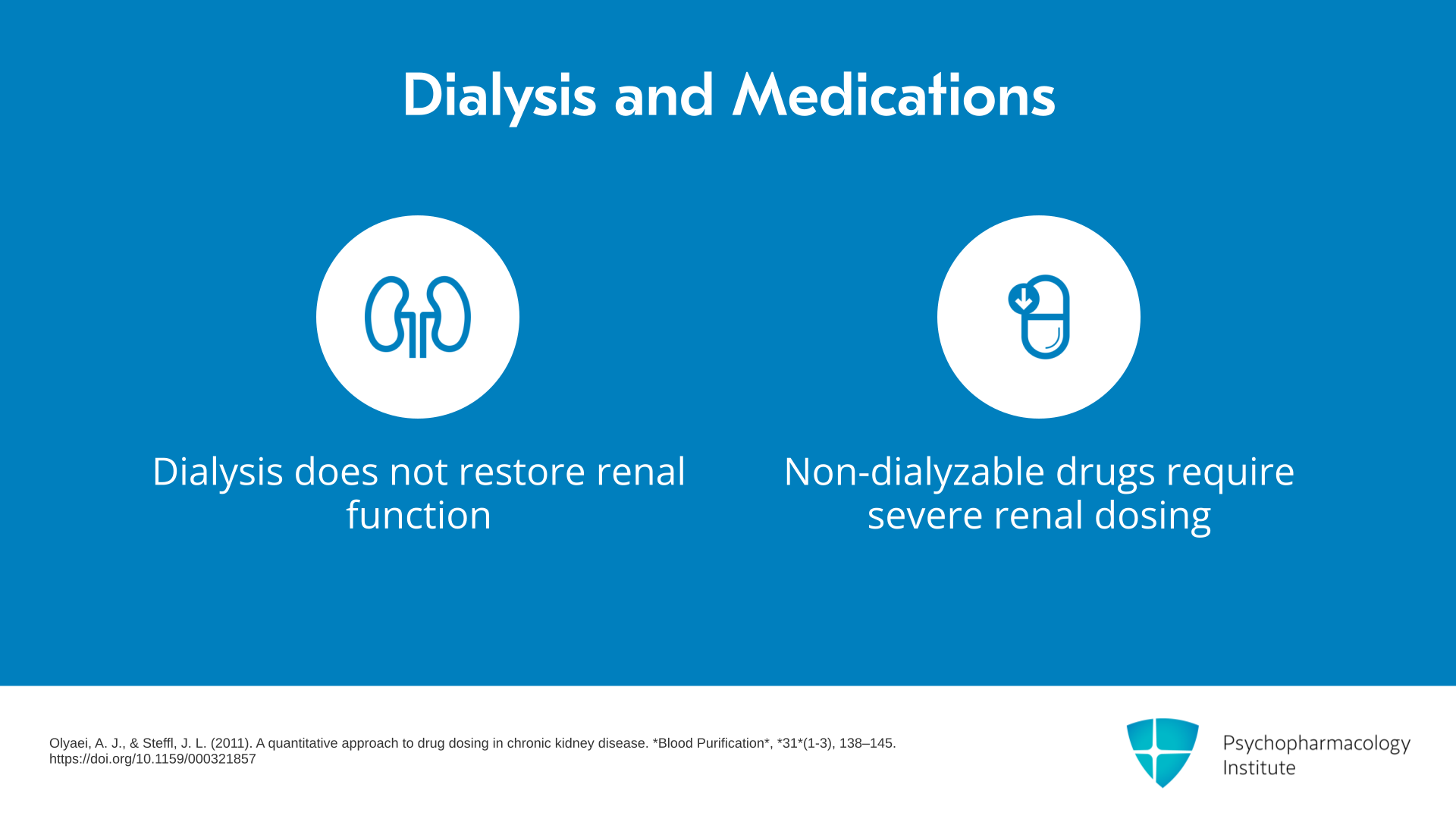
Firstly, the effect of dialysis on psychiatric medicine. The key principle to hold in mind here is that dialysis doesn’t restore renal function. So patients on hemodialysis still have extremely poor to no kidney function in between their sessions of hemodialysis, and that means that drugs that are not removed by dialysis need to be used as you would do in somebody with very severe renal impairment. And even when drugs are removed by the process of dialysis, that’s not equivalent to having working kidneys.
References:
- Olyaei, A. J., & Steffl, J. L. (2011). A quantitative approach to drug dosing in chronic kidney disease. *Blood Purification*, *31*(1-3), 138–145. https://doi.org/10.1159/000321857
Free Files
Download PDF and other files
Success!
Check your inbox, we sent you all the materials there.
Slide 3 of 21
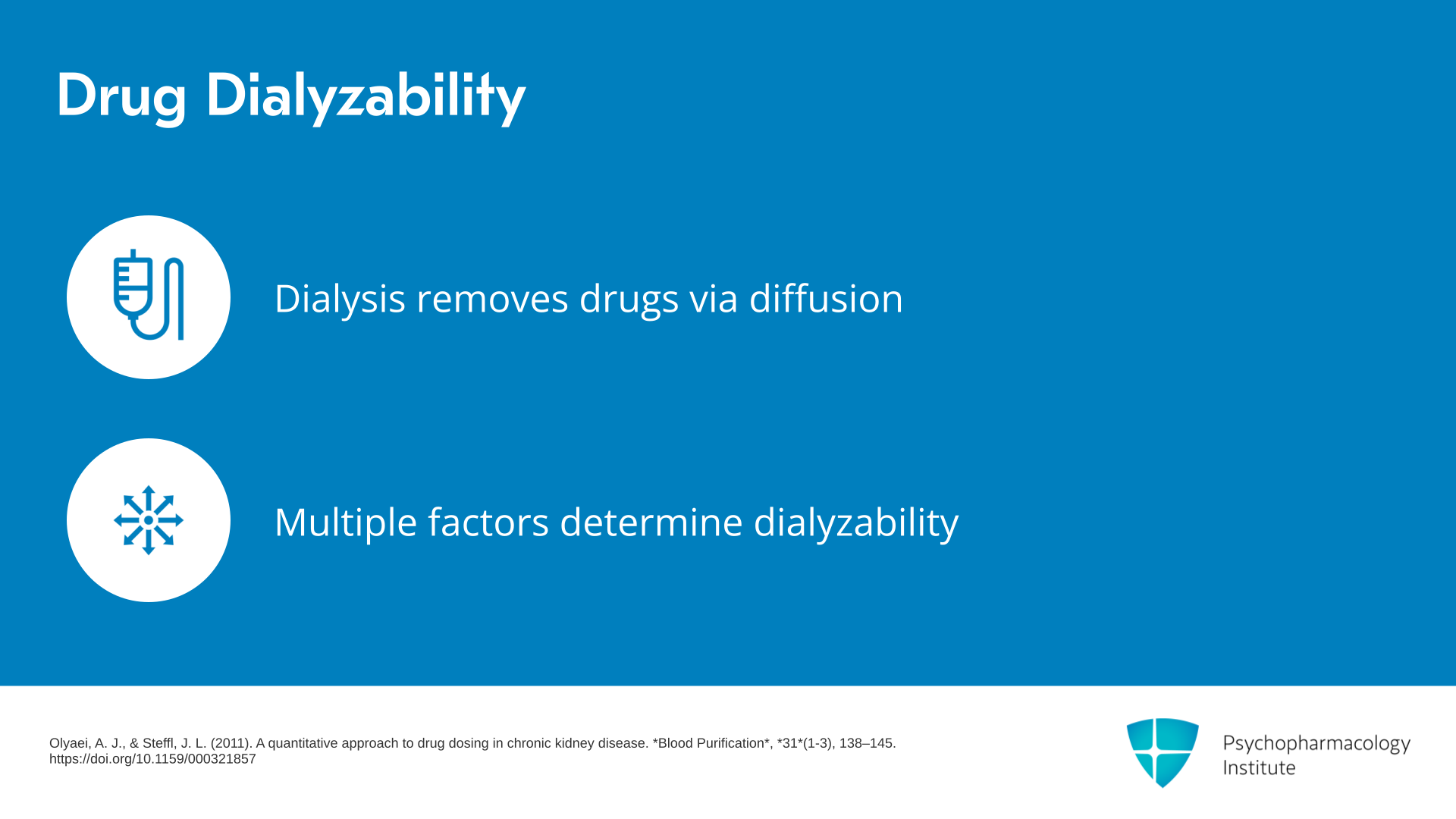
In principle, drugs should be removed by the process of dialysis because dialysis involves diffusion of drugs along a concentration gradient but the reality is actually much more complicated than that, because their removal depends on multiple factors and it’s the combination of these factors that determines what we might term a drug’s dialyzability.
References:
- Olyaei, A. J., & Steffl, J. L. (2011). A quantitative approach to drug dosing in chronic kidney disease. *Blood Purification*, *31*(1-3), 138–145. https://doi.org/10.1159/000321857
Slide 4 of 21
These factors are firstly molecular size. So the drug itself has to be small enough to pass through the semipermeable membrane pores of the dialysis machine.
References:
- Olyaei, A. J., & Steffl, J. L. (2011). A quantitative approach to drug dosing in chronic kidney disease. *Blood Purification*, *31*(1-3), 138–145. https://doi.org/10.1159/000321857
Free Files
Download PDF and other files
Success!
Check your inbox, we sent you all the materials there.
Slide 5 of 21
Secondly, protein binding. Molecules that are bound to proteins are too big to pass through the semipermeable membrane, and that means that only unbound drug can be removed by dialysis. The proportion of drug available for removal by dialysis therefore might change if the patient’s protein levels change. As a general rule, drugs that are more than 80% protein bound are less likely to be removed by the process of dialysis than those that have a lower protein binding.
References:
- Olyaei, A. J., & Steffl, J. L. (2011). A quantitative approach to drug dosing in chronic kidney disease. *Blood Purification*, *31*(1-3), 138–145. https://doi.org/10.1159/000321857
Slide 6 of 21
The third factor that contributes to dialyzability is volume of distribution. High volume drugs tend to have lower plasma protein binding but are more lipid soluble, and that means that they are distributed widely throughout the body tissues and they’re present in relatively small amounts in the blood. And the drug has to be available in the blood to be able to be removed for dialysis, so that means drugs with a very high volume of distribution are less likely to be available for removal by dialysis. And a volume of distribution of more than 0.7 mL/kg is considered to be high in this context.
References:
- Olyaei, A. J., & Steffl, J. L. (2011). A quantitative approach to drug dosing in chronic kidney disease. *Blood Purification*, *31*(1-3), 138–145. https://doi.org/10.1159/000321857
Free Files
Download PDF and other files
Success!
Check your inbox, we sent you all the materials there.
Slide 7 of 21
Bringing us to think specifically about patients with depression, depression occurs very frequently in patients with chronic kidney disease. The prevalence rate is possibly three times that of the general population, and actually rates of depression in patients with chronic kidney disease might exceed even those rates in patients with other chronic illnesses. When patients on hemodialysis are screened for depression, rates are similarly high. They’re at least 1 in 4, and many patients are both undiagnosed and untreated for their depression.
References:
- Palmer, S., Vecchio, M., Craig, J. C., Tonelli, M., Johnson, D. W., Nicolucci, A., Pellegrini, F., Saglimbene, V., Logroscino, G., Fishbane, S., & Strippoli, G. F. (2013). Prevalence of depression in chronic kidney disease: systematic review and meta-analysis of observational studies. Kidney International, 84(1), 179–191. https://doi.org/10.1038/ki.2013.77
- Shirazian, S., Grant, C. D., Aina, O., Mattana, J., Khorassani, F., & Ricardo, A. C. (2016). Depression in chronic kidney disease and end-stage renal disease: Similarities and differences in diagnosis, epidemiology, and management. *Kidney International Reports*, *2*(1), 94–107. https://doi.org/10.1016/j.ekir.2016.09.005
Slide 8 of 21
The reason for this has been suggested to be at least 3-dimensional. It may be to do with inflammation that’s associated with depression that may contribute to kidney disease progression. It’s possible that interleukin-6 plays a role in the pathophysiology of chronic kidney disease.
References:
- Sonikian, M., Metaxaki, P., Papavasileiou, D., Boufidou, F., Nikolaou, C., Vlassopoulos, D., & Vlahakos, D. V. (2010). Effects of interleukin-6 on depression risk in dialysis patients. *American Journal of Nephrology*, *31*(4), 303–308. https://doi.org/10.1159/000285110
- Katon, W. J. (2003). Clinical and health services relationships between major depression, depressive symptoms, and general medical illness. *Biological Psychiatry*, *54*(3), 216–226. https://doi.org/10.1016/s0006-3223(03)00273-7
Free Files
Download PDF and other files
Success!
Check your inbox, we sent you all the materials there.
Slide 9 of 21
The burden of end-stage kidney disease may itself lead to depression and depression may increase the perceived burden of end-stage renal disease. Depression may interfere with treatment adherence. There are a lot of medications that patients are expected to take if they have chronic kidney disease in particular. And it also may be difficult if you have depression to maintain good nutrition, which in turn is important for good kidney health.
References:
- Sonikian, M., Metaxaki, P., Papavasileiou, D., Boufidou, F., Nikolaou, C., Vlassopoulos, D., & Vlahakos, D. V. (2010). Effects of interleukin-6 on depression risk in dialysis patients. *American Journal of Nephrology*, *31*(4), 303–308. https://doi.org/10.1159/000285110
Slide 10 of 21
And depression in end-stage renal disease is very important, not only for the importance of mental health itself, but also because it’s associated with increased physical health mortality. And in fact, the degree of risk of physical health mortality from the kidney disease is linked to the severity of depression. So the more depressed the patient is, the higher mortality risk with their kidney disease.
References:
- Saglimbene, V., Palmer, S., Scardapane, M., Craig, J. C., Ruospo, M., Natale, P., Gargano, L., Leal, M., Bednarek-Skublewska, A., Dulawa, J., Ecder, T., Stroumza, P., Marco Murgo, A., Schön, S., Wollheim, C., Hegbrant, J., & Strippoli, G. F. (2017). Depression and all-cause and cardiovascular mortality in patients on haemodialysis: A multinational cohort study. Nephrology Dialysis Transplantation, 32(2), 377–384. https://doi.org/10.1093/ndt/gfw016
- Wu, P. H., Lin, M. Y., Huang, T. H., Lin, Y. T., Hung, C. C., Yeh, Y. C., Kuo, H. T., Chiu, Y. W., Hwang, S. J., Tsai, J. C., & Carrero, J. J. (2019). Depression amongst patients commencing maintenance dialysis is associated with increased risk of death and severe infections: A nationwide cohort study. *PLoS ONE*, *14*(6), e0218335. https://doi.org/10.1371/journal.pone.0218335
Free Files
Download PDF and other files
Success!
Check your inbox, we sent you all the materials there.
Slide 11 of 21
Antidepressants in patients with chronic kidney disease are actually very important. They’re important not only for the treatment of their depression but also for outcomes in the kidney disease itself. Despite the prevalence of depression in chronic kidney disease and the impact of it, trials examining antidepressant efficacy and safety in patients on dialysis are few and far between. They’re mostly quite short so they’re limited to 12 weeks. Many of the studies are non-randomized or they’re open-label studies and they are largely focused on SSRIs, and that means that there’s really insufficient data to support the selection of any single drug over another purely in terms of efficacy in patients with chronic kidney disease.
References:
- Palmer, S. C., Natale, P., Ruospo, M., Saglimbene, V. M., Rabindranath, K. S., Craig, J. C., & Strippoli, G. F. (2016). Antidepressants for treating depression in adults with end-stage kidney disease treated with dialysis. The Cochrane Database of Systematic Reviews, 2016(5), CD004541. https://doi.org/10.1002/14651858.CD004541.pub3
- Nagler, E. V., Webster, A. C., Vanholder, R., & Zoccali, C. (2012). Antidepressants for depression in stage 3-5 chronic kidney disease: a systematic review of pharmacokinetics, efficacy and safety with recommendations by European Renal Best Practice (ERBP). Nephrology, Dialysis, Transplantation, 27(10), 3736–3745. https://doi.org/10.1093/ndt/gfs295
Slide 12 of 21
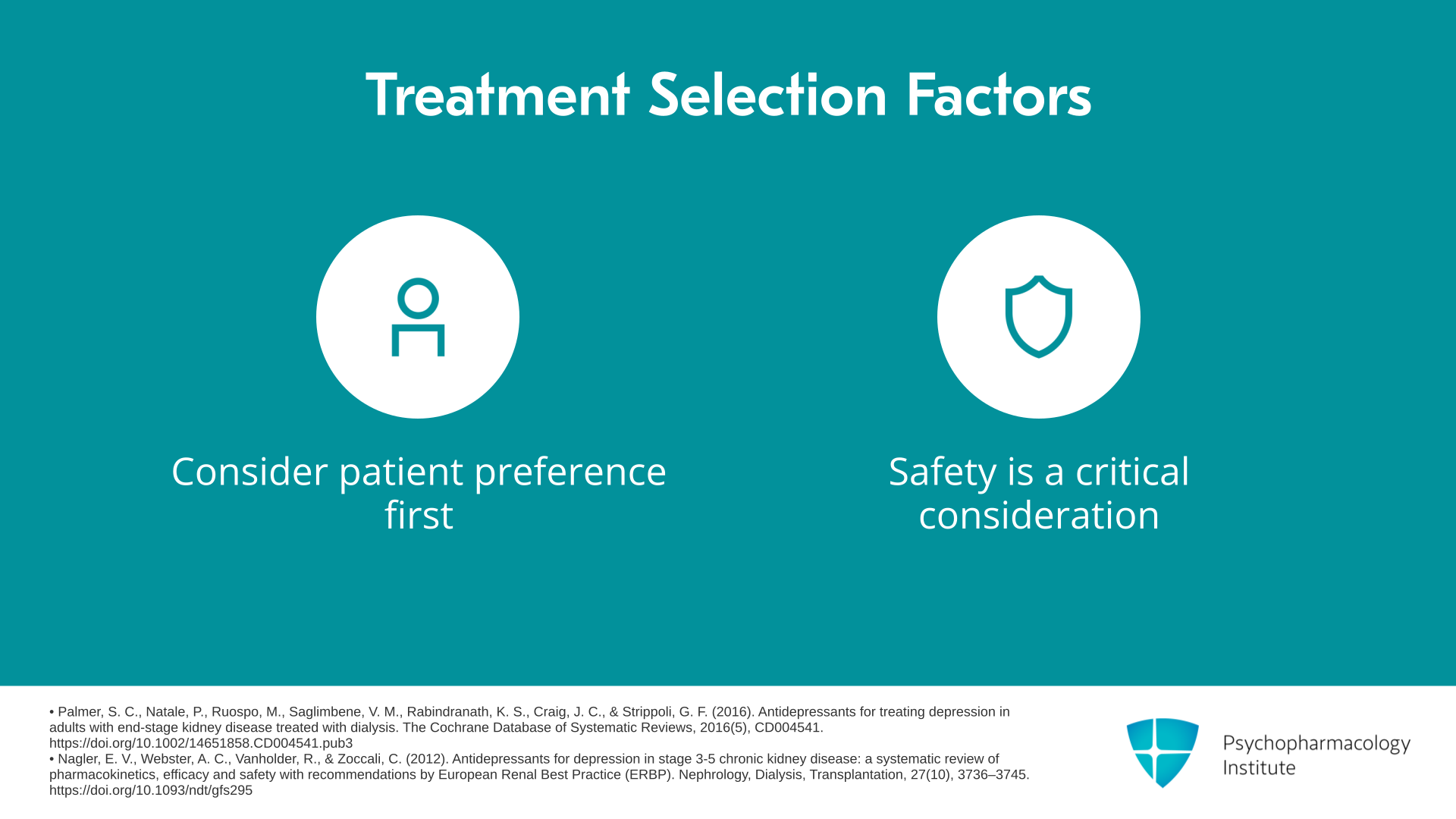
The choice instead should be based on patient preference and extrapolation of data from non-dialysis populations. Safety is also very important and in fact is likely to be the most important factor because patients on dialysis with chronic kidney disease are likely to have a very significant comorbidity burden.
References:
- Palmer, S. C., Natale, P., Ruospo, M., Saglimbene, V. M., Rabindranath, K. S., Craig, J. C., & Strippoli, G. F. (2016). Antidepressants for treating depression in adults with end-stage kidney disease treated with dialysis. The Cochrane Database of Systematic Reviews, 2016(5), CD004541. https://doi.org/10.1002/14651858.CD004541.pub3
- Nagler, E. V., Webster, A. C., Vanholder, R., & Zoccali, C. (2012). Antidepressants for depression in stage 3-5 chronic kidney disease: a systematic review of pharmacokinetics, efficacy and safety with recommendations by European Renal Best Practice (ERBP). Nephrology, Dialysis, Transplantation, 27(10), 3736–3745. https://doi.org/10.1093/ndt/gfs295
Free Files
Download PDF and other files
Success!
Check your inbox, we sent you all the materials there.
Slide 13 of 21
It’s also important to remember that some symptoms commonly experienced by dialysis patients, say for example, fatigue, insomnia, poor appetite, might be caused by uremia in chronic kidney disease but they also overlap with depression diagnostic criteria. And that’s a key factor if you are analyzing clinical trials in this area but also treating patients of course.
References:
- Shirazian, S., Grant, C. D., Aina, O., Mattana, J., Khorassani, F., & Ricardo, A. C. (2016). Depression in chronic kidney disease and end-stage renal disease: Similarities and differences in diagnosis, epidemiology, and management. *Kidney International Reports*, *2*(1), 94–107. https://doi.org/10.1016/j.ekir.2016.09.005
Slide 14 of 21
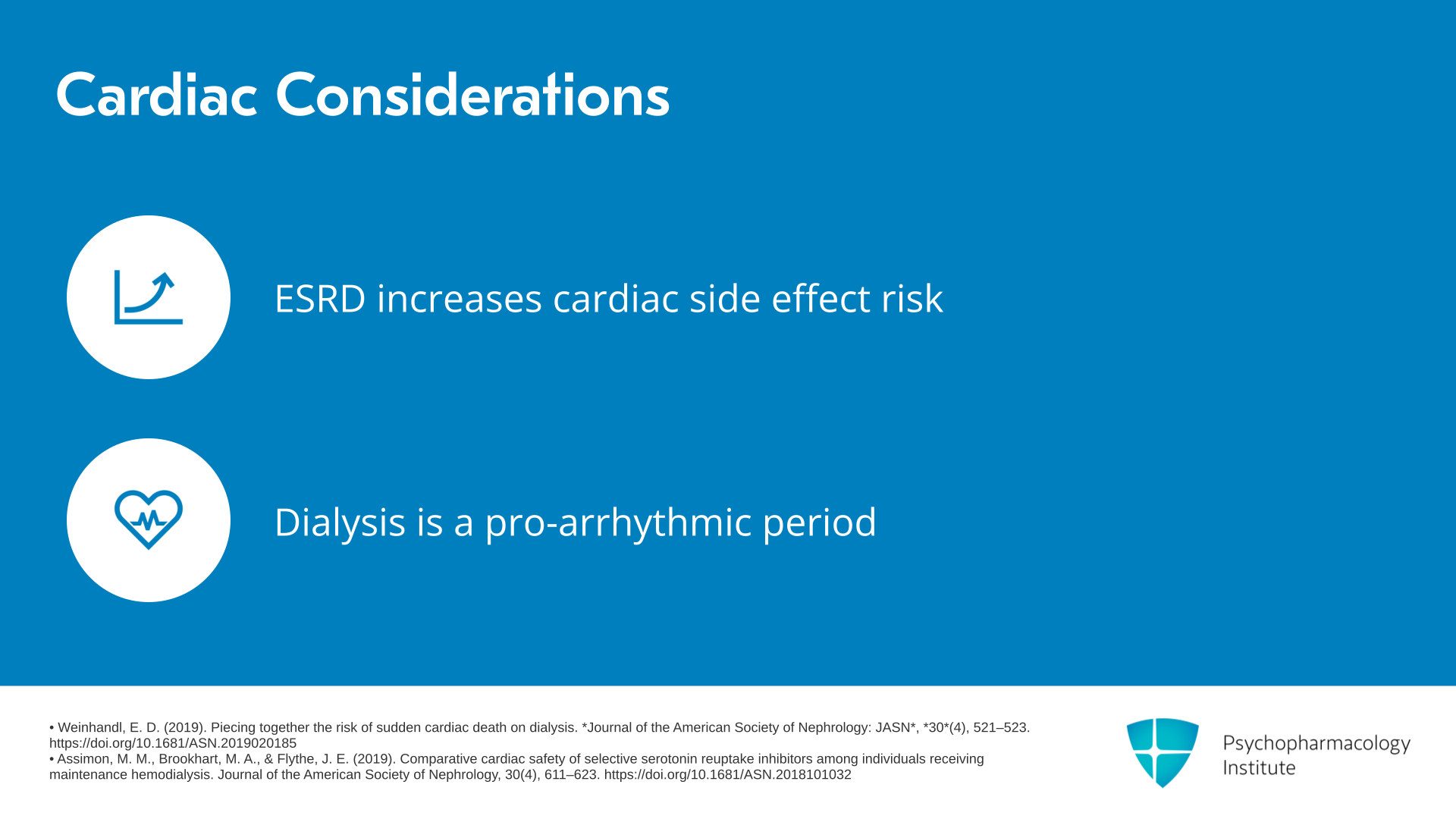
Cardiac considerations are crucial when considering prescribing antidepressants in patients who are undergoing dialysis and that’s because patients with end-stage renal disease are at increased risk of cardiac side effects for many reasons partly due to polypharmacy, also because there are significant electrolyte changes during dialysis. So the period of dialysis is a pro-arrhythmic time. And patients with chronic kidney disease have, frequently have cardiovascular comorbidities.
References:
- Weinhandl, E. D. (2019). Piecing together the risk of sudden cardiac death on dialysis. *Journal of the American Society of Nephrology: JASN*, *30*(4), 521–523. https://doi.org/10.1681/ASN.2019020185
- Assimon, M. M., Brookhart, M. A., & Flythe, J. E. (2019). Comparative cardiac safety of selective serotonin reuptake inhibitors among individuals receiving maintenance hemodialysis. Journal of the American Society of Nephrology, 30(4), 611–623. https://doi.org/10.1681/ASN.2018101032
Free Files
Download PDF and other files
Success!
Check your inbox, we sent you all the materials there.
Slide 15 of 21
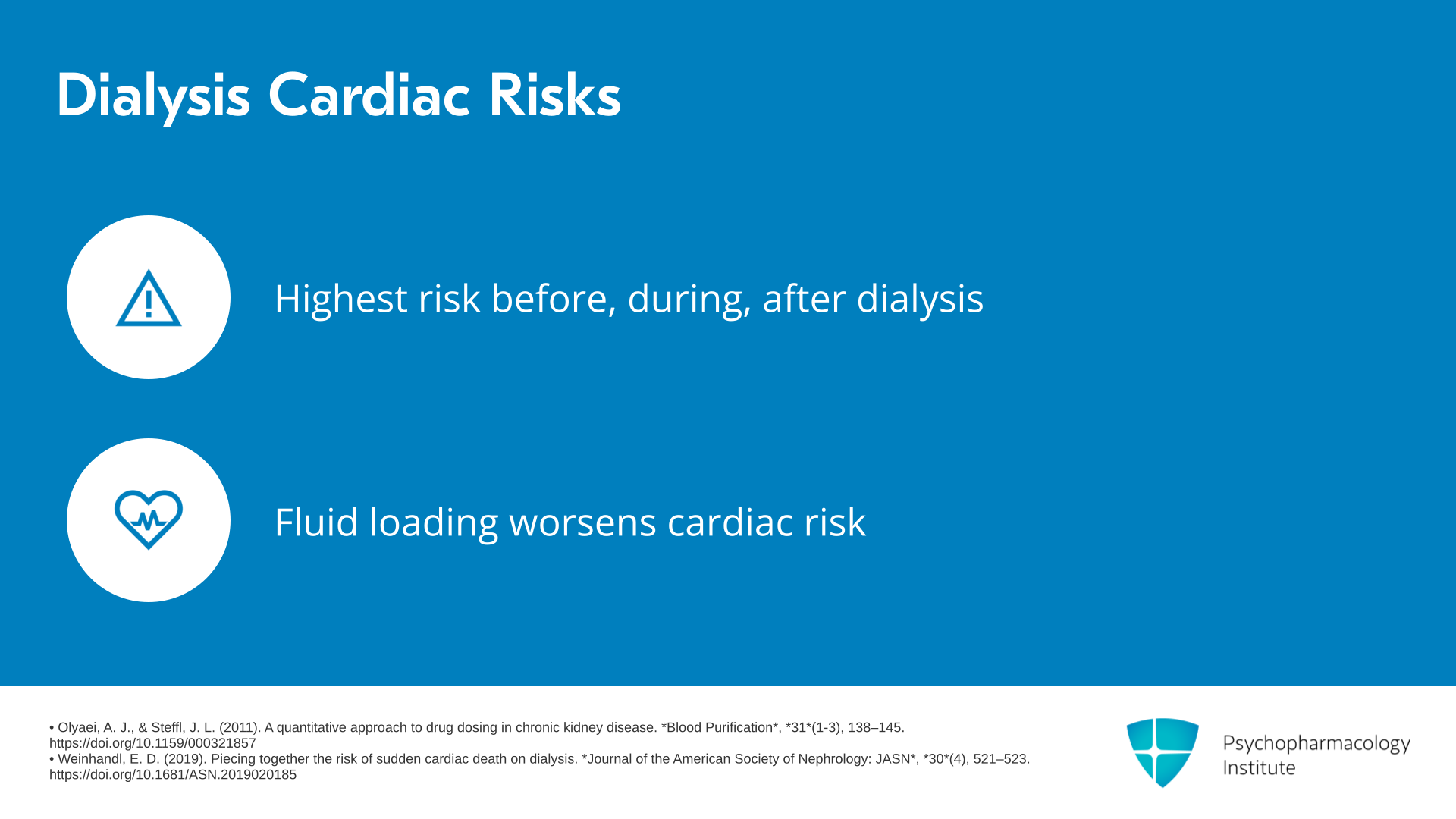
The riskiest times for a cardiac event are the hours before, during and immediately after the process of dialysis. And this is because fluid loading increases up to the time of dialysis which increases the risk of bradycardia in the preceding 12 hours and an increase in right ventricular pressure, and all of that increases the atrial fibrillation risk during dialysis. And there are also other considerations. So for example, if the patient is taking a rate-controlling medication that’s removed by the dialysis, then the arrhythmia risk will be higher immediately after the dialysis procedure.
References:
- Olyaei, A. J., & Steffl, J. L. (2011). A quantitative approach to drug dosing in chronic kidney disease. *Blood Purification*, *31*(1-3), 138–145. https://doi.org/10.1159/000321857
- Weinhandl, E. D. (2019). Piecing together the risk of sudden cardiac death on dialysis. *Journal of the American Society of Nephrology: JASN*, *30*(4), 521–523. https://doi.org/10.1681/ASN.2019020185
Slide 16 of 21
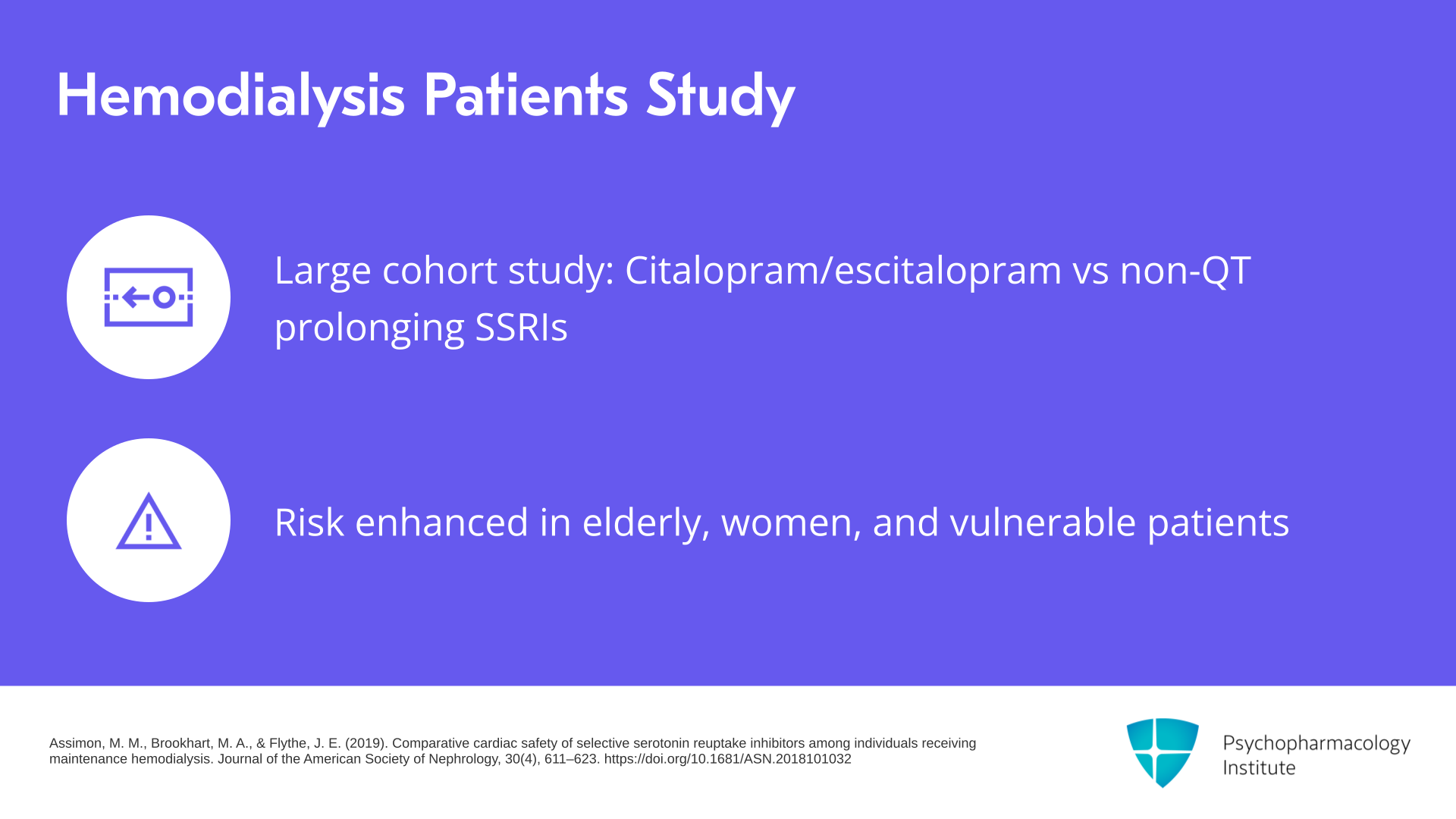
There is a large retrospective cohort study of more than 65,000 hemodialysis patients who were taking citalopram or escitalopram versus non-QT prolonging SSRIs. And this study found a hazard ratio for sudden cardiac death of 1.18 for escitalopram and citalopram. Now, the absolute risk of sudden cardiac death was very small. It was 0.02% versus 0.017%, but this translates to 1 extra death per 48 patients treated every year. The effect is enhanced in elderly patients, in women, in patients with pre-existing conduction disorders and those taking other QT prolonging medication.
References:
- Assimon, M. M., Brookhart, M. A., & Flythe, J. E. (2019). Comparative cardiac safety of selective serotonin reuptake inhibitors among individuals receiving maintenance hemodialysis. Journal of the American Society of Nephrology, 30(4), 611–623. https://doi.org/10.1681/ASN.2018101032
Free Files
Download PDF and other files
Success!
Check your inbox, we sent you all the materials there.
Slide 17 of 21
So as a result of this study, I would avoid using citalopram and escitalopram in patients undergoing dialysis if possible, and especially in those who have other risk factors for a prolonged QT interval. I would avoid using tricyclic antidepressants for the same reason due to pro-arrhythmic effect of the drugs themselves, potential bradycardia, and the effect of tricyclic drugs on cardiac contractility.
References:
- Assimon, M. M., Brookhart, M. A., & Flythe, J. E. (2019). Comparative cardiac safety of selective serotonin reuptake inhibitors among individuals receiving maintenance hemodialysis. Journal of the American Society of Nephrology, 30(4), 611–623. https://doi.org/10.1681/ASN.2018101032
Slide 18 of 21
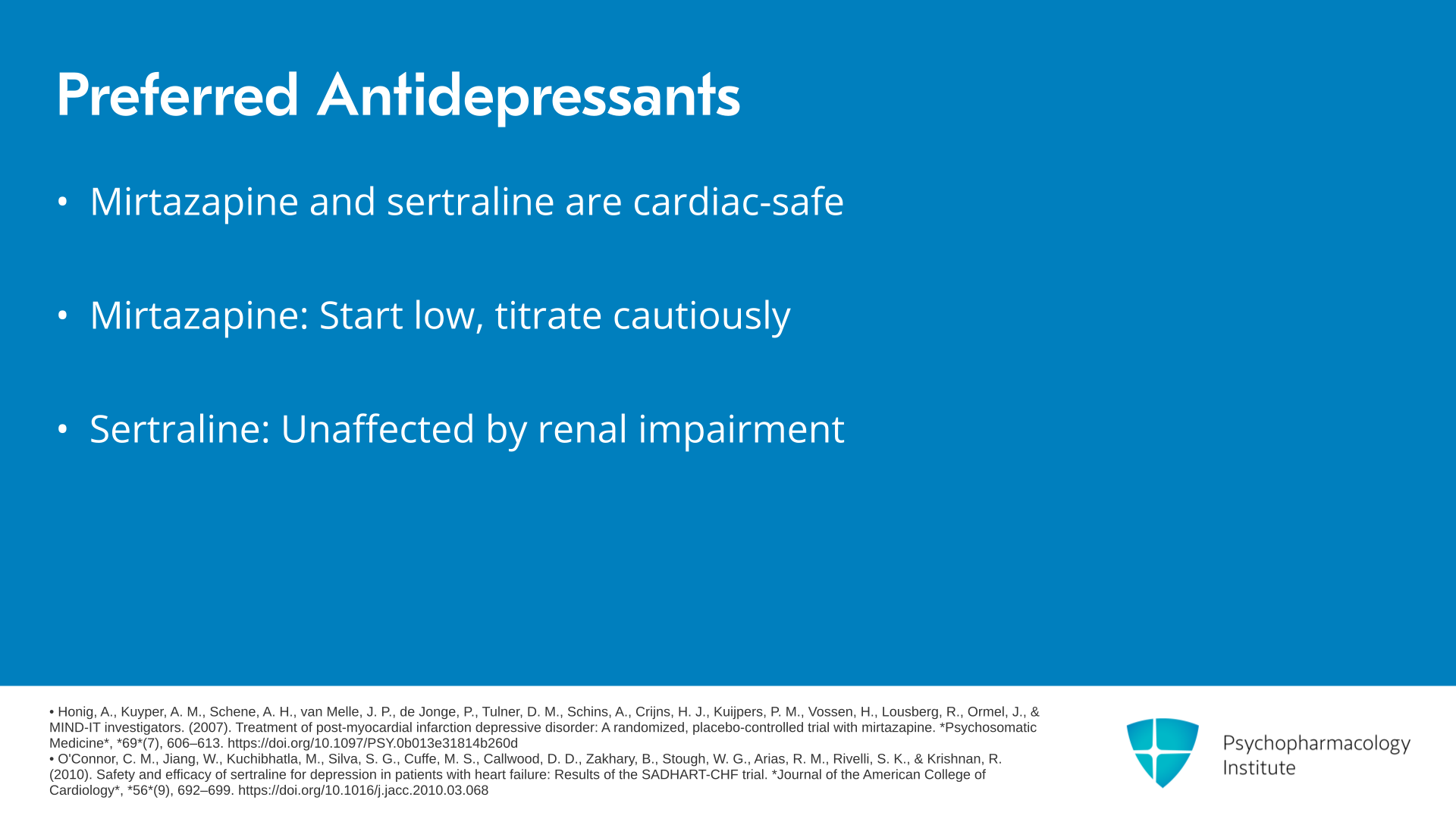
I would have a preference for using mirtazapine or sertraline and that’s because these two antidepressants are both shown to be safe in patients who are post myocardial infarction. So we’re thinking here largely about drugs that are known to be safer in patients at high risk of a cardiac event. Neither mirtazapine nor sertraline are removed by dialysis although mirtazapine in patients with severe renal impairment should be started at a low dose and increased cautiously because the clearance of mirtazapine may be reduced by about 50% in severe renal impairment. Sertraline is a little easier to use. The clearance is not significantly affected by renal impairment and you can prescribe it as you normally would.
References:
- Honig, A., Kuyper, A. M., Schene, A. H., van Melle, J. P., de Jonge, P., Tulner, D. M., Schins, A., Crijns, H. J., Kuijpers, P. M., Vossen, H., Lousberg, R., Ormel, J., & MIND-IT investigators. (2007). Treatment of post-myocardial infarction depressive disorder: A randomized, placebo-controlled trial with mirtazapine. *Psychosomatic Medicine*, *69*(7), 606–613. https://doi.org/10.1097/PSY.0b013e31814b260d
- O'Connor, C. M., Jiang, W., Kuchibhatla, M., Silva, S. G., Cuffe, M. S., Callwood, D. D., Zakhary, B., Stough, W. G., Arias, R. M., Rivelli, S. K., & Krishnan, R. (2010). Safety and efficacy of sertraline for depression in patients with heart failure: Results of the SADHART-CHF trial. *Journal of the American College of Cardiology*, *56*(9), 692–699. https://doi.org/10.1016/j.jacc.2010.03.068
Free Files
Download PDF and other files
Success!
Check your inbox, we sent you all the materials there.
Slide 19 of 21
The only antidepressant that is a possible problem particularly with the process of dialysis is moclobemide. Moclobemide is 50% protein bound and has a volume of distribution of 1 L/kg. It is probably dialyzed by hemodialysis but almost no moclobemide is excreted in the urine. So dosing of moclobemide doesn’t need alteration for renal impairment. So the kidneys are not really involved in its excretion. And so really, dialysis should have no appreciable impact on plasma concentrations, and that’s confirmed by published data showing no pharmacokinetic changes in moclobemide for patients undergoing dialysis. So although it may be a problem in theory based on the dialyzability of the drug, in reality it’s unlikely to be an issue.
References:
- Ashley, C., & Dunleavy, A. (Eds.). (2022). *The renal drug database*. CRC Press. https://doi.org/10.1201/9781003221487
- Stoeckel, K., Pfefen, J. P., Mayersohn, M., Schoerlin, M. P., Andressen, C., Ohnhaus, E. E., Frey, F., & Guentert, T. W. (1990). Absorption and disposition of moclobemide in patients with advanced age or reduced liver or kidney function. Acta Psychiatrica Scandinavica. Supplementum, 360, 94–97. https://doi.org/10.1111/j.1600-0447.1990.tb05346.x
Slide 20 of 21
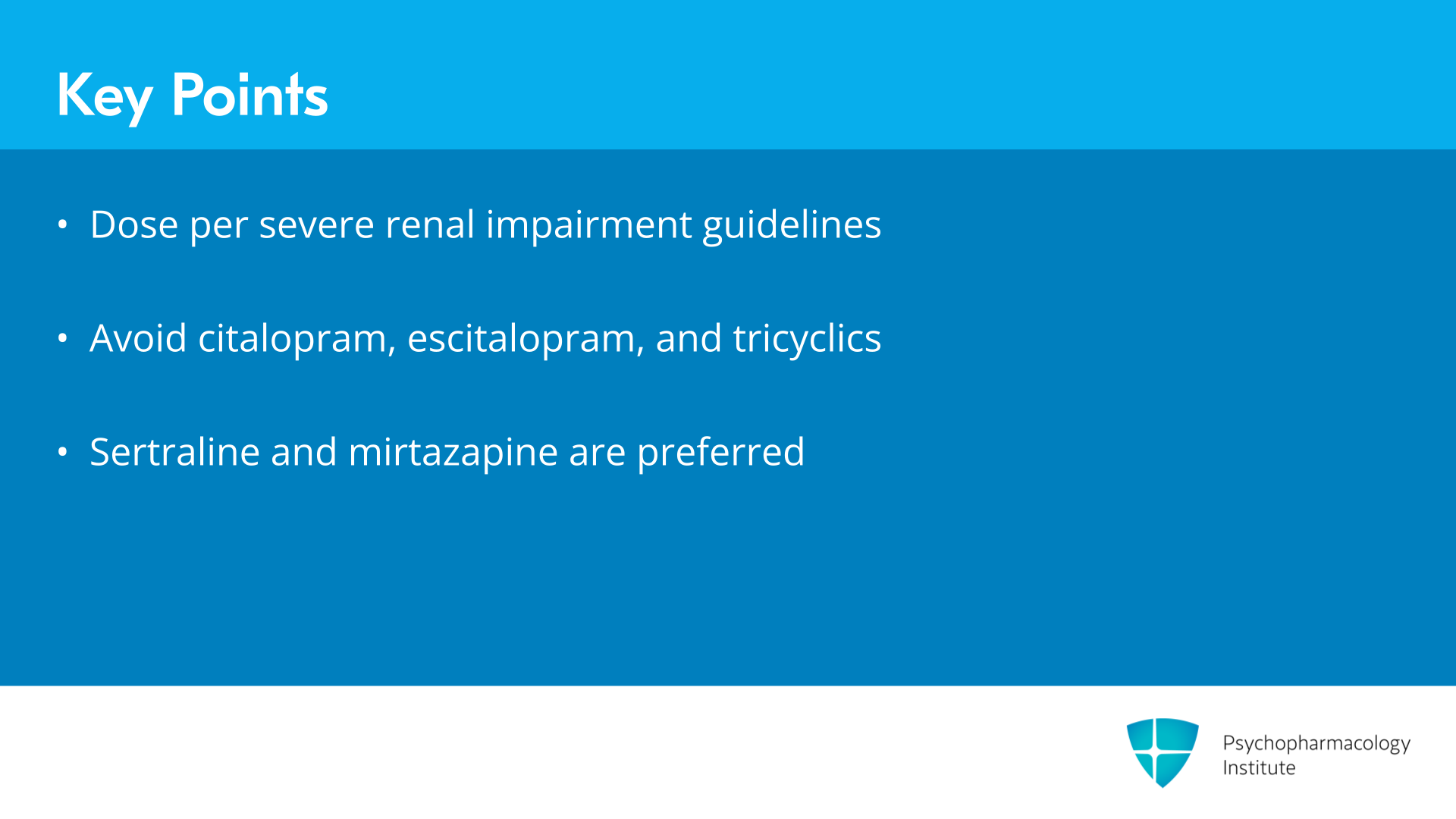
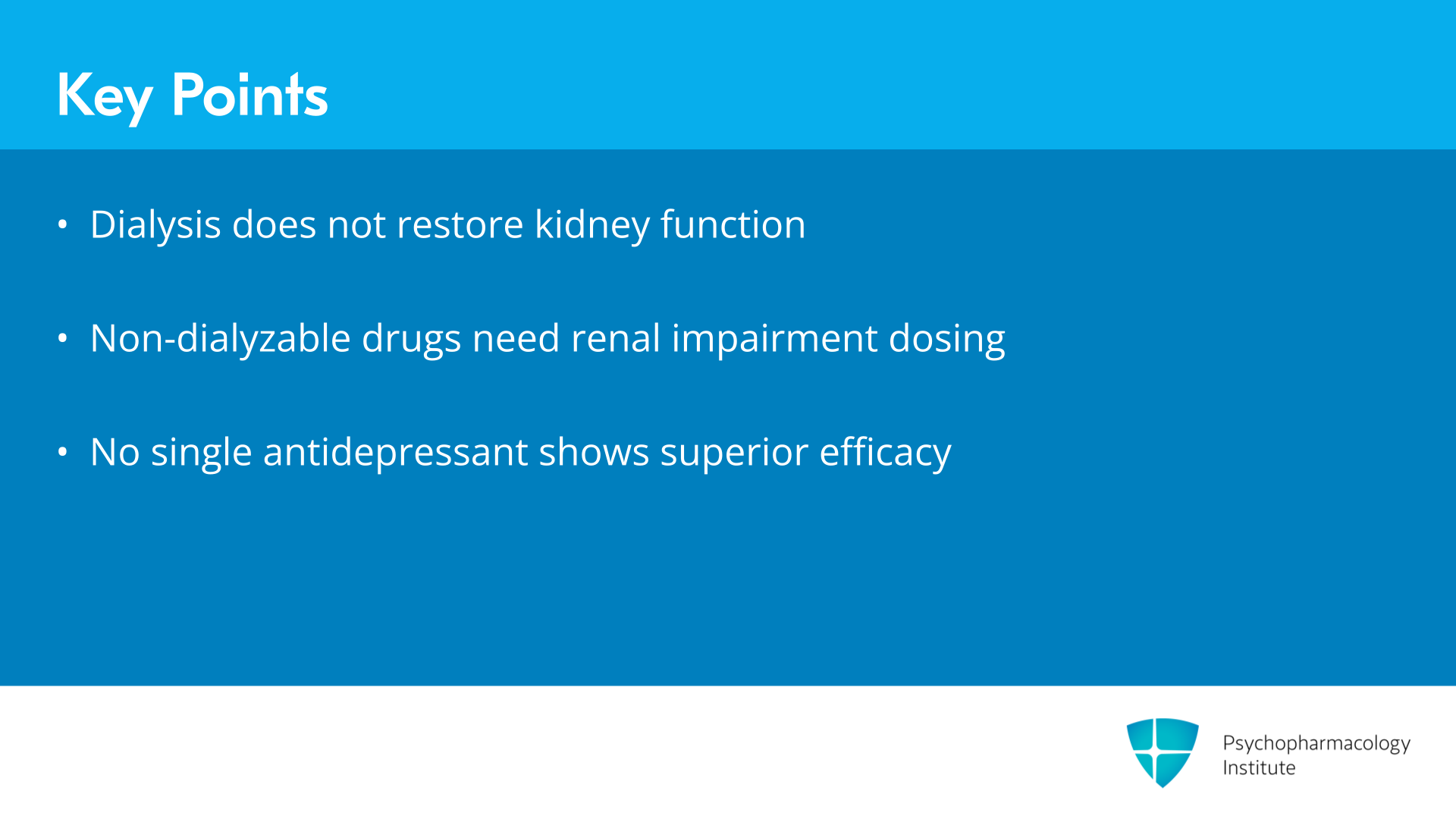
Key points for the use of antidepressants in patients undergoing dialysis. Dialysis doesn’t restore renal function. Patients still have extremely poor to zero kidney function in between dialysis sessions. That means that if a drug is not removed by the dialysis process it should be used as one would do in severe renal impairment. Depression is very common in patients undergoing dialysis. There are insufficient data to suggest the superiority of any single antidepressant in terms of efficacy in dialysis patients.
Free Files
Download PDF and other files
Success!
Check your inbox, we sent you all the materials there.
Slide 21 of 21
Antidepressants are not dialyzed and so they should be dosed in line with guidelines for severe renal impairment. There may be an increased risk of sudden cardiac death with citalopram and escitalopram and so these drugs should ideally be avoided. Tricyclic antidepressants should also be avoided due to the cardiac risk. Sertraline and mirtazapine are generally good choices.