
Slides and Transcript
Slide 1 of 14
In this section, we’ll discuss what are the different strategies for antipsychotic switching. So what I would say here is that there’s not necessarily an absolute right or wrong way to do the switch. Switching depends on a number of clinical and patient factors, but my goal here would be to discuss with you the different ways that we could make the switch.
References:
- Brian Miller, M.D., Ph.D., M.P.H.
Slide 2 of 14
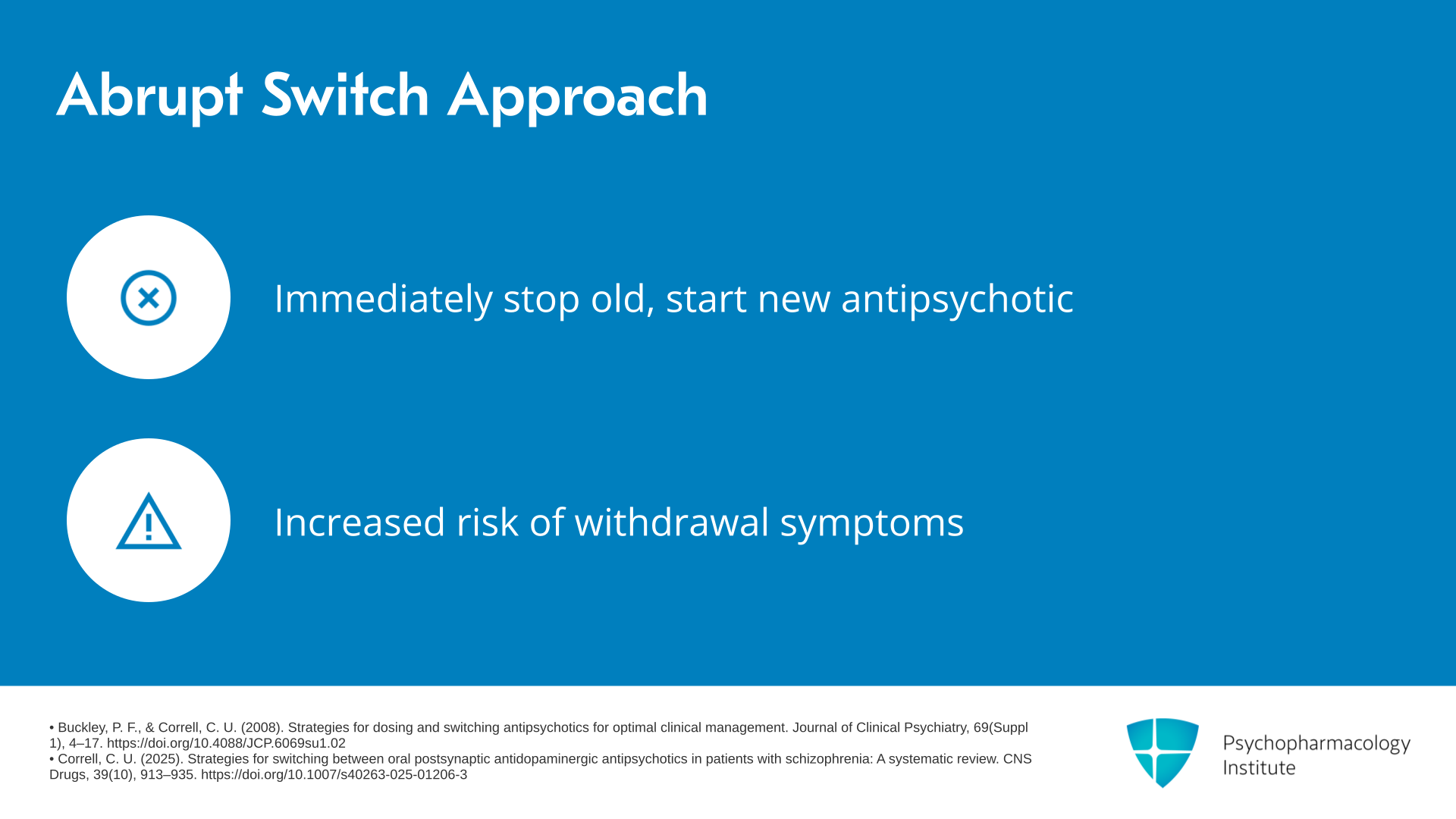
First of all would be the abrupt or stop-start switch, that is we immediately discontinue the pre-switch antipsychotic and immediately start in its place the new antipsychotic. This scenario approach is common in clinical trials and would be the preferred approach in cases of serious severe adverse effects. However, we note that this approach also carries a higher risk of withdrawal symptoms.
References:
- Buckley, P. F., & Correll, C. U. (2008). Strategies for dosing and switching antipsychotics for optimal clinical management. Journal of Clinical Psychiatry, 69(Suppl 1), 4–17. https://doi.org/10.4088/JCP.6069su1.02
- Correll, C. U. (2025). Strategies for switching between oral postsynaptic antidopaminergic antipsychotics in patients with schizophrenia: A systematic review. CNS Drugs, 39(10), 913–935. https://doi.org/10.1007/s40263-025-01206-3
Free Files
Download PDF and other files
Success!
Check your inbox, we sent you all the materials there.
Slide 3 of 14
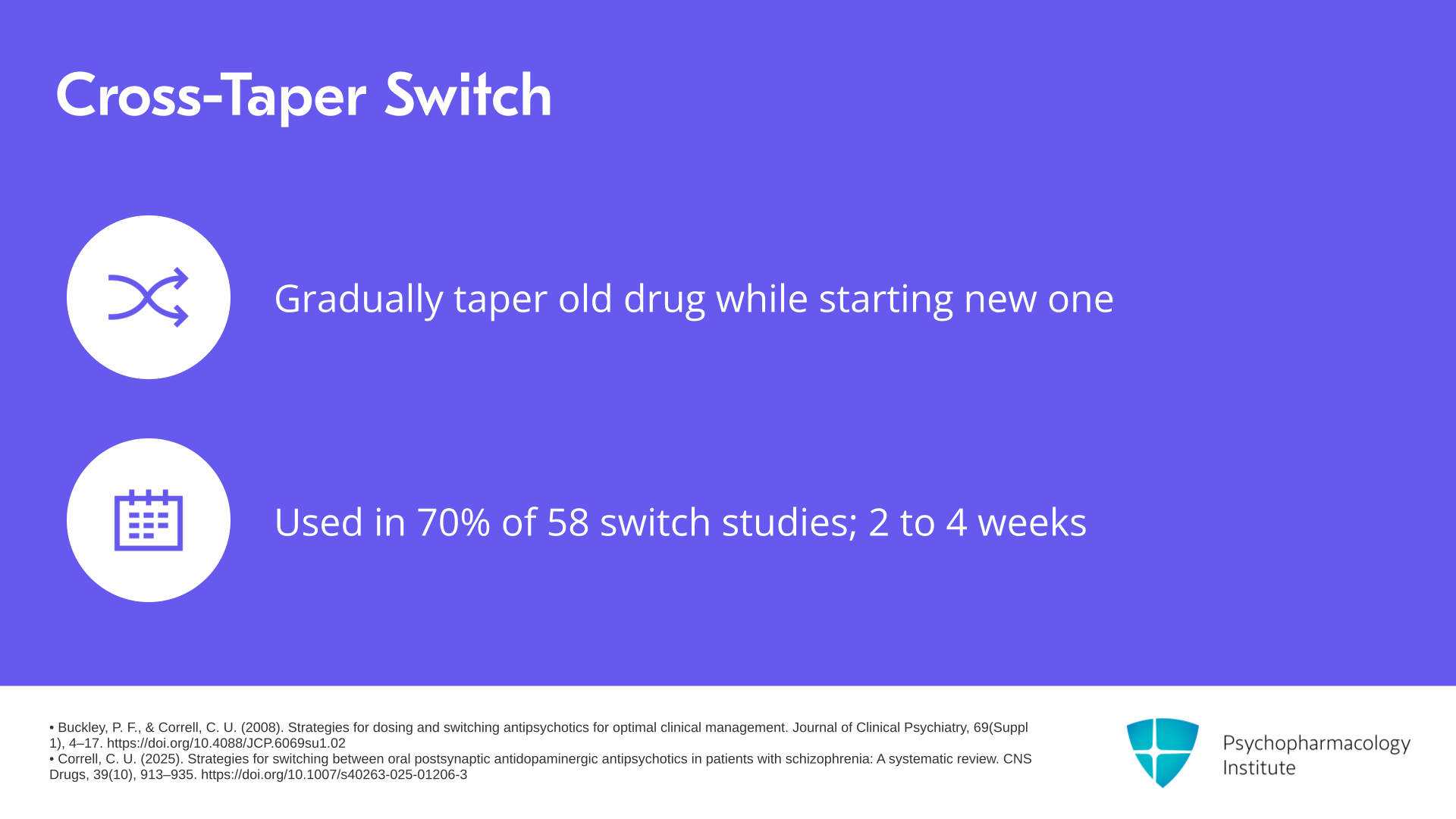
The second strategy would be the so-called cross-taper switch, where we gradually taper the pre-switch antipsychotic and simultaneously gradually start and titrate the new antipsychotic. This is considered the safest way to prevent illness relapse when switching although drug-drug interactions are still possible. The cross-taper switch is recommended by most experts. The evidence of that, we have a systematic review of 58 switch studies and this was the method used in 70% of such switch trials. So the general convention is that a typical time period for a switch might be two to four weeks for the cross-taper.
References:
- Buckley, P. F., & Correll, C. U. (2008). Strategies for dosing and switching antipsychotics for optimal clinical management. Journal of Clinical Psychiatry, 69(Suppl 1), 4–17. https://doi.org/10.4088/JCP.6069su1.02
- Correll, C. U. (2025). Strategies for switching between oral postsynaptic antidopaminergic antipsychotics in patients with schizophrenia: A systematic review. CNS Drugs, 39(10), 913–935. https://doi.org/10.1007/s40263-025-01206-3
Slide 4 of 14
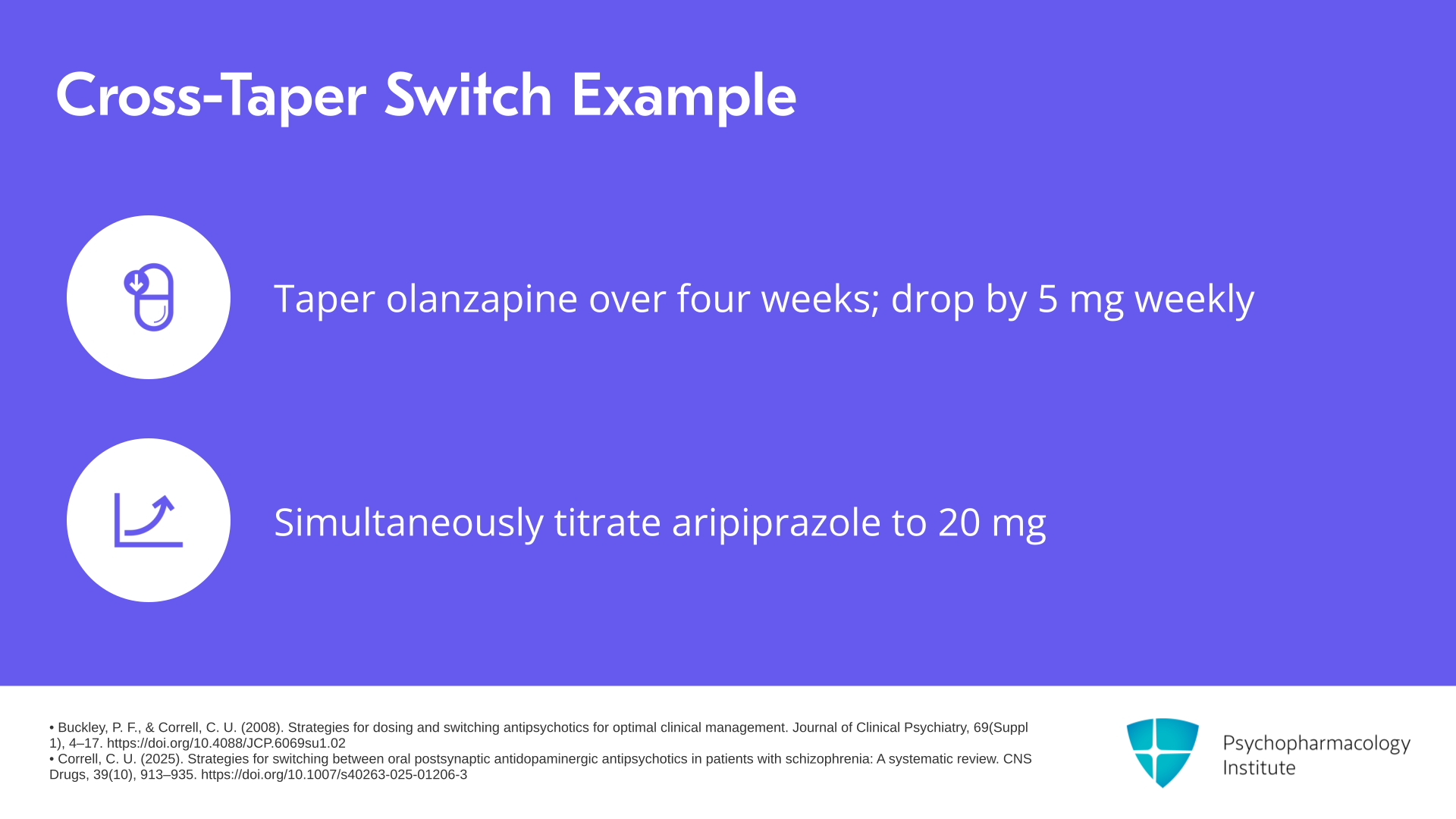
So for example, we have a patient taking 20 mg of olanzapine at baseline. We decided to switch to aripiprazole over a period of about three or four weeks. So one approach would be to taper off the olanzapine dropping the dose by 5 mg to 15 on week 1, 10 on week 2, 5 on week 3 and then discontinuing olanzapine on week 4. And then on the flipside, we might start aripiprazole at 5 mg on week 1, increase to 10 on week 2, 15 on week 3 and then maybe even up to a target dose of 20 mg on week 4. So that is the gradual cross-taper switch.
References:
- Buckley, P. F., & Correll, C. U. (2008). Strategies for dosing and switching antipsychotics for optimal clinical management. Journal of Clinical Psychiatry, 69(Suppl 1), 4–17. https://doi.org/10.4088/JCP.6069su1.02
- Correll, C. U. (2025). Strategies for switching between oral postsynaptic antidopaminergic antipsychotics in patients with schizophrenia: A systematic review. CNS Drugs, 39(10), 913–935. https://doi.org/10.1007/s40263-025-01206-3
Free Files
Download PDF and other files
Success!
Check your inbox, we sent you all the materials there.
Slide 5 of 14
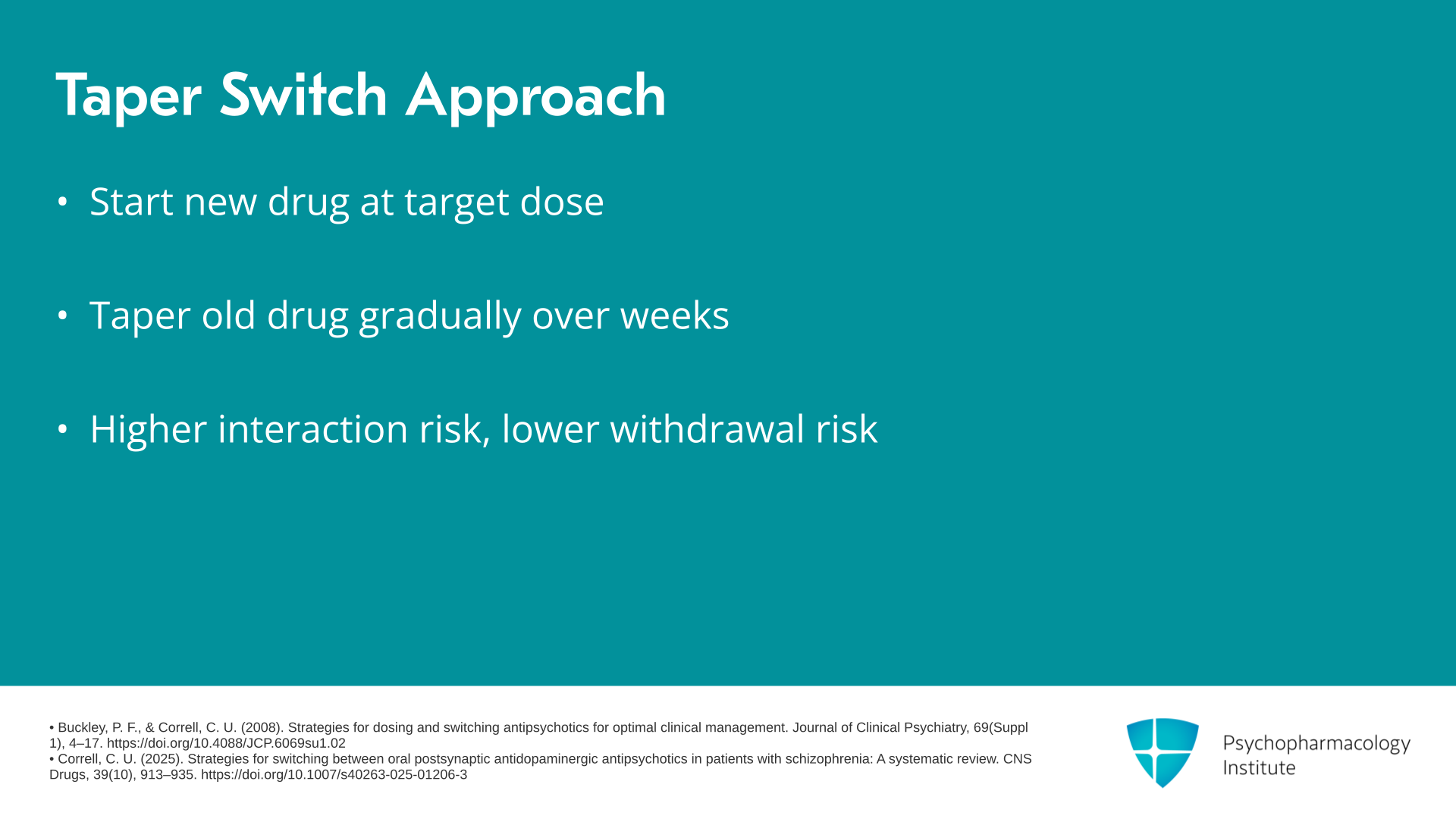
A third approach would be termed the taper switch, which involves immediately starting the new antipsychotic at its target dose and then gradually discontinuing the pre-switch antipsychotic. Building off our previous example, if we were switching from olanzapine to aripiprazole utilizing the taper switch, we would start 20 mg of aripiprazole immediately and then taper off the olanzapine by 5 mg per week over a period of about four weeks. So compared to the cross-taper switch, the taper switch has a higher risk of drug-drug interactions but potentially less risk of withdrawal symptoms.
References:
- Buckley, P. F., & Correll, C. U. (2008). Strategies for dosing and switching antipsychotics for optimal clinical management. Journal of Clinical Psychiatry, 69(Suppl 1), 4–17. https://doi.org/10.4088/JCP.6069su1.02
- Correll, C. U. (2025). Strategies for switching between oral postsynaptic antidopaminergic antipsychotics in patients with schizophrenia: A systematic review. CNS Drugs, 39(10), 913–935. https://doi.org/10.1007/s40263-025-01206-3
Slide 6 of 14
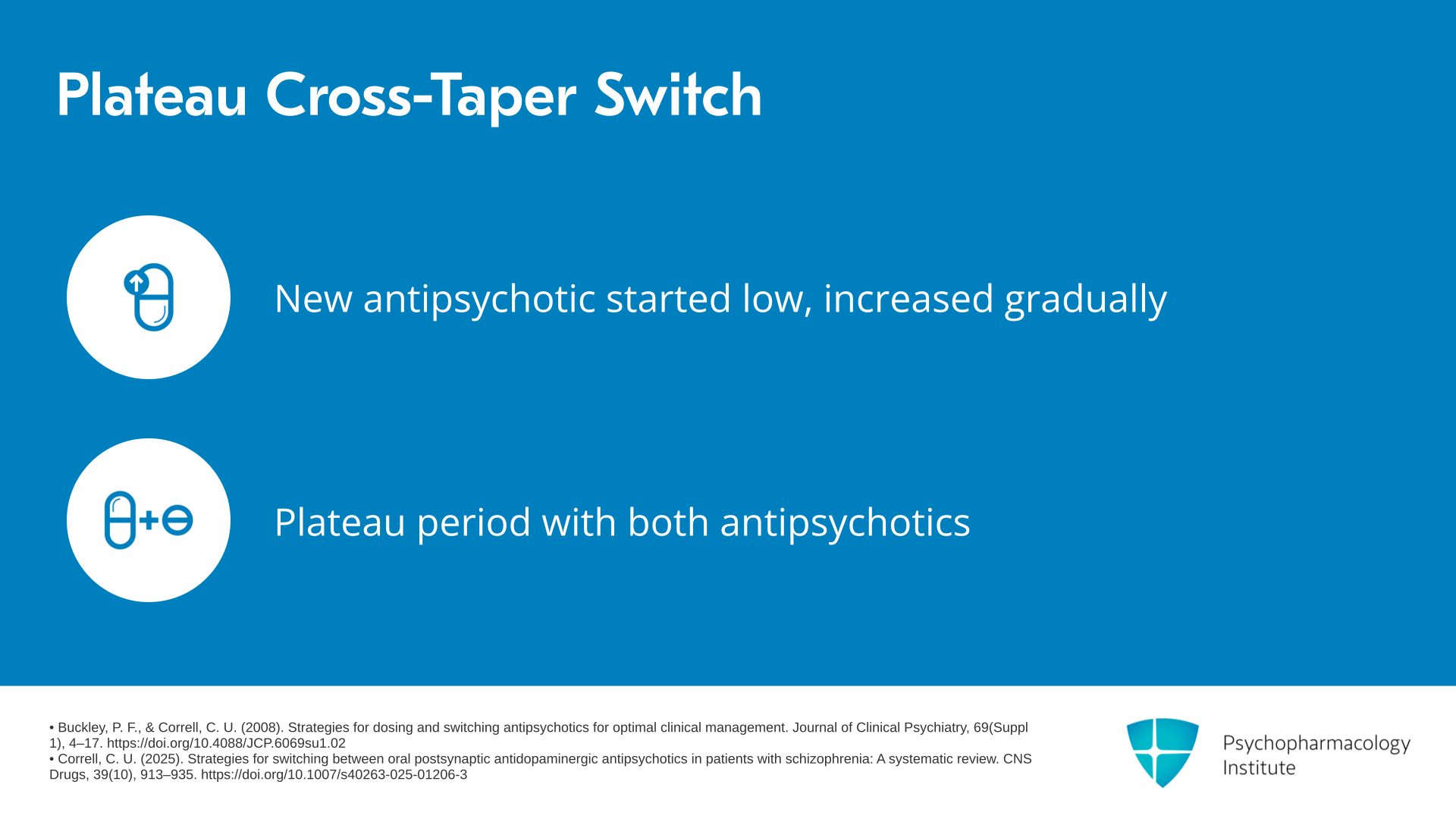
And then the fourth approach would be the so-called plateau cross-taper switch or the overlap and taper. This is a very common approach when we’re switching patients to clozapine. In this scenario, the new antipsychotic is started at a low dose and gradually increased and then eventually there’s a period where there’s a plateau and the patient is being treated with both the pre-switch and the new antipsychotic at the same time for a period and only then do we taper off the pre-switch antipsychotic. It’s not uncommon that when switching to clozapine, for example, a patient is continued on the pre-switch antipsychotic as we begin to increase the dose of clozapine and only after we get to doses in the range of 100 to 200 mg of clozapine do we start tapering the patient off of the pre-switch antipsychotic.
References:
- Buckley, P. F., & Correll, C. U. (2008). Strategies for dosing and switching antipsychotics for optimal clinical management. Journal of Clinical Psychiatry, 69(Suppl 1), 4–17. https://doi.org/10.4088/JCP.6069su1.02
- Correll, C. U. (2025). Strategies for switching between oral postsynaptic antidopaminergic antipsychotics in patients with schizophrenia: A systematic review. CNS Drugs, 39(10), 913–935. https://doi.org/10.1007/s40263-025-01206-3
Free Files
Download PDF and other files
Success!
Check your inbox, we sent you all the materials there.
Slide 7 of 14
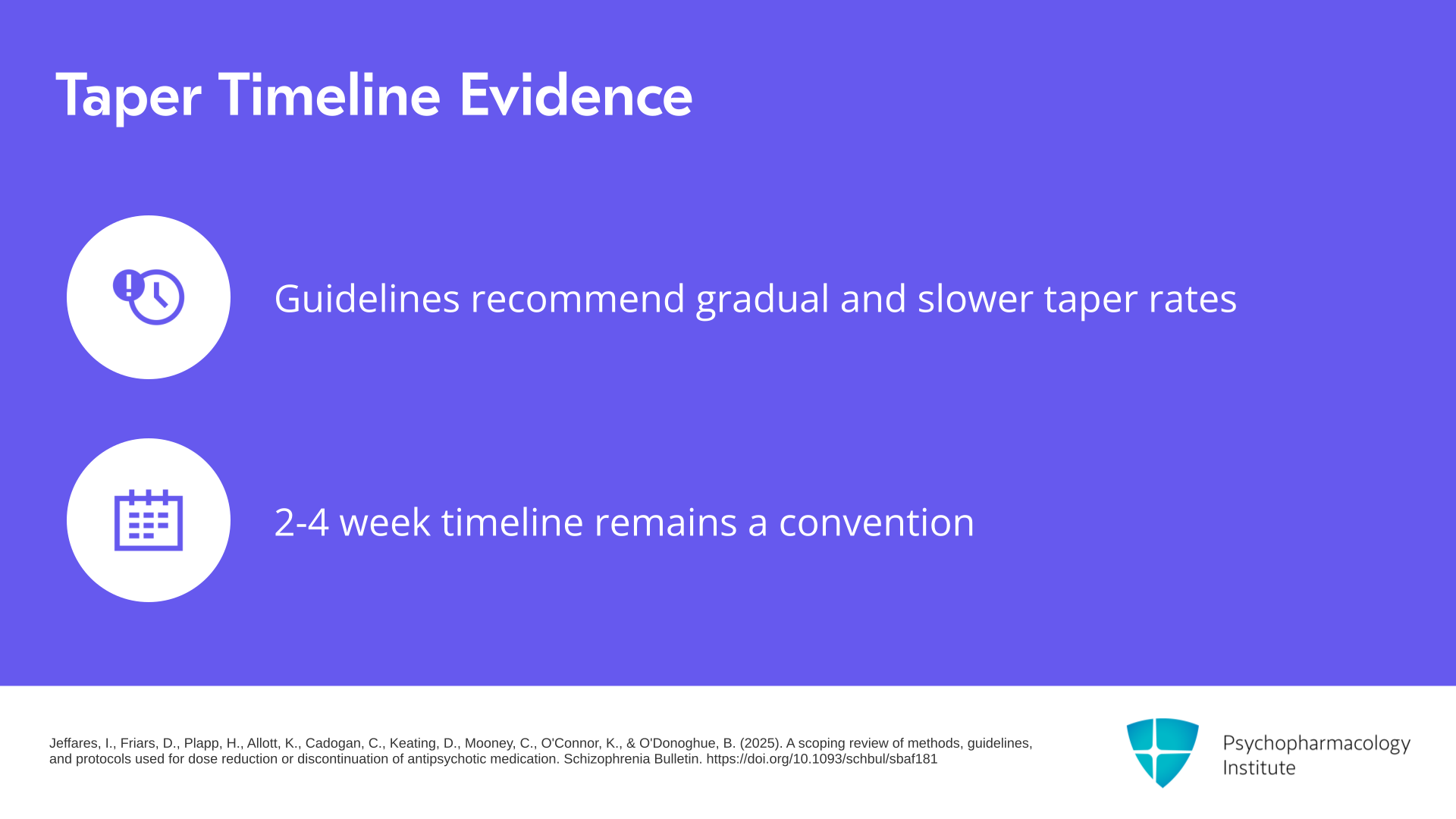
Now, I mentioned earlier the notion of a two- to four-week time period for the cross-taper switch and it’s important to ask, is that convention evidence based? And so interestingly, a 2025 scoping review of 32 studies of antipsychotic dose reduction or discontinuation in patients with psychosis included two practice guidelines. And interestingly, both of these guidelines actually recommended a longer, more gradual taper rate on the order of 10% per month or even 20% every six months. Neither of these guidelines clarified whether the percentage applied to the original antipsychotic dose or the current dose. Therefore, the two- to four-week timeline is therefore really just a convention. It does remain a reasonable default time period but patients and clinicians should be aware of its evidentiary status. So for patients who have poor tolerability of this approach, clinicians should consider a longer, more gradual taper as that may be warranted.
References:
- Jeffares, I., Friars, D., Plapp, H., Allott, K., Cadogan, C., Keating, D., Mooney, C., O'Connor, K., & O'Donoghue, B. (2025). A scoping review of methods, guidelines, and protocols used for dose reduction or discontinuation of antipsychotic medication. Schizophrenia Bulletin. https://doi.org/10.1093/schbul/sbaf181
Slide 8 of 14
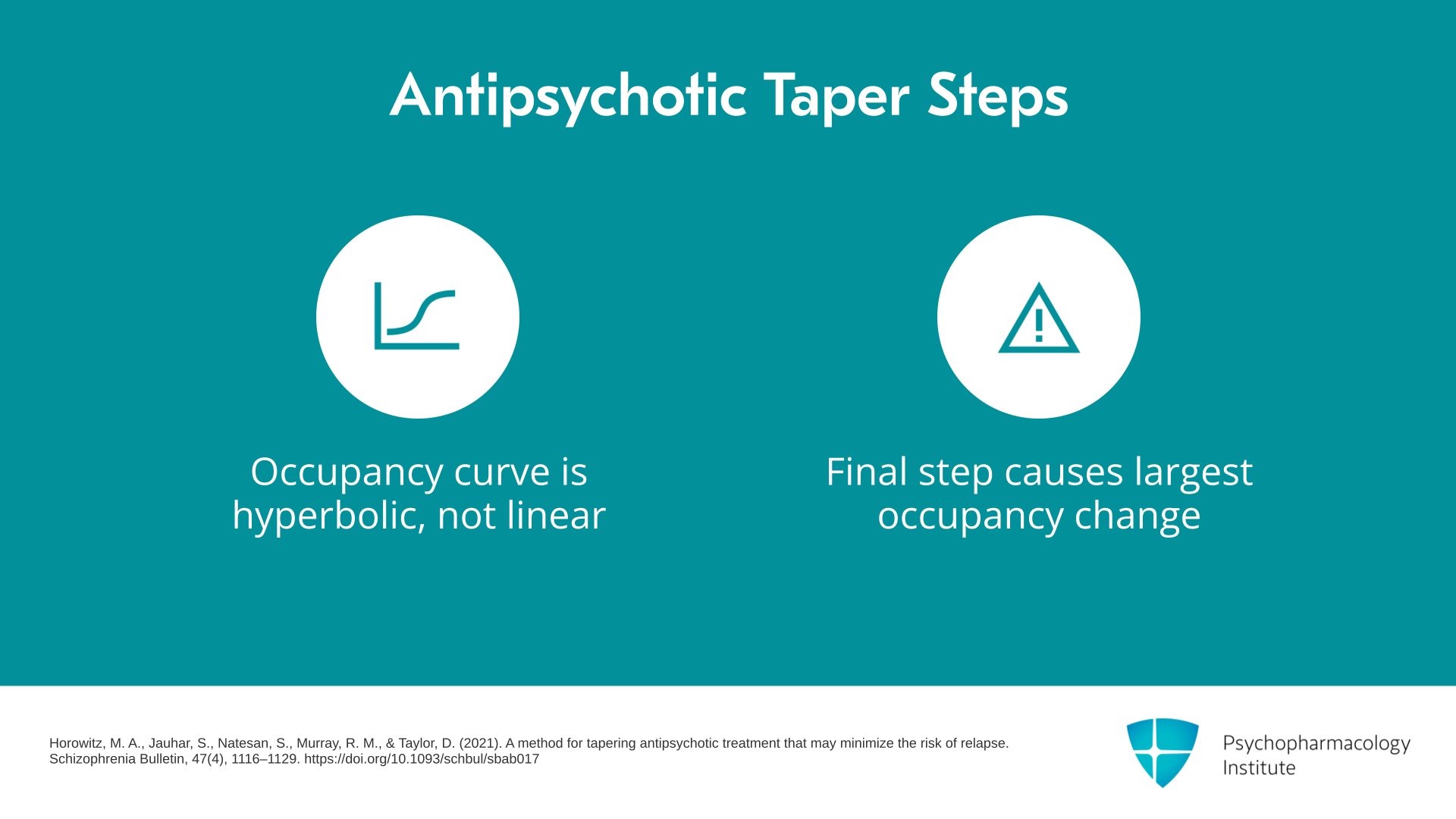
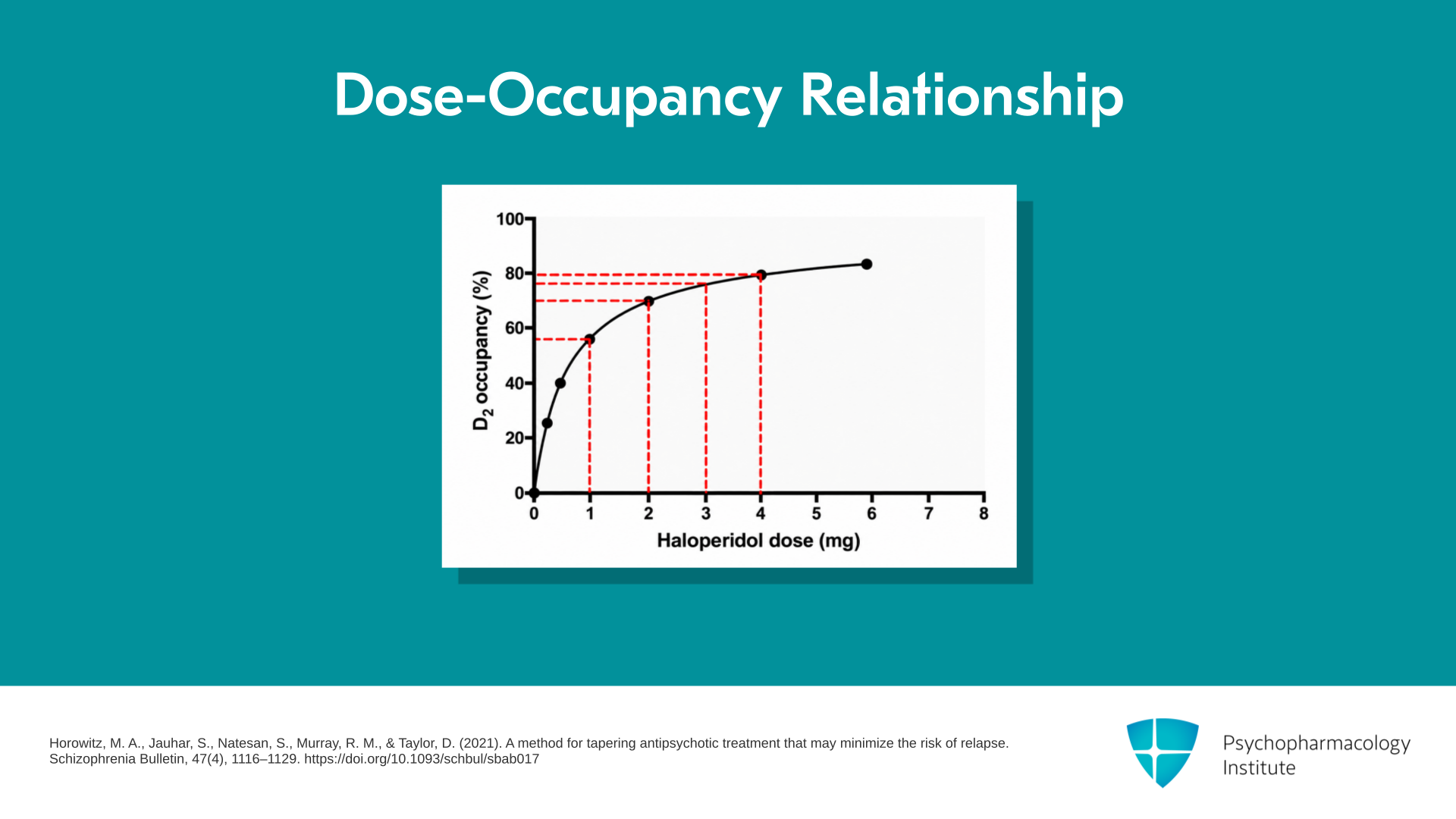
Another important question here is, do equal dose reduction steps produce equal effects during an antipsychotic taper? So because the antipsychotic dose to D2 receptor occupancy curve is hyperbolic, linear decreases in dose actually produce accelerating decreases in D2 receptor occupancy. So in other words, the final step of discontinuation, so going from 5 mg to 0 mg of olanzapine, actually results in the largest percent change of D2 receptor occupancy actually when the new antipsychotic may not yet be at steady state.
References:
- Horowitz, M. A., Jauhar, S., Natesan, S., Murray, R. M., & Taylor, D. (2021). A method for tapering antipsychotic treatment that may minimize the risk of relapse. Schizophrenia Bulletin, 47(4), 1116–1129. https://doi.org/10.1093/schbul/sbab017
Free Files
Download PDF and other files
Success!
Check your inbox, we sent you all the materials there.
Slide 9 of 14
So for example, here, as you can see in the chart, if a patient is on 4 mg of haloperidol, that’s associated with a D2 receptor occupancy of about 80%. If we decrease that to 3 mg, we’re still looking at a D2 receptor occupancy in the 70s. By contrast, when we go from 1 mg of haloperidol to 0, we’re dropping D2 receptor occupancy from 55% approximately to 0.
References:
- Horowitz, M. A., Jauhar, S., Natesan, S., Murray, R. M., & Taylor, D. (2021). A method for tapering antipsychotic treatment that may minimize the risk of relapse. Schizophrenia Bulletin, 47(4), 1116–1129. https://doi.org/10.1093/schbul/sbab017
Slide 10 of 14
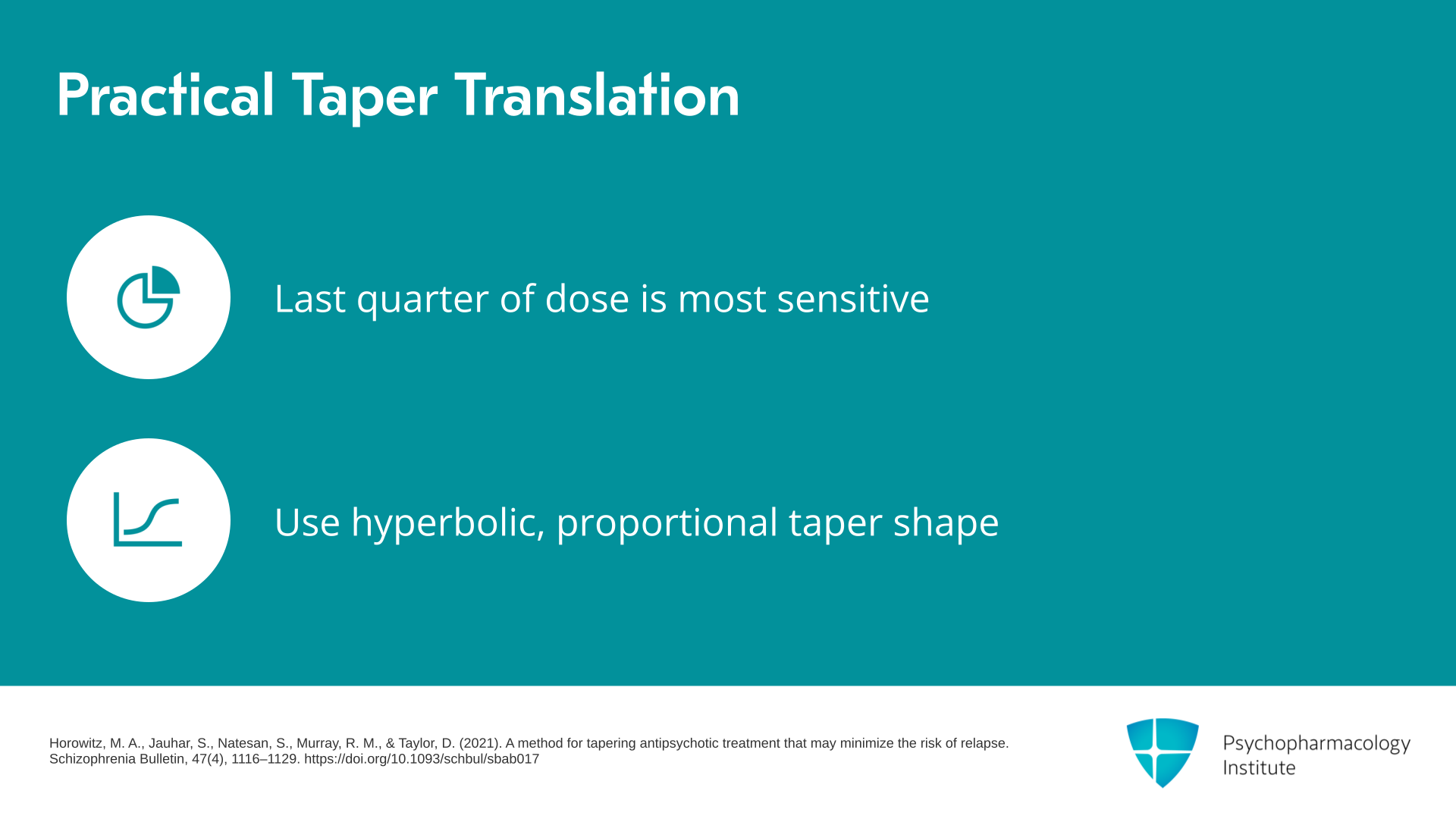
So what’s the practical translation here for the cross-taper? Clinicians should treat the last quarter of the outgoing dose as potentially the most sensitive part of the switch. So Horowitz and colleagues in 2021 recommended the hyperbolic or this proportional shape for all tapers with a step size and interval that is individualized for more sensitive patients.
References:
- Horowitz, M. A., Jauhar, S., Natesan, S., Murray, R. M., & Taylor, D. (2021). A method for tapering antipsychotic treatment that may minimize the risk of relapse. Schizophrenia Bulletin, 47(4), 1116–1129. https://doi.org/10.1093/schbul/sbab017
Free Files
Download PDF and other files
Success!
Check your inbox, we sent you all the materials there.
Slide 11 of 14
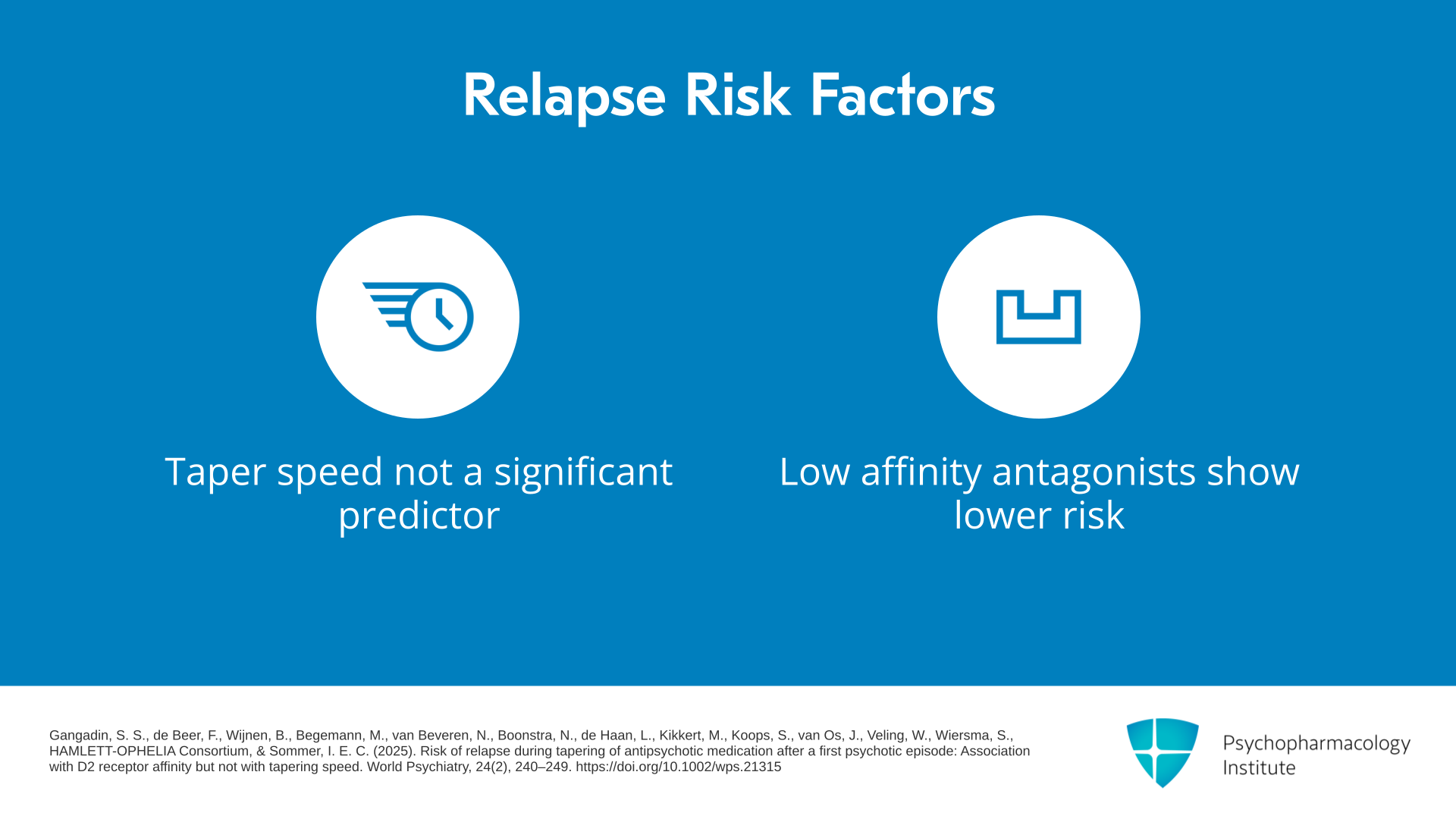
Another important related question here is regarding relapse risk. Does the speed of antipsychotic taper drive the relapse risk or is it something else? So in a study of 227 first-episode patients who tapered antipsychotic medication after remission, the average taper speed was not a significant predictor of relapse. What was, was actually the D2 receptor affinity of the antipsychotic. So compared to patients taking high affinity D2 receptor antagonists, patients taking low D2 affinity antagonist or D2 partial agonist had a roughly 1/2 lower risk of relapse. So now, it’s important to note that this study tested the average taper speed, not the shape of the taper nor the final step size which could be relevant to the hyperbolic argument.
References:
- Gangadin, S. S., de Beer, F., Wijnen, B., Begemann, M., van Beveren, N., Boonstra, N., de Haan, L., Kikkert, M., Koops, S., van Os, J., Veling, W., Wiersma, S., HAMLETT-OPHELIA Consortium, & Sommer, I. E. C. (2025). Risk of relapse during tapering of antipsychotic medication after a first psychotic episode: Association with D2 receptor affinity but not with tapering speed. World Psychiatry, 24(2), 240–249. https://doi.org/10.1002/wps.21315
Slide 12 of 14
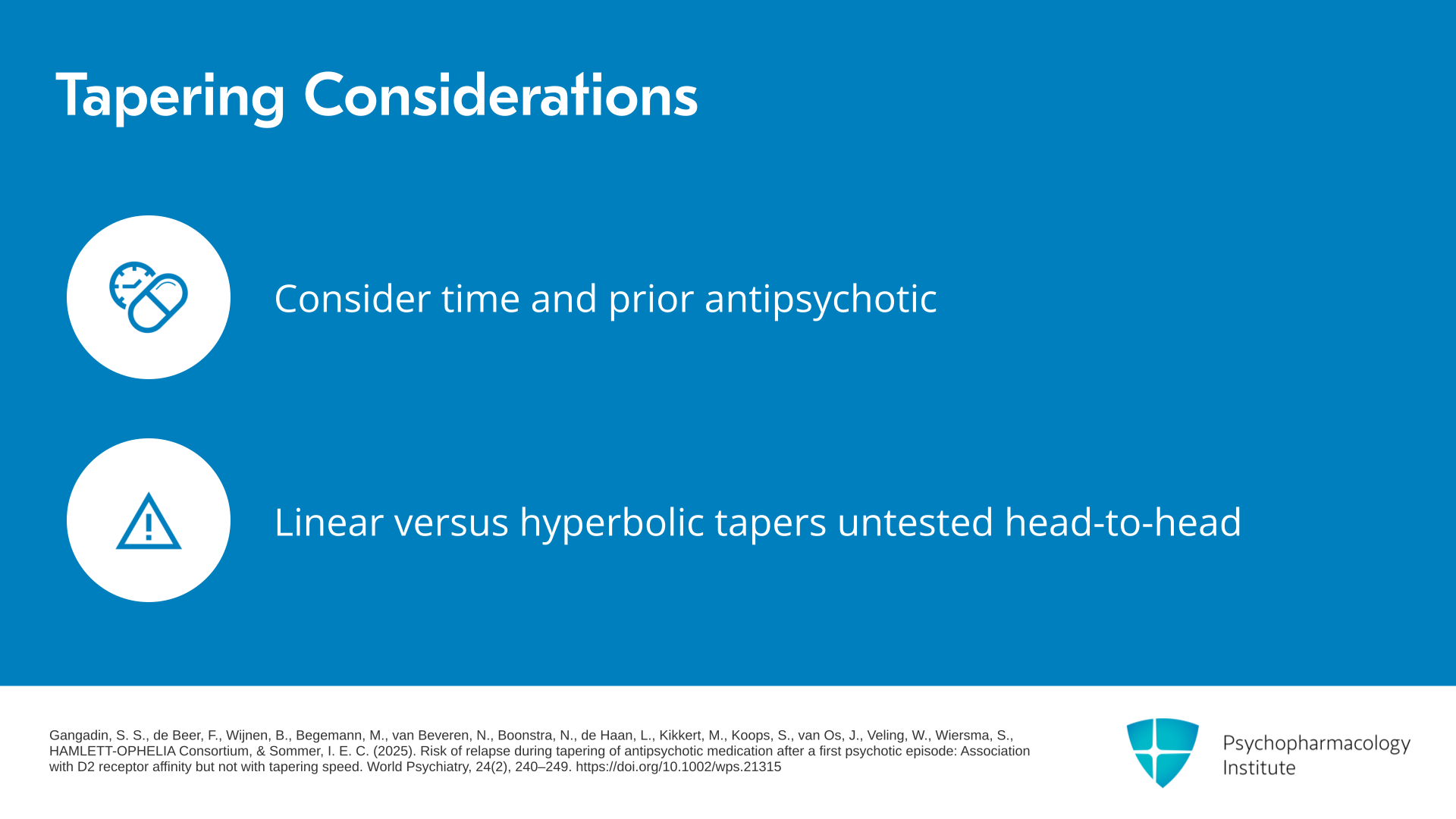
So what’s the clinical implication here? Both time and the pre-switch antipsychotic are factors that should be considered when tapering. So coming off haloperidol or risperidone may be a clinically different problem than coming off quetiapine or aripiprazole, for example. And this is the current state of ambiguity in the field. So findings regarding taper speed and D2 receptor affinity are intention rather than contradiction. And importantly, no trials have directly continued linear versus hyperbolic antipsychotic tapers head-to-head.
References:
- Gangadin, S. S., de Beer, F., Wijnen, B., Begemann, M., van Beveren, N., Boonstra, N., de Haan, L., Kikkert, M., Koops, S., van Os, J., Veling, W., Wiersma, S., HAMLETT-OPHELIA Consortium, & Sommer, I. E. C. (2025). Risk of relapse during tapering of antipsychotic medication after a first psychotic episode: Association with D2 receptor affinity but not with tapering speed. World Psychiatry, 24(2), 240–249. https://doi.org/10.1002/wps.21315
Free Files
Download PDF and other files
Success!
Check your inbox, we sent you all the materials there.
Slide 13 of 14
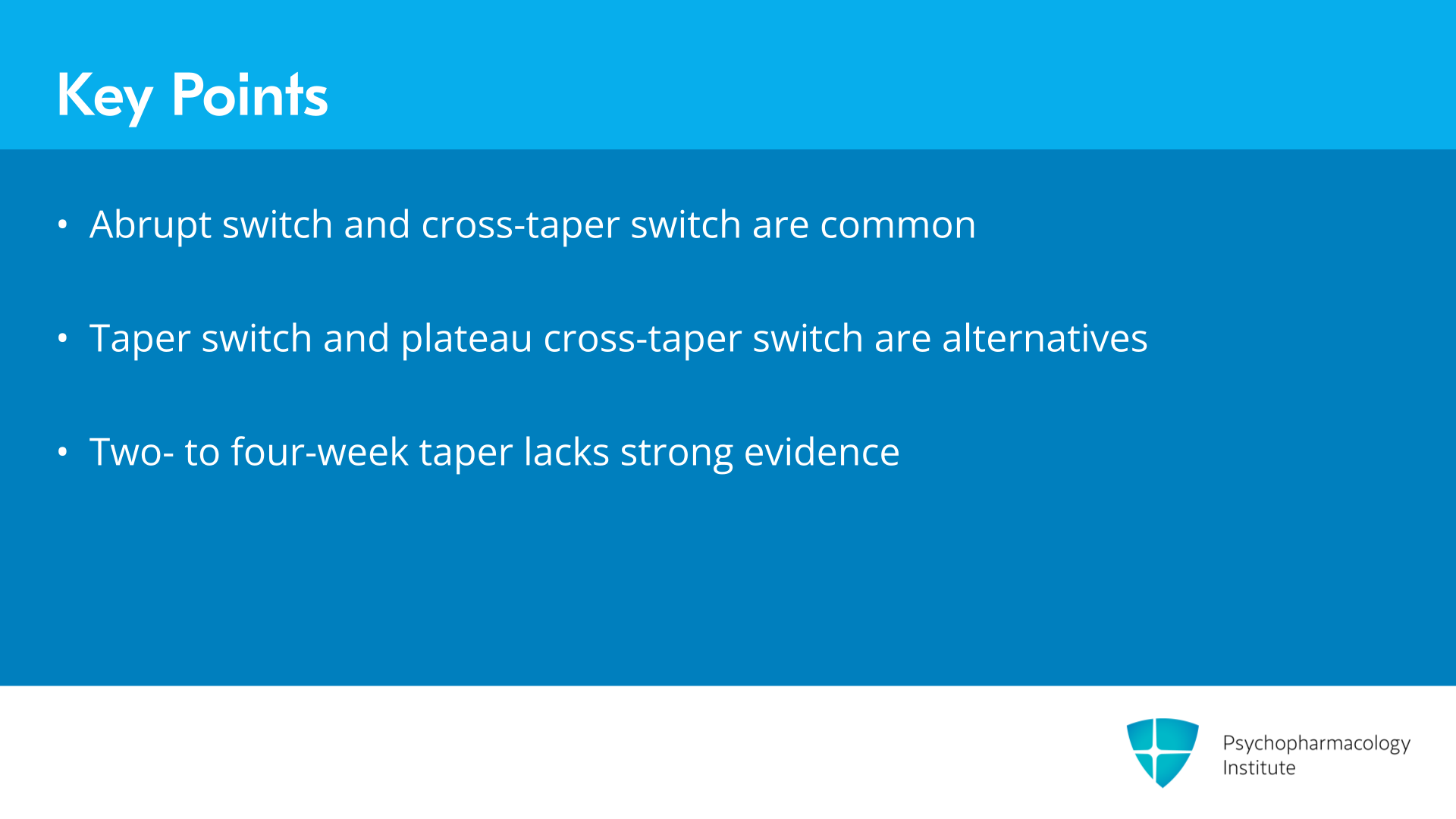
Here are the key points for this section. Common switch strategies include the abrupt switch and the cross-taper switch. Other potential strategies are the taper switch and the plateau cross-taper switch. The two- to four-week antipsychotic taper is the default convention but not an explicit evidence-based approach.
Slide 14 of 14
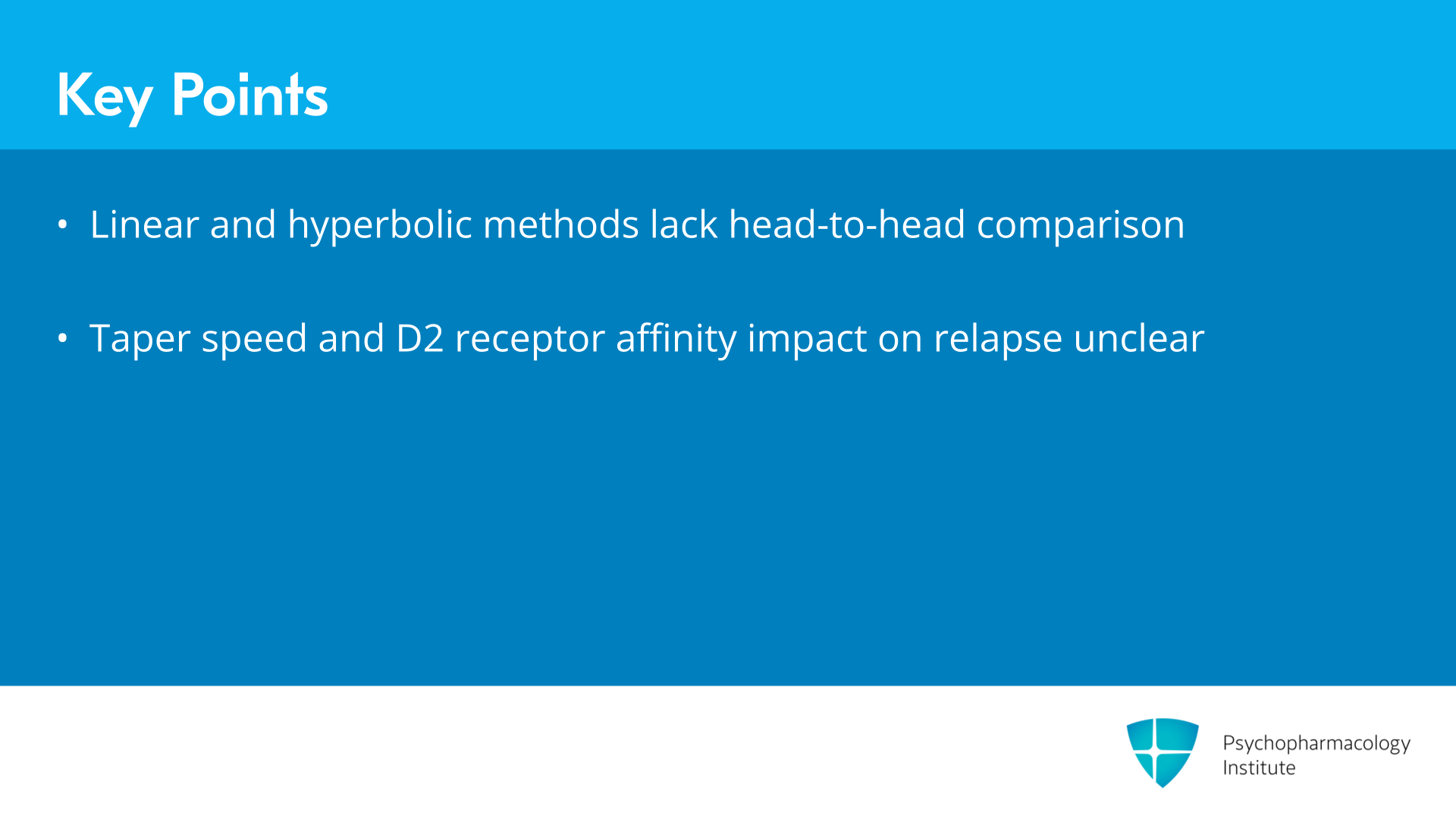
Approaches to antipsychotic tapering including the linear and hyperbolic method, these approaches have not been compared head-to-head. When tapering antipsychotics, the relative contributions of taper speed and D2 receptor affinity on relapse risk are unclear.
Free Files
Download PDF and other files
Success!
Check your inbox, we sent you all the materials there.