Slides and Transcript
Slide 1 of 21
In this section, we will talk about Z-drugs and benzodiazepine-hypnotics emphasizing risks, warnings and tapering as well.
Slide 2 of 21
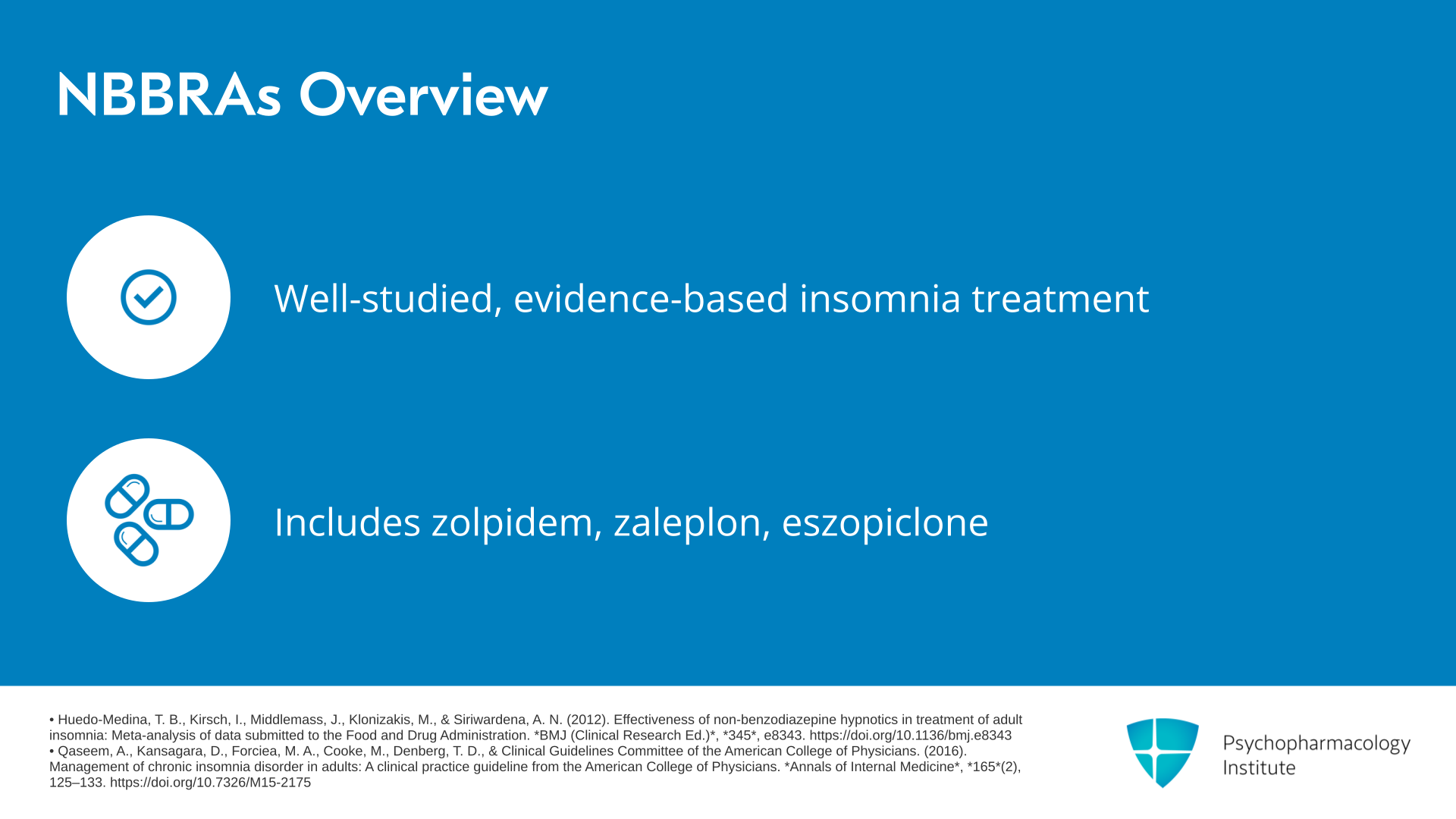
NBBRAs or non-benzodiazepine benzodiazepine receptor agonists, these are the Z-drugs, are well-studied, evidence-based pharmacological options for chronic insomnia disorder which can still be offered as first line in the appropriate patient. These include zolpidem and its derivatives, zaleplon and eszopiclone.
References:
- Huedo-Medina, T. B., Kirsch, I., Middlemass, J., Klonizakis, M., & Siriwardena, A. N. (2012). Effectiveness of non-benzodiazepine hypnotics in treatment of adult insomnia: Meta-analysis of data submitted to the Food and Drug Administration. *BMJ (Clinical Research Ed.)*, *345*, e8343. https://doi.org/10.1136/bmj.e8343
- Qaseem, A., Kansagara, D., Forciea, M. A., Cooke, M., Denberg, T. D., & Clinical Guidelines Committee of the American College of Physicians. (2016). Management of chronic insomnia disorder in adults: A clinical practice guideline from the American College of Physicians. *Annals of Internal Medicine*, *165*(2), 125–133. https://doi.org/10.7326/M15-2175
Free Files
Download PDF and other files
Success!
Check your inbox, we sent you all the materials there.
Slide 3 of 21
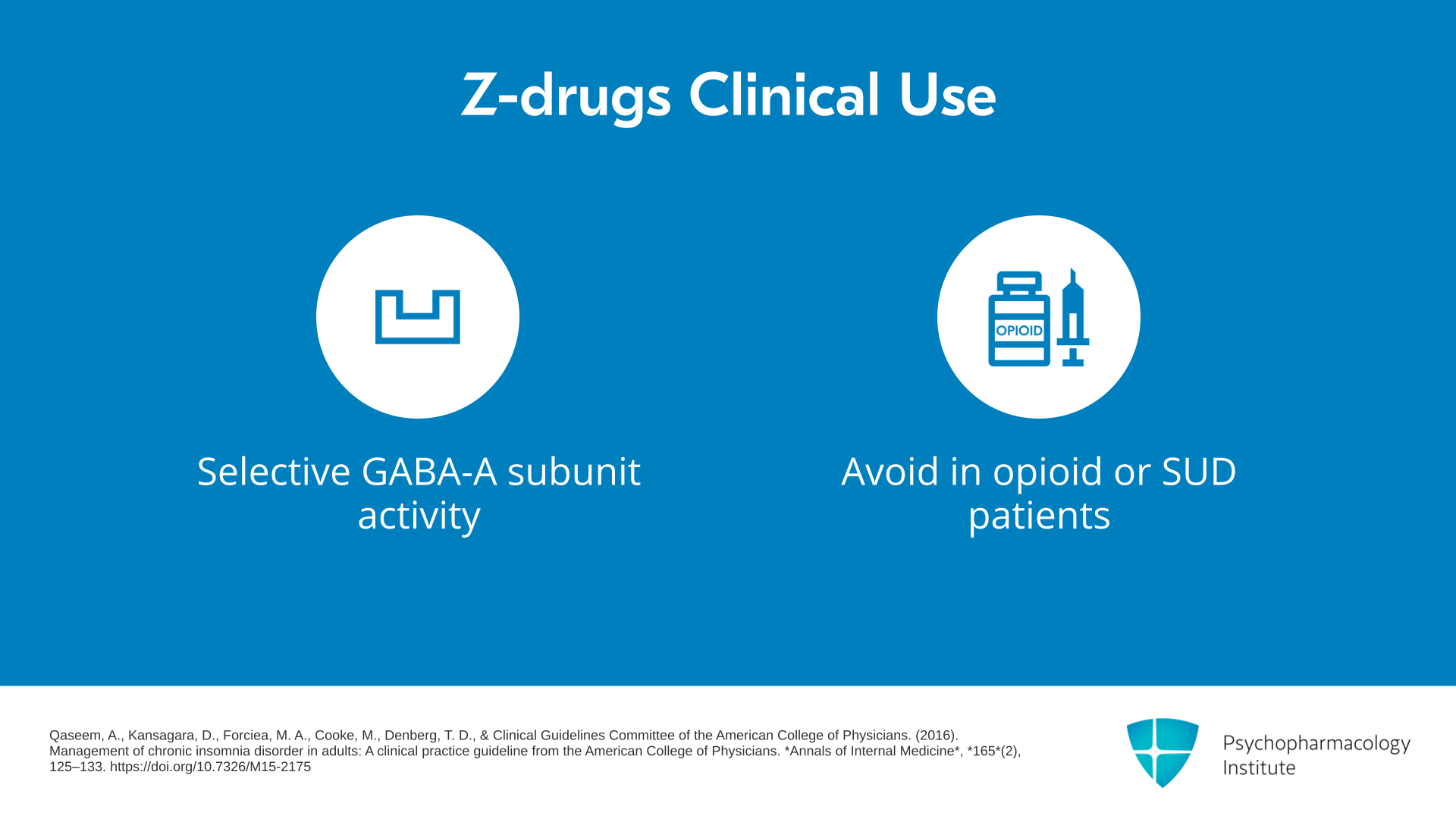
These Z-drugs have a greater selectivity for certain GABA-A subunits and therefore have less abuse potential and really no muscle relaxation properties at least in therapeutic doses. They should be avoided in patients currently on opioid medication. Z-drugs should be prescribed only after exhausting other pharmacological options in patients with a recent substance use disorder.
References:
- Qaseem, A., Kansagara, D., Forciea, M. A., Cooke, M., Denberg, T. D., & Clinical Guidelines Committee of the American College of Physicians. (2016). Management of chronic insomnia disorder in adults: A clinical practice guideline from the American College of Physicians. *Annals of Internal Medicine*, *165*(2), 125–133. https://doi.org/10.7326/M15-2175
Slide 4 of 21
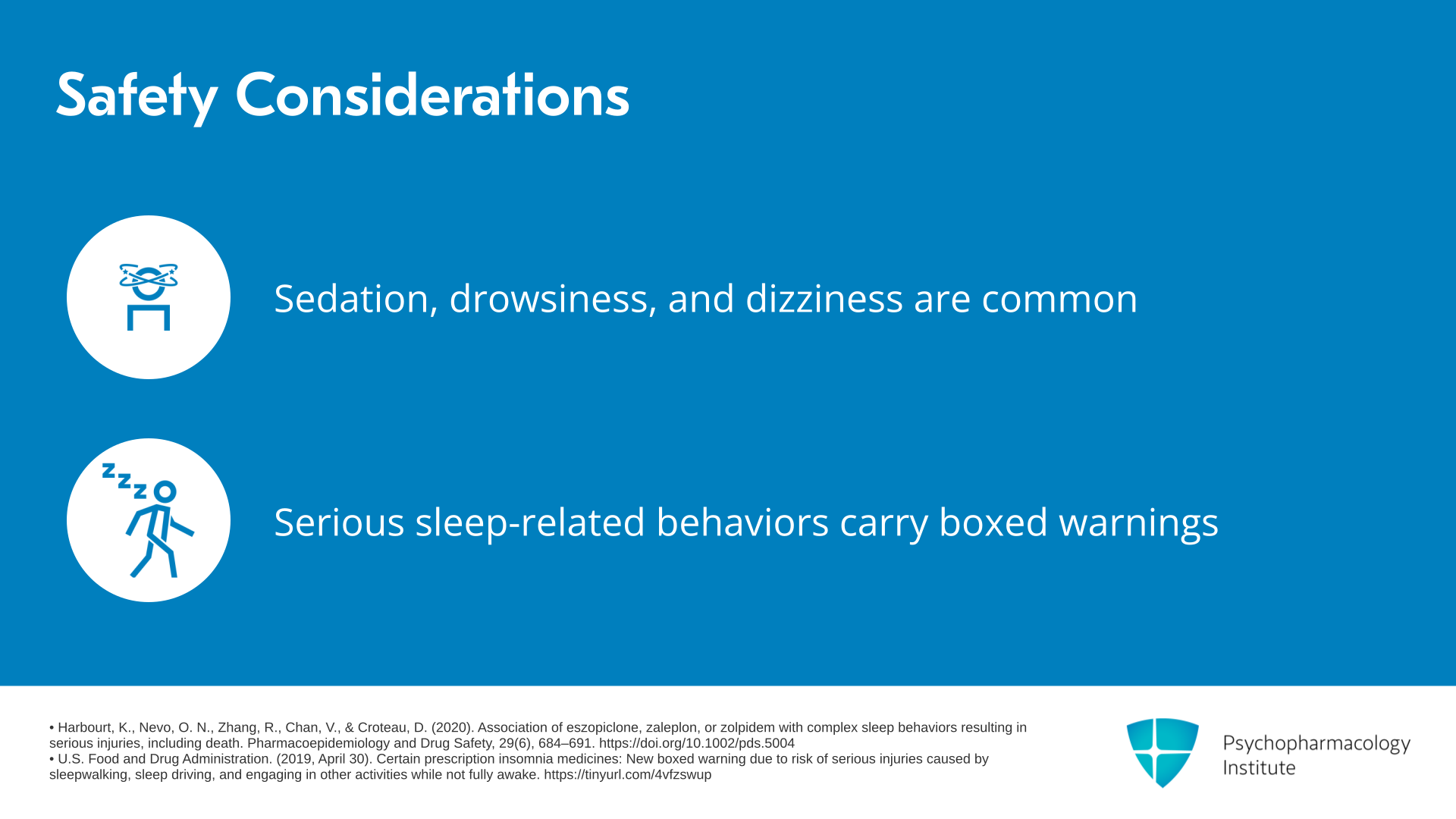
Common side effects for all of these drugs include sedation, drowsiness and dizziness. The FDA boxed warnings are for serious, complex sleep-related behaviors occurring at night and for combined use with opioids.
References:
- Harbourt, K., Nevo, O. N., Zhang, R., Chan, V., & Croteau, D. (2020). Association of eszopiclone, zaleplon, or zolpidem with complex sleep behaviors resulting in serious injuries, including death. Pharmacoepidemiology and Drug Safety, 29(6), 684–691. https://doi.org/10.1002/pds.5004
- U.S. Food and Drug Administration. (2019, April 30). Certain prescription insomnia medicines: New boxed warning due to risk of serious injuries caused by sleepwalking, sleep driving, and engaging in other activities while not fully awake. https://tinyurl.com/4vfzswup
Free Files
Download PDF and other files
Success!
Check your inbox, we sent you all the materials there.
Slide 5 of 21
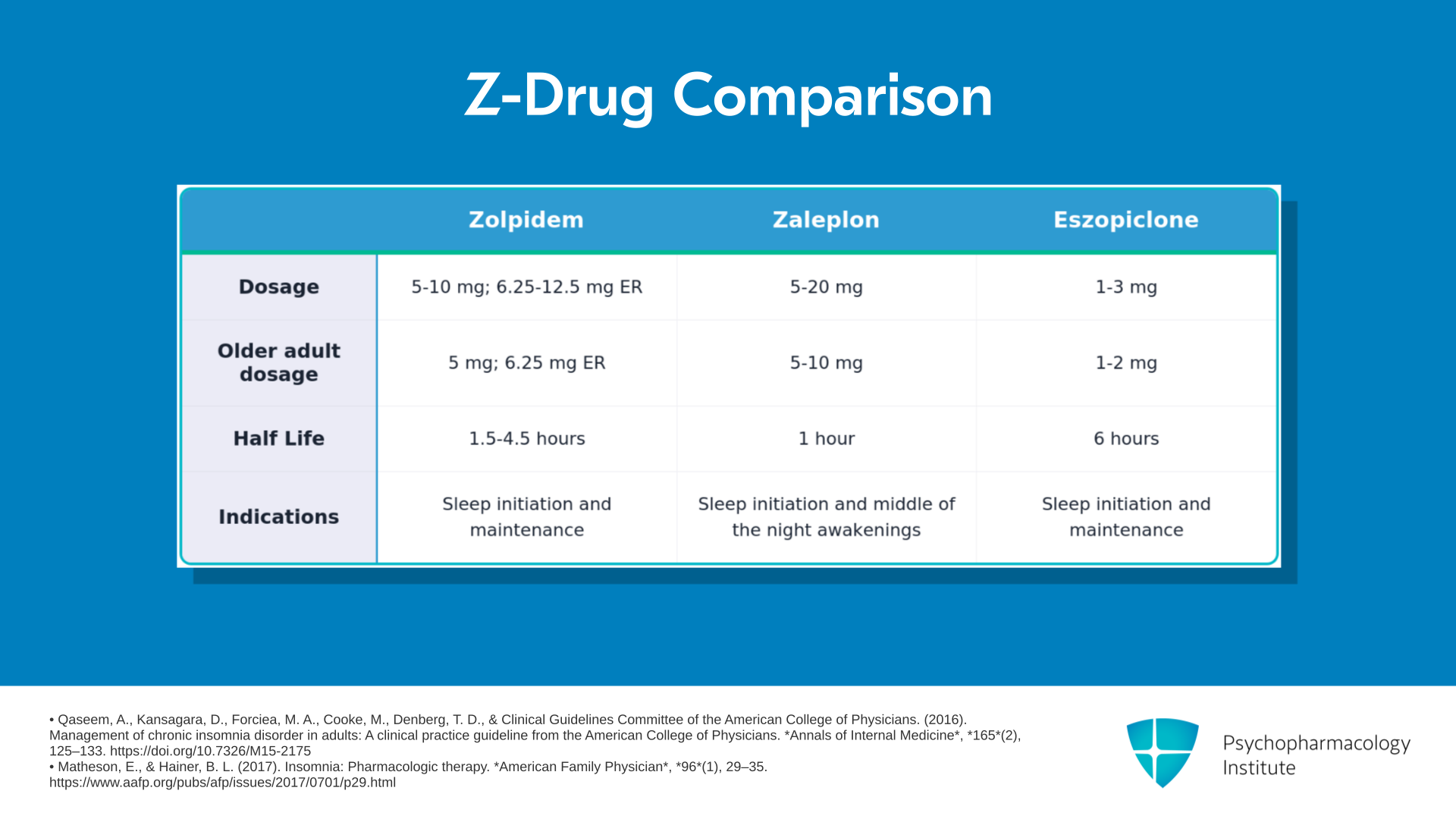
In this table, you can compare the doses of zolpidem, zaleplon, eszopiclone as well as recommended dosage in older adults which is usually half for zolpidem and zaleplon and slightly less than the maximum 3 mg for eszopiclone. The half-life is longest for eszopiclone of about six hours. Zaleplon is extremely short acting at 1 hour and zolpidem has a half-life of between 1.5 to 4.5 hours. And based on these half-lives, you can see that zaleplon is used for sleep initiation or middle of the night awakening, while zolpidem and eszopiclone can be used for both sleep initiation and maintenance.
References:
- Qaseem, A., Kansagara, D., Forciea, M. A., Cooke, M., Denberg, T. D., & Clinical Guidelines Committee of the American College of Physicians. (2016). Management of chronic insomnia disorder in adults: A clinical practice guideline from the American College of Physicians. *Annals of Internal Medicine*, *165*(2), 125–133. https://doi.org/10.7326/M15-2175
- Matheson, E., & Hainer, B. L. (2017). Insomnia: Pharmacologic therapy. *American Family Physician*, *96*(1), 29–35. https://www.aafp.org/pubs/afp/issues/2017/0701/p29.html
Slide 6 of 21
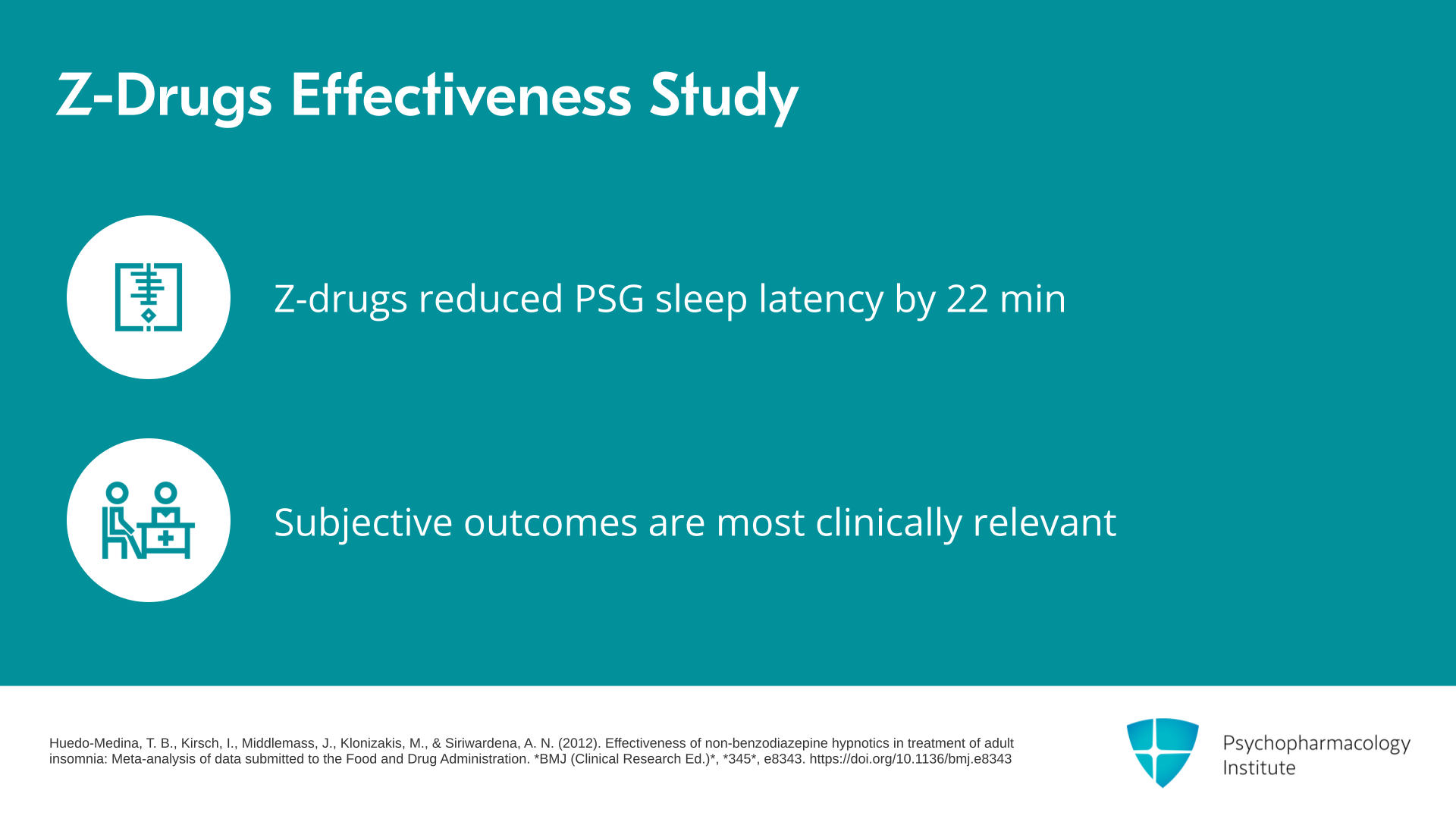
In this study which has compared both PSG and subjective findings in terms of sleep outcomes in patients taking Z-drugs as compared to placebo, they reported at least a 22-minute difference in polysomnographic sleep latency as compared to placebo and about 7-minute subjective sleep latency. There were also improvements in multiple secondary outcomes including wake after sleep onset, the number of awakenings both PSG and subjective, increase in total sleep time on PSG and sleep efficiency on the PSG. The difference between drug and placebo was 22 minutes for the polysomnographic sleep latency and 7 minutes for subjective sleep latency. However, subjective improvements are much more important than objective changes on PSG parameters especially since insomnia is a clinical diagnosis.
References:
- Huedo-Medina, T. B., Kirsch, I., Middlemass, J., Klonizakis, M., & Siriwardena, A. N. (2012). Effectiveness of non-benzodiazepine hypnotics in treatment of adult insomnia: Meta-analysis of data submitted to the Food and Drug Administration. *BMJ (Clinical Research Ed.)*, *345*, e8343. https://doi.org/10.1136/bmj.e8343
Free Files
Download PDF and other files
Success!
Check your inbox, we sent you all the materials there.
Slide 7 of 21
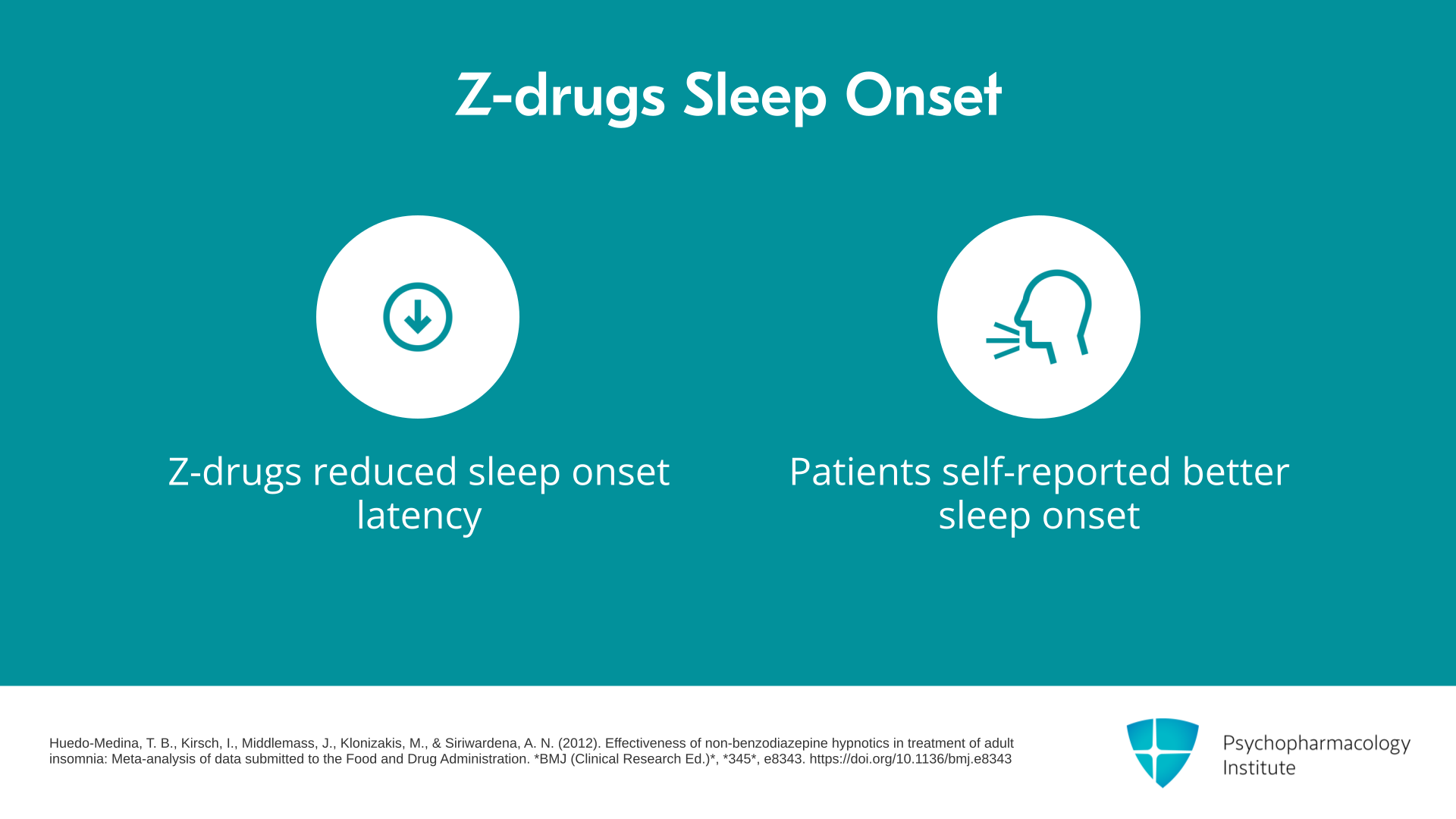
The Z-drugs were compared to placebo on sleep onset latency on the PSG and there is an improvement when it was objectively measured on the PSG. And when patients were also asked to self-report, there was a clear improvement in subjective or self-reported sleep onset latency.
References:
- Huedo-Medina, T. B., Kirsch, I., Middlemass, J., Klonizakis, M., & Siriwardena, A. N. (2012). Effectiveness of non-benzodiazepine hypnotics in treatment of adult insomnia: Meta-analysis of data submitted to the Food and Drug Administration. *BMJ (Clinical Research Ed.)*, *345*, e8343. https://doi.org/10.1136/bmj.e8343
Slide 8 of 21
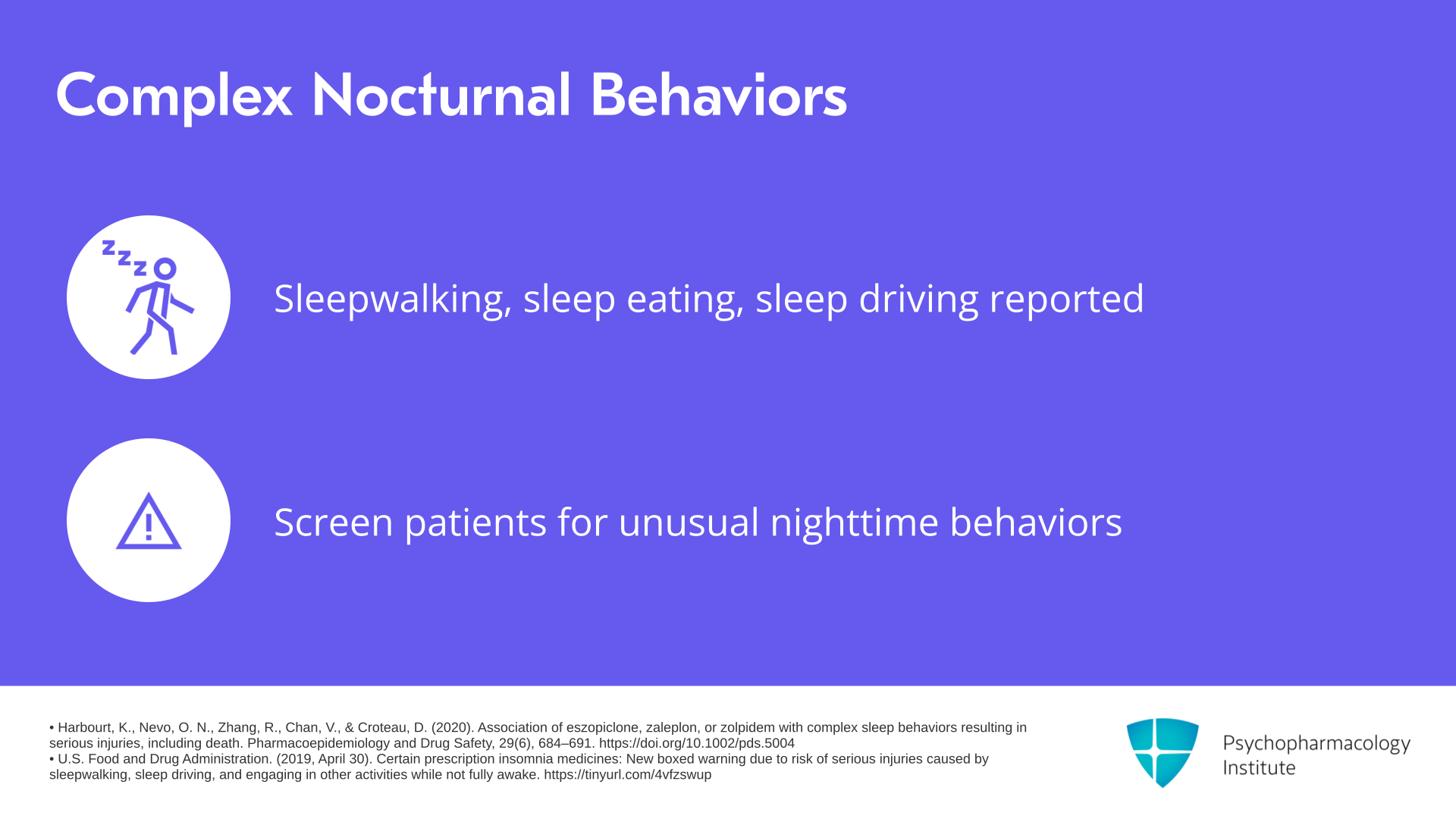
Common complex nocturnal behaviors occurring on Z-drugs include sleep walking, sleep eating and rarely sleep driving. Patients should always be asked about any unusual nighttime behaviors that have started to occur since starting on these medications. The FDA has issued boxed warning about the possibility of these complex nocturnal behaviors and recommend immediate discontinuation of this medication if these symptoms were to occur.
References:
- Harbourt, K., Nevo, O. N., Zhang, R., Chan, V., & Croteau, D. (2020). Association of eszopiclone, zaleplon, or zolpidem with complex sleep behaviors resulting in serious injuries, including death. Pharmacoepidemiology and Drug Safety, 29(6), 684–691. https://doi.org/10.1002/pds.5004
- U.S. Food and Drug Administration. (2019, April 30). Certain prescription insomnia medicines: New boxed warning due to risk of serious injuries caused by sleepwalking, sleep driving, and engaging in other activities while not fully awake. https://tinyurl.com/4vfzswup
Free Files
Download PDF and other files
Success!
Check your inbox, we sent you all the materials there.
Slide 9 of 21
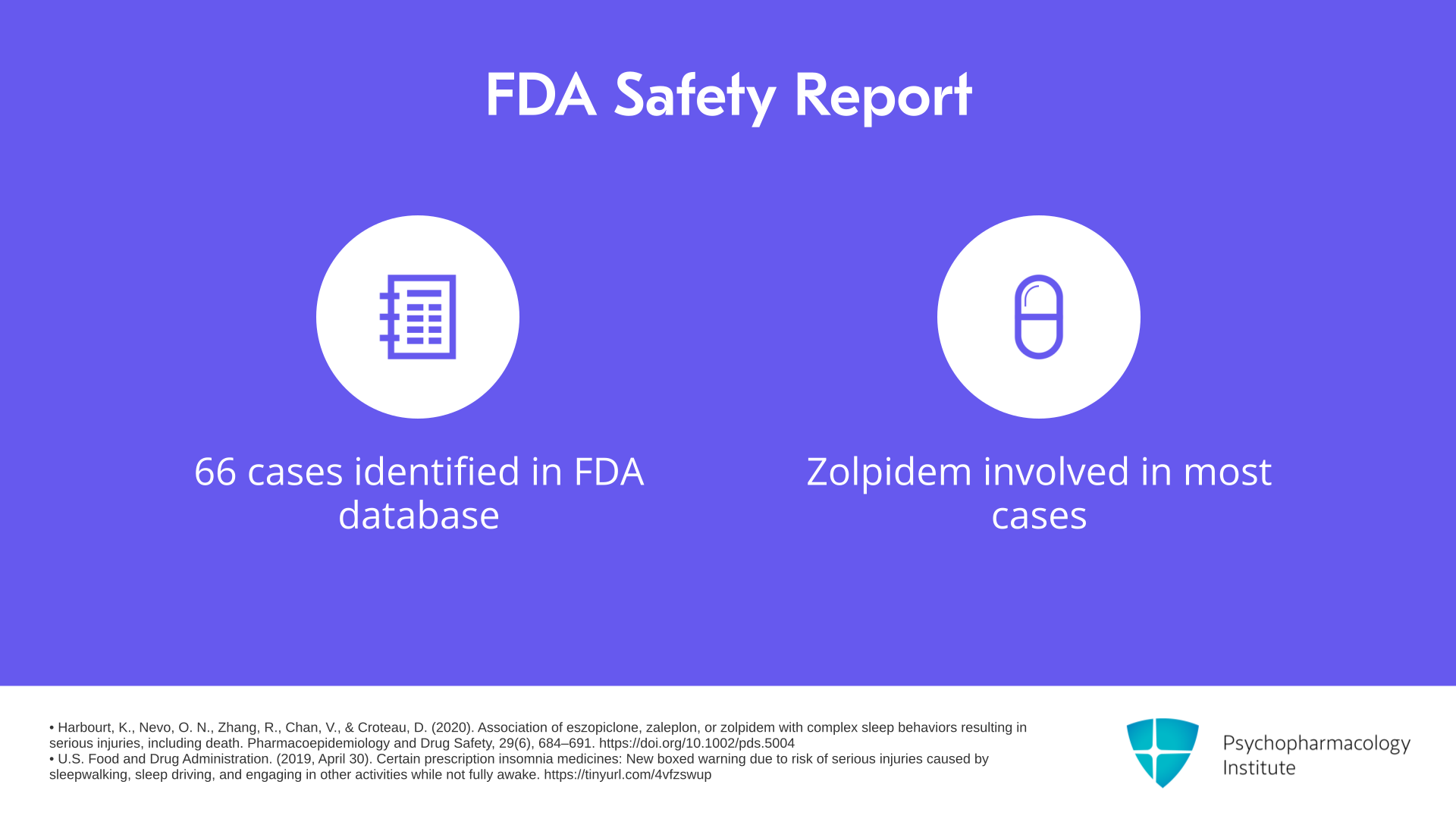
This is based off of a retrospective analysis of the US FDA Adverse Event Reporting System which identified 66 cases. Of these, there were 20 reported deaths and 46 serious injuries. 22 cases reported a previous episode of complex nocturnal behavior prior to the reported event, thus prompting this recommendation that if these were to occur, patients need to discontinue the medication immediately. The majority of cases in this series were taking zolpidem, so 61 out of the 66. Of the remaining, three were on eszopiclone and two on zaleplon. The mechanism by which this occurs is unclear.
References:
- Harbourt, K., Nevo, O. N., Zhang, R., Chan, V., & Croteau, D. (2020). Association of eszopiclone, zaleplon, or zolpidem with complex sleep behaviors resulting in serious injuries, including death. Pharmacoepidemiology and Drug Safety, 29(6), 684–691. https://doi.org/10.1002/pds.5004
- U.S. Food and Drug Administration. (2019, April 30). Certain prescription insomnia medicines: New boxed warning due to risk of serious injuries caused by sleepwalking, sleep driving, and engaging in other activities while not fully awake. https://tinyurl.com/4vfzswup
Slide 10 of 21
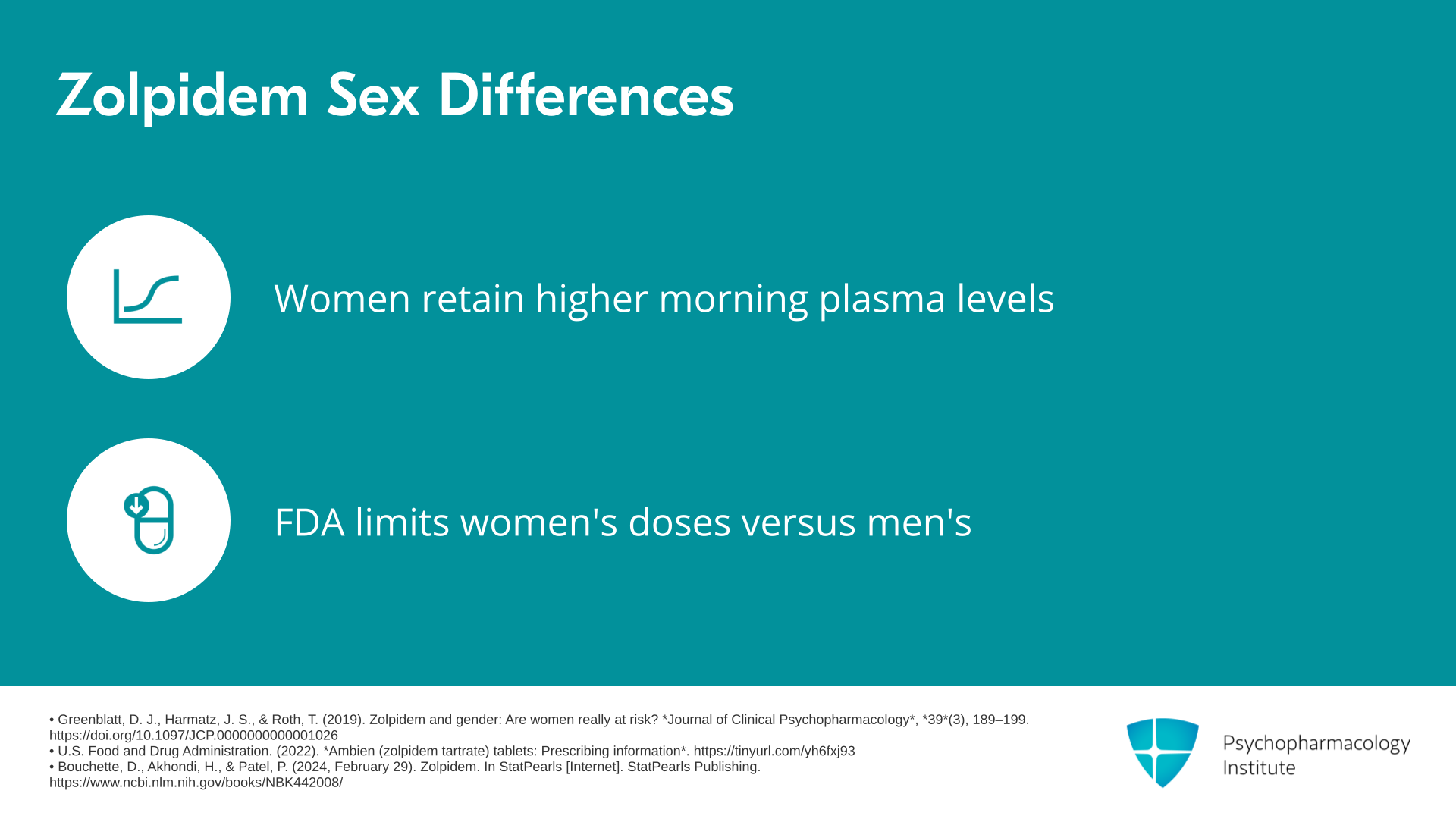
There is also a sex-specific dosing alert for zolpidem. The FDA recommendation for lower doses in women specifically relates to this possible increased risk of higher plasma levels of the medication in the morning following nighttime dosing. These increased levels could in turn potentially lead to delayed reaction time and accidents which prompted the FDA to limit dosing in women as compared to men.
References:
- Greenblatt, D. J., Harmatz, J. S., & Roth, T. (2019). Zolpidem and gender: Are women really at risk? *Journal of Clinical Psychopharmacology*, *39*(3), 189–199. https://doi.org/10.1097/JCP.0000000000001026
- U.S. Food and Drug Administration. (2022). *Ambien (zolpidem tartrate) tablets: Prescribing information*. https://tinyurl.com/yh6fxj93
- Bouchette, D., Akhondi, H., & Patel, P. (2024, February 29). Zolpidem. In StatPearls [Internet]. StatPearls Publishing. https://www.ncbi.nlm.nih.gov/books/NBK442008/
Free Files
Download PDF and other files
Success!
Check your inbox, we sent you all the materials there.
Slide 11 of 21
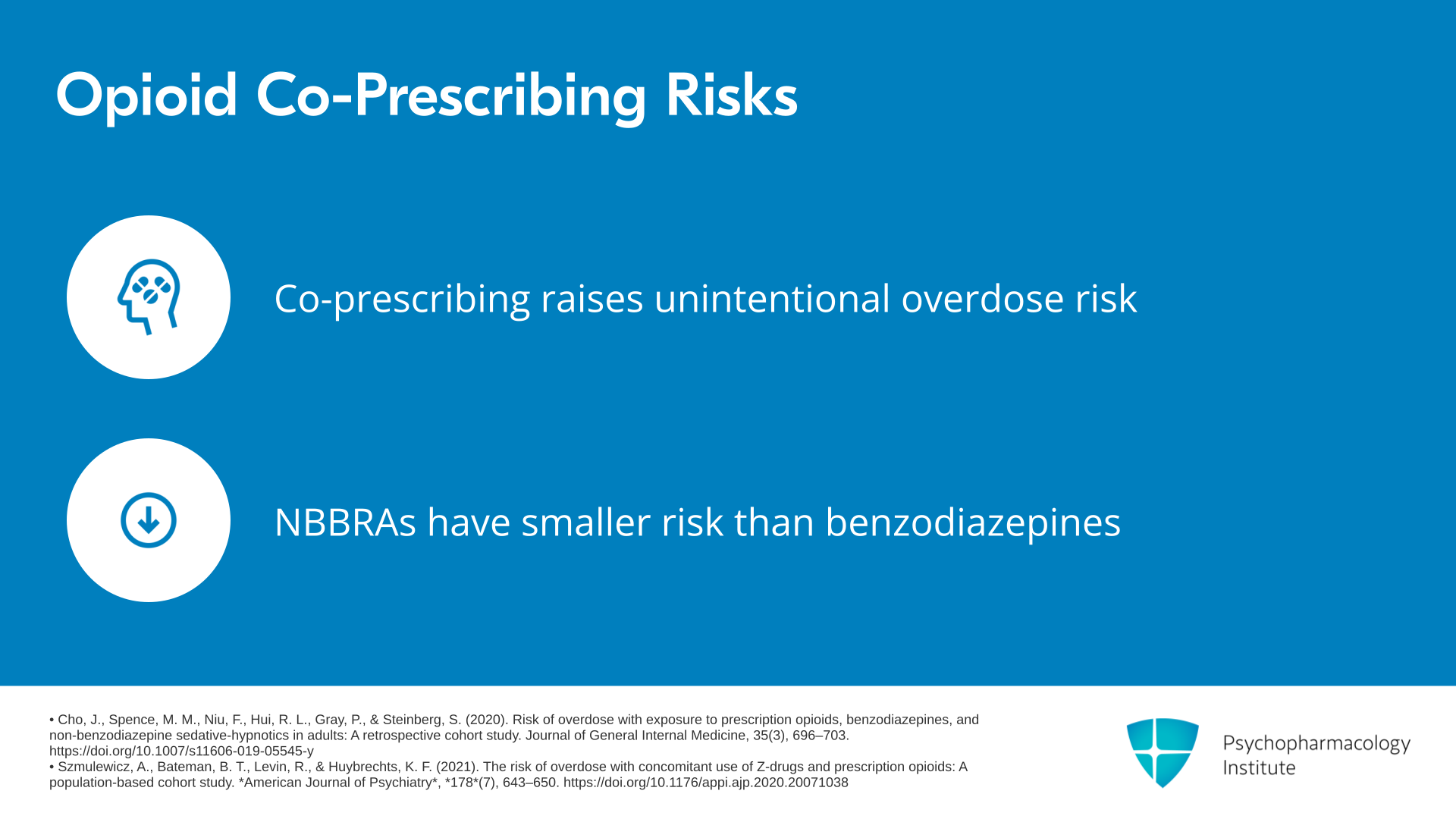
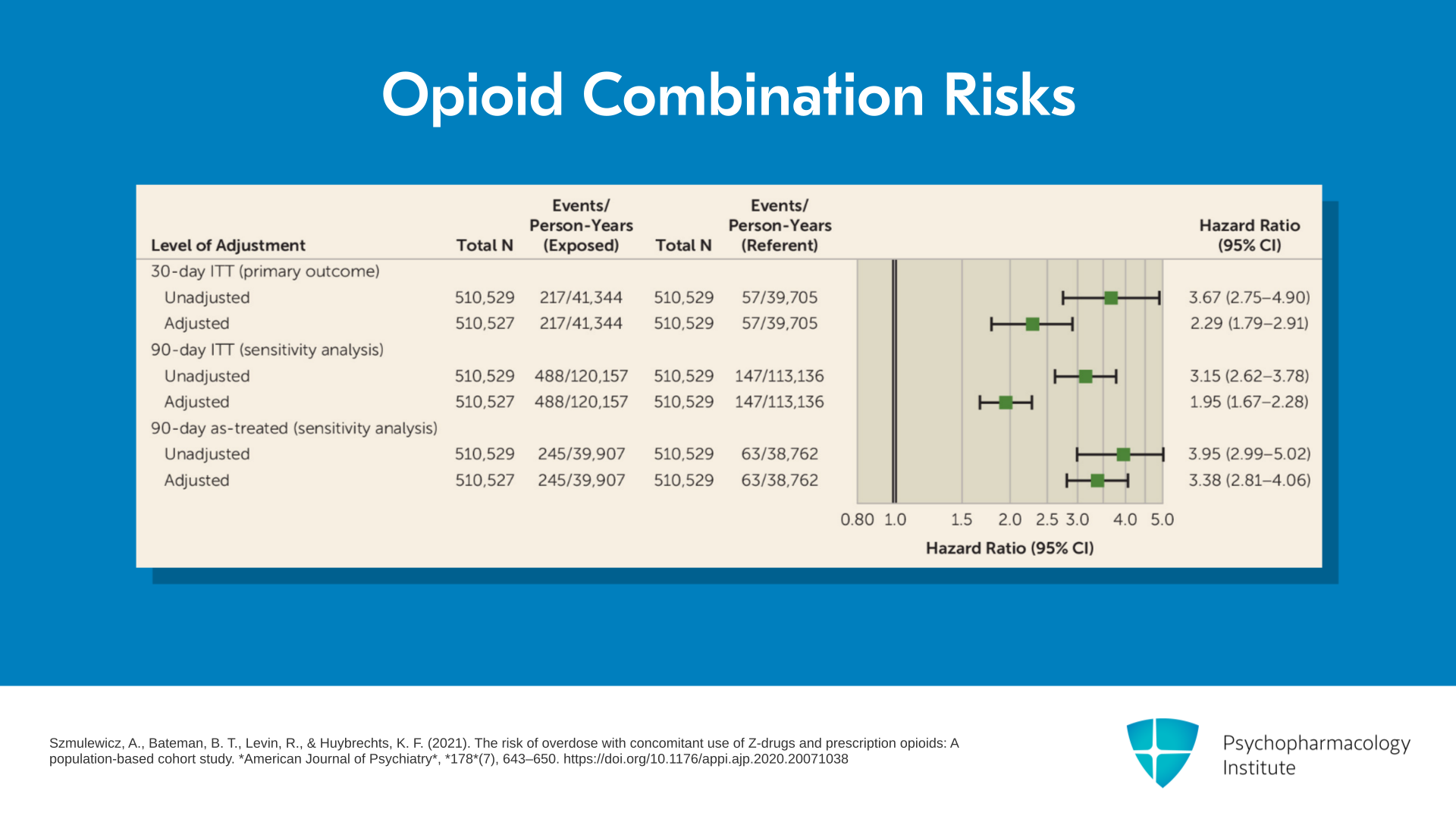
The other boxed warning pertains to opioid co-prescribing both for NBBRAs and for benzodiazepines. There is a substantially increased risk of unintentional overdose associated with the co-prescription of NBBRAs or Z-drugs to patients receiving opioids. This effect is smaller than with co-prescription of benzodiazepines.
References:
- Cho, J., Spence, M. M., Niu, F., Hui, R. L., Gray, P., & Steinberg, S. (2020). Risk of overdose with exposure to prescription opioids, benzodiazepines, and non-benzodiazepine sedative-hypnotics in adults: A retrospective cohort study. Journal of General Internal Medicine, 35(3), 696–703. https://doi.org/10.1007/s11606-019-05545-y
- Szmulewicz, A., Bateman, B. T., Levin, R., & Huybrechts, K. F. (2021). The risk of overdose with concomitant use of Z-drugs and prescription opioids: A population-based cohort study. *American Journal of Psychiatry*, *178*(7), 643–650. https://doi.org/10.1176/appi.ajp.2020.20071038
Slide 12 of 21
In this study which examined both 30-day and 90-day intent to treat as well as other additional analyses of patients receiving a Z-drug and opioid, there was clearly an increased hazard of overdose when these two medications were co-prescribed. And here again, the survival probability of opioids alone versus opioids plus Z-drugs showing an increased risk of overdose occurring when there is this combination of opioids and Z-drugs.
References:
- Szmulewicz, A., Bateman, B. T., Levin, R., & Huybrechts, K. F. (2021). The risk of overdose with concomitant use of Z-drugs and prescription opioids: A population-based cohort study. *American Journal of Psychiatry*, *178*(7), 643–650. https://doi.org/10.1176/appi.ajp.2020.20071038
Free Files
Download PDF and other files
Success!
Check your inbox, we sent you all the materials there.
Slide 13 of 21
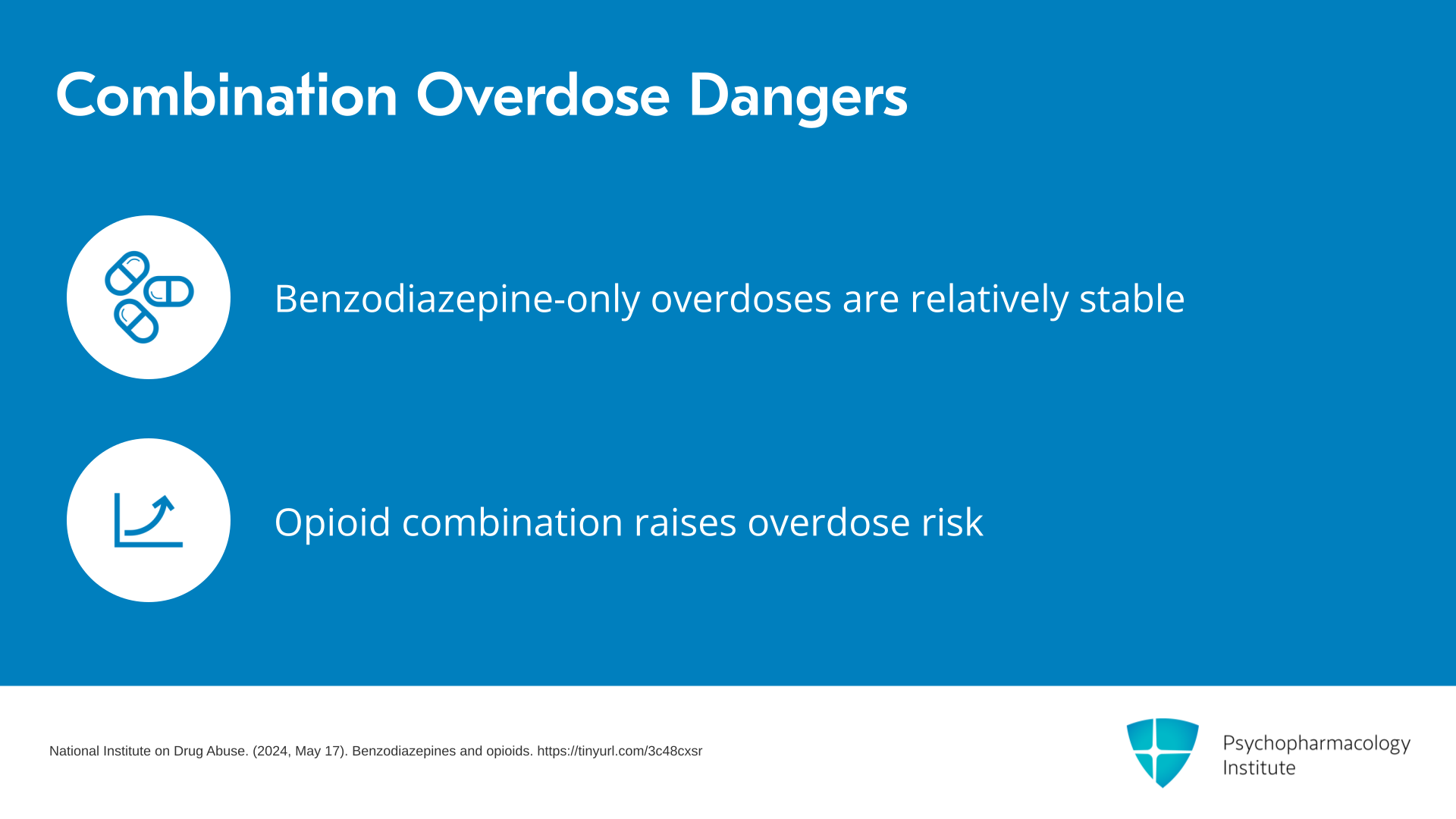
This is especially important; data from the National Institute of Drug Abuse show benzodiazepine-only overdoses are relatively flat while if there is a combination of benzodiazepine with opioids, there is a substantial increase in the overdose risk.
References:
- National Institute on Drug Abuse. (2024, May 17). Benzodiazepines and opioids. https://tinyurl.com/3c48cxsr
Slide 14 of 21
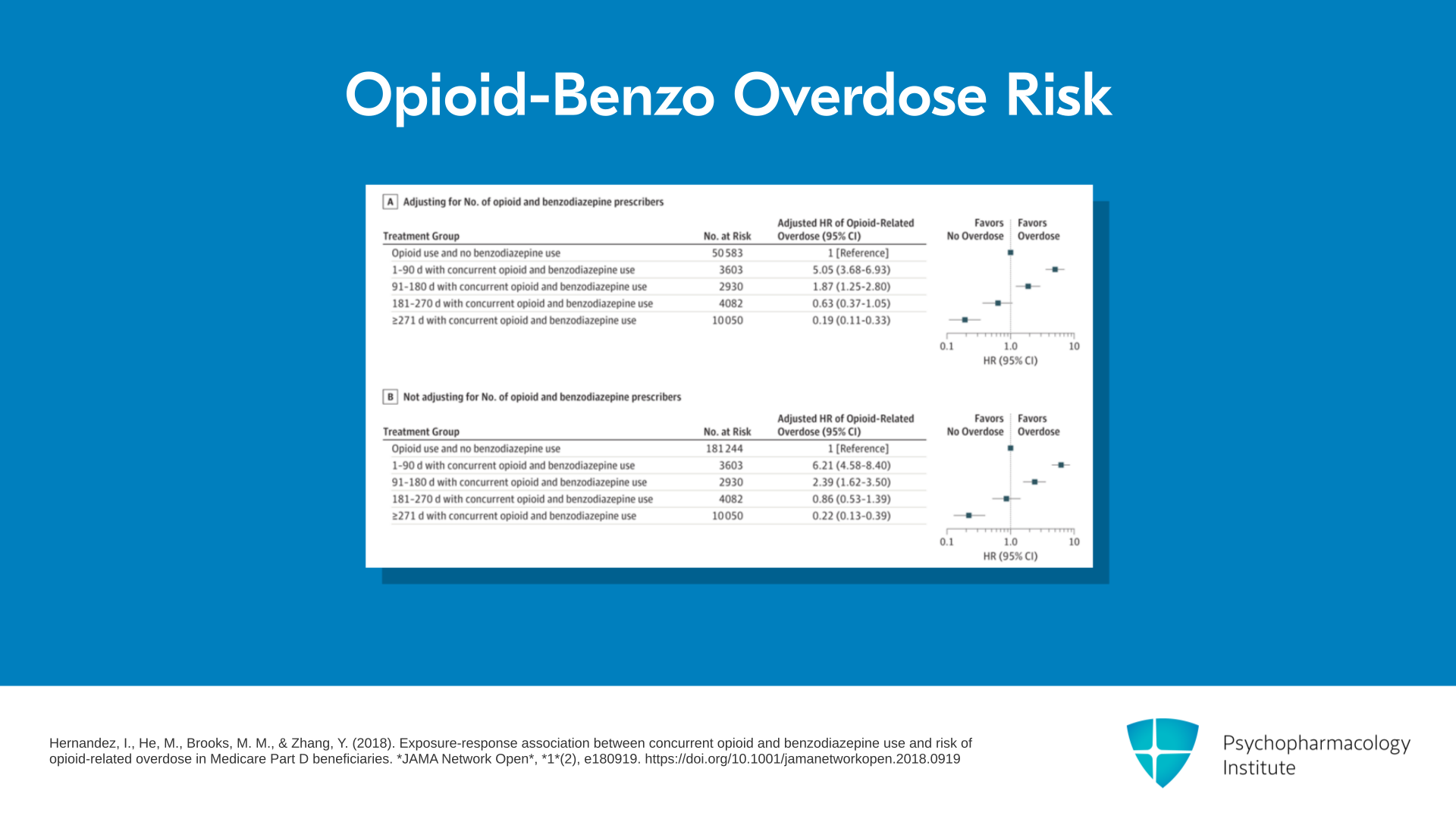
And in this JAMA Network Open study, again clearly showing when there is a combination of opioid use and benzodiazepines especially in the first 90 days after adjusting for everything, there is a clear increased risk of overdose that can occur. And the reduced risk that we see after 271 days is likely due to the survivor effect with most of the people already experiencing the event in the first 90 days.
References:
- Hernandez, I., He, M., Brooks, M. M., & Zhang, Y. (2018). Exposure-response association between concurrent opioid and benzodiazepine use and risk of opioid-related overdose in Medicare Part D beneficiaries. *JAMA Network Open*, *1*(2), e180919. https://doi.org/10.1001/jamanetworkopen.2018.0919
Free Files
Download PDF and other files
Success!
Check your inbox, we sent you all the materials there.
Slide 15 of 21
Moving on to benzodiazepines for insomnia. In current clinical practice, benzodiazepines are usually reserved for severe recalcitrant insomnia that has not responded to multiple other medication trials. Benzodiazepines act via the GABA receptor. Among the benzodiazepines, currently, temazepam and triazolam are the most commonly used for sleep.
References:
- Qaseem, A., Kansagara, D., Forciea, M. A., Cooke, M., Denberg, T. D., & Clinical Guidelines Committee of the American College of Physicians. (2016). Management of chronic insomnia disorder in adults: A clinical practice guideline from the American College of Physicians. *Annals of Internal Medicine*, *165*(2), 125–133. https://doi.org/10.7326/M15-2175
- Sateia, M., Buysse, D., Krystal, A., et al. (2017). Clinical practice guideline for the pharmacologic treatment of chronic insomnia in adults: An American Academy of Sleep Medicine clinical practice guideline. *Journal of Clinical Sleep Medicine*, *13*(2), 307–349. https://doi.org/10.5664/jcsm.6470
Slide 16 of 21
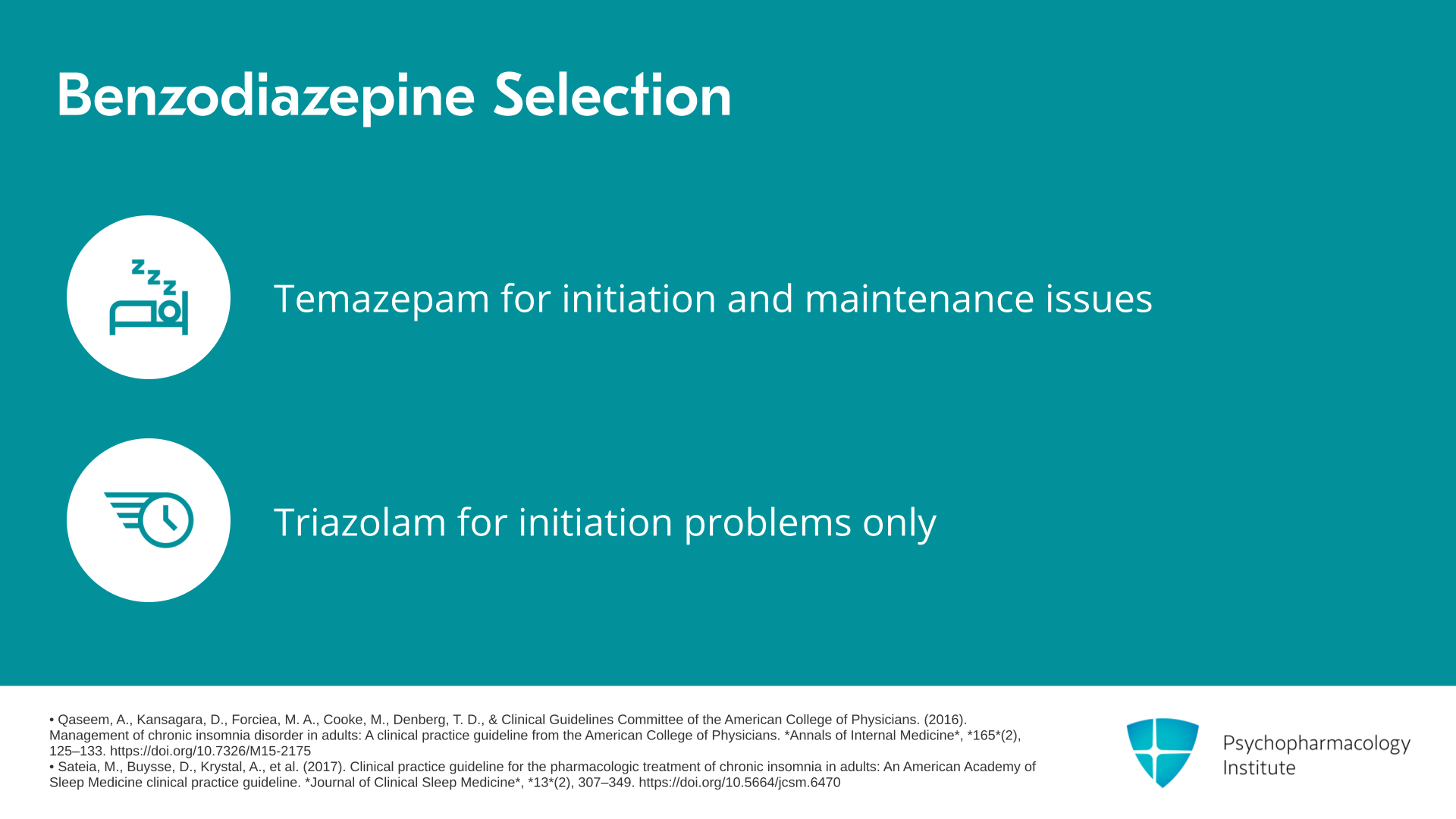
For patients with both sleep initiation and maintenance difficulties, temazepam should be considered. For patients with only sleep initiation problems, the shorter-acting triazolam should be considered. Flurazepam and estazolam also have FDA approval but these medications are very rarely used in clinical practice currently.
References:
- Qaseem, A., Kansagara, D., Forciea, M. A., Cooke, M., Denberg, T. D., & Clinical Guidelines Committee of the American College of Physicians. (2016). Management of chronic insomnia disorder in adults: A clinical practice guideline from the American College of Physicians. *Annals of Internal Medicine*, *165*(2), 125–133. https://doi.org/10.7326/M15-2175
- Sateia, M., Buysse, D., Krystal, A., et al. (2017). Clinical practice guideline for the pharmacologic treatment of chronic insomnia in adults: An American Academy of Sleep Medicine clinical practice guideline. *Journal of Clinical Sleep Medicine*, *13*(2), 307–349. https://doi.org/10.5664/jcsm.6470
Free Files
Download PDF and other files
Success!
Check your inbox, we sent you all the materials there.
Slide 17 of 21
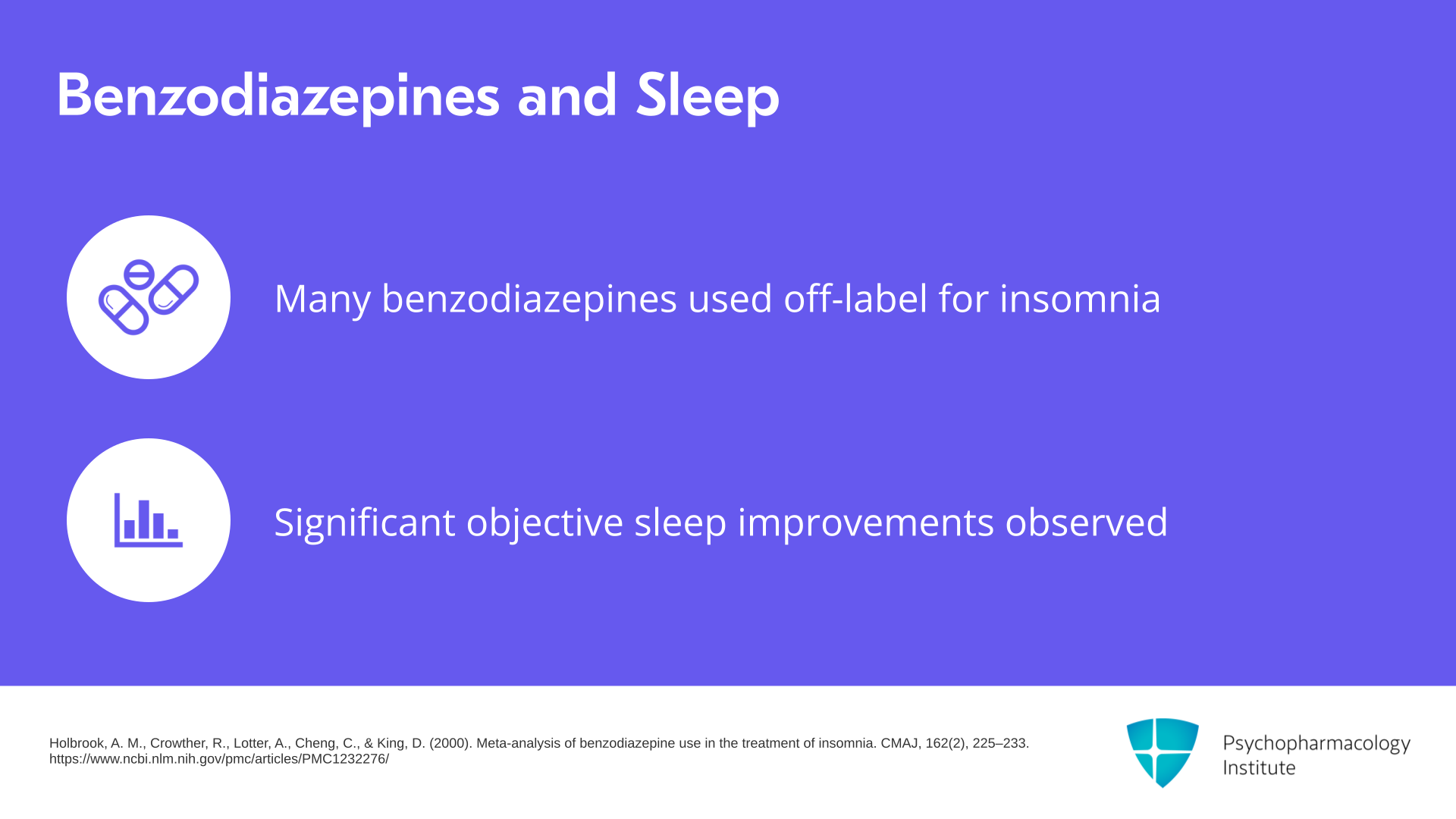
Many of the other benzodiazepines which are used for the treatment of anxiety are also used off-label to treat insomnia. And it is unclear as to whether there are any actual differences between the FDA-approved benzodiazepines versus the others. Objectively, benzodiazepines decrease sleep latency by about 4.2 minutes and significantly increase total sleep duration by about 61.8 minutes. Subjective sleep onset latency was also reduced by about 14.3 minutes.
References:
- Holbrook, A. M., Crowther, R., Lotter, A., Cheng, C., & King, D. (2000). Meta-analysis of benzodiazepine use in the treatment of insomnia. CMAJ, 162(2), 225–233. https://www.ncbi.nlm.nih.gov/pmc/articles/PMC1232276/
Slide 18 of 21
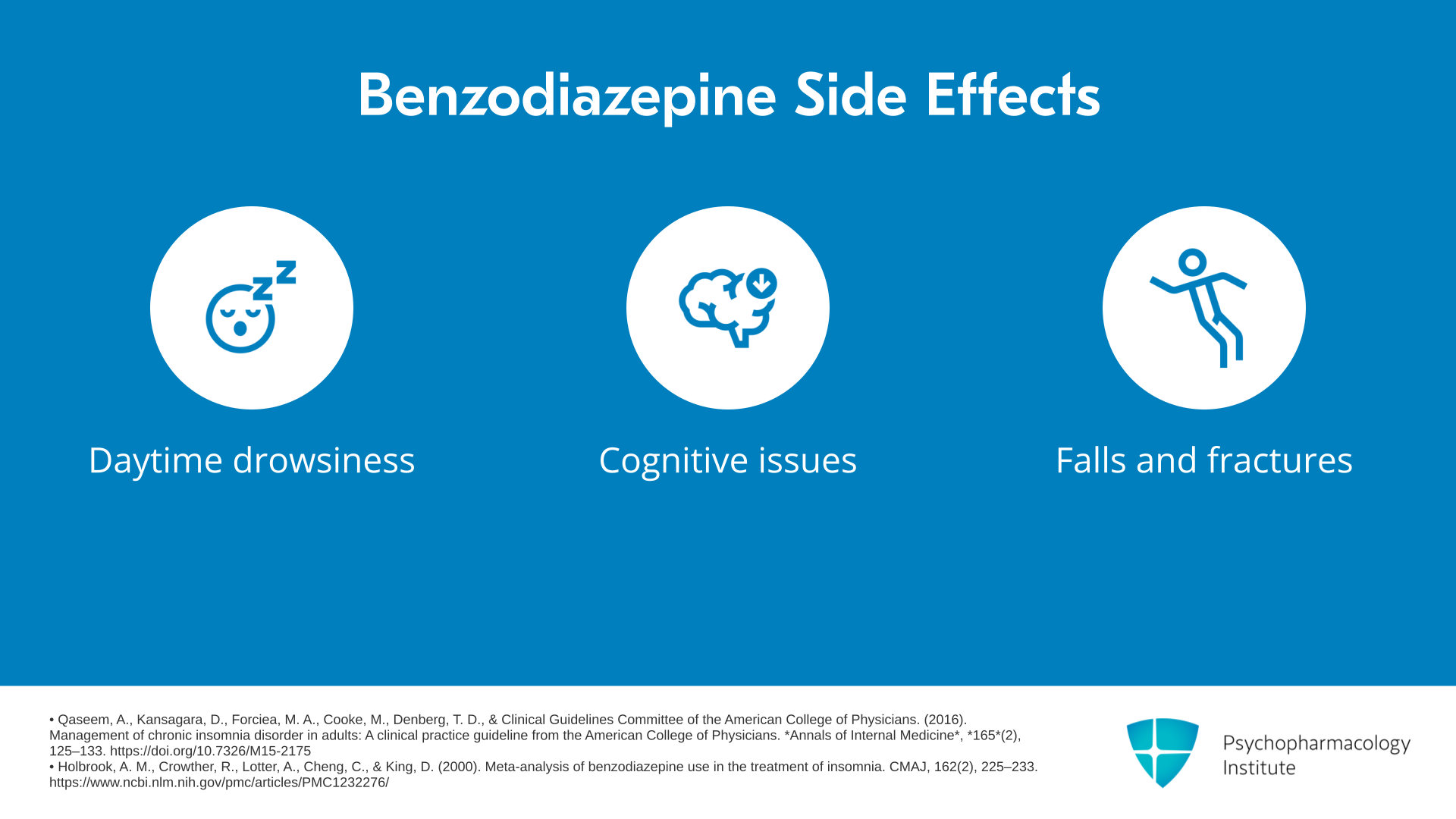
The major side effect concerns for benzodiazepines include daytime drowsiness, dizziness, cognitive issues, falls and fractures.
References:
- Qaseem, A., Kansagara, D., Forciea, M. A., Cooke, M., Denberg, T. D., & Clinical Guidelines Committee of the American College of Physicians. (2016). Management of chronic insomnia disorder in adults: A clinical practice guideline from the American College of Physicians. *Annals of Internal Medicine*, *165*(2), 125–133. https://doi.org/10.7326/M15-2175
- Holbrook, A. M., Crowther, R., Lotter, A., Cheng, C., & King, D. (2000). Meta-analysis of benzodiazepine use in the treatment of insomnia. CMAJ, 162(2), 225–233. https://www.ncbi.nlm.nih.gov/pmc/articles/PMC1232276/
Free Files
Download PDF and other files
Success!
Check your inbox, we sent you all the materials there.
Slide 19 of 21
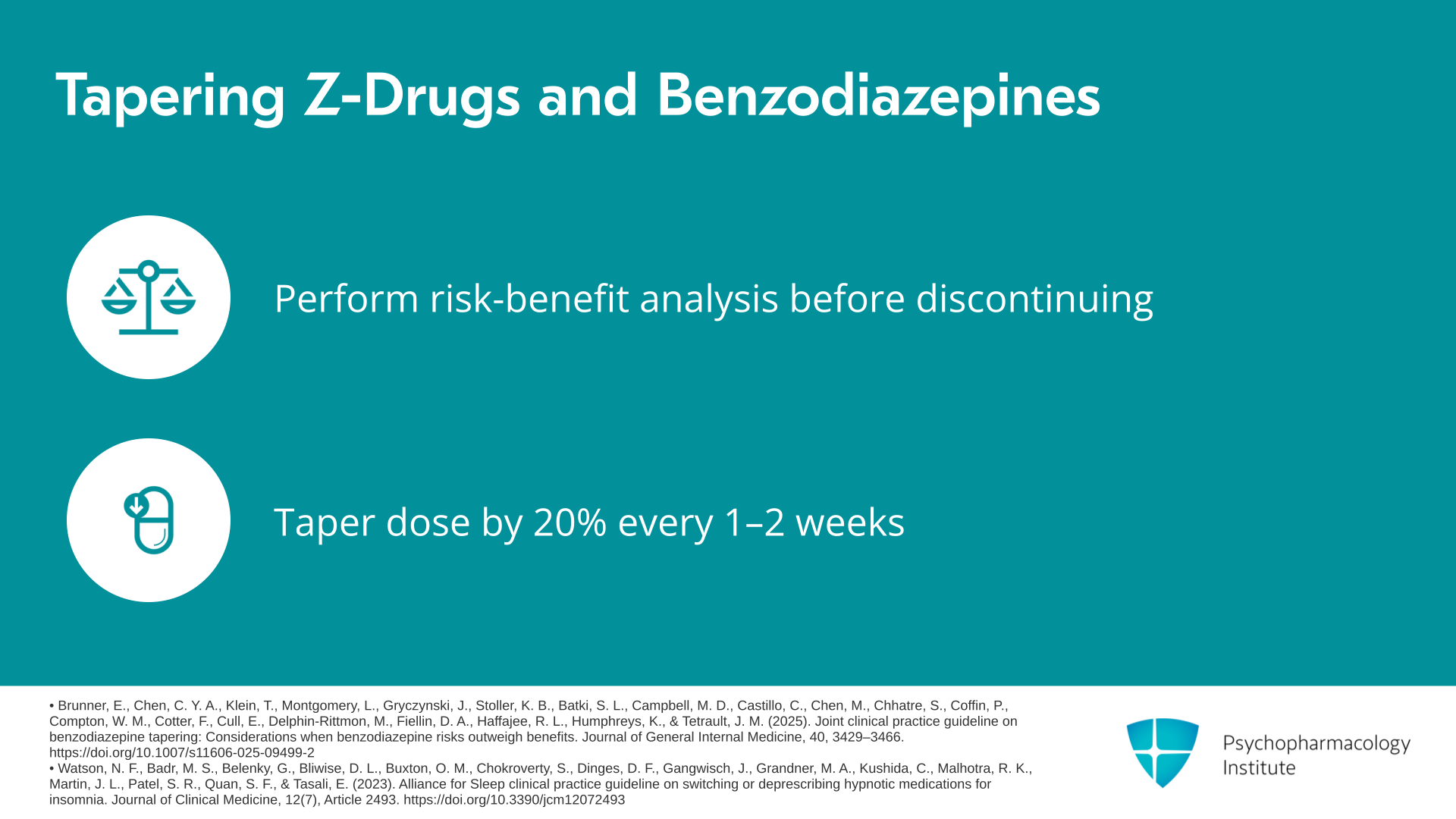
When it comes to tapering Z-drugs and benzodiazepines, in patients who are stable on long-term Z-drug or benzodiazepine regimen, a careful risk-benefit analysis of discontinuation must be conducted with emphasis on shared decision making. If the decision is to discontinue the medication, an acceptable and safe taper usually consists of reducing the dose by 20% every one to two weeks. If the patient experiences significant withdrawal or rebound insomnia, the taper can be slowed down further and conducted as per the patient’s tolerance.
References:
- Brunner, E., Chen, C. Y. A., Klein, T., Montgomery, L., Gryczynski, J., Stoller, K. B., Batki, S. L., Campbell, M. D., Castillo, C., Chen, M., Chhatre, S., Coffin, P., Compton, W. M., Cotter, F., Cull, E., Delphin-Rittmon, M., Fiellin, D. A., Haffajee, R. L., Humphreys, K., & Tetrault, J. M. (2025). Joint clinical practice guideline on benzodiazepine tapering: Considerations when benzodiazepine risks outweigh benefits. Journal of General Internal Medicine, 40, 3429–3466. https://doi.org/10.1007/s11606-025-09499-2
- Watson, N. F., Badr, M. S., Belenky, G., Bliwise, D. L., Buxton, O. M., Chokroverty, S., Dinges, D. F., Gangwisch, J., Grandner, M. A., Kushida, C., Malhotra, R. K., Martin, J. L., Patel, S. R., Quan, S. F., & Tasali, E. (2023). Alliance for Sleep clinical practice guideline on switching or deprescribing hypnotic medications for insomnia. Journal of Clinical Medicine, 12(7), Article 2493. https://doi.org/10.3390/jcm12072493
Slide 20 of 21
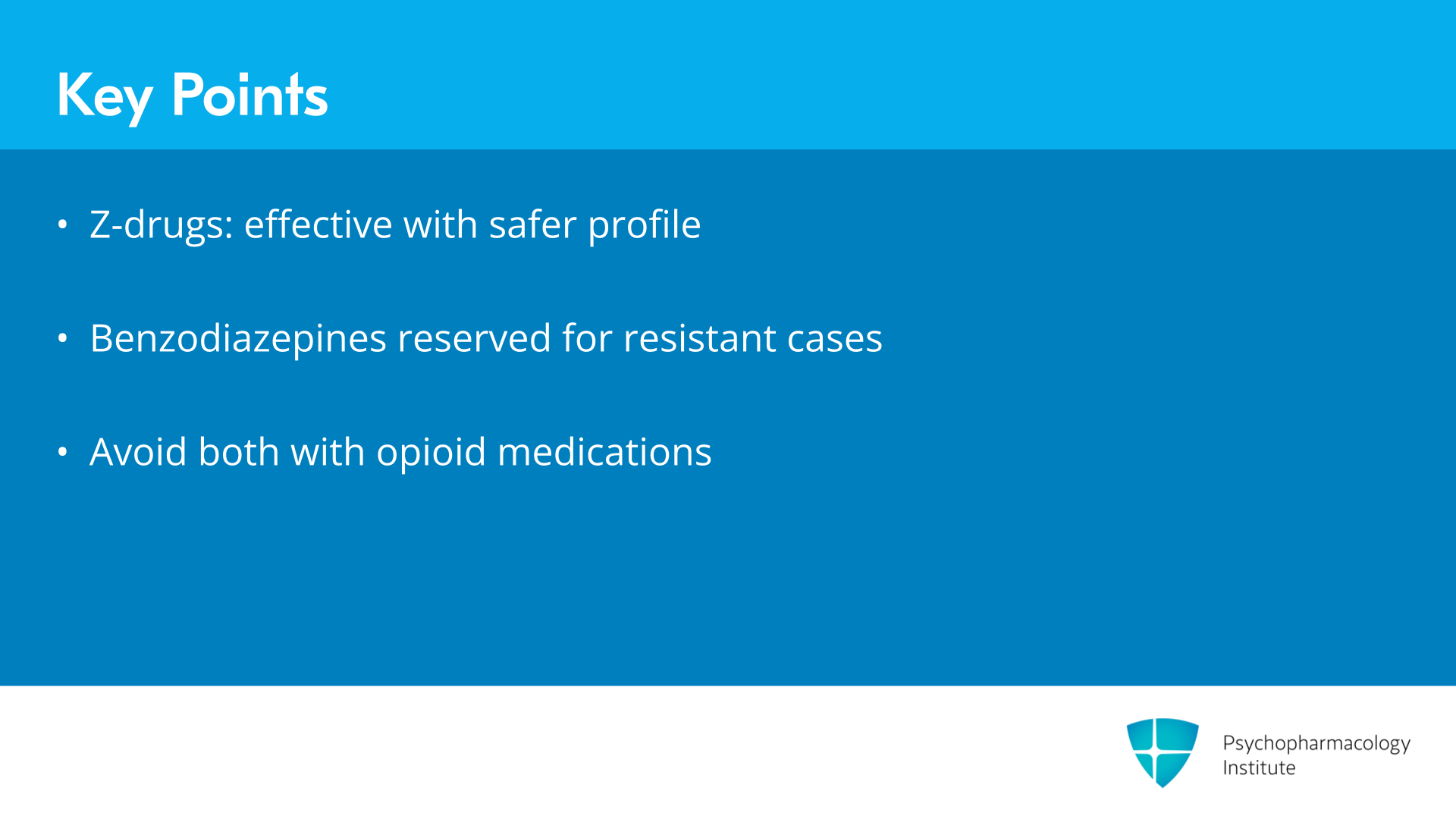
Key points for this section include: Z-drugs are effective treatments for chronic insomnia disorder with a relatively safe side effect profile. Benzodiazepines are effective for chronic insomnia disorder but due to their side effect profile are reserved for treatment-resistant cases. Both Z-drugs and benzodiazepines should be avoided in patients receiving opioid medication.
Free Files
Download PDF and other files
Success!
Check your inbox, we sent you all the materials there.
Slide 21 of 21
Z-drugs can be associated with complex nocturnal behaviors such as sleep walking, sleep eating and driving. If these occur, immediate discontinuation is recommended. While tapering Z-drugs and benzodiazepines, they should be reduced by 20% every one to two weeks.