

Text Version
Weighing Ongoing Benefit Against Simplifying the Regimen
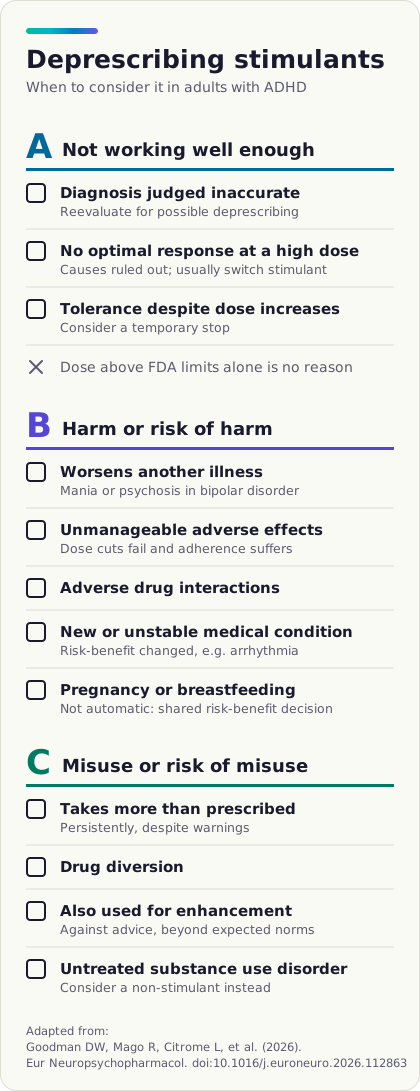
Flavio Guzman, M.D.: The task force organizes stimulant deprescribing in adult ADHD into three main domains: efficacy, harm, and misuse. In practice, how do you decide whether a patient still needs the stimulant?
David Goodman, M.D.: In clinical practice, we consider whether the patient is on medication, whether they need to be on medication, and, if so, what benefit the medication provides. You look at the reduction in symptoms but, more importantly, at the improvement in daytime functioning.
When a patient has been on medication for a long period of time, consider whether the medication is still serving its purpose or whether it might be deprescribed.¹ For example, the patient may no longer need medication if they have been on it for a while and:
- Their life demands have diminished.
- Psychotherapy has helped them build time management and organizational skills.
Let’s address misuse first, because it is unique to stimulants. In the other deprescribing manuscripts, covering antidepressants, mood stabilizers, antipsychotics, and lithium, patients are not seeking these medications for misuse and abuse.
Misuse is specific to stimulant medications. We included it to alert clinicians that patients may not be taking the medication as prescribed.²
In discussing deprescribing, please don’t assume that I am advocating for patients to be off their psychotropic medications. I am not.
But in an era of polypharmacy, patients end up on three, four, five, or six psychiatric medications. The question is whether each one is still serving the purpose for which it was initially prescribed.
Alternatively, the clinician may have decided not to rock the boat and continued the medications without considering whether the regimen could be simplified.
Download PDF and other files
How Environment Shapes Impairment in ADHD
Flavio Guzman, M.D.: ADHD itself doesn’t really change, but life context does. How do you weigh the interaction between the disorder and life demands when deciding who needs medication?
David Goodman, M.D.: It is the interaction of environment with the disorder. There is a spectrum of disorder severity and a spectrum of cognitive demands from environmental factors.
Both contribute to the level of impairment you see and the degree of distress the patient experiences.
A patient with ADHD who is not in a high-demand situation may or may not need medication. They can manage their symptoms with:
- Organizational techniques
- Time management
- Sequencing
A supportive and understanding partner, spouse, or coworker can also provide environmental accommodations, so to speak.
But if demands increase, even relatively mild ADHD may tax the person’s ability to compensate adequately. At that point, the symptoms produce very distressing impairment because the demands have exceeded their ability to compensate.
That is why it is important to ask patients why they are coming in now. Consider a 32-year-old woman with cognitive complaints who saw a TikTok or YouTube video and thinks she has ADHD.
Ask her why she is coming in now, and then obtain the childhood history. If there is a childhood history, the answer to “Why now?” becomes important because it shows which environmental factors have pressed on the person to the point that she can no longer compensate.
Revisiting Lifelong Treatment Assumptions
Flavio Guzman, M.D.: In a stable adult whose ADHD will persist, what prompts you to go back and question the need for the stimulant?
David Goodman, M.D.: Correct, the condition won’t go away. People tend to view these disorders monolithically.
The assumption is that if you have the disorder, you will have it for the rest of your life, it will cause impairment, and therefore you need to stay on whatever makes you better for the rest of your life. We need to modify that view to be more nuanced to the patient’s demands and level of distress.
That means discussing it with the patient directly. For example: “You’ve been stable on the medication for the last five years, so let’s see whether it is still serving its purpose.”
Download PDF and other files
The Rationale for a Gradual Taper
Flavio Guzman, M.D.: Once you and the patient agree it’s time to try coming off the stimulant, what is the thinking behind how you approach the taper?
David Goodman, M.D.: You taper down to see where the symptoms reemerge while decreasing the likelihood of withdrawal symptoms from the dose reduction.
Patients will often run this experiment themselves without your knowledge. Two common scenarios:
- They go on vacation, forget their medication for two weeks, and come back saying, “I’m fine. I don’t need to be on the medicine.” That warrants a discussion.
- They go on vacation, forget their medication, and three days later I get a call: “My wife tells me I’m irritable, I don’t have any motivation, and I’m taking naps in the afternoon when I never did.” Those are withdrawal symptoms.
You have to sort that out. The best way to reduce the likelihood of withdrawal symptoms is to taper at a slow pace.
In ADHD, a patient who has been off medication for a year can go back on it if demands increase, such as after a promotion. Doing well off medication doesn’t mean the patient can’t resume it if life demands start to impinge on their ability to compensate.
That said, if you have ADHD, you should take your medication consistently every day so you can function optimally. You don’t decide each morning whether to take it based on what you have to do that day.
When patients do that, they take it for performance rather than for their ADHD. They take it to get the work done, without realizing that their spouse, family, and coworkers have to deal with them when they are unmedicated.
There are social implications as well as performance implications. Individuals with ADHD often focus on performance and less on the social side because their capacity for self-observation is compromised.
They may not realize that they are being disruptive, intrusive, or problematic in social settings.
A Stepwise Methylphenidate Taper Schedule
Flavio Guzman, M.D.: For a patient who has been on a steady dose of methylphenidate for a couple of years and has decided with you to deprescribe, how do you structure the taper?
David Goodman, M.D.: When patients stop their stimulant abruptly, for example by forgetting it on vacation, the physiological withdrawal is relatively mild. It typically includes:
- Lower energy
- Lower motivation
- Slightly more irritability
These symptoms last about 72 hours and then resolve.
When I taper in a supervised, therapeutic fashion, I want to evaluate whether ADHD symptoms increase as the dose comes down.³ Reducing the dose slowly avoids withdrawal symptoms that would contaminate your assessment of whether the ADHD is worsening.
The point is to eliminate withdrawal effects while you observe whether cognitive function stays the same or ADHD symptoms reemerge at the lower dose.
To taper:
- Reduce the dose by one-third and maintain it for one to two weeks.
- Reduce by the next third and maintain it for two weeks.
- Reduce to the final third and maintain it for two weeks.
With this slow decline, the patient can report at each step whether their cognitive symptoms are getting worse.
How to interpret the response:
- If the patient reaches the last third and reports problems such as showing up late, forgetting things, or their spouse complaining, the previous dose was the effective one.
- If the patient noticed no difference between the full dose and the dose reduced by one-third, return to the last tolerated step rather than the original dose.
The patient may be able to manage on the lower dose rather than the higher dose they were on before. You are now finding the lowest effective dose at which the patient can function and feel good about the day.
Download PDF and other files
The Developmental Toll of Untreated ADHD
Flavio Guzman, M.D.: Beyond individual functioning, untreated ADHD affects families and the people around patients. What does leaving the condition untreated look like across a life trajectory?
David Goodman, M.D.: Right. This comes up with people who say these patients shouldn’t be on medication, so you need to look at the negative consequences of not treating ADHD.⁴
Developmentally, untreated ADHD is associated with:
- Higher risk of cigarette smoking in early adolescence
- Higher risk of substance use disorder
- Higher risk of car accidents
- Higher risk of pregnancy
- Higher risk of criminal activity
- Lower likelihood of finishing high school
- Lower likelihood of finishing college, and taking longer when they do
- More jobs over a 10-year period than other people
The second-order effect is that changing jobs every two or three years means you never gain traction in a career. You always enter at the entry level.
That affects financial standing, so you never reach a career-level salary and can’t save money. It also affects the family, if you have a family or a partner.
You can see a downward progression here. However, this is not true of every individual with ADHD.
I have treated physicians, lawyers, and successful businesspeople. They often have someone in their life working as an executive secretary, officially or unofficially.
Compensatory skills are delegated to another person while they do what they do best. That points to a fallacy.
The fallacy is that a successful person, in whatever career, can’t have ADHD. That is completely untrue.
IQ is independent of whether you have ADHD. A person with a high IQ can compensate academically, while a person with average or lower IQ will be taxed by even the relatively simple demands of everyday life.
Follow-Up Frequency for Stable Patients
Flavio Guzman, M.D.: For a stable patient on the same stimulant and dose for a couple of years, how often do you want to see them?
David Goodman, M.D.: My follow-up schedule progresses as follows:
- At initiation, I follow a titration schedule and see the patient back in two to three weeks.
- If another titration step is needed, I see them a month later, and again a month after that.
- Eventually, visits move to every three to six months.
Occasionally I go beyond six months for patients who travel nationally or internationally and whose schedules don’t allow it. But in general, you ought to see patients every three to six months.
For measurement-based care, have patients complete the Adult ADHD Self-Report Scale, which covers the 18 DSM-5 symptoms.⁵ It shows how frequently each symptom occurs and helps you target specific residual symptoms.⁵
Download PDF and other files
Prescription Monitoring as a Safety Habit
Flavio Guzman, M.D.: If you had to pick one stimulant prescribing habit that makes treatment safer and better for patients over the long run, what would it be?
David Goodman, M.D.: Monitoring. That starts with monitoring your prescriptions.
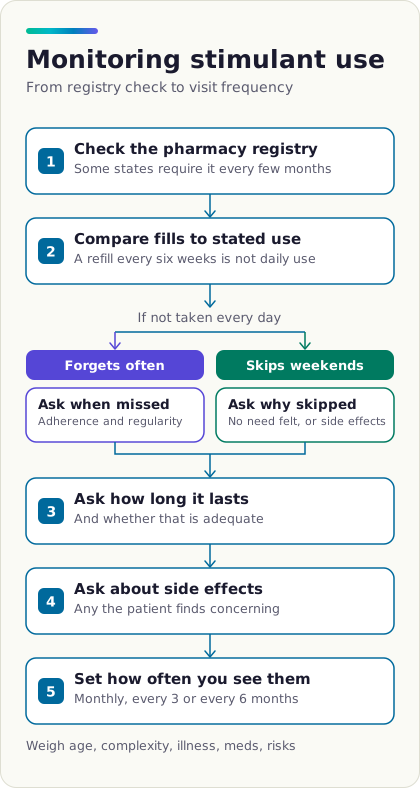
In the United States, many states have a pharmacy registry, and you should check it periodically. Some states require checks every few months, while others don’t.
Periodic registry checks show you fill dates and how consistently the person is taking the medication. If a patient says they take it daily but requests a refill every six weeks, they are not taking it every day, and you need to assess when they skip it.
Work through a decision tree:
- Are they regularly forgetting, or skipping specifically on weekends?
- If on weekends, is it because they don’t feel they need the effect, or because there are subtle side effects they prefer to avoid?
Then ask about:
- Adherence and regularity
- How long the medication lasts during the day, and whether that duration is adequate
- Any side effects they consider problematic or concerning
Finally, monitor how often you see the patient: monthly, every three months, or every six months. That frequency depends on several factors:
- Age of the patient
- Clinical complexity
- Medical issues
- Polypharmacy
- History of risk factors
References
- Goodman, D.W., Mago, R., Citrome, L., et al. The American Society of Clinical Psychopharmacology task force consensus statement on the deprescribing of stimulant medications in adults with ADHD. European Neuropsychopharmacology. 2026;111:112863.
- Compton, W.M., Han, B., Blanco, C., et al. Prevalence and correlates of prescription stimulant use, misuse, use disorders, and motivations for misuse among adults in the United States. American Journal of Psychiatry. 2018;175(8):741-755.
- Buitelaar, J., Asherson, P., Soutullo, C., et al. Differences in maintenance of response upon discontinuation across medication treatments in attention-deficit/hyperactivity disorder. European Neuropsychopharmacology. 2015;25(10):1611-1621.
- Shaw, M., Hodgkins, P., Caci, H., et al. A systematic review and analysis of long-term outcomes in attention deficit hyperactivity disorder: effects of treatment and non-treatment. BMC Medicine. 2012;10:99.
- Kessler, R.C., Adler, L., Ames, M., et al. The World Health Organization adult ADHD self-report scale (ASRS): a short screening scale for use in the general population. Psychological Medicine. 2005;35(2):245-256.