Slides and Transcript
Slide 1 of 29
In this next section, we’re going to focus on QT prolongation with antipsychotics. Because QTc prolongation and psychiatric medications is such a large topic, we’re going to break it down by class and start with antipsychotics.
Slide 2 of 29
As a reminder, QTc prolongation is an inexact surrogate marker for risk of torsades de pointes which is a potentially lethal ventricular arrhythmia that can be associated with sudden cardiac death. And that’s the outcome we really worry about when we talk about QT prolongation.
References:
- Beach, S. R., Celano, C. M., Sugrue, A. M., Adams, C., Ackerman, M. J., Noseworthy, P. A., & Huffman, J. C. (2018). QT prolongation, torsades de pointes, and psychotropic medications: A 5-year update. Psychosomatics, 59(2), 105–122. https://doi.org/10.1016/j.psym.2017.10.009
Free Files
Download PDF and other files
Success!
Check your inbox, we sent you all the materials there.
Slide 3 of 29
Let’s start with typical antipsychotics. We know historically that low-potency phenothiazines, those include thioridazine, chlorpromazine and mesoridazine, are the class that’s most associated with QT prolongation. Overall, typical antipsychotics are linked to greater QT prolongation than atypicals but this effect is likely primarily driven by those low-potency phenothiazines and specifically by thioridazine.
References:
- Beach, S. R., Celano, C. M., Sugrue, A. M., Adams, C., Ackerman, M. J., Noseworthy, P. A., & Huffman, J. C. (2018). QT prolongation, torsades de pointes, and psychotropic medications: A 5-year update. Psychosomatics, 59(2), 105–122. https://doi.org/10.1016/j.psym.2017.10.009
Slide 4 of 29
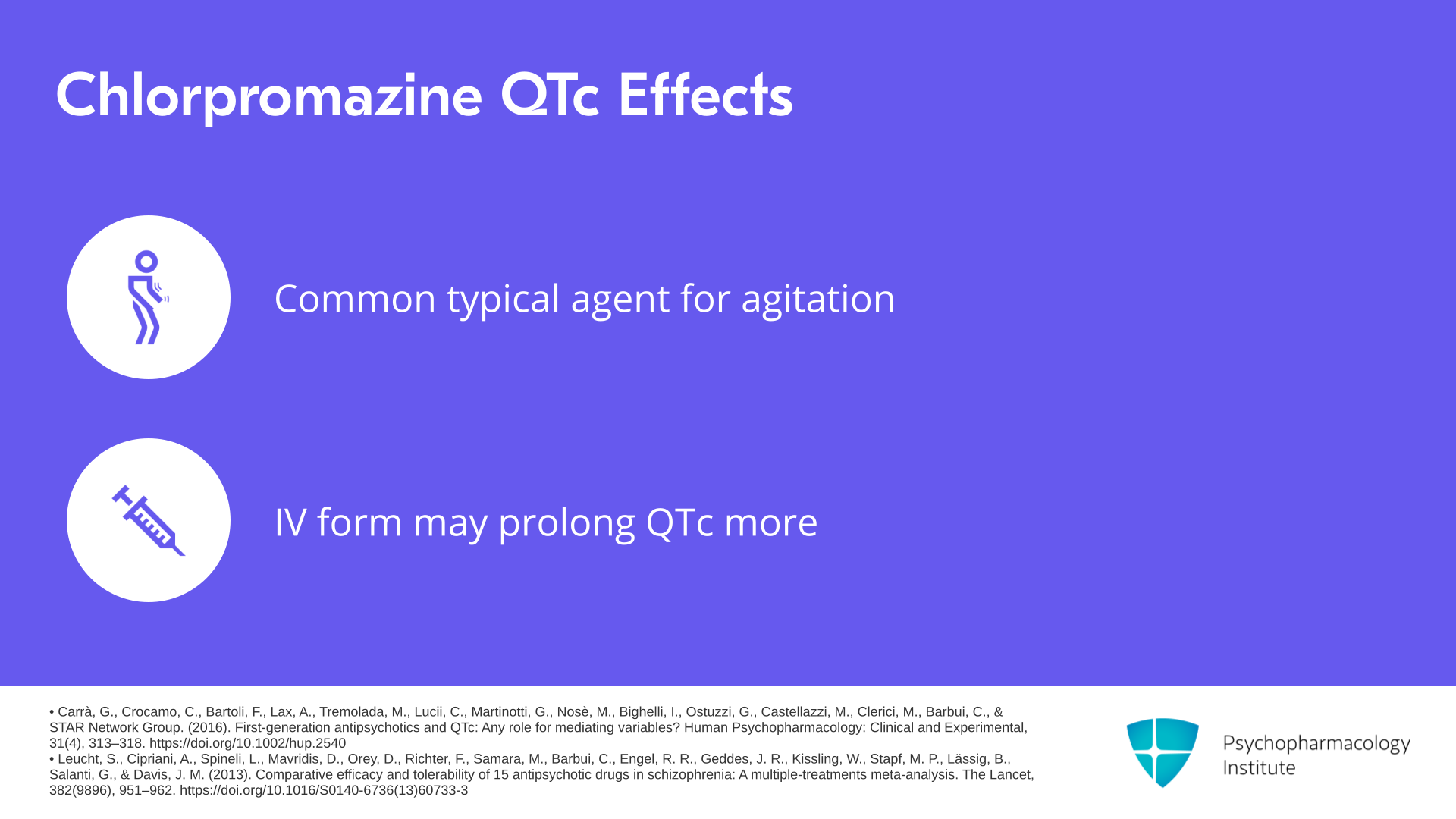
Chlorpromazine is one of the more common typical agents that I use in the hospital setting for agitation. The QTc prolonging effect of chlorpromazine is thought to be dose dependent though there’s never been a Thorough QT study. The IV form is often said to cause greater QTc prolongation than p.o. but again we don’t have any head-to-head studies. However, it would make sense if you think about the potency of the IV form compared to p.o. which is somewhere between 2-4 to 1.
References:
- Carrà, G., Crocamo, C., Bartoli, F., Lax, A., Tremolada, M., Lucii, C., Martinotti, G., Nosè, M., Bighelli, I., Ostuzzi, G., Castellazzi, M., Clerici, M., Barbui, C., & STAR Network Group. (2016). First-generation antipsychotics and QTc: Any role for mediating variables? Human Psychopharmacology: Clinical and Experimental, 31(4), 313–318. https://doi.org/10.1002/hup.2540
- Leucht, S., Cipriani, A., Spineli, L., Mavridis, D., Orey, D., Richter, F., Samara, M., Barbui, C., Engel, R. R., Geddes, J. R., Kissling, W., Stapf, M. P., Lässig, B., Salanti, G., & Davis, J. M. (2013). Comparative efficacy and tolerability of 15 antipsychotic drugs in schizophrenia: A multiple-treatments meta-analysis. The Lancet, 382(9896), 951–962. https://doi.org/10.1016/S0140-6736(13)60733-3
Free Files
Download PDF and other files
Success!
Check your inbox, we sent you all the materials there.
Slide 5 of 29
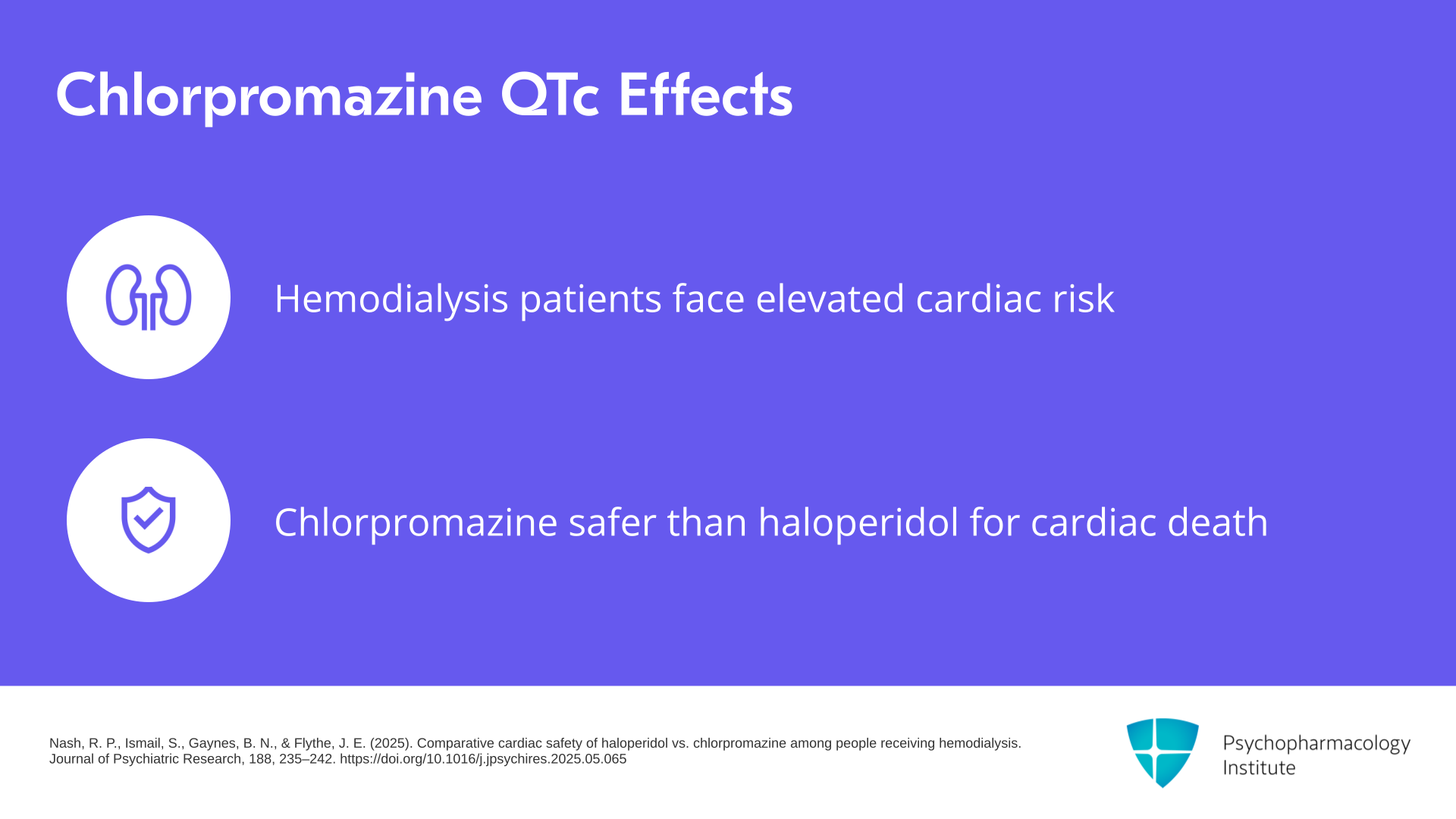
There is a 2025 study showing that the risk of sudden cardiac death among hemodialysis patients who are at increased risk for cardiac arrhythmias and sudden cardiac death to begin with is actually less for those taking chlorpromazine when compared to those taking haloperidol.
References:
- Nash, R. P., Ismail, S., Gaynes, B. N., & Flythe, J. E. (2025). Comparative cardiac safety of haloperidol vs. chlorpromazine among people receiving hemodialysis. Journal of Psychiatric Research, 188, 235–242. https://doi.org/10.1016/j.jpsychires.2025.05.065
Slide 6 of 29
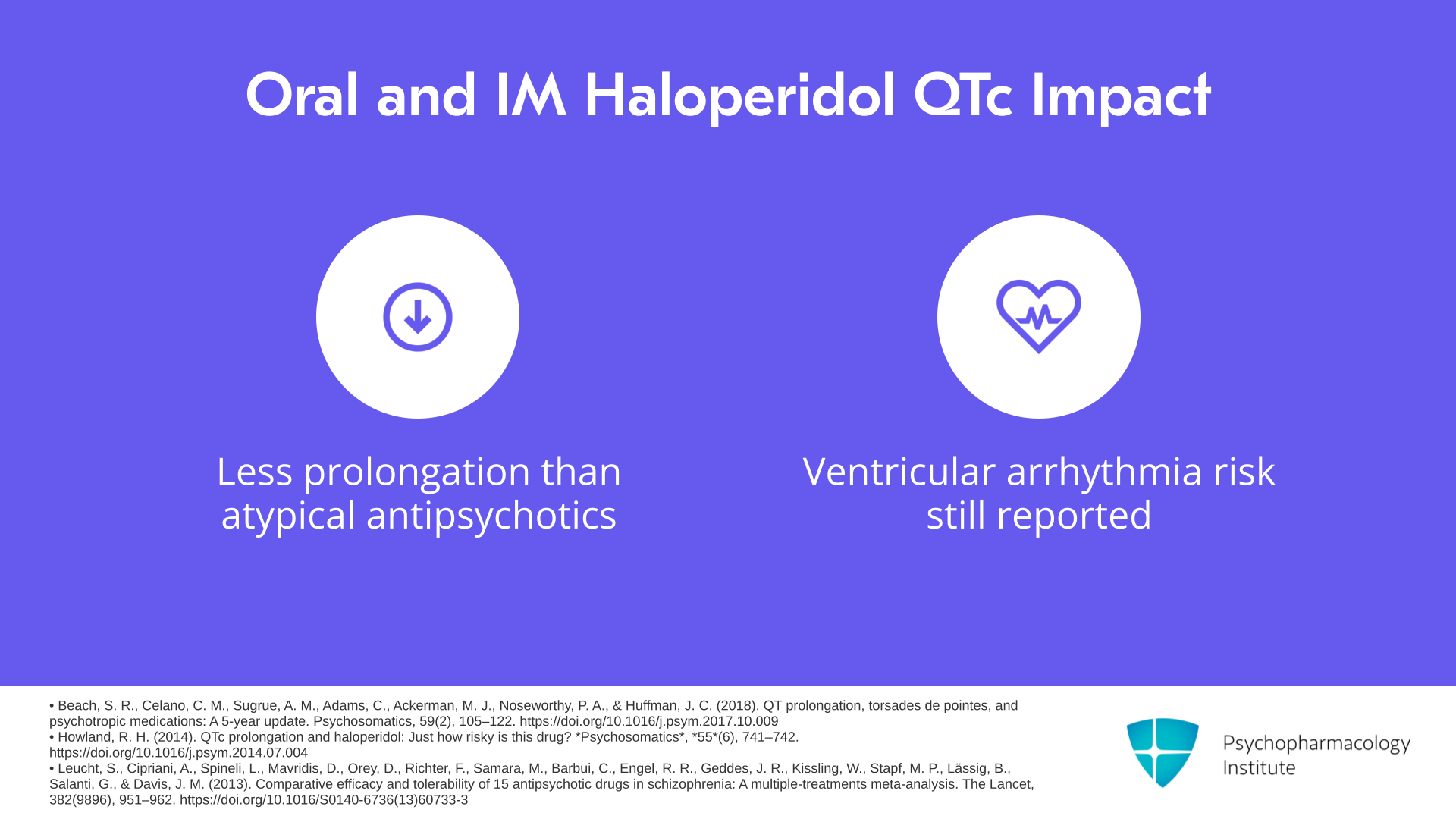
If we think about other typical antipsychotics, we can think about the oral and intramuscular forms of haloperidol which is at the opposite end of the spectrum. It’s a high-potency agent. Most studies suggest that these forms of haloperidol prolong the QTc by about 5 to 8 ms which actually turns out to be less than most atypical antipsychotics. Both the p.o. and IM form do not separate out from placebo in some studies and in one study, IM haloperidol does not separate out from IM olanzapine. However, there are some studies that continue to suggest a greater risk for ventricular arrhythmias or sudden cardiac death when using oral or IM haloperidol despite modest QTc prolongation.
References:
- Beach, S. R., Celano, C. M., Sugrue, A. M., Adams, C., Ackerman, M. J., Noseworthy, P. A., & Huffman, J. C. (2018). QT prolongation, torsades de pointes, and psychotropic medications: A 5-year update. Psychosomatics, 59(2), 105–122. https://doi.org/10.1016/j.psym.2017.10.009
- Howland, R. H. (2014). QTc prolongation and haloperidol: Just how risky is this drug? *Psychosomatics*, *55*(6), 741–742. https://doi.org/10.1016/j.psym.2014.07.004
- Leucht, S., Cipriani, A., Spineli, L., Mavridis, D., Orey, D., Richter, F., Samara, M., Barbui, C., Engel, R. R., Geddes, J. R., Kissling, W., Stapf, M. P., Lässig, B., Salanti, G., & Davis, J. M. (2013). Comparative efficacy and tolerability of 15 antipsychotic drugs in schizophrenia: A multiple-treatments meta-analysis. The Lancet, 382(9896), 951–962. https://doi.org/10.1016/S0140-6736(13)60733-3
Free Files
Download PDF and other files
Success!
Check your inbox, we sent you all the materials there.
Slide 7 of 29
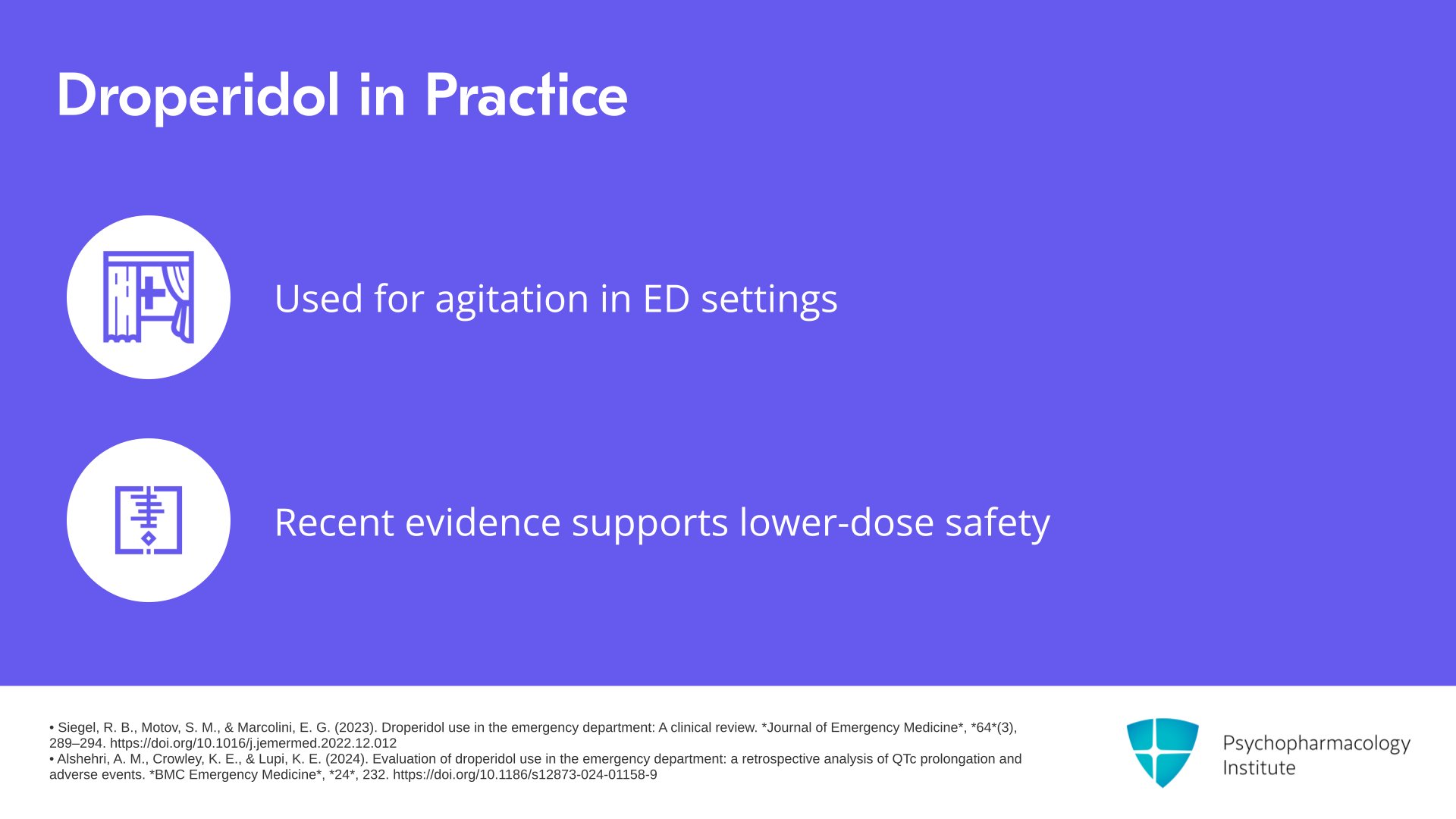
Another agent that has made a bit of a resurgence recently is droperidol. I often see it used for agitation management in ED settings. It does carry a black box warning from 2000 regarding QTc prolongation and torsade but in the more recent past, several emergency medicine groups have advocated for its safety at lower doses and a couple of Cochrane reviews suggested low risk.
References:
- Siegel, R. B., Motov, S. M., & Marcolini, E. G. (2023). Droperidol use in the emergency department: A clinical review. *Journal of Emergency Medicine*, *64*(3), 289–294. https://doi.org/10.1016/j.jemermed.2022.12.012
- Alshehri, A. M., Crowley, K. E., & Lupi, K. E. (2024). Evaluation of droperidol use in the emergency department: a retrospective analysis of QTc prolongation and adverse events. *BMC Emergency Medicine*, *24*, 232. https://doi.org/10.1186/s12873-024-01158-9
Slide 8 of 29
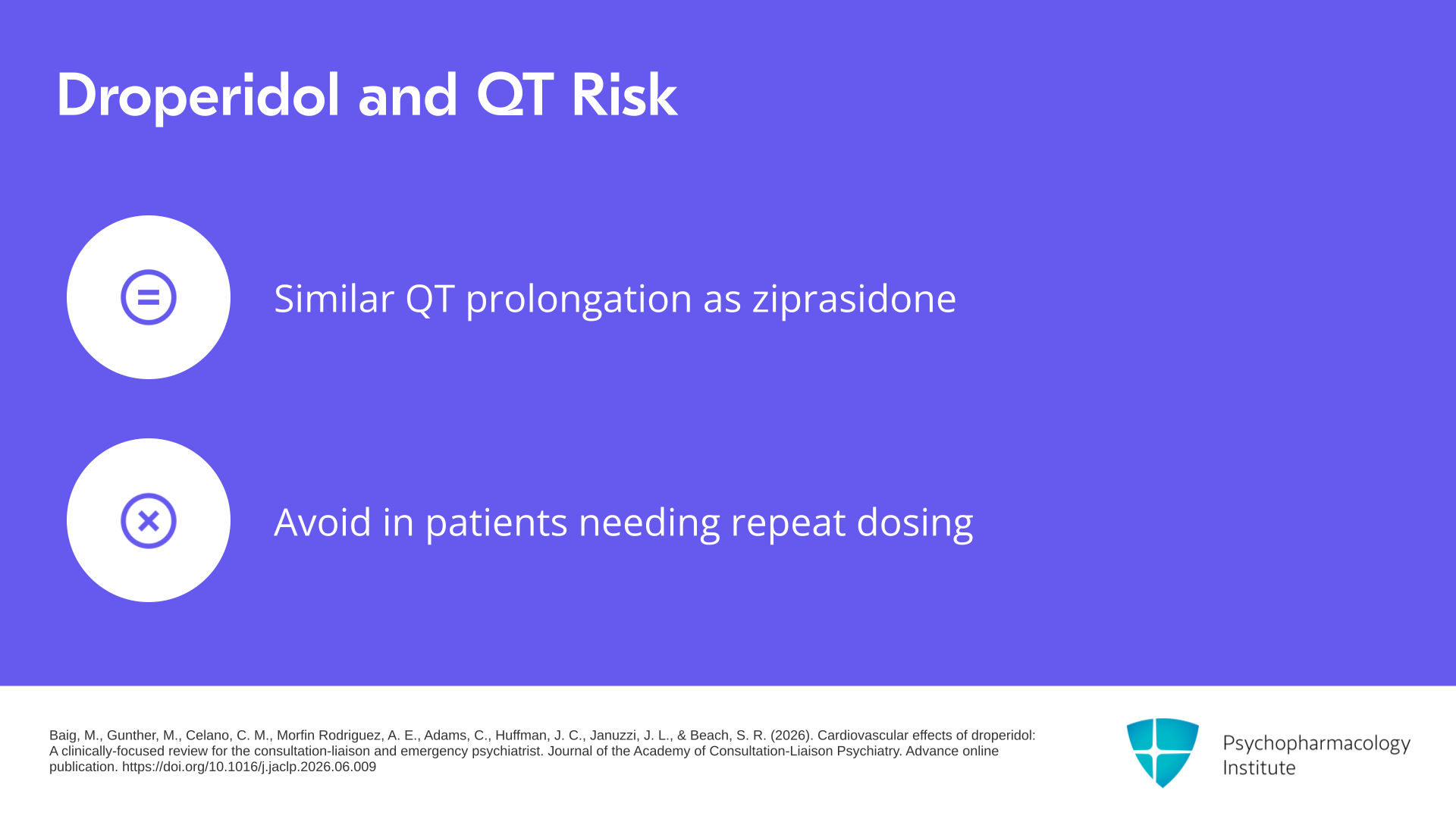
Interestingly, our group just completed a review of droperidol and we found that it actually looks similar to ziprasidone in terms of its degree of QT prolongation, 10 to 25 ms in most studies even at low doses. The risk also seems to be dose dependent. For this reason, we recommended that it not be used for patients likely to require repeat dosing for agitation given the relative QT prolongation compared to other agents. We also recommended baseline and followup EKGs when droperidol is used in hospital settings given a similar risk to ziprasidone.
References:
- Baig, M., Gunther, M., Celano, C. M., Morfin Rodriguez, A. E., Adams, C., Huffman, J. C., Januzzi, J. L., & Beach, S. R. (2026). Cardiovascular effects of droperidol: A clinically-focused review for the consultation-liaison and emergency psychiatrist. Journal of the Academy of Consultation-Liaison Psychiatry. Advance online publication. https://doi.org/10.1016/j.jaclp.2026.06.009
Free Files
Download PDF and other files
Success!
Check your inbox, we sent you all the materials there.
Slide 9 of 29
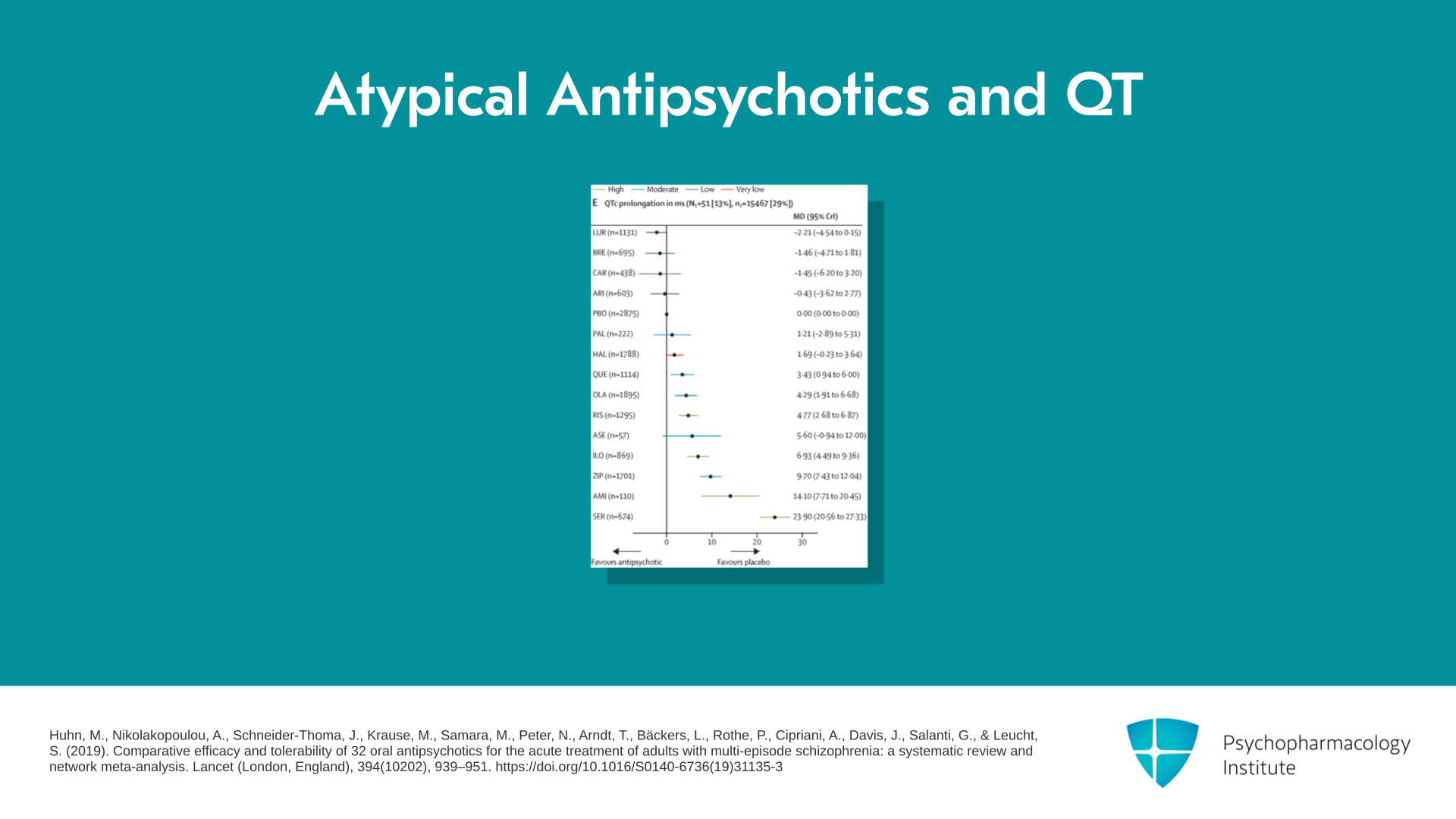
If we start to look at atypical antipsychotics and their effect on the QT, we can be informed somewhat by a 2019 network meta-analysis that compared most of the atypicals with regard to QT prolonging properties. The main figure from this study demonstrates that haloperidol actually causes less QT prolongation than most of the commonly used atypicals including olanzapine and quetiapine. At the bottom of the figure, asenapine, iloperidone and ziprasidone performed the worst in this network meta-analysis.
References:
- Huhn, M., Nikolakopoulou, A., Schneider-Thoma, J., Krause, M., Samara, M., Peter, N., Arndt, T., Bäckers, L., Rothe, P., Cipriani, A., Davis, J., Salanti, G., & Leucht, S. (2019). Comparative efficacy and tolerability of 32 oral antipsychotics for the acute treatment of adults with multi-episode schizophrenia: a systematic review and network meta-analysis. Lancet (London, England), 394(10202), 939–951. https://doi.org/10.1016/S0140-6736(19)31135-3
Slide 10 of 29
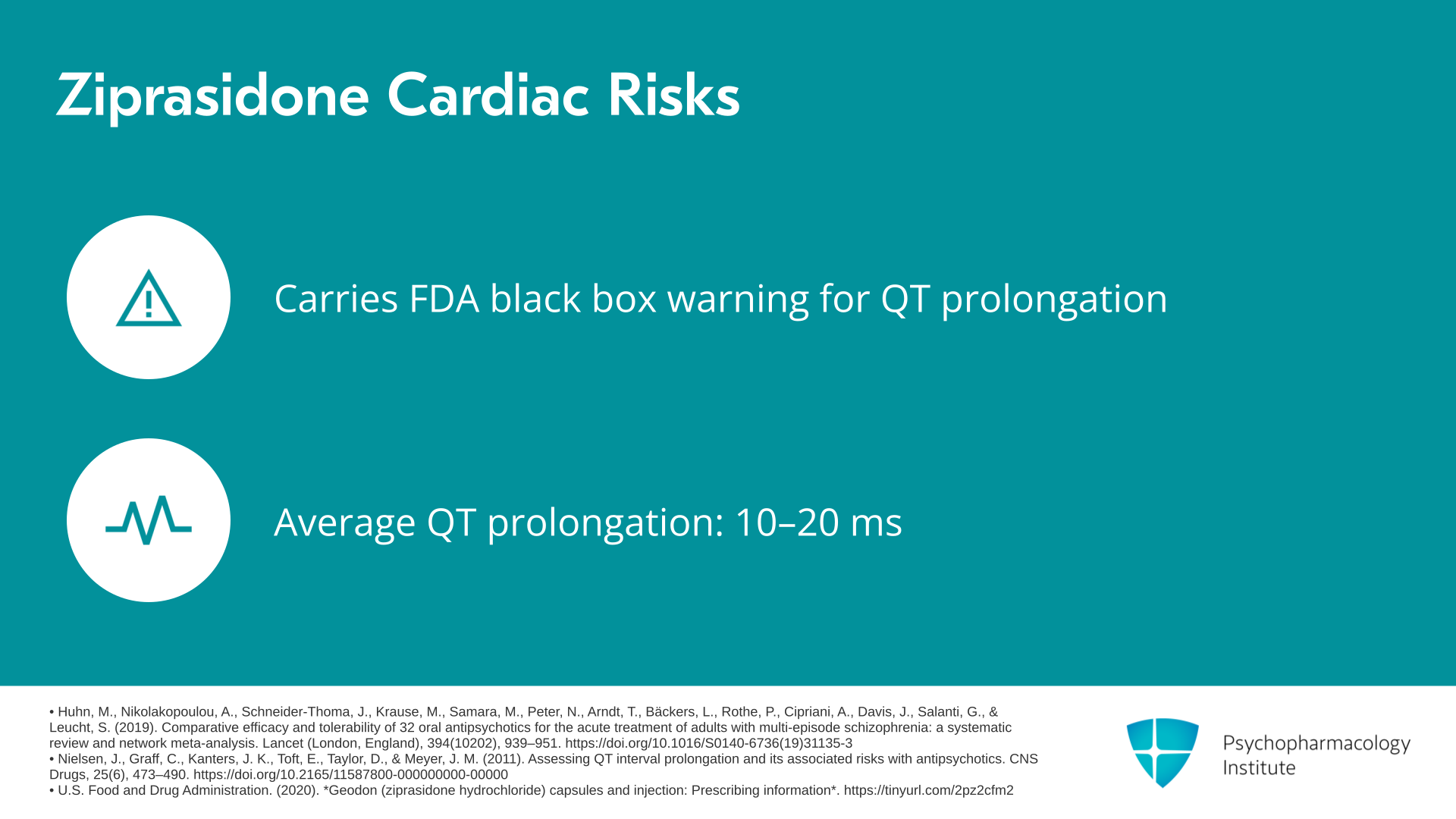
Let’s break that down a little bit more in terms of ziprasidone. I think most people are familiar with the fact that of the atypicals it is the one that’s most associated with QT prolongation and the only one that carries a black box warning from the FDA. It is recommended to not be used in combination with other QT prolonging agents or in patients with a history of cardiac arrhythmia. The average QT prolongation with ziprasidone is about 10 to 20 ms but importantly, 1 in 5 patients will experience a QT prolongation greater than 60 ms.
References:
- Huhn, M., Nikolakopoulou, A., Schneider-Thoma, J., Krause, M., Samara, M., Peter, N., Arndt, T., Bäckers, L., Rothe, P., Cipriani, A., Davis, J., Salanti, G., & Leucht, S. (2019). Comparative efficacy and tolerability of 32 oral antipsychotics for the acute treatment of adults with multi-episode schizophrenia: a systematic review and network meta-analysis. Lancet (London, England), 394(10202), 939–951. https://doi.org/10.1016/S0140-6736(19)31135-3
- Nielsen, J., Graff, C., Kanters, J. K., Toft, E., Taylor, D., & Meyer, J. M. (2011). Assessing QT interval prolongation and its associated risks with antipsychotics. CNS Drugs, 25(6), 473–490. https://doi.org/10.2165/11587800-000000000-00000
- U.S. Food and Drug Administration. (2020). *Geodon (ziprasidone hydrochloride) capsules and injection: Prescribing information*. https://tinyurl.com/2pz2cfm2
Free Files
Download PDF and other files
Success!
Check your inbox, we sent you all the materials there.
Slide 11 of 29
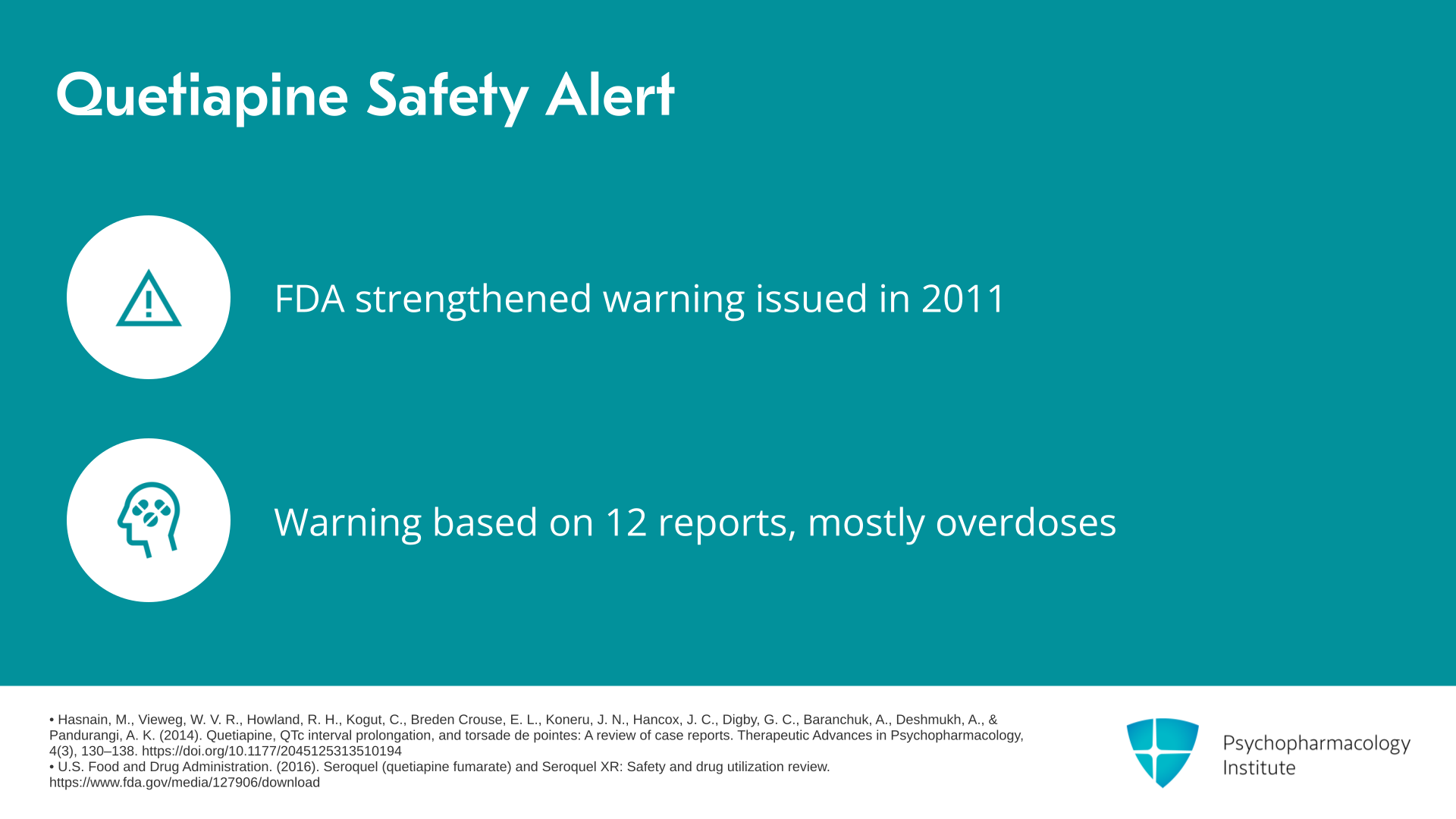
Quetiapine is also an interesting one. It has a 2011 strengthened warning from the FDA, so not a black box warning but a warning that makes it somewhat unique among atypicals. That warning again recommends that quetiapine not be given with other QT prolonging agents or in patients with a history of arrhythmias or metabolic deficits. Now, the warning is based on only 12 reports, most of which were in the context of overdose and 4 of which developed torsade.
References:
- Hasnain, M., Vieweg, W. V. R., Howland, R. H., Kogut, C., Breden Crouse, E. L., Koneru, J. N., Hancox, J. C., Digby, G. C., Baranchuk, A., Deshmukh, A., & Pandurangi, A. K. (2014). Quetiapine, QTc interval prolongation, and torsade de pointes: A review of case reports. Therapeutic Advances in Psychopharmacology, 4(3), 130–138. https://doi.org/10.1177/2045125313510194
- U.S. Food and Drug Administration. (2016). Seroquel (quetiapine fumarate) and Seroquel XR: Safety and drug utilization review. https://www.fda.gov/media/127906/download
Slide 12 of 29
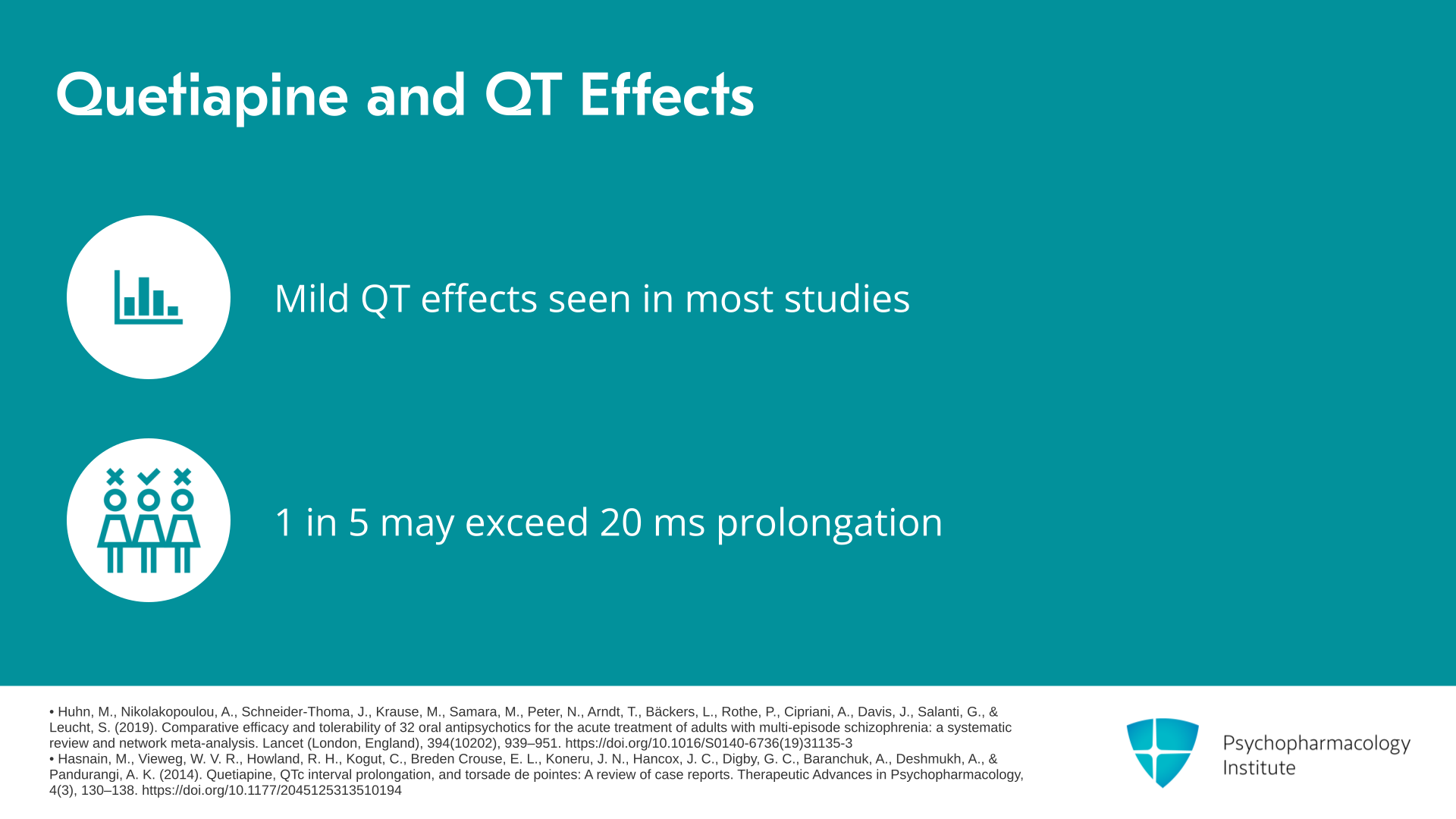
Most studies suggest only mild effects on QT but some do suggest that similar to ziprasidone, about 1 in 5 people will experience a more significant prolongation, in this case more than 20 ms.
References:
- Huhn, M., Nikolakopoulou, A., Schneider-Thoma, J., Krause, M., Samara, M., Peter, N., Arndt, T., Bäckers, L., Rothe, P., Cipriani, A., Davis, J., Salanti, G., & Leucht, S. (2019). Comparative efficacy and tolerability of 32 oral antipsychotics for the acute treatment of adults with multi-episode schizophrenia: a systematic review and network meta-analysis. Lancet (London, England), 394(10202), 939–951. https://doi.org/10.1016/S0140-6736(19)31135-3
- Hasnain, M., Vieweg, W. V. R., Howland, R. H., Kogut, C., Breden Crouse, E. L., Koneru, J. N., Hancox, J. C., Digby, G. C., Baranchuk, A., Deshmukh, A., & Pandurangi, A. K. (2014). Quetiapine, QTc interval prolongation, and torsade de pointes: A review of case reports. Therapeutic Advances in Psychopharmacology, 4(3), 130–138. https://doi.org/10.1177/2045125313510194
Free Files
Download PDF and other files
Success!
Check your inbox, we sent you all the materials there.
Slide 13 of 29
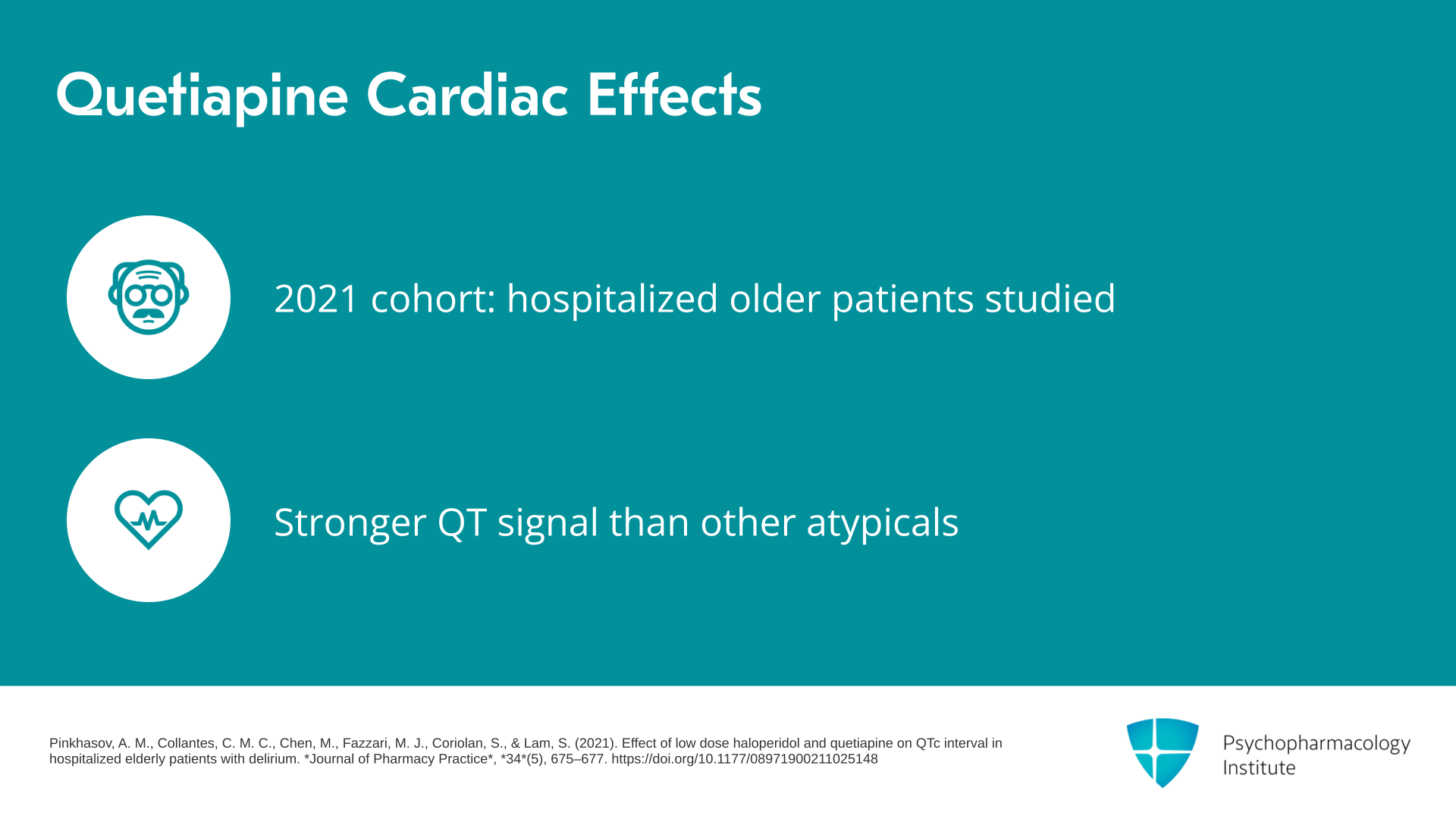
There’s also a 2021 cohort analysis of hospitalized older patients who received quetiapine demonstrating a mean QTc increase from baseline of about 7 ms with 7% of those patients having a post-treatment QTc greater than 500 ms. So some mixed data on quetiapine but it does seem to have a little more of a signal for QT prolongation than some of the other atypicals.
References:
- Pinkhasov, A. M., Collantes, C. M. C., Chen, M., Fazzari, M. J., Coriolan, S., & Lam, S. (2021). Effect of low dose haloperidol and quetiapine on QTc interval in hospitalized elderly patients with delirium. *Journal of Pharmacy Practice*, *34*(5), 675–677. https://doi.org/10.1177/08971900211025148
Slide 14 of 29
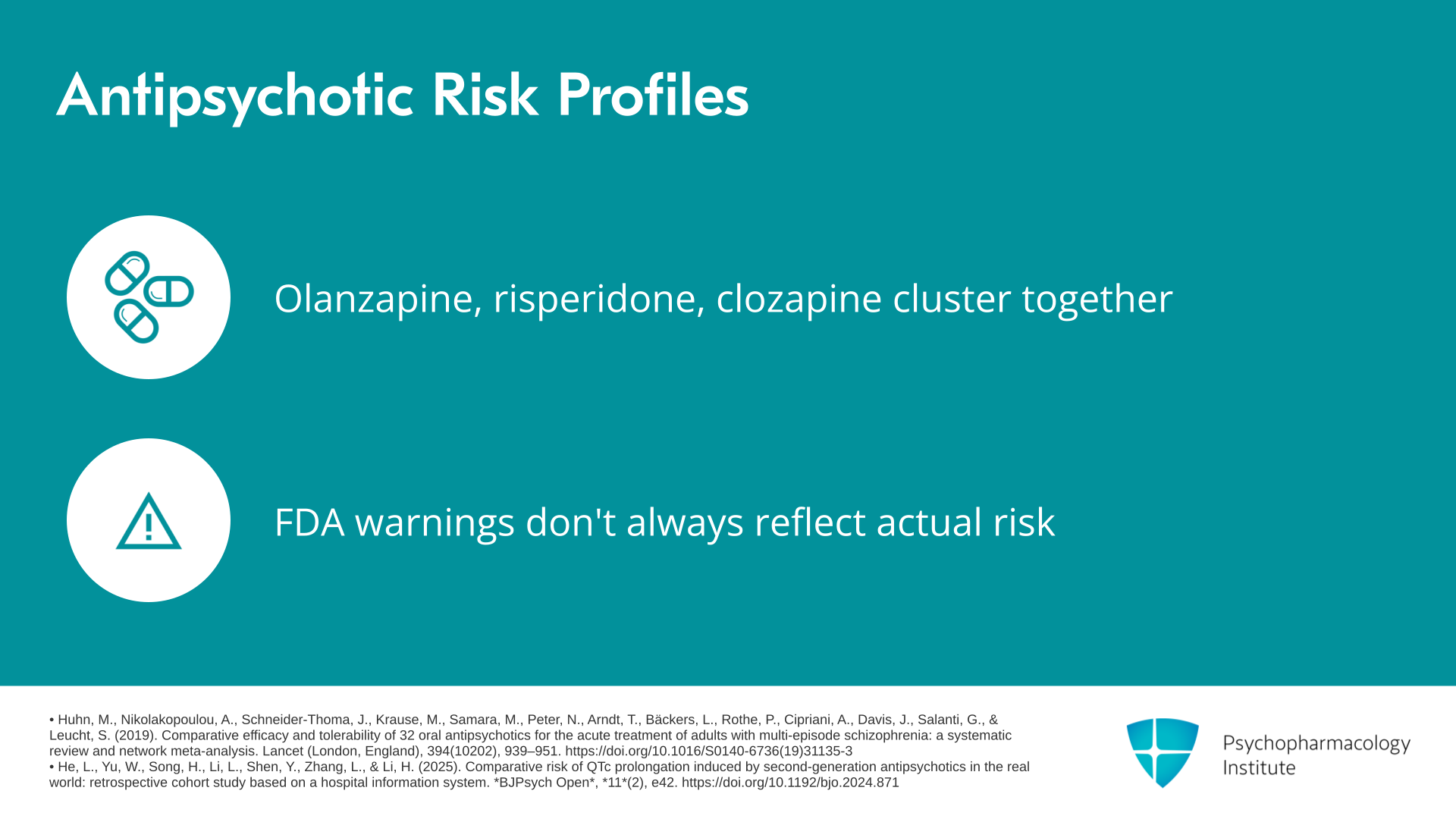
Other atypicals that we would commonly use like olanzapine, risperidone and clozapine are all pretty similar in this regard and cluster together somewhere in the middle. Importantly, I want to emphasize that the risk associated with a particular antipsychotic is not always well correlated with FDA warnings and that’s been shown in several studies.
References:
- Huhn, M., Nikolakopoulou, A., Schneider-Thoma, J., Krause, M., Samara, M., Peter, N., Arndt, T., Bäckers, L., Rothe, P., Cipriani, A., Davis, J., Salanti, G., & Leucht, S. (2019). Comparative efficacy and tolerability of 32 oral antipsychotics for the acute treatment of adults with multi-episode schizophrenia: a systematic review and network meta-analysis. Lancet (London, England), 394(10202), 939–951. https://doi.org/10.1016/S0140-6736(19)31135-3
- He, L., Yu, W., Song, H., Li, L., Shen, Y., Zhang, L., & Li, H. (2025). Comparative risk of QTc prolongation induced by second-generation antipsychotics in the real world: retrospective cohort study based on a hospital information system. *BJPsych Open*, *11*(2), e42. https://doi.org/10.1192/bjo.2024.871
Free Files
Download PDF and other files
Success!
Check your inbox, we sent you all the materials there.
Slide 15 of 29
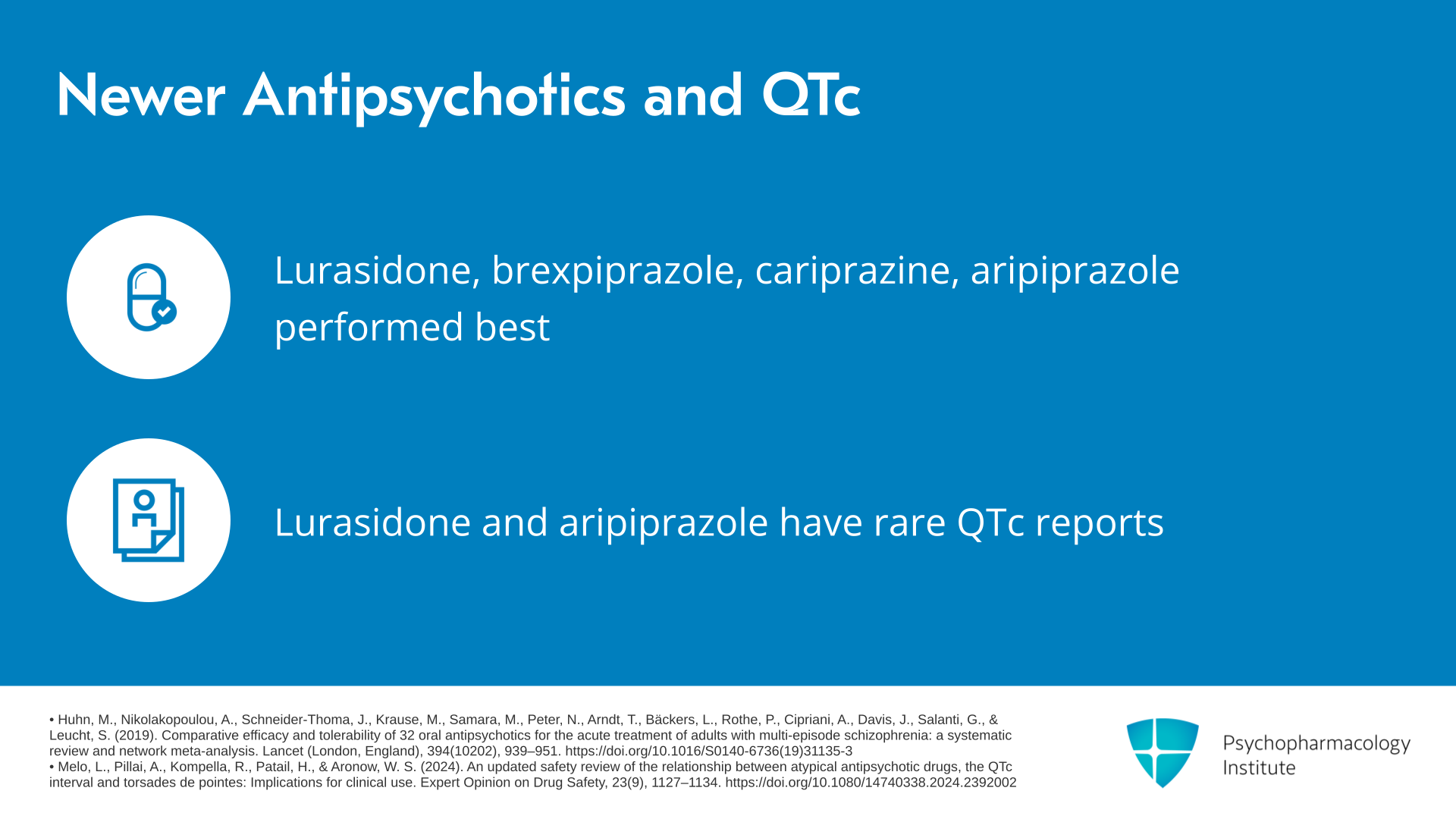
Turning to newer antipsychotics and their effect on QTc. If we go back to that 2019 meta-analysis, the agents that performed the best were lurasidone, brexpiprazole, cariprazine and aripiprazole. Lurasidone and aripiprazole now have at least one case report associating them with QTc prolongation but in general, I would consider them pretty safe.
References:
- Huhn, M., Nikolakopoulou, A., Schneider-Thoma, J., Krause, M., Samara, M., Peter, N., Arndt, T., Bäckers, L., Rothe, P., Cipriani, A., Davis, J., Salanti, G., & Leucht, S. (2019). Comparative efficacy and tolerability of 32 oral antipsychotics for the acute treatment of adults with multi-episode schizophrenia: a systematic review and network meta-analysis. Lancet (London, England), 394(10202), 939–951. https://doi.org/10.1016/S0140-6736(19)31135-3
- Melo, L., Pillai, A., Kompella, R., Patail, H., & Aronow, W. S. (2024). An updated safety review of the relationship between atypical antipsychotic drugs, the QTc interval and torsades de pointes: Implications for clinical use. Expert Opinion on Drug Safety, 23(9), 1127–1134. https://doi.org/10.1080/14740338.2024.2392002
Slide 16 of 29
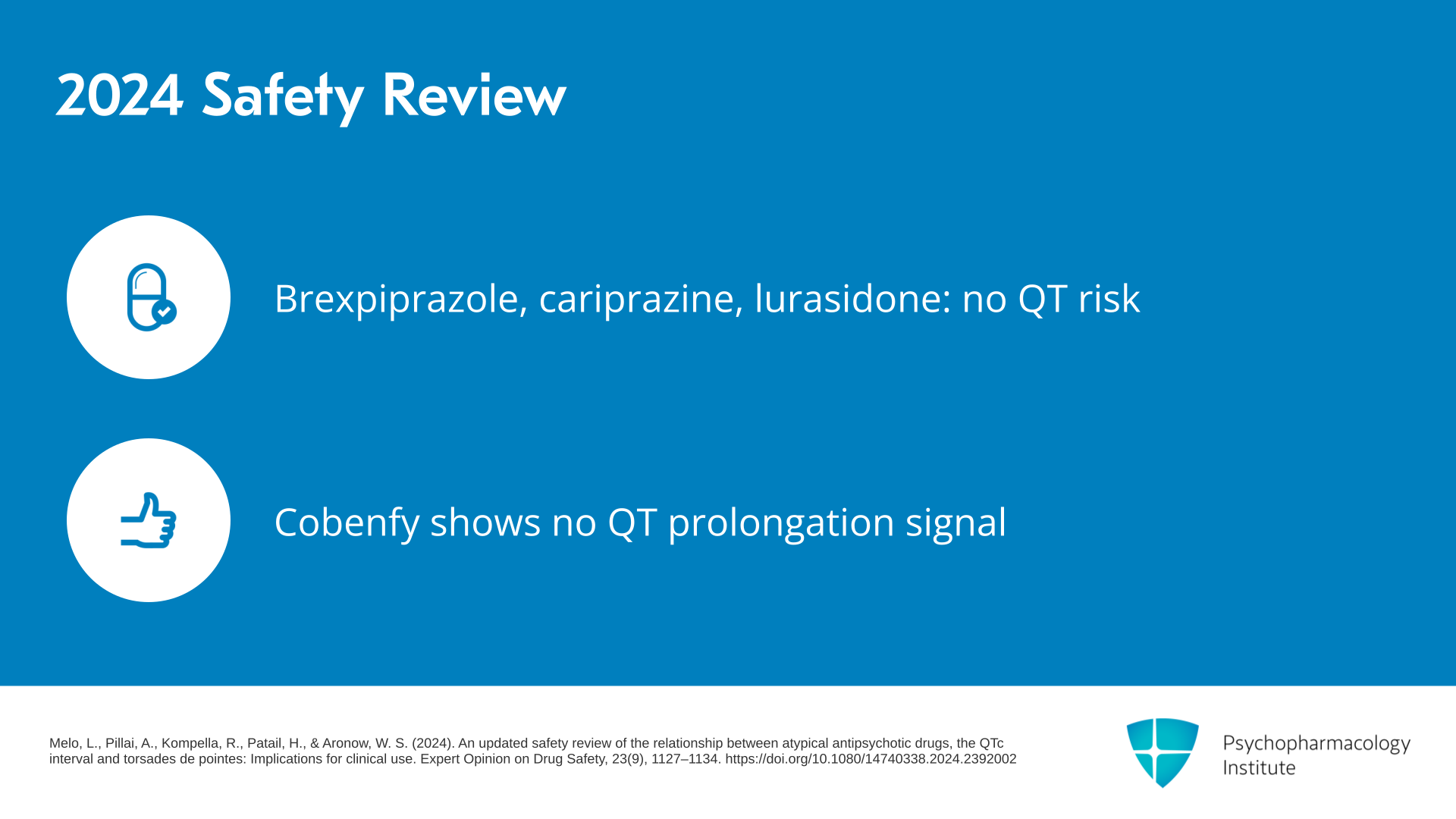
A 2024 safety review suggested that brexpiprazole, cariprazine and lurasidone carry no risk for QT prolongation and classified aripiprazole as low risk. Cobenfy, the newest antipsychotic, also currently has no signal for causing QT prolongation and the phase 2 and phase 3 trials showed no QT prolongation compared to placebo.
References:
- Melo, L., Pillai, A., Kompella, R., Patail, H., & Aronow, W. S. (2024). An updated safety review of the relationship between atypical antipsychotic drugs, the QTc interval and torsades de pointes: Implications for clinical use. Expert Opinion on Drug Safety, 23(9), 1127–1134. https://doi.org/10.1080/14740338.2024.2392002
Free Files
Download PDF and other files
Success!
Check your inbox, we sent you all the materials there.
Slide 17 of 29
What about the question of antipsychotic polypharmacy and QTc? Well, here, there’s really mixed data about whether combining antipsychotics leads to greater QTc prolongation. A 2024 meta-analysis found that across two studies antipsychotic polypharmacy was linked to QTc prolongation compared to monotherapy.
References:
- Højlund, M., Köhler-Forsberg, O., Gregersen, A. T., Rohde, C., Mellentin, A. I., Anhøj, S. J., Kemp, A. F., Fuglsang, N. B., Wiuff, A. C., Nissen, L., Sørensen, M. A., Madsen, N. M., Wagner, C. B., Agharazi, A., Søndergaard, C., Sandmark, M., Reinhart, J., & Correll, C. U. (2024). Prevalence, correlates, tolerability-related outcomes, and efficacy-related outcomes of antipsychotic polypharmacy: A systematic review and meta-analysis. The Lancet Psychiatry, 11(12), 975–989. https://doi.org/10.1016/S2215-0366(24)00314-6
Slide 18 of 29
There’s another older study suggesting that if polypharmacy is associated with an increased QTc, it could be mediated by cumulative dose. In other words, there might not be anything special about the fact that two different agents are being used but rather just that the cumulative dose of those two agents increases the risk for QT prolongation given that most medications have a dose-dependent relationship.
References:
- Barbui, C., Bighelli, I., Carrà, G., Castellazzi, M., Lucii, C., Martinotti, G., Nosè, M., Ostuzzi, G., & STAR NETWORK INVESTIGATORS. (2016). Antipsychotic dose mediates the association between polypharmacy and corrected QT interval. *PLOS ONE*, *11*(2), e0148212. https://doi.org/10.1371/journal.pone.0148212
Free Files
Download PDF and other files
Success!
Check your inbox, we sent you all the materials there.
Slide 19 of 29
A 2024 drug safety review attempted to risk stratify antipsychotics in terms of their likelihood to cause QT prolongation and torsade. I’m going to quibble with their analysis a little bit. For example, they separated olanzapine from quetiapine stating that quetiapine was a little bit higher risk. I’m not sure about that. If you look back at that 2019 meta-analysis, olanzapine is actually a little worse than quetiapine and the studies since then have been pretty mixed.
References:
- Huhn, M., Nikolakopoulou, A., Schneider-Thoma, J., Krause, M., Samara, M., Peter, N., Arndt, T., Bäckers, L., Rothe, P., Cipriani, A., Davis, J., Salanti, G., & Leucht, S. (2019). Comparative efficacy and tolerability of 32 oral antipsychotics for the acute treatment of adults with multi-episode schizophrenia: a systematic review and network meta-analysis. Lancet (London, England), 394(10202), 939–951. https://doi.org/10.1016/S0140-6736(19)31135-3
- Melo, L., Pillai, A., Kompella, R., Patail, H., & Aronow, W. S. (2024). An updated safety review of the relationship between atypical antipsychotic drugs, the QTc interval and torsades de pointes: Implications for clinical use. Expert Opinion on Drug Safety, 23(9), 1127–1134. https://doi.org/10.1080/14740338.2024.2392002
Slide 20 of 29
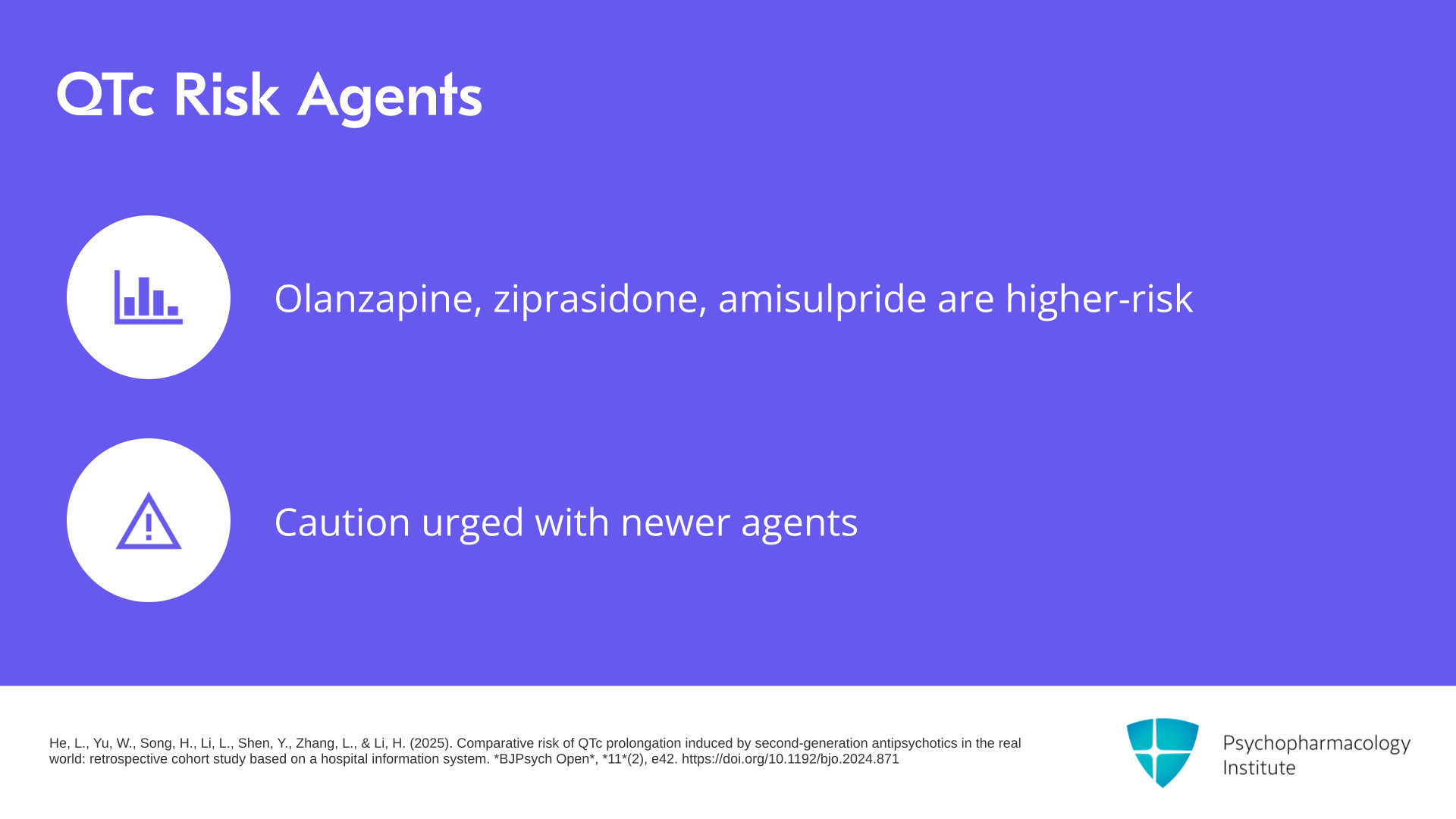
In fact, in a 2025 real-world study, olanzapine was found along with ziprasidone and amisulpride to be a higher-risk agent. I think this becomes the challenge of trying to create neat categories. It’s really hard to differentiate the stuff in the middle. I would also urge caution with the newer agents. Right now, they look good but the trend has been for concerns to emerge with more experience especially in the absence of any Thorough QT studies for those agents.
References:
- He, L., Yu, W., Song, H., Li, L., Shen, Y., Zhang, L., & Li, H. (2025). Comparative risk of QTc prolongation induced by second-generation antipsychotics in the real world: retrospective cohort study based on a hospital information system. *BJPsych Open*, *11*(2), e42. https://doi.org/10.1192/bjo.2024.871
Free Files
Download PDF and other files
Success!
Check your inbox, we sent you all the materials there.
Slide 21 of 29
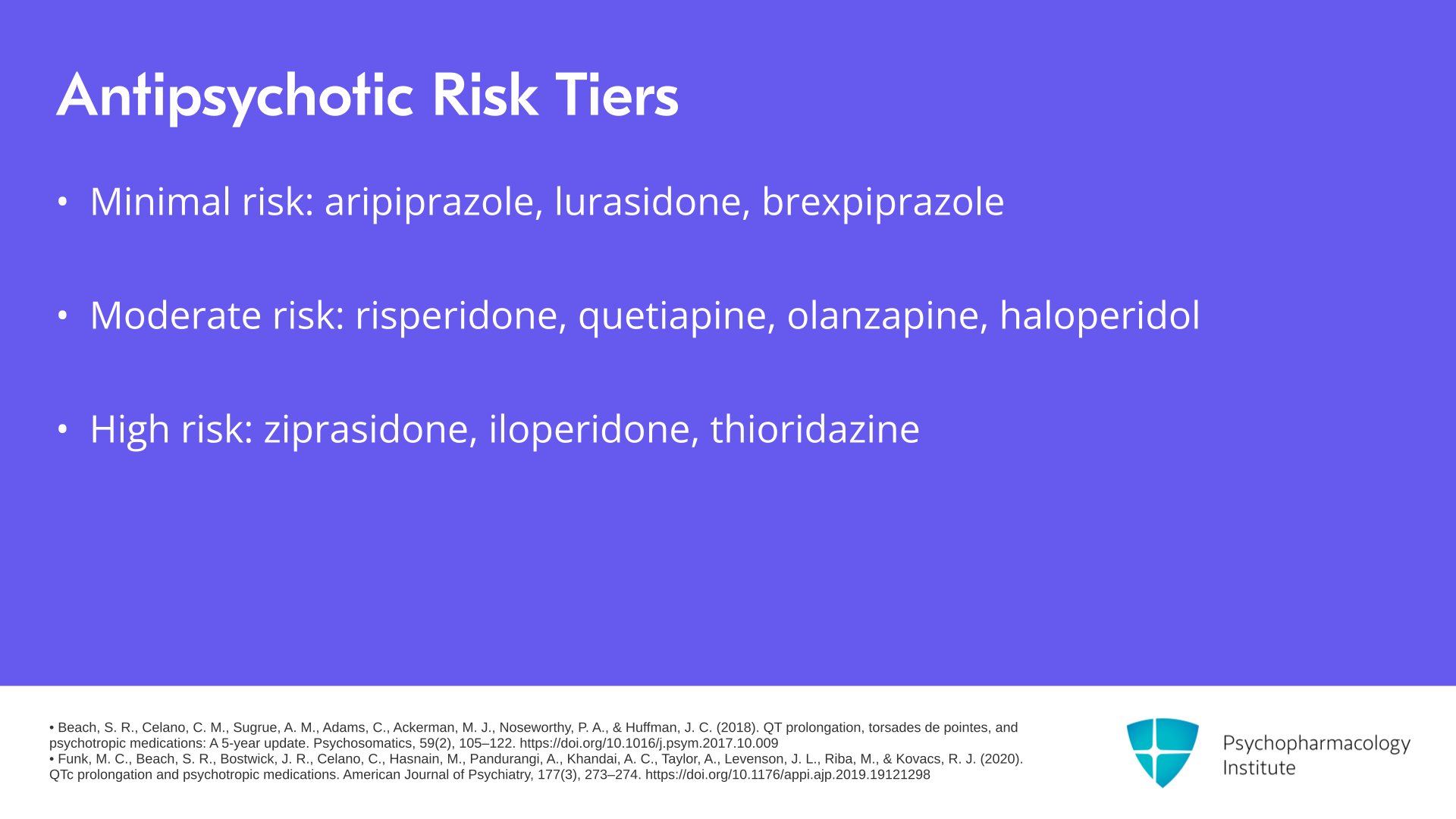
My breakdown of risk would go something like this. Agents that appear to have minimal risk at this point include aripiprazole, lurasidone, brexpiprazole, cariprazine and Cobenfy, though for the latter three, I would say we probably don’t have enough data yet. Moderate-risk agents include most of the antipsychotics – risperidone, quetiapine, olanzapine, haloperidol, chlorpromazine. I think all of those things cluster together in the middle and can’t really be separated out. And then you’ve got a few high-risk agents – ziprasidone, iloperidone, thioridazine. The data on those are pretty consistent.
References:
- Beach, S. R., Celano, C. M., Sugrue, A. M., Adams, C., Ackerman, M. J., Noseworthy, P. A., & Huffman, J. C. (2018). QT prolongation, torsades de pointes, and psychotropic medications: A 5-year update. Psychosomatics, 59(2), 105–122. https://doi.org/10.1016/j.psym.2017.10.009
- Funk, M. C., Beach, S. R., Bostwick, J. R., Celano, C., Hasnain, M., Pandurangi, A., Khandai, A. C., Taylor, A., Levenson, J. L., Riba, M., & Kovacs, R. J. (2020). QTc prolongation and psychotropic medications. American Journal of Psychiatry, 177(3), 273–274. https://doi.org/10.1176/appi.ajp.2019.19121298
Slide 22 of 29
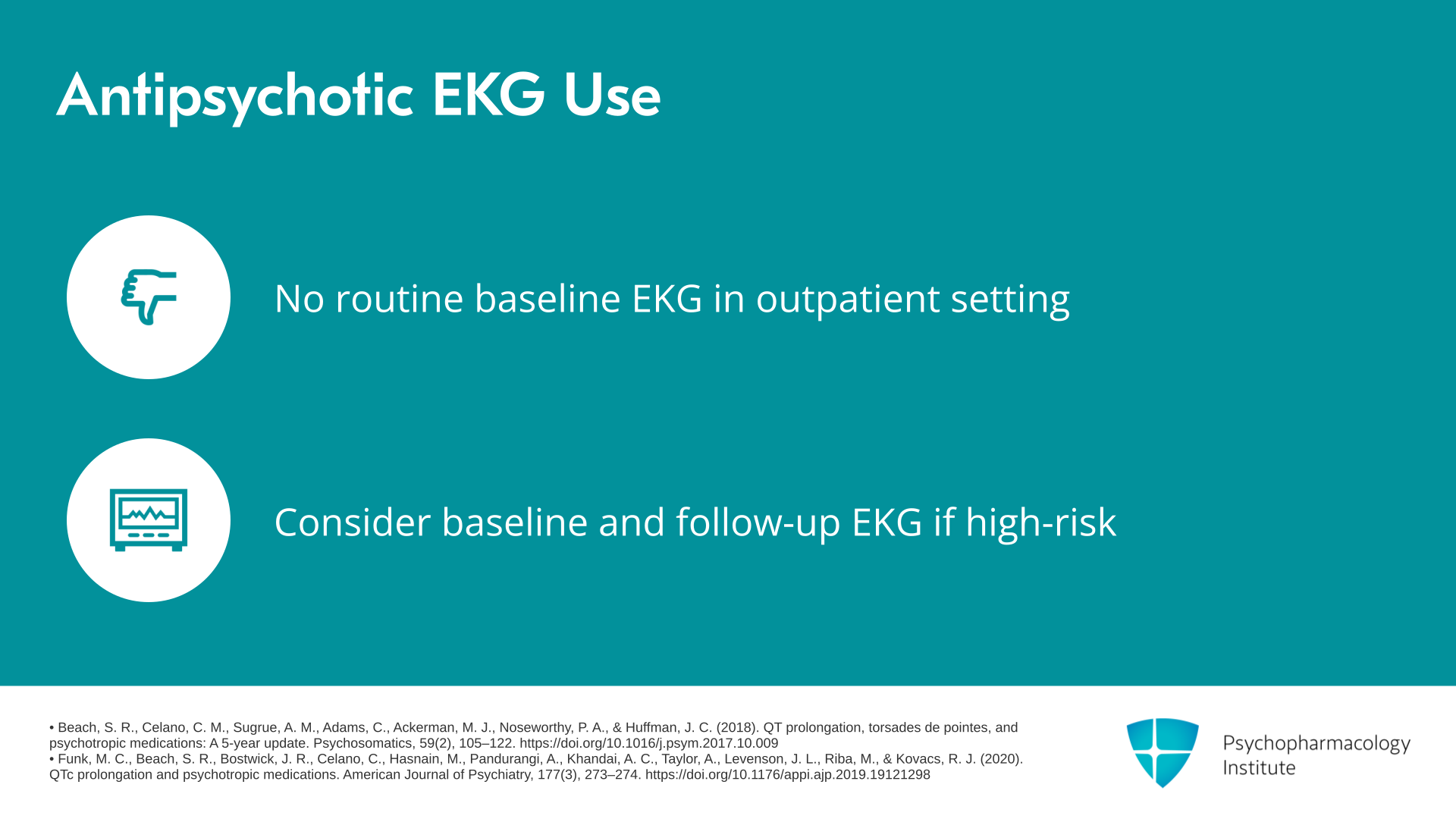
So how do we think about using antipsychotics given these risks? In the outpatient setting, there really is no indication for a baseline EKG with all antipsychotic initiation at this point. I would consider a baseline EKG and maybe a followup EKG for patients with significant risk factors who are being started on a low or moderate-risk antipsychotic. So somebody who has more than two risk factors for QT prolongation or torsade being started on an antipsychotic, I’d probably get a baseline and followup EKG.
References:
- Beach, S. R., Celano, C. M., Sugrue, A. M., Adams, C., Ackerman, M. J., Noseworthy, P. A., & Huffman, J. C. (2018). QT prolongation, torsades de pointes, and psychotropic medications: A 5-year update. Psychosomatics, 59(2), 105–122. https://doi.org/10.1016/j.psym.2017.10.009
- Funk, M. C., Beach, S. R., Bostwick, J. R., Celano, C., Hasnain, M., Pandurangi, A., Khandai, A. C., Taylor, A., Levenson, J. L., Riba, M., & Kovacs, R. J. (2020). QTc prolongation and psychotropic medications. American Journal of Psychiatry, 177(3), 273–274. https://doi.org/10.1176/appi.ajp.2019.19121298
Free Files
Download PDF and other files
Success!
Check your inbox, we sent you all the materials there.
Slide 23 of 29
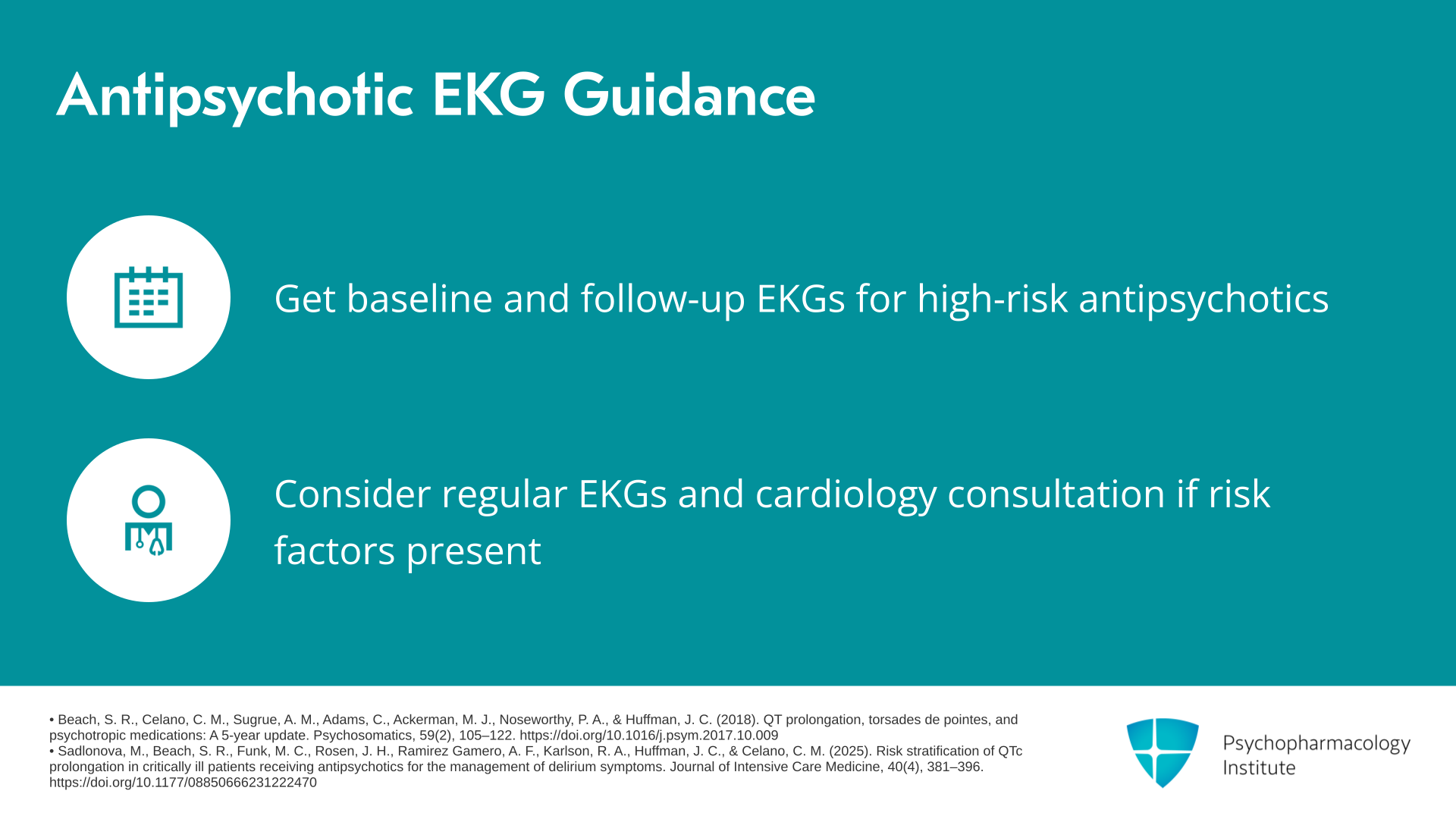
Similarly, if you had somebody with no risk factors but you were starting them on one of those high-risk antipsychotics like ziprasidone or iloperidone or thioridazine, I’d probably also get a baseline and a followup EKG in those patients. For patients who have risk factors and who are being started on a high-risk antipsychotic, that’s a case where I might consider regular EKG monitoring and sometimes perhaps even a cardiology consult. In general, I would avoid multiple antipsychotics for patients who are at higher risk for torsade because we just don’t really understand the impact of that yet.
References:
- Beach, S. R., Celano, C. M., Sugrue, A. M., Adams, C., Ackerman, M. J., Noseworthy, P. A., & Huffman, J. C. (2018). QT prolongation, torsades de pointes, and psychotropic medications: A 5-year update. Psychosomatics, 59(2), 105–122. https://doi.org/10.1016/j.psym.2017.10.009
- Sadlonova, M., Beach, S. R., Funk, M. C., Rosen, J. H., Ramirez Gamero, A. F., Karlson, R. A., Huffman, J. C., & Celano, C. M. (2025). Risk stratification of QTc prolongation in critically ill patients receiving antipsychotics for the management of delirium symptoms. Journal of Intensive Care Medicine, 40(4), 381–396. https://doi.org/10.1177/08850666231222470
Slide 24 of 29
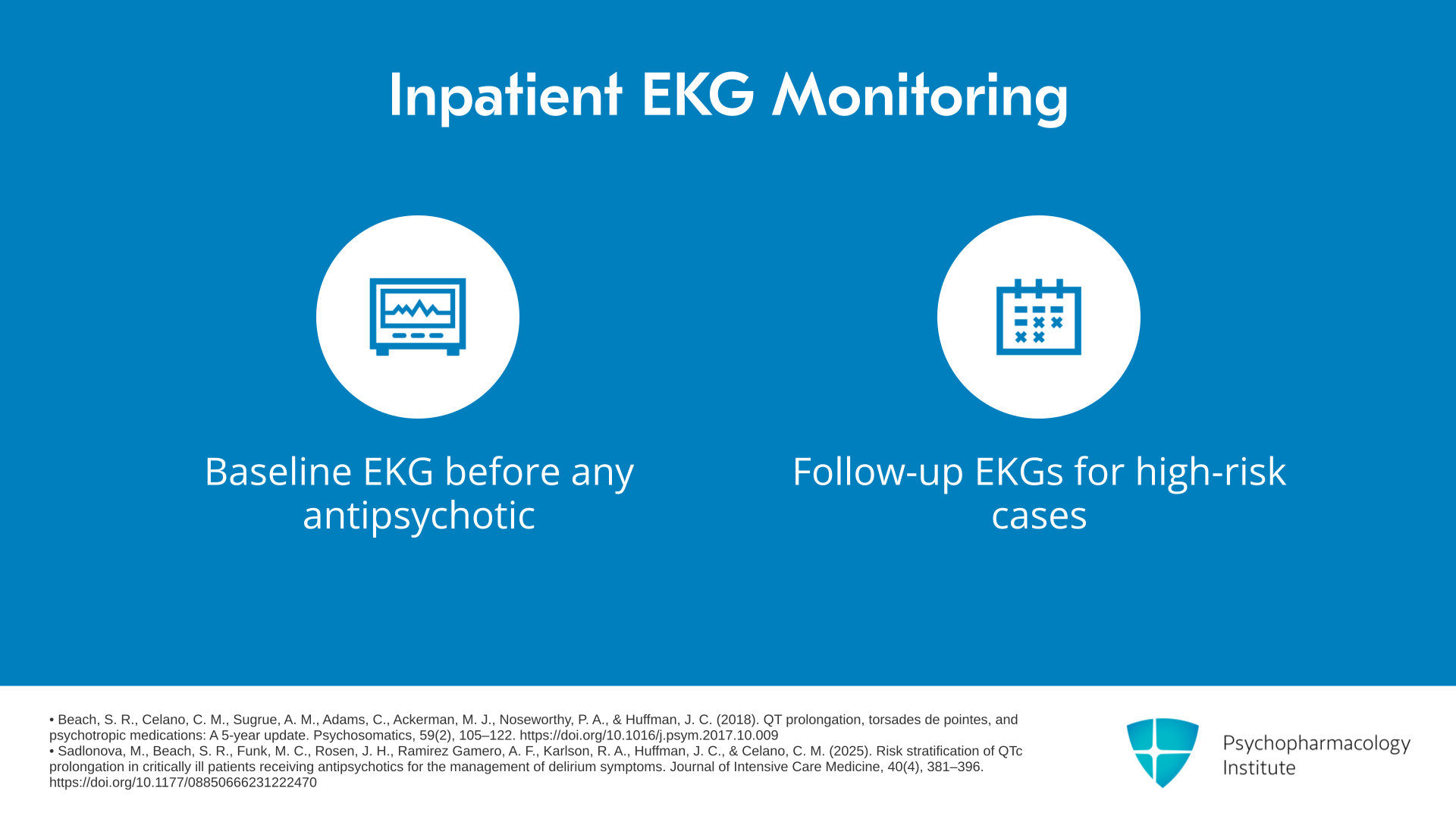
On the inpatient setting, things are slightly different. It’s a lot easier to get EKGs and I think we can assume a higher risk for torsade among inpatients. Because of that, I tend to get a baseline EKG before initiating any antipsychotic unless I’m using it in an emergent capacity. I really only get followup EKGs for patients with significant risk factors, now in the hospital setting that does turn out to be a lot of patients, or those who are receiving either a high-risk antipsychotic or a very high dose of a moderate-risk antipsychotic.
References:
- Beach, S. R., Celano, C. M., Sugrue, A. M., Adams, C., Ackerman, M. J., Noseworthy, P. A., & Huffman, J. C. (2018). QT prolongation, torsades de pointes, and psychotropic medications: A 5-year update. Psychosomatics, 59(2), 105–122. https://doi.org/10.1016/j.psym.2017.10.009
- Sadlonova, M., Beach, S. R., Funk, M. C., Rosen, J. H., Ramirez Gamero, A. F., Karlson, R. A., Huffman, J. C., & Celano, C. M. (2025). Risk stratification of QTc prolongation in critically ill patients receiving antipsychotics for the management of delirium symptoms. Journal of Intensive Care Medicine, 40(4), 381–396. https://doi.org/10.1177/08850666231222470
Free Files
Download PDF and other files
Success!
Check your inbox, we sent you all the materials there.
Slide 25 of 29
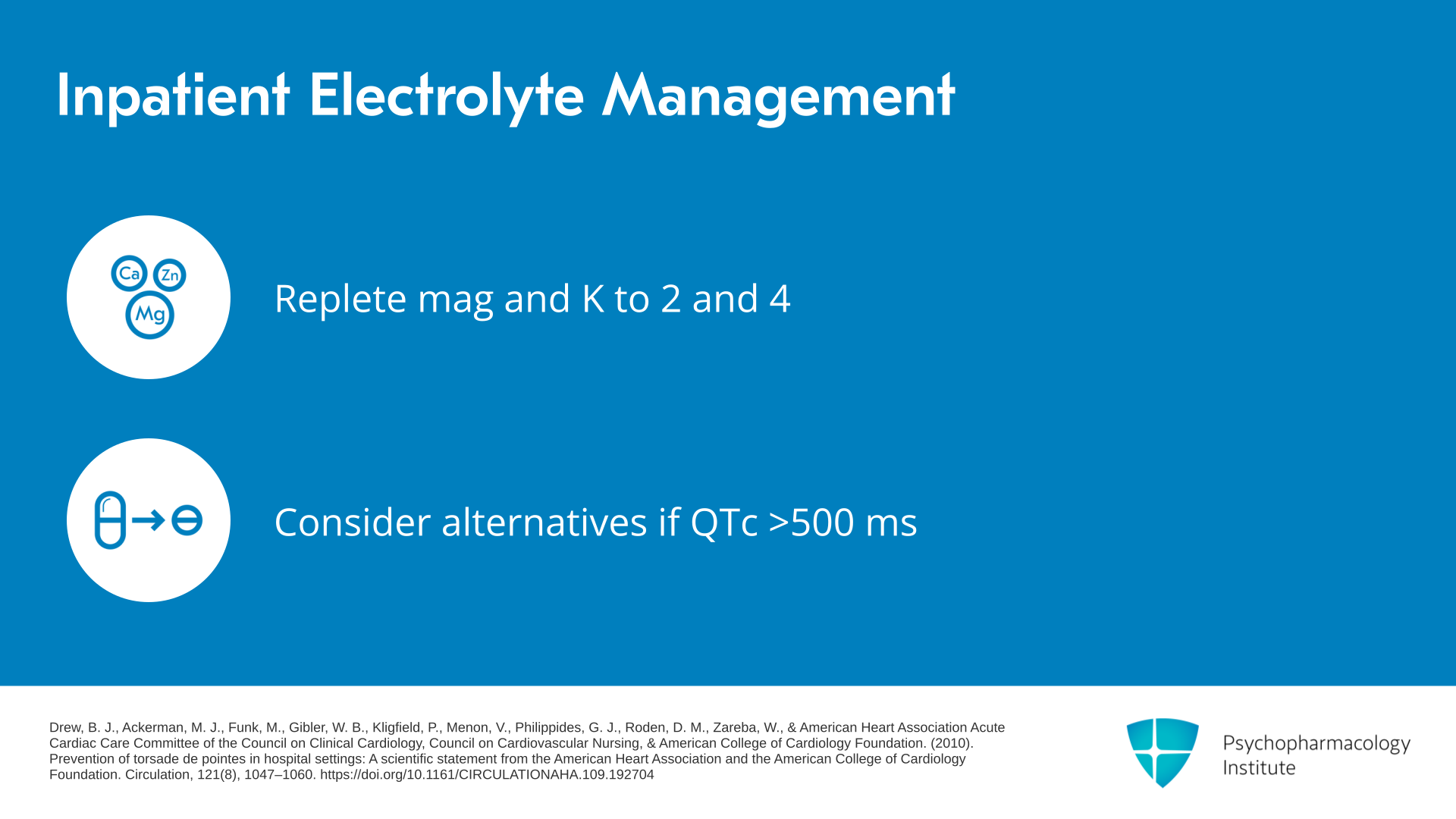
In the hospital setting, I’m really attuned to repleting electrolytes. Generally, that’s mag and K to 2 and 4 although some more recent evidence has suggested that we probably only need to replete K to 3.5. And then I also am considering alternative agents if the QTc is greater than 500 ms. But as I’ll tell you later, I want you to avoid the urge to use a QTc cutoff and really think about it as a risk-benefit analysis.
References:
- Drew, B. J., Ackerman, M. J., Funk, M., Gibler, W. B., Kligfield, P., Menon, V., Philippides, G. J., Roden, D. M., Zareba, W., & American Heart Association Acute Cardiac Care Committee of the Council on Clinical Cardiology, Council on Cardiovascular Nursing, & American College of Cardiology Foundation. (2010). Prevention of torsade de pointes in hospital settings: A scientific statement from the American Heart Association and the American College of Cardiology Foundation. Circulation, 121(8), 1047–1060. https://doi.org/10.1161/CIRCULATIONAHA.109.192704
Slide 26 of 29
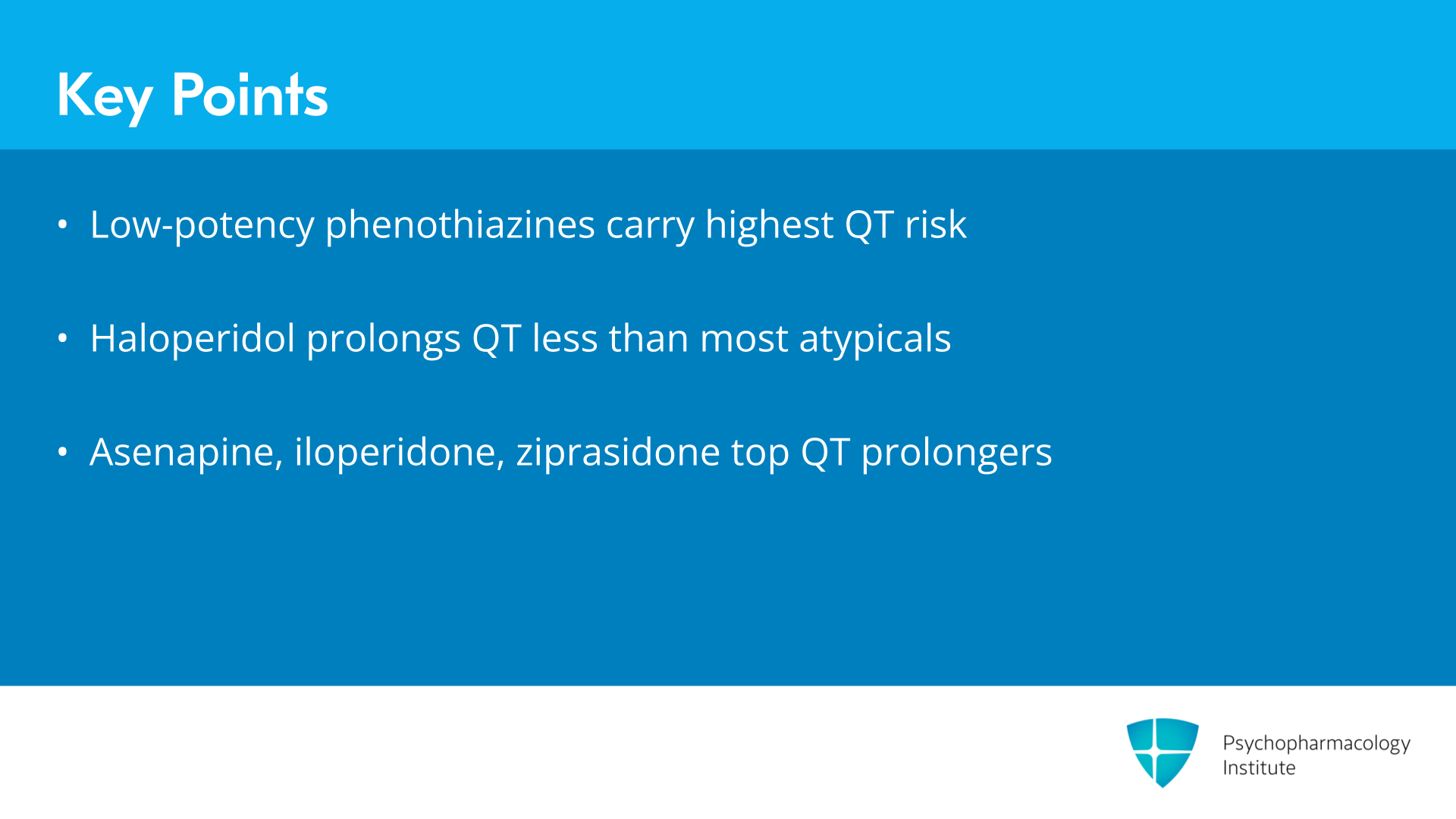
So to summarize key points for this section: Low-potency phenothiazines – thioridazine, chlorpromazine, mesoridazine – those are the ones most associated with QT prolongation. Most studies suggest that QT prolongation of 5 to 8 ms occurs for oral or IM forms of haloperidol which turns out to be less than most atypical antipsychotics. In a recent network meta-analysis, asenapine, iloperidone and ziprasidone cause the greatest degree of QT prolongation.
Free Files
Download PDF and other files
Success!
Check your inbox, we sent you all the materials there.
Slide 27 of 29
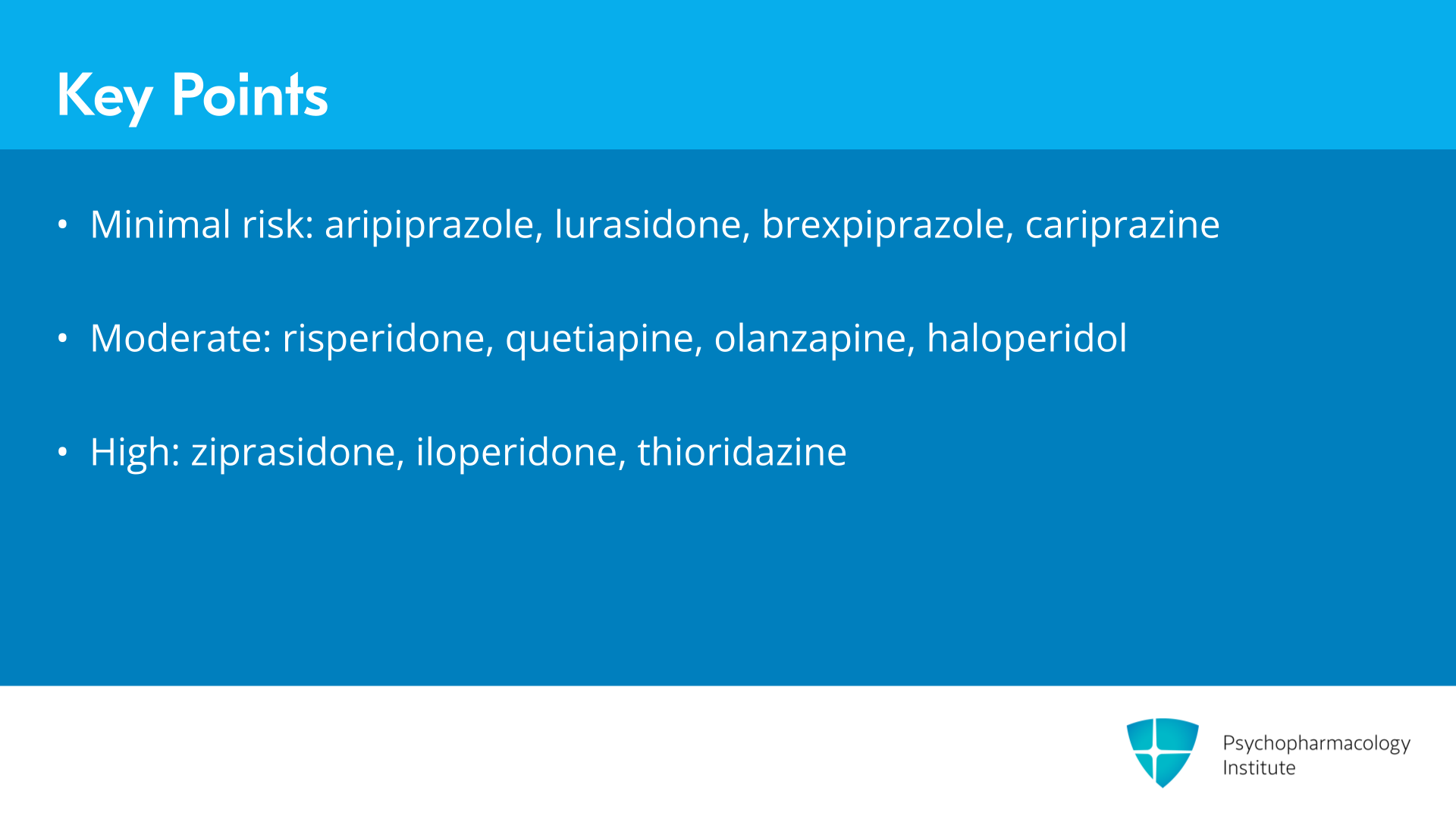
My best guess at risk stratification right now is minimal risk – aripiprazole, lurasidone, brexpiprazole, cariprazine; moderate risk – risperidone, quetiapine, olanzapine, haloperidol, chlorpromazine; high risk – ziprasidone, iloperidone, thioridazine. There is mixed data about whether antipsychotic polypharmacy leads to greater QT prolongation.
Slide 28 of 29
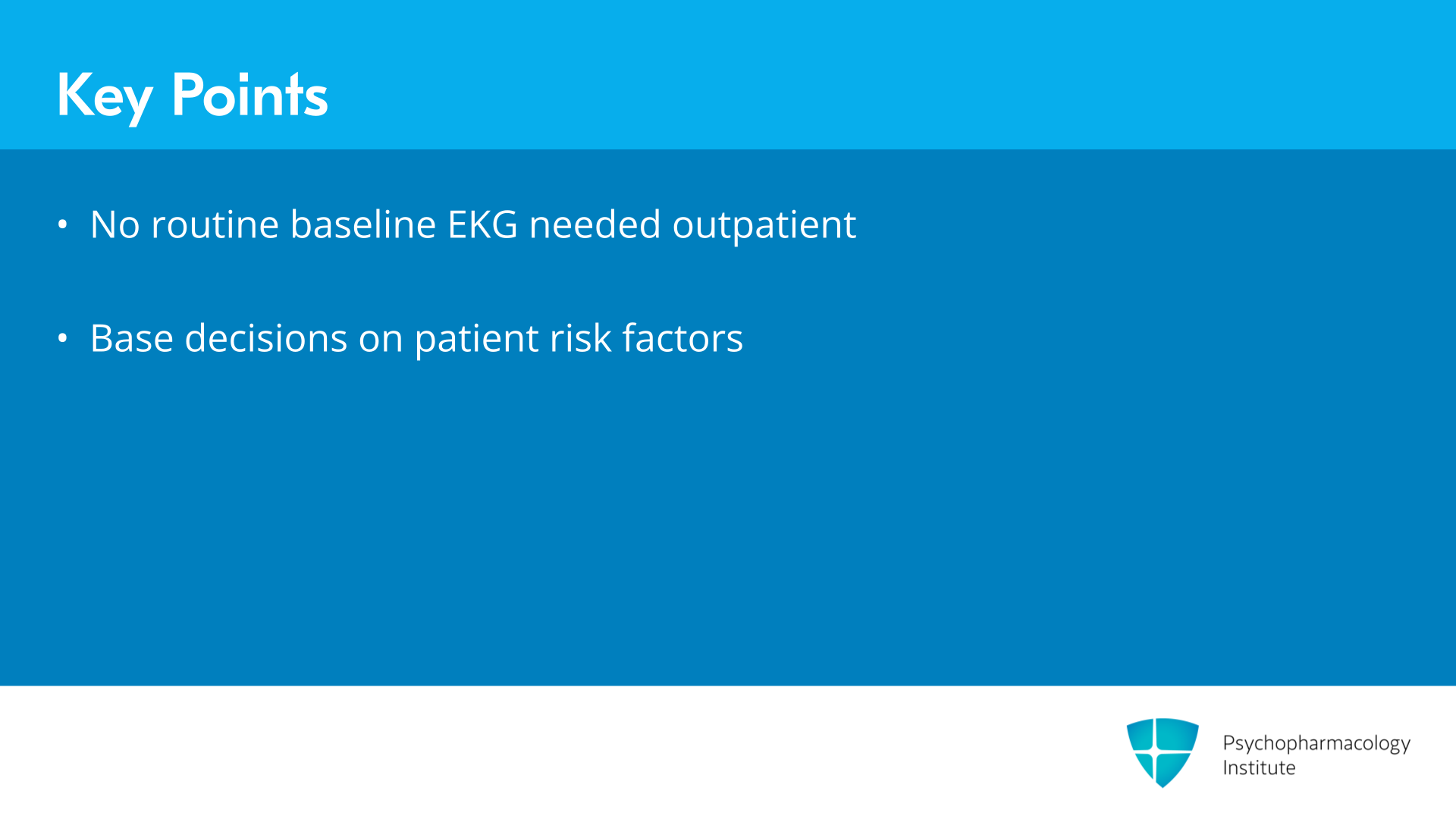
There is no indication for baseline EKG with all antipsychotic initiations in the outpatient setting and decisions about monitoring should be based on the patient’s risk factors and the risks associated with the specific antipsychotic.
Free Files
Download PDF and other files
Success!
Check your inbox, we sent you all the materials there.
Slide 29 of 29
On the inpatient side, given the higher risk for torsade among inpatients and an increased ease of monitoring, it would be good practice to obtain a baseline EKG prior to initiation of any antipsychotic and followup EKGs for patients with risk factors or those receiving either a high-risk antipsychotic or a high dose of a moderate-risk antipsychotic.