
Text version
Psychotropic Medications and Suicide Risk: Beyond Clozapine and Lithium
It is a commonly repeated pearl that only two medications, clozapine and lithium, are proven to reduce the risk of suicide. By proven, both are supported by the gold standard of evidence: randomized clinical trials, and even better, meta-analyses of randomized clinical trials. A new study published in eClinicalMedicine suggests that even randomized trials have their limitations, including that each trial has exclusion criteria.
In the context of assessing efficacy for reducing risk of suicide, the common exclusion of subjects with elevated risk of suicide is problematic. The authors suggest that observational studies could address this issue by including patients with a full range of risk of suicidal behavior.
Download PDF and other files
A Meta-Analysis of Observational Studies
The authors performed a structured search for prospective and retrospective cohort studies, case-control studies, and crossover studies investigating the effect of psychiatric medication on the incidence of suicide attempts, including self-harm, and suicide death. Each study had to include diagnostic classifications. They excluded studies conducted only in one age group, such as children, or in selected populations, such as inpatients.
Diagnoses without at least two studies for each medication or class were also excluded. A random-effects meta-analysis was performed to calculate the odds ratio (OR) of suicide attempts and deaths for each diagnosis in the presence versus absence of each medication or class. In total, 48 studies were included, with 406 comparisons of medication with no medication in 6.5 million people.
Atypicals Protective, Typicals Harmful in Schizophrenia
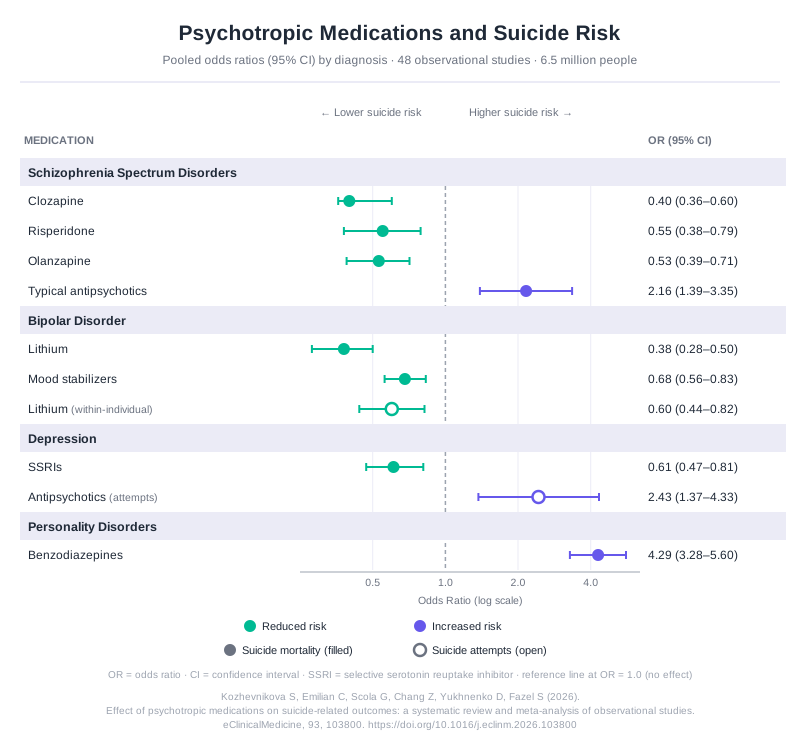
The largest sample was for schizophrenia spectrum disorders and included 19 studies across 11 countries. Clozapine was associated with the lowest risk of mortality from suicide, with an OR of 0.4. This risk reduction triangulates with clinical trials of clozapine showing a clinically significant reduction in suicide attempts.
Risperidone and olanzapine were both associated with significantly reduced risk on both outcomes:
- Risperidone: OR 0.61 for suicide attempts and 0.55 for suicide mortality
- Olanzapine: OR 0.76 for suicide attempts and 0.53 for suicide mortality
Oddly, when combined together as a class, atypical antipsychotic medication yielded an OR of 0.65, which was not statistically significant, possibly due to the addition of aripiprazole and quetiapine, with larger confidence intervals. In contrast, typical antipsychotic medication elevated the risk of mortality, with a significant OR of 2.16. One could argue that the addition of 5-HT2A blockade in atypical antipsychotic medication is the crucial factor in their positive effect on suicide risk, or the difference could be due to an uncontrolled confounding factor that steers clinicians to prescribe typical antipsychotic medication to patients with more severe illness.
Download PDF and other files
Lithium Protective in Bipolar Disorder
Seventeen studies included subjects with bipolar disorder across nine different countries. Lithium was associated with a significant reduction in risk of suicide mortality, with an OR of 0.38, and unspecified mood stabilizers also significantly decreased the risk, at 0.68.
As for suicide attempts, the authors stratified the studies in bipolar disorder by study design, either between-individual or within-individual.
- Between-individual designs compare risk in groups taking a medication with groups that were not taking the medication.
- Within-individual designs compare risk when an individual was taking a medication to when they weren’t, allowing each subject to serve as their own control and cancelling many confounding factors.
Of note, the OR of suicide attempts was 0.86 for the five studies using a between-individual design, which was not significant. It was significant, however, with an OR of 0.6 in the six studies using a within-individual design, in which subjects served as their own controls. These observational findings for lithium triangulate with clinical trials showing a protective effect of lithium for suicide.
SSRIs Protective, Antipsychotics Increased Risk in Depression
Fourteen studies included subjects with depression over six countries. SSRIs were associated with a significant protective OR of 0.61 for suicide mortality, based on two studies.
In contrast to antidepressants in depression and antipsychotics in schizophrenia, antipsychotic medication in depression increased the risk of suicide attempts, with a significant OR of 2.43 based on three studies with a between-individual design. Again, one could wonder whether this finding is due to a confounding factor: either greater severity of depression in subjects with psychotic symptoms or the need for an antipsychotic medication as an adjunct.
One within-individual study showed a beneficial effect of lithium for patients with unipolar depression, another finding supported by randomized trials.
Download PDF and other files
Benzodiazepines Increased Suicide Mortality Across Diagnoses
Finally, five studies included subjects with personality disorders. The only significant finding was that benzodiazepines increased the risk of suicide mortality, based on two studies, with a significant OR of 4.29.
This finding was not limited to patients with personality disorders. A significantly elevated risk of suicide with benzodiazepine use was also found for patients with bipolar disorder and schizophrenia spectrum disorders. For subjects with depression, the OR of mortality from suicide with benzodiazepine use was 2 (CI=0.94 to 4.22), barely outside the range of statistical significance.
This finding of elevated risk of suicidal behavior with benzodiazepines also triangulates with randomized controlled trials.
Bottom Line: Protection Extends Beyond Clozapine and Lithium
The biggest takeaways of this article are that the beneficial effects of medication on suicide risk may not be limited to only a couple of medications. They may extend to most antidepressants for major depression, mood stabilizers for bipolar disorder, and the most commonly prescribed atypical antipsychotic medications in schizophrenia spectrum disorders.
Although addressing all confounding factors in an observational study is nearly impossible, many of their findings were supported by similar results from randomized clinical trials, serving as a type of validation of their methodology. Finally, it is worth noting that medications are only part of an effort to reduce risk of suicide that also includes effective behavioral approaches.
Download PDF and other files
Abstract
Effect of psychotropic medications on suicide-related outcomes: a systematic review and meta-analysis of observational studies
Stefaniya Kozhevnikova; Christina Emilian; Giulio Scola, et al
Background
Psychiatric disorders are associated with increased risk of suicide-related outcomes, and the impact of pharmacological treatments on these outcomes is uncertain. Although randomised controlled trials are the main approach to evaluate efficacy, they may not provide externally valid results for suicide prevention in psychiatric populations. Thus, we aimed to synthesise the evidence on the effect of psychotropic medications on suicide-related outcomes from observational studies.
Methods
In this systematic review and meta-analysis, we systematically searched Ovid (MEDLINE, Embase, APA PsychArticles, AMED, BIOSIS, Global Health, PsycINFO), and Web of Science Core Collection from database inception to 8 December 2025 for pharmacoepidemiological and other observational studies on suicide-related outcomes in people treated with the main types of psychotropic medications: antidepressants, antipsychotics, mood stabilisers (including antiepileptics), and medications for anxiety (anxiolytics), attention deficit and hyperactivity disorder (ADHD), and substance use disorder (SUD). We included primary studies involving adults with common psychiatric diagnoses (schizophrenia spectrum disorders, bipolar disorder, depressive disorders, and personality disorders), who were prescribed medication and a comparison sample with the same diagnosis without prescribed medication (between-individual studies) or the same individuals during a non-prescription period (within-individual studies). We excluded studies that did not report psychiatric diagnoses and from selected samples. Outcomes were suicide attempts/self-harm and suicide mortality. We pooled effect sizes as odds ratios (OR), hazard ratios (HR) or risk ratios (RR) using random-effects models and assessed study quality using NOS and QUIPS tools. Study protocol was registered with PROSPERO, CRD42024515794.
Findings
Of 5653 records identified, 48 independent studies from 13 countries based on more than 6 million people (47% male) met inclusion criteria. Across the main diagnostic categories and 70 individual medications examined, associations with reducing risk of suicide mortality were found for second generation antipsychotics in schizophrenia spectrum disorders: clozapine (OR = 0.40; 0.36-0.60; I 2 = 60%, moderate certainty), olanzapine (OR = 0.53; 0.39-0.71; I 2 = 34%, high certainty), quetiapine (OR = 0.75; 0.58-0.96; I 2 = 0%, high certainty), and zuclopenthixol (OR = 0.44; 0.30-0.63; I 2 = 0%, high certainty). In schizophrenia, second generation antipsychotics were also associated with reduced risks of suicide attempts: olanzapine (OR = 0.76; 0.60-0.98; I 2 = 84%, moderate certainty) and risperidone (OR = 0.61; 0.52-0.72; I 2 = 57%, moderate certainty). In bipolar disorder, lithium (OR = 0.38; 0.28-0.50; I 2 = 67%, moderate certainty) and valproic acid (OR = 0.66; 0.59-0.75; I 2 = 0%, high certainty) were associated with lower suicide risks, and lithium was also associated with lower risks of suicide attempts (OR = 0.60; 0.44-0.82; I 2 = 92%, moderate certainty). In depression, associations with lower risk of suicide mortality for selective serotonin reuptake inhibitors (SSRIs) (OR = 0.61; 0.47-0.81; I 2 = 23%, high certainty) and tricyclic antidepressants (OR = 0.68; 0.59-0.78; I 2 = 0%, high certainty) were found. Benzodiazepines were associated with higher risk of suicide mortality in most diagnostic categories, except depression. There was some evidence for publication bias for lithium in bipolar disorder and clozapine in schizophrenia spectrum disorders, leading to more papers reporting lower risks of suicide-related outcomes. The risk of bias in included studies was
low in 47 studies, moderate in one study, and certainty of evidence was moderate.
Interpretation
There is evidence of varying effects of psychotropic medication on the risk of suicide-related outcomes across different psychiatric disorders. The appropriate use of prescribed medications in people with high risks of suicide-related outcomes is an important suicide prevention strategy. Findings are not causal, and limitations include the observational nature of included studies, risk of residual confounding, high heterogeneity for some outcomes, and moderate quality of the evidence.
Funding
University of Oxford (Hill Foundation), NIHR Oxford Health Biomedical Research Centre, Wellcome Trust.
Reference
Kozhevnikova, S.; Emilian, C.; Scola, G.; Chang, Z.; Yukhnenko, D. & Fazel, S. (2026). Effect of psychotropic medications on suicide-related outcomes: a systematic review and meta-analysis of observational studies. EClinicalMedicine; 93:103800.