Slides and Transcript
Slide 1 of 17
The next section of this algorithm for psychopharm of PTSD is about the use of prazosin for PTSD-related nightmares, disturbed awakenings and sleep terrors. So in this particular section, I think we’re going to be talking about the two most important things I have to say in the whole algorithm – first of all, recommending prazosin and when to use it, and secondly, knowing how to dose it in accordance with the evidence base.
Slide 2 of 17
So we are recommending prazosin for the sleep problems. It’s a non-sedating alpha-1 antagonist. I mentioned the non-sedating because this is not a drug that knocks you out.
References:
- Skeie-Larsen, M., Stave, R., Grønli, J., Bjorvatn, B., Wilhelmsen-Langeland, A., Zandi, A., & Pallesen, S. (2022). The effects of pharmacological treatment of nightmares: A systematic literature review and meta-analysis of placebo-controlled, randomized clinical trials. International Journal of Environmental Research and Public Health, 20(1), 777. https://doi.org/10.3390/ijerph20010777
Free Files
Download PDF and other files
Success!
Check your inbox, we sent you all the materials there.
Slide 3 of 17
So why of the various drugs in this class which includes prazosin, doxazosin, terazosin, why this one? Because it’s the best at crossing the blood-brain barrier. We now have 10 placebo-controlled trials that are in the literature of prazosin for sleep and other problems in PTSD. Seven of 10 were positive. Many of these studies that were positive had large effect sizes and I’ll show you some of those.
References:
- Skeie-Larsen, M., Stave, R., Grønli, J., Bjorvatn, B., Wilhelmsen-Langeland, A., Zandi, A., & Pallesen, S. (2022). The effects of pharmacological treatment of nightmares: A systematic literature review and meta-analysis of placebo-controlled, randomized clinical trials. International Journal of Environmental Research and Public Health, 20(1), 777. https://doi.org/10.3390/ijerph20010777
Slide 4 of 17
Of particular interest, perhaps, is the most recent one, by Guo and colleagues in 2024. It was a randomized, double-blind, placebo-controlled trial finding that it worked for PTSD but also for depression. There was significant improvement in depression versus placebo in this group. And this is something that we who use a lot of prazosin have suspected for a long time. In PTSD people who have secondary depression, it may be very helpful for that depression and this Guo study found that.
References:
- Guo, P., Xu, Y., Lv, L., Feng, M., Fang, Y., Cheng, S., Xiao, X., Huang, J., Sheng, W., Wang, S., & Chen, H. (2025). Augmentation with prazosin for patients with depression and a history of trauma: A randomised, double-blind, placebo-controlled study. Acta Psychiatrica Scandinavica, 151(2), 142–151. https://doi.org/10.1111/acps.13763
Free Files
Download PDF and other files
Success!
Check your inbox, we sent you all the materials there.
Slide 5 of 17
Prazosin, it’s generally well tolerated even at relatively high dose in the elderly. There was a review in 2020 of use of the drug in various elderly people, not a controlled study, just experience, case series in the VA finding that older people can sometimes tolerate quite high doses.
References:
- Khaw, C., & Argo, T. (2020). Prazosin outcomes in older veterans with posttraumatic stress disorder. *Federal Practitioner: For the Health Care Professionals of the VA, DoD, and PHS*, *37*(2), 72–78.
Slide 6 of 17
A key predictor of who responds to prazosin who has PTSD is if they have high blood pressure, and Dr. Raskind has dubbed that the adrenergic subtype of PTSD. Now, keep in mind, they may have had high blood pressure which has been treated by the time you see them. They may be on an antihypertensive med already. When you add prazosin, you may have to reduce or stop one or more of the other blood pressure meds to make room for the prazosin in there and not produce unwanted low blood pressure.
References:
- Raskind, M. A., Millard, S. P., Petrie, E. C., Peterson, K., Williams, T., Hoff, D. J., Hart, K., Holmes, H., Hill, J., Daniels, C., Hendrickson, R., & Peskind, E. R. (2016). Higher pretreatment blood pressure is associated with greater posttraumatic stress disorder symptom reduction in soldiers treated with prazosin. Biological Psychiatry, 80(10), 736–742. https://doi.org/10.1016/j.biopsych.2016.03.2108
Free Files
Download PDF and other files
Success!
Check your inbox, we sent you all the materials there.
Slide 7 of 17
There is a significant risk of syncope from low blood pressure. About 1% of people could get that but hopefully it can be prevented with appropriate cautioning of the patient to not leap out of bed in the morning or in the middle of the night when they might get up to urinate or otherwise and sit on the edge of their bed for half a minute. Be sure they’re not going to be lightheaded. Stand up, do the same thing. Be sure they’re not lightheaded rather than rushing off to the bathroom and starting to pee.
References:
- Raskind, M. A., Millard, S. P., Petrie, E. C., Peterson, K., Williams, T., Hoff, D. J., Hart, K., Holmes, H., Hill, J., Daniels, C., Hendrickson, R., & Peskind, E. R. (2016). Higher pretreatment blood pressure is associated with greater posttraumatic stress disorder symptom reduction in soldiers treated with prazosin. Biological Psychiatry, 80(10), 736–742. https://doi.org/10.1016/j.biopsych.2016.03.2108
Slide 8 of 17
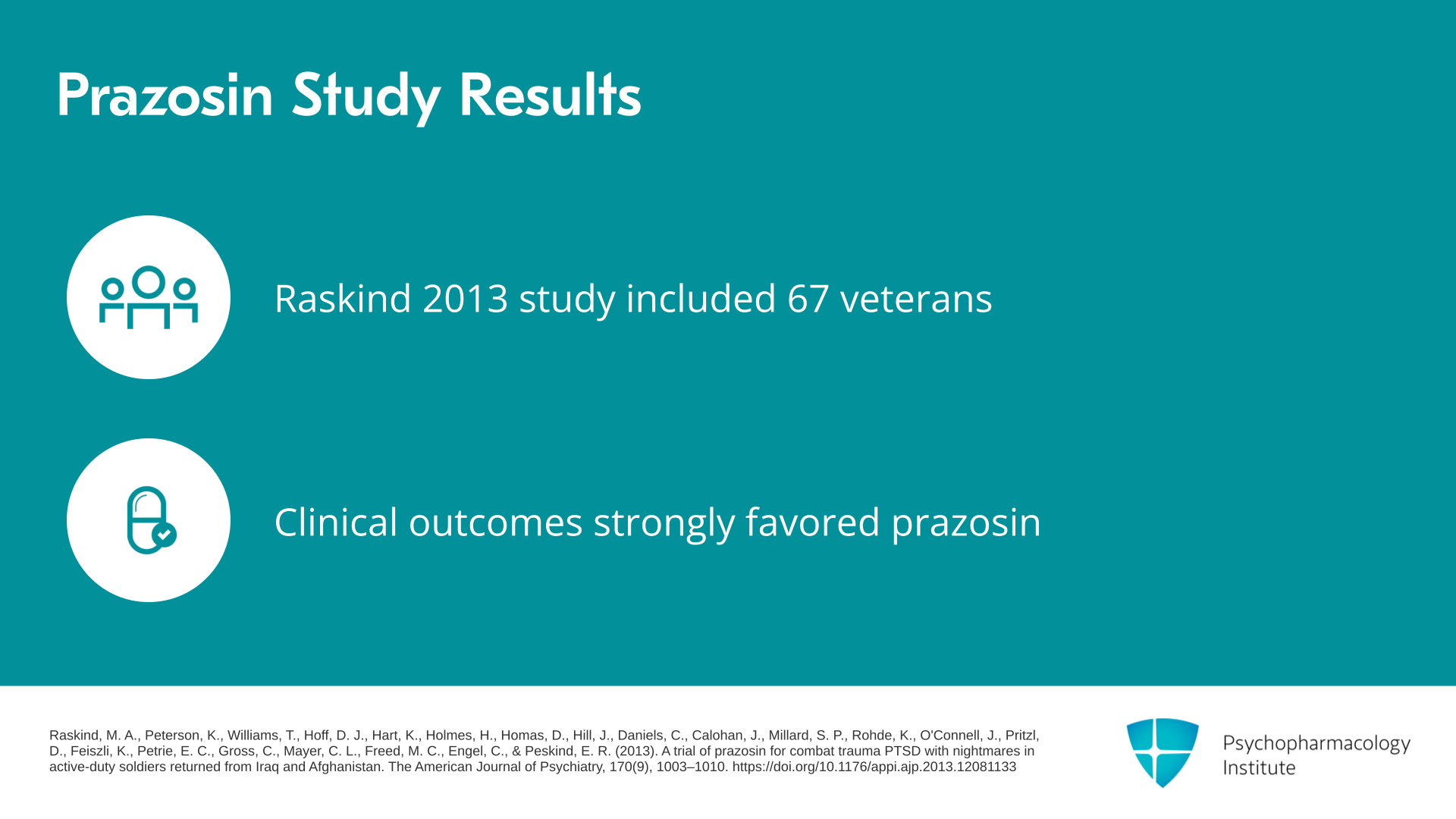
Now, in the study by Raskind’s group in 2013, this was a little bit larger study with 67 people in it, a 15-week total, was mostly male veterans and 16% dropped out from both the placebo and prazosin groups. Anyway, the results on this study were Clinical Global Impression of Response scores showed 64% responders on prazosin, 27% on placebo, number needed to treat 2.7. But all other outcome measures beside number needed to treat strongly favored prazosin. There was no difference in blood pressure. Two placebo patients became suicidal.
References:
- Raskind, M. A., Peterson, K., Williams, T., Hoff, D. J., Hart, K., Holmes, H., Homas, D., Hill, J., Daniels, C., Calohan, J., Millard, S. P., Rohde, K., O'Connell, J., Pritzl, D., Feiszli, K., Petrie, E. C., Gross, C., Mayer, C. L., Freed, M. C., Engel, C., & Peskind, E. R. (2013). A trial of prazosin for combat trauma PTSD with nightmares in active-duty soldiers returned from Iraq and Afghanistan. The American Journal of Psychiatry, 170(9), 1003–1010. https://doi.org/10.1176/appi.ajp.2013.12081133
Free Files
Download PDF and other files
Success!
Check your inbox, we sent you all the materials there.
Slide 9 of 17
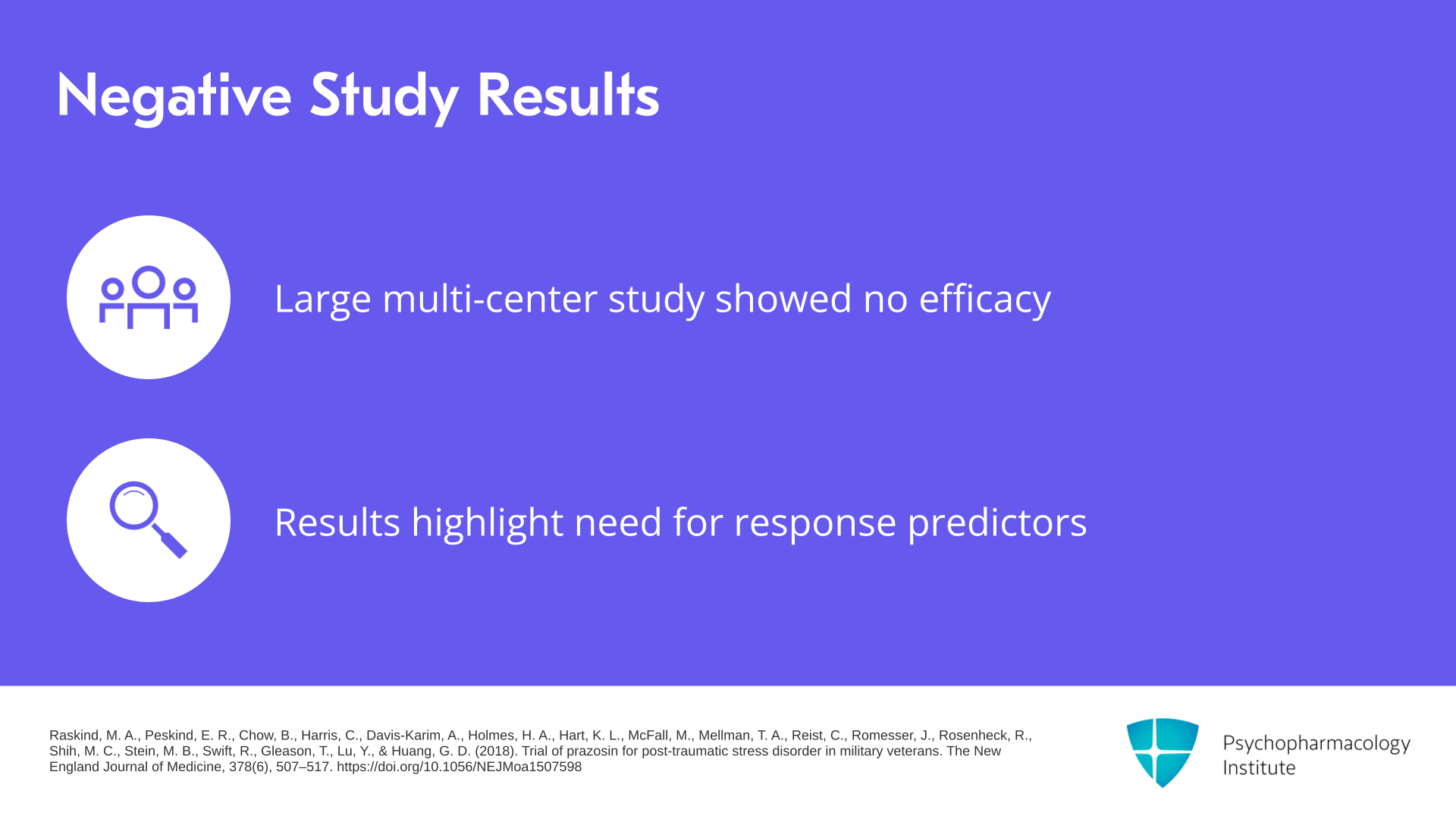
Now, the next study by Raskind once again, found no efficacy. It’s one of the three negative studies. So there has been a lot of head scratching about this. Do we think that it negates all the other positive data? No. It did show a need though to find predictors of response because some people don’t respond clearly. And as I already mentioned, higher starting blood pressure predicts greater response. But in this study, the patients had normal blood pressure. They were selected for that. Suicidality is a possible predictor of poor response too. That wasn’t particularly prominent in this study though.
References:
- Raskind, M. A., Peskind, E. R., Chow, B., Harris, C., Davis-Karim, A., Holmes, H. A., Hart, K. L., McFall, M., Mellman, T. A., Reist, C., Romesser, J., Rosenheck, R., Shih, M. C., Stein, M. B., Swift, R., Gleason, T., Lu, Y., & Huang, G. D. (2018). Trial of prazosin for post-traumatic stress disorder in military veterans. The New England Journal of Medicine, 378(6), 507–517. https://doi.org/10.1056/NEJMoa1507598
Slide 10 of 17
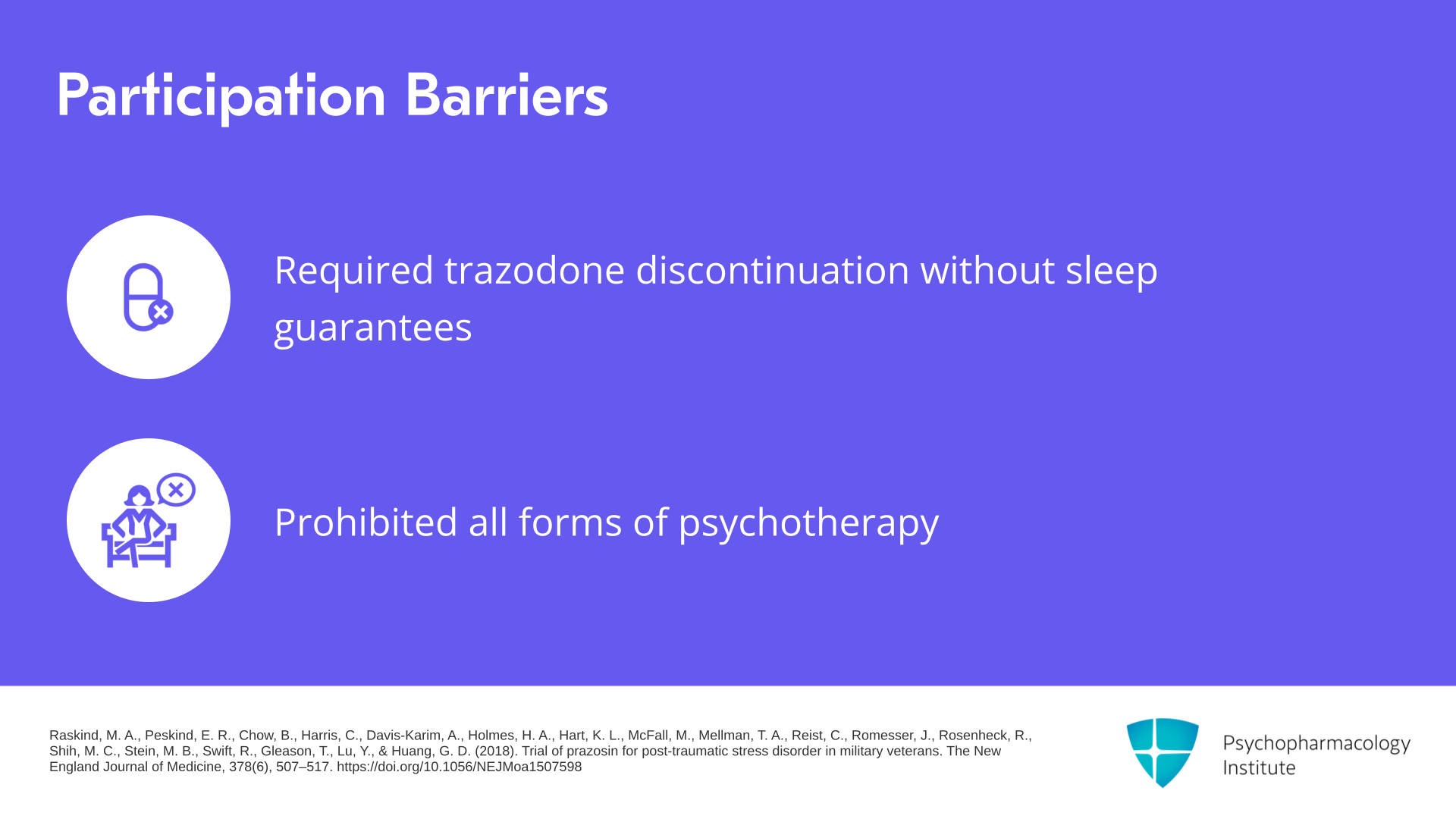
And another reason why this study might have failed is that they didn’t allow them to have trazodone to help them fall asleep. If they were on it, they had to go off it. And probably, many of them would have been reluctant to do that ’cause they were, could not be promised that they would get any benefit on falling asleep from their prazosin. And furthermore, everybody in this study was not allowed to have any psychotherapy. That also probably led to a lot of people not volunteering. So it was a peculiar population, we think.
References:
- Raskind, M. A., Peskind, E. R., Chow, B., Harris, C., Davis-Karim, A., Holmes, H. A., Hart, K. L., McFall, M., Mellman, T. A., Reist, C., Romesser, J., Rosenheck, R., Shih, M. C., Stein, M. B., Swift, R., Gleason, T., Lu, Y., & Huang, G. D. (2018). Trial of prazosin for post-traumatic stress disorder in military veterans. The New England Journal of Medicine, 378(6), 507–517. https://doi.org/10.1056/NEJMoa1507598
Free Files
Download PDF and other files
Success!
Check your inbox, we sent you all the materials there.
Slide 11 of 17
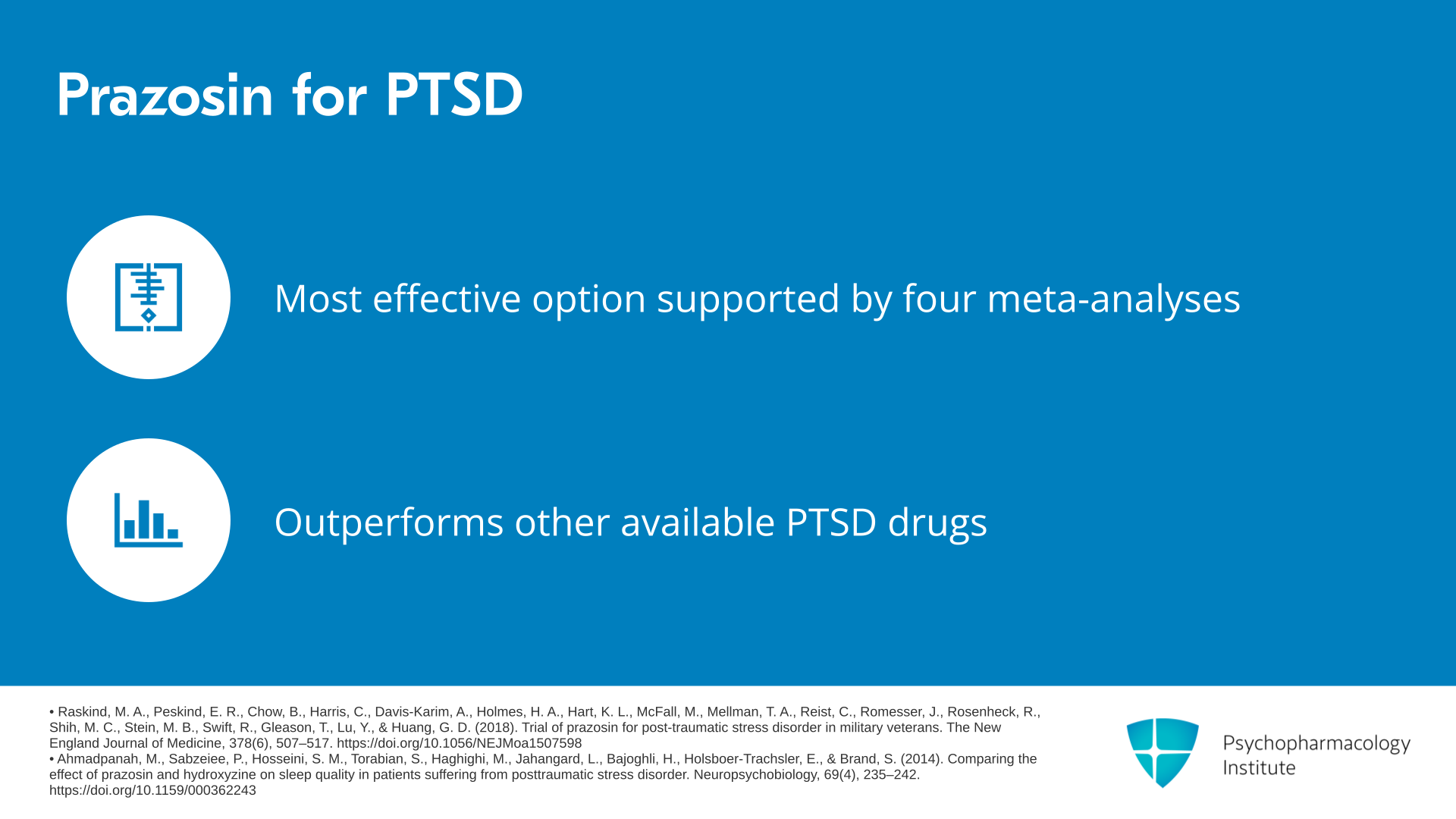
We think prazosin remains the best treatment that we have. There have been at least four meta-analyses of all the PTSD-prazosin studies including this negative one comparing the results with other drugs that we have for PTSD. All those meta-analyses, every one concludes that prazosin is the most effective treatment we have. So we remain in accord with all of them and enthusiastic about it.
References:
- Raskind, M. A., Peskind, E. R., Chow, B., Harris, C., Davis-Karim, A., Holmes, H. A., Hart, K. L., McFall, M., Mellman, T. A., Reist, C., Romesser, J., Rosenheck, R., Shih, M. C., Stein, M. B., Swift, R., Gleason, T., Lu, Y., & Huang, G. D. (2018). Trial of prazosin for post-traumatic stress disorder in military veterans. The New England Journal of Medicine, 378(6), 507–517. https://doi.org/10.1056/NEJMoa1507598
- Ahmadpanah, M., Sabzeiee, P., Hosseini, S. M., Torabian, S., Haghighi, M., Jahangard, L., Bajoghli, H., Holsboer-Trachsler, E., & Brand, S. (2014). Comparing the effect of prazosin and hydroxyzine on sleep quality in patients suffering from posttraumatic stress disorder. Neuropsychobiology, 69(4), 235–242. https://doi.org/10.1159/000362243
Slide 12 of 17
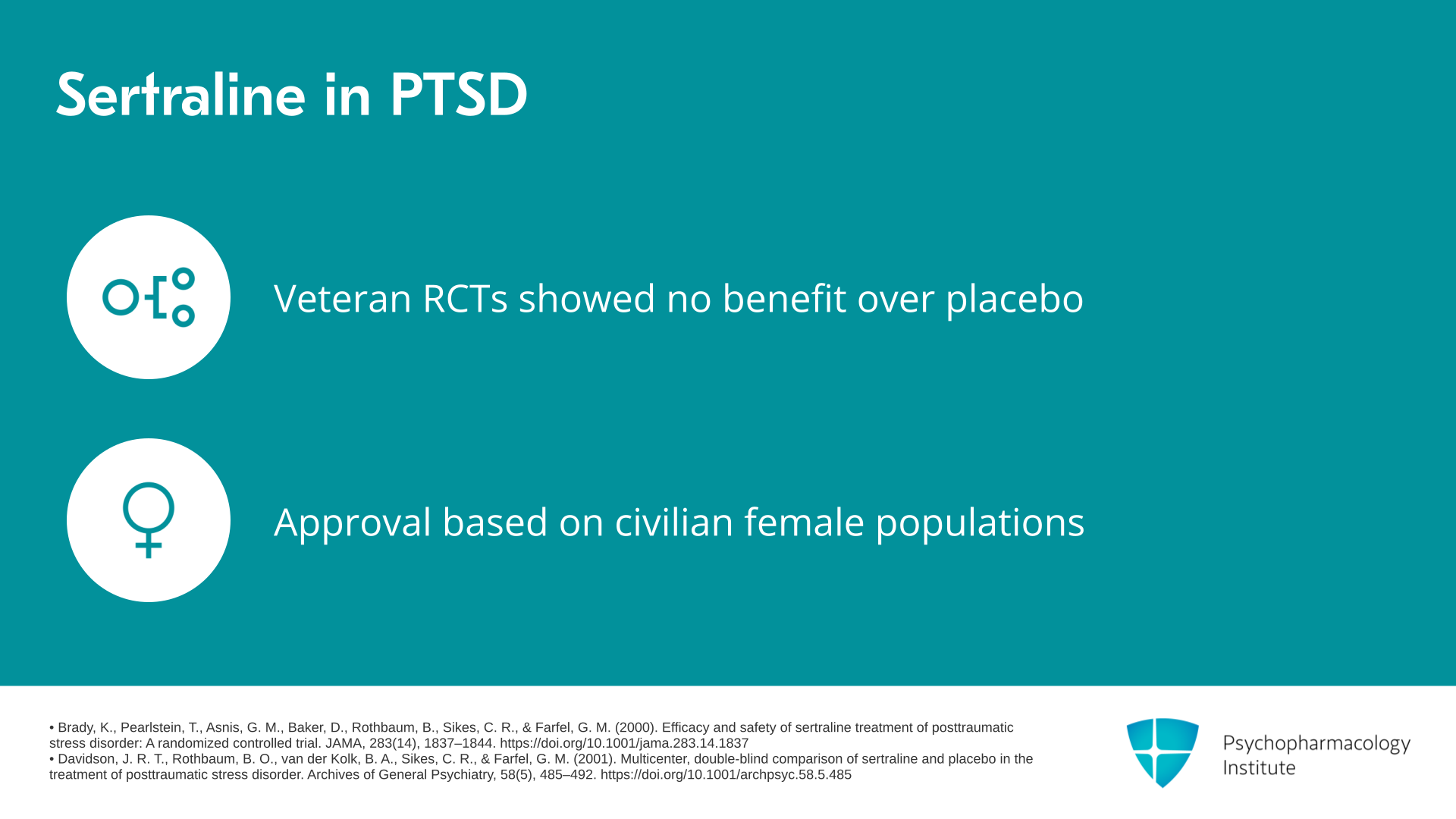
And you should contrast that with sertraline, which is one of the two FDA-approved SSRIs for PTSD. It’s very interesting that this med has had two large randomized controlled trials in Veterans. Both studies were negative, found no difference from placebo. There were also two large unpublished civilian studies that are also negative. The drug got approval from submitting two studies in civilians. Over 3/4 of the study participants were women mostly with sexual trauma.
References:
- Brady, K., Pearlstein, T., Asnis, G. M., Baker, D., Rothbaum, B., Sikes, C. R., & Farfel, G. M. (2000). Efficacy and safety of sertraline treatment of posttraumatic stress disorder: A randomized controlled trial. JAMA, 283(14), 1837–1844. https://doi.org/10.1001/jama.283.14.1837
- Davidson, J. R. T., Rothbaum, B. O., van der Kolk, B. A., Sikes, C. R., & Farfel, G. M. (2001). Multicenter, double‑blind comparison of sertraline and placebo in the treatment of posttraumatic stress disorder. Archives of General Psychiatry, 58(5), 485–492. https://doi.org/10.1001/archpsyc.58.5.485
Free Files
Download PDF and other files
Success!
Check your inbox, we sent you all the materials there.
Slide 13 of 17
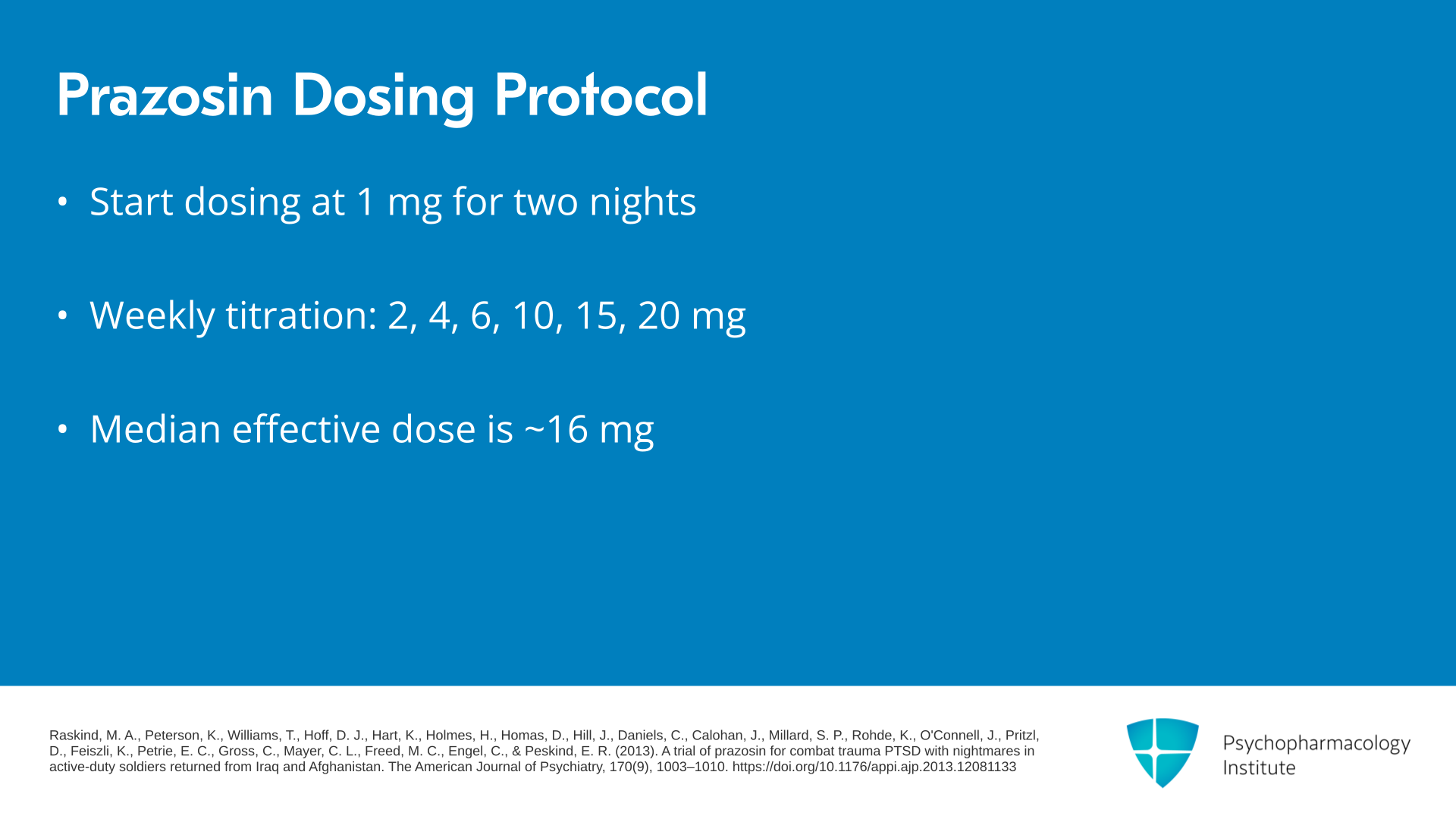
Now, the last thing in this section is the dosing. I take it from the 2013 Raskind study that I just showed you. They start with 1 mg of prazosin for two nights, then they do 2 mg for five nights to complete the first week. Then it’s 4 mg for seven nights for the second week. Then it’s 6 mg for the third week, 10 mg for the fourth week, 15 mg for the fifth week. It comes in 2’s and 5’s by the way so we’re switching to the higher size capsule as we’re going up on dose. 20 was the maximum in this particular study. The median dose that reached maximum benefit that was tolerated by these veterans was almost 16 mg. My personal experience is that I see two groups of responders. Some seem to respond between 4 and 10 and others respond at 25 or 30. Most of the people I see responding are at the lower doses, but I do see some at the higher doses.
References:
- Raskind, M. A., Peterson, K., Williams, T., Hoff, D. J., Hart, K., Holmes, H., Homas, D., Hill, J., Daniels, C., Calohan, J., Millard, S. P., Rohde, K., O'Connell, J., Pritzl, D., Feiszli, K., Petrie, E. C., Gross, C., Mayer, C. L., Freed, M. C., Engel, C., & Peskind, E. R. (2013). A trial of prazosin for combat trauma PTSD with nightmares in active-duty soldiers returned from Iraq and Afghanistan. The American Journal of Psychiatry, 170(9), 1003–1010. https://doi.org/10.1176/appi.ajp.2013.12081133
Slide 14 of 17
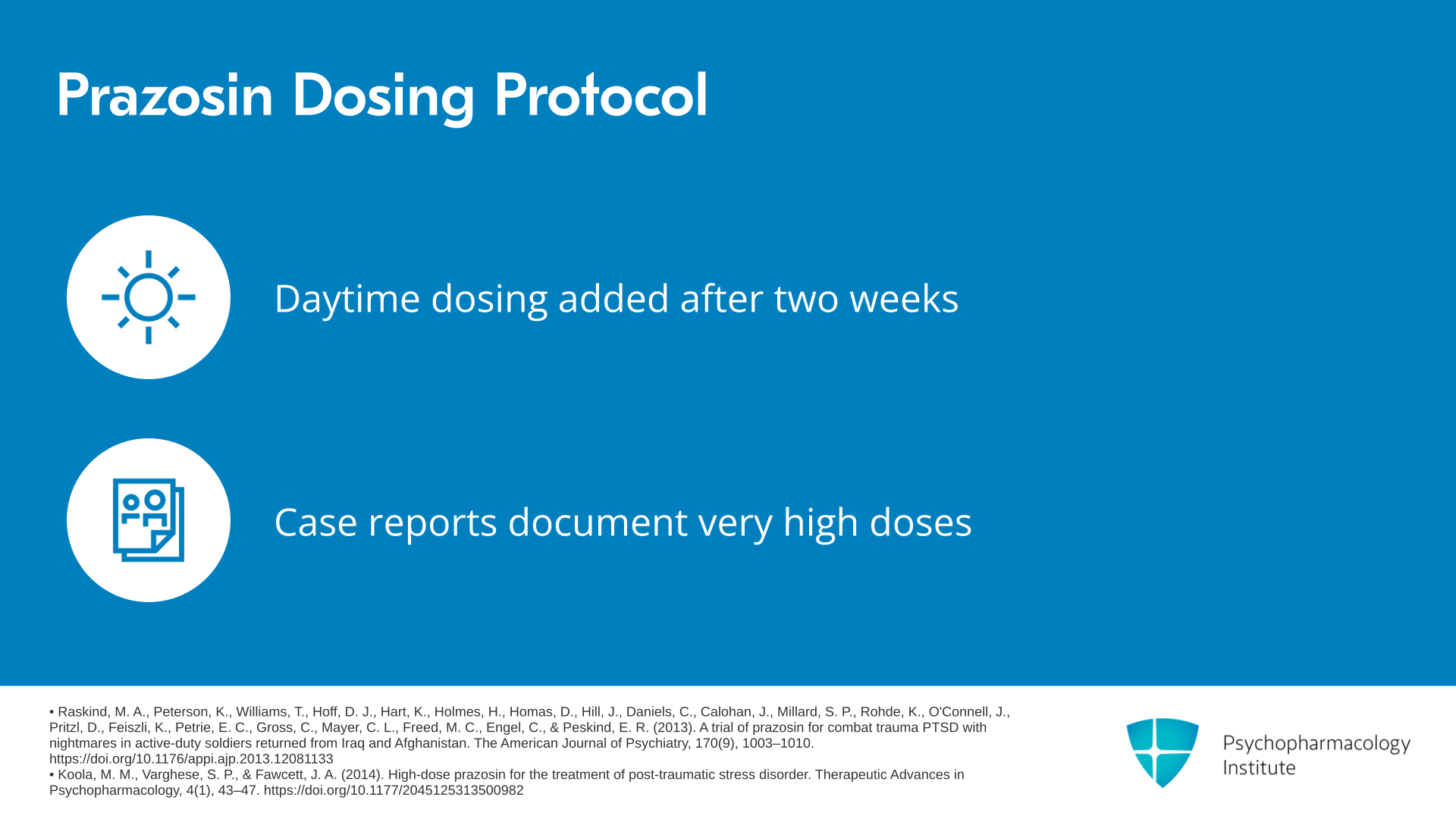
Now, as part of that protocol, they also started a day dose of prazosin for the day symptoms. Usually, after two weeks, they were tolerating the two weeks’ worth of increases at night so they then started them with 1 mg in the morning, typically midmorning. And then for the next week, they could go up to 2 mg and by weeks 5 or 6, they could get as high as 5. So that was the morning and night protocol. You may be interested to know though that there are case reports in the literature of patients being prescribed 30 and 45 mg, respectively, for two cases, tolerating it and finally doing well and staying well at those doses with a publication in a peer-reviewed journal by Koola and colleagues almost a little over 10 years ago.
References:
- Raskind, M. A., Peterson, K., Williams, T., Hoff, D. J., Hart, K., Holmes, H., Homas, D., Hill, J., Daniels, C., Calohan, J., Millard, S. P., Rohde, K., O'Connell, J., Pritzl, D., Feiszli, K., Petrie, E. C., Gross, C., Mayer, C. L., Freed, M. C., Engel, C., & Peskind, E. R. (2013). A trial of prazosin for combat trauma PTSD with nightmares in active-duty soldiers returned from Iraq and Afghanistan. The American Journal of Psychiatry, 170(9), 1003–1010. https://doi.org/10.1176/appi.ajp.2013.12081133
- Koola, M. M., Varghese, S. P., & Fawcett, J. A. (2014). High-dose prazosin for the treatment of post-traumatic stress disorder. Therapeutic Advances in Psychopharmacology, 4(1), 43–47. https://doi.org/10.1177/2045125313500982
Free Files
Download PDF and other files
Success!
Check your inbox, we sent you all the materials there.
Slide 15 of 17
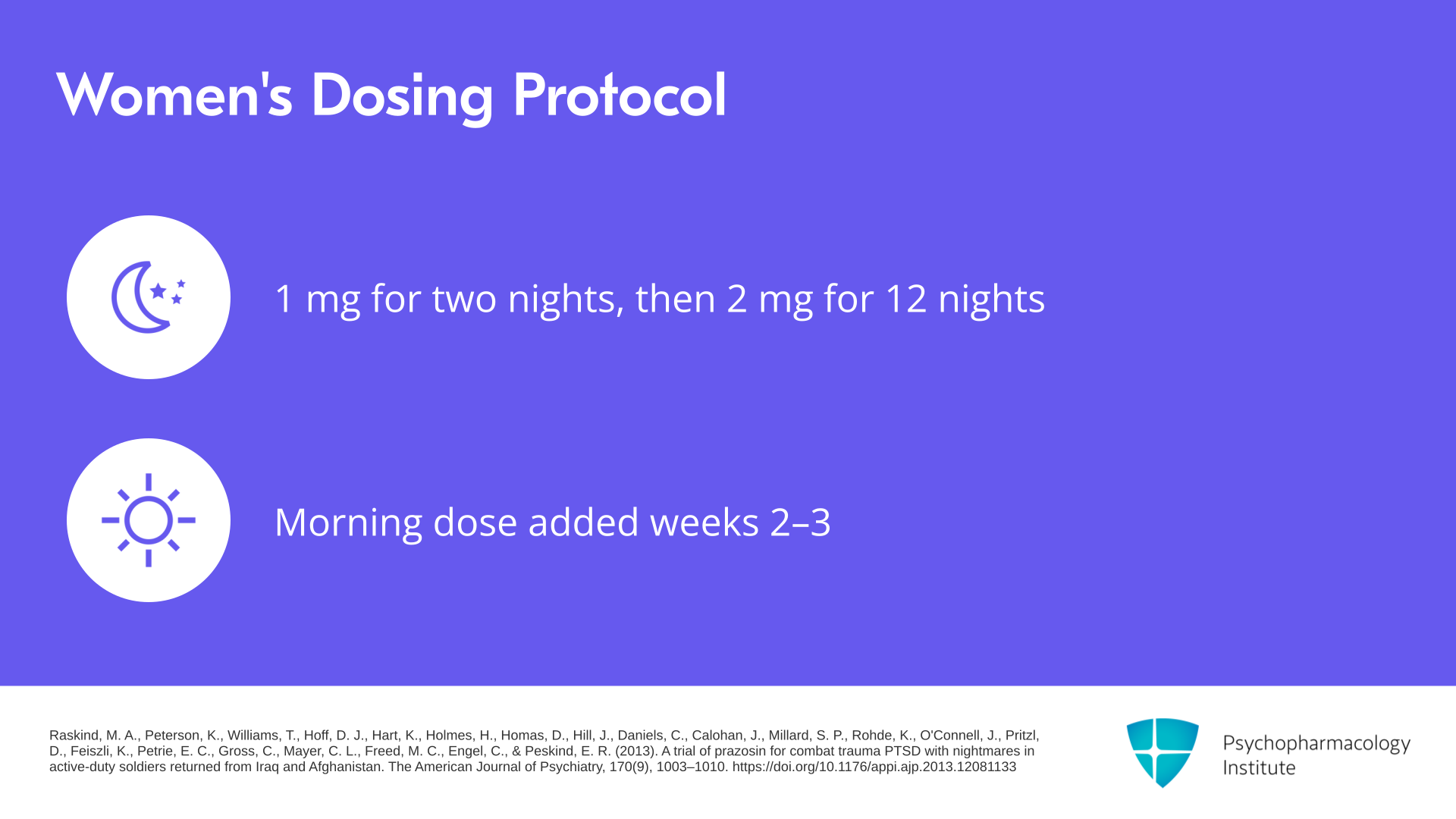
Now, the dosing for women is slower. They don’t seem to need as much. Raskind does 1 mg for two nights again but then 2 mg for the rest of two weeks rather than one week. So 12 more nights of 2 mg. If they still are tolerating it and not having satisfactory results on their nightmares and disturbed awakenings, then they go to 4 mg, 6 mg. 10 was the maximum in this study but the median dose was 7 for the women. And as far as the morning dose, between weeks 2 and 3, they would do 1 mg and then go to 2 for up to five weeks. We don’t know why women seem to need less.
References:
- Raskind, M. A., Peterson, K., Williams, T., Hoff, D. J., Hart, K., Holmes, H., Homas, D., Hill, J., Daniels, C., Calohan, J., Millard, S. P., Rohde, K., O'Connell, J., Pritzl, D., Feiszli, K., Petrie, E. C., Gross, C., Mayer, C. L., Freed, M. C., Engel, C., & Peskind, E. R. (2013). A trial of prazosin for combat trauma PTSD with nightmares in active-duty soldiers returned from Iraq and Afghanistan. The American Journal of Psychiatry, 170(9), 1003–1010. https://doi.org/10.1176/appi.ajp.2013.12081133
Slide 16 of 17
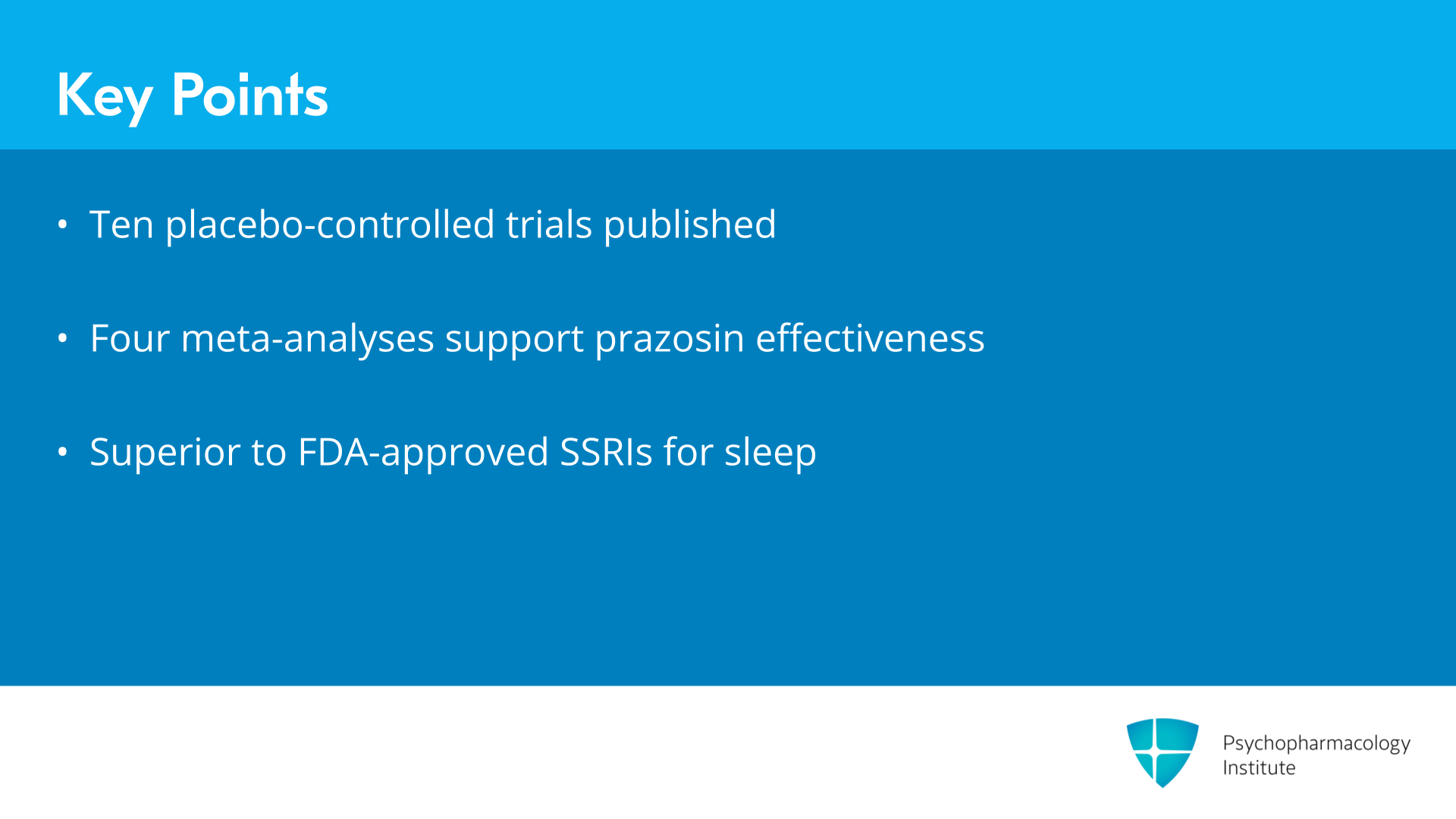
So that concludes this section on use of prazosin which I will now summarize the key points of. In this section, the evidence on prazosin was outlined. There have been 10 placebo-controlled trials published of which seven were positive. Three meta-analyses, there are now four actually, have concluded that it’s the best medicine available and far more impressive than the two FDA-approved SSRIs for PTSD, neither of which particularly help with sleep.
Free Files
Download PDF and other files
Success!
Check your inbox, we sent you all the materials there.
Slide 17 of 17
Equally important to knowing about prazosin as a treatment is knowing how to dose. We presented the dosing used in successful studies and we urge clinicians to use this dosing as modified in the individual case though by side effects that may require you to slow down the titration or may in some cases make it impossible to use prazosin effectively. And if they’re on other antihypertensives, you might have to reduce or cut them out. The dosing for men is generally greater than for women. For men, in one of the major studies, the mean final dose was 16 at night, 5 in the morning. And in that same study, the mean was 7 at night for women, and 2 in the morning.