
Text version
Pramipexole for Anhedonic Depression
Anhedonia, the inability to experience pleasure. Life without pleasure would appear to be a worthy clinical target. Among residual symptoms in treated depression, anhedonia is particularly disabling, with functional impairment and increased risk of suicide.
Let’s look at a randomized trial in patients with significant anhedonia, where pramipexole was superior to placebo with a substantial effect size of 0.6. This study is a good example of when digging into the details may lead to a different conclusion than just looking at the abstract or hearing that one-line result.
So, the usual questions. Who are the participants, and were they like your patients for whom you might consider pramipexole? How was anhedonia measured, and was the margin of improvement clinically, not just statistically, relevant?
Lastly, what are the potential side effects and risks to compare with the apparent benefits? Let’s go, and hang on. I think the details are worth it.
Download PDF and other files
A Treatment-Resistant Swedish Sample
First, the participants in this Swedish study. Of the 82 patients, roughly 60% had a diagnosis of major depressive disorder and 40% dysthymia. The study was open to people with bipolar disorder, but only two had that diagnosis, even though 12% were on a mood stabilizer.
That might reflect the common hesitation to invoke a bipolar label if not on their diagnosis per se, given that anhedonia is a soft bipolar marker. For further comparison with your patients, 100% were taking an antidepressant, some more than one. So this is a study of antidepressant augmentation, where there are lots of candidates these days.
Don’t forget lowly low-dose lithium, and checking thyroid status. And maybe even fish oil, if you want to buy time for behavioral activation or some other brief psychotherapy. It’s an excellent placebo for some patients, and it has enough efficacy in clinical trials to be an ethical suggestion.
Back to Sweden. Patients in this study would generally be regarded as treatment resistant, with an average of four prior pharmacotherapies and, interestingly, less than 5% on some form of psychotherapy. Also, 10% had received electroconvulsive therapy and 10% had a previous suicide attempt.
Not an easy crowd in which to see improvement, and probably less likely to have great improvements on placebo. Let’s see.
Measuring Anhedonia With the SHAPS
The primary outcome measure was change in the Snaith-Hamilton Pleasure Scale (SHAPS) score. This scale has 14 items, such as:
- I would enjoy reading a book
- I would enjoy a beautiful landscape or view
- I would get pleasure from helping others
And so on. These items are scored on a 1 to 4 scale, where 4 equals strongly disagree. So high scores are bad and falling scores are good.
Download PDF and other files
A Four-Point Advantage Over Placebo
During the trial, the pramipexole group’s SHAPS scores went from 41 to 35, a 6-point drop, while the placebo group went from 39 to 37, a 2-point drop. So a difference of 4 points on a scale from 14 to 56, big enough for an effect size of 0.6.
Remember, with effect sizes, 1.0 is large, 0.5 is medium, and 0.3 is generally regarded as small but likely still clinically noticeable.
What does clinically noticeable look like on the SHAPS? There is no agreed-upon minimal clinically important difference for this scale, so we have to think. A drop of 6 points means that, on average, the pramipexole group scored 6 of the 14 items as a 3 instead of a 4, or 3 of the items as a 2 instead of a 4.
This is a new scale for me, but offhand it doesn’t really sound like much. Maybe it’s worth it, though, if the risks and side effects aren’t too bad. Let’s see.
High Doses Brought High Side-Effect Rates
The mean dose of pramipexole in this study was 3.5 mg. That’s a lot. It’s on the high end of the dose range for treating Parkinson’s disease, where the dose range is 1.5 to 4.5 mg, a range that’s literally 10 times higher than the dose range for treating restless legs syndrome.
Since most of pramipexole’s side effects are dose related, it’s not surprising that there were a lot of problems:
- Sleep disturbance, which encompasses both daytime somnolence and nighttime insomnia: 72% in the pramipexole group versus 33% with placebo
- Nausea: 60% versus 14%
- Dizziness: 32% versus 5%
Now add the US Food and Drug Administration (FDA) drug label warnings:
- Risk of falling asleep suddenly, including while driving
- Impulsivity, such as pathologic gambling, hypersexuality, compulsive spending, and binge eating
- A dopamine agonist withdrawal syndrome, with apathy, anxiety, depression, fatigue, insomnia, and pain on discontinuation or dose reduction, which according to the FDA drug label may be severe
If I may be allowed an editorial comment: low-dose lithium, anyone?
To be fair, I should note that an open-label followup was offered and 54 of the 82 patients continued. But that includes patients switching over from placebo hoping for benefit. And remember, unlike the entire group of your patients who may warrant some augmentation strategy, these patients were selected for their high anhedonia scores.
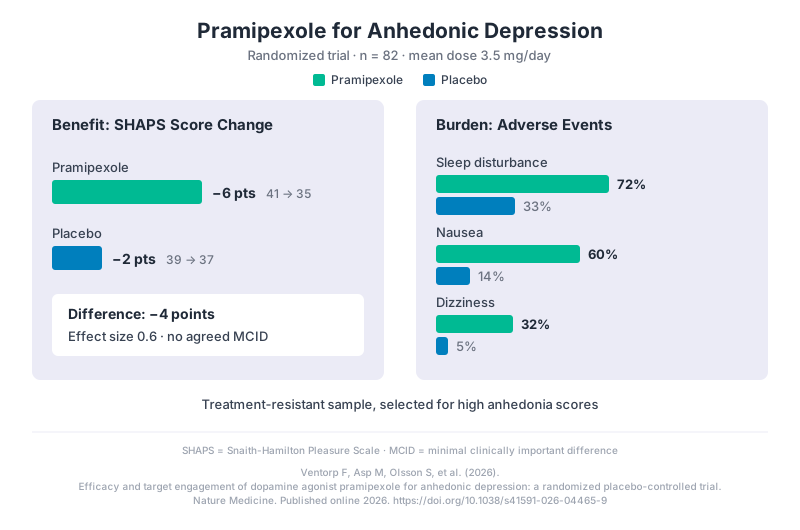
So for a patient with a substantial loss of the ability to experience pleasure, is potential improvement, albeit probably small, worth the risks and probable side effects? Your call, along with your patient.
Download PDF and other files
Consider Antidepressant-Induced Emotional Blunting
Before concluding, an obvious question. Could your patient’s anhedonia be emotional blunting from the antidepressant they’re already on?
The incidence of this phenomenon is still debated, ranging in recent reviews from 5% to 50%, or even higher for serotonin reuptake inhibitors specifically.
But overall, there seems little doubt anymore that this is a real concern. And the treatment implications, if anhedonia could be even partly iatrogenic, are obvious.
Anhedonia May Be Trait, Not State
And then lastly, a caution. While diagnostic criteria suggest that anhedonia is a symptom, there’s evidence that it may actually belong more to the patient than to the depression, a trait rather than a state, if you will. In other studies it’s been observed that after remission of depression, anhedonia often persists.
For such patients, functional imaging studies show diminished activation of reward-related circuits including the ventral striatum. That’s why a consenting subset of patients in this Swedish trial had functional magnetic resonance imaging (fMRI) studies, which showed preserved reward-related activity in the pramipexole group compared to decreased ventral striatum activity in the placebo group.
But if that decreased activity is a trait, not a depression-related state, then we’ve entered the territory of trying to change a patient’s personality here, not just treat their depression. That’s not unfamiliar territory, of course, but we should be mindful of what we’re offering and attempting.
Download PDF and other files
Abstract
Efficacy and target engagement of dopamine agonist pramipexole for anhedonic depression: a randomized placebo-controlled trial
Filip Ventorp; Marie Asp; Sofia Olsson, et al
Anhedonia is a core and disabling symptom of mood disorders with limited treatment options. We evaluated the efficacy and safety of the dopamine agonist pramipexole in patients with mood disorders characterized by clinically significant anhedonia. In this single-center, randomized, double-blind, placebo-controlled trial, adults with major depressive disorder, dysthymia or bipolar depression and elevated Snaith-Hamilton Pleasure Scale (SHAPS) scores were assigned (1:1) to flexible dose, once-daily oral pramipexole as add-on treatment or placebo for 9 weeks. The primary outcome was change in SHAPS score from baseline to week 9. Analyses were conducted in the modified intention-to-treat population. Eighty-five participants were randomized, and 82 were included in the analysis. The primary outcome was met: pramipexole was associated with a greater reduction in SHAPS scores compared to placebo (mean difference: -4.04, 95% confidence interval: -6.89 to -1.18, P = 0.006, Hedges’ g = 0.62). Exploratory analyses indicated that pramipexole was associated with increased light physical activity and relative preservation of reward-related ventral striatal activation. Improvements in anhedonia were sustained during a 6-month open-label extension. Pramipexole was generally well tolerated compared to placebo. Pramipexole significantly improved anhedonia and showed a favorable safety profile, supporting its potential as an augmentation strategy in mood disorders. ClinicalTrials.gov identifiers: NCT05355337 and NCT05825235 .
Reference
Ventorp, F.; Asp, M.; Olsson, S.; Lindahl, J.; Möller, S.; Svensson, M. et al. (2026). Efficacy and target engagement of dopamine agonist pramipexole for anhedonic depression: a randomized placebo-controlled trial. Nat Med; 32(7):2570-2578.