

Close Banner
Free Section  - Quick Takes

03. Negative Symptoms in Schizophrenia: What to Check Before Adding a Drug

Published on November 25, 2026 Certification expiration date: November 25, 2029

Oliver Freudenreich, M.D., F.A.C.L.P.

Co-director of the MGH Psychosis Clinical and Research Program & Professor of Clinical Psychiatry - Massachusetts General Hospital - Harvard Medical School

Key Points

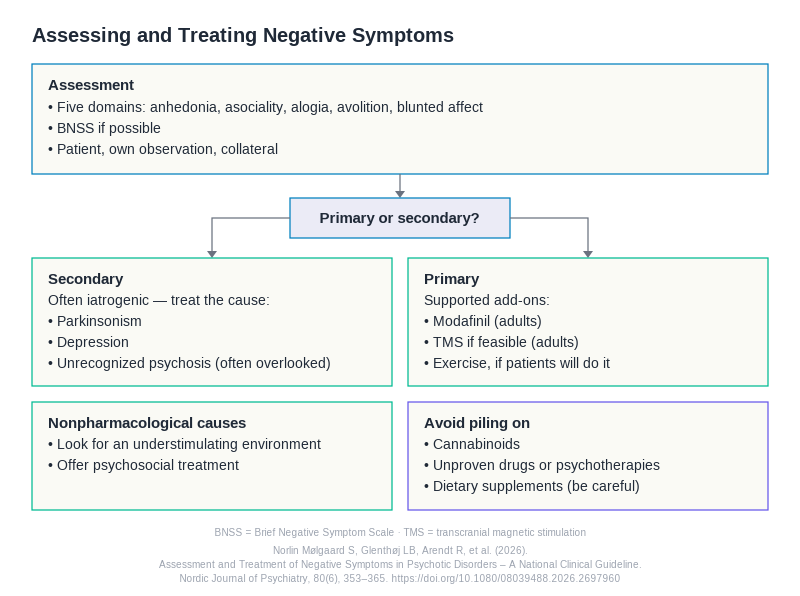
  • Assess negative symptoms across five consensus domains: anhedonia, asociality, alogia, avolition, and blunted affect, per a Danish national guideline. The Brief Negative Symptom Scale (BNSS) is probably the most helpful rating scale.
  • Secondary negative symptoms from parkinsonism, depression, or unrecognized psychosis call for treating the cause. For primary negative symptoms, the guideline supports modafinil or TMS in adults, not cannabinoids.
  • Many negative symptoms are related to aimless, unstructured lives with few positive reinforcing experiences. Addressing those problems requires more than a simple pharmacology review.

Free Downloads for Offline Access

  • Free Download PDF File
  • Free Download Audio File (MP3)

Text version

Assessing and Treating Negative Symptoms: A National Guideline

For this Quick Take today, I would like to make you aware of a national clinical guideline for the assessment and treatment of negative symptoms in psychotic disorders across all ages. This guideline represents the work of the so-called Danish Multidisciplinary Psychiatry Group (DMPG). The DMPG was established by the Danish Regions to develop national clinical guidelines in order to standardize professional quality and implement best practices throughout Danish psychiatry.

While developed in Denmark for Denmark, I believe you can adopt this national guideline for your own setting. You do not need to live in Denmark to use it for the benefit of your patients.

The guideline makes 21 specific recommendations. I won’t simply list them verbatim, and I encourage you to go to the publication itself for more detail (1). For this Quick Take, let me summarize the recommendations into five main points.

Free Files
Success!
Check your inbox, we sent you all the materials there.

Assess the Five Consensus Domains

First, be more precise when you assess negative symptoms, and use the five consensus domains that the field has agreed on:

  • Anhedonia
  • Asociality
  • Alogia
  • Avolition
  • Blunted affect

If you can, use a rating scale to help you assess these consensus domains; the scale that is probably most helpful is the Brief Negative Symptom Scale (BNSS). Make sure you involve the patient. Use your own observation, too, and collateral information from someone like a family member or group home staff.
Separate Primary From Secondary Symptoms

Diagnostically, it is critical to differentiate between primary and secondary negative symptoms.

Address secondary, often iatrogenic, problems like parkinsonism or depression, which mimic negative symptoms. Unrecognized psychosis, or positive symptoms, is often overlooked as a cause of negative symptoms that will improve if you treat the psychosis.

Free Files
Success!
Check your inbox, we sent you all the materials there.

Modafinil, TMS, Exercise; Not Cannabinoids

Add treatments for primary negative symptoms that have some support in the literature. The authors suggest modafinil, or transcranial magnetic stimulation (TMS) if feasible. Exercise would be great if patients will do it.

However, do not just add treatments for primary negative symptoms that have no support in the literature, and that applies to unproven pharmacological treatments and unproven psychotherapies alike. Essentially, you really want to avoid piling on non-evidence-based treatments.

The guideline authors explicitly do not want us to use cannabinoids. I would also be careful with dietary supplements, for example.

Address an Understimulating Environment

Finally, make sure you consider nonpharmacological causes of negative symptoms, such as an understimulating environment, and offer treatments that address such psychosocial problems.

Free Files
Success!
Check your inbox, we sent you all the materials there.

Caveats: Symptom Overlap and Flexibility in Assessment

Let me point out three problems that I see with this guideline. First, primary and secondary negative symptoms may not be categorical, and you may be better off with a more flexible view regarding whether negative symptoms are primary or secondary. Still, I think for pedagogical reasons the primary and secondary distinction is helpful as a starting point.

Second, there is also overlap between negative symptoms and cognitive symptoms like executive function. Some patients may be motivated to do something (they have a goal, for example) but they lack the executive function to come up with a plan and the steps to reach their goal. They do not need more motivation; they need more help implementing a plan.

Third, I also think measurement-based care is aspirational in most settings. The clinical assessment of negative symptoms using a scale is just not routinely done in clinical practice, due to time constraints and also because you need an informant. It is very typical, for example, for patients to paint a rosier picture of the richness — or the supposed richness — of their social lives than family members do.

Clinical Bottom Line

Here is my bottom line for today. Anyone who treats patients with schizophrenia should take a look at this guideline to get an update on how to manage the negative symptoms of schizophrenia. Perhaps you will be able to take one or two of the recommendations and incorporate them into your practice.

Just evaluating the five consensus domains of negative symptoms a bit better and identifying secondary causes of negative symptoms will be most helpful. Don’t forget that many negative symptoms are related to having aimless and unstructured lives with few positive reinforcing experiences, and addressing those problems requires more than a simple pharmacology review.

Free Files
Success!
Check your inbox, we sent you all the materials there.

References

  1. Norlin Mølgaard S, Glenthøj LB, Arendt R, et al. Assessment and treatment of negative symptoms in psychotic disorders – a national clinical guideline. Nord J Psychiatry. 2026;80(6):353-365. doi:10.1080/08039488.2026.2697960

Editor’s note: The guideline limits its modafinil and TMS recommendations to adults and does not extend them to patients under 18.

Abstract

Assessment and treatment of negative symptoms in psychotic disorders – a national clinical guideline

Sofie Norlin Mølgaard; Louise Birkedal Glenthøj; Runhild Arendt, et al

Purpose

Negative symptoms remain a primary driver of functional disability in schizophrenia spectrum disorders. This article presents the official Danish Multidisciplinary Psychiatry Group’s (DMPG) national clinical guideline for the assessment and treatment of negative symptoms in psychotic disorders across the lifespan.

Materials and Methods

A systematic literature search for systematic reviews and meta-analyses published between 2019 and 2024 was conducted in PubMed and PsycInfo. Studies were screened and extracted by independent reviewers using Covidence. To ensure clinical utility, recommendations were formulated by synthesizing the evidence base with expert consensus, which included extrapolating adult data to formulate guidance for children and adolescents where primary evidence is scarce.

Results

The consensus process yielded 21 specific clinical recommendations. The guideline mandates the assessment of five distinct domains (anhedonia, asociality, alogia, avolition, and blunted affect) using dedicated scales like the BNSS. It provides clear guidance on pharmacological strategies, including a conditional endorsement of modafinil augmentation and a recommendation against cannabinoids. Evidence-based psychosocial interventions, such as cognitive behavioral therapy and cognitive remediation, are also recommended.

Conclusions

The guideline establishes a comprehensive, clinically actionable framework for managing negative symptoms in children, adolescents, and adults. Furthermore, it emphasizes that advancing the field requires future research to utilize domain-specific tools to accurately distinguish primary from secondary negative symptoms.

Free Files
Success!
Check your inbox, we sent you all the materials there.

Reference

Norlin Mølgaard, S.; Glenthøj, L.; Arendt, R.; Schierup Nielsen, U.; Nordentoft, M.; Ørbech-Grønlund Jacobsen, I. et al. (2026). Assessment and treatment of negative symptoms in psychotic disorders – a national clinical guideline. Nord J Psychiatry; 80(6):353-365.

Learning Objectives

After completing this activity, the learner will be able to:

  1. Compare the contributions of antipsychotic selection, dose, and patient sex to hyperprolactinemia risk, and select a management strategy after considering other causes of elevated prolactin, such as lactation.
  2. Evaluate the short-term efficacy and safety of serial ketamine infusions in treatment-resistant bipolar depression, and describe the limits of the evidence on maintenance and long-term use.
  3. Apply a national guideline to assess negative symptoms across the five consensus domains, distinguish primary from secondary negative symptoms, and select treatments with support in the literature.
  4. Describe the association between postoperative delirium and long-term cognitive decline in older adults, and apply it when discussing prognosis with patients and families.
  5. Identify the antipsychotics whose exposure changes with food, caffeine, or grapefruit juice, and apply this when giving administration instructions and when interpreting an unexpected change in response.

Activity

Original Release Date: November 25, 2026
Expiration Date: November 25, 2029
Experts: Amanda Koire, M.D., Ph.D., James Phelps, M.D., Oliver Freudenreich, M.D., F.A.C.L.P., Scott R. Beach, M.D. & Derick E. Vergne, M.D.
Medical Editors: Sebastián Malleza, M.D. & Flavio Guzmán, M.D.

Relevant Financial Disclosures:

James Phelps, M.D. declares the following interests:
– McGraw-Hill: Published books about bipolar
– W.W. Norton & Co.: Published books about bipolar
– PESI: Honoraria for webinars about bipolar
– eCare: Honoraria for webinars about bipolar

Oliver Freudenreich, M.D., F.A.C.L.P. declares the following interests:
– Karuna: Researcher (MGH)
– Medscape: Speaker honorarium
– Wolters-Kluwer: Royalties for medical writing

All the relevant financial relationships listed above have been mitigated by Medical Academy and the Psychopharmacology Institute.

None of the other faculty, planners, and reviewers for this educational activity has relevant financial relationships to disclose during the last 24 months with ineligible companies whose primary business is producing, marketing, selling, re-selling, or distributing healthcare products used by or on patients.

Instructions for Participation and Credit

Participants must complete the activity online within the valid credit period noted above.
Follow these steps to earn CME credit:

  1. View the required educational content provided on this course page.
  2. Complete the Post-Activity Evaluation to provide the necessary feedback for continuing accreditation purposes and for the development of future activities. NOTE: Completing the Post Activity Evaluation after the quiz is required to receive the earned credit.
  3. Download your certificate.

Please note that CME and SA CME certificates completion dates are recorded using UTC. Depending on your local time zone, activities completed later in the day may appear on your certificate with the following calendar date.

Contact Information: For questions regarding the content or access to this activity, contact us at support@psychopharmacologyinstitute.com

Accreditation

Physicians

Accreditation Statement:
This activity has been planned and implemented in accordance with the accreditation requirements and policies of the Accreditation Council for Continuing Medical Education through the joint providership of Medical Academy LLC and the Psychopharmacology Institute. Medical Academy is accredited by the ACCME to provide continuing medical education for physicians.

Credit Designation Statement:
Medical Academy designates this enduring activity for a maximum of 0.75 AMA PRA Category 1 credit(s)™. Physicians should claim only the credit commensurate with the extent of their participation in the activity.

Nursing professionals — The ANCC accepts AMA PRA Category 1 Credit(s)™ as Contact Hours, under this calculation: 1 CME = 1 Contact Hour. All of our content is psychopharmacology, so the pharmacology hours shown on your certificate match the credits awarded for that activity. Your certificate states them on their own line, separately from the credit designation statement. This applies to APRN pharmacology renewal as well. Boards of nursing define pharmacology CE in their own way, so please confirm with your board that this is the documentation they expect.

Physician assistants — The NCCPA accepts AMA PRA Category 1 Credit™ from providers accredited by the ACCME toward PA certification maintenance. Requirements are set by the NCCPA, so please confirm with them what your current cycle requires.

Physicians outside the United States — AMA PRA Category 1 Credit™ may be awarded to physicians regardless of where they are licensed. Physicians interested in converting AMA PRA Category 1 Credit™ to UEMS-European Accreditation Council for Continuing Medical Education CME credits (ECMEC®s) should contact the UEMS at mutualrecognition@uems.eu. Acceptance toward a national continuing education requirement is determined by each country’s own authority.

Artificial Intelligence (AI) Use Disclosure

Artificial intelligence (AI) tools may have been used in limited stages of developing this activity (e.g., drafting or language refinement). The specific tool, version, and date of use are documented internally. AI is used solely as an editorial support mechanism and does not replace human expertise. AI does not determine clinical recommendations. All content is reviewed, verified, and approved by the listed experts and medical editors, and reflects independent human clinical judgment consistent with ACCME Standards for Integrity and Independence in Accredited Continuing Education.

Free Files
Success!
Check your inbox, we sent you all the materials there.
Continue in the website
Instant access modal

Become a Silver, Gold, Silver extended or Gold extended Member.

2026–27 Psychopharmacology CME Program

Unlock up to 155 CME Credits, including 40 SA CME Credits.