Text version
Serial Ketamine Infusions for Treatment-Resistant Bipolar Depression
The bottom line, if you must have it first: a new study suggests that ketamine infusions work about the same in bipolar depression as they do in unipolar depression. But may I offer a little historical perspective, being somewhat historic myself?
Download PDF and other files
New Drugs Reveal Harms Slowly
When olanzapine came out in 1996, it cost almost $200 a month, while haloperidol cost 2 cents a pill. It didn’t take long to discover that olanzapine was just more effective than the old stuff. Of course, it also didn’t take long to discover that olanzapine frequently caused metabolic syndrome.
And then, here’s the point: it has taken much longer for psychiatry to recognize that antipsychotics interfere with brain glucose metabolism as well. My general rule from residency, “Don’t use new medications that cost too much,” gradually grew to include this one: “We can’t know their long-term consequences until some patients have been using them long term.”
Yes, thalidomide was supposed to teach us that lesson, and tardive dyskinesia, of course. But now we have ketamine and its various forms.
The Maintenance Question Remains Open
The article for review in this Quick Take is about a randomized trial of serial ketamine infusions in bipolar depression. With my old-guy perspective, I’ve been watching the growing use of ketamine in so-called unipolar depression and thinking, yeah, let’s just see where this goes after a few years, so I can avoid starting there when considering use in bipolar disorder.
Yes, ketamine can dramatically lower suicidal ideation. One study in treatment-resistant depression found that short-term use was associated with an 84% reduction in emergency department visits for suicidal ideation. But what happens after that?
Will ketamine need to be managed like ECT, where acute treatment transitions to less frequent maintenance dosing, and then what? Without continued treatment, what is the relapse rate a year or two out? In ECT, that’s 40% to 50% in uncontrolled trials and case series.
Download PDF and other files
Long-Term Safety Data Remain Sparse
So what do we know about long-term use of ketamine? A just-published review by Tychique Wasolua and colleagues (1) found 32 studies of ketamine that followed patients for at least 12 weeks. Of those, only 6 have data one year out, and only 1 looked at patients who continued to use ketamine throughout that interval.
In that observational study of 85 patients, only 28 continued maintenance ketamine after completing acute treatment. By the end of observation, only 6 of them were still in responder status: not remission, but the lower bar of response. So far, it’s not sounding too great.
Dr. Wasolua and colleagues’ review was actually designed to examine the safety of repeated ketamine dosing. But again, the majority of studies examined exposure durations of 6 months or less, with only 7 studies examining follow-up between 6 and 12 months.
Across all the studies examined, the authors found no association with cumulative organ toxicity or iatrogenic addiction. That’s reassuring, but still limited to less than a year of exposure.
Results: Ketamine Outperformed Midazolam
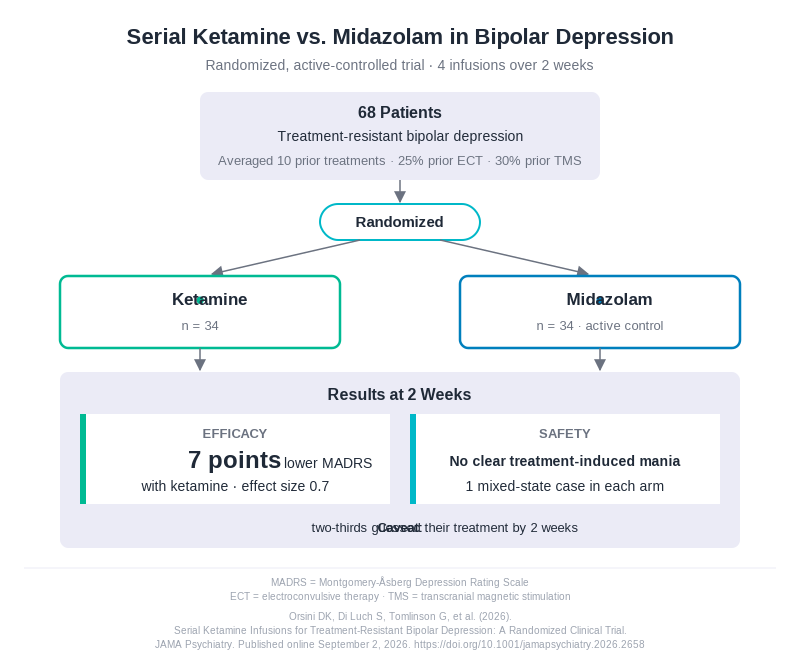
With all that in mind, let’s have a look at this new randomized trial of ketamine infusions for bipolar depression from Diana Orsini in Joshua Rosenblat’s lab (2). Efficacy? Yes.
In 68 participants, after four infusions spaced over two weeks, Montgomery-Åsberg Depression Rating Scale (MADRS) scores were 7 points lower in the ketamine group than in the active control group, which received midazolam. The ketamine group dropped 12 points, and the effect size was 0.7. That’s quite robust, and indeed a little better than the 0.4 to 0.5 effect sizes seen with ketamine in most major depression trials.
Download PDF and other files
No Clear Treatment-Induced Mania
And what about safety? That’s obviously the big concern, since trials to date have excluded people with bipolar disorder out of a concern for inducing manic or mixed states. The answer: no clear treatment-induced mania.
There were two cases of treatment-associated mixed states, one each in the ketamine and midazolam groups. Based on the experience of the 34 people in the active treatment arm of this two-week study, we could say that short-term ketamine doesn’t appear to make bipolar disorder worse, and that it helps as much as one would expect in so-called unipolar depression, maybe even a bit better.
Midazolam Matched Ketamine Initially
But there’s more interesting stuff. What were these people taking during the trial? It’s like a snapshot of bipolar treatment: about two-thirds were on an antipsychotic, about half were on an antidepressant and just over a quarter were on lithium.
Digging a little deeper, and relevant to this trial: what percentage were on a benzodiazepine? Wow, almost half. It’s kind of amazing that midazolam would do anything in that context.
Midazolam was associated with just as large an antidepressant effect as ketamine after the first infusion, but a between-treatment gap opened after that, thus the significant difference by two weeks. Notably, by that point, how many participants had figured out what they were taking? Two-thirds, which the authors acknowledged could have contributed to the widening gap.
Download PDF and other files
A Treatment-Resistant Sample
Finally, to give you an idea of how hard it could be to get a positive result in this group, consider what these patients had already been through:
- An average of 10 prior treatment efforts
- 25% had had ECT
- 30% had had transcranial magnetic stimulation
Definitely treatment resistant.
Equal Evidence, Decades More Experience
In this context, I can’t resist adding one more reference, also in treatment-resistant bipolar depression: the 2022 TRIO-BD study by Cynthia Calkin and colleagues (3). Their patients had insulin resistance, a common bipolar co-traveler, often with iatrogenic origin or exacerbation, as I mentioned at the beginning.
In that study of 45 people, the 11 patients who reversed their insulin resistance had a 16-point drop in their MADRS scores, for an effect size of 1.0 at 26 weeks. Their Hamilton Anxiety Rating Scale (HAM-A) scores also dropped significantly.
And how did they reverse their insulin resistance? Metformin: aggressive metformin, titrated to a target of 1000 mg twice daily.
Obviously, I’m suggesting that we have just as much evidence for metformin, namely one randomized trial, as we do for ketamine in treatment-resistant bipolar depression. Metformin is an inexpensive drug with which we have several decades of experience, including, for example, the need for B12 supplementation for many patients.
That’s the kind of long-term problem that takes years and years to recognize. I wonder what we’ll learn about long-term ketamine. For now, we can say that in one short-term trial, ketamine worked, and it didn’t cause any clear worsening in bipolar depression over two weeks.
References
- Wasolua TT, Hardy MS, Bommersbach TJ, McIntyre RS, Rhee TG. A Systematic Review of Long-Term Safety Outcomes of Ketamine and Esketamine in Patients with Treatment-Resistant Depression. Psychother Psychosom. Published online August 17, 2026. doi:10.1159/pps/aemag005
- Orsini DK, Di Luch S, Tomlinson G, et al. Serial Ketamine Infusions for Treatment-Resistant Bipolar Depression: A Randomized Clinical Trial. JAMA Psychiatry. Published online September 2, 2026. doi:10.1001/jamapsychiatry.2026.2658
- Calkin CV, Chengappa KNR, Cairns K, et al. Treating Insulin Resistance With Metformin as a Strategy to Improve Clinical Outcomes in Treatment-Resistant Bipolar Depression (the TRIO-BD Study): A Randomized, Quadruple-Masked, Placebo-Controlled Clinical Trial. J Clin Psychiatry. 2022;83(2):21m14022. Published 2022 Feb 1. doi:10.4088/JCP.21m14022
Download PDF and other files
Abstract
Serial Ketamine Infusions for Treatment-Resistant Bipolar Depression
Diana K. Orsini; Sara Di Luch; George Tomlinson, et al
Importance
Antidepressant efficacy of intravenous (IV) ketamine has been demonstrated in major depressive disorder; however, the efficacy and safety of ketamine for bipolar depression remain largely unknown, with limited data available in this specific population.
Objective
To evaluate the efficacy, safety, and tolerability of adjunctive IV ketamine compared with midazolam for treatment-resistant bipolar I or II depression (TRBD).
Design, Setting, and Participants
The Ket-BD study (Ketamine for Treatment-Resistant Bipolar Disorder) was an investigator-led, double-blind, midazolam-controlled randomized clinical trial conducted at 3 sites in Ontario, Canada, from July 2022 to November 2025. Participants included adult outpatients (aged 21-65 years) with a primary bipolar I or II disorder DSM-5 diagnosis with a current moderate to severe major depressive episode (Montgomery-Åsberg Depression Rating Scale [MADRS] score ≥21), having had at least 2 failed trials of evidence-based pharmacotherapies. Data were analyzed from November 2025 through February 2026.
Interventions
Participants were randomized 1:1 to receive 4 flexibly dosed 40-minute infusions over 2 weeks of either ketamine (0.5-0.75 mg/kg) or midazolam (0.02-0.03 mg/kg) adjunctive to a stable dose of at least 1 mood stabilizer or antipsychotic.
Main Outcomes and Measures
The primary outcome was change in depression symptom severity measured by the observer-rated MADRS score from baseline to end of treatment (day 14). Safety and tolerability were assessed with close evaluation for potential treatment-emergent mania, hypomania, mixed features, or psychosis.
Results
Of 68 randomized participants (mean [SD] age, 44.4 [11.8] years; 38 female [55.8%]), 63 were included in the final efficacy analysis as 5 participants withdrew (1 ketamine, 4 midazolam) before the primary end point. In the primary efficacy analysis, controlling for sex, bipolar type, and baseline MADRS, the mean MADRS score at day 14 was significantly lower in the ketamine group compared to the midazolam group (between-group difference = -7.3 points; 95% CI, -12.0 to -2.5; P = .003; Cohen d = 0.7). No cases of mania, hypomania, psychosis, or suicide attempts were observed in either group. One case of mixed features (subthreshold hypomanic symptoms) was observed in each group. After the first infusion, 31 of 66 participants (47%) correctly guessed treatment allocation.
Conclusions and Relevance
In TRBD, adjunctive IV ketamine was well tolerated and associated with significant antidepressant effects compared to midazolam.
Trial Registration
ClinicalTrials.gov Identifier: NCT05004896.
Reference
Orsini, D.; Di Luch, S.; Tomlinson, G.; Lovell, G.; Vasudeva, S.; Rodrigues, N. et al. (2026). Serial Ketamine Infusions for Treatment-Resistant Bipolar Depression. JAMA Psychiatry.