



As with other drugs in psychopharmacology, the mechanism of action of aripiprazole in schizophrenia has not been fully elucidated. From a pharmacological perspective, aripiprazole is different to other antipsychotic agents , as it is the only approved antipsychotic that reduces dopaminergic neurotransmission through D2 partial agonism, not D2 antagonism. The following presentation discusses current thinking on the mechanism of action of aripiprazole (scroll down to see a summary with images).
Summary
If you don’t have time to go through the entire video, this summary highlights the most important concepts explained in the presentation.
- Aripiprazole binds to a number of CNS receptors, this includes effects as:
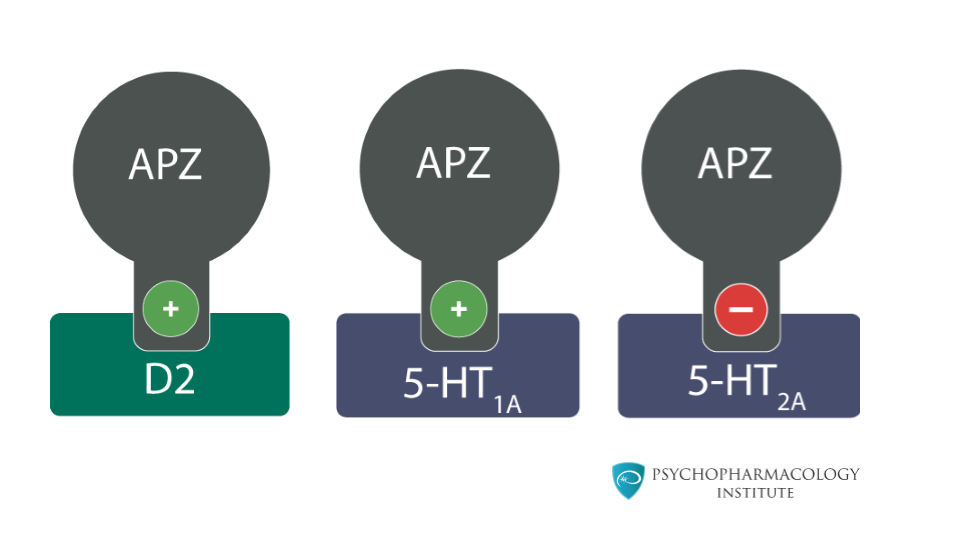
This image depicts aripiprazole binding to three different receptors: D2, 5HT1A, 5HT2A
- What are the implications of D2 partial agonism? Aripiprazole binds to the D2 receptor with the same affinity as dopamine, but has a lower intrinsic efficacy, so the response it triggers is lower than dopamine but higher than an antagonist.
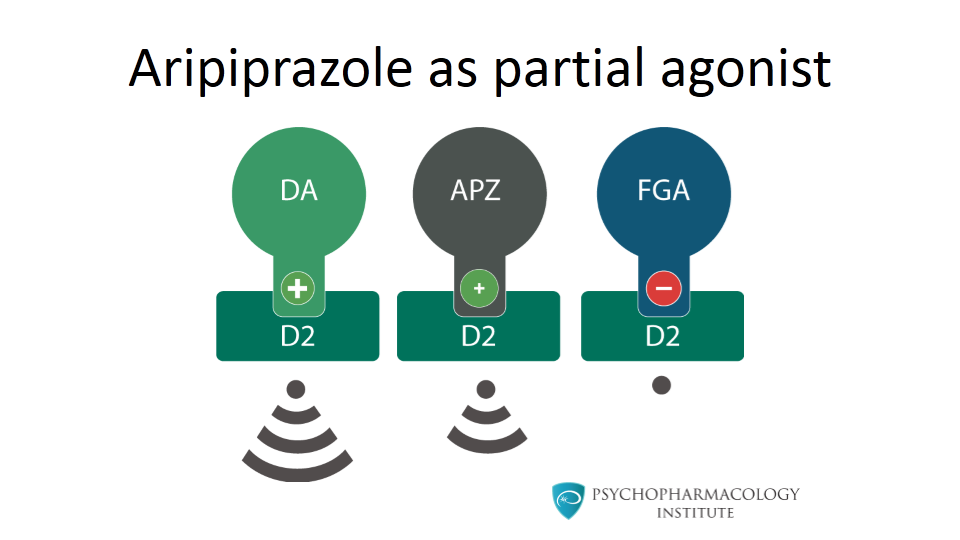
Aripiprazole as partial agonist: note that the “signal” is lower than dopamine but higher than an antagonist
- As partial agonist at D2 receptors, it modulates neurotransmission in dopaminergic pathways (mainly mesolimbic and mesocortical pathway).
- According to the dopamine theory of schizophrenia, overactivity of the mesolimbic pathway may trigger positive symptoms (hallucinations, delusions).
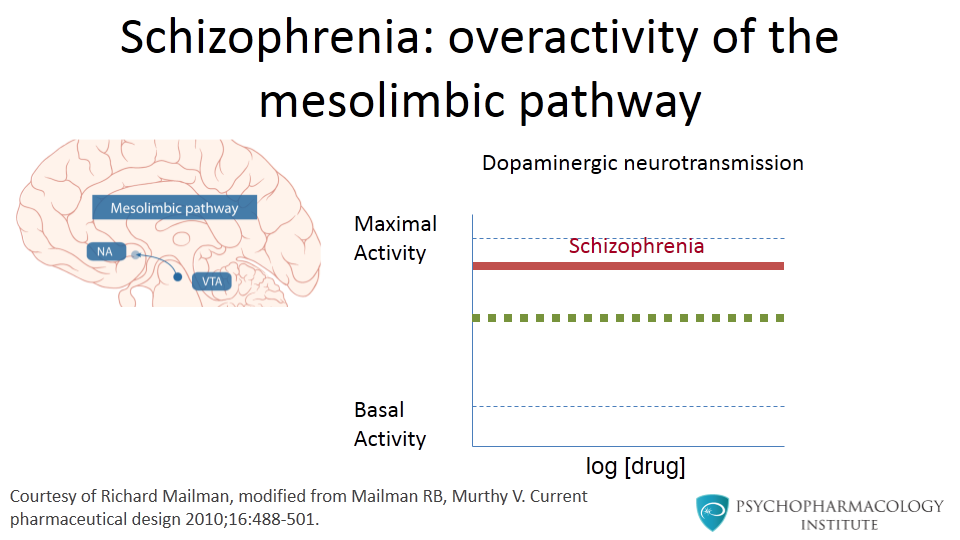
Positive symptoms of schizophrenia might be the result of an overactivation of the mesolimbic pathway.
- Aripiprazole might decrease activity in the mesolimbic pathway through partial D2 agonism, which would, in turn, reduce positive symptoms.
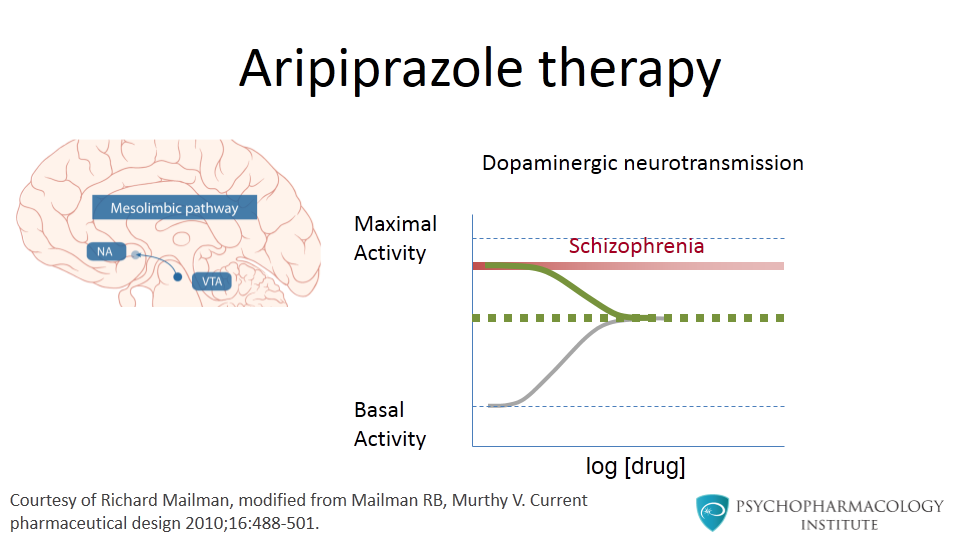
Aripiprazole reduces dopaminergic activity in the mesolimbic pathway through partial D2 agonism.[/caption]
- The dopamine theory of negative and cognitive symptoms suggests that there is a hypofunction of dopaminergic neurotransmission in the mesocortical pathway.
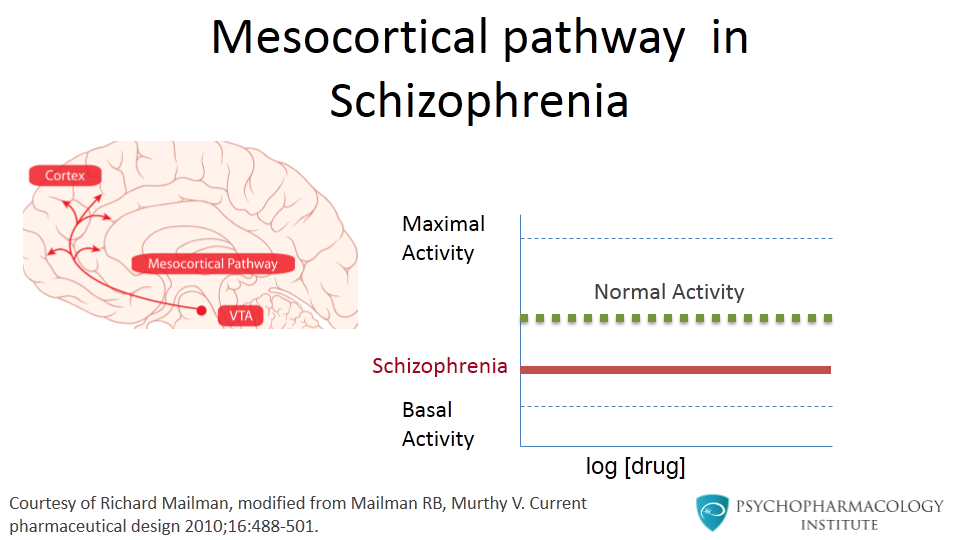
- One postulated mechanism of action of aripiprazole in schizophrenia is the ability of the drug to increase dopaminergic activity from a subnormal level to normal activity in the mesocortical pathway.

Partial D2 agonism might increase dopaminergic activity in the mesocortical pathway.
Key Points
- Aripiprazole is a partial agonist at D2 receptors.
- It may act as an antipsychotic by:
- Lowering dopaminergic neurotransmission in the mesolimbic pathway.
- Enhancing dopaminergic activity in the mesocortical pathway.
- It has a lower risk of EPS and hyperprolactinemia than other antipsychotics.
More Information on Aripiprazole
- Aripiprazole Indications: FDA-Approved and Off-Label Uses
- Aripiprazole Lauroxil Extended-Release Injectable (ARISTADA)
- Pharmacokinetics of Aripiprazole: Clinical Summary
- Aripiprazole for Schizophrenia
- Aripiprazole for Mania
- Aripiprazole for Depression
References
- Mailman RB, Murthy V. Third generation antipsychotic drugs: partial agonism or receptor functional selectivity? Current pharmaceutical design 2010;16:488-501.
- Brunton LB, Lazo JS, Parker KL, eds. Goodman & Gilman’s The Pharmacological Basis of Therapeutics. 12th ed. New York: McGraw-Hill; 2010.
- Stahl, S M. Stahl’s Essential Psychopharmacology: Neuroscientific Basis and Practical Applications. 4th ed. New York: Cambrigde University Press; 2013
