



Quetiapine is a second-generation antipsychotic that has affinity for D2, 5-HT2A, H1, alpha 1 and 5-HT1A receptors. Its precise mechanism of action is unknown, but according to the dopamine theory of schizophrenia, antipsychotic effects might be related to the drug’s ability to reduce dopaminergic neurotransmission in the mesolimbic pathway.
Quetiapine, D2 receptor blockade and the “kiss and run” hypothesis
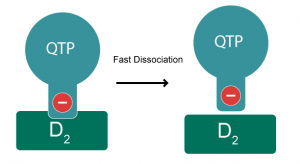
Quetiapine mechanism of action might involve rapid dissociation from D2 receptors.[/caption] PET studies show that there is a relationship between D2 receptor occupancy and antipsychotic effects [1]. D2 receptor occupancy in the ranges of 60 % to 75% is associated with antipsychotic efficacy. Interestingly, quetiapine has been shown to occupy approximately 30% of D2 receptors at therapeutic doses [2]. To explain the apparent discrepancy, Kapur proposed the “kiss and run” hypothesis. In a series of studies they found that in contrast to other antipsychotics, quetiapine had a more rapid “run-off”, or rapid dissociation, from D2 receptors [2].
Pharmacodynamics of quetiapine
This section is an illustrated representation of the most relevant pharmacodynamic properties of quetiapine.
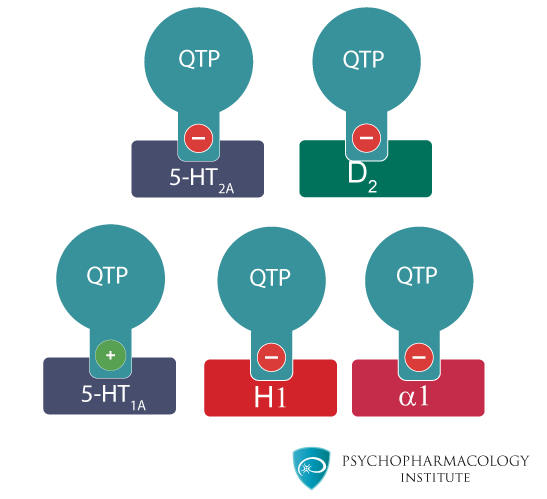
Putative mechanism of action of quetiapine involves 5-HT2A/D2 antagonism and 5-HT1A partial agonism.
H1 and alpha 1 antagonism are linked to side effects.
5HT2A and D2 antagonism
Quetiapine has antagonist actions at 5-HT2A receptors, one of the key properties of second-generation antipsychotics is that they have a high 5-HT2A/D2 ratio. Quetiapine has higher affinity for 5-HT2A receptors than for
[3].
5HT1A partial agonism
Quetiapine, aripiprazole, asenapine and ziprasidone are partial agonists at
. Affinity for this receptor is one of the proposed mechanisms of action of quetiapine’s antidepressant effects [4].
Alpha 1 and H1 antagonism
Alpha 1 antagonism can cause orthostatic hypotension, this potential side effect can be prevented by slow dose titration. Quetiapine is a strong antagonist at H1 receptors. H1 antagonism is linked to sedative effects and weight gain [2].
Binding potency of quetiapine at different receptors
This table shows Ki values for quetiapine at different neurotransmitter receptors. Ki is inversely proportional to affinity. This means that high Ki numbers suggest low affinity at a given receptor, while low Ki numbers are associated with high affinity.
| Receptor type | Ki value (nM) |
|---|---|
| D2 | 380 |
| 5HT1A | 390 |
| 5HT2A | 640 |
| 5HT2C | 1840 |
| D1 | 990 |
| D4 | 2020 |
| M1 | 37 |
| Alpha 1 A | 22 |
| Alpha 2 A | 2900 |
| H1 | 6.9 |
Interactive activity
Click each button to learn more about quetiapine affinity at a given receptor.
More information on quetiapine
- Quetiapine Indications: FDA-Approved and Off-label Uses
- Quetiapine Pharmacokinetics
- Quetiapine for Mania
- Quetiapine for Depression
- Quetiapine for Bipolar Depression
References
- Kapur S, Zipursky R, Jones C, Remington G, Houle S. Relationship between dopamine D(2) occupancy, clinical response, and side effects: a double-blind PET study of first-episode schizophrenia . The American journal of psychiatry 2000;157:514-20.
- Schatzberg, AF, Nemeroff, C . The American Psychiatric Publishing Textbook of Psychopharmacology. 4th ed.American Psychiatric Publishing, 2009.
- Tasman, A; Lieberman, J; Key, J; Maj, M. Psychiatry. 3rd ed. John Wiley & Sons, 2008
- Jensen NH, Rodriguiz RM, Caron MG, Wetsel WC, Rothman RB, Roth BL. N- desalkylquetiapine , a potent norepinephrine reuptake inhibitor and partial 5-HT1A agonist, as a putative mediator of quetiapine’s antidepressant activity. Neuropsychopharmacology : official publication of the American College of Neuropsychopharmacology 2008;33:2303-12.
- Brunton LB, Lazo JS, Parker KL, eds. Goodman & Gilman’s The Pharmacological Basis of Therapeutics. 12th ed. New York: McGraw-Hill; 2010.
