



Mechanism of Action
The mechanism of action of ziprasidone, as with other drugs having efficacy in schizophrenia, is unknown. However, it has been proposed that this drug’s efficacy in schizophrenia is mediated through a combination of dopamine type 2 (D2) and serotonin type 2 (5HT2) antagonism. As with other drugs having efficacy in bipolar disorder, the mechanism of action of ziprasidone in bipolar disorder is unknown. The video below discusses the relationship between 5HT2A/D2 antagonism in the mechanism of action of second-generation antipsychotics:
Pharmacodynamics
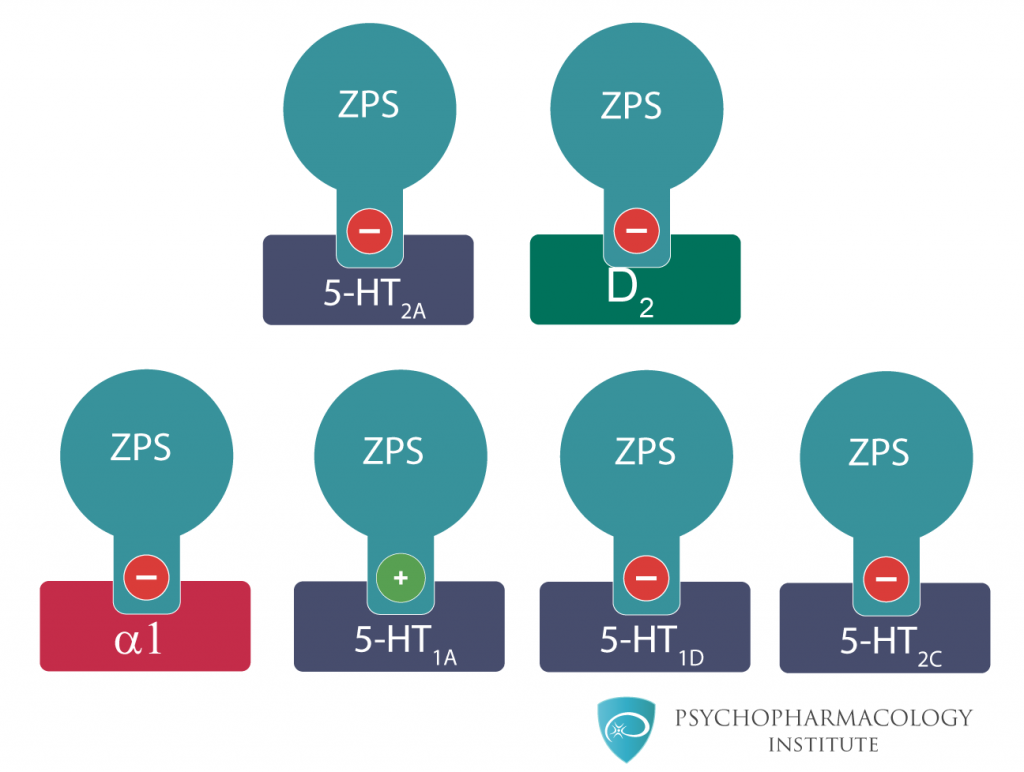
Ziprasidone pharmacodynamics: a schematic representation of its most relevant affinities.[/caption] Ziprasidone exhibited high in vitro binding affinity for the dopamine D2 and D3, the serotonin 5HT2A, 5HT2C, 5HT1A, 5HT1D, and α1-adrenergic receptors (Ki s of 4.8, 7.2, 0.4, 1.3, 3.4, 2, and 10 nM, respectively), and moderate affinity for the histamine H1 receptor (Ki=47 nM). Ziprasidone functioned as an antagonist at the D2, 5HT2A, and 5HT1D receptors, and as an agonist at the 5HT1A receptor. Ziprasidone inhibited synaptic reuptake of serotonin and norepinephrine. No appreciable affinity was exhibited for other receptor/binding sites tested, including the cholinergic muscarinic receptor (IC50 >1 µM). Antagonism at receptors other than dopamine and 5HT2 with similar receptor affinities may explain some of the other therapeutic and side effects of ziprasidone. Ziprasidone’s antagonism of histamine H1 receptors may explain the somnolence observed with this drug. Ziprasidone’s antagonism of α1-adrenergic receptors may explain the orthostatic hypotension observed with this drug .
Related Olanzapine Information
- FDA Warning: Ziprasidone Associated with DRESS Syndrome
- Ziprasidone (Geodon) Indications: FDA-Approved Uses
- Ziprasidone (Geodon) Pharmacokinetics
- Ziprasidone Adverse Effects
References and Further Reading
- Drug labeling information submitted to the Food and Drug Administration (FDA), updated by the National Library of Medicine (NLM) .
- Schmidt AW, Lebel LA, Howard HR, Jr., Zorn SH. Ziprasidone: a novel antipsychotic agent with a unique human receptor binding profile. European journal of pharmacology. 2001;425(3):197-201.
