



Source: Drug labeling information submitted to the Food and Drug Administration (FDA), updated by the National Library of Medicine (NLM) .
Mechanism of Action
The mechanism of action of iloperidone, as with other drugs having efficacy in schizophrenia, is unknown. However, it is proposed that the efficacy of iloperidone is mediated through a combination of dopamine type 2 (D2) and serotonin type 2 (5-HT2) antagonisms. Play the video below to learn more about the 5HT2A/D2 theory of “atypicality”.
Click here to learn more about the mechanism of action of second-generation antipsychotics .
Pharmacodynamics
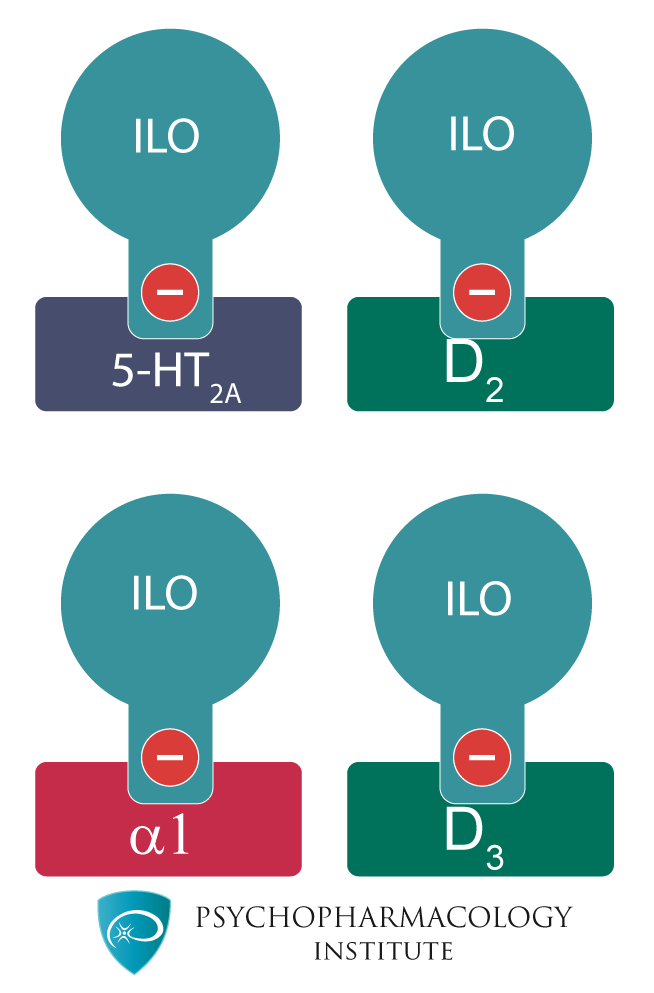
Iloperidone pharmacodynamics: a schematic representation of its most relevant affinities.
Iloperidone exhibits high (nM) affinity binding to serotonin 5-HT2A, dopamine D2 and D3 receptors, and norepinephrine NE α1 receptors (Ki values of 5.6, 6.3, 7.1, and 0.36 nM, respectively). FANAPT has moderate affinity for dopamine D4, and serotonin 5-HT6 and 5-HT7receptors (Ki values of 25, 43, and 22, nM respectively), and low affinity for the serotonin 5-HT1A, dopamine D1, and histamine H1 receptors (Ki values of 168, 216 and 437 nM, respectively). FANAPT has no appreciable affinity (Ki>1000 nM) for cholinergic muscarinic receptors. FANAPT functions as an antagonist at the dopamine D2, D3, serotonin 5-HT1A and norepinephrine α1/α2C receptors. The affinity of the FANAPT metabolite P88 is generally equal or less than that of the parent compound. In contrast, the metabolite P95 only shows affinity for 5-HT2A (Ki value of 3.91) and the NEα1A, NEα1B, NEα1D, and NEα2C receptors (Ki values of 4.7, 2.7, 8.8 and 4.7 nM respectively).
Related Paliperidone Information
- Iloperidone (Fanapt) Indications: FDA-Approved Uses
- Iloperidone (Fanapt) Drug Interactions
- Iloperidone Pharmacokinetics
- Iloperidone (Fanapt): Adverse Effects and Warnings
Further Reading
Citrome L. Iloperidone: chemistry, pharmacodynamics, pharmacokinetics and metabolism, clinical efficacy, safety and tolerability, regulatory affairs, and an opinion. Expert opinion on drug metabolism & toxicology. 2010;6(12):1551-64
