



Asenapine is a second-generation antipsychotic that acts as antagonist at 5HT2A and D2 receptors.
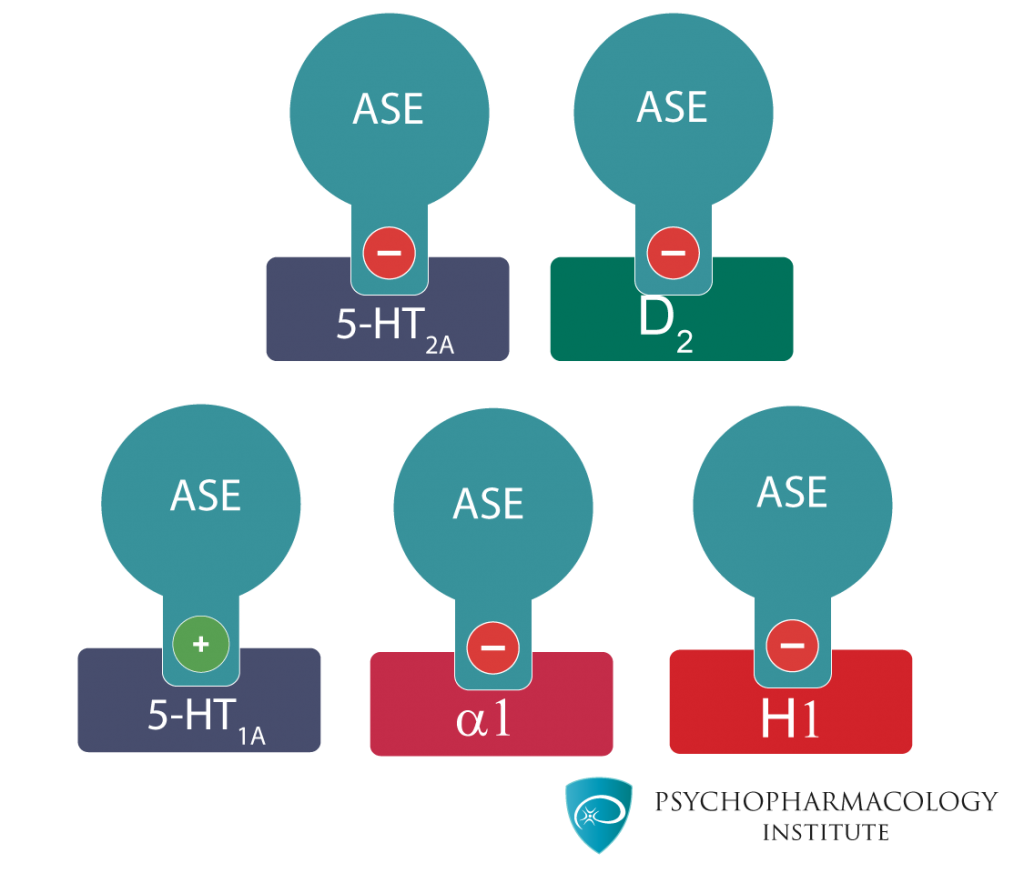
Asenapine pharmacodynamics: a schematic representation of its most relevant affinities.
The mechanism of action of asenapine, as with other drugs having efficacy in schizophrenia and bipolar disorder, is unknown. It has been suggested that the efficacy of asenapine in schizophrenia is mediated through a combination of antagonist activity at D2 and 5-HT2A receptors.
Effects on other receptors include:
- 5HT1A partial agonism
- Antagonism at 5HT receptors: 5-HT2B, 5-HT2C, 5-HT5A, 5-HT6, 5-HT7
- Alpha 1 antagonism
- H1 antagonism
Asenapine exhibits high affinity for serotonin 5-HT1A, 5-HT1B, 5-HT2A, 5-HT2B, 5-HT2C, 5-HT5, 5-HT6, and 5-HT7 receptors (Ki values of 2.5, 4.0, 0.06, 0.16, 0.03, 1.6, 0.25, and 0.13 nM), dopamine D2, D3, D4, and D1 receptors (Ki values of 1.3, 0.42, 1.1, and 1.4 nM), α1 and α2-adrenergic receptors (Ki values of 1.2 and 1.2 nM), and histamine H1 receptors (Ki value 1.0 nM), and moderate affinity for H2 receptors (Ki value of 6.2 nM). In in vitro assays asenapine acts as an antagonist at these receptors.
Asenapine has no appreciable affinity for muscarinic cholinergic receptors (e.g., Ki value of 8128 nM for M1). Play the video below to learn more about the 5HT2A/D2 theory of ‘atypicality’.
References and further reading
- McIntyre RS. Pharmacology and efficacy of asenapine for manic and mixed states in adults with bipolar disorder. Expert review of neurotherapeutics . 2010;10(5):645-9.
- Merck Pharmaceuticals. Saphris (asenapine sublingual tablets) prescribing information. Retrieved from http://www.merck.com/product/usa/pi_circulars/s/saphris/saphris_pi.pdf
