



In a nutshell
Antidepressant-induced hyponatremia is the most clinically significant electrolyte complication of antidepressant therapy. It is idiosyncratic rather than dose-dependent: it occurs at therapeutic doses and does not reliably track with plasma levels. [1–3] No antidepressant is risk-free: mirtazapine has the most consistent evidence for lower comparative risk than SSRIs [4–10]
The clinical challenge is recognition: the symptoms are non-specific and routinely misattributed to the psychiatric illness, to aging, or to expected drug side effects. Symptoms depend on both the sodium value and the speed of decline.
- Hyponatremia risk at a glance:
- Clearly increased risk: SSRIs and SNRIs
- Pooled analyses generally place SNRIs somewhat above SSRIs, but this is not uniform across newer cohorts [5,7–10]
- Lower comparative risk, best supported: mirtazapine
- Plausible lower-risk alternative, limited comparative data: bupropion [6, 10]
- Potentially lower risk but evidence-sparse: trazodone and agomelatine
- No reliable individual-drug ranking:
- Venlafaxine, duloxetine, fluoxetine, paroxetine, sertraline, citalopram, and escitalopram have each produced the strongest signal in different datasets [5–8,12,13]
- Clearly increased risk: SSRIs and SNRIs

- Key clinical recommendations:
- Check baseline sodium before starting or increasing an antidepressant in patients with meaningful risk:[1,3,14–16]
- Older age (particularly ≥65)
- Prior hyponatremia or syndrome of inappropriate antidiuresis (SIAD)
- Low or low-normal baseline sodium
- Thiazide use, or multiple hyponatremia-associated drugs
- Major heart, liver, or kidney disease
- Prefer a lower-risk agent in hyponatremia-prone patients:
- In high-risk patients, recheck sodium during the early risk window:
- Treat symptoms and acuity, not the sodium value alone:
- For antidepressant-induced hyponatremia without severe symptoms:
- Generally avoid rechallenge with the implicated antidepressant:
- Check baseline sodium before starting or increasing an antidepressant in patients with meaningful risk:[1,3,14–16]
Introduction
Clinical Significance
- Antidepressants are among the most frequently implicated medication groups in the syndrome of inappropriate antidiuresis (SIAD), the modern umbrella term (broader than SIADH) for inappropriate free-water retention that dilutes serum sodium [14, 20]
- Hyponatremia is a leading cause of falls and fractures in older adults; even mild, chronic cases have been linked to attention and gait impairment [13, 14, 20]
- Frequently underrecognized in psychiatric settings because the core symptoms (confusion, fatigue, cognitive decline, gait instability) overlap with the conditions being treated [1]
Incidence and Risk
- Incidence depends on definition, population, and follow-up window:
- 6% event rate for study-defined hyponatremia according to a 2025 SSRI/SNRI meta-analysis [7]
- 8.25% for any hyponatremia and 2.87% for clinically relevant hyponatremia among older antidepressant users, according to a 2026 geriatric meta-analysis
- Timing:
- The highest-risk window is shortly after initiation or a dose increase; risk peaks in the first 2 weeks and is no longer significant after one year [12]
- Late-onset hyponatremia can still occur when a new illness, increased fluid intake, or an interacting medication is added, so do not treat long-term exposure as protective [12]
Mechanisms of Antidepressant-Induced Hyponatremia
- The final common pathway is impaired renal excretion of electrolyte-free water. This produces a hypotonic, usually euvolemic hyponatremia: an excess of free water, not a deficiency of sodium [18, 19, 21, 22]
- Serotonin transporter (SERT) binding affinity is one mechanistic signal, not a clinically validated ranking that holds across populations and outcomes [4–7]
- In a triangulation study, the size of the sodium drop correlated with an antidepressant’s SERT affinity [4]
- Higher SERT binding (paroxetine, duloxetine, escitalopram) tended toward a greater sodium decrease
- Low or no SERT binding (mirtazapine, bupropion) showed minimal or no effect on sodium
- The association is not dose-dependent:
- Two pathways can converge on water retention in the renal collecting duct [20, 22]
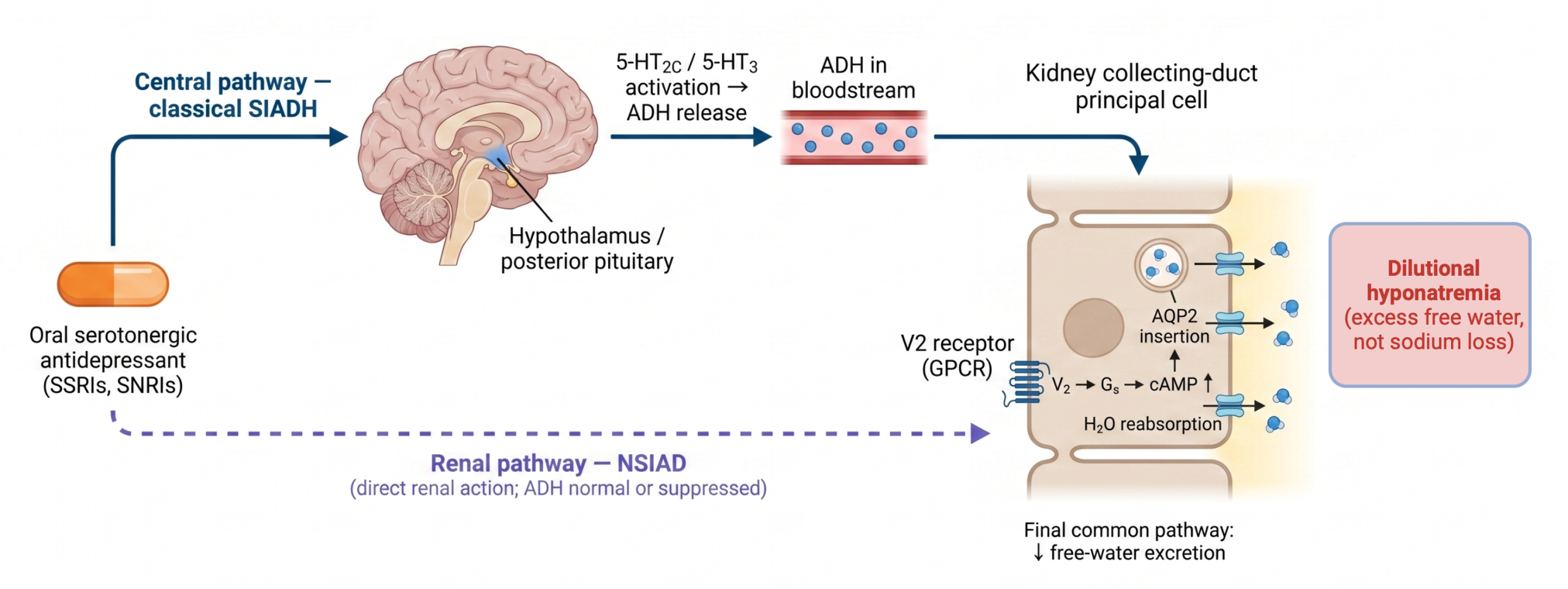
- Central pathway (classical SIADH):
- Serotonergic antidepressants stimulate ADH (vasopressin) secretion, likely via 5-HT2C and 5-HT3 receptor activation [20, 22]
- ADH then acts on V2 receptors in the collecting duct, driving AQP2 water-channel insertion, water retention, and dilutional hyponatremia [20, 22]
- SIADH accounts for approximately one-third of all hyponatremia cases in clinical practice [21]
- Renal pathway (nephrogenic syndrome of inappropriate antidiuresis, NSIAD):
- Some drugs may increase collecting-duct V2/AQP2 signaling or renal sensitivity to vasopressin, so ADH can be normal or even suppressed [22]
- This nephrogenic mechanism is biologically plausible and supported by experimental data for selected drugs (including sertraline) [22]
- It is not established as the predominant pathway for antidepressants and should not be presented as a class effect
- It also explains why tolvaptan (a V2 receptor antagonist) can work even when ADH is not elevated
Comparing Hyponatremia Risk Across Antidepressants
- Comparative evidence is almost entirely observational and highly heterogeneous [5–10]
- Differences in age, baseline sodium, laboratory testing, indication, concomitant medications, and outcome definition can reverse apparent rankings.
- Use broad tiers and patient-specific risk rather than a definitive league table [5–8]
Risk by Class and Agent Group
| Class or agent group | Clinical interpretation | Limitations |
|---|---|---|
| SNRIs | Pooled analyses often find modestly higher risk than with SSRIs [5, 7, 9] | A 2026 multi-institutional cohort found a significant signal for SSRIs but not SNRIs, showing that the hierarchy is not uniform [10] |
| SSRIs | Consistently associated with increased risk, especially soon after initiation and in older adults [5, 7, 10, 12] | Individual SSRI rankings conflict across datasets. |
| TCAs | Pooled risk is generally lower than for SSRIs and SNRIs [5, 8] | Anticholinergic, cardiovascular, and overdose risks usually prevent choosing a TCA solely to reduce hyponatremia risk. |
| Mirtazapine | Best-supported lower-risk alternative relative to SSRIs [5, 9] | It remains associated with hyponatremia versus non-use, and rare severe cases occur [5, 8, 9, 24] |
| Bupropion | Reasonable lower-risk option when clinically appropriate [6, 10] | Comparative evidence is limited and does not establish zero risk [6, 10] |
| Trazodone | A potentially lower-risk option [5] | Few studies and substantial uncertainty; evidence is weaker than for mirtazapine. |
| Agomelatine | Potential alternative in countries where available | Evidence is sparse and includes a small 2025 case series; liver-function monitoring and local labeling apply [2, 11] |
Individual Agents
- Different large datasets have generated higher signals for venlafaxine, duloxetine, citalopram, sertraline, paroxetine, escitalopram, and fluoxetine, but the agent flagged as highest varies from cohort to cohort, so no individual drug can be reliably ranked as the riskiest [6–8,12,13]
Clinical Bottom Line
- Available evidence does not support a universally valid rank order among individual drugs; match agent choice to the individual patient’s risk profile rather than to a fixed hierarchy
- When lower hyponatremia risk is a major priority [5, 6, 9]
- Mirtazapine has the strongest comparative support
- Bupropion is reasonable when clinically suitable
- Evidence for trazodone and agomelatine is too sparse to call them equivalently proven
Clinical Presentation and Diagnosis
- Symptoms of hyponatremia overlap substantially with depression and antidepressant side effects, so the first challenge is recognizing it at all, particularly in mild cases.
- Separate biochemical severity (the sodium number) from clinical severity (the symptoms) [18, 19]
- Symptoms depend on both the sodium concentration and the speed of decline
- An acutely falling sodium of 128 mmol/L can be more dangerous than a stable, chronic value below 125 mmol/L
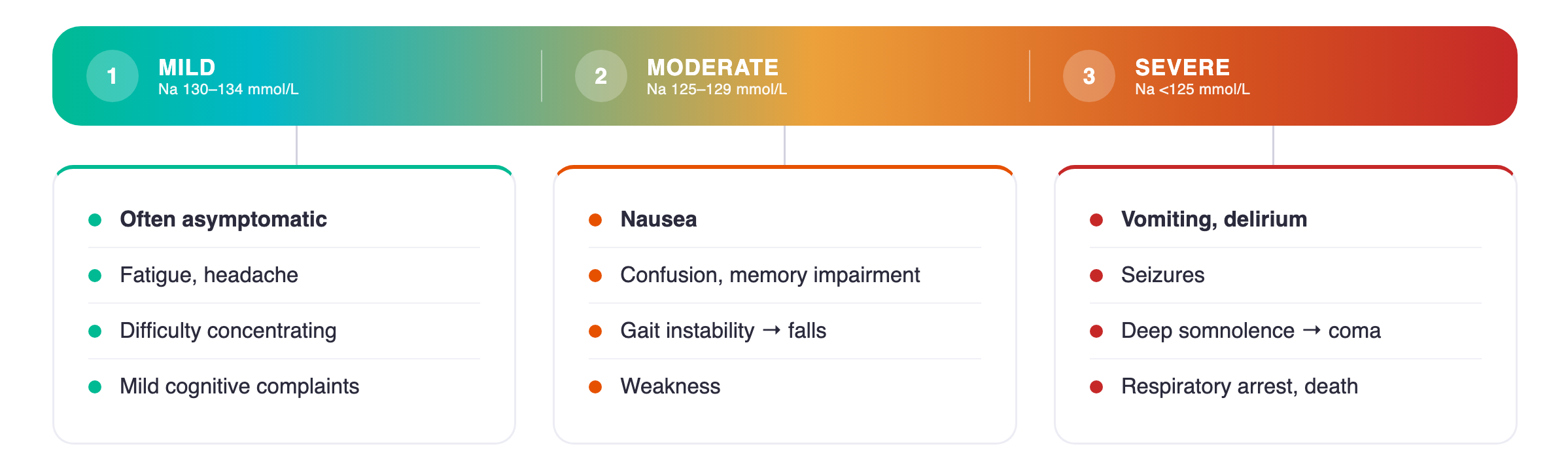
Symptom Recognition by Severity
- Mild (Na 130–134 mmol/L):
- Often asymptomatic; may present as fatigue, headache, difficulty concentrating, or mild cognitive complaints [20]
- Routinely misattributed to depression, aging, or other drug side effects
- Moderate (Na 125–129 mmol/L):
- Severe (Na <125 mmol/L):
Diagnostic Workup
- The goal is to confirm true hypotonic hyponatremia, establish volume status, and determine whether the antidepressant is the cause.
- When to check sodium:
- Per the monitoring plan, or whenever new confusion, cognitive decline, unsteadiness, falls, or nausea develops on an antidepressant
- What to order and review:
- Serum osmolality and glucose to confirm tonicity:
- Urine osmolality and urine sodium, ideally before saline, diuretics, or major fluid changes:
- Urine osmolality >100 mOsm/kg indicates ongoing antidiuretic effect but is not specific for SIAD; <100 suggests primary polydipsia or low solute intake [21]
- Urine sodium >30 mmol/L is compatible with SIAD once dietary sodium is adequate and diuretics, kidney disease, and adrenal insufficiency have been considered [14, 21]
- Review likely contributors: recent antidepressant start or dose increase, thiazides, carbamazepine/oxcarbazepine, NSAIDs, opioids [14, 22]
- Exclude competing causes:
- Assess renal function and adrenal insufficiency
- Check TSH when indicated; severe hypothyroidism can contribute, but mild thyroid abnormalities rarely explain marked hyponatremia
- Also weigh heart failure, cirrhosis, kidney disease, gastrointestinal losses, and low-solute intake before attributing to the antidepressant [20, 21]
- Do not routinely measure plasma ADH or vasopressin: the assay is technically difficult, is not required for the diagnosis, and rarely changes management [18, 22]
Differential Diagnosis
- Primary polydipsia:
- Particularly in patients with psychotic disorders
- Excessive water intake can overwhelm renal excretory capacity even with normal diluting ability
- Urine will be maximally dilute (<100 mOsm/kg), the opposite of the concentrated urine seen in SIADH [21]
- Thiazide-induced hyponatremia:
- Mimics SIADH clinically (apparent euvolemia, concentrated urine, high urine sodium)
- In patients on both a thiazide and an antidepressant, causality is often multifactorial
Patient Risk Factors
- Risk depends on both the drug selected and the patient’s individual profile.
- Antidepressant hyponatremia is uncommon in patients without risk factors but far more common than generally appreciated when several coincide [1, 14]
- The factors below are cumulative, so the more that apply, the more intensive the monitoring
- Higher-confidence risk factors:
- Older age, particularly ≥65 and most markedly ≥80:
- Previous hyponatremia or SIAD:
- Low or low-normal baseline sodium [1]
- Low body weight, low BMI, or frailty [1, 14]
- Thiazide or thiazide-like diuretic use:
- Carbamazepine or oxcarbazepine:
- Multiple concomitant hyponatremia-associated medications, or acute medical illness
- Weaker or contextual contributors (add to cumulative risk, but do not weigh them as equal hazards):
- Female sex (higher in very old women, but partly confounded by age, body size, and prescribing patterns), and NSAIDs, ACE inhibitors/ARBs, PPIs, or opioids [6, 12, 14, 20]
- Heart failure, cirrhosis, and kidney disease matter mainly as alternative causes to exclude (see Clinical Presentation and Diagnosis); diabetes matters through hyperglycemia, kidney disease, and treatment context [6, 21]
Monitoring and Management
- Management is driven by symptoms and acuity, not the sodium value [18, 19]
- Identify severe neurological symptoms and whether onset is acute
- Severe symptoms require emergency hypertonic-saline treatment; fluid restriction is not the initial intervention
- The central question for the prescriber is whether the antidepressant can be continued, reduced, switched, or must be stopped urgently.
- Keep the underlying principle in view: antidepressant-associated hyponatremia is usually excess free water, not a sodium deficit
Monitoring
- No APA, CANMAT, or NICE guideline currently mandates routine sodium monitoring with antidepressants; the following synthesizes expert consensus [3, 14, 24]
When to Consider Baseline Sodium
- Obtain baseline sodium before starting or increasing an antidepressant in patients with meaningful risk [1, 3, 14, 16]
- Previous hyponatremia or SIAD
- Older age, particularly ≥65
- Low or low-normal baseline sodium
- Low body weight or frailty
- Thiazide use or several hyponatremia-associated medications
- Significant heart, liver, or kidney disease
- Consider starting with a lower-risk antidepressant (mirtazapine or bupropion) from the outset [5]
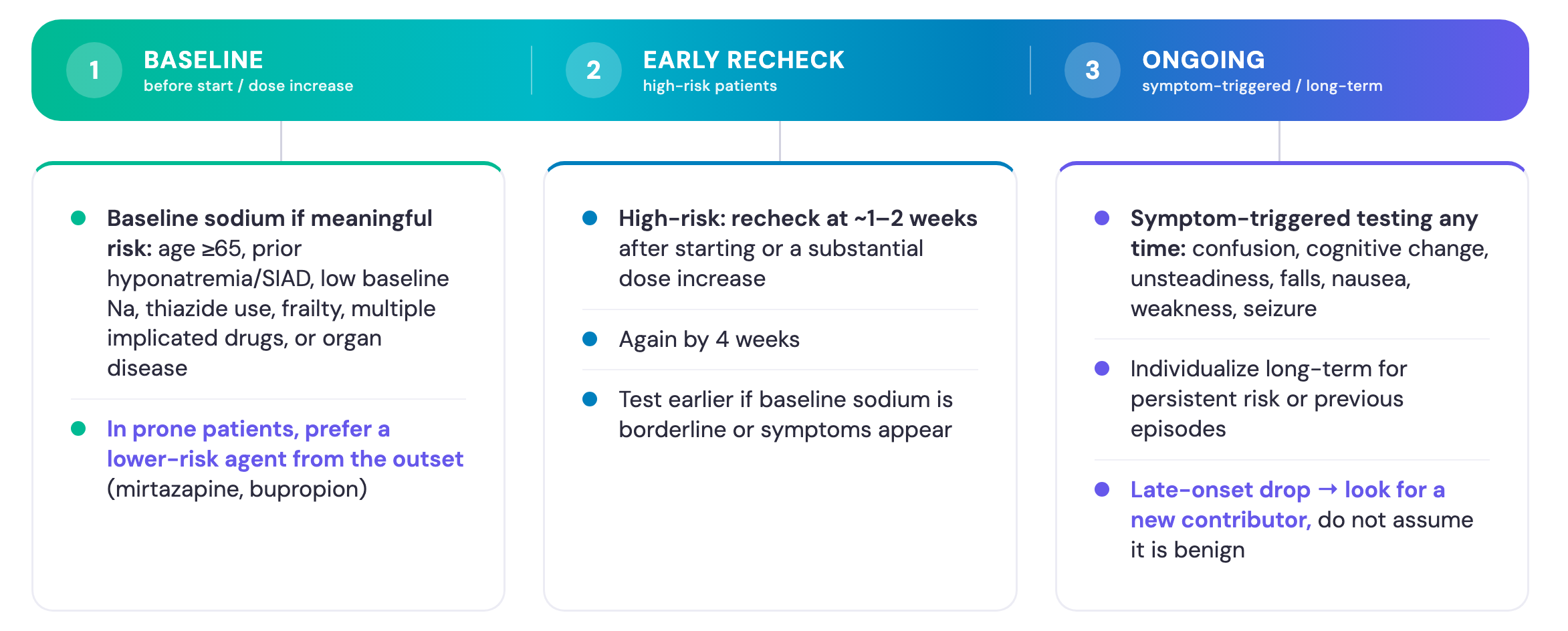
- Early risk window:[3, 5, 12, 14]
- For high-risk patients, commonly at about 1–2 weeks after initiation or a substantial dose increase, and again by 4 weeks
- Test earlier if baseline sodium is borderline or symptoms appear
- Symptom-triggered and longer-term monitoring:
- Check sodium promptly at any time for new nausea, headache, confusion, cognitive change, unsteadiness, falls, weakness, or seizure [3, 18, 19]
- Individualize longer-term monitoring for previous episodes, persistently low sodium, ongoing interacting medications, or major comorbidity
- When hyponatremia begins after prolonged stable treatment, search for a new illness, medication, fluid-intake change, or low-solute intake before assigning causality solely to the antidepressant [12, 25]
Mild Hyponatremia (Na 130–134 mmol/L, asymptomatic)

- Confirm true hypotonic hyponatremia and review other causes.
- When the antidepressant is likely causal, options include dose reduction, switching, or discontinuation according to psychiatric urgency and sodium trajectory
- Expert consensus suggests a 25–50% reduction for selected stable patients, with repeat sodium in approximately 1–4 weeks according to the value, symptoms, and trajectory [14]
Moderate Hyponatremia (Na 125–129 mmol/L, no severe symptoms)

- Arrange prompt medical review.
- If the antidepressant is a plausible cause, generally stop it or make a substantial reduction or switch based on psychiatric risk [14, 19]
- Confirm hypotonicity and volume status. In confirmed euvolemic SIAD, fluid restriction may be used, but response is variable and monitoring should occur within days rather than after several weeks [18, 19]
- Salt tablets, loop diuretics, or oral urea should be individualized and are usually specialist-guided [19, 21]
Severe or Symptomatic Hyponatremia (emergency)

- Severe symptoms (seizure, markedly reduced consciousness, severe confusion or delirium, cardiorespiratory distress) are a medical emergency regardless of the sodium value
- Stop the suspected antidepressant and arrange emergency medical care [18, 19]
- Definitive treatment is 3% hypertonic saline under a local emergency protocol [18, 19]
- The emergency team corrects cautiously (generally no more than 10 mmol/L in the first 24 hours) to avoid overcorrection and osmotic demyelination [18]
- Profound sodium (<125 mmol/L) without severe symptoms still warrants urgent assessment and closely supervised management, because both deterioration and overcorrection are possible [18, 19]
Switching After Antidepressant-Induced Hyponatremia
- Mirtazapine:
- Bupropion:
- Trazodone or agomelatine:
- Rechallenge with the implicated drug is generally avoided after a convincing or severe episode when alternatives exist [2, 14]
- Cross-sensitivity can occur, so switching classes reduces but does not eliminate risk
- If a different serotonergic agent is used, check sodium at baseline and during the early risk window
References
1. Fabian, T. J., Amico, J. A., Kroboth, P. D., Mulsant, B. H., Corey, S. E., Begley, A. E., Bensasi, S. G., Weber, E., Dew, M. A., Reynolds, C. F., & Pollock, B. G. (2004). Paroxetine-induced hyponatremia in older adults: A 12-week prospective study. Archives of Internal Medicine, 164(3), 327–332.
2. Martínez Cortés, M., & Gurillo Muñoz, P. (2019). Hyponatremia and Psychotropic Drugs. In U. Mahmood (Ed.). Fluid and Electrolyte Disorders. IntechOpen.
3. Dodd, S., Mitchell, P. B., Bauer, M., Yatham, L., Young, A. H., Kennedy, S. H., Williams, L., Suppes, T., Lopez Jaramillo, C., Trivedi, M. H., Fava, M., Rush, A. J., McIntyre, R. S., Thase, M. E., Lam, R. W., Severus, E., Kasper, S., & Berk, M. (2018). Monitoring for antidepressant-associated adverse events in the treatment of patients with major depressive disorder: An international consensus statement. The World Journal of Biological Psychiatry, 19(5), 330–348.
4. Nagashima, T., Hayakawa, T., Akimoto, H., Minagawa, K., Takahashi, Y., & Asai, S. (2022). Identifying Antidepressants Less Likely to Cause Hyponatremia: Triangulation of Retrospective Cohort, Disproportionality, and Pharmacodynamic Studies. Clinical Pharmacology and Therapeutics, 111(6), 1258–1267.
5. Gheysens, T., Van Den Eede, F., & De Picker, L. (2024). The risk of antidepressant-induced hyponatremia: A meta-analysis of antidepressant classes and compounds. European Psychiatry, 67(1), e20.
6. Mo, H., Channa, Y., Ferrara, T. M., Waxse, B. J., Schlueter, D. J., Tran, T. C., Awan, A. H., Goleva, S. B., Williams, A., Babbar, A., Stubblefield, O., Keaton, J. M., Larson, E. A., Wilke, R. A., & Denny, J. C. (2024). Hyponatremia Associated with the Use of Common Antidepressants in the All of Us Research Program. Clinical Pharmacology and Therapeutics, 117(2), 534–543.
7. Li, Y., Du, X., & Wu, H. (2025). The risk of hyponatremia induced by SSRIs and SNRIs antidepressants: A systematic review and meta-analysis. BMC Pharmacology & Toxicology, 26, 144.
8. Norello, D., Defazio, G., Corona, G., Caiulo, C., Maggi, M., & Peri, A. (2025). Treatment with antidepressant drugs and hyponatremia: A network meta-analysis. Journal of Endocrinological Investigation, 48(8), 1707–1715.
9. Zhang, Y., Zhang, J., & Jing, R. (2026). Risk of antidepressant-induced hyponatremia in geriatric patients: A systematic review and meta-analysis. BMC Geriatrics.
10. Jung, K., Kim, J. H., Hyeon, D. E., Ji, J., Lee, M. Y., Choi, H., Lee, D. Y., Kim, M. W., Jang, Y., Hwang, S., Cho, J., Song, S. Y., Rhee, S. Y., Cha, J. M., Seo, W.-W., Jeong, C.-W., Kwag, S.-J., Kim, W. J., Hwang, J., … Shin, J.-Y. (2026). Antidepressants and the risk of hyponatremia: A multi-institutional cohort study using observational medical outcomes partnership—Common Data Model. British Journal of Clinical Pharmacology, 92(6), 1706–1715.
11. Barquera, J. A. O.-S. de la, García, L. A. D. la G., Sánchez-Torres, G., Gogeascoechea-Hernández, A., Martinez, S. J., Porras-Garza, G. A., & Garza, P. P. Z. (2025). Agomelatine as Antidepressant Treatment in Elderly Patients With Previous Hyponatremia Due To SSRI Use: Case Series. Human Psychopharmacology, 40(1), e2914.
12. Issa, I., Skov, J., Falhammar, H., Roos, M., Lindh, J. D., & Mannheimer, B. (2025). The association of selective serotonin reuptake inhibitors and venlafaxine with profound hyponatremia. European Journal of Endocrinology, 193(1), 179–187.
13. Leth-Møller, K. B., Hansen, A. H., Torstensson, M., Andersen, S. E., Ødum, L., Gislasson, G., Torp-Pedersen, C., & Holm, E. A. (2016). Antidepressants and the risk of hyponatremia: A Danish register-based population study. BMJ Open, 6(5), e011200.
14. Pinkhasov, A., Xiong, G., Bourgeois, J. A., Heinrich, T. W., Huang, H., Coriolan, S., Annamalai, A., Mangal, J. P., Frankel, S., Lang, M., Raj, Y. P., Dandois, M., Barth, K., Stewart, A. L., Rado, J., Pesek, J., Sanders, A., Spearman-McCarthy, E. V., Gagliardi, J., & Fiedorowicz, J. G. (2021). Management of SIADH-related hyponatremia due to psychotropic medications – An expert consensus from the Association of Medicine and Psychiatry. Journal of Psychosomatic Research, 151, 110654.
15. Gandhi, S., Shariff, S. Z., Al-Jaishi, A., Reiss, J. P., Mamdani, M. M., Hackam, D. G., Li, L., McArthur, E., Weir, M. A., & Garg, A. X. (2017). Second-Generation Antidepressants and Hyponatremia Risk: A Population-Based Cohort Study of Older Adults. American Journal of Kidney Diseases, 69(1), 87–96.
16. Matsuura, T., Tawfik, A. G., Ben-Umeh, K. C., Hansten, P. D., & Malone, D. C. (2025). Evaluation of hyponatremia among older adults exposed to selective serotonin reuptake inhibitors and thiazide diuretics. Pharmacotherapy, 45(3), 169–176.
17. Lane, N. E., Bai, L., Seitz, D. P., Juurlink, D. N., Paterson, J. M., Guan, J., & Stukel, T. A. (2024). Hyponatremia-associated hospital visits are not reduced by early electrolyte testing in older adults starting antidepressants. Journal of the American Geriatrics Society, 72(6), 1770–1780.
18. Sterns, R. H., Rondon-Berrios, H., Adrogué, H. J., Berl, T., Burst, V., Cohen, D. M., Christ-Crain, M., Cuesta, M., Decaux, G., Emmett, M., Garrahy, A., Gankam-Kengne, F., Hix, J. K., Hoorn, E. J., Kamel, K. S., Madias, N. E., Peri, A., Refardt, J., Rosner, M. H., … Verbalis, J. G. (2024). Treatment Guidelines for Hyponatremia. Clinical Journal of the American Society of Nephrology : CJASN, 19(1), 129–135.
19. Spasovski, G. (2024). Hyponatraemia—treatment standard 2024. Nephrology Dialysis Transplantation, 39(10), 1583–1592.
20. Capinha, M., Lavrador, M., Liberato, J., Pinheiro, A., Aveiro, A., Figueiredo, I. V., & Castel-Branco, M. (2025). Drug-Induced Hyponatremia: Insights into Pharmacological Mechanisms and Clinical Practice Management. Journal of Clinical Medicine, 14(18), 6584.
21. Gross, P. (2012). Clinical management of SIADH. Therapeutic Advances in Endocrinology and Metabolism, 3(2), 61–73.
22. Kim, G.-H. (2022). Pathophysiology of Drug-Induced Hyponatremia. Journal of Clinical Medicine, 11(19), 5810.
23. Mannheimer, B., Falhammar, H., Calissendorff, J., Skov, J., & Lindh, J. D. (2021). Time-dependent association between selective serotonin reuptake inhibitors and hospitalization due to hyponatremia. Journal of Psychopharmacology, 35(8), 928–933.
24. Chavez, L., Scott, J., Hoile, R., McNulty, J., & Marchant-Rutherford, L. (2021). Hyponatraemia monitoring in those prescribed antidepressants – an audit from an inpatient older adult ward. BJPsych Open, 7, S70–S71.
25. Chiu, C.-Y., Sarwal, A., Munir, R. A., Widjaja, M., Khalid, A., & Khanna, R. (2020). Syndrome of Inappropriate Antidiuretic Hormone (SIADH) Induced by Long-Term Use of Citalopram and Short-Term Use of Naproxen. The American Journal of Case Reports, 21, e926561-1-e926561-4.
