



Text version
Clozapine After One Failed Antipsychotic Trial
For today’s Quick Take, let’s look together at a randomized clinical trial that asked a clinically important question: should you use clozapine after only one failed antipsychotic trial in first-episode patients? This multisite trial was conducted by colleagues in China and was just published in JAMA Psychiatry, with first author Xuan Li. Let me first give you some context on why I think it is an important study.
Download PDF and other files
The Guideline Path to Clozapine
If you treat first-episode patients, you expect a good response to the first antipsychotic you try — say, risperidone. Compared to chronic patients, first-episode patients are generally good responders to antipsychotics. There is, however, a significant minority, at least around 20%, who do not respond to that first agent.
Essentially all current schizophrenia treatment guidelines recommend a second antipsychotic trial in this situation, followed by clozapine if there is still no response. At that point, the patient essentially meets criteria for treatment-resistant schizophrenia.
Why Resistance Is Usually Present Early
The problem with the logic of this algorithm is that most patients with treatment-resistant schizophrenia are resistant from the get-go, when they first present for clinical care — usually a first episode of psychosis. This is a biologically different subgroup of schizophrenia that does not respond well to dopamine blockade. A much smaller group develops treatment resistance only over time.
So if you treat a first-episode patient with a dopamine-blocking antipsychotic and there is no good response, chances are your patient falls into that biologically different, treatment-resistant group and should be offered clozapine. There is no reason — logically — to assume that a second dopamine-blocking antipsychotic would be more effective than the first one that failed.
It would be nice to have a biomarker to flag first-episode patients who are treatment resistant. Since we do not have one, we have to determine treatment resistance clinically, by showing that dopamine blockade is not helpful.
Download PDF and other files
Inside the SMART-CAT Trial
Here is my snapshot of this first-episode psychosis trial, known as the Sequential Multi-Assessment Randomized Trials to Compare Antipsychotic Treatments (SMART-CAT). As the name implies, there were several sequential phases.
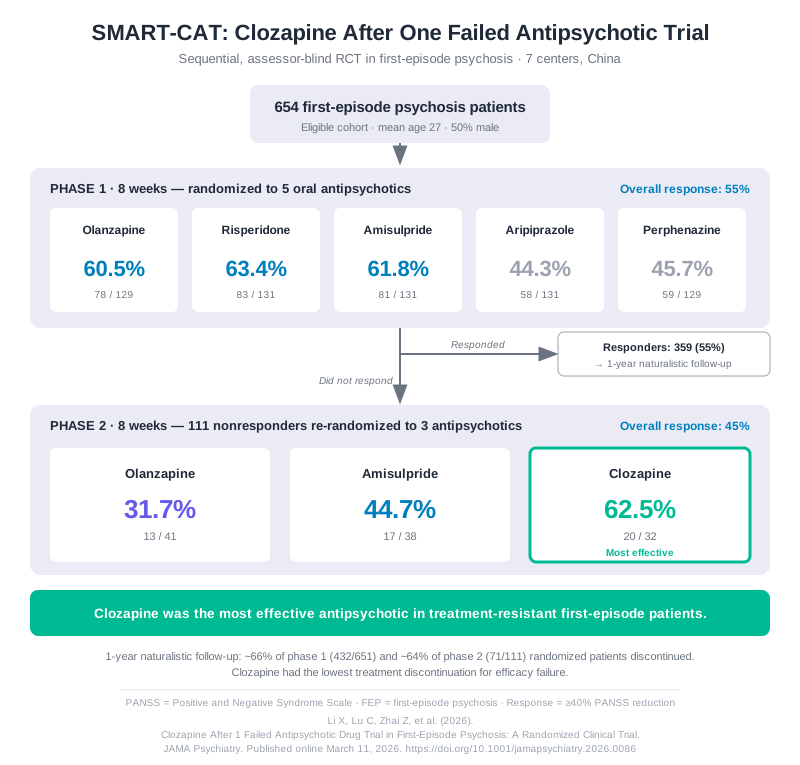
The first was an eight-week phase in which patients were randomized to one of five antipsychotics: olanzapine, risperidone, amisulpride, aripiprazole, and perphenazine. The second was another eight-week phase in which patients who did not respond in phase 1 were re-randomized to olanzapine, amisulpride, or clozapine, making sure no patient was reassigned to the same antipsychotic they had received in phase 1.
Assessments were done by blinded raters, but patients and their clinicians knew the assigned medications. The sites in China managed to randomize 654 patients with first-episode schizophrenia who were early in their course of illness and had never received an antipsychotic, or had only minimal exposure. The male-to-female ratio was about 50-50, and the mean age was 27 years.
A little side-bar here: as someone who has conducted a first-episode trial myself, let me say that recruiting this cohort was quite an accomplishment.
Results: PANSS Response
For this Quick Take, let us look only at the psychopathology outcomes, as measured by the Positive and Negative Syndrome Scale (PANSS) — specifically, a 40% reduction in PANSS score as the measure of response, which was one of the designated primary outcomes. The other primary outcome, all-cause discontinuation, we are basically going to skip. It was not as informative: there was no difference between treatment groups, in part because only 111 patients started phase 2.
The clozapine arm, for example, consisted of only 32 patients. Keep that in mind: some results rest on very small numbers, despite an overall impressive sample size for a trial like this.
Download PDF and other files
Phase 1: No Clear Winner
I will give you three main takeaways, skipping over the statistical details. The first concerns phase 1, where the overall response rate was 55%, with no statistical differences between the antipsychotics in PANSS score reduction. The numerical spread, however, was worth noting:
- Risperidone and amisulpride: around 62%
- Aripiprazole and perphenazine: around 44%
Phase 2: Clozapine Pulled Ahead
The second takeaway concerns phase 2, where the overall response rate was 45%. Here clozapine showed a clear advantage over olanzapine and amisulpride, both for overall response and for PANSS score reduction. Remember, this is now a treatment-resistant sample:
- Clozapine: 62.5%
- Amisulpride: 45%
- Olanzapine: 32%
Download PDF and other files
Two-Thirds Discontinued Within a Year
The third takeaway is about retention. Two-thirds of the patients randomized in phase 1 and phase 2 discontinued treatment over the course of the one-year naturalistic follow-up, with no antipsychotic emerging as a clear winner, although clozapine had a lower risk of discontinuation for efficacy failure.
I think this high rate of treatment discontinuation is an important finding. While it was not part of the original randomized comparison, it shows the real difficulty of keeping first-episode patients in treatment over the long term.
Switch to Clozapine After One Failed Antipsychotic Trial?
Let me return to the question this trial set out to answer. Based on these results, would I recommend moving to clozapine after one failed antipsychotic trial? Yes and no.
As I said at the outset, we should not wait on a clozapine trial once treatment resistance in a first-episode patient has been established. Clozapine was the most effective antipsychotic for those patients who were treatment resistant in this cohort after only one trial. That is the yes.
I still think there are solid clinical reasons to try two antipsychotics before reaching for clozapine. For one, you may want to offer a long-acting injectable antipsychotic as the second agent if there are questions about partial adherence; and there often are.
In some patients, the first antipsychotic is simply poorly tolerated, and you may never get a clean trial because you are mostly managing side effects. Trying another antipsychotic then makes sense.
I also think the determination that a medication is not working happens in a gray zone of partial efficacy mixed with side effects. It is not as clear-cut as the guidelines suggest. Even in phase 2, some patients did respond to the other two antipsychotics.
Last, there are some very good reasons to move to clozapine very early — for instance, a patient who is aggressive and psychotic — where you want to offer the most effective antipsychotic before something tragic happens.
Download PDF and other files
Bottom Line: Don’t Lose Years, Consider Clozapine Early
The importance of this trial lies in its message: we should not take several years — which is typical — before switching a treatment-resistant first-episode patient to clozapine. These are lost years for a young person, with an inability to go to school or work.
This randomized clinical trial convincingly shows that clozapine is the most effective antipsychotic as soon as treatment resistance has been clinically established — which may be quite obvious after only one antipsychotic trial.
Let me add one final thought. In my own practice, I would want to have a clozapine conversation with my first-episode patient and their family if there is no good response after, say, three or four months of trying to get them better, regardless of the number of antipsychotics tried.
Maybe we should focus more on the time spent on ineffective treatment than on the number of antipsychotics used during that time.
Abstract
Clozapine After 1 Failed Antipsychotic Drug Trial in First-Episode Psychosis
Xuan Li, M.D., PhD; Chang Lu, M.D., PhD; Zhaolin Zhai, M.D., PhD & et al
Importance There is an urgent need for algorithm trials that address treatment steps in schizophrenia sequentially. Moreover, there is a debate about whether clozapine should be used after 1 failed antipsychotic drug trial.
Objective To investigate whether switching to clozapine is effective in patients with first-episode psychosis (FEP) who have not responded to 1 previous antipsychotic drug.
Design, Setting, and Participants This was a sequential, assessor-blind trial with 2 randomizations conducted across 7 centers in China from February 2019 to October 2022. Included were individuals aged 16 to 45 years and with FEP (schizophrenia, schizophreniform disorder, or schizoaffective disorder). In phase 1, patients with FEP were randomized to receive oral olanzapine, risperidone, amisulpride, aripiprazole, or perphenazine for 8 weeks. In phase 2, nonresponders were rerandomized to receive olanzapine, amisulpride, or clozapine for another 8 weeks. Responders entered a 1-year naturalistic follow-up. Study data were analyzed from February to August 2025.
Interventions Specific antipsychotic drugs.
Main Outcomes and Measures The primary outcomes were as follows (1) symptomatic response, defined as the proportion of patients achieving a greater than or equal to 40% reduction in Positive and Negative Syndrome Scale (PANSS) total score and (2) time to all-cause discontinuation, defined as discontinuation of antipsychotic drugs for any reason.
Results A total of 762 participants were randomized, and 654 (mean [SD] age, 26.9 [7.5] years; 328 male [50.2%]) were eligible for the study. Of the eligible participants, 556 (85.4%) completed phase 1, and 359 (55.1%) responded to treatment. Response rates were 60.5% (78 of 129) for olanzapine, 63.4% (83 of 131) for risperidone, 61.8% (81 of 131) for amisulpride, 44.3% (58 of 131) for aripiprazole, and 45.7% (59 of 129) for perphenazine (χ2 = 18.3; P = .001). In phase 2, 111 nonresponders were rerandomized (41 taking olanzapine, 38 taking amisulpride, and 32 taking clozapine). A total of 92 patients (82.9%) completed phase 2, and the following achieved a response: 13 (31.7%) taking olanzapine vs 17 (44.7%) taking amisulpride and 20 (62.5%) taking clozapine (χ2 = 6.9; P = .03).
Conclusions and Relevance The majority of patients with FEP responded to an initial antipsychotic drug trial, with risperidone and amisulpride being superior to aripiprazole and perphenazine. In those who initially did not respond to antipsychotic treatment, clozapine was more efficacious than olanzapine and amisulpride based on the PANSS ratings criteria outcome. This study provides some evidence for clinicians to consider regarding use of clozapine as the next sequential treatment after patients have failed an adequate trial with 1 of the more traditional antipsychotics.
Trial Registration ClinicalTrials.gov Identifier: NCT03510325
Download PDF and other files
Reference
Li, X.; Lu, C.; Zhai, Z.; Smith, R.; Zhang, S.; Wang, H. et al. (2026). Clozapine After 1 Failed Antipsychotic Drug Trial in First-Episode Psychosis. JAMA Psychiatry; 83(6):570.
