



In a nutshell
- Pharmacodynamics:
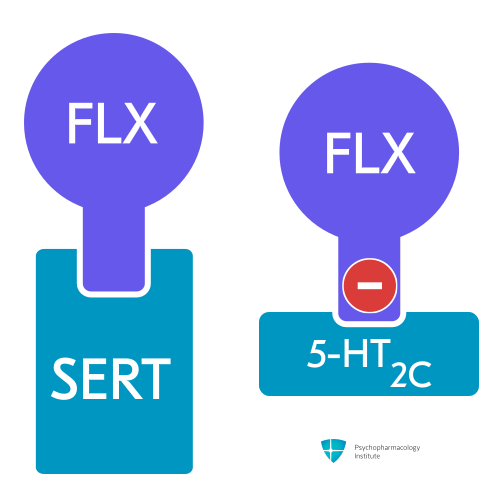
- Fluoxetine potently inhibits the serotonin transporter (SERT).
- At higher doses, it also acts as an antagonist at 5HT2C receptors, which may contribute to its activating properties.
- Clinical uses:
- Fluoxetine is FDA-approved to treat major depressive disorder, obsessive-compulsive disorder, panic disorder, and bulimia nervosa.
- It is also used off-label to treat repetitive behaviors in autism spectrum disorder.
- Unique features:
- Fluoxetine has a long half-life of 2-4 days (norfluoxetine metabolite has a half-life of 7-14 days).
Pharmacodynamics
- Animal studies reveal that:
- Potential clinical implications:
- The 5HT2C antagonism is thought to contribute to fluoxetine’s activating properties.
Pharmacokinetics
Half-life
- Fluoxetine half-life: 2-4 days
- Norfluoxetine (active metabolite) half-life: 7-14 days
- Benefits of a long half-life:
- Patients are less likely to experience serotonin discontinuation symptoms after a missed dose or when discontinuing treatment. 3
- Prescribing considerations related to long-half life:
- The effects of dose changes will not be fully reflected for several weeks.
- If you need to switch a patient from fluoxetine to an MAOI, you must wait a longer washout period before initiating the MAOI. It is generally recommended to wait 5 weeks.4
- Weekly delayed-release fluoxetine 90mg yields similar plasma levels to 10-20mg daily. 5
Effects on CYP2D6
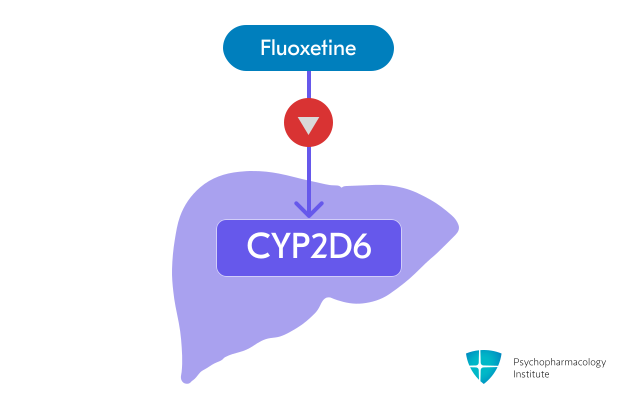
- Fluoxetine inhibits the activity of CYP2D6.
- This may cause individuals with regular CYP2D6 metabolic activity to resemble poor metabolizers.
- Fluoxetine can increase the levels of pimozide and thioridazine.
Dosage forms and available strengths
- Prozac and generic fluoxetine 6
- Pulvules (Lilly’s brand of gelatin capsules):
- 10 mg
- 20 mg
- 40 mg
- Capsules (generic):
- 10 mg
- 20 mg
- 40 mg
- Tablets (generic):
- 10 mg
- 20 mg
- 60 mg.
- Delayed-release capsules (generic):
- 90 mg
- Oral solution (generic):
- 20mg/5mL
- Pulvules (Lilly’s brand of gelatin capsules):
- Symbyax [^Symbyax]
- Capsules:
- 25mg/3mg (fluoxetine/olanzapine)
- 25mg/6mg (fluoxetine/olanzapine)
- Capsules:
Indications
FDA-approved indications and dosing
Overview
- Mood disorders:
- Major depressive disorder
- Bipolar depression (as olanzapine/fluoxetine combination, Symbyax)
- Treatment-resistant depression(as olanzapine/fluoxetine combination, Symbyax)
- Anxiety disorders:
- Panic disorder
- OCD
- Fluoxetine is the only antidepressant approved for the treatment of bulimia.
Major depressive disorder
- Adults
- Starting dose:
- Initiate 20 mg/day orally in the morning.
- Dose increases:
- Consider a dose increase after several weeks if insufficient clinical improvement is observed.
- Administer doses above 20 mg/day once daily in the morning or twice daily (i.e., morning and noon).
- Maximum dose: 80 mg/day.
- Consider a dose increase after several weeks if insufficient clinical improvement is observed.
- Starting dose:
- Pediatric (children and adolescents):
- Fluoxetine is the recommended first-line medication for depression in children and adolescents. 7
- Initiate 10 or 20 mg/day.
- After 1 week at 10 mg/day, increase the dose to 20 mg/day.
- However, due to higher plasma levels in lower-weight children, the starting and target dose in this group may be 10 mg/day.
- Consider a dose increase to 20 mg/day after several weeks if insufficient clinical improvement is observed.
Obsessive-compulsive disorder
- Adults
- Starting dose:
- Initiate 20 mg/day orally in the morning.
- Dose increases:
- It may take at least 5 weeks of treatment for the complete therapeutic effect to be achieved.
- If there is not enough clinical improvement after several weeks, consider a dose increase.
- Administer doses above 20 mg/day once daily in the morning or twice daily (i.e., morning and noon).
- Dose range:
- A dose range of 20 to 60 mg/day is recommended.
- Maximum dose:
- The maximum dose should not exceed 80 mg/day.
- Pediatric (children and adolescents)
- In adolescents and higher-weight children:
- Initiate treatment with a dose of 10 mg/day.
- After 2 weeks, increase the dose to 20 mg/day.
- Dose range: 20 to 60 mg/day.
- In lower-weight children:
- Initiate treatment with a dose of 10 mg/day.
- Dose range: 20 to 30 mg/day.
- In adolescents and higher-weight children:
- Starting dose:
Panic disorder
- Starting dose:
- Initiate 10 mg/day.
- Dose increases:
- After one week, increase the dose to 20 mg/day.
- Dose range: 10 to 60 mg/day.
- Maximum dose: 60 mg/day
- The most frequently administered dose in the 2 flexible-dose clinical trials was 20 mg/day.
Bulimia nervosa
- Early response (at 3 weeks) is a strong predictor of response overall.8
- Starting dose:
- 60 mg/day in the morning.
- For some patients, it may be advisable to titrate up to this target dose over several days.
- Dose range:
- 60 mg/day
- Maximum dose:
- Fluoxetine doses above 60 mg/day have not been systematically studied in patients with bulimia.
Bipolar depression (as Symbyax)
- The olanzapine/fluoxetine combination is recommended by NICE guidelines, along with quetiapine, as the first-line treatment for bipolar depression in youth as in adults. 9
- The well-known adverse effect profile of olanzapine constrains its use.
- In markets where Symbyax is not available, combining olanzapine and fluoxetine (e.g. 5/20mg or 10/40mg) can achieve the same effects. 10
- Adults
- Timing: Once daily in the evening.
- Starting dose:
- Start with the olanzapine 6 mg/ fluoxetine 25 mg capsule.
- Maximum dose: olanzapine 12 mg/ fluoxetine 50 mg once daily.
- Children and adolescents (10 -17 years of age)
- Timing: Once daily in the evening.
- Starting dose:
- Olanzapine 3 mg/ fluoxetine 25 mg
- Maximum dose:
- Olanzapine 12 mg/ fluoxetine 50 mg
Treatment-resistant depression (as Symbyax)
- Adults
- Timing: Once daily in the evening.
- Starting dose:
- Start with the olanzapine 6 mg/ fluoxetine 25 mg capsule.
- Maximum dose: olanzapine 12 mg/ fluoxetine 50 mg once daily.
Off-label uses
Repetitive behaviors in ASD
- Normally, much lower doses of fluoxetine are required to treat repetitive behaviors in ASD patients than those used to treat depression. 11
- Use a liquid preparation and begin at the lowest possible dose, monitoring for adverse effects.
- Dosing:
- 2.5mg/day a day for 1 week
- 2.5mg = 0.625mL, which is difficult to measure accurately.
- Follow with a flexible titration schedule of 0.8mg/kg/day.
- Week 2: 0.3mg/kg
- Week 3: 0.5mg/kg/day
- 0.8mg/kg/ day subsequently
- 2.5mg/day a day for 1 week
PTSD
- The overall evidence is inconclusive regarding the efficacy of fluoxetine for PTSD, especially in veterans. The results from placebo-controlled trials are mixed. 12
Social anxiety disorder
- All SSRIs are probably effective for social anxiety disorder, but some have stronger supporting evidence. 13
- Fluoxetine may have some efficacy in treating SAD, but the results appear less robust than those of other SSRIs. 14
Adverse effects
Most common side effects
- Nausea, diarrhea
- Activation symptoms
- Nervousness
- Insomnia
- Sleep symptoms:
- Insomnia
- Abnormal dreams
- Anorexia
- Monitor for significant weight loss, especially if the patient is underweight or has a bulimia nervosa diagnosis.
- Antidepressant-induced excessive sweating (ADIES): 15 16
- Dose-related side effect
- If antidepressant dose reduction is clinically feasible, it should be tried.
- Switching to another antidepressant might be effective.
- Adding another medication (an “antidote”):
- When antidepressant dose reduction or switching is not an option.
- Evidence of fair quality supports the use of terazosin (an alpha-1 adrenergic blocker).
- Tremor
- Sexual dysfunction: 17
- Decreased libido: up to 4% incidence
- There are no specific incidence reports for impotence, erectile dysfunction, delayed ejaculation, or anorgasmia.
- “Drug holidays” are not effective for fluoxetine. 18
- Headache
- Rash
Serious, but rare side effects
- Hyponatremia, mainly in the elderly.
- Gastrointestinal bleeding, especially when combined with NSAIDs such as ibuprofen.
Use in special populations
Breastfeeding
- The average amount of drug in breastmilk is higher with fluoxetine than with most other SSRIs
- Agents that are less excreted in breast milk may be a better option, especially when nursing a newborn or preterm infant. 19
- Should breastfeeding be stopped?
- If fluoxetine is required by the mother, it is not a reason to discontinue breastfeeding.
- Should fluoxetine be switched during breastfeeding?
- If a mother was taking fluoxetine during pregnancy or if other antidepressants proved ineffective, most experts advise against switching medications while breastfeeding.
Hepatic impairment
- Liver impairment can increase the half-lives of fluoxetine and norfluoxetine. 20
- It can take many weeks to reach steady-state serum levels.
- Fluoxetine is complex to use in this population.
- If fluoxetine is administered to patients with liver disease: 21
- consider a dose reduction of at least 50%, or
- consider alternate-day dosing.
Renal impairment
- GFR 20–50mL/min: dose as normal renal function.
- GFR <20mL/min:
- use a low dose or,
- use alternate day dosing, and increase according to response
Brand names
- Other brand names (some may be discontinued): Prozac Weekly (discontinued), Sarafem (discontinued), Rapiflux (discontinued), Selfemra (discontinued), Fluctin, Fluctine, Fluoxétine Lilly, Fluoxétine RPG Prozac, Fontex, Ladose.
References
- Pälvimäki, E. P., Roth, B. L., Majasuo, H., Laakso, A., Kuoppamäki, M., Syvälahti, E., & Hietala, J. (1996). Interactions of selective serotonin reuptake inhibitors with the serotonin 5-HT2c receptor. Psychopharmacology, 126(3), 234–240. https://doi.org/10.1007/BF02246453↩︎
- Bymaster, F. P., Zhang, W., Carter, P. A., Shaw, J., Chernet, E., Phebus, L., Wong, D. T., & Perry, K. W. (2002). Fluoxetine, but not other selective serotonin uptake inhibitors, increases norepinephrine and dopamine extracellular levels in prefrontal cortex. Psychopharmacology, 160(4), 353–361. https://doi.org/10.1007/s00213-001-0986-x↩︎
- Puzantian, T., Carlat, D. (2020). Medication Fact Book for Psychiatric Practice, Fifth Edition. United States: Carlat Publishing, LLC.↩︎
- Eli Lilly and Company. (2023). Prozac (fluoxetine hydrochloride) capsules for oral use. Retrieved September 7, 2023, from https://pi.lilly.com/us/prozac.pdf↩︎
- Procyshyn,R. M., Bezchlibnyk-Butler, K. Z., & Kim, D. D. (Eds.). (2023). Clinical handbook of psychotropic drugs (25th edition). Hogrefe Publishing.↩︎
- Eli Lilly and Company. (2023). Prozac (fluoxetine hydrochloride) capsules for oral use. Retrieved September 7, 2023, from https://pi.lilly.com/us/prozac.pdf↩︎
- National Institute for Health and Care Excellence (NICE). Depression in children and young people: identification and management. NICE Guideline [NG134]. 2019; www.nice.org.uk/guidance/ng134.↩︎
- Sysko, R., Sha, N., Wang, Y., Duan, N., & Walsh, B. T. (2010). Early response to antidepressant treatment in bulimia nervosa. Psychological medicine, 40(6), 999–1005. https://doi.org/10.1017/S0033291709991218↩︎
- National Institute for Health and Care Excellence (NICE). Depression in children and young people: identification and management. NICE Guideline [NG134]. 2019; www.nice.org.uk/guidance/ng134.↩︎
- Taylor, D. M., Barnes, T. R. E., & Young, A. H. (2021). The Maudsley prescribing guidelines in psychiatry (14th ed.). Wiley-Blackwell.↩︎
- Taylor, D. M., Barnes, T. R. E., & Young, A. H. (2021). The Maudsley prescribing guidelines in psychiatry (14th ed.). Wiley-Blackwell.↩︎
- Bajor, L. A., Balsara, C., & Osser, D. N. (2022). An evidence-based approach to psychopharmacology for posttraumatic stress disorder (PTSD) – 2022 update. Psychiatry Research, 317, 114840. https://doi.org/10.1016/j.psychres.2022.114840↩︎
- Osser, D. (2020). Social Anxiety Disorder algorithm. Psychopharm. Mobi. https://psychopharm.mobi/algo_live/#↩︎
- Blanco, C., Bragdon, L. B., Schneier, F. R., & Liebowitz, M. R. (2013). The evidence-based pharmacotherapy of social anxiety disorder. International Journal of Neuropsychopharmacology, 16(1), 235-249. https://doi.org/10.1017/S1461145712000119↩︎
- Thompson, S., Compton, L., Chen, J.-L., & Fang, M.-L. (2021). Pharmacologic Treatment of Antidepressant-Induced Excessive Sweating: A Systematic Review. Archives of Clinical Psychiatry (São Paulo), 48, 57-65. https://doi.org/10.15761/0101-60830000000279.↩︎
- Mago, Rajnish. (Accesed 2023, September 6). Antidepressant-induced excessive sweating (ADIES) or hyperhidrosis: Management. https://simpleandpractical.com/antidepressant-induced-excessive-sweating-adies-hyperhidrosis-management/↩︎
- Joseph F. Goldberg, M.D., M.S., Carrie L. Ernst, M.D.. (2018). Managing the Side Effects of Psychotropic Medications. American Psychiatric Association Publishing. https://ebooks.appi.org/epubreader/managing-side-effects-psychotropic-medications↩︎
- Rothschild A. J. (1995). Selective serotonin reuptake inhibitor-induced sexual dysfunction: efficacy of a drug holiday. The American journal of psychiatry, 152(10), 1514–1516. https://doi.org/10.1176/ajp.152.10.1514↩︎
- Drugs and Lactation Database (LactMed®) [Internet]. Bethesda (MD): National Institute of Child Health and Human Development; 2006-. Fluoxetine. [Updated 2023 Aug 15]. Available from: https://www.ncbi.nlm.nih.gov/books/NBK501186/↩︎
- Eli Lilly and Company. (2023). Prozac (fluoxetine hydrochloride) capsules for oral use. Retrieved September 7, 2023, from https://pi.lilly.com/us/prozac.pdf↩︎
- Taylor, D. M., Barnes, T. R. E., & Young, A. H. (2021). The Maudsley prescribing guidelines in psychiatry (14th ed.). Wiley-Blackwell.↩︎
