



Risperidone is a second-generation antipsychotic that has an affinity for D2, 5-HT2A, alpha 1, alpha 2 and H1 receptors. The mechanism of action of risperidone is not fully understood, current theories focus mainly on its ability to block D2 and 5-HT2A receptors.
General Mechanism of Action of Antipsychotic Drugs
It has been observed that from a pharmacodynamic perspective, all antipsychotics share a common feature: they reduce dopaminergic neurotransmission. According to the dopamine theory of schizophrenia, positive symptoms of schizophrenia might be explained through an overactivity of the mesolimbic pathway. Negative and cognitive symptoms of schizophrenia have been linked to a dysfunction of the mesocortical pathway [1]. Play the video below to learn more about the dopamine hypothesis of schizophrenia and the mechanism of action of antipsychotics.
Risperidone Pharmacodynamics and Binding Affinity
The table below shows Ki values for risperidone at different neurotransmitter receptors. Ki is inversely proportional to affinity. This means that high Ki numbers suggest low affinity at a given receptor, while low Ki numbers are associated with high affinity.
| Receptor | Ki value (nM) |
|---|---|
| D2 | 3.2 |
| 5-HT1A | 420 |
| 5-HT2A | 0.2 |
| 5-HT2C | 50 |
| D1 | 240 |
| D4 | 7.3 |
| M1 | >10,000 |
| Alpha 1A | 5 |
| Alpha 2A | 16 |
| H1 | 20 |
Binding potency of risperidone at different receptors. Modified from [2] Risperidone acts as an antagonist at the following receptors:
- D2
- 5-HT2A
- Alpha 1
- Alpha 2
- H1 (moderate affinity)
The image below schematically illustrates the interaction of risperidone with different neurotransmitter receptors.

The 5-HT2A /D2 theory of atypicality
Risperidone was synthesized based on attempts to replicate clozapine effectiveness without its side effects profile. The goal was to develop a drug with low risk of extrapyramidal symptoms (EPS) based on the assumption that a high 5-HT2A/D2 ratio could confer this property [3]. However, when prescribed at higher doses, risperidone produces EPS consistently [4], indicating that 5-HT2A antagonism alone cannot eliminate EPS associated with substantial D2 receptor blockade.
The video mentions other theories of atypicality that are not applicable to risperidone such as fast dissociation from D2 receptors and 5-HT1A agonism.
D2 Antagonism
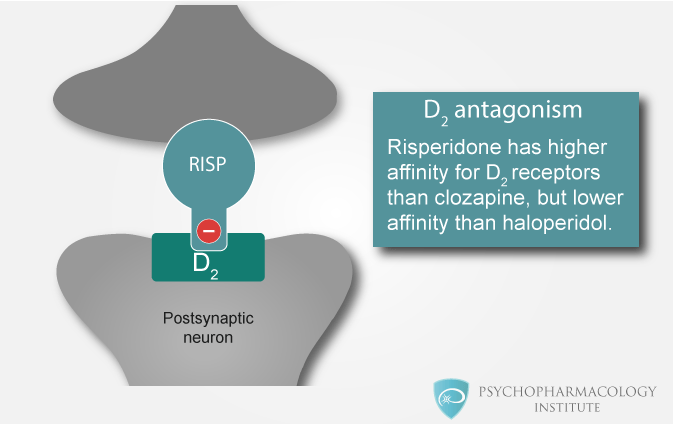
A PET study showed that risperidone occupies 75-80% of striatal D2 receptors when administered to patients suffering from schizophrenia at a dose of 6 mg/day [5]. Despite high levels of D2 receptor occupancy, moderate-dose risperidone treatment (4-6 mg/day) poses a somewhat lower EPS risk than treatment with some FGAs [6]. The affinity of risperidone for D2 receptors is approximately 50- fold greater than that of clozapine and approximately 20-50 % that of haloperidol [7].
5-HT2A Antagonism
Risperidone is characterized by a very high affinity for 5-HT2A receptors, and a moderately high affinity for D2, H1, and alpha 1 and alpha 2 adrenergic receptors. In vitro, the affinity of risperidone for 5-HT2A receptors is roughly 10- to 20-fold greater than for D2 receptors [3]

Summary – Key Points
- Risperidone is an SGA with a high 5-HT2A/D2 ratio (it has a higher affinity for 5-HT2A receptors than for D2 receptors).
- According to the dopamine theory of schizophrenia, the mechanism of action of risperidone might involve a reduction of dopaminergic neurotransmission in the mesolimbic pathway.
- The higher the risperidone daily dose, the higher the risk of EPS.
Related information
- Pharmacokinetics of Risperidone: Clinical Summary
- Risperidone Indications: FDA-Approved and Off-Label Uses
References
- Stahl, S M. Stahl’s Essential Psychopharmacology: Neuroscientific Basis and Practical Applications. 3rd ed. New York: Cambrigde University Press; 2008
- Brunton LB, Lazo JS, Parker KL, eds. Goodman & Gilman’s The Pharmacological Basis of Therapeutics. 12th ed. New York: McGraw-Hill; 2010.
- Schatzberg, AF, Nemeroff, C . The American Psychiatric Publishing Textbook of Psychopharmacology. 4th ed.American Psychiatric Publishing, 2009.
- Marder SR, Meibach RC. Risperidone in the treatment of schizophrenia. The American Journal of Psychiatry. 1994;151(6):825-35.
- Farde L, Nyberg S, Oxenstierna G, Nakashima Y, Halldin C, Ericsson B. Positron emission tomography studies on D2 and 5-HT2 receptor binding in risperidone-treated schizophrenic patients. Journal of clinical psychopharmacology. 1995;15(1 Suppl 1):19S-23S.
- Tasman, A; Lieberman, J; Key, J; Maj, M. Psychiatry. 3rd ed. John Wiley & Sons, 2008
- Leysen JE, Janssen PM, Megens AA, Schotte A. Risperidone: a novel antipsychotic with balanced serotonin-dopamine antagonism, receptor occupancy profile, and pharmacologic activity. The Journal of clinical psychiatry. 1994;55 Suppl:5-12.
