Slides and Transcript
Slide 1 of 9
Section 8: Addressing Hyperprolactinemia and Sexual Side Effects from Antipsychotic Use.
Slide 2 of 9
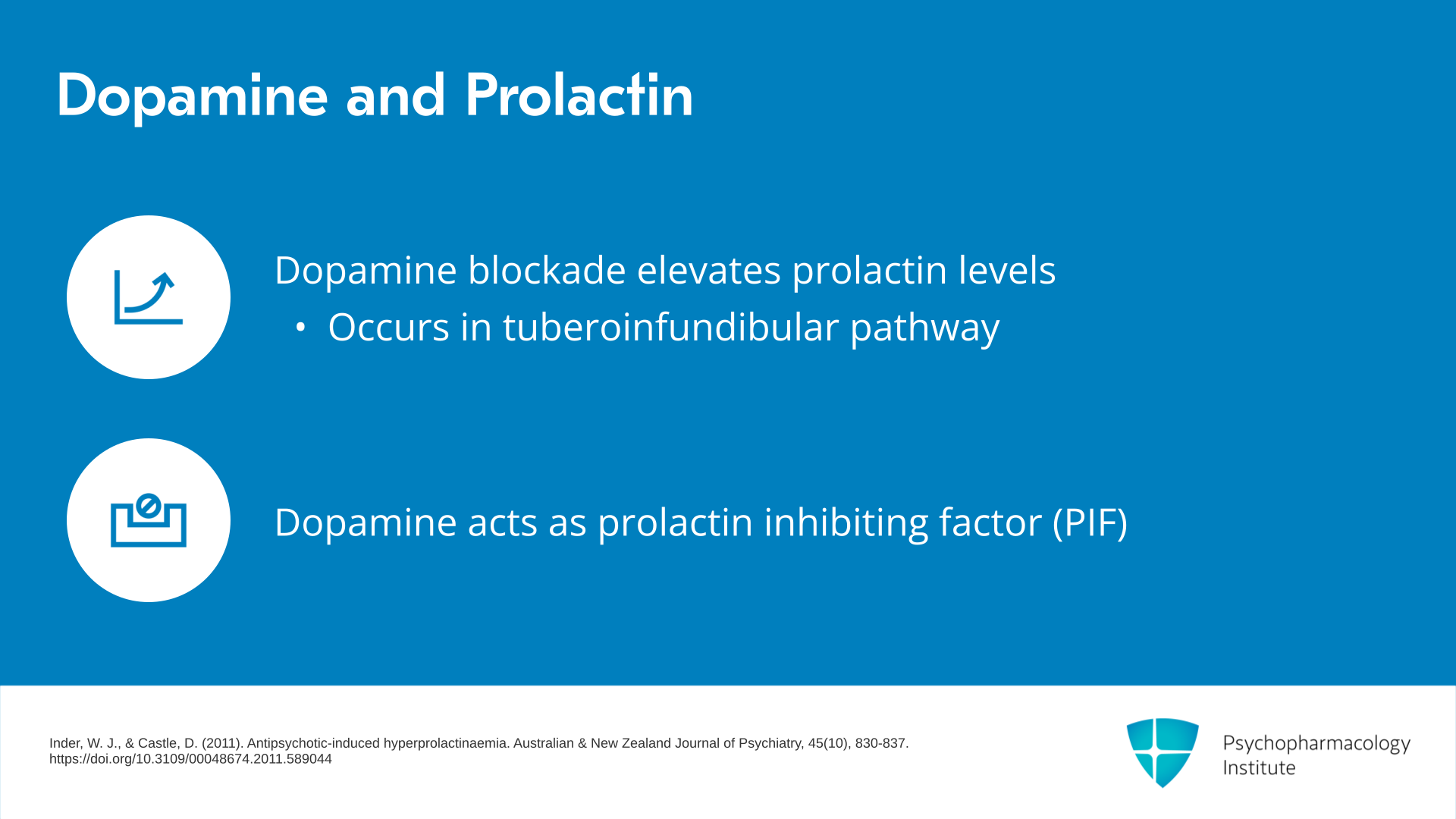
Elevated prolactin levels are the result of dopamine blockade in the tuberoinfundibular pathway. When I went to medical school, there was a so-called prolactin inhibiting factor or PIF describing the tonic inhibition of prolactin release. It turns out to be dopamine. So dopamine is PIF and as a result if we block dopamine we remove this inhibiting factor and prolactin goes up.
References:
- Inder, W. J., & Castle, D. (2011). Antipsychotic-induced hyperprolactinaemia. Australian & New Zealand Journal of Psychiatry, 45(10), 830-837. https://doi.org/10.3109/00048674.2011.589044
Free Files
Download PDF and other files
Success!
Check your inbox, we sent you all the materials there.
Slide 3 of 9
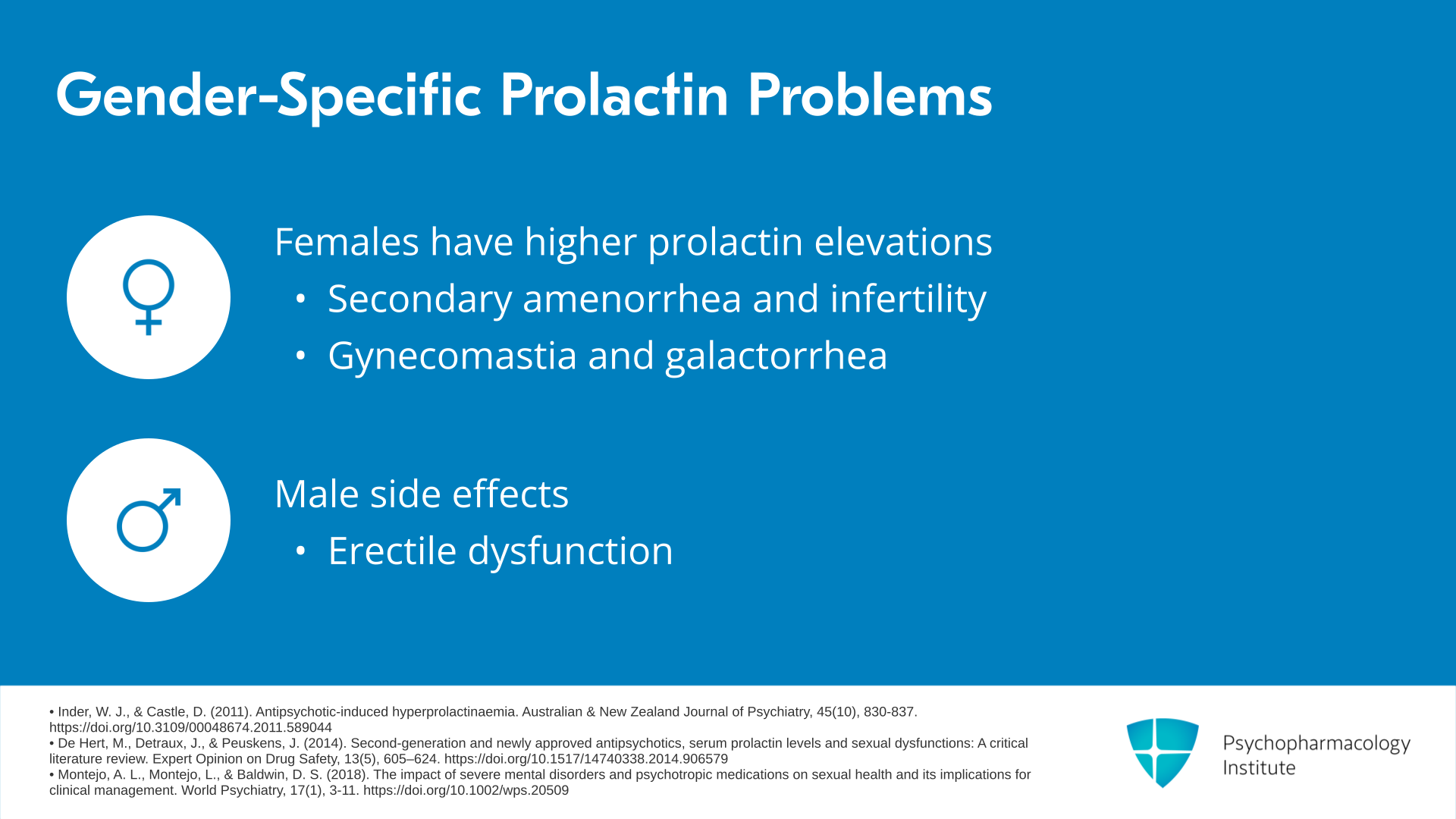
There are gender-specific problems that you see. Females have in general actually higher prolactin elevations in response to dopamine blockade. The female side effects are secondary amenorrhea, infertility, gynecomastia, galactorrhea and loss of libido. The male side effects are loss of libido and erectile dysfunction in addition to also gynecomastia and galactorrhea.
References:
- Inder, W. J., & Castle, D. (2011). Antipsychotic-induced hyperprolactinaemia. Australian & New Zealand Journal of Psychiatry, 45(10), 830-837. https://doi.org/10.3109/00048674.2011.589044
- De Hert, M., Detraux, J., & Peuskens, J. (2014). Second-generation and newly approved antipsychotics, serum prolactin levels and sexual dysfunctions: A critical literature review. Expert Opinion on Drug Safety, 13(5), 605–624. https://doi.org/10.1517/14740338.2014.906579
- Montejo, A. L., Montejo, L., & Baldwin, D. S. (2018). The impact of severe mental disorders and psychotropic medications on sexual health and its implications for clinical management. World Psychiatry, 17(1), 3-11. https://doi.org/10.1002/wps.20509
Slide 4 of 9
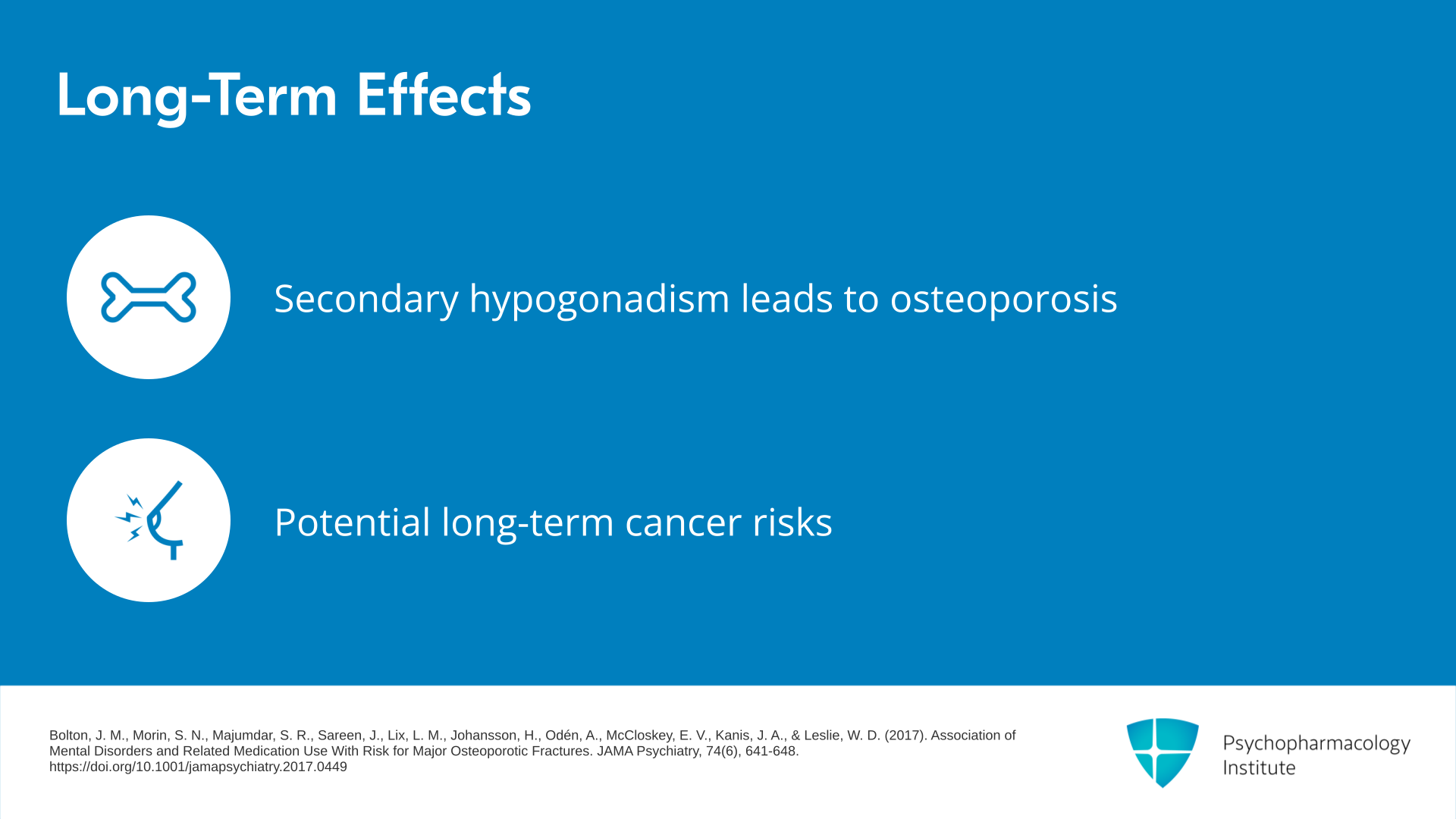
The long-term effects from increased prolactin levels are really due to the secondary hypogonadism that you may see which could lead to osteoporosis and increase the patient’s risk for fractures. There’s possibly an increased breast cancer risk although this has not been proven and there’s a suggestion that the endometrial cancer risk may not be increased but similarly I think the jury is out. So there may be some long-term cancer risks related to hypogonadism.
References:
- Bolton, J. M., Morin, S. N., Majumdar, S. R., Sareen, J., Lix, L. M., Johansson, H., Odén, A., McCloskey, E. V., Kanis, J. A., & Leslie, W. D. (2017). Association of Mental Disorders and Related Medication Use With Risk for Major Osteoporotic Fractures. JAMA Psychiatry, 74(6), 641-648. https://doi.org/10.1001/jamapsychiatry.2017.0449
Free Files
Download PDF and other files
Success!
Check your inbox, we sent you all the materials there.
Slide 5 of 9
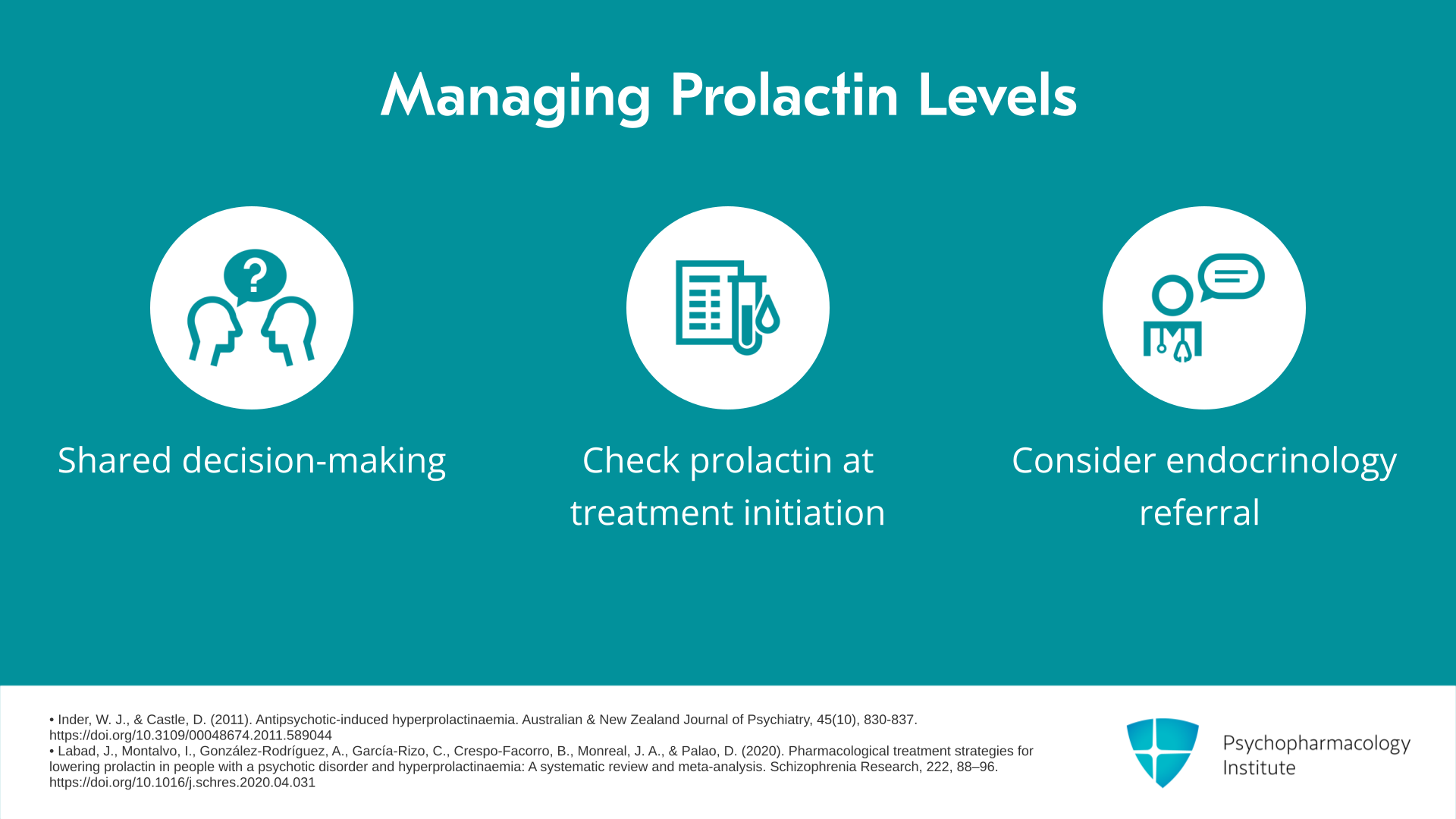
How do you approach elevated prolactin levels? I think it’s an example where shared decision-making is really critical because some people may just be okay and have no problems from living with elevated prolactin levels, whereas others may be quite concerned about possible long-term risks. I usually check prolactin at the beginning of treatment and then at some later point just to see if it’s elevated or not. Then you have to decide with the patient if it’s elevated whether to send them to Endocrinology or to do serial prolactin levels to establish that the level is not increasing like you would see in a prolactinoma which is your main concern.
References:
- Inder, W. J., & Castle, D. (2011). Antipsychotic-induced hyperprolactinaemia. Australian & New Zealand Journal of Psychiatry, 45(10), 830-837. https://doi.org/10.3109/00048674.2011.589044
- Labad, J., Montalvo, I., González-Rodríguez, A., García-Rizo, C., Crespo-Facorro, B., Monreal, J. A., & Palao, D. (2020). Pharmacological treatment strategies for lowering prolactin in people with a psychotic disorder and hyperprolactinaemia: A systematic review and meta-analysis. Schizophrenia Research, 222, 88–96. https://doi.org/10.1016/j.schres.2020.04.031
Slide 6 of 9
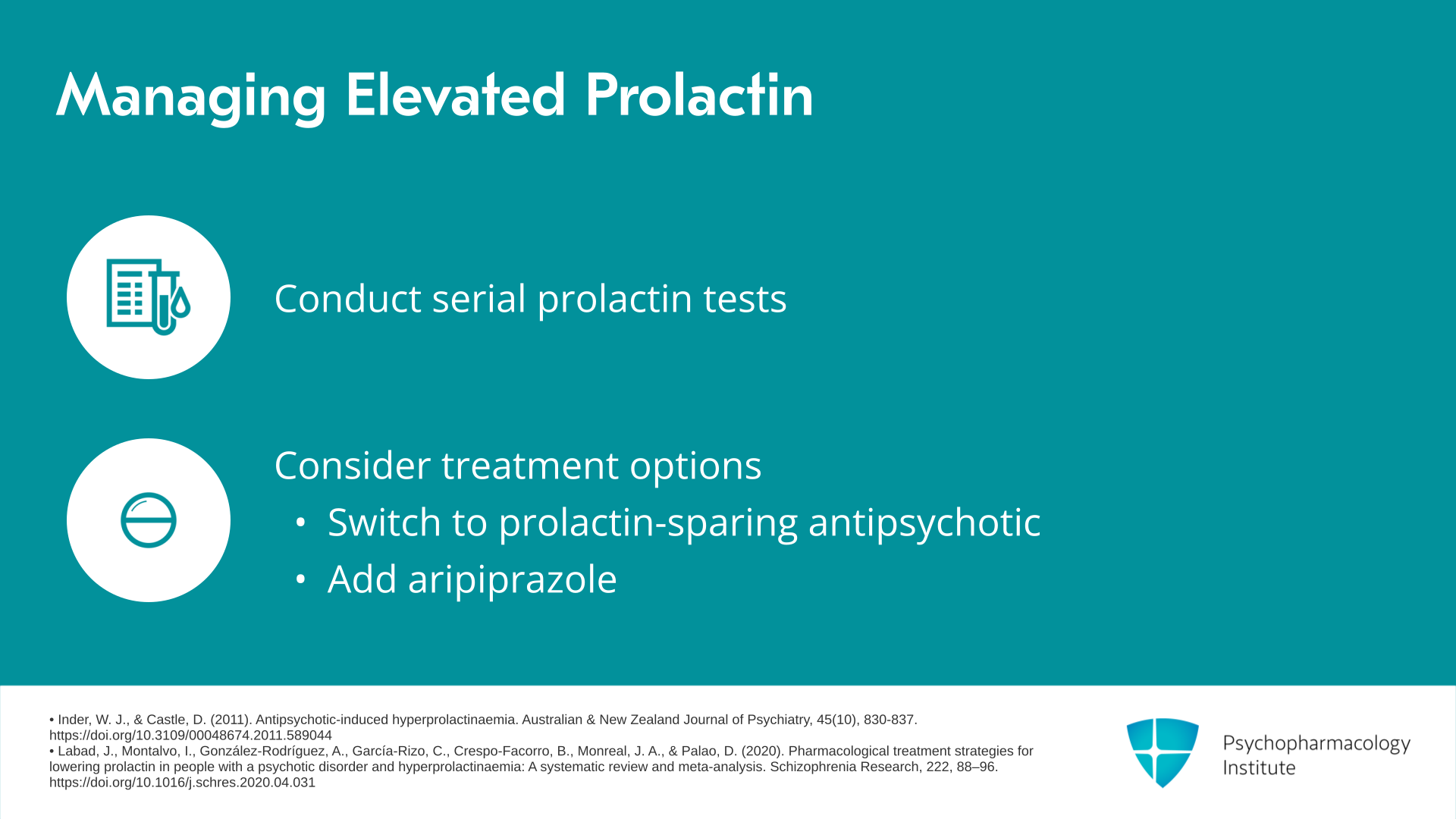
I think if somebody has an elevated prolactin level on a typical dose of risperidone, I would be okay with doing serial prolactin levels. But if the level is rather high I would probably send them to Endocrinology. So what would you do? You can either stay the course. You could switch to a prolactin-sparing antipsychotic. Or you could add aripiprazole which is a very effective strategy and may be worthwhile for people who are on long-acting injectables that you don’t really want to change.
References:
- Inder, W. J., & Castle, D. (2011). Antipsychotic-induced hyperprolactinaemia. Australian & New Zealand Journal of Psychiatry, 45(10), 830-837. https://doi.org/10.3109/00048674.2011.589044
- Labad, J., Montalvo, I., González-Rodríguez, A., García-Rizo, C., Crespo-Facorro, B., Monreal, J. A., & Palao, D. (2020). Pharmacological treatment strategies for lowering prolactin in people with a psychotic disorder and hyperprolactinaemia: A systematic review and meta-analysis. Schizophrenia Research, 222, 88–96. https://doi.org/10.1016/j.schres.2020.04.031
Free Files
Download PDF and other files
Success!
Check your inbox, we sent you all the materials there.
Slide 7 of 9
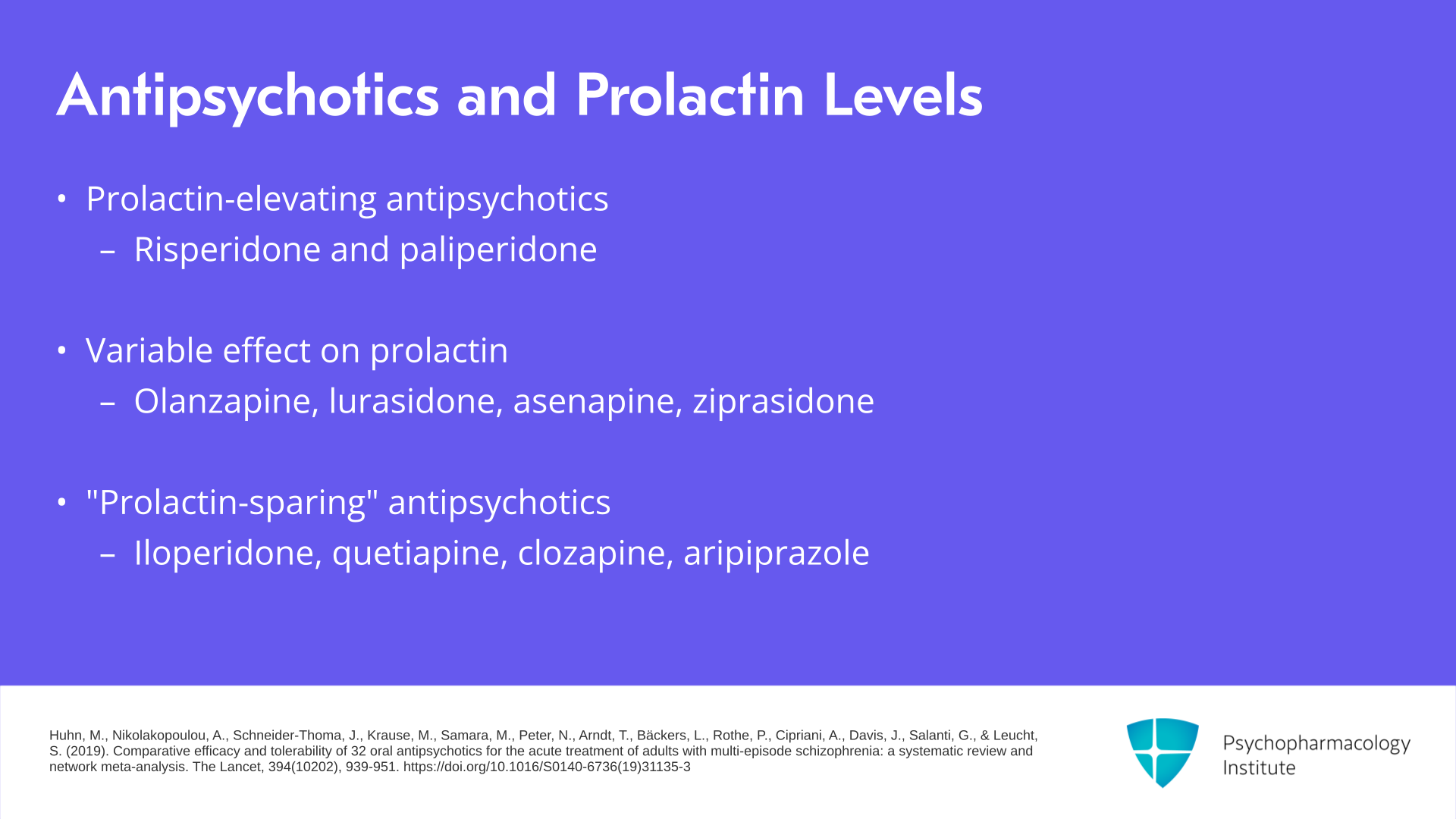
There are some so-called prolactin-sparing antipsychotics and then some that very typically cause hyperprolactinemia. Paliperidone, the metabolite of risperidone, risperidone itself and all the first-generation antipsychotics reliably cause hyperprolactinemia. Paliperidone is probably the worst offender. Then you have in the middle olanzapine, lurasidone, asenapine and ziprasidone which may or may not cause some elevation and sometimes even only transiently. And then you have iloperidone, quetiapine, clozapine, aripiprazole and other partial agonists who usually do not cause hyperprolactinemia. Aripiprazole specifically if you add it to an antipsychotic will actually reliably lower prolactin levels.
References:
- Huhn, M., Nikolakopoulou, A., Schneider-Thoma, J., Krause, M., Samara, M., Peter, N., Arndt, T., Bäckers, L., Rothe, P., Cipriani, A., Davis, J., Salanti, G., & Leucht, S. (2019). Comparative efficacy and tolerability of 32 oral antipsychotics for the acute treatment of adults with multi-episode schizophrenia: a systematic review and network meta-analysis. The Lancet, 394(10202), 939-951. https://doi.org/10.1016/S0140-6736(19)31135-3
Slide 8 of 9
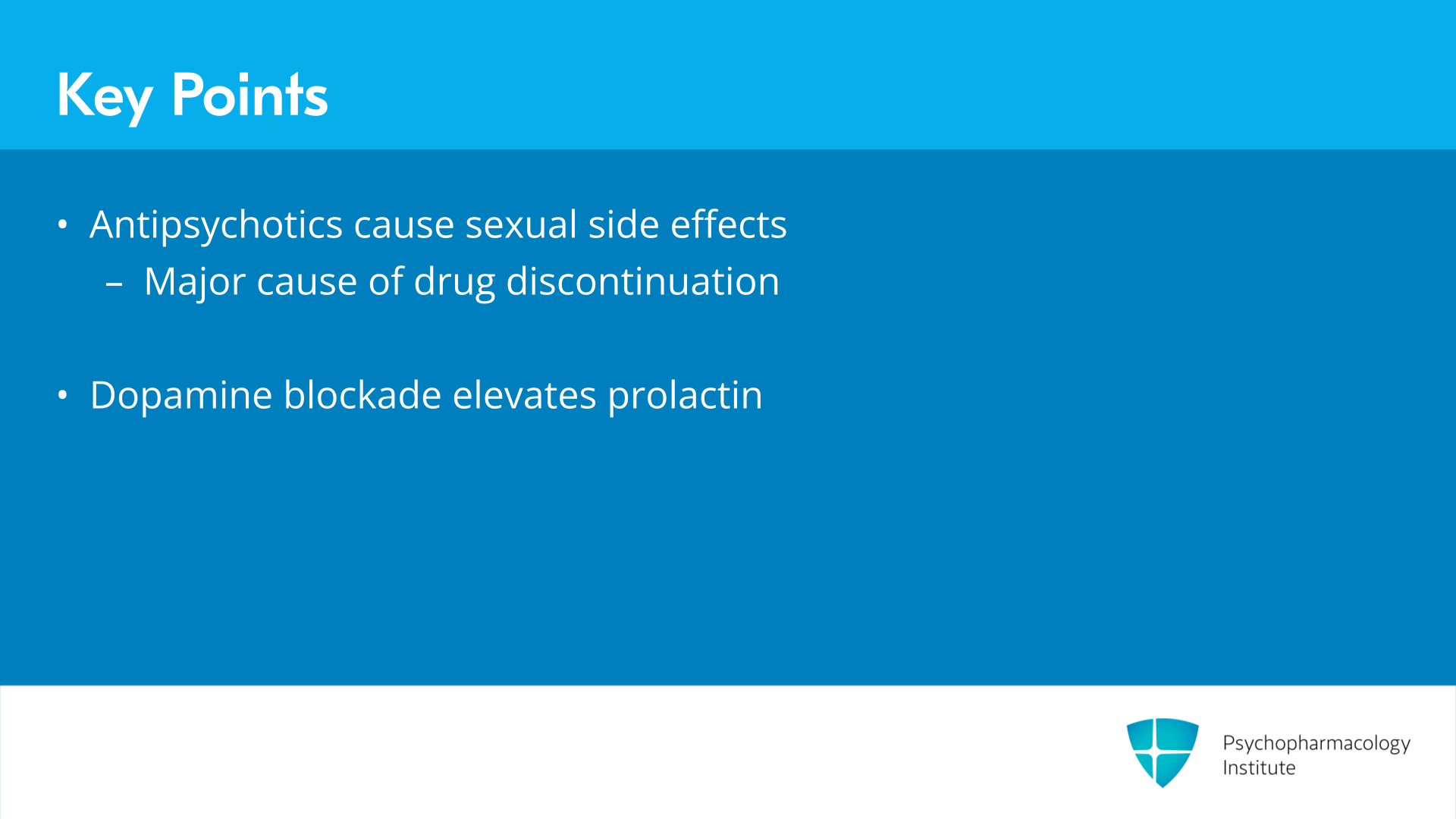
The key points. All antipsychotics can have sexual side effects which is a major cause of drug discontinuation in young people. It is in part due to prolactin elevation which can also cause galactorrhea. Dopamine blockade in the tuberoinfundibular system can cause prolactin elevation. The degree of prolactin elevation varies between antipsychotics with tight dopamine blockade being somewhat predictive.
Free Files
Download PDF and other files
Success!
Check your inbox, we sent you all the materials there.
Slide 9 of 9
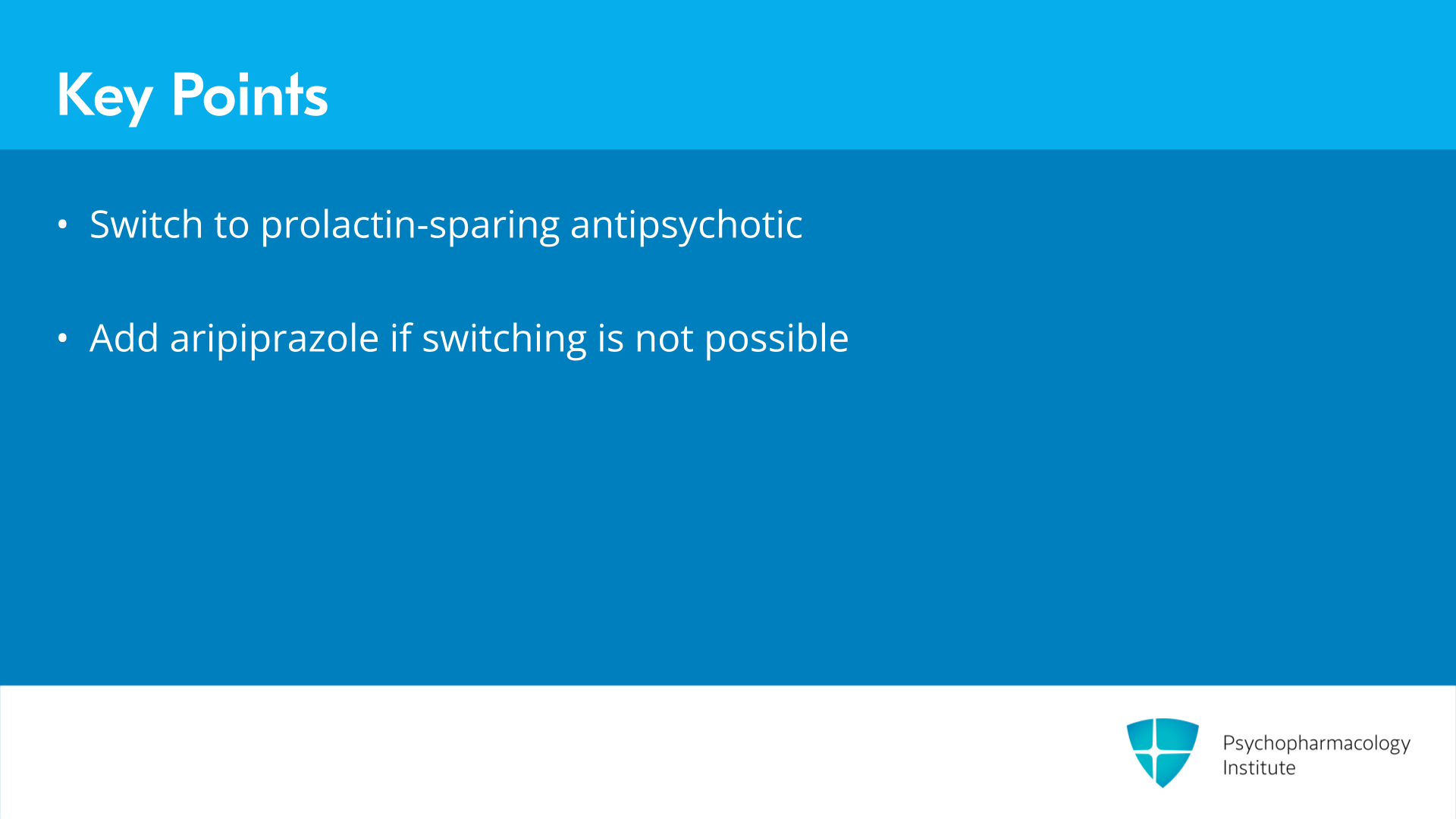
The best management if possible is switching to a prolactin-sparing antipsychotic like the third-generation antipsychotics. If switching is not possible, adding aripiprazole will reliably lower prolactin levels