Slides and Transcript
Slide 1 of 15
This is video 5 of the algorithm for the treatment of mania and hypomania and we now get into the nuts and bolts of treating this acute manic episode. And this portion of the algorithm focuses on the treatment of mania with mixed features. So we’ll be reviewing nodes 2a, 2b, and 2c.
Slide 2 of 15
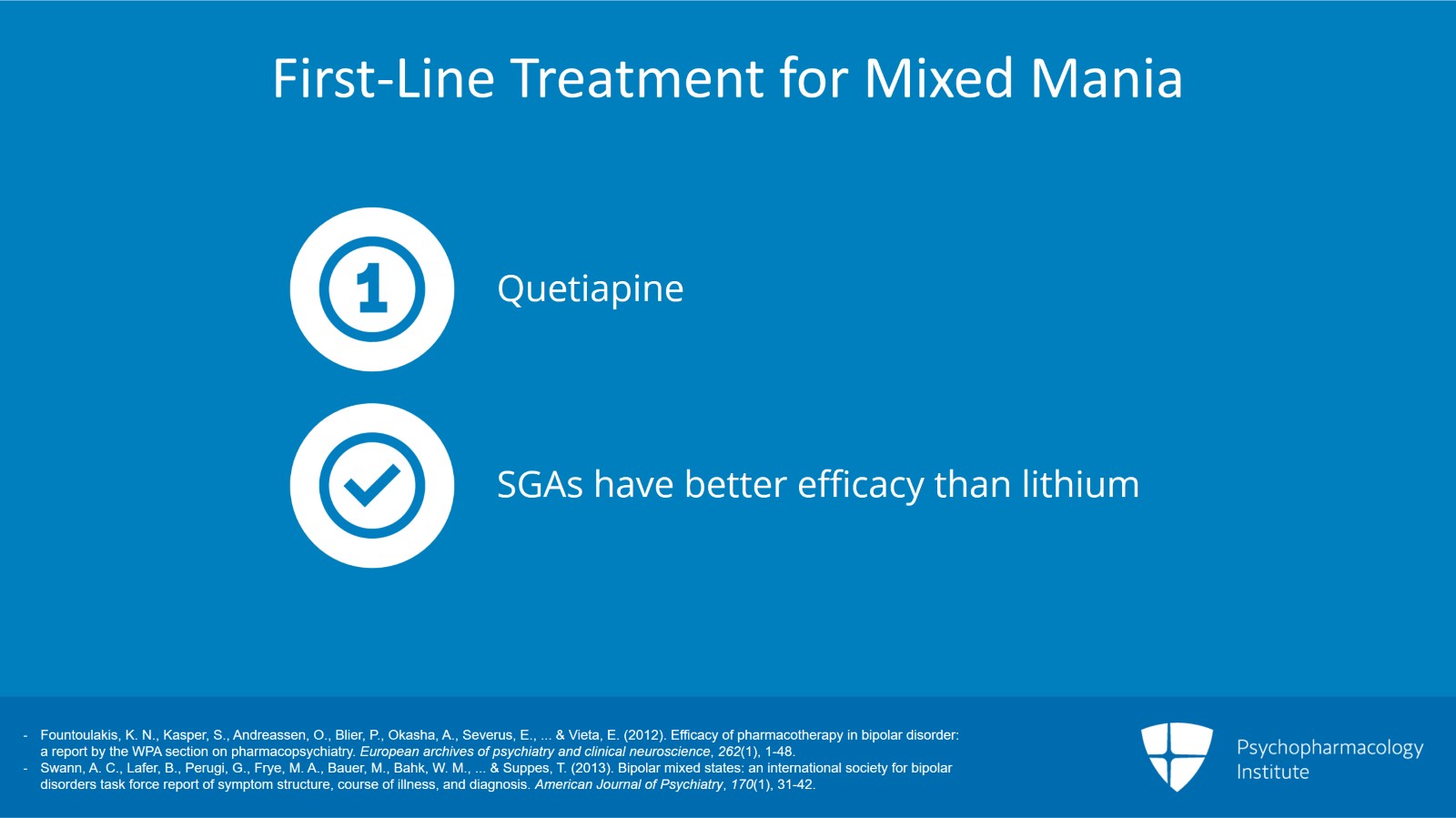
So mixed mania, what is first line psychopharmacology for mixed mania episode? It is a second-generation antipsychotic. And the first line among those we think would be quetiapine. These second-generation antipsychotic or anti-manic agents which we abbreviate SGAs have better efficacy than lithium according to two major reviews.
References:
- Fountoulakis, K. N., Kasper, S., Andreassen, O., Blier, P., Okasha, A., Severus, E., … & Vieta, E. (2012). Efficacy of pharmacotherapy in bipolar disorder: a report by the WPA section on pharmacopsychiatry. European archives of psychiatry and clinical neuroscience, 262(1), 1-48.
- Swann, A. C., Lafer, B., Perugi, G., Frye, M. A., Bauer, M., Bahk, W. M., … & Suppes, T. (2013). Bipolar mixed states: an international society for bipolar disorders task force report of symptom structure, course of illness, and diagnosis. American Journal of Psychiatry, 170(1), 31-42.
Free Files
Download PDF and other files
Success!
Check your inbox, we sent you all the materials there.
Slide 3 of 15
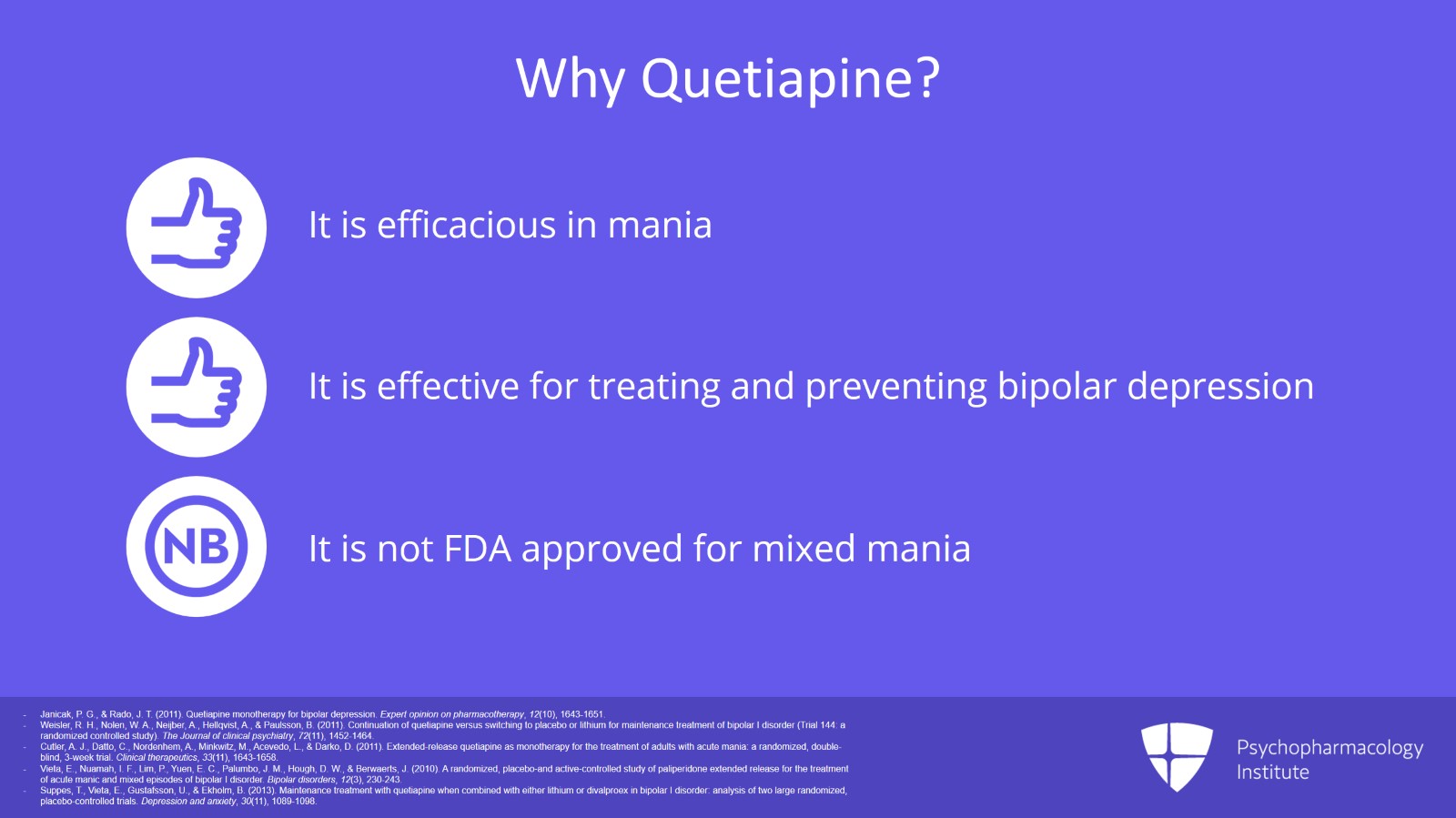
Quetiapine is preferred because though it just has average efficacy in mania it’s unique among the SGAs in also being effective for treating and preventing bipolar depression. Remember back to video 1 where we talked about how the priorities in choosing how to sequence our medications in this algorithm is not only efficacy but also ability to prevent switching into depression and to prevent future episodes. So here’s why we are having a preference for quetiapine because it has this unique ability to treat both mania and robust evidence of treating and preventing the depression which is definitely something that you and the patients want. They want to have their mania remit and not plunge into a depression right afterwards. The one somewhat of a sticking point on this is that it’s not actually FDA approved for mixed mania. There had been three studies with quetiapine in mixed mania cited on your reference sheet there where it was found effective. So we feel satisfied that it is effective and reasonable for mixed mania.
References:
- Janicak, P. G., & Rado, J. T. (2011). Quetiapine monotherapy for bipolar depression. Expert opinion on pharmacotherapy, 12(10), 1643-1651.
- Weisler, R. H., Nolen, W. A., Neijber, A., Hellqvist, A., & Paulsson, B. (2011). Continuation of quetiapine versus switching to placebo or lithium for maintenance treatment of bipolar I disorder (Trial 144: a randomized controlled study). The Journal of clinical psychiatry, 72(11), 1452-1464.
- Cutler, A. J., Datto, C., Nordenhem, A., Minkwitz, M., Acevedo, L., & Darko, D. (2011). Extended-release quetiapine as monotherapy for the treatment of adults with acute mania: a randomized, double-blind, 3-week trial. Clinical therapeutics, 33(11), 1643-1658.
- Vieta, E., Nuamah, I. F., Lim, P., Yuen, E. C., Palumbo, J. M., Hough, D. W., & Berwaerts, J. (2010). A randomized, placebo‐and active‐controlled study of paliperidone extended release for the treatment of acute manic and mixed episodes of bipolar I disorder. Bipolar disorders, 12(3), 230-243.
- Suppes, T., Vieta, E., Gustafsson, U., & Ekholm, B. (2013). Maintenance treatment with quetiapine when combined with either lithium or divalproex in bipolar I disorder: analysis of two large randomized, placebo‐controlled trials. Depression and anxiety, 30(11), 1089-1098.
Slide 4 of 15
Now if you choose not to do quetiapine for some reason, we do have other SGAs that are quite reasonable. For example, olanzapine. Olanzapine did have a somewhat larger effect size than quetiapine in acute mania in a meta-analysis by Cipriani in 2011 frequently cited. The olanzapine was 43% better than the placebo when you meta-analyze all of the placebo comparative studies versus the quetiapine being 37% better than the placebo in its studies. So that’s why I said earlier that quetiapine has maybe just average efficacy in mania but it’s not that different from olanzapine in this meta-analysis.
References:
- Cipriani, A., Barbui, C., Salanti, G., Rendell, J., Brown, R., Stockton, S., … & Geddes, J. R. (2011). Comparative efficacy and acceptability of antimanic drugs in acute mania: a multiple-treatments meta-analysis. The Lancet, 378(9799), 1306-1315.

Free Files
Download PDF and other files
Success!
Check your inbox, we sent you all the materials there.
Slide 5 of 15
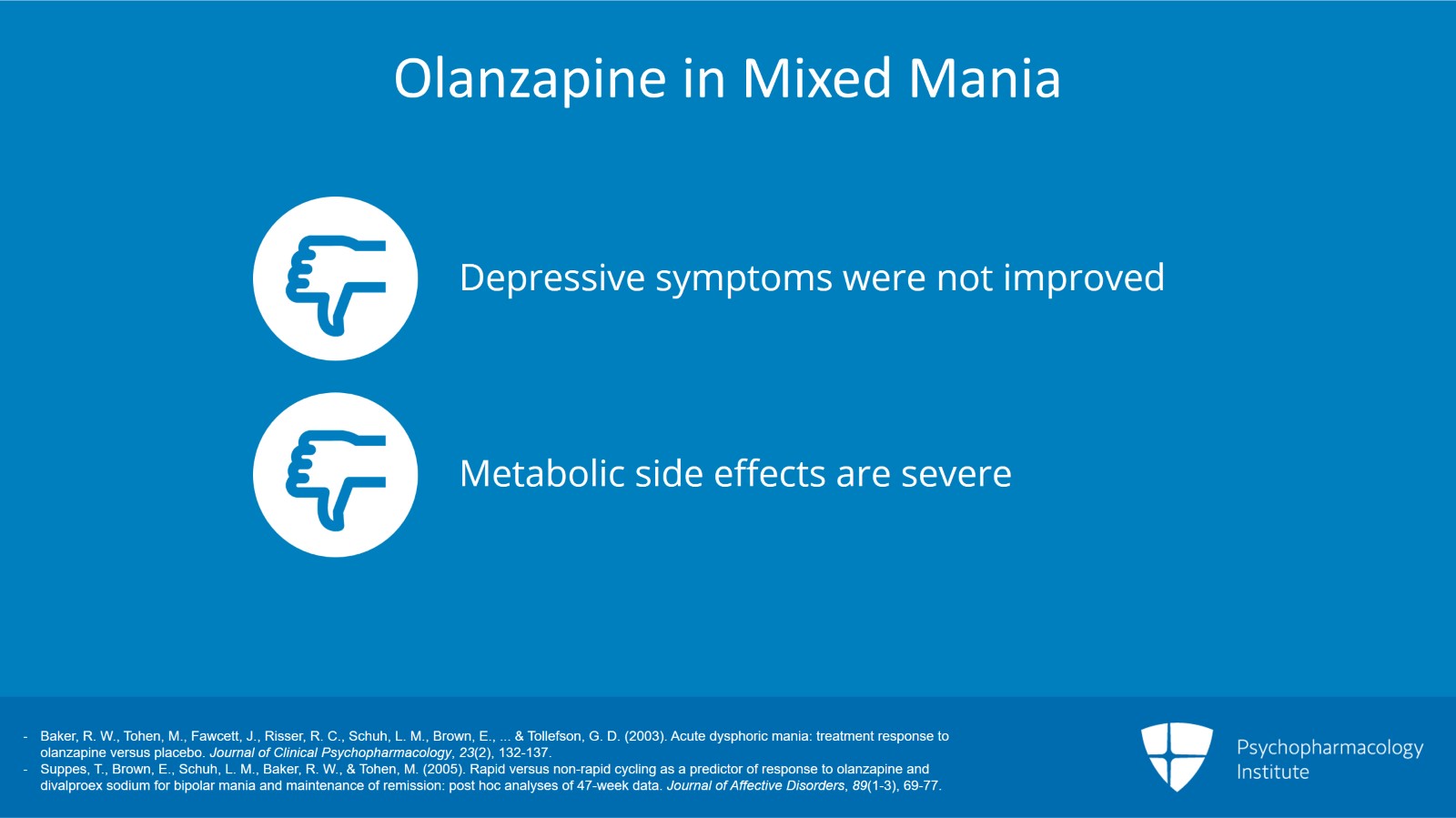
But the other interesting thing about olanzapine is they actually have analyzed how did the olanzapine do in the mixed patients that were in those studies that they included in treating acute mania. And the results were not good. The depressive symptoms were not improved by olanzapine in the mixed mania studies where they had those patients. So that’s why we don’t particularly favor it for mixed mania over quetiapine. And also, many other reviewers have argued that olanzapine is not a first-line treatment for mania in any situation due to its metabolic side effects being so severe.
References:
- Baker, R. W., Tohen, M., Fawcett, J., Risser, R. C., Schuh, L. M., Brown, E., … & Tollefson, G. D. (2003). Acute dysphoric mania: treatment response to olanzapine versus placebo. Journal of Clinical Psychopharmacology, 23(2), 132-137.
- Suppes, T., Brown, E., Schuh, L. M., Baker, R. W., & Tohen, M. (2005). Rapid versus non-rapid cycling as a predictor of response to olanzapine and divalproex sodium for bipolar mania and maintenance of remission: post hoc analyses of 47-week data. Journal of Affective Disorders, 89(1-3), 69-77.
Slide 6 of 15
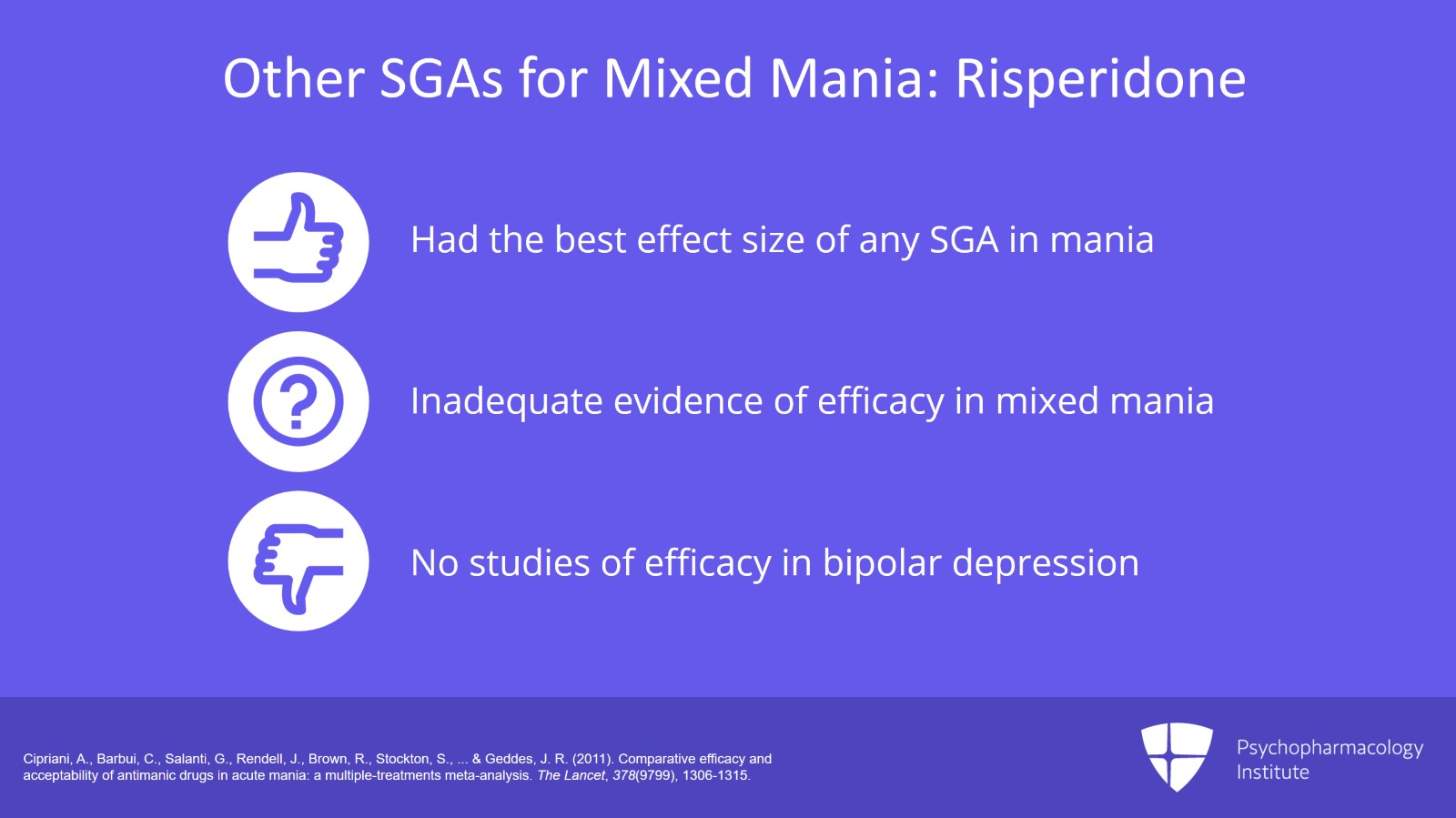
Now, another SGA that you could consider though would be risperidone that actually had the best effect size of any of the SGAs in mania in Cipriani’s meta-analysis of -0.5. The downside of it is that there are no adequate evaluations of it in mixed and no studies at all in bipolar depression. So the best evidence overall considering all the factors that are important in choosing a drug for a mixed manic episode leads us to still have a slight preference for quetiapine.
References:
- Cipriani, A., Barbui, C., Salanti, G., Rendell, J., Brown, R., Stockton, S., … & Geddes, J. R. (2011). Comparative efficacy and acceptability of antimanic drugs in acute mania: a multiple-treatments meta-analysis. The Lancet, 378(9799), 1306-1315.
Free Files
Download PDF and other files
Success!
Check your inbox, we sent you all the materials there.
Slide 7 of 15
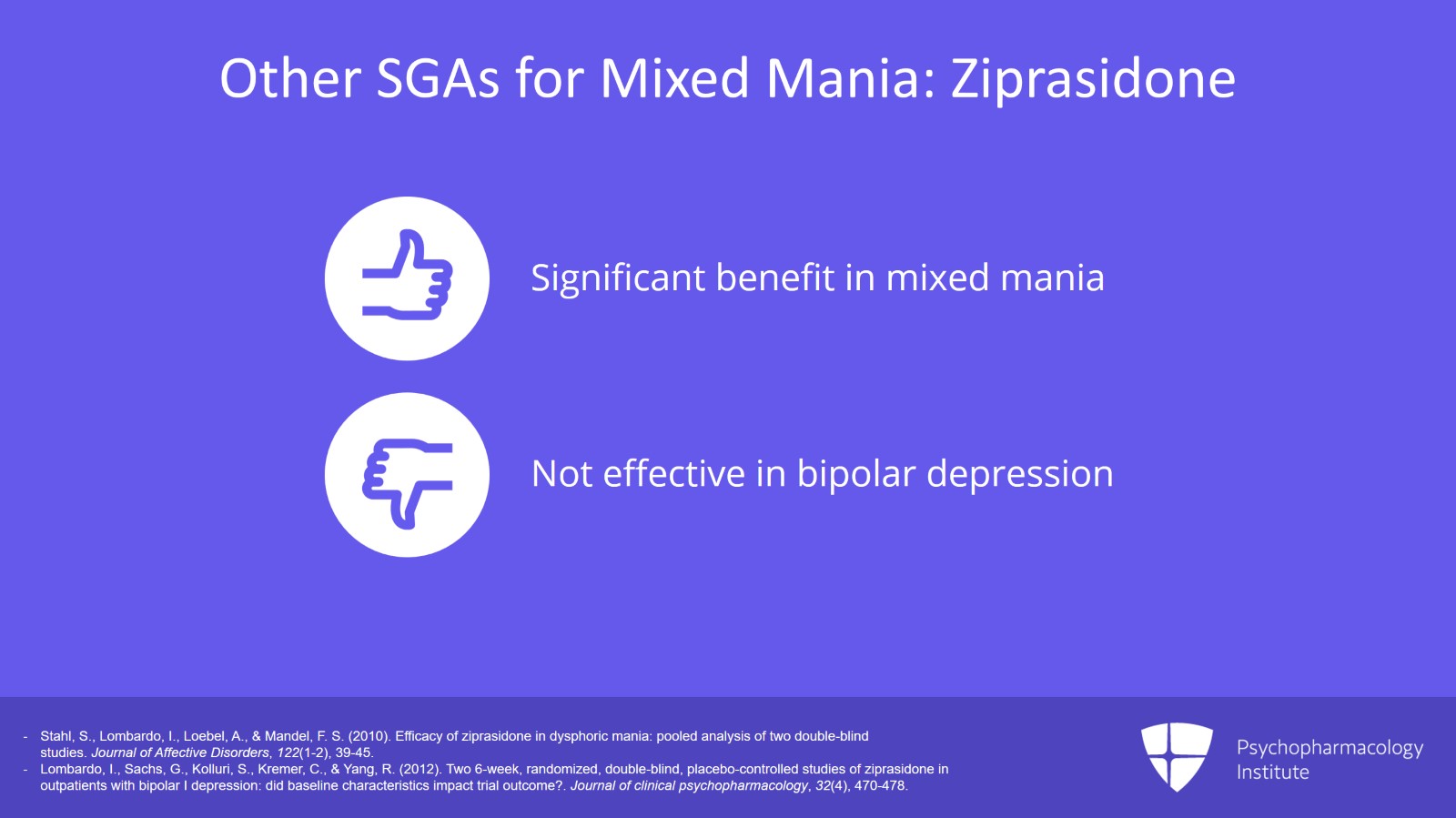
Now, what about other SGAs? Are there others you can think about? How about ziprasidone? It turns out to have significant benefit in the mixed mania patients when you similarly pull them out and meta-analyze them in the mania studies that ziprasidone did. But it also is not effective in bipolar depression. There are two randomized controlled trials of ziprasidone in bipolar depression, no efficacy.
References:
- Stahl, S., Lombardo, I., Loebel, A., & Mandel, F. S. (2010). Efficacy of ziprasidone in dysphoric mania: pooled analysis of two double-blind studies. Journal of Affective Disorders, 122(1-2), 39-45.
- Lombardo, I., Sachs, G., Kolluri, S., Kremer, C., & Yang, R. (2012). Two 6-week, randomized, double-blind, placebo-controlled studies of ziprasidone in outpatients with bipolar I depression: did baseline characteristics impact trial outcome?. Journal of clinical psychopharmacology, 32(4), 470-478.
Slide 8 of 15
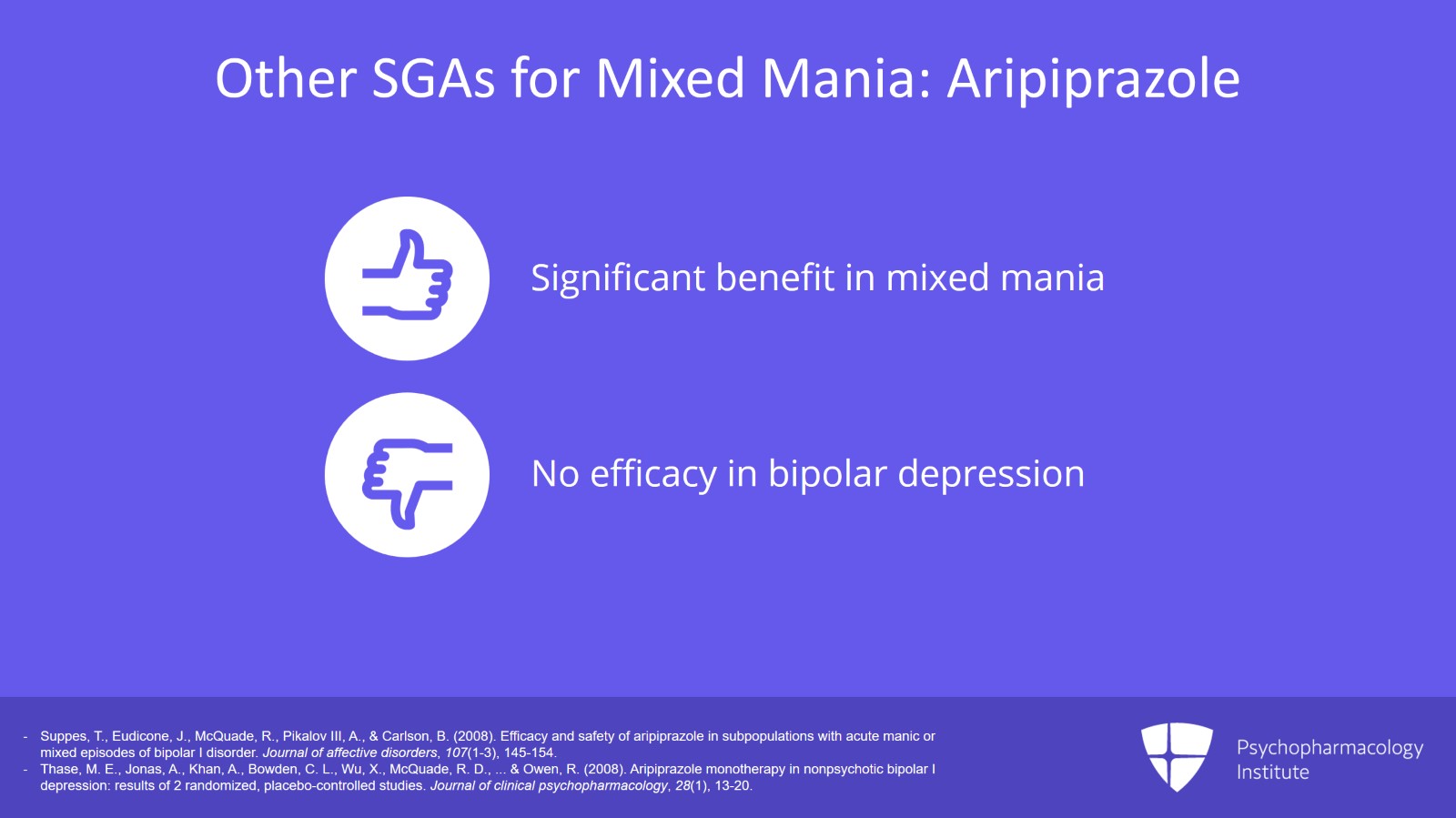
And how about aripiprazole? That too on the plus side had similar benefits to ziprasidone looking at the acute results in the mixed mania patients when separated from the larger population of manics in those studies. But it’s got the same negative as ziprasidone, two randomized controlled trials of aripiprazole in bipolar depression showing no efficacy. I want to emphasize this point because I think a lot of clinicians are not aware of this negative evidence on aripiprazole in bipolar depression as a treatment. We’re all very familiar with aripiprazole’s role as an augmentation in unipolar depression when added to an SSRI. However, it didn’t work in bipolar depression despite two very carefully drawn studies. But that fact seems to have passed over many clinicians’ awareness because I see a lot of aripiprazole being prescribed thinking it’s going to work for the depressive component of patients with bipolar disorder and for these mixed patients with mania.
References:
- Suppes, T., Eudicone, J., McQuade, R., Pikalov III, A., & Carlson, B. (2008). Efficacy and safety of aripiprazole in subpopulations with acute manic or mixed episodes of bipolar I disorder. Journal of affective disorders, 107(1-3), 145-154.
- Thase, M. E., Jonas, A., Khan, A., Bowden, C. L., Wu, X., McQuade, R. D., … & Owen, R. (2008). Aripiprazole monotherapy in nonpsychotic bipolar I depression: results of 2 randomized, placebo-controlled studies. Journal of clinical psychopharmacology, 28(1), 13-20.
Free Files
Download PDF and other files
Success!
Check your inbox, we sent you all the materials there.
Slide 9 of 15
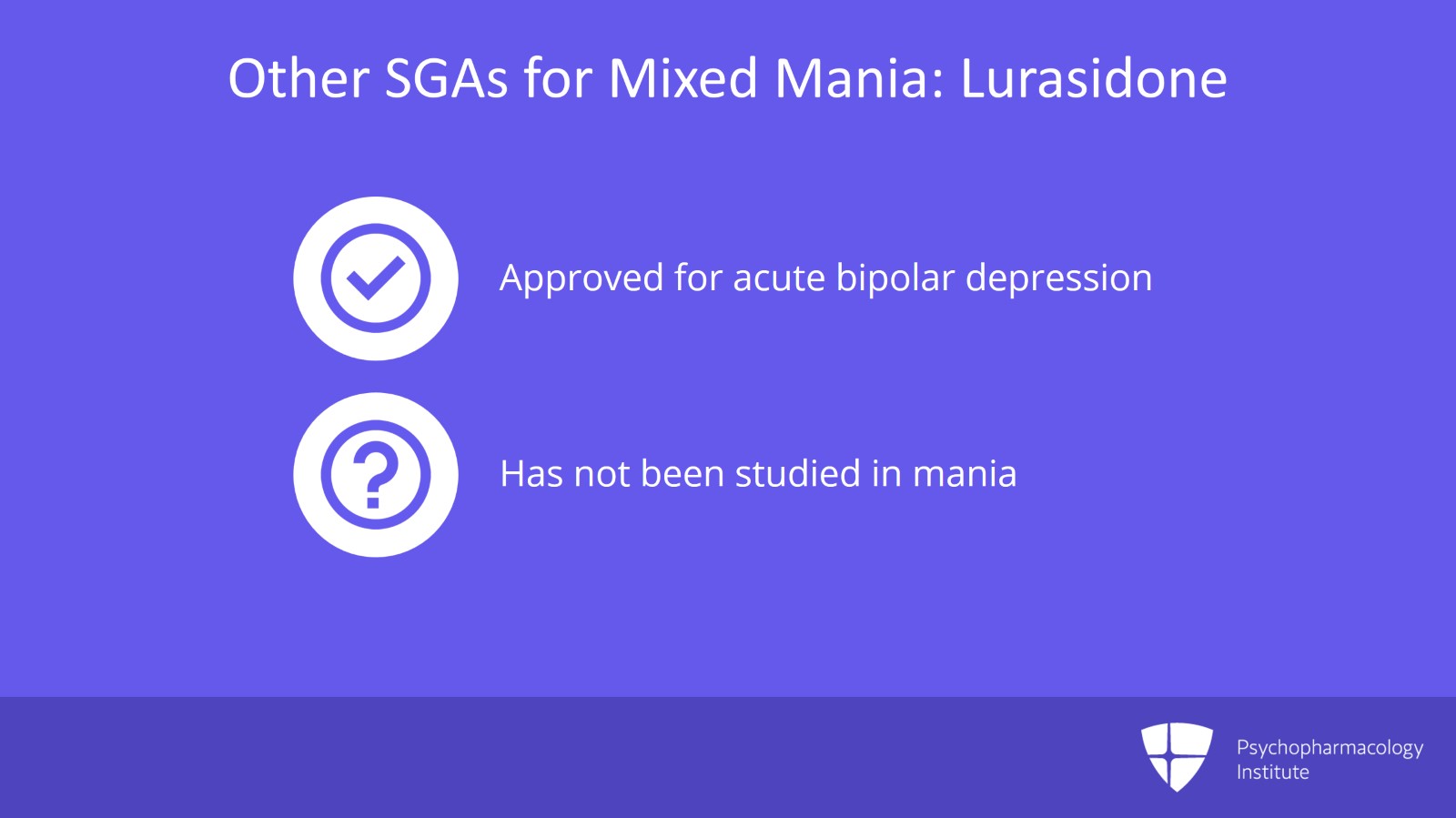
Now, lurasidone is a third option you might think about. Again, I mentioned it earlier. It’s been approved for acute bipolar depression but it’s never been studied in mania. So we can’t really recommend it. And also, you should know that there are some case reports out there where the load doses that they used in bipolar depression are associated with some manic switches actually. So I don’t think it’s strongly evidenced by any means as a treatment for bipolar mania with mixed features.
Slide 10 of 15
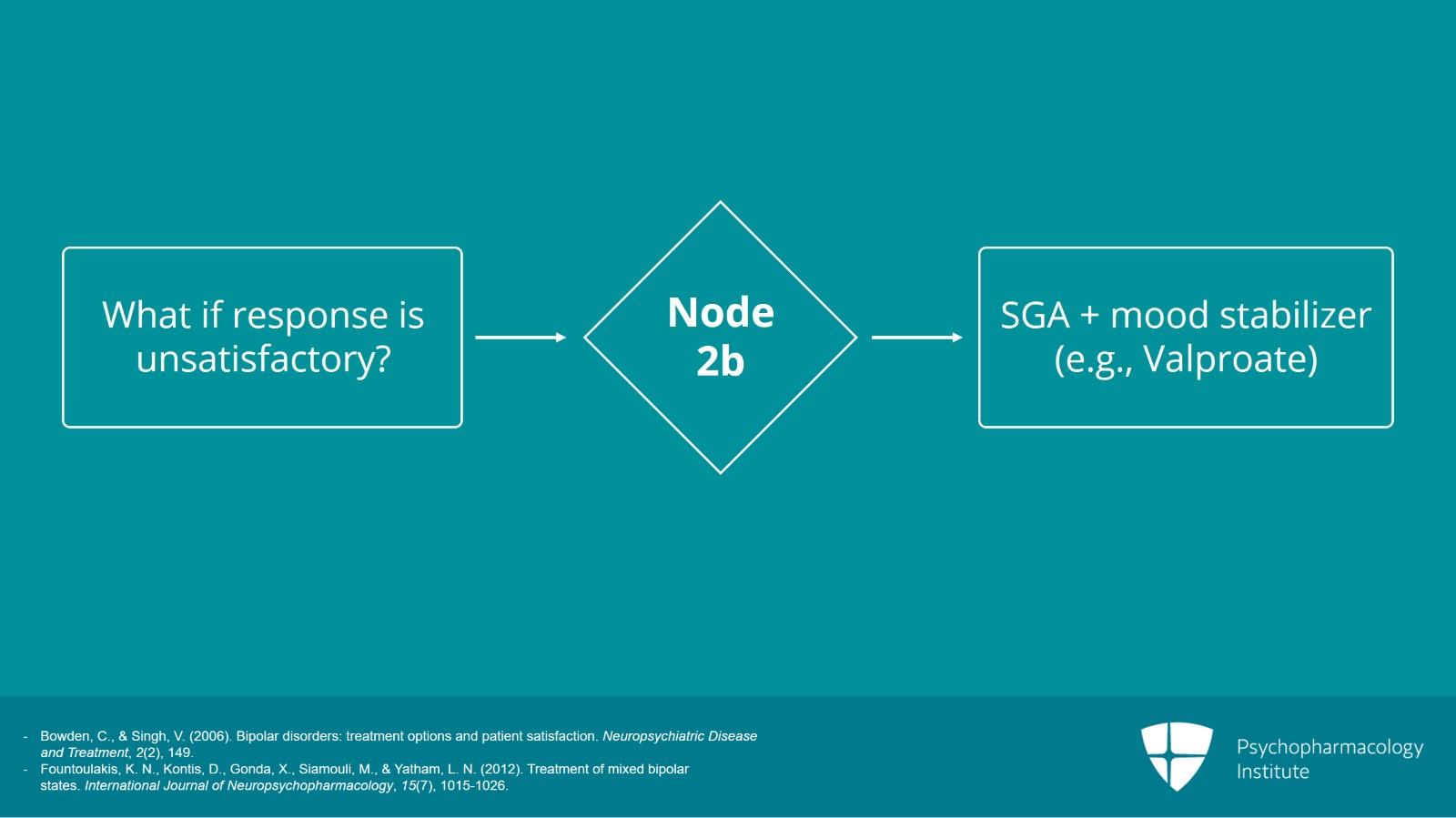
Now, the next step if you’ve tried your quetiapine or other SGAs for this acute mixed episode is what do you do if the SGA response was unsatisfactory? This is node 2B. Now, there’s plenty of evidence that combination treatment is more effective than single treatment after the single treatment has failed by adding together an SGA with a mood stabilizer. And it just so happens that the mixed manics are the ones more likely to need that. And as far as which mood stabilizer to add, the best evidence is with valproate according to three reviews. So that is our preference.
References:
- Bowden, C., & Singh, V. (2006). Bipolar disorders: treatment options and patient satisfaction. Neuropsychiatric Disease and Treatment, 2(2), 149.
- Fountoulakis, K. N., Kontis, D., Gonda, X., Siamouli, M., & Yatham, L. N. (2012). Treatment of mixed bipolar states. International Journal of Neuropsychopharmacology, 15(7), 1015-1026.
Free Files
Download PDF and other files
Success!
Check your inbox, we sent you all the materials there.
Slide 11 of 15
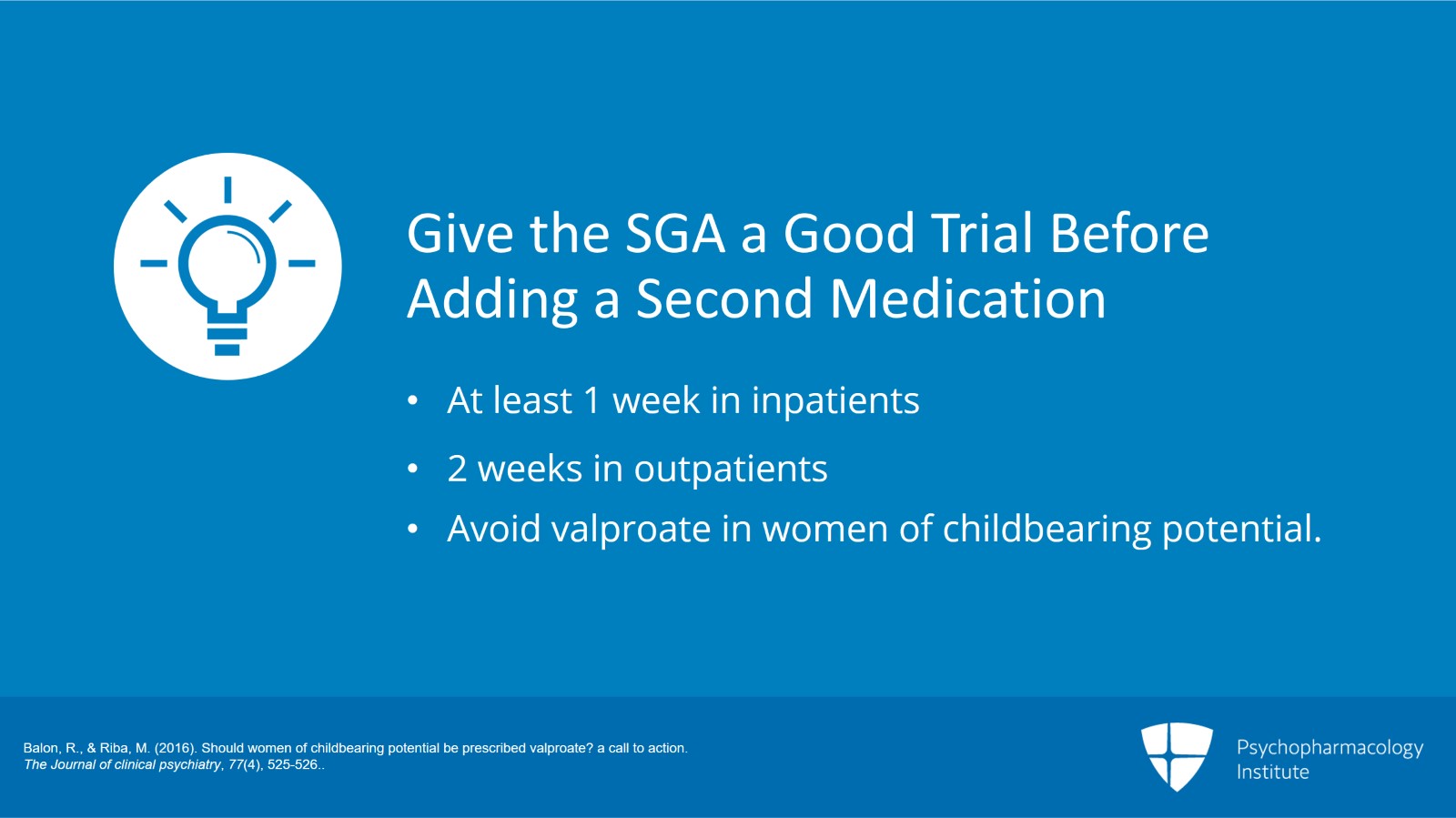
Now, we prefer to give that SGA a good trial before you add this second medication. There are studies where they show combination treatment is better but there are virtually no studies where they initiate manic patients on combination treatment. If you look carefully at those combination studies, they all have as an entry criterion that they’ve been tried on some single agent typically for two weeks and had an unsatisfactory response. Then they add the second treatment or placebo and they find that adding the second treatment is better than the placebo. So that is the evidence base for combination being better but the evidence does not say that you should always start with a combination. Many of those patients may not need a combination. And these combinations have more side effects and other problems. Now, that may be difficult on inpatient units where you’re under pressure to do things quickly, get them out quickly, go to polypharmacy quickly. Try as best as you can to resist that pressure. At least, give that first drug a week if you can. If it’s an outpatient, certainly two weeks would be very reasonable especially with hypomania before you think of adding a second medication. But as I’m saying, the second medication of choice might be valproate. There are certain patients that probably should not get valproate including most women of childbearing potential due to the potential for fetal harm.
References:
- Balon, R., & Riba, M. (2016). Should women of childbearing potential be prescribed valproate? a call to action. The Journal of clinical psychiatry, 77(4), 525-526..
Slide 12 of 15
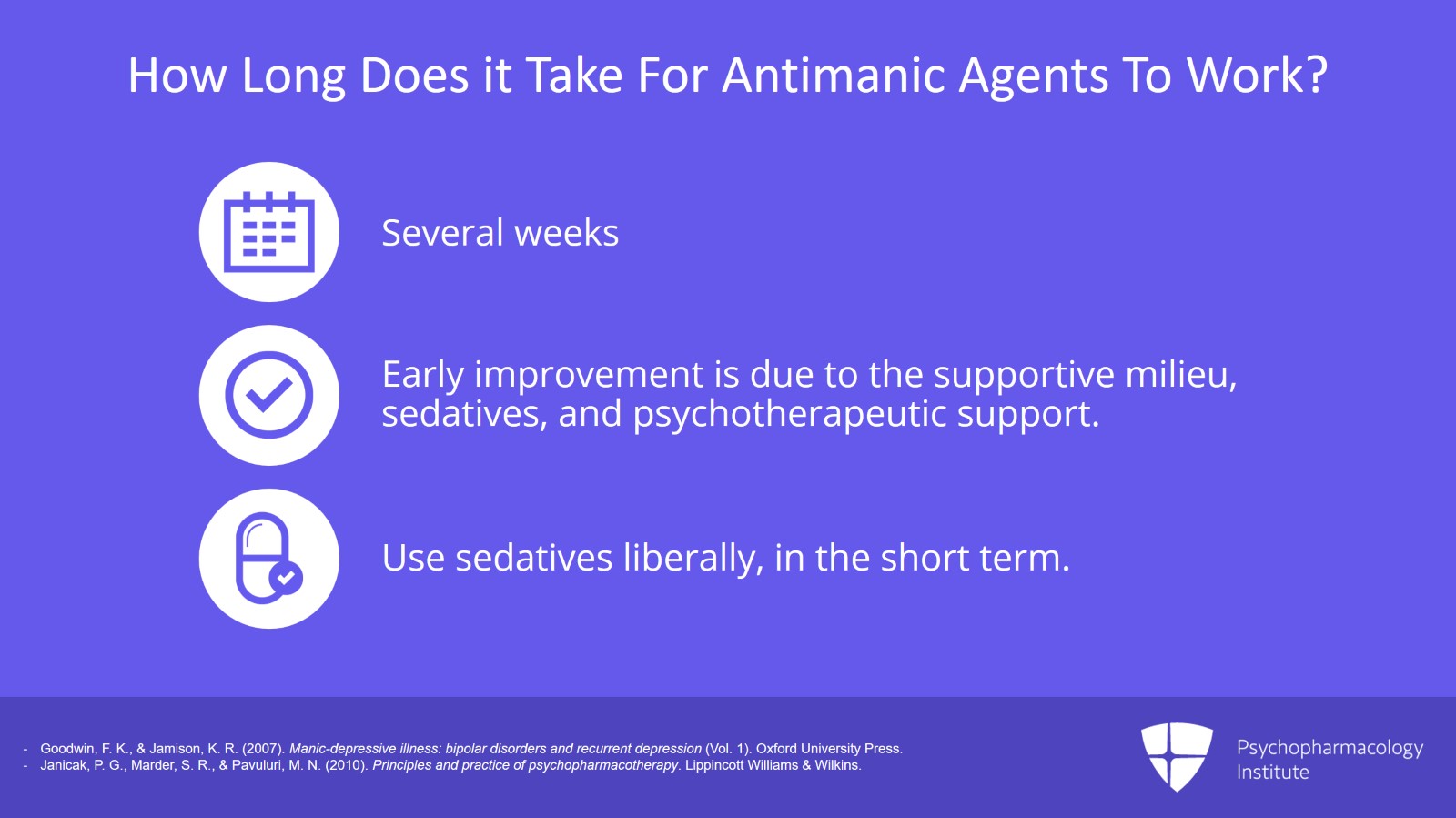
Now, while you’re waiting for that SGA to work, I just want to comment a little further about that. How long does it take these anti-manic agents to work in the studies? Do they work in two days? No. They work on mania over several weeks and remission takes even longer than that. So improvement in the first few days of an inpatient stay is usually due not to the medication you started, that SGA, but more importantly, the thing that does produce improvement in the few days is the effects of the supportive milieu, the sedatives that are used in the early parts of the admission to calm patients down, tranquilizers, psychotherapeutic support, containment. So we do recommend using sedatives liberally short term when they first come in rather than combining anti-manic agents. We recommend that and certainly many other experts in the field as cited here in their textbooks by Goodwin and the textbook by Janicak, two excellent resources. They recommend using benzos liberally and then being sure you don’t send them out of the hospital on them if not necessary. Try to just use them for early behavioral help while you’re waiting for the first medication, the main medication to work on the mania.
References:
- Goodwin, F. K., & Jamison, K. R. (2007). Manic-depressive illness: bipolar disorders and recurrent depression (Vol. 1). Oxford University Press.
- Janicak, P. G., Marder, S. R., & Pavuluri, M. N. (2010). Principles and practice of psychopharmacotherapy. Lippincott Williams & Wilkins.
Free Files
Download PDF and other files
Success!
Check your inbox, we sent you all the materials there.
Slide 13 of 15
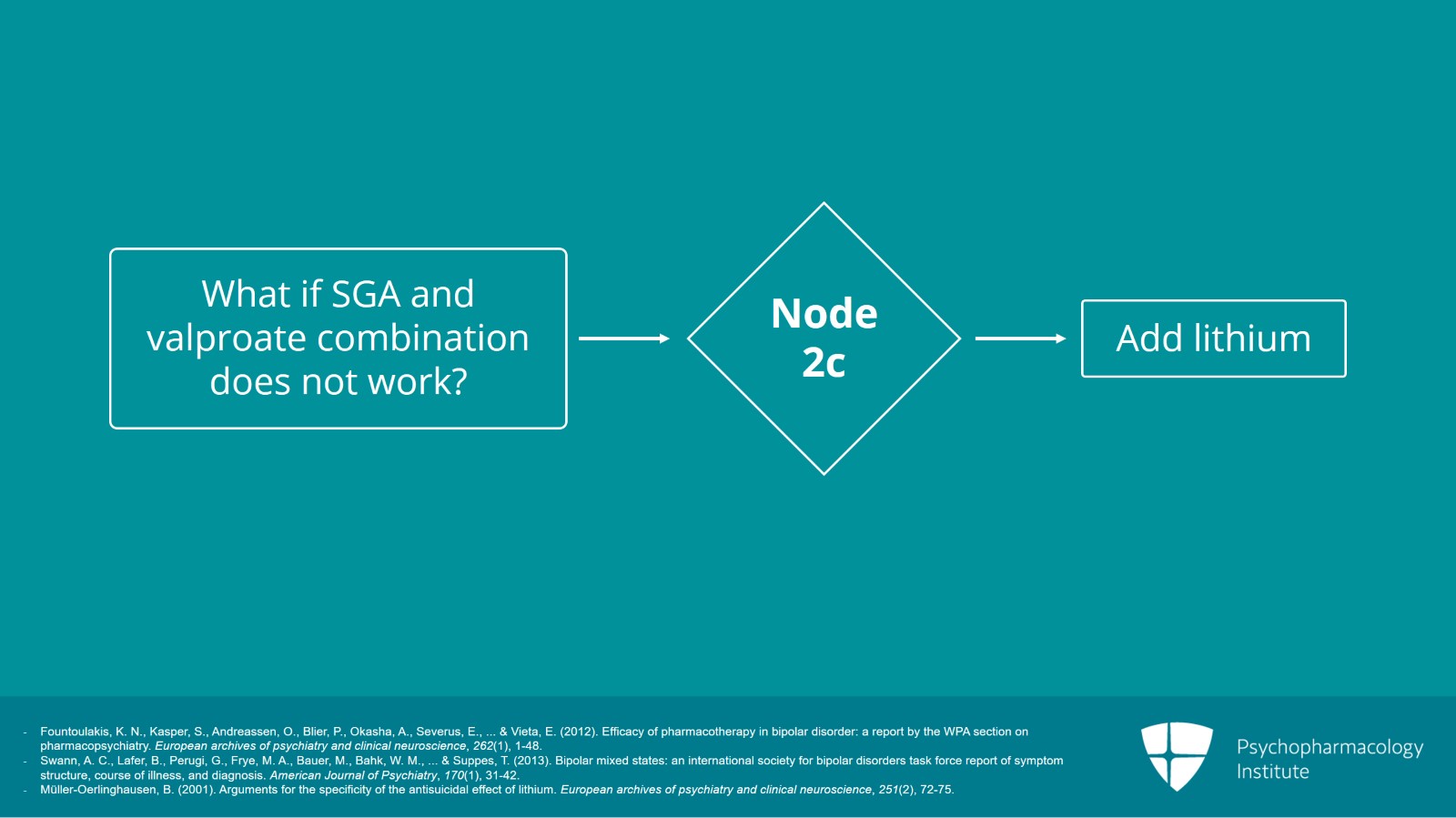
And that brings us to node 2C which is what if the combination of the SGA and valproate does not work, still producing an unsatisfactory response? At this point, we would consider adding lithium as the third medication to consider. Now, results with lithium as I said earlier in mixed states are not as good as with SGAs or valproate. Lithium is a well-established anti-manic agent in general and so it certainly may be reasonable now to consider adding it. Another issue is that mixed patients have increased rates of suicidality due to those depressive symptoms that they have. Lithium is good for that even if not effective for the mood episode itself. The anti-suicide effect may be independent of the anti-manic effect in some patients. So for all these reasons, we recommend lithium at this node 2C of the algorithm as the third medication.
References:
- Fountoulakis, K. N., Kasper, S., Andreassen, O., Blier, P., Okasha, A., Severus, E., … & Vieta, E. (2012). Efficacy of pharmacotherapy in bipolar disorder: a report by the WPA section on pharmacopsychiatry. European archives of psychiatry and clinical neuroscience, 262(1), 1-48.
- Swann, A. C., Lafer, B., Perugi, G., Frye, M. A., Bauer, M., Bahk, W. M., … & Suppes, T. (2013). Bipolar mixed states: an international society for bipolar disorders task force report of symptom structure, course of illness, and diagnosis. American Journal of Psychiatry, 170(1), 31-42.
- Müller-Oerlinghausen, B. (2001). Arguments for the specificity of the antisuicidal effect of lithium. European archives of psychiatry and clinical neuroscience, 251(2), 72-75.
Slide 14 of 15
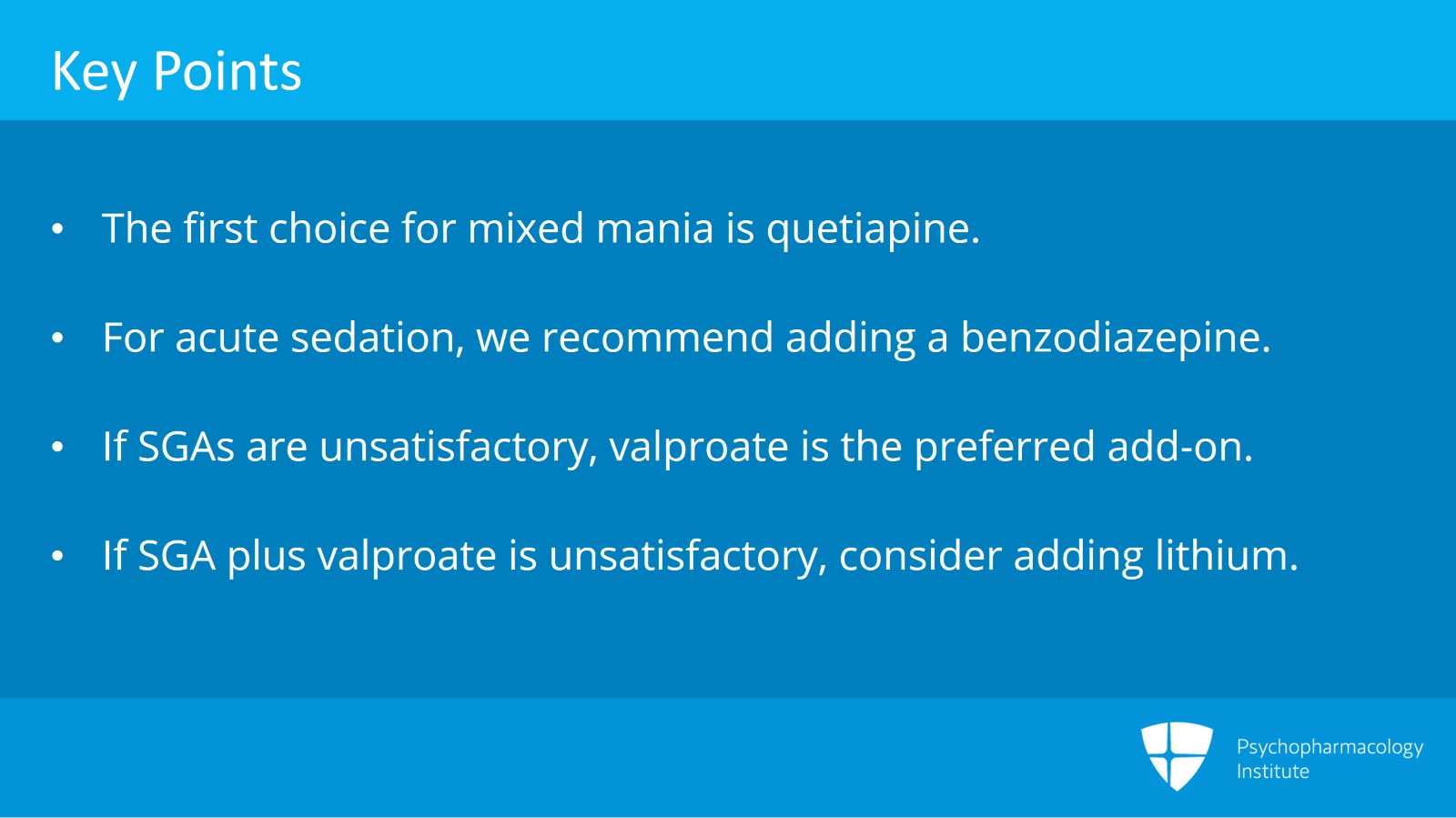
So to summarize the key points of video 5, the first choice for effectiveness, safety and ability to prevent the depression that may be coming around the corner in mixed mania is an SGA and quetiapine is preferred because of its superior evidence of being able to prevent that next depression. For acute sedation, we recommend adding a benzodiazepine short term rather than a second anti-manic. But if you need to add a second one after a reasonable interval of time, a week minimum, two weeks would be better, then valproate is preferred. And if the second-generation antipsychotic plus valproate is unsatisfactory, the next step would be to consider adding lithium.
Free Files
Download PDF and other files
Success!
Check your inbox, we sent you all the materials there.
Slide 15 of 15