



Text version
Real-World Abuse Potential of Insomnia Medications
Insomnia is a very common medical complaint. Recommended first-line treatments are psychosocial, improved sleep hygiene and cognitive behavioral therapy. For patients who don’t respond adequately to psychosocial treatment, several types of FDA-approved medications are available. In addition, some medications not FDA approved for insomnia are commonly used off-label.
An important consideration for physicians when prescribing is the abuse liability of the medication. This is especially important for medications that are taken chronically as insomnia medications often are. A major guide to abuse liability is the medication scheduling under the Controlled Substances Act, known as the CSA. Schedules run from 1 to 5; the higher the schedule number, the lower the abuse liability.
However, this scheduling system is sometimes based on limited or absent evidence especially for medications that were FDA approved before 2010. This was the year that the FDA first required explicit human abuse potential testing for all new psychoactive medications.
Download PDF and other files
Real-World Data From FDA Adverse Events
To fill this information gap, Saskin and colleagues used real-world evidence from a systematic review of the FDA’s Adverse Event Reporting System. They used a proportion of individual patient adverse event case reports coded as abuse, dependence or withdrawal as the measure of abuse liability for a medication. It compared this case proportion across six different types of medication used to treat insomnia whether or not the medication was FDA approved for this indication.
They used two widely used statistical techniques, reporting odds ratios and proportional reporting ratios, to evaluate whether the various medications differed significantly in the proportion of cases coded as abuse, dependence or withdrawal.
Rankings Did Not Match CSA Schedules
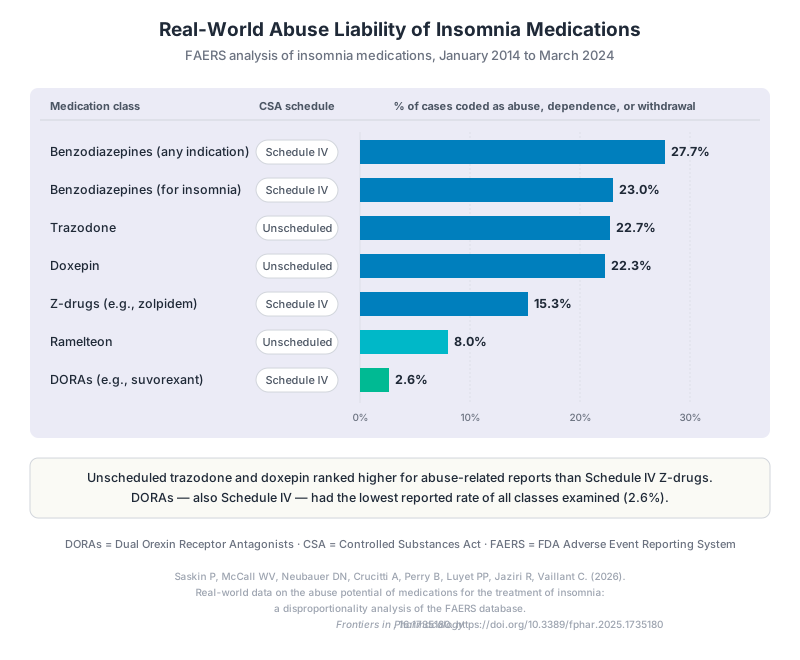
The study found that the ranking of case proportions did not always follow the medication scheduling under the CSA.
- The highest case proportion was for benzodiazepines, with those approved for any indication ranked somewhat higher than those approved for insomnia. Interestingly, both types of benzodiazepines are classified in schedule 4, which indicates low potential for abuse but still requiring control.
- The next highest proportion of cases was for trazodone and doxepin. These are both non-tricyclic antidepressants which are not scheduled at all, that is they are not considered to have any abuse liability.
- The next highest proportion of cases was for the Z-drugs such as zolpidem, which are also in schedule 4.
- The lowest proportion of cases was for ramelteon and dual-orexin receptor antagonists such as suvorexant, which are commonly known as DORAs for short. Neither of these medications is scheduled.
Download PDF and other files
Study Limitations
These findings may be helpful to clinicians but have several major limitations that must be kept in mind.
First, the FDA Adverse Event Reporting System relies on spontaneous reporting by physicians or patients. Thus, the prevalence of cases with adverse events may be underreported and may fluctuate depending on the medication’s prominence in the media.
Second, case reports are not evaluated for causality. At best, these data reflect only an apparent association between the medication and the adverse event.
Third, the two statistical methods that were used are subject to several types of bias. I do have somewhat more confidence in the findings because both statistical methods generated the same pattern of results.
Bottom Line for Clinicians
The bottom line is that physicians should not rely solely on CSA scheduling when judging the abuse liability of medications for insomnia. These real-world data suggest that ramelteon or DORAs are the best choice for insomnia medication when abuse liability is an important clinical consideration. This will be the case for patients at increased risk of developing a substance use disorder such as patients with a personal history of substance use disorder or those likely to remain on the medication long term.
Regrettably, there are no head-to-head efficacy comparisons between ramelteon and DORAs. Indirect network comparisons suggest that DORAs are more effective than ramelteon. Therefore, I suggest DORAs as first choice medication for patients at higher risk for substance use disorder.
For patients for whom DORAs are not a good choice because of its schedule 4 classification or cost or insurance barriers, I suggest doxepin. Doxepin is more effective than ramelteon based on indirect network comparisons. Since it is generic, doxepin is substantially cheaper than ramelteon or DORAs. For patients doing well on their current insomnia medication, I would suggest not switching to another medication.
Download PDF and other files
Abstract
Real-world data on the abuse potential of medications for the treatment of insomnia: a disproportionality analysis of the FAERS database
Paul Saskin, William V. McCall, David N. Neubauer, Antonio Crucitti, Bradford Perry, Pierre Philippe Luyet, Riphed Jaziri & Cedric Vaillant
Background:
Insomnia disorder is a chronic medical condition estimated to affect 12% of adults. The potential for abuse of hypnotics often contributes to physician reluctance to prescribe medications to treat insomnia as a chronic condition. This study examined the real-world abuse potential of approved and off-label medications used to treat insomnia, employing data from the FDA Adverse Event Reporting System (FAERS) database.
Methods:
Data from 1 January 2014 to 31 March 2024 were retrieved. Drugs of interest included Schedule IV drugs (benzodiazepines, Z-drugs, dual orexin receptor antagonists [DORAs]) and non-scheduled drugs (trazodone, doxepin, ramelteon). Relevant reported adverse events denoting drug abuse were identified if they contained an event with any preferred terms from the SMQ Drug abuse, dependence, and withdrawal (MedDRA v26.1), with cases of overdose due to suicide attempts excluded. The reporting odds ratios (ROR) and proportional reporting ratios (PRR) were used as disproportionality measures.
Results:
Rates of adverse event cases of abuse, dependence, and withdrawal retrieved were highest for benzodiazepines approved for any indication, followed by benzodiazepines approved for insomnia, trazodone, doxepin, Z-drugs, ramelteon, and DORAs. DORAs were associated with a low ROR value relative to Z-drugs (ROR = 0.150; 95% CI [0.131, 0.171]) and to trazodone (ROR = 0.092; 95% CI [0.081, 0.105]). Similar results were obtained using the PRR. The DORA class had the lowest rates of adverse event denoting drug abuse, even lower than the unscheduled drugs ramelteon and doxepin, which are known not to be prone to abuse or dependence. Furthermore, the DORA class had significantly lower odds of reporting for adverse events denoting drug abuse when compared with zolpidem or the unscheduled medication trazodone.
Conclusion:
This study identified significantly fewer reported cases of real-world abuse, misuse, overdose, and other safety risks for DORAs compared with the unscheduled drug trazodone and scheduled Z-drugs. This suggests that categorization of DORAs as Schedule IV drugs may overstate their abuse potential.
Reference
Saskin, P.; McCall, W.; Neubauer, D.; Crucitti, A.; Perry, B.; Luyet, P. et al. (2026). Real-world data on the abuse potential of medications for the treatment of insomnia: a disproportionality analysis of the FAERS database. Frontiers in Pharmacology; 16.
