Close Banner
Free Section  - Video Lectures

03. Consequences of Alcohol Use Disorder: Withdrawal

Published on July 1, 2021 Expired on April 1, 2025 DOI: 10.64239/PI-VL4303

Joji Suzuki, M.D.

Assistant Professor of Psychiatry - Harvard Medical School

Key Points

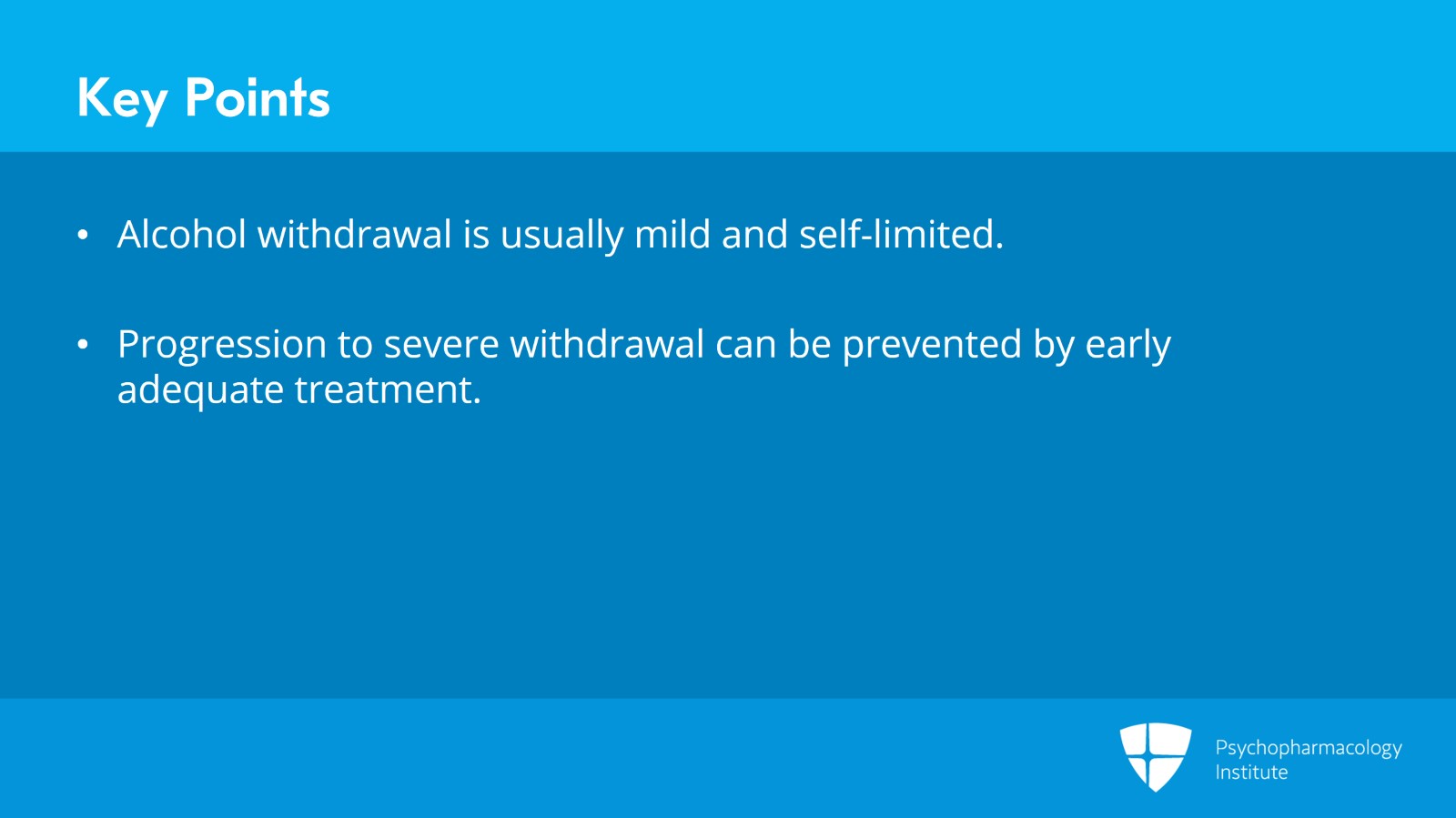
  • Alcohol withdrawal is usually mild and self-limited.
  • Progression to severe withdrawal can be prevented by early adequate treatment.
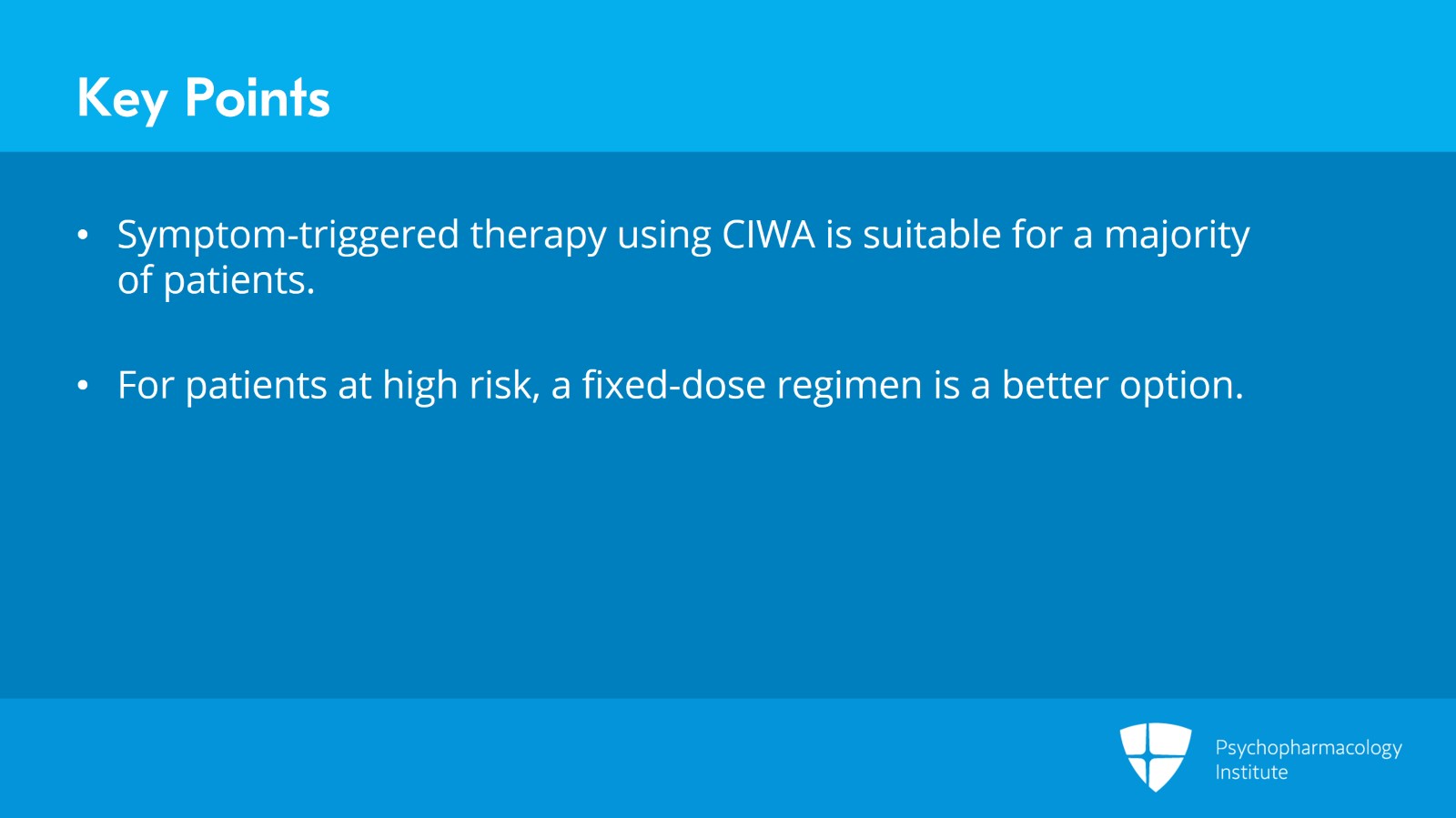
  • Symptom-triggered therapy using CIWA is suitable for a majority of patients.
  • For patients at high risk, a fixed-dose regimen is a better option.

Free Downloads for Offline Access

  • Free Download Video (MP4)
  • Free Download Audio File (MP3)
  • Free Download Presentation File (PPTX)

Slides and Transcript
Slide 1 of 17

Let’s move on to the next section, Consequences of Alcohol Use Disorder: Withdrawal.

Slide 2 of 17

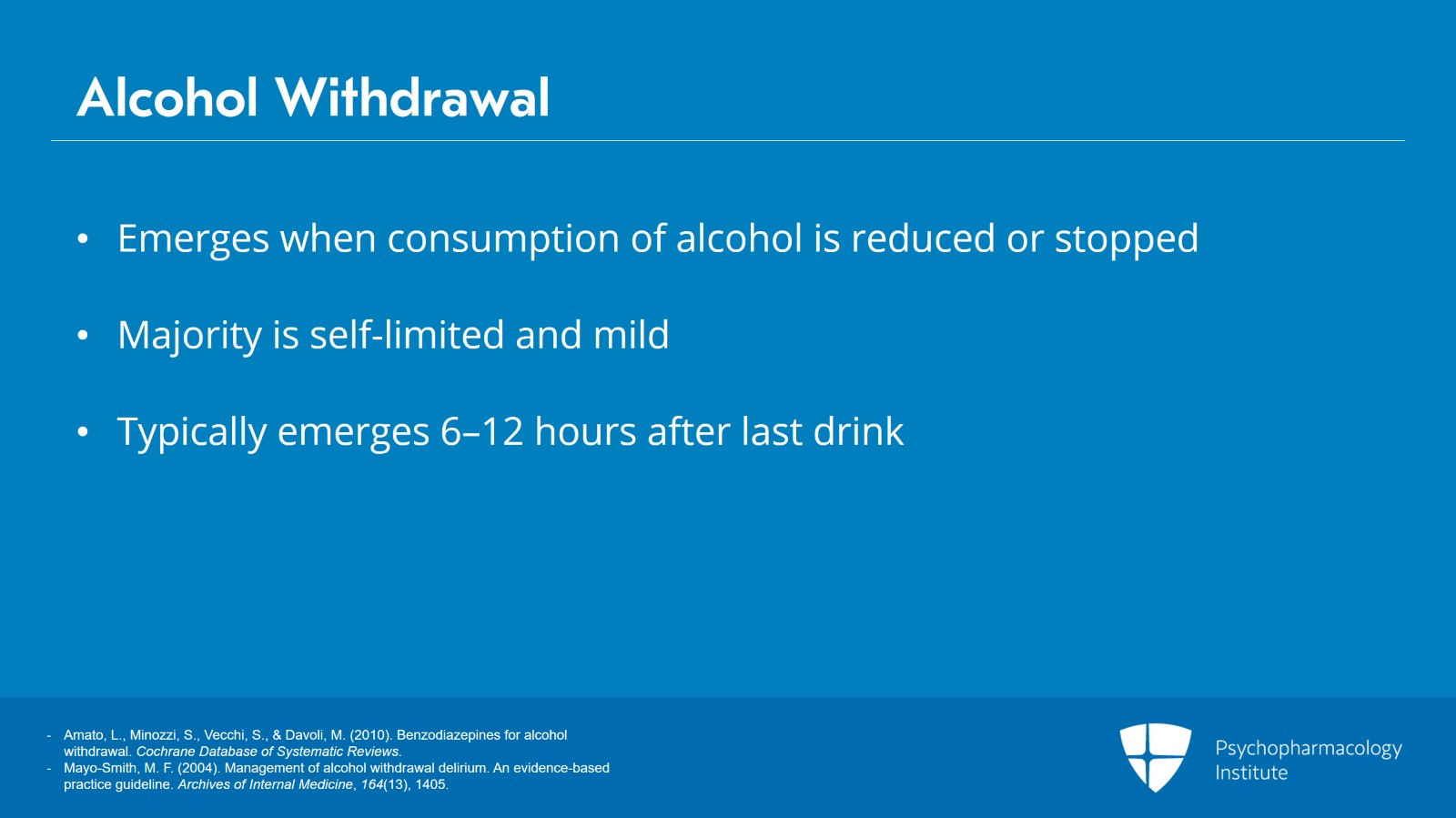
One of the immediate consequences of patients with alcohol use disorder is the emergence of withdrawal when consumption of alcohol is reduced or stopped. And as we all know, this is part of the diagnostic criteria. So most patients with alcohol use disorder will report, you know, some degree of withdrawal when they reduce or stop their drinking. The good news is that the majority of alcohol withdrawal is self-limited and mild in nature, typically emerging within six to 12 hours after their last drink.
References:
  • Amato, L., Minozzi, S., Vecchi, S., & Davoli, M. (2010). Benzodiazepines for alcohol withdrawal. Cochrane Database of Systematic Reviews.
  • Mayo-Smith, M. F. (2004). Management of alcohol withdrawal delirium. An evidence-based practice guideline. Archives of Internal Medicine, 164(13), 1405. 
Free Files
Success!
Check your inbox, we sent you all the materials there.
Slide 3 of 17

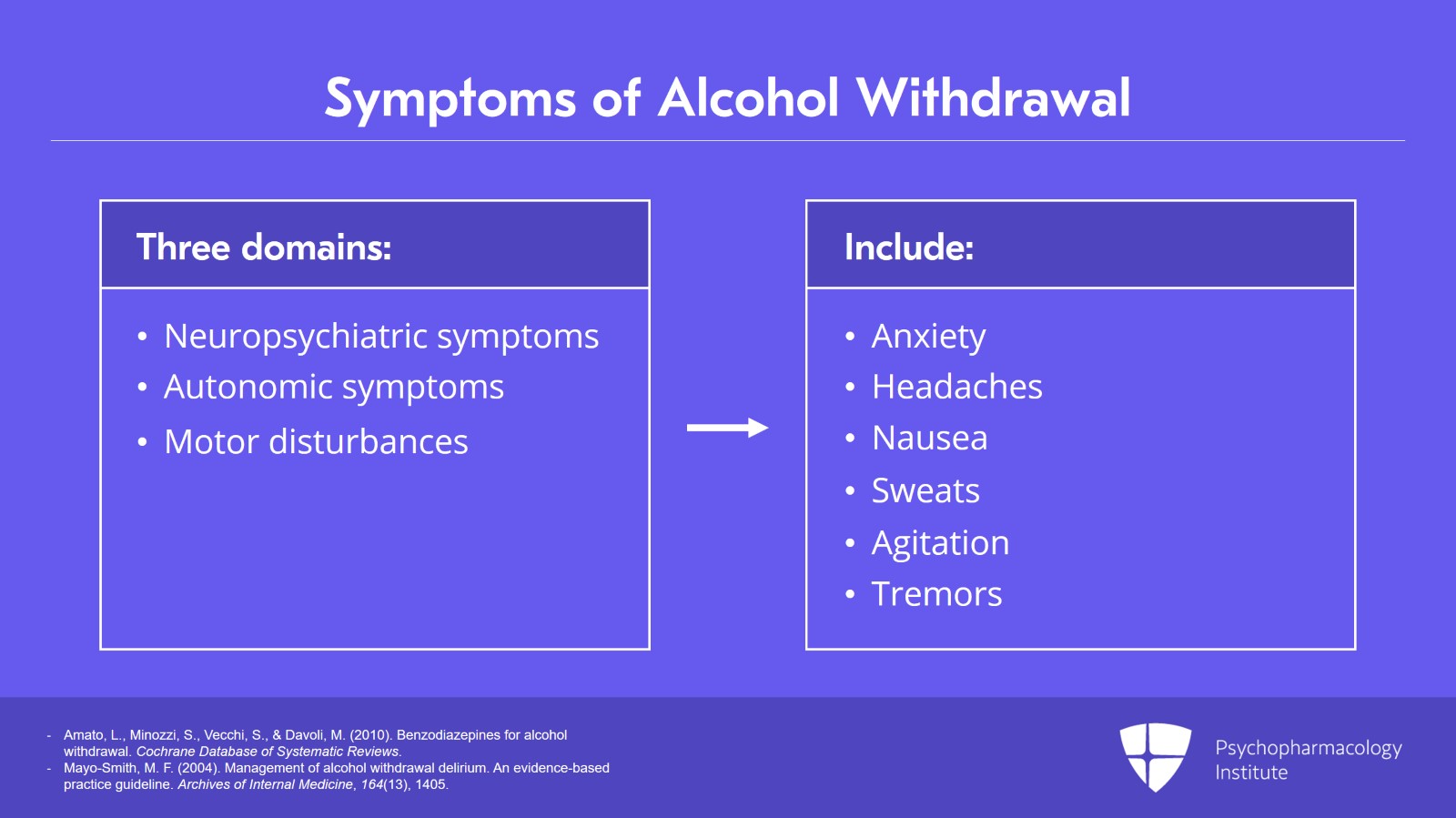
But we can think of the withdrawal coming in three sort of domains, neuropsychiatric symptoms, autonomic symptoms and then motor disturbances. And all these things include like anxiety, headaches, nausea, sweats, agitation and tremors.
References:
  • Amato, L., Minozzi, S., Vecchi, S., & Davoli, M. (2010). Benzodiazepines for alcohol withdrawal. Cochrane Database of Systematic Reviews.
  • Mayo-Smith, M. F. (2004). Management of alcohol withdrawal delirium. An evidence-based practice guideline. Archives of Internal Medicine, 164(13), 1405. 

Slide 4 of 17

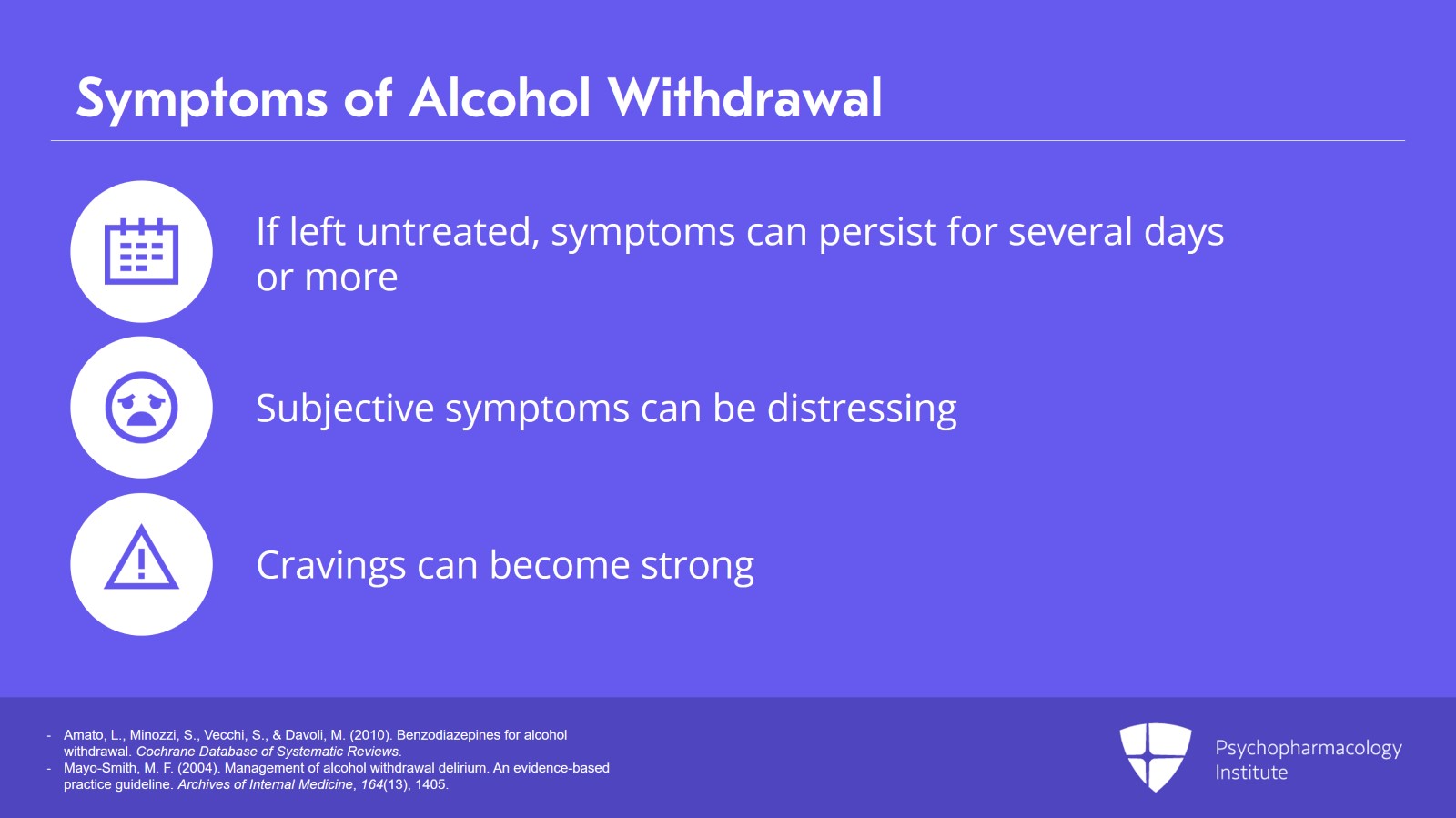
If left untreated, these symptoms can persist for several days or more. The subjective symptoms can be quite distressing. And then of course, cravings can become pretty strong during this time as well.
References:
  • Amato, L., Minozzi, S., Vecchi, S., & Davoli, M. (2010). Benzodiazepines for alcohol withdrawal. Cochrane Database of Systematic Reviews.
  • Mayo-Smith, M. F. (2004). Management of alcohol withdrawal delirium. An evidence-based practice guideline. Archives of Internal Medicine, 164(13), 1405. 
Free Files
Success!
Check your inbox, we sent you all the materials there.
Slide 5 of 17

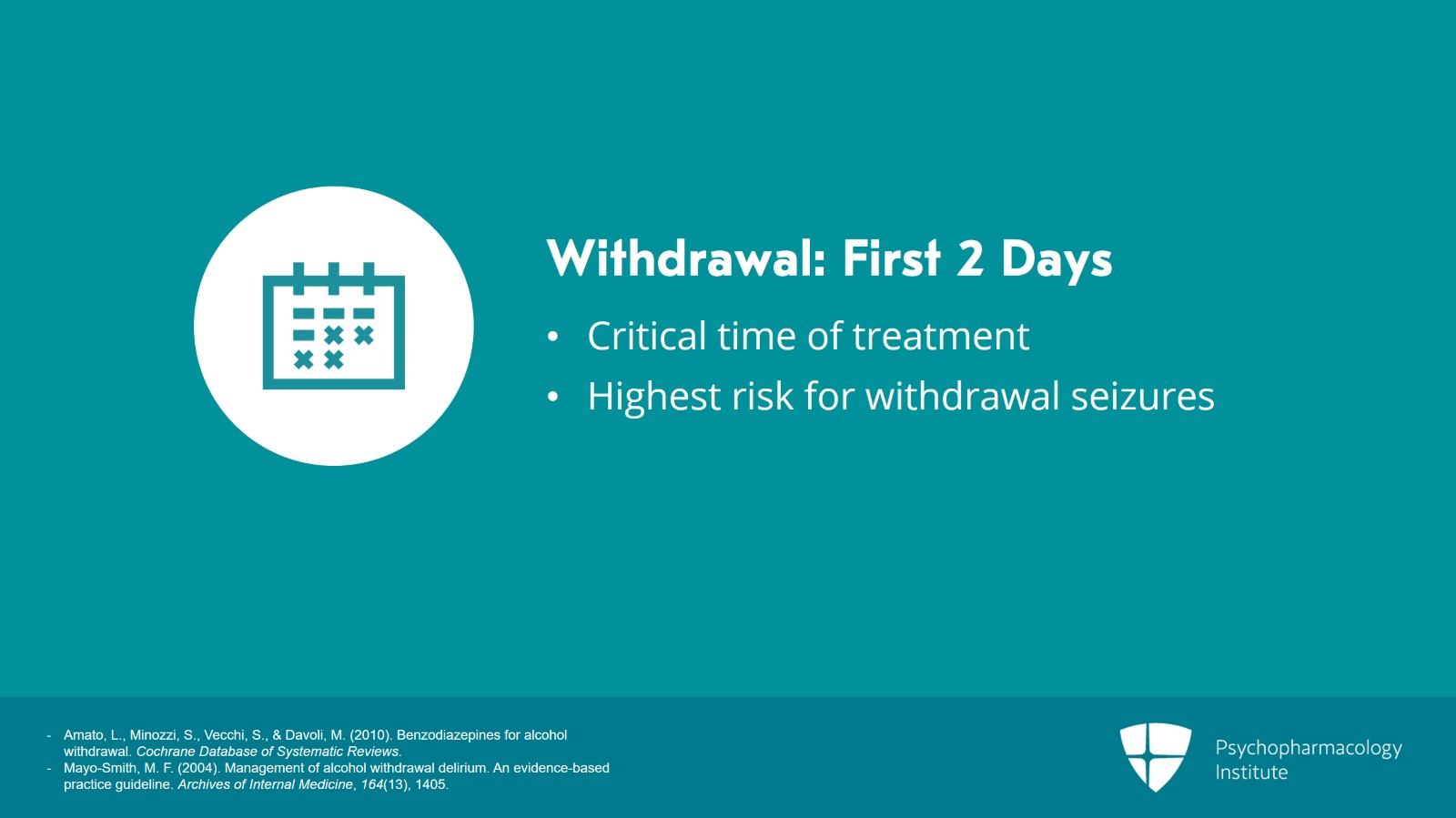
But in terms of managing the withdrawal, the first day or two after they begin to emerge is the critical time when individuals need to be treated. And this is also the timeframe that the individuals are most at risk for withdrawal seizures if they are going to occur, typically tonic-clonic seizures that occur in a single seizure or in rapid burst.
References:
  • Amato, L., Minozzi, S., Vecchi, S., & Davoli, M. (2010). Benzodiazepines for alcohol withdrawal. Cochrane Database of Systematic Reviews.
  • Mayo-Smith, M. F. (2004). Management of alcohol withdrawal delirium. An evidence-based practice guideline. Archives of Internal Medicine, 164(13), 1405. 

Slide 6 of 17

But for some individuals, the most feared consequence of alcohol withdrawal is really the progression to delirium tremens or DTs. And this really occurs in the context of poorly managed withdrawal and it’s really a medical emergency that absolutely requires hospital-level treatment. In many places, it’s ICU transfer.
References:
  • Amato, L., Minozzi, S., Vecchi, S., & Davoli, M. (2010). Benzodiazepines for alcohol withdrawal. Cochrane Database of Systematic Reviews.
  • Mayo-Smith, M. F. (2004). Management of alcohol withdrawal delirium. An evidence-based practice guideline. Archives of Internal Medicine, 164(13), 1405. 
Free Files
Success!
Check your inbox, we sent you all the materials there.
Slide 7 of 17

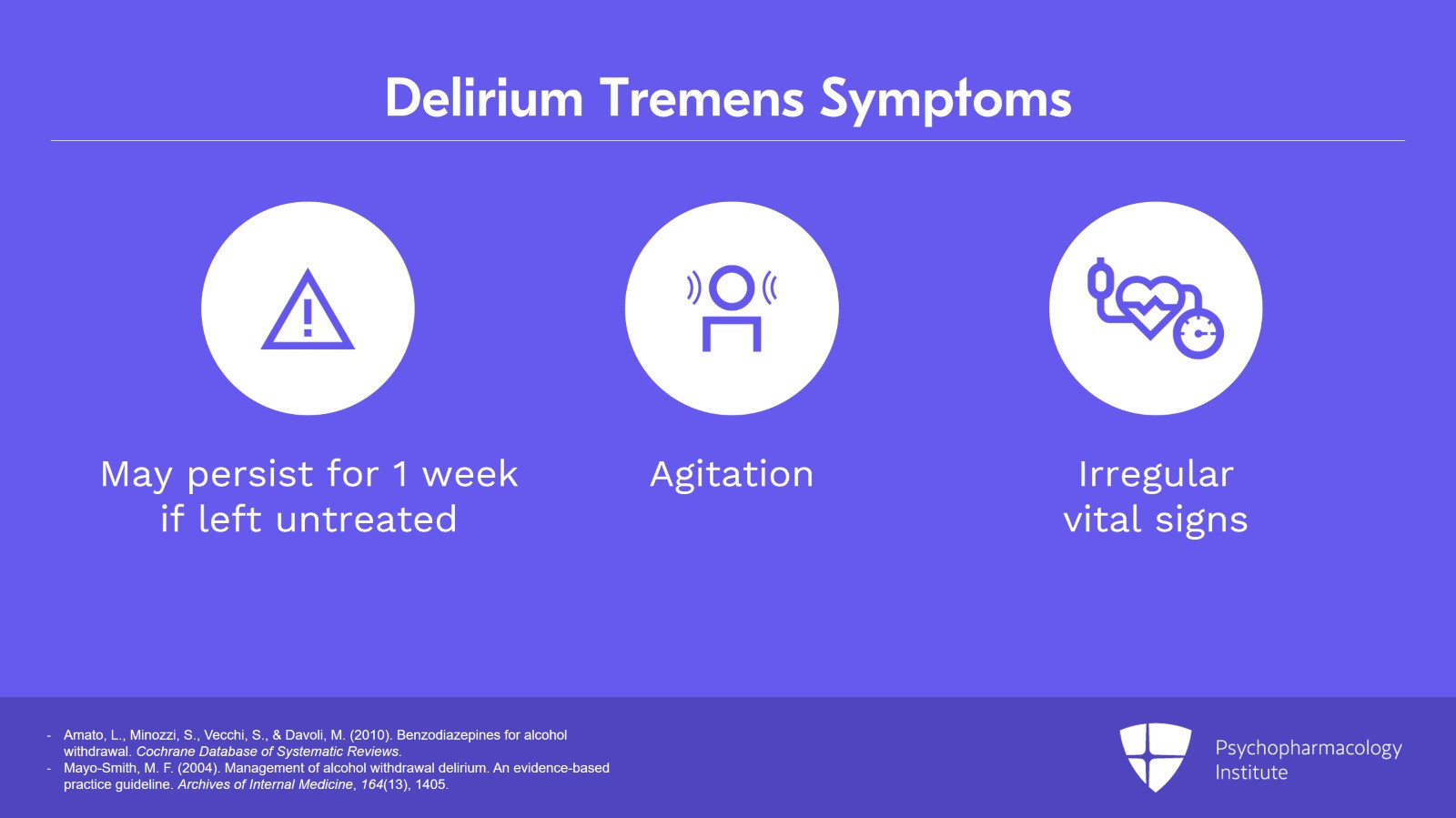
And DTs are characterized by severe symptoms which can persist for up to a week if left untreated. And patients are really toxic looking. They’re highly agitated, you know. Vital signs are highly irregular.
References:
  • Amato, L., Minozzi, S., Vecchi, S., & Davoli, M. (2010). Benzodiazepines for alcohol withdrawal. Cochrane Database of Systematic Reviews.
  • Mayo-Smith, M. F. (2004). Management of alcohol withdrawal delirium. An evidence-based practice guideline. Archives of Internal Medicine, 164(13), 1405. 

Slide 8 of 17

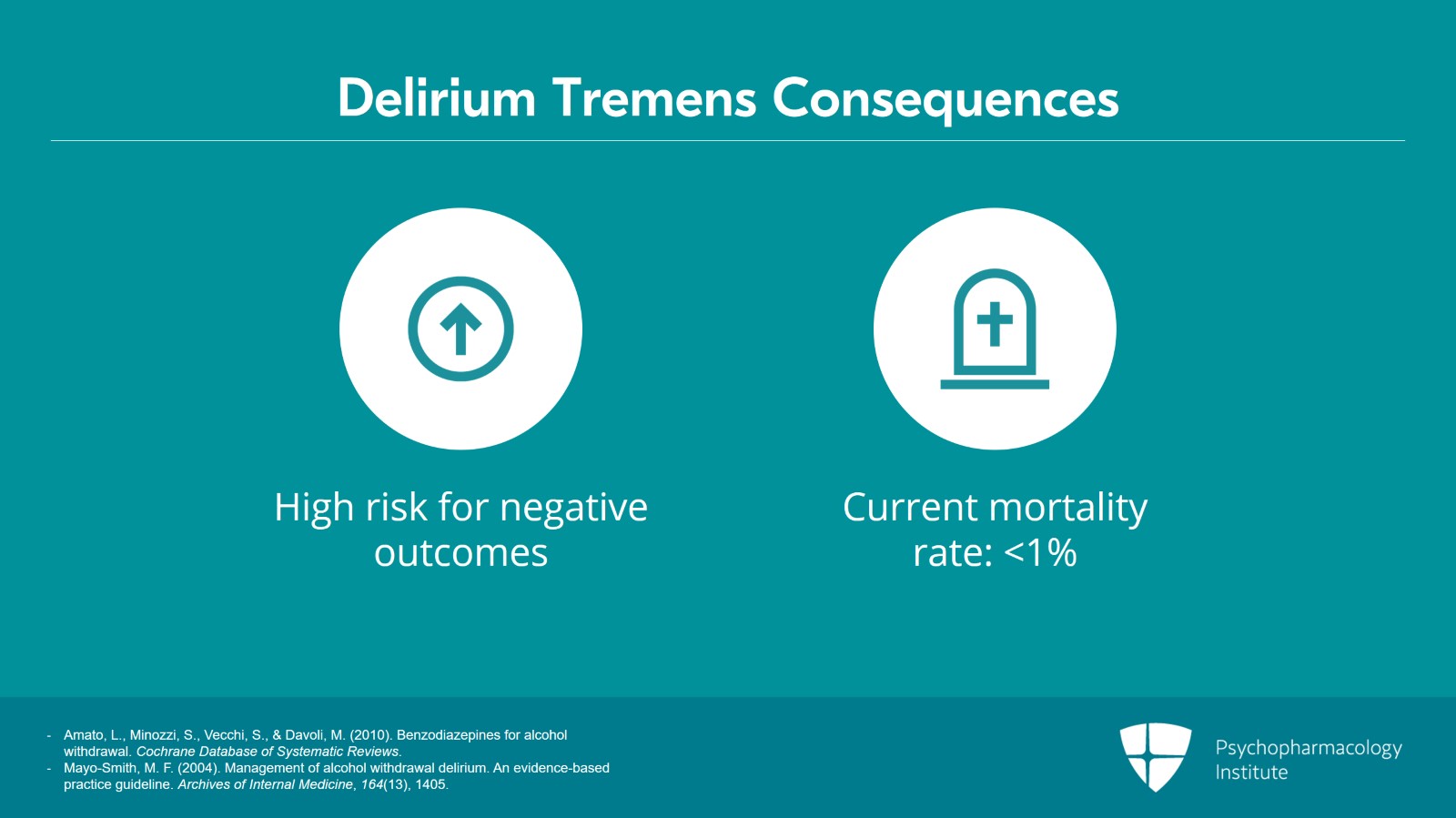
And patients are extremely high risk for negative outcomes. Historically, before adequate treatment was offered, mortality rates were as high as 30%–40%. Today, it’s sub-1% level. So in the hospital setting, this is well managed but still it’s considered a medical emergency.
References:
  • Amato, L., Minozzi, S., Vecchi, S., & Davoli, M. (2010). Benzodiazepines for alcohol withdrawal. Cochrane Database of Systematic Reviews.
  • Mayo-Smith, M. F. (2004). Management of alcohol withdrawal delirium. An evidence-based practice guideline. Archives of Internal Medicine, 164(13), 1405. 
Free Files
Success!
Check your inbox, we sent you all the materials there.
Slide 9 of 17

One of the challenges of DTs is that we actually don’t have a good way to predict it. The majority of patients who have DTs have severe alcohol use disorder and prior history of DTs which turns out to be the strongest predictor. But otherwise, we actually don’t have a good way of predicting.
References:
  • Amato, L., Minozzi, S., Vecchi, S., & Davoli, M. (2010). Benzodiazepines for alcohol withdrawal. Cochrane Database of Systematic Reviews.
  • Mayo-Smith, M. F. (2004). Management of alcohol withdrawal delirium. An evidence-based practice guideline. Archives of Internal Medicine, 164(13), 1405. 

Slide 10 of 17

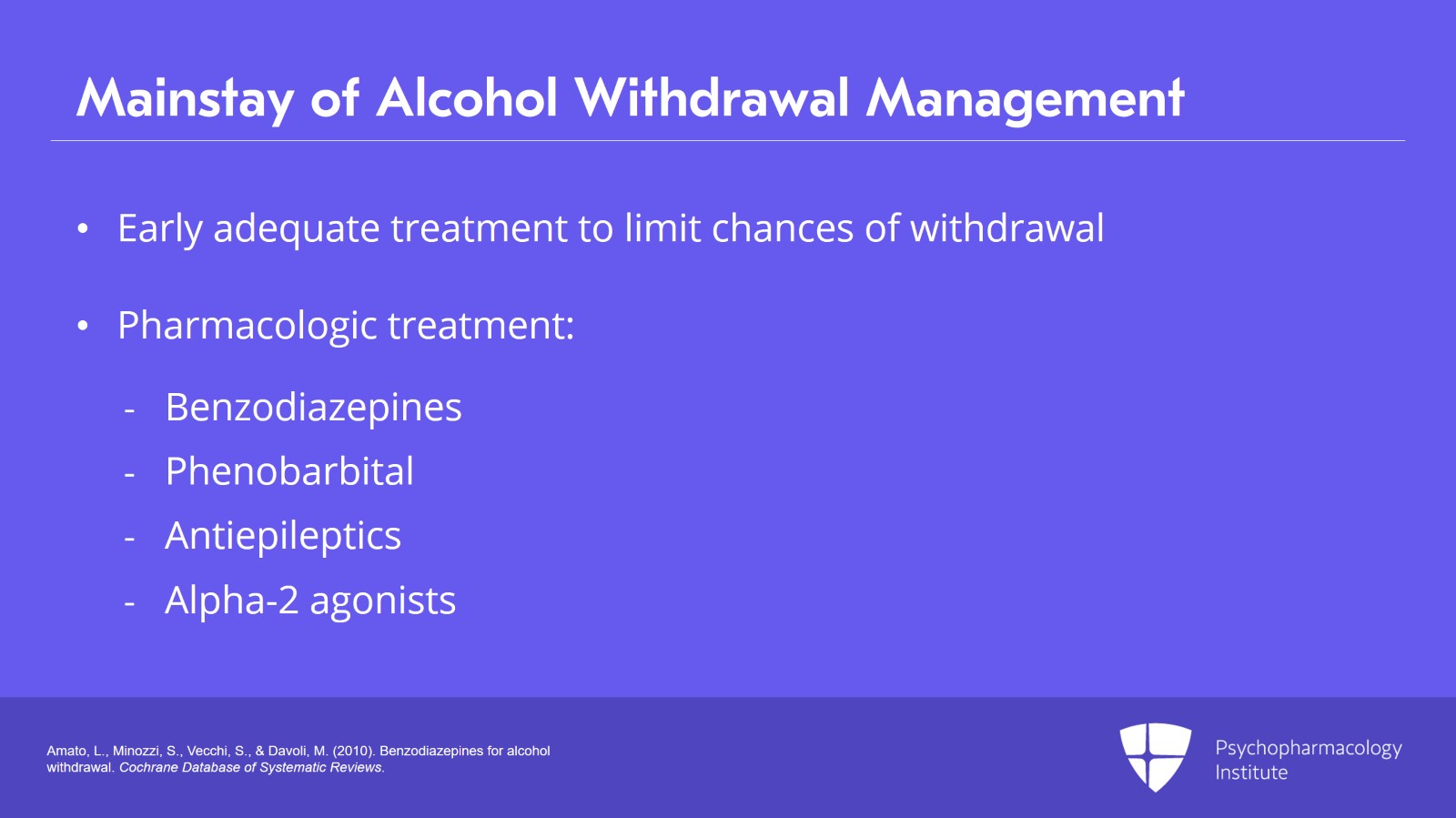
And therefore, the mainstay of alcohol withdrawal management is early adequate treatment. If you do that, that should really limit the chances of progressing to more severe forms of withdrawal including seizures and DTs. So the mainstay of treatment of alcohol withdrawal is pharmacologic treatment with benzodiazepines. Of course, there are many other agents that are used today. Phenobarbital, for example, is gaining a lot of interest. There are antiepileptics, you know, anti-seizure medications which can be used or alpha-2 agonists which include things like clonidine or dexmedetomidine.
References:
  • Amato, L., Minozzi, S., Vecchi, S., & Davoli, M. (2010). Benzodiazepines for alcohol withdrawal. Cochrane Database of Systematic Reviews.
Free Files
Success!
Check your inbox, we sent you all the materials there.
Slide 11 of 17

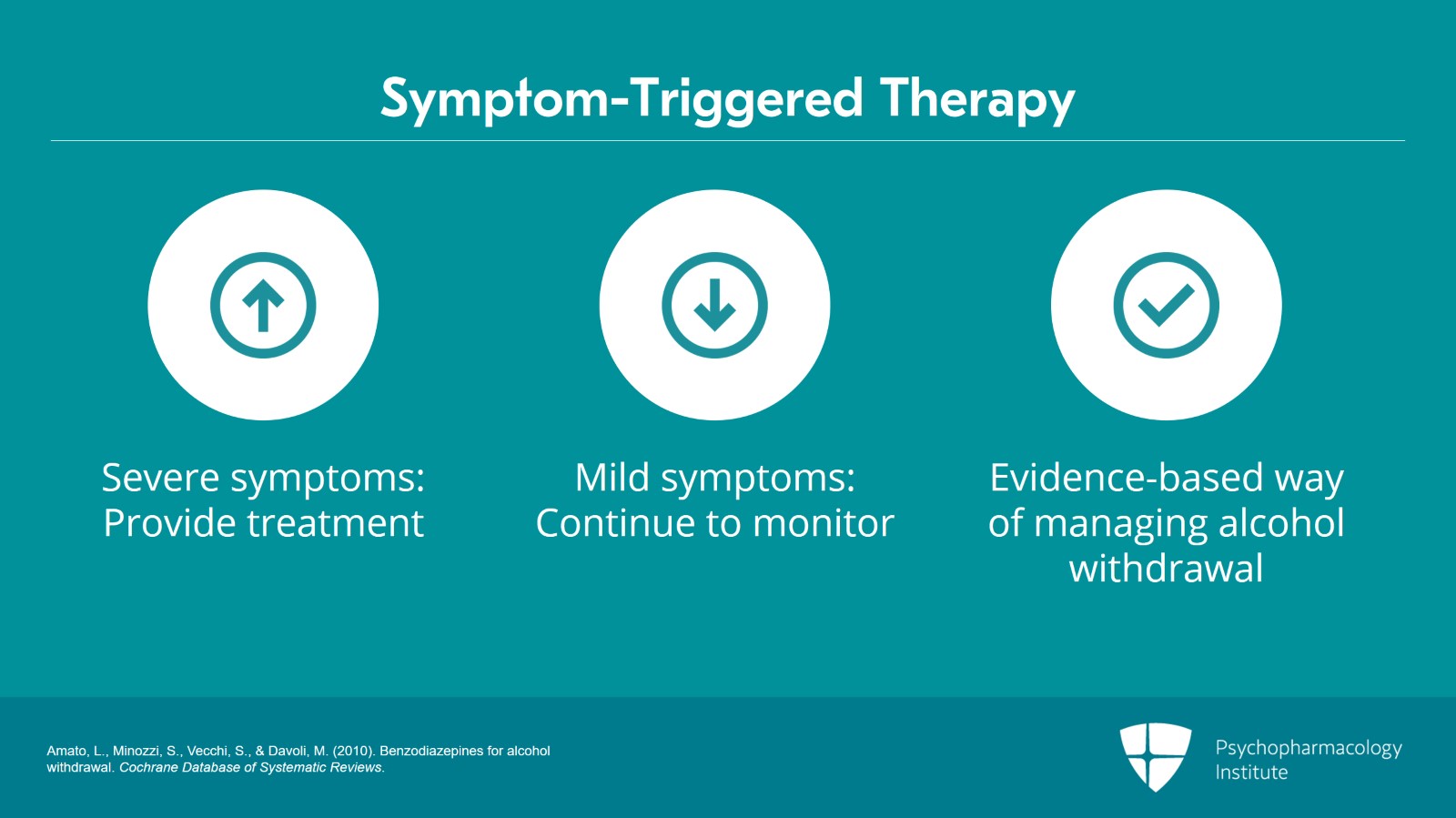
So the symptom-triggered therapy is when treatment is provided only if the symptoms are severe. That would indicate that some type of medication may need to be administered. But if it’s lower than that, then you actually just simply continue to monitor. And this is considered perfectly appropriate in evidence-based way of managing alcohol withdrawal. It ensures that those who need pharmacologic treatment will get it but those who don’t need it because it’s only mild withdrawal actually don’t receive anything. Because benzodiazepines on its own can actually be problematic if it’s given to people who actually don’t need it. And so this is considered a safe, appropriate way to use this.
References:
  • Amato, L., Minozzi, S., Vecchi, S., & Davoli, M. (2010). Benzodiazepines for alcohol withdrawal. Cochrane Database of Systematic Reviews.

Slide 12 of 17

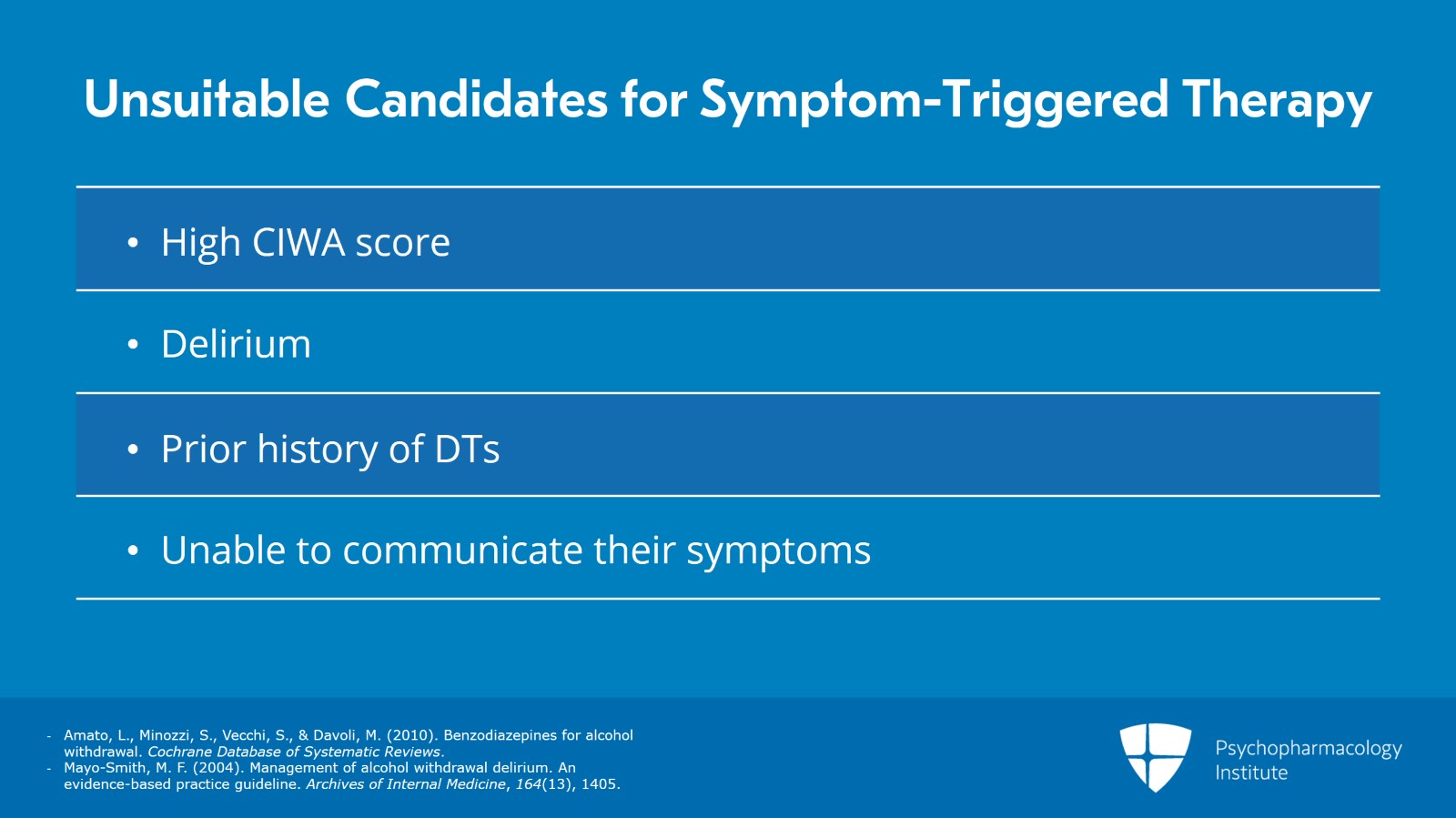
Those who score high on the CIWA or those who are already delirious or those who have prior history of DTs actually would not be suitable candidates for the symptom-triggered therapy or the CIWA-based approaches.   The CIWA is a gold standard withdrawal monitoring tool. Another example of individuals who should not be placed on CIWA-based approaches are those who are unable to report their symptoms, so people who are intubated, unconscious or somehow verbally unable to communicate. For those patients, a fixed-dose regimen of some type needs to be administered.
References:
  • Amato, L., Minozzi, S., Vecchi, S., & Davoli, M. (2010). Benzodiazepines for alcohol withdrawal. Cochrane Database of Systematic Reviews.
  • Mayo-Smith, M. F. (2004). Management of alcohol withdrawal delirium. An evidence-based practice guideline. Archives of Internal Medicine, 164(13), 1405. 
Free Files
Success!
Check your inbox, we sent you all the materials there.
Slide 13 of 17

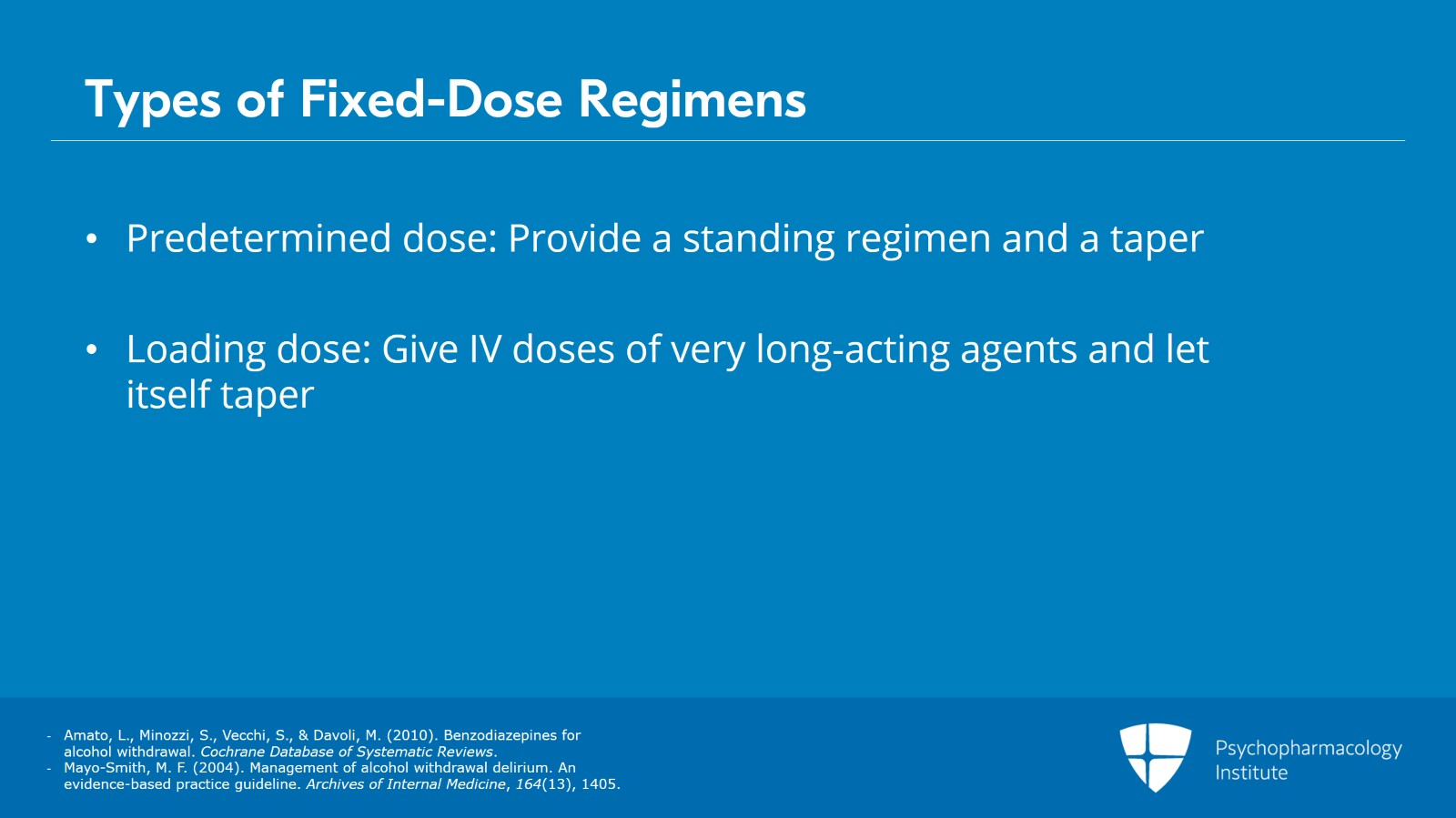
And so some type of fixed-dose regimen is predetermine how much they’re going to get and provide a standing regimen and a taper. Another iteration of fixed-dose regimen is to do what’s called a loading dose where you actually give IV doses of things like diazepam or phenobarbital which are very long-acting agents on day 1 and then simply let itself taper or provide a tapering dose of the medications.
References:
  • Amato, L., Minozzi, S., Vecchi, S., & Davoli, M. (2010). Benzodiazepines for alcohol withdrawal. Cochrane Database of Systematic Reviews.
  • Mayo-Smith, M. F. (2004). Management of alcohol withdrawal delirium. An evidence-based practice guideline. Archives of Internal Medicine, 164(13), 1405. 

Slide 14 of 17

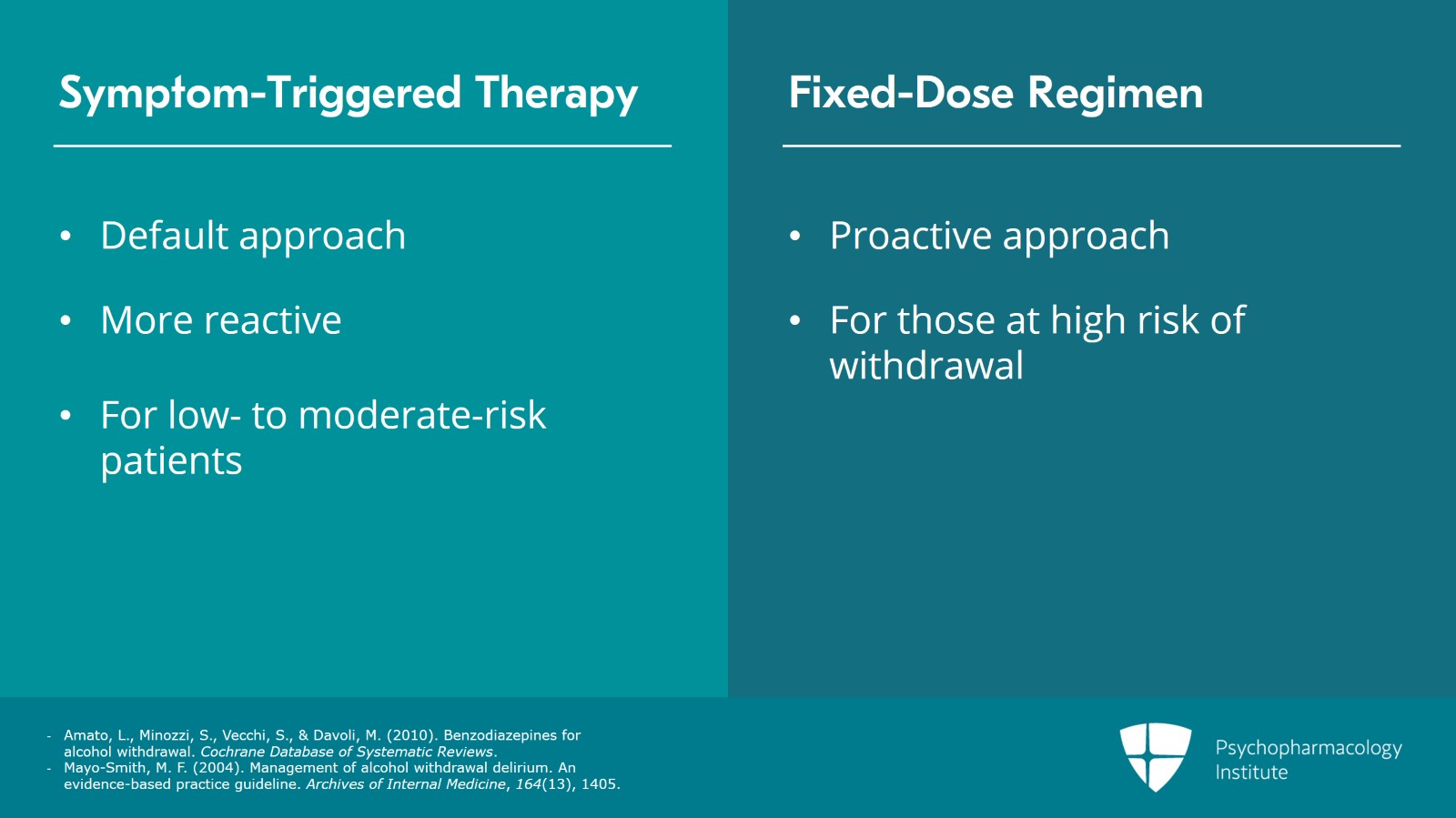
So the bottom line, symptom-triggered therapy is a default approach unless there are certain contraindications in which case a fixed-dose regimen is recommended. Symptom-triggered has a more reactive approach which is considered, you know, reasonable for low- to moderate-risk patients. And really, the fixed-dose regimen is a proactive way of managing that’s why it’s reserved for those more at high risk of withdrawal.
References:
  • Amato, L., Minozzi, S., Vecchi, S., & Davoli, M. (2010). Benzodiazepines for alcohol withdrawal. Cochrane Database of Systematic Reviews.
  • Mayo-Smith, M. F. (2004). Management of alcohol withdrawal delirium. An evidence-based practice guideline. Archives of Internal Medicine, 164(13), 1405. 14
Free Files
Success!
Check your inbox, we sent you all the materials there.

Slide 15 of 17

So key points for this section is that alcohol withdrawal is usually mild and self-limited in nature but for some it can progress to more severe withdrawal which is prevented by adequate early treatment which is a gold standard approach.

Slide 16 of 17

Now, symptom-triggered therapy using things like the CIWA tool is considered suitable for the majority of patients. But for those who are at high risk, for example, any prior history of DTs or seizures, those patients are too high risk to be placed on symptom-triggered therapy. And a fixed-dose regimen is considered a better option.
Free Files
Success!
Check your inbox, we sent you all the materials there.
Slide 17 of 17

Learning Objectives:

After completing this activity, the learner will be able to:

  1. Describe approaches in the assessment of alcohol use disorder.
  2. Identify the consequences of alcohol use disorder, including withdrawal and nutritional deficiencies.
  3. Discuss pharmacologic and nonpharmacologic strategies used in the management of alcohol use disorder and comorbid conditions.

Original Release Date: 07/01/2021

Review and Re-release Date: 03/01/2024

Expiration Date: 04/01/2025

Expert: Joji Suzuki, M.D.

Medical Editor: Melissa Mariano, M.D

Relevant Financial Disclosures:

None of the faculty, planners, and reviewers for this educational activity have relevant financial relationship(s) to disclose during the last 24 months with ineligible companies whose primary business is producing, marketing, selling, re-selling, or distributing healthcare products used by or on patients.

Contact Information: For questions regarding the content or access to this activity, contact us at support@psychopharmacologyinstitute.com

Instructions for Participation and Credit:

Participants must complete the activity online during the valid credit period that is noted above.

Follow these steps to earn CME credit:

  1. View the required educational content provided on this course page.
  2. Complete the Post Activity Evaluation for providing the necessary feedback for continuing accreditation purposes and for the development of future activities. NOTE: Completing the Post Activity Evaluation after the quiz is required to receive the earned credit.
  3. Download your certificate.

Accreditation Statement

This activity has been planned and implemented in accordance with the accreditation requirements and policies of the Accreditation Council for Continuing Medical Education through the joint providership of Medical Academy LLC and the Psychopharmacology Institute. Medical Academy is accredited by the ACCME to provide continuing medical education for physicians.

Credit Designation Statement

Medical Academy designates this enduring activity for a maximum of 1.00 AMA PRA Category 1 credit(s). Physicians should claim only the credit commensurate with the extent of their participation in the activity.

Free Files
Success!
Check your inbox, we sent you all the materials there.
Continue in the website
Instant access modal

Become a Bronze, Silver, Gold, Bronze extended, Silver extended or Gold extended Member.

2025–26 Psychopharmacology CME Program

Unlock up to 155 CME Credits, including 40 SA CME Credits.