Slides and Transcript
Slide 1 of 27
The next section is QT prolongation with antidepressants. We’re now going to return to the topic of QT prolongation and we’re going to focus on another class of agents.
Slide 2 of 27
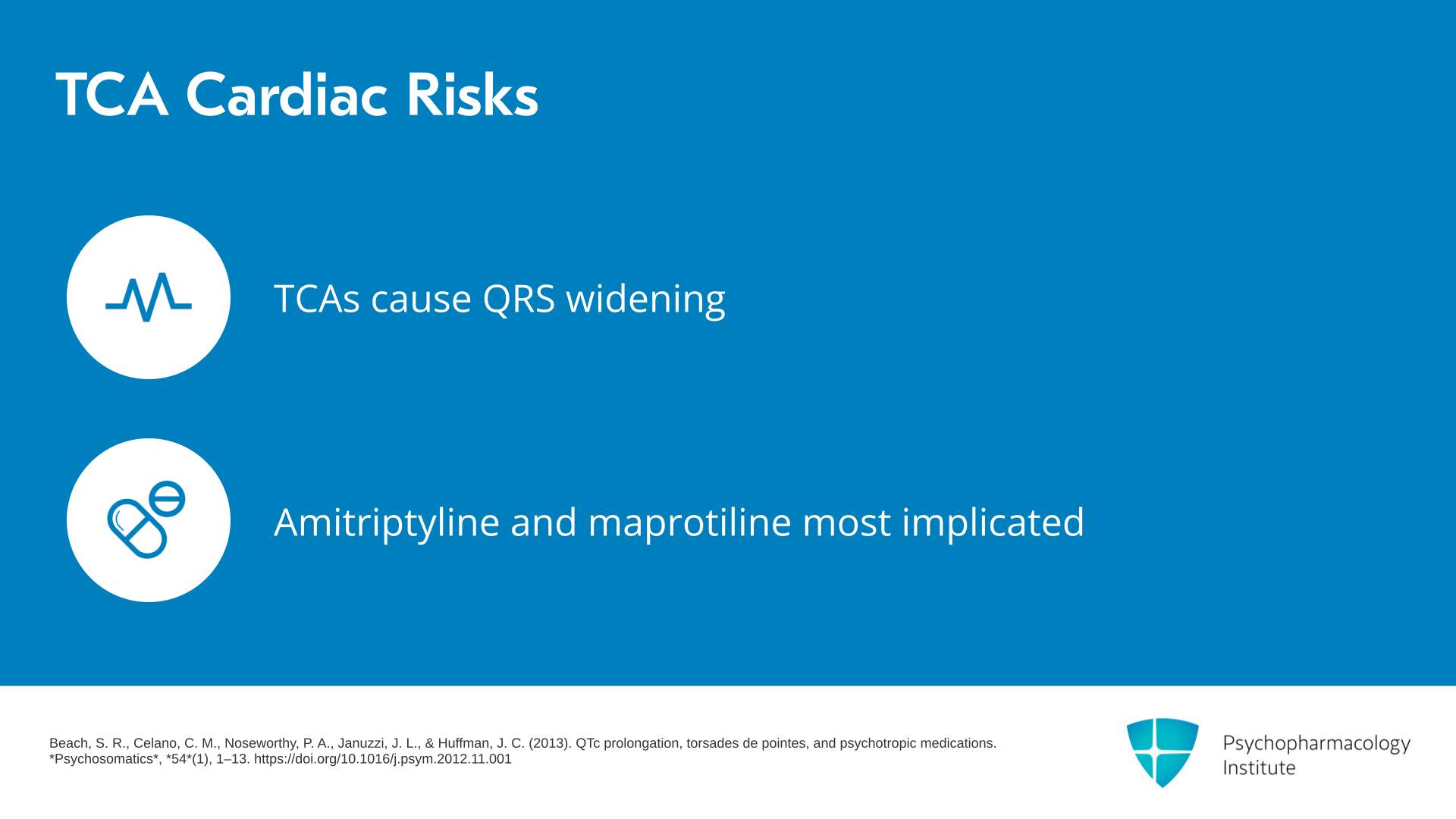
So a common question is, which antidepressants prolong the QT interval? Tricyclic antidepressants are sodium channel blockers. They tend to cause QRS widening and because of that they pose danger at therapeutic doses primarily in patients with pre-existing bundle branch disease or ischemic heart disease. Of TCAs, amitriptyline and maprotiline are the most commonly implicated. Clomipramine may actually be the least likely to cause QRS widening.
References:
- Beach, S. R., Celano, C. M., Noseworthy, P. A., Januzzi, J. L., & Huffman, J. C. (2013). QTc prolongation, torsades de pointes, and psychotropic medications. *Psychosomatics*, *54*(1), 1–13. https://doi.org/10.1016/j.psym.2012.11.001
Free Files
Download PDF and other files
Success!
Check your inbox, we sent you all the materials there.
Slide 3 of 27
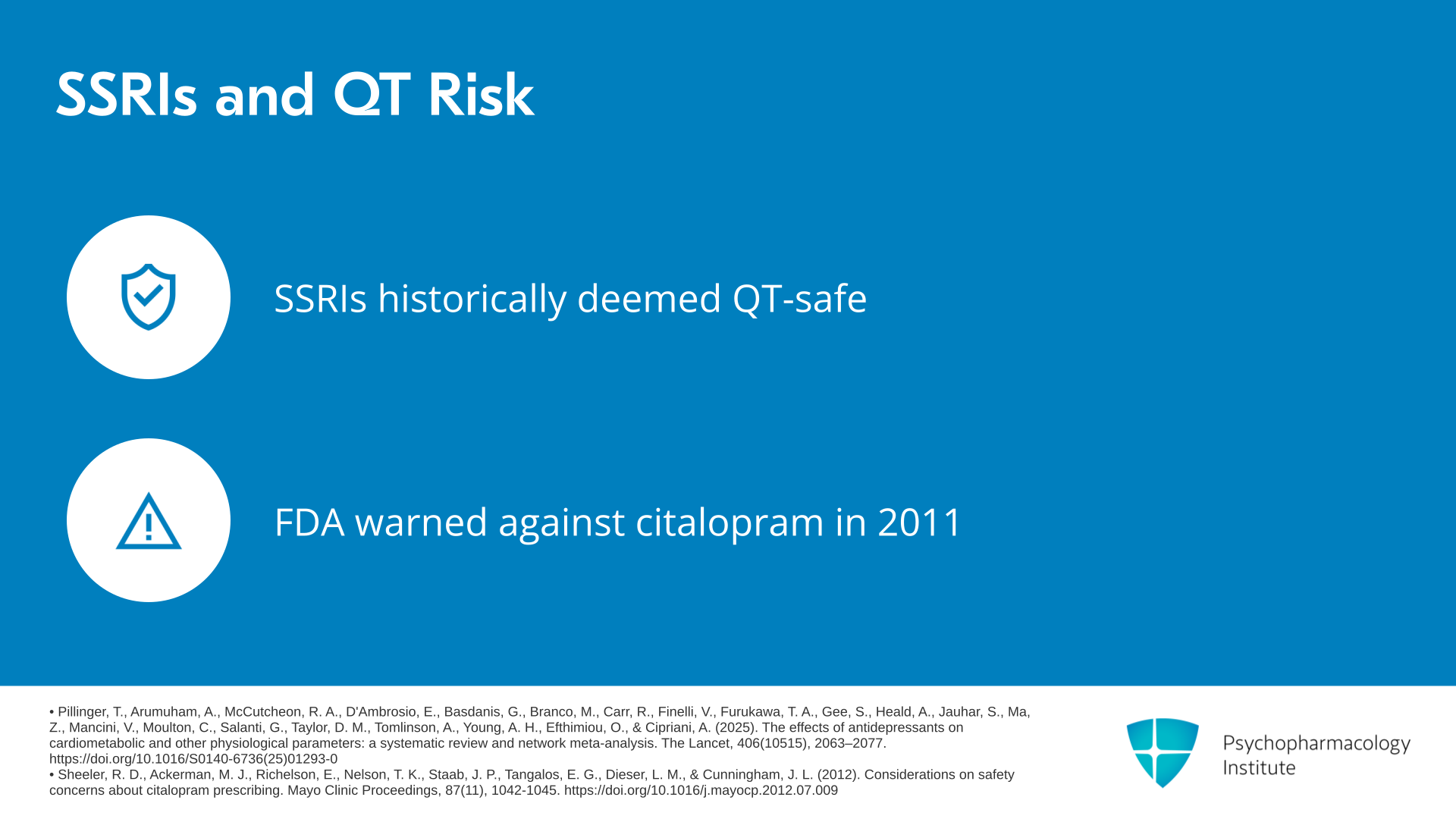
For a long time, SSRIs had been considered safe in terms of QT prolongation and again they’re the most studied agents in cardiac populations. That changed a little bit in 2011 when the FDA issued a warning regarding citalopram and then later revised recommendations saying that citalopram was not recommended at doses greater than 40 mg and that it should be discontinued in anyone with a QTc of greater than 500 ms.
References:
- Pillinger, T., Arumuham, A., McCutcheon, R. A., D'Ambrosio, E., Basdanis, G., Branco, M., Carr, R., Finelli, V., Furukawa, T. A., Gee, S., Heald, A., Jauhar, S., Ma, Z., Mancini, V., Moulton, C., Salanti, G., Taylor, D. M., Tomlinson, A., Young, A. H., Efthimiou, O., & Cipriani, A. (2025). The effects of antidepressants on cardiometabolic and other physiological parameters: a systematic review and network meta-analysis. The Lancet, 406(10515), 2063–2077. https://doi.org/10.1016/S0140-6736(25)01293-0
- Sheeler, R. D., Ackerman, M. J., Richelson, E., Nelson, T. K., Staab, J. P., Tangalos, E. G., Dieser, L. M., & Cunningham, J. L. (2012). Considerations on safety concerns about citalopram prescribing. Mayo Clinic Proceedings, 87(11), 1042-1045. https://doi.org/10.1016/j.mayocp.2012.07.009
Slide 4 of 27
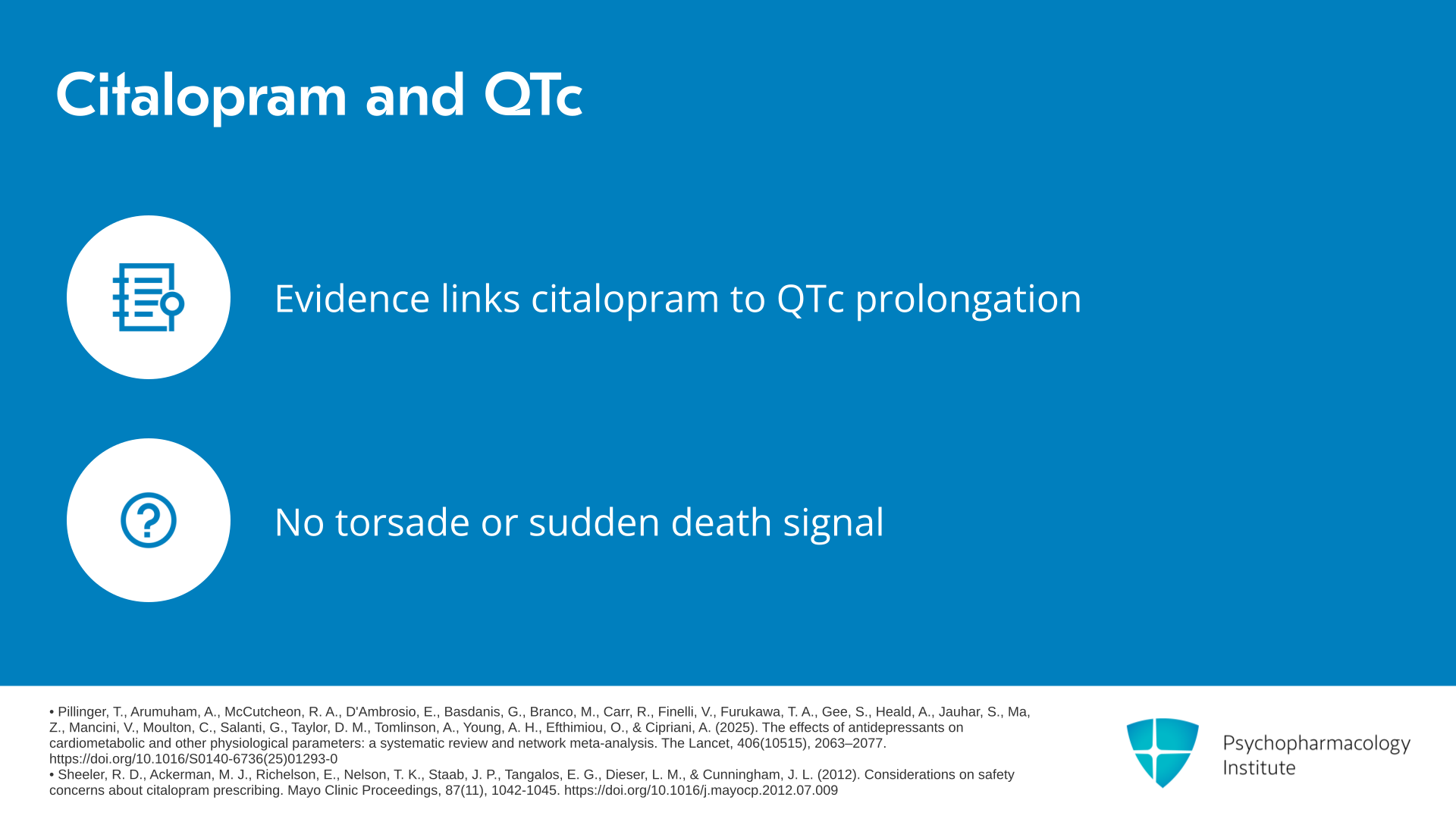
Since then, consistent evidence from subsequent studies does show a connection between citalopram and QTc prolongation. However, there is no signal for an increased risk of torsade, ventricular arrhythmias or sudden cardiac death. So we sort of interpret this as suggesting that citalopram probably does increase the QT interval but the actual risk associated with that increase is not clinically significant.
References:
- Pillinger, T., Arumuham, A., McCutcheon, R. A., D'Ambrosio, E., Basdanis, G., Branco, M., Carr, R., Finelli, V., Furukawa, T. A., Gee, S., Heald, A., Jauhar, S., Ma, Z., Mancini, V., Moulton, C., Salanti, G., Taylor, D. M., Tomlinson, A., Young, A. H., Efthimiou, O., & Cipriani, A. (2025). The effects of antidepressants on cardiometabolic and other physiological parameters: a systematic review and network meta-analysis. The Lancet, 406(10515), 2063–2077. https://doi.org/10.1016/S0140-6736(25)01293-0
- Sheeler, R. D., Ackerman, M. J., Richelson, E., Nelson, T. K., Staab, J. P., Tangalos, E. G., Dieser, L. M., & Cunningham, J. L. (2012). Considerations on safety concerns about citalopram prescribing. Mayo Clinic Proceedings, 87(11), 1042-1045. https://doi.org/10.1016/j.mayocp.2012.07.009
Free Files
Download PDF and other files
Success!
Check your inbox, we sent you all the materials there.
Slide 5 of 27
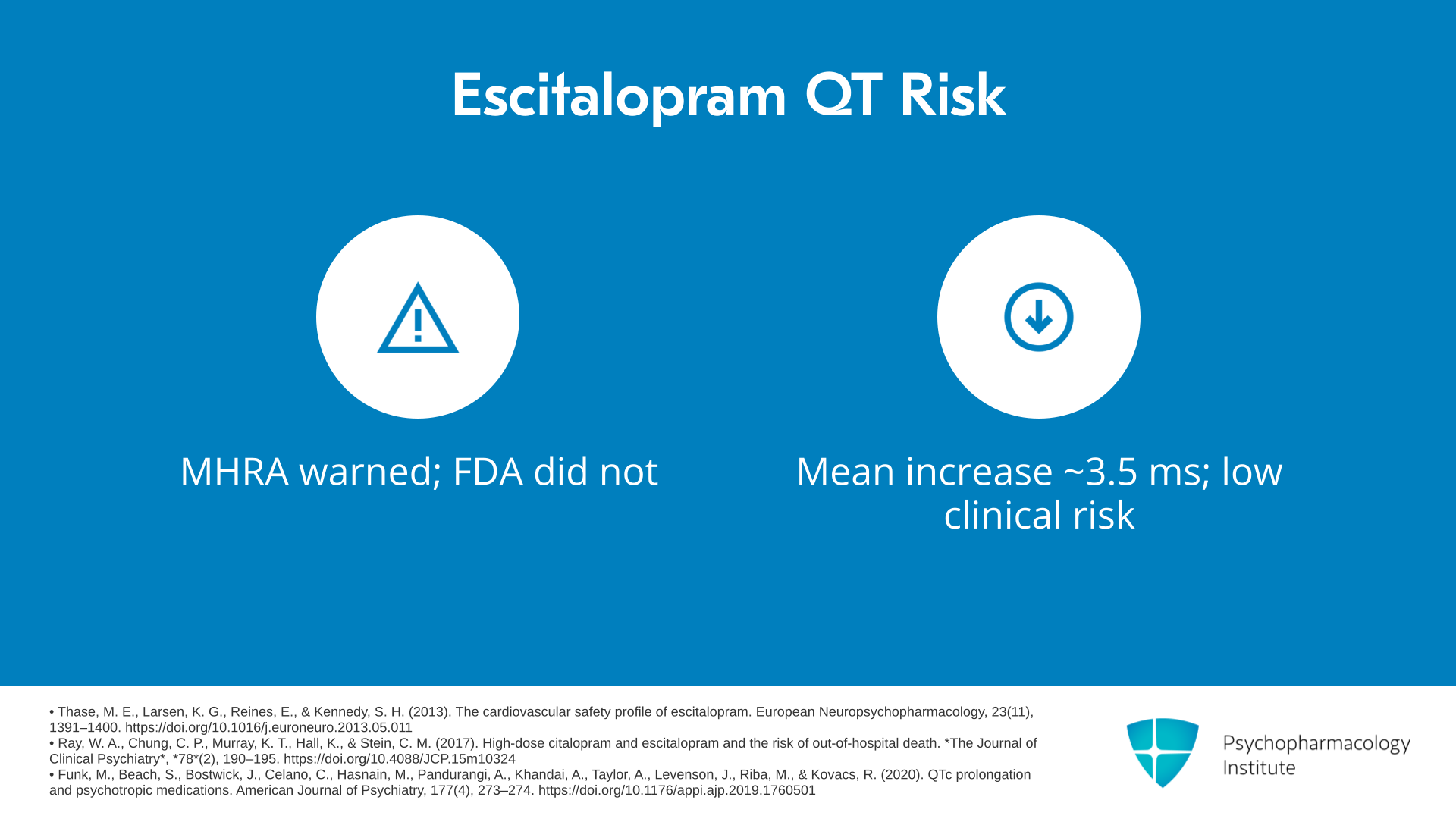
With regard to escitalopram, a similar pattern of dose-related QT lengthening was demonstrated in a Thorough QT study but that did not yield any FDA warning. The MHRA did issue a warning. Escitalopram does separate out from placebo and from other antidepressants in some studies. There’s a meta-analysis of patient level data, however, showing that the mean increase with escitalopram is only about 3.5 ms which is very unlikely to be clinically significant. And in a Tennessee Medicaid cohort study, escitalopram was not associated with greater mortality.
References:
- Thase, M. E., Larsen, K. G., Reines, E., & Kennedy, S. H. (2013). The cardiovascular safety profile of escitalopram. European Neuropsychopharmacology, 23(11), 1391–1400. https://doi.org/10.1016/j.euroneuro.2013.05.011
- Ray, W. A., Chung, C. P., Murray, K. T., Hall, K., & Stein, C. M. (2017). High-dose citalopram and escitalopram and the risk of out-of-hospital death. *The Journal of Clinical Psychiatry*, *78*(2), 190–195. https://doi.org/10.4088/JCP.15m10324
- Funk, M., Beach, S., Bostwick, J., Celano, C., Hasnain, M., Pandurangi, A., Khandai, A., Taylor, A., Levenson, J., Riba, M., & Kovacs, R. (2020). QTc prolongation and psychotropic medications. American Journal of Psychiatry, 177(4), 273–274. https://doi.org/10.1176/appi.ajp.2019.1760501
Slide 6 of 27
So our take-home there is that escitalopram probably carries some risk of very modest QT prolongation but it’s unlikely to be clinically significant. Despite that, it is still often grouped with citalopram as equivalent and that’s probably not exactly true.
References:
- Beach, S. R., Kostis, W. J., Celano, C. M., Januzzi, J. L., Ruskin, J. N., Noseworthy, P. A., & Huffman, J. C. (2014). Meta-analysis of selective serotonin reuptake inhibitor-associated QTc prolongation. Journal of Clinical Psychiatry, 75(5), e441–e449. https://doi.org/10.4088/JCP.13r08672
- Funk, M., Beach, S., Bostwick, J., Celano, C., Hasnain, M., Pandurangi, A., Khandai, A., Taylor, A., Levenson, J., Riba, M., & Kovacs, R. (2020). QTc prolongation and psychotropic medications. American Journal of Psychiatry, 177(4), 273–274. https://doi.org/10.1176/appi.ajp.2019.1760501
Free Files
Download PDF and other files
Success!
Check your inbox, we sent you all the materials there.
Slide 7 of 27
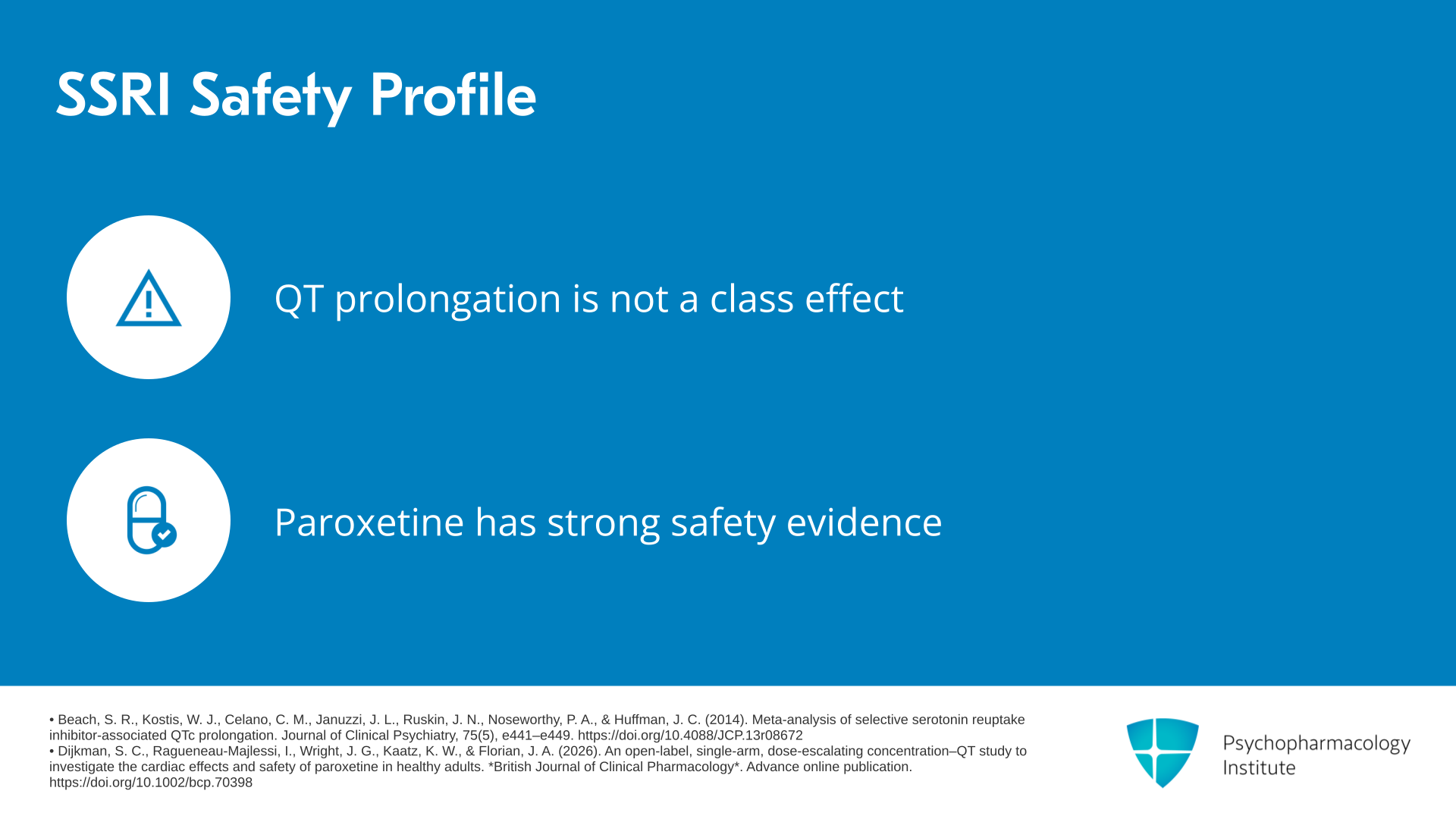
Importantly, we still consider other SSRIs to be entirely safe with regard to QT prolongation. This is not a class effect. Many studies have now shown no signal for QT prolongation with SSRIs like sertraline, fluoxetine and paroxetine. In fact, paroxetine has a 2026 QT concentration study showing no QT prolongation in healthy individuals.
References:
- Beach, S. R., Kostis, W. J., Celano, C. M., Januzzi, J. L., Ruskin, J. N., Noseworthy, P. A., & Huffman, J. C. (2014). Meta-analysis of selective serotonin reuptake inhibitor-associated QTc prolongation. Journal of Clinical Psychiatry, 75(5), e441–e449. https://doi.org/10.4088/JCP.13r08672
- Dijkman, S. C., Ragueneau-Majlessi, I., Wright, J. G., Kaatz, K. W., & Florian, J. A. (2026). An open-label, single-arm, dose-escalating concentration–QT study to investigate the cardiac effects and safety of paroxetine in healthy adults. *British Journal of Clinical Pharmacology*. Advance online publication. https://doi.org/10.1002/bcp.70398
Slide 8 of 27
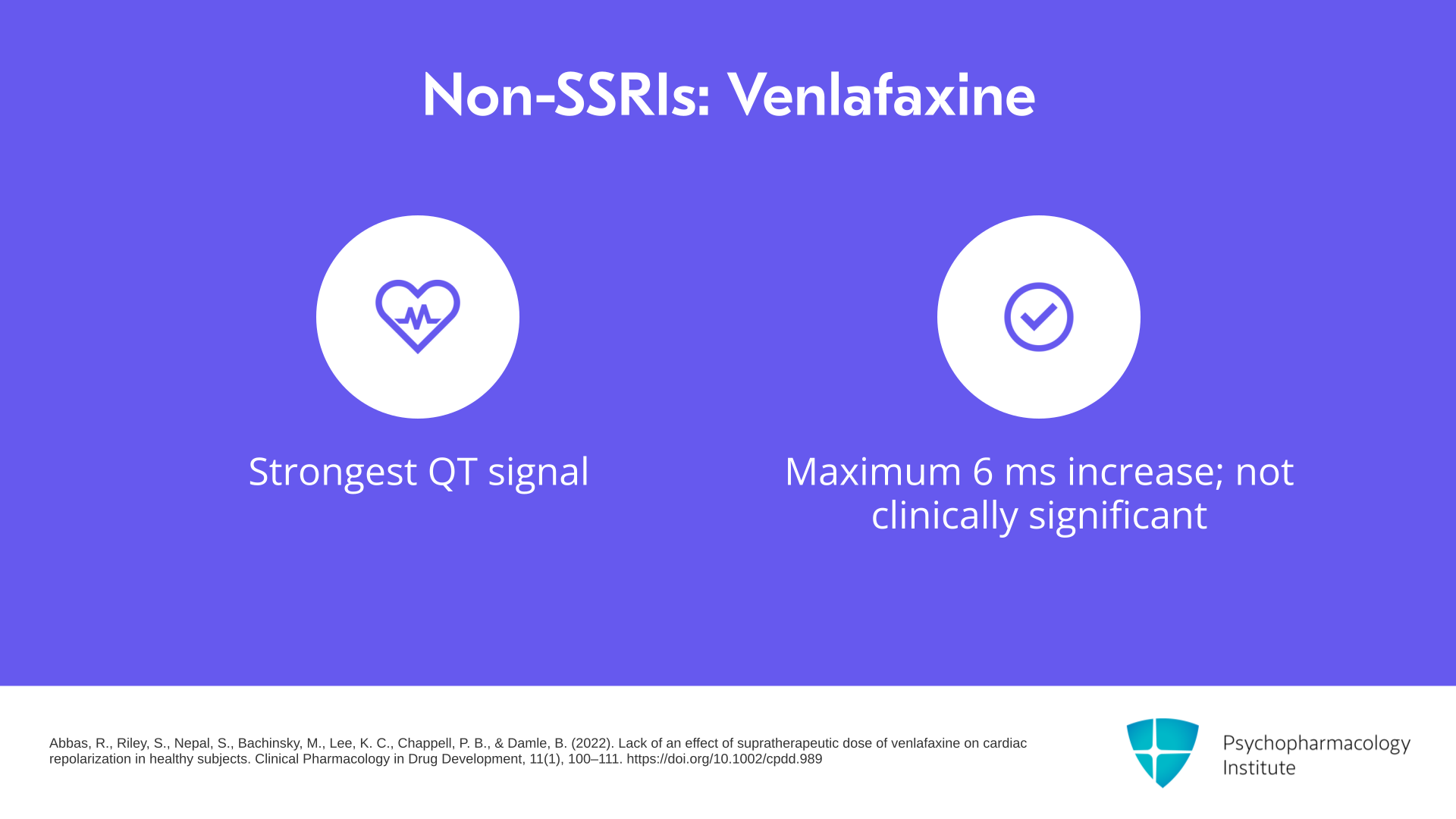
So what about some other antidepressants and QT prolongation? Among non-SSRI, non-tricyclic antidepressants, the one with the most signal for QT prolongation is probably venlafaxine but most cases occur either in the setting of overdose or in patients with other risk factors. Venlafaxine does in fact have a 2022 Thorough QT study suggesting a maximum of 6 ms increase. Again, very unlikely to be clinically significant.
References:
- Abbas, R., Riley, S., Nepal, S., Bachinsky, M., Lee, K. C., Chappell, P. B., & Damle, B. (2022). Lack of an effect of supratherapeutic dose of venlafaxine on cardiac repolarization in healthy subjects. Clinical Pharmacology in Drug Development, 11(1), 100–111. https://doi.org/10.1002/cpdd.989
Free Files
Download PDF and other files
Success!
Check your inbox, we sent you all the materials there.
Slide 9 of 27
Bupropion has some reports of QT prolongation but these occur mostly in the setting of overdose and are likely confounded by tachycardia.
References:
- Isbister, G. K., & Balit, C. R. (2003). Bupropion overdose: QTc prolongation and its clinical significance. Annals of Pharmacotherapy, 37(7–8), 999–1002. https://doi.org/10.1345/aph.1C481
Slide 10 of 27
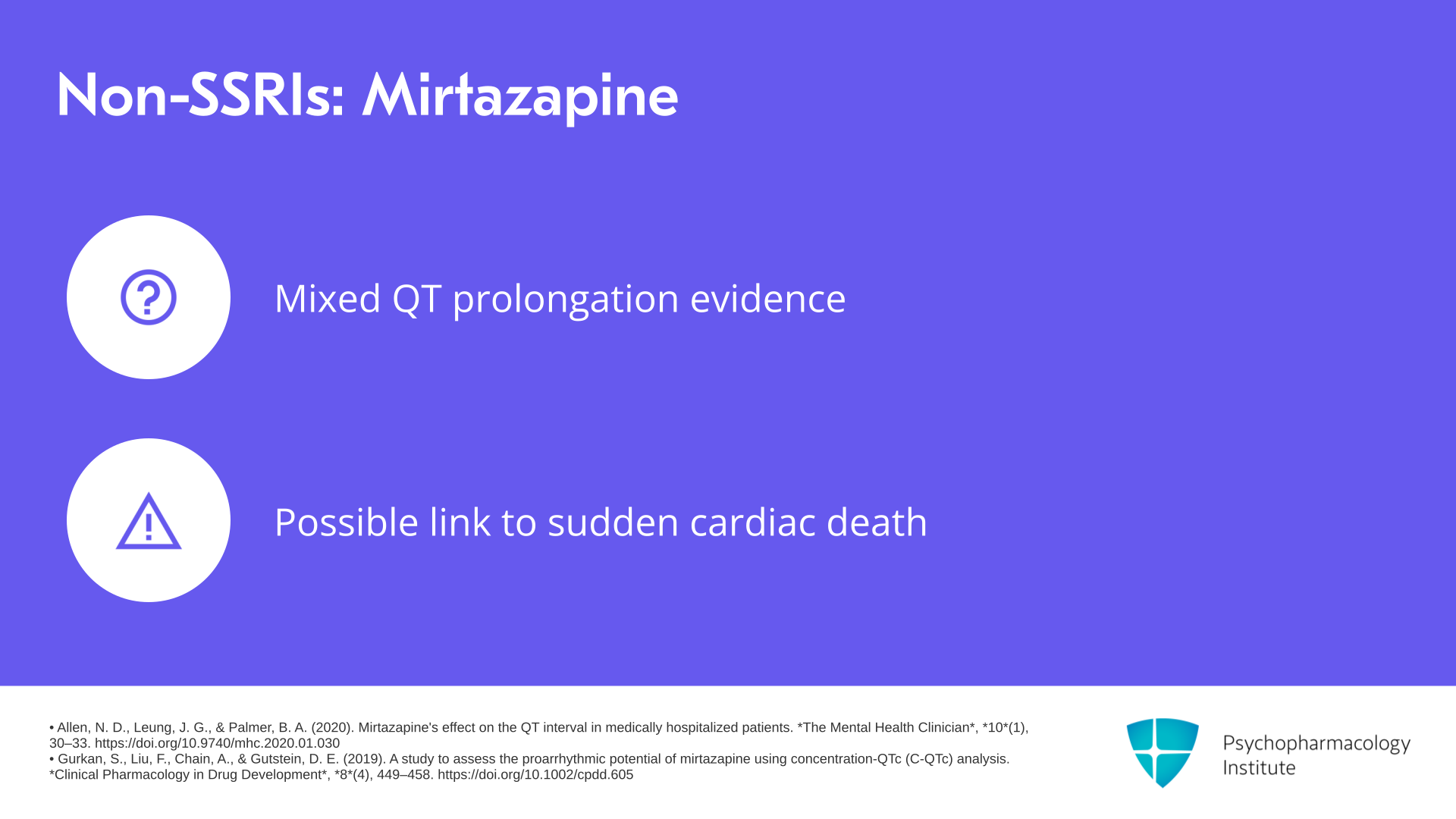
Mirtazapine is kind of a mixed picture. There’s one study showing no patients with QT prolongation even in overdose, another small study in medically ill patients showing no QT change but there’s a QT concentration analysis suggesting a change of about 2 to 3 ms which would actually be similar to escitalopram. There’s another study linking mirtazapine to increased sudden cardiac death but the authors hesitated to make a causal association.
References:
- Allen, N. D., Leung, J. G., & Palmer, B. A. (2020). Mirtazapine's effect on the QT interval in medically hospitalized patients. *The Mental Health Clinician*, *10*(1), 30–33. https://doi.org/10.9740/mhc.2020.01.030
- Gurkan, S., Liu, F., Chain, A., & Gutstein, D. E. (2019). A study to assess the proarrhythmic potential of mirtazapine using concentration-QTc (C-QTc) analysis. *Clinical Pharmacology in Drug Development*, *8*(4), 449–458. https://doi.org/10.1002/cpdd.605
Free Files
Download PDF and other files
Success!
Check your inbox, we sent you all the materials there.
Slide 11 of 27
So overall, it’s hard to say. One interesting thing that I do sometimes here from primary teams is that mirtazapine is safer than other antidepressants with regard to QT prolongation. This definitely doesn’t seem to be true. That being said, I wouldn’t consider it a high-risk agent from that regard either.
References:
- Beach, S. R., Celano, C. M., Noseworthy, P. A., Januzzi, J. L., & Huffman, J. C. (2013). QTc prolongation, torsades de pointes, and psychotropic medications. *Psychosomatics*, *54*(1), 1–13. https://doi.org/10.1016/j.psym.2012.11.001
- Funk, M., Beach, S., Bostwick, J., Celano, C., Hasnain, M., Pandurangi, A., Khandai, A., Taylor, A., Levenson, J., Riba, M., & Kovacs, R. (2020). QTc prolongation and psychotropic medications. American Journal of Psychiatry, 177(4), 273–274. https://doi.org/10.1176/appi.ajp.2019.1760501
Slide 12 of 27
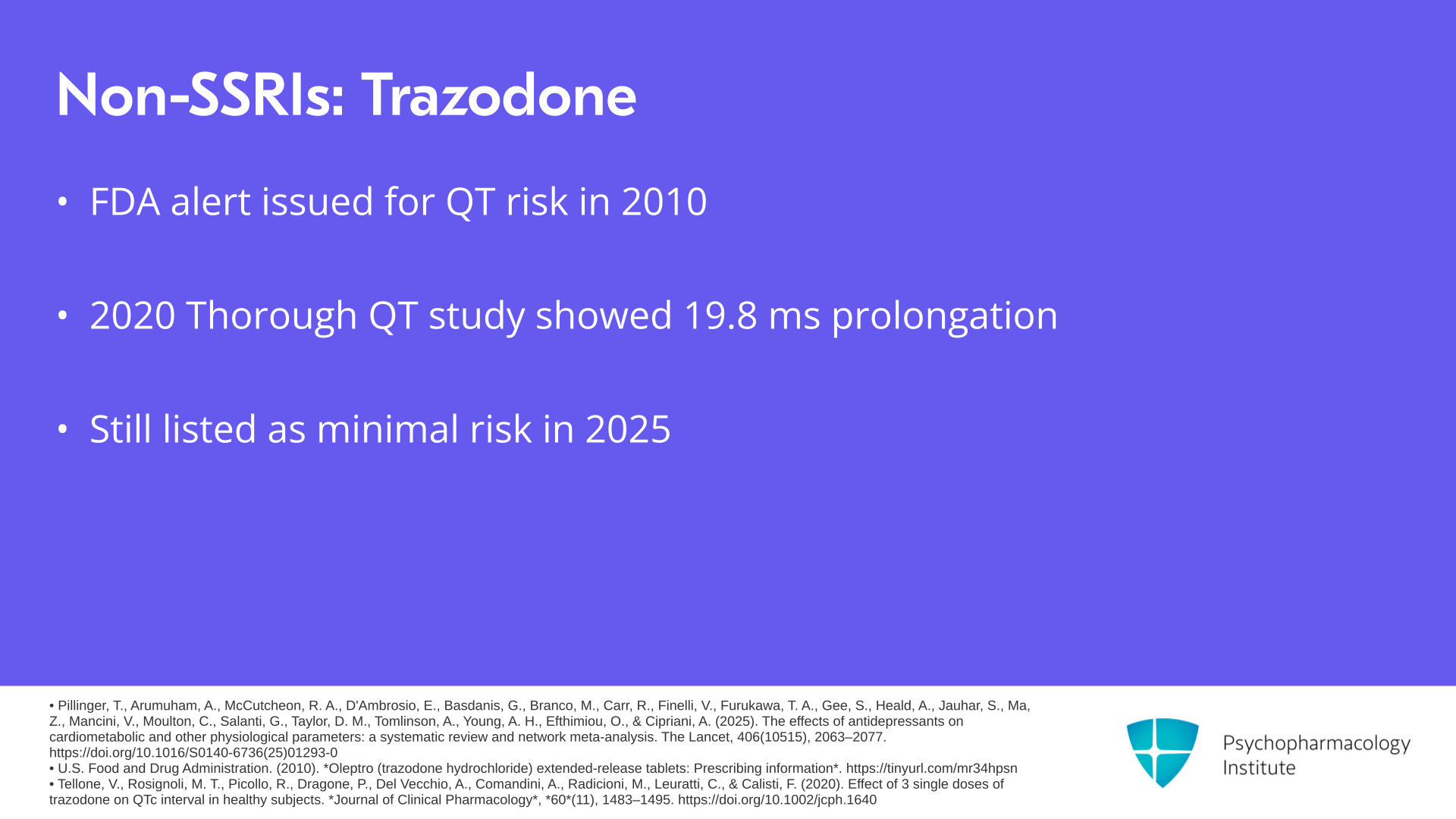
There are a few case reports showing a risk of transient QT prolongation in the setting of trazodone overdose and there’s actually a 2010 FDA safety alert related to QT prolongation with trazodone. That being said, I think most people including myself would have considered trazodone pretty safe in this regard and were quite surprised by a Thorough QT study in 2020 showing a prolongation of 19.8 ms at a dose of 140 mg. That’s similar to ziprasidone. Despite that study, it still is listed as minimal risk in a 2025 network meta-analysis of all antidepressants. But I think it’s important to keep in mind it’s one of the few agents that has a Thorough QT study and it did not look good in that study.
References:
- Pillinger, T., Arumuham, A., McCutcheon, R. A., D'Ambrosio, E., Basdanis, G., Branco, M., Carr, R., Finelli, V., Furukawa, T. A., Gee, S., Heald, A., Jauhar, S., Ma, Z., Mancini, V., Moulton, C., Salanti, G., Taylor, D. M., Tomlinson, A., Young, A. H., Efthimiou, O., & Cipriani, A. (2025). The effects of antidepressants on cardiometabolic and other physiological parameters: a systematic review and network meta-analysis. The Lancet, 406(10515), 2063–2077. https://doi.org/10.1016/S0140-6736(25)01293-0
- U.S. Food and Drug Administration. (2010). *Oleptro (trazodone hydrochloride) extended-release tablets: Prescribing information*. https://tinyurl.com/mr34hpsn
- Tellone, V., Rosignoli, M. T., Picollo, R., Dragone, P., Del Vecchio, A., Comandini, A., Radicioni, M., Leuratti, C., & Calisti, F. (2020). Effect of 3 single doses of trazodone on QTc interval in healthy subjects. *Journal of Clinical Pharmacology*, *60*(11), 1483–1495. https://doi.org/10.1002/jcph.1640
Free Files
Download PDF and other files
Success!
Check your inbox, we sent you all the materials there.
Slide 13 of 27
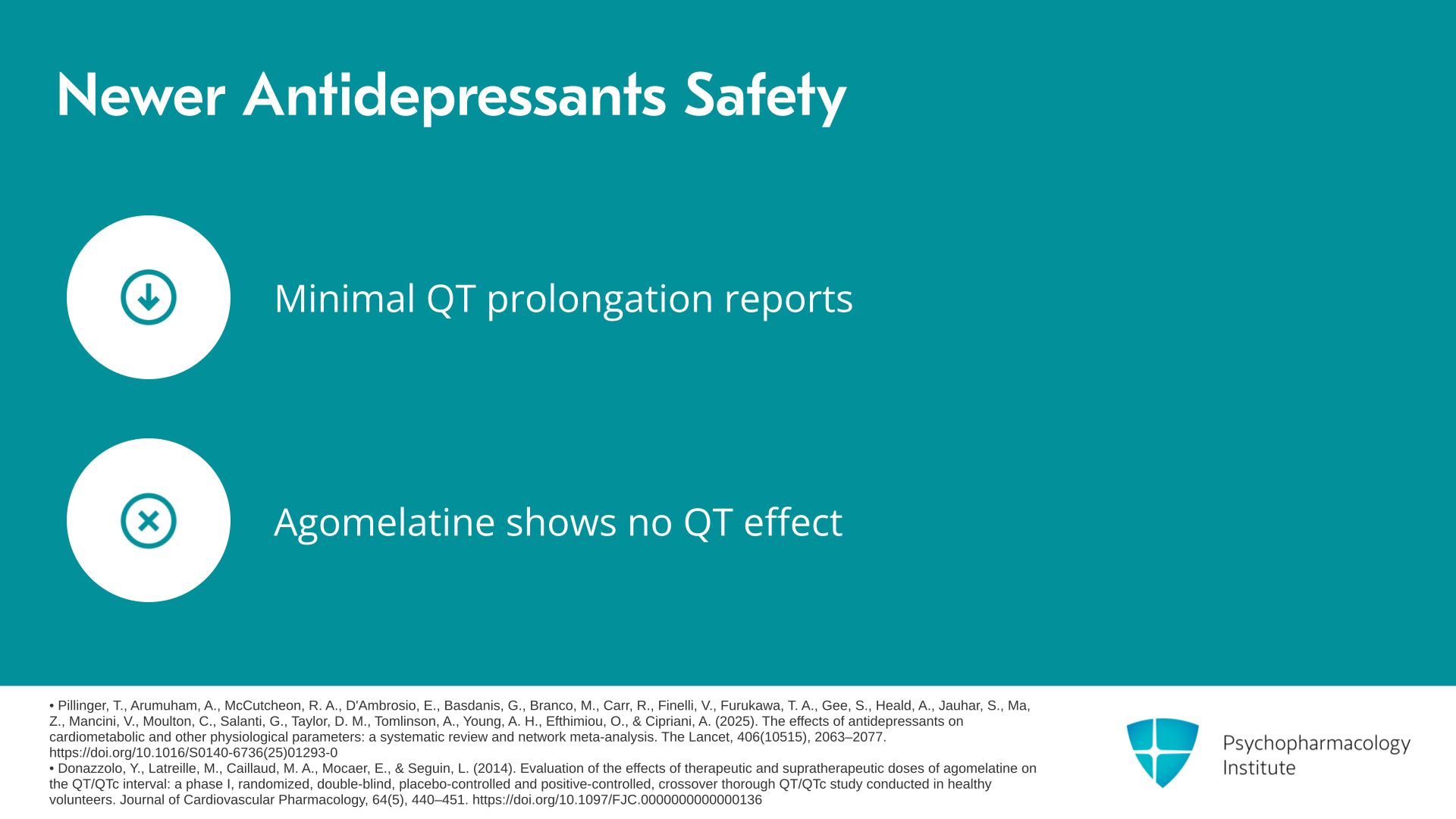
Among newer antidepressants, there are very few reports of QT prolongation for agents like duloxetine, vilazodone, desvenlafaxine, vortioxetine or levomilnacipran. There is a Thorough QT study done for agomelatine and that suggests no effect on the QT interval.
References:
- Pillinger, T., Arumuham, A., McCutcheon, R. A., D'Ambrosio, E., Basdanis, G., Branco, M., Carr, R., Finelli, V., Furukawa, T. A., Gee, S., Heald, A., Jauhar, S., Ma, Z., Mancini, V., Moulton, C., Salanti, G., Taylor, D. M., Tomlinson, A., Young, A. H., Efthimiou, O., & Cipriani, A. (2025). The effects of antidepressants on cardiometabolic and other physiological parameters: a systematic review and network meta-analysis. The Lancet, 406(10515), 2063–2077. https://doi.org/10.1016/S0140-6736(25)01293-0
- Donazzolo, Y., Latreille, M., Caillaud, M. A., Mocaer, E., & Seguin, L. (2014). Evaluation of the effects of therapeutic and supratherapeutic doses of agomelatine on the QT/QTc interval: a phase I, randomized, double-blind, placebo-controlled and positive-controlled, crossover thorough QT/QTc study conducted in healthy volunteers. Journal of Cardiovascular Pharmacology, 64(5), 440–451. https://doi.org/10.1097/FJC.0000000000000136
Slide 14 of 27
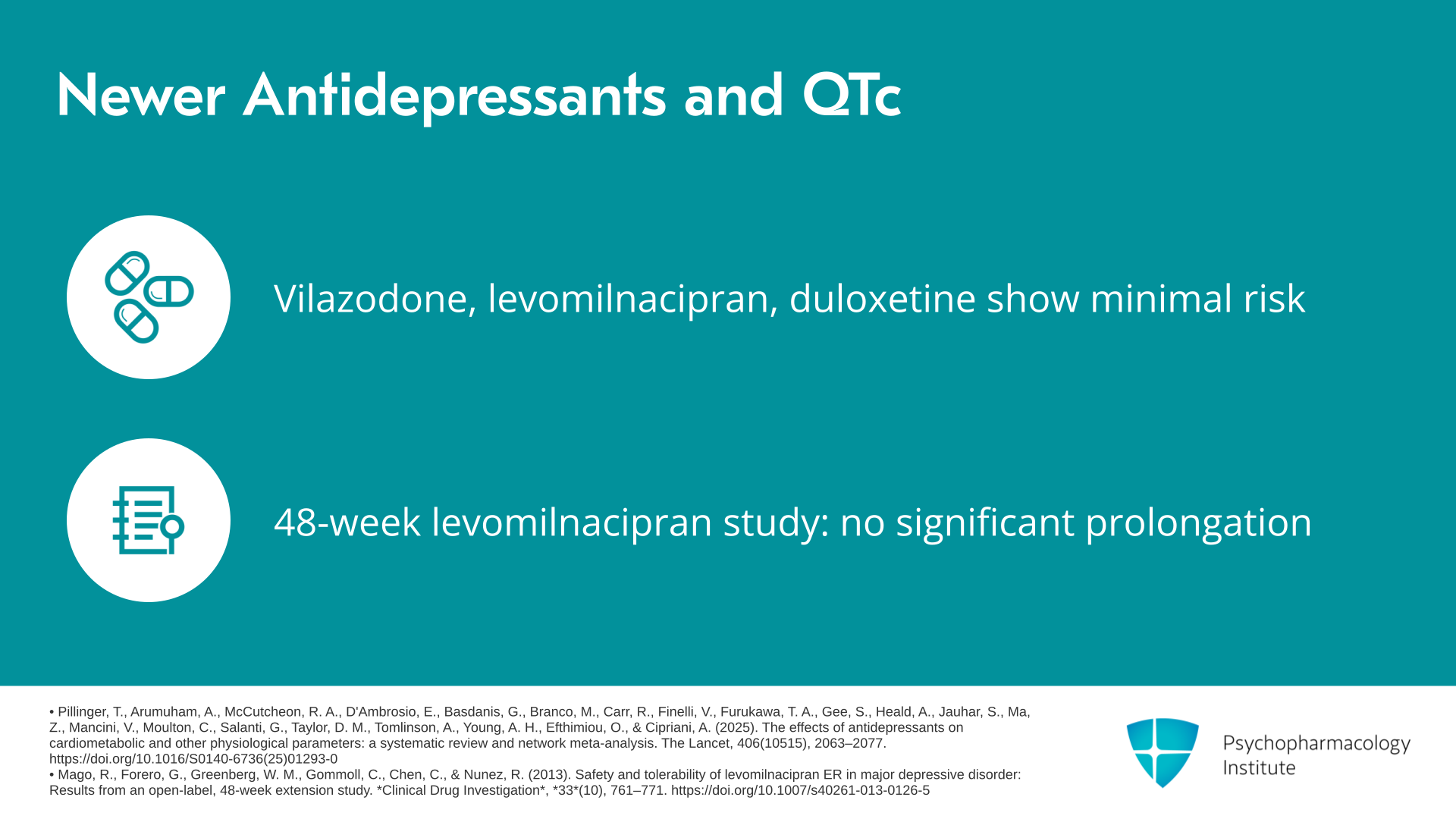
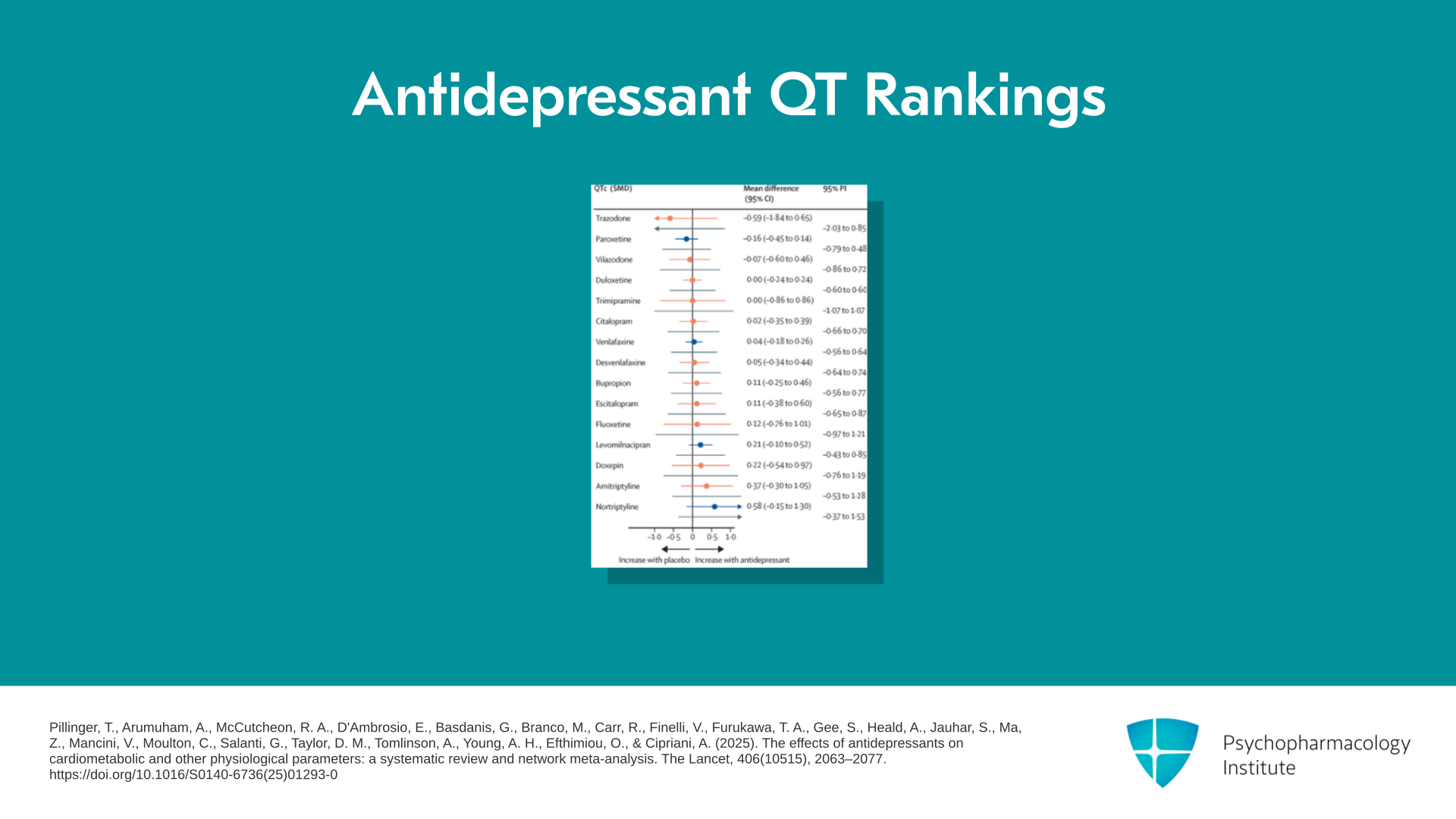
I mention this 2025 Lancet network meta-analysis looking at antidepressants and QT prolongation. It’s similar to that one that we looked at with antipsychotics done by the same group. The conclusion for that is that vilazodone, levomilnacipran and duloxetine showed little evidence of change in QTc. We also have a 48-week open label study of levomilnacipran showing no significant prolongation. So pretty reassuring for some of the newer agents.
References:
- Pillinger, T., Arumuham, A., McCutcheon, R. A., D'Ambrosio, E., Basdanis, G., Branco, M., Carr, R., Finelli, V., Furukawa, T. A., Gee, S., Heald, A., Jauhar, S., Ma, Z., Mancini, V., Moulton, C., Salanti, G., Taylor, D. M., Tomlinson, A., Young, A. H., Efthimiou, O., & Cipriani, A. (2025). The effects of antidepressants on cardiometabolic and other physiological parameters: a systematic review and network meta-analysis. The Lancet, 406(10515), 2063–2077. https://doi.org/10.1016/S0140-6736(25)01293-0
- Mago, R., Forero, G., Greenberg, W. M., Gommoll, C., Chen, C., & Nunez, R. (2013). Safety and tolerability of levomilnacipran ER in major depressive disorder: Results from an open-label, 48-week extension study. *Clinical Drug Investigation*, *33*(10), 761–771. https://doi.org/10.1007/s40261-013-0126-5
Free Files
Download PDF and other files
Success!
Check your inbox, we sent you all the materials there.
Slide 15 of 27
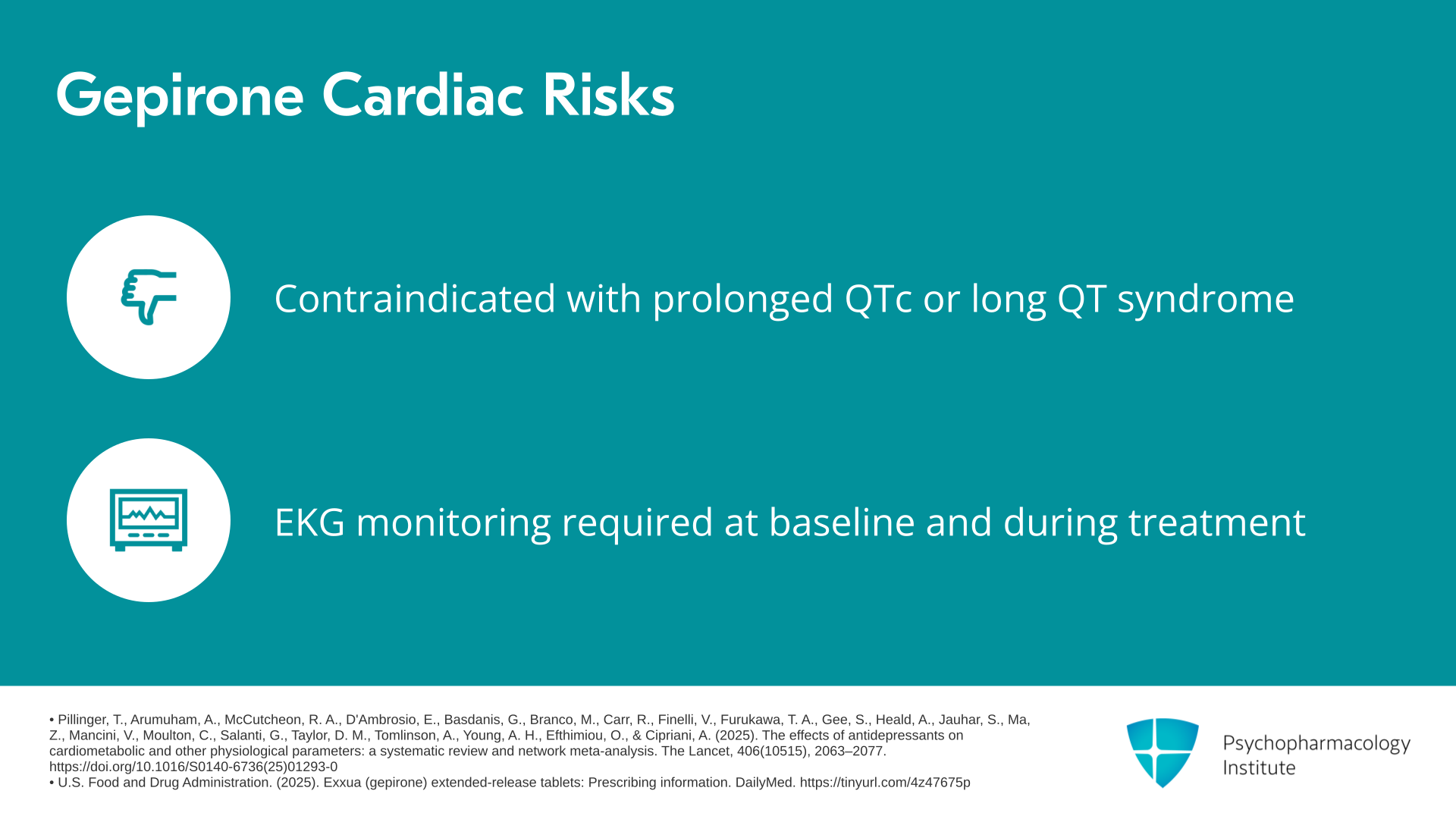
One newer agent that doesn’t have reassuring data is gepirone extended release. That’s actually contraindicated in patients who have a baseline QTc greater than 450 ms or those with congenital long QT syndrome. Gepirone had a Thorough QT study showing a maximum increase of 18.5 ms on day 1 and 16 ms on day 7 at doses twice the maximum recommended dose. The label actually mandates EKG testing at baseline during initiation and periodically during treatment and gepirone can also cause increased heart rate, palpitations and dizziness.
References:
- Pillinger, T., Arumuham, A., McCutcheon, R. A., D'Ambrosio, E., Basdanis, G., Branco, M., Carr, R., Finelli, V., Furukawa, T. A., Gee, S., Heald, A., Jauhar, S., Ma, Z., Mancini, V., Moulton, C., Salanti, G., Taylor, D. M., Tomlinson, A., Young, A. H., Efthimiou, O., & Cipriani, A. (2025). The effects of antidepressants on cardiometabolic and other physiological parameters: a systematic review and network meta-analysis. The Lancet, 406(10515), 2063–2077. https://doi.org/10.1016/S0140-6736(25)01293-0
- U.S. Food and Drug Administration. (2025). Exxua (gepirone) extended-release tablets: Prescribing information. DailyMed. https://tinyurl.com/4z47675p
Slide 16 of 27
If we dive a bit deeper into that 2025 Lancet network meta-analysis I mentioned, we have a nice figure similar to the one that we saw for antipsychotics. Now importantly, these rankings are based only on randomized controlled trials that included placebo. So a lot of studies that we’ve reviewed would not have been included in this network meta-analysis. For that reason, it’s important to sort of recognize that the rankings may not take into account all of the available data. I mentioned already that trazodone here is listed as the lowest risk agent despite what I said earlier about the Thorough QT study. And then you have some other agents that we would generally consider safe like fluoxetine which are at the higher end. So I think it’s important to recognize the limitations of this and also probably the fact that it speaks to how hard it can be to risk stratify these antidepressants.
References:
- Pillinger, T., Arumuham, A., McCutcheon, R. A., D'Ambrosio, E., Basdanis, G., Branco, M., Carr, R., Finelli, V., Furukawa, T. A., Gee, S., Heald, A., Jauhar, S., Ma, Z., Mancini, V., Moulton, C., Salanti, G., Taylor, D. M., Tomlinson, A., Young, A. H., Efthimiou, O., & Cipriani, A. (2025). The effects of antidepressants on cardiometabolic and other physiological parameters: a systematic review and network meta-analysis. The Lancet, 406(10515), 2063–2077. https://doi.org/10.1016/S0140-6736(25)01293-0
Free Files
Download PDF and other files
Success!
Check your inbox, we sent you all the materials there.
Slide 17 of 27
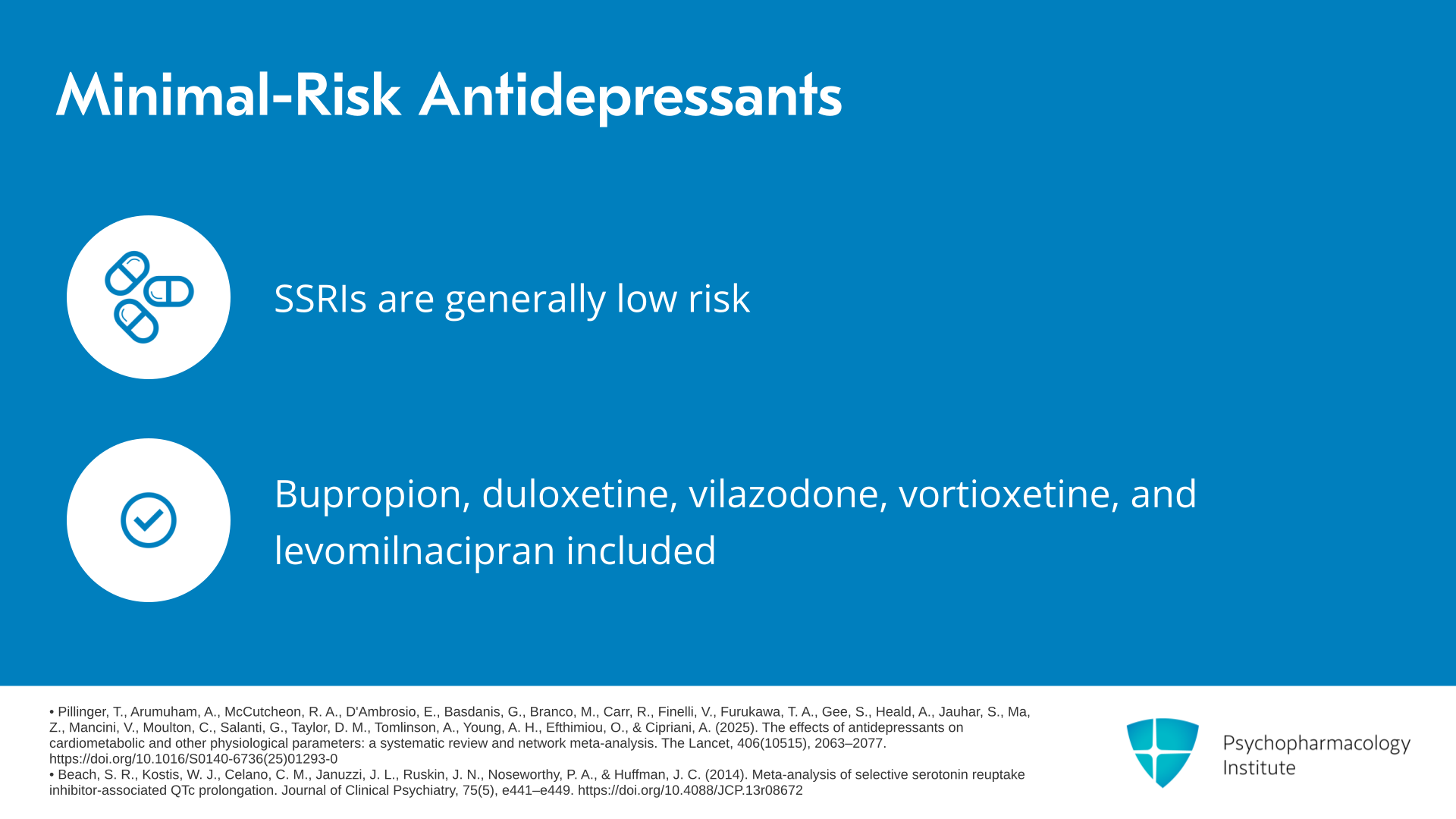
At this time, based on all of the evidence, I would probably risk stratify like this. Most antidepressants have minimal risk. In the minimal risk category, I would include most SSRIs, bupropion, duloxetine, vilazodone, desvenlafaxine, vortioxetine, levomilnacipran and agomelatine.
References:
- Pillinger, T., Arumuham, A., McCutcheon, R. A., D'Ambrosio, E., Basdanis, G., Branco, M., Carr, R., Finelli, V., Furukawa, T. A., Gee, S., Heald, A., Jauhar, S., Ma, Z., Mancini, V., Moulton, C., Salanti, G., Taylor, D. M., Tomlinson, A., Young, A. H., Efthimiou, O., & Cipriani, A. (2025). The effects of antidepressants on cardiometabolic and other physiological parameters: a systematic review and network meta-analysis. The Lancet, 406(10515), 2063–2077. https://doi.org/10.1016/S0140-6736(25)01293-0
- Beach, S. R., Kostis, W. J., Celano, C. M., Januzzi, J. L., Ruskin, J. N., Noseworthy, P. A., & Huffman, J. C. (2014). Meta-analysis of selective serotonin reuptake inhibitor-associated QTc prolongation. Journal of Clinical Psychiatry, 75(5), e441–e449. https://doi.org/10.4088/JCP.13r08672
Slide 18 of 27
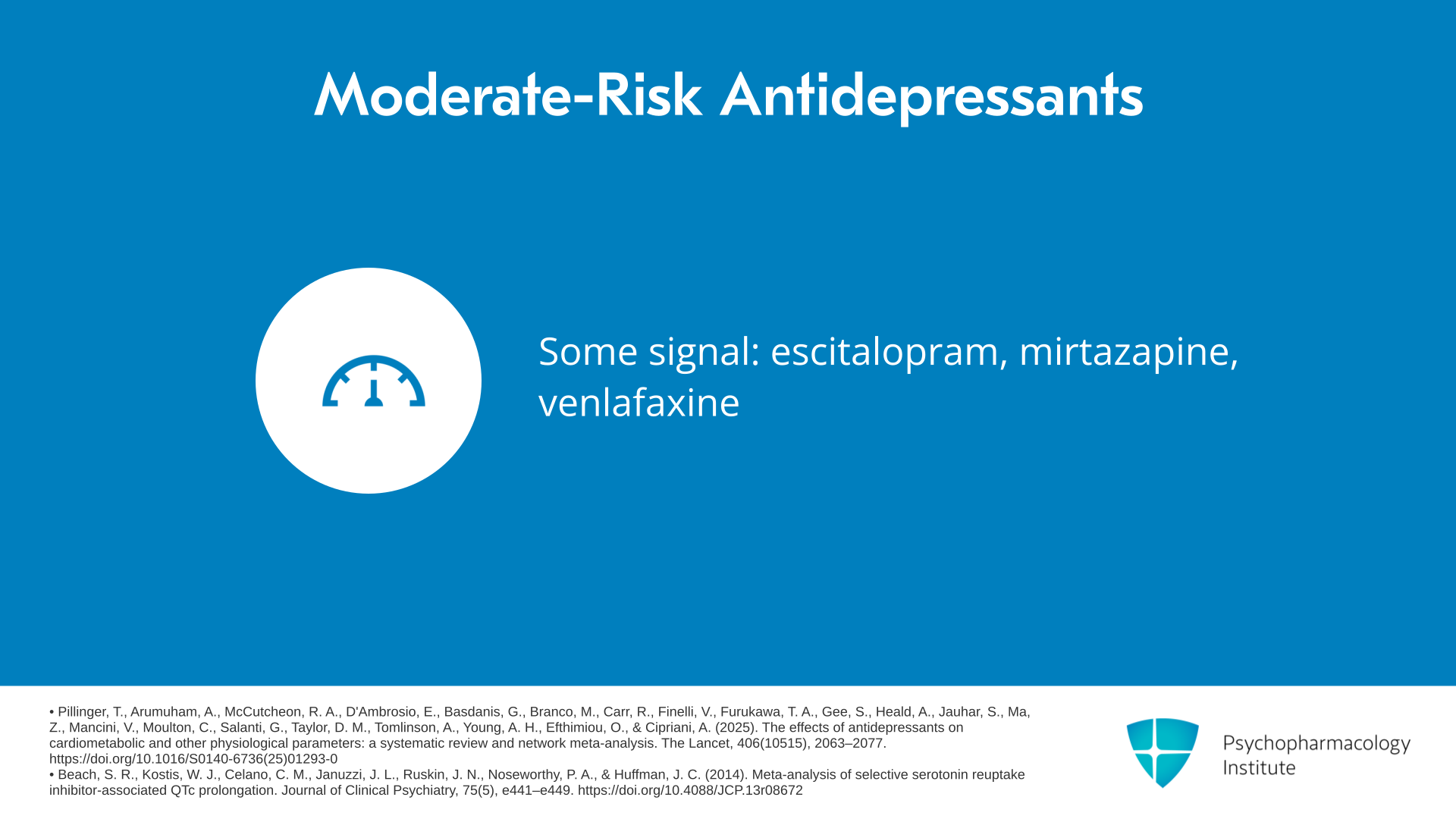
Moderate-risk agents, those with some signal include escitalopram, mirtazapine and venlafaxine though I would note the caveat here that moderate-risk agents here are probably safer on the whole than moderate-risk antipsychotic agents.
References:
- Pillinger, T., Arumuham, A., McCutcheon, R. A., D'Ambrosio, E., Basdanis, G., Branco, M., Carr, R., Finelli, V., Furukawa, T. A., Gee, S., Heald, A., Jauhar, S., Ma, Z., Mancini, V., Moulton, C., Salanti, G., Taylor, D. M., Tomlinson, A., Young, A. H., Efthimiou, O., & Cipriani, A. (2025). The effects of antidepressants on cardiometabolic and other physiological parameters: a systematic review and network meta-analysis. The Lancet, 406(10515), 2063–2077. https://doi.org/10.1016/S0140-6736(25)01293-0
- Beach, S. R., Kostis, W. J., Celano, C. M., Januzzi, J. L., Ruskin, J. N., Noseworthy, P. A., & Huffman, J. C. (2014). Meta-analysis of selective serotonin reuptake inhibitor-associated QTc prolongation. Journal of Clinical Psychiatry, 75(5), e441–e449. https://doi.org/10.4088/JCP.13r08672
Free Files
Download PDF and other files
Success!
Check your inbox, we sent you all the materials there.
Slide 19 of 27
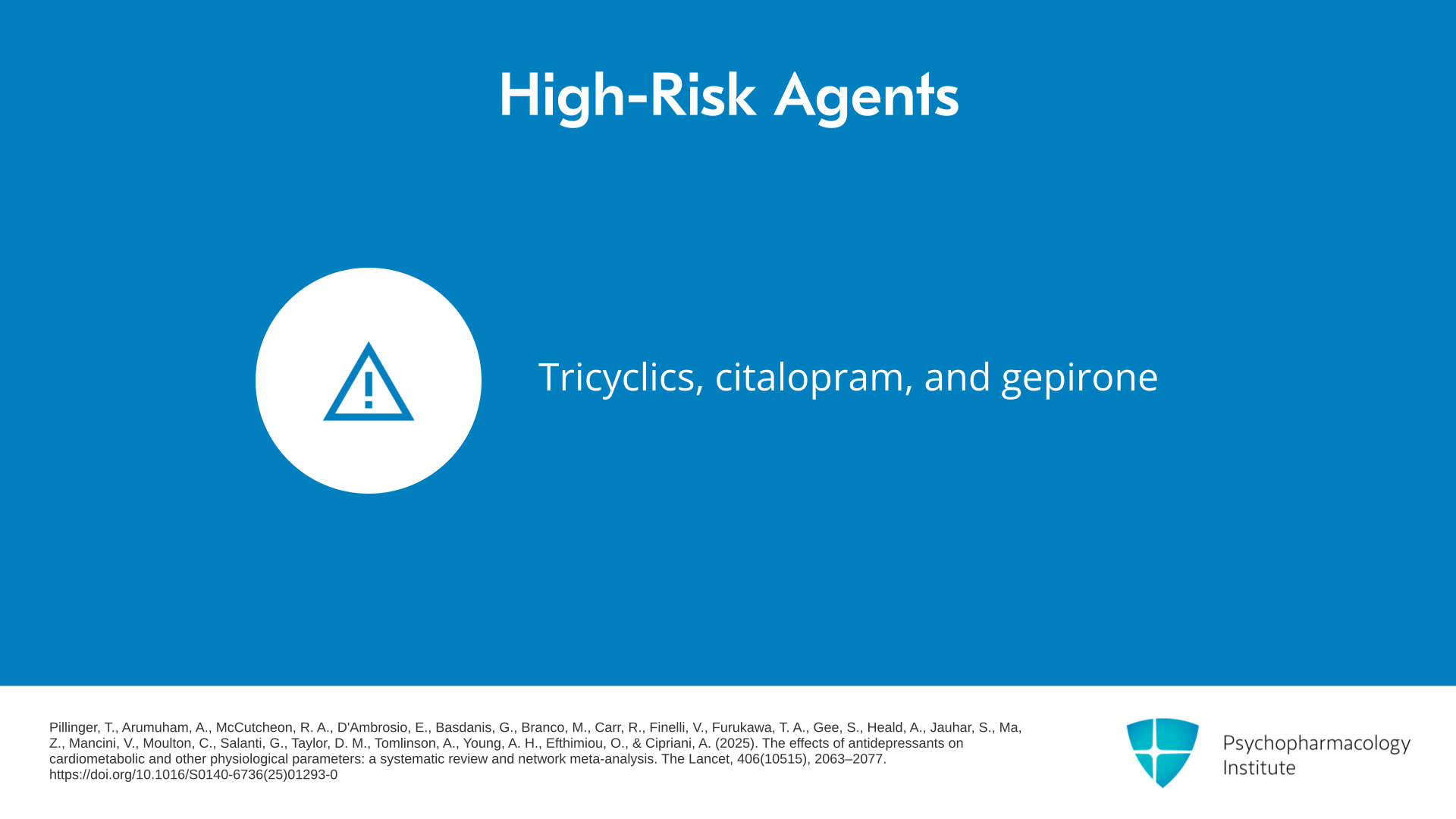
And finally, high-risk agents here include tricyclics, citalopram and gepirone.
References:
- Pillinger, T., Arumuham, A., McCutcheon, R. A., D'Ambrosio, E., Basdanis, G., Branco, M., Carr, R., Finelli, V., Furukawa, T. A., Gee, S., Heald, A., Jauhar, S., Ma, Z., Mancini, V., Moulton, C., Salanti, G., Taylor, D. M., Tomlinson, A., Young, A. H., Efthimiou, O., & Cipriani, A. (2025). The effects of antidepressants on cardiometabolic and other physiological parameters: a systematic review and network meta-analysis. The Lancet, 406(10515), 2063–2077. https://doi.org/10.1016/S0140-6736(25)01293-0
Slide 20 of 27
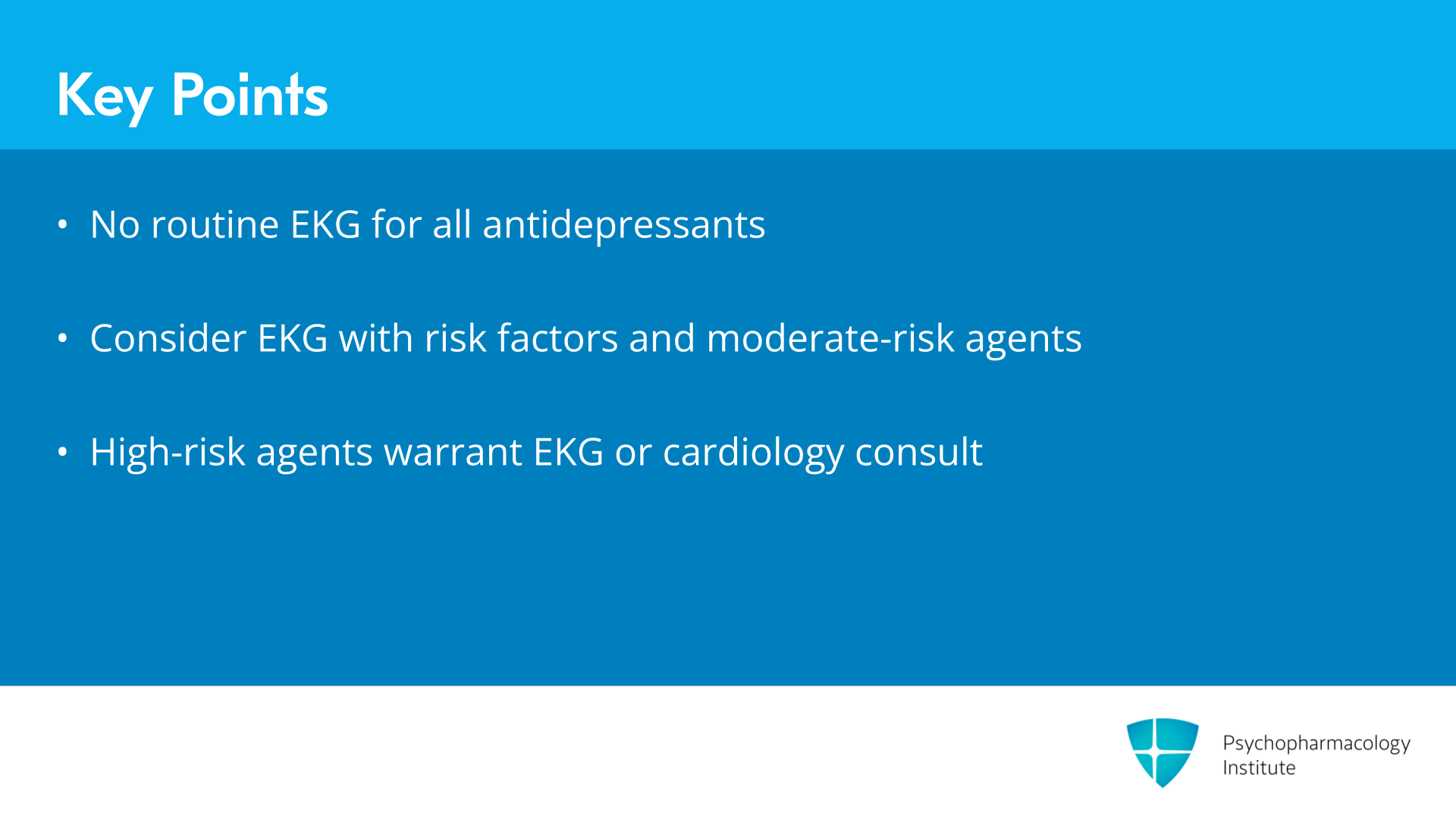
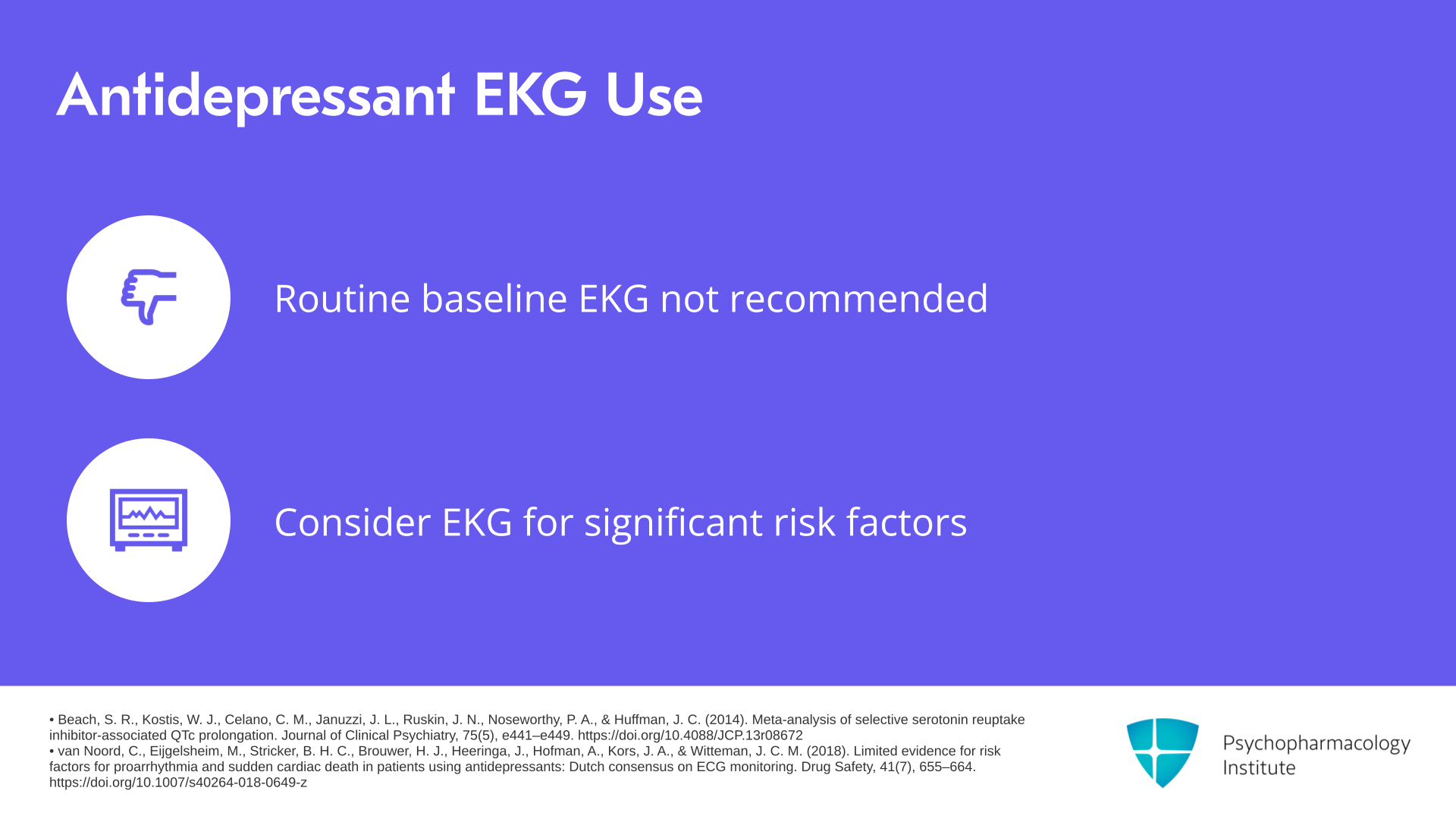
So how do we think about using antidepressants? Well, I think the overall magnitude of QTc increases with SSRIs and most antidepressants is small. And for that reason, I don’t see an indication for a baseline EKG with all antidepressant initiation. I would consider a baseline EKG for patients with significant risk factors who are started on a low to moderate risk antidepressant.
References:
- Beach, S. R., Kostis, W. J., Celano, C. M., Januzzi, J. L., Ruskin, J. N., Noseworthy, P. A., & Huffman, J. C. (2014). Meta-analysis of selective serotonin reuptake inhibitor-associated QTc prolongation. Journal of Clinical Psychiatry, 75(5), e441–e449. https://doi.org/10.4088/JCP.13r08672
- van Noord, C., Eijgelsheim, M., Stricker, B. H. C., Brouwer, H. J., Heeringa, J., Hofman, A., Kors, J. A., & Witteman, J. C. M. (2018). Limited evidence for risk factors for proarrhythmia and sudden cardiac death in patients using antidepressants: Dutch consensus on ECG monitoring. Drug Safety, 41(7), 655–664. https://doi.org/10.1007/s40264-018-0649-z
Free Files
Download PDF and other files
Success!
Check your inbox, we sent you all the materials there.
Slide 21 of 27
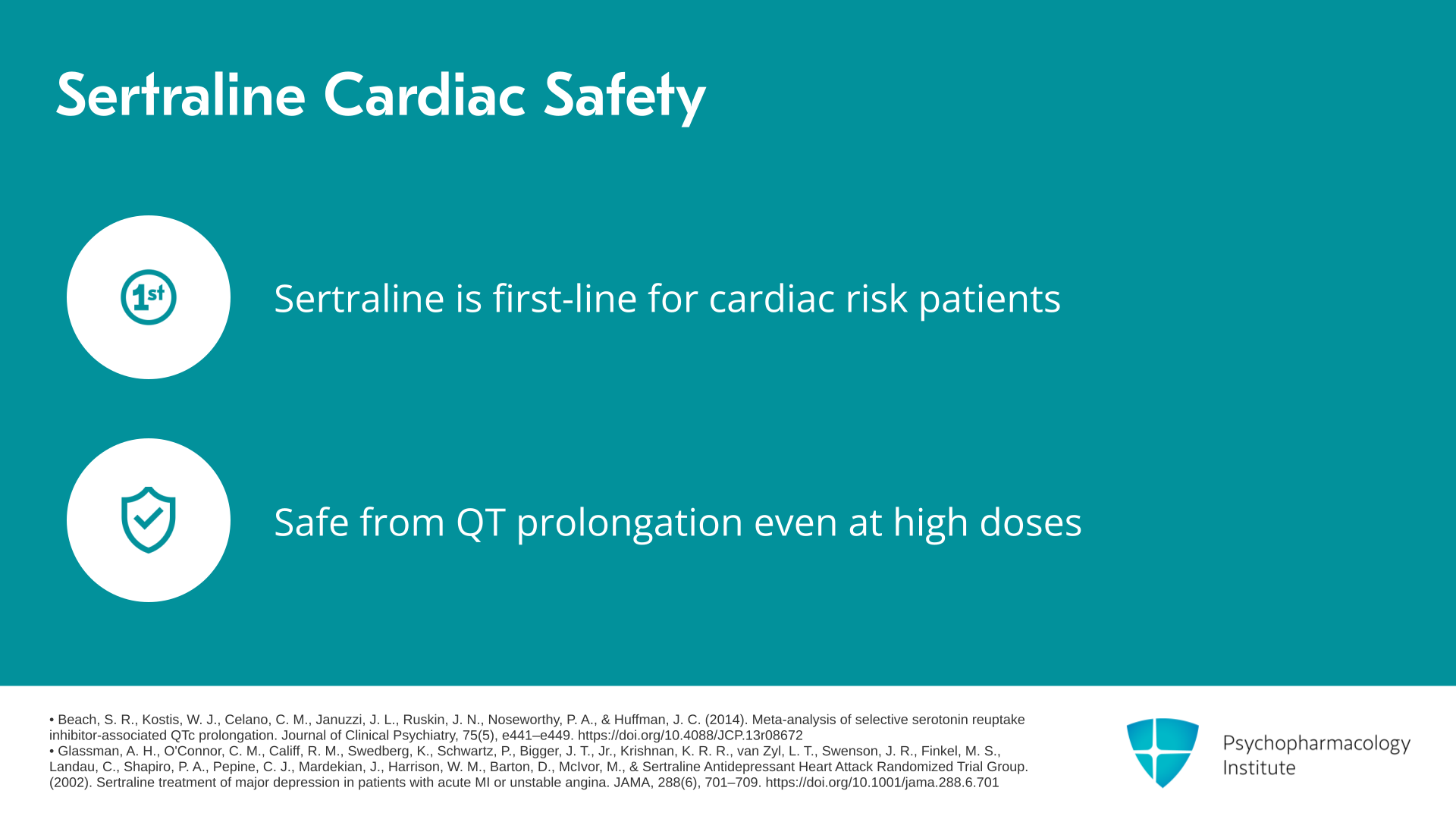
I would still consider sertraline the first-line SSRI, really the first-line antidepressant in patients at risk for cardiac disease because of its established safety. While there is some evidence suggesting a dose-response relationship between SSRI dose and the extent of QT prolongation, sertraline remains safe from this standpoint even at high doses.
References:
- Beach, S. R., Kostis, W. J., Celano, C. M., Januzzi, J. L., Ruskin, J. N., Noseworthy, P. A., & Huffman, J. C. (2014). Meta-analysis of selective serotonin reuptake inhibitor-associated QTc prolongation. Journal of Clinical Psychiatry, 75(5), e441–e449. https://doi.org/10.4088/JCP.13r08672
- Glassman, A. H., O'Connor, C. M., Califf, R. M., Swedberg, K., Schwartz, P., Bigger, J. T., Jr., Krishnan, K. R. R., van Zyl, L. T., Swenson, J. R., Finkel, M. S., Landau, C., Shapiro, P. A., Pepine, C. J., Mardekian, J., Harrison, W. M., Barton, D., McIvor, M., & Sertraline Antidepressant Heart Attack Randomized Trial Group. (2002). Sertraline treatment of major depression in patients with acute MI or unstable angina. JAMA, 288(6), 701–709. https://doi.org/10.1001/jama.288.6.701
Slide 22 of 27
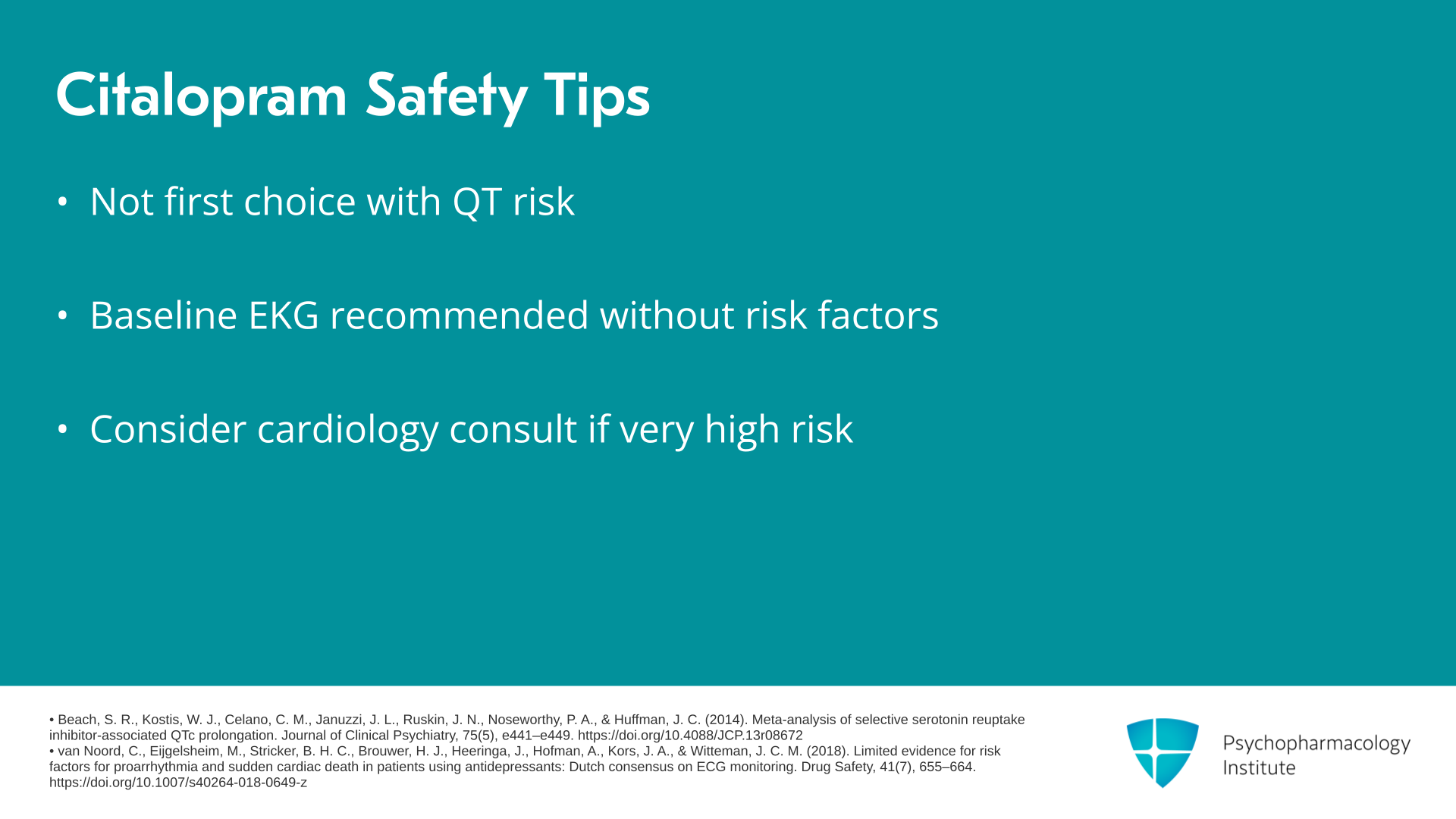
For patients who have an elevated risk for QT prolongation or torsade, citalopram is not my first choice. If I were starting citalopram in somebody without risk factors, I’d probably check a baseline EKG. If I were starting citalopram in someone with risk factors, I’d probably consider EKG monitoring or maybe even a cardiology consult if I thought they were extremely high risk.
References:
- Beach, S. R., Kostis, W. J., Celano, C. M., Januzzi, J. L., Ruskin, J. N., Noseworthy, P. A., & Huffman, J. C. (2014). Meta-analysis of selective serotonin reuptake inhibitor-associated QTc prolongation. Journal of Clinical Psychiatry, 75(5), e441–e449. https://doi.org/10.4088/JCP.13r08672
- van Noord, C., Eijgelsheim, M., Stricker, B. H. C., Brouwer, H. J., Heeringa, J., Hofman, A., Kors, J. A., & Witteman, J. C. M. (2018). Limited evidence for risk factors for proarrhythmia and sudden cardiac death in patients using antidepressants: Dutch consensus on ECG monitoring. Drug Safety, 41(7), 655–664. https://doi.org/10.1007/s40264-018-0649-z
Free Files
Download PDF and other files
Success!
Check your inbox, we sent you all the materials there.
Slide 23 of 27
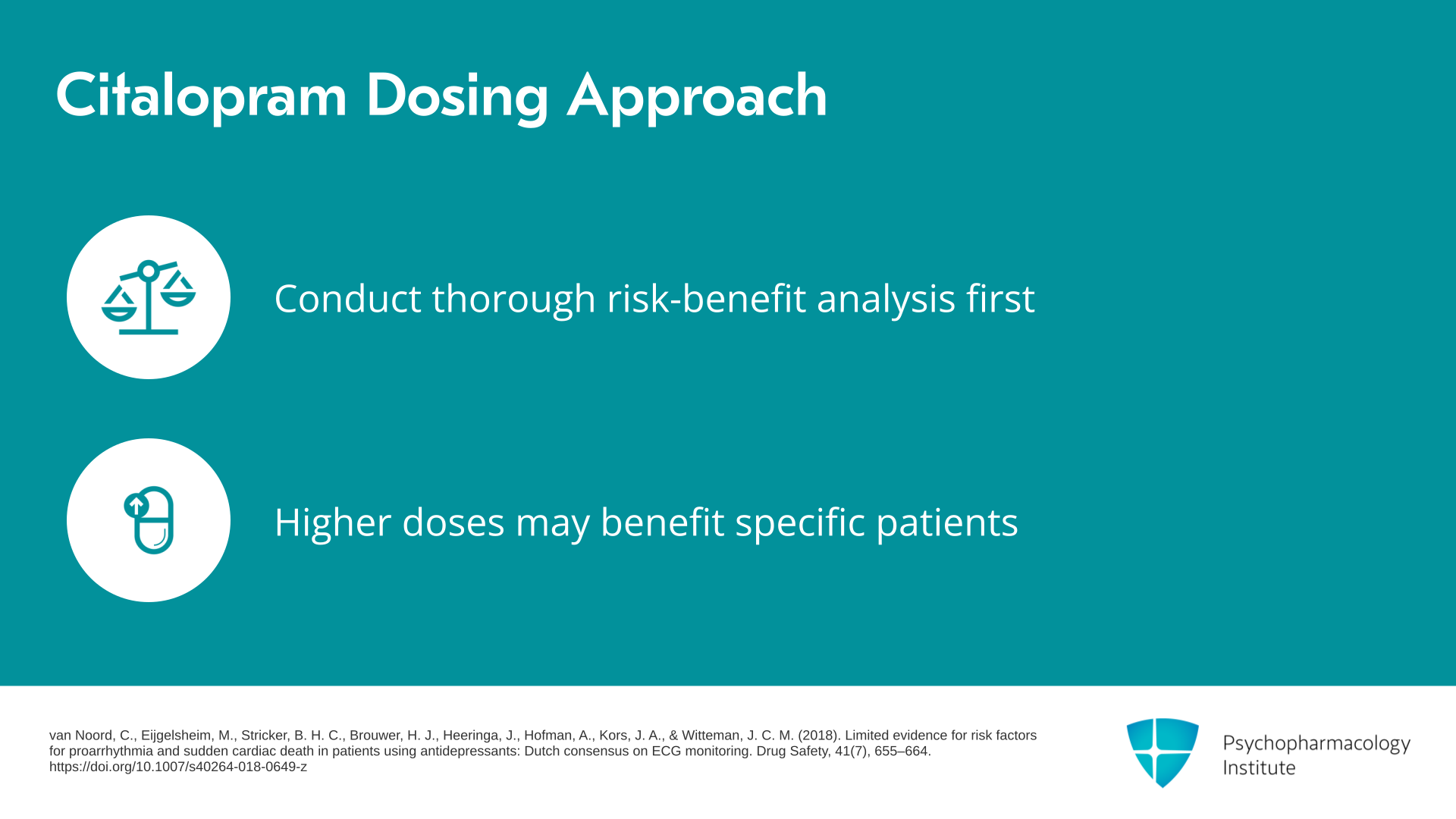
That being said, I would also not reflexively reduce the citalopram dose in a patient who has some risk factors without doing a careful risk-benefit analysis. And I do think a compelling case can be made for using higher doses of citalopram in specific patients but we need to do that judiciously and we need to think about EKG monitoring.
References:
- van Noord, C., Eijgelsheim, M., Stricker, B. H. C., Brouwer, H. J., Heeringa, J., Hofman, A., Kors, J. A., & Witteman, J. C. M. (2018). Limited evidence for risk factors for proarrhythmia and sudden cardiac death in patients using antidepressants: Dutch consensus on ECG monitoring. Drug Safety, 41(7), 655–664. https://doi.org/10.1007/s40264-018-0649-z
Slide 24 of 27
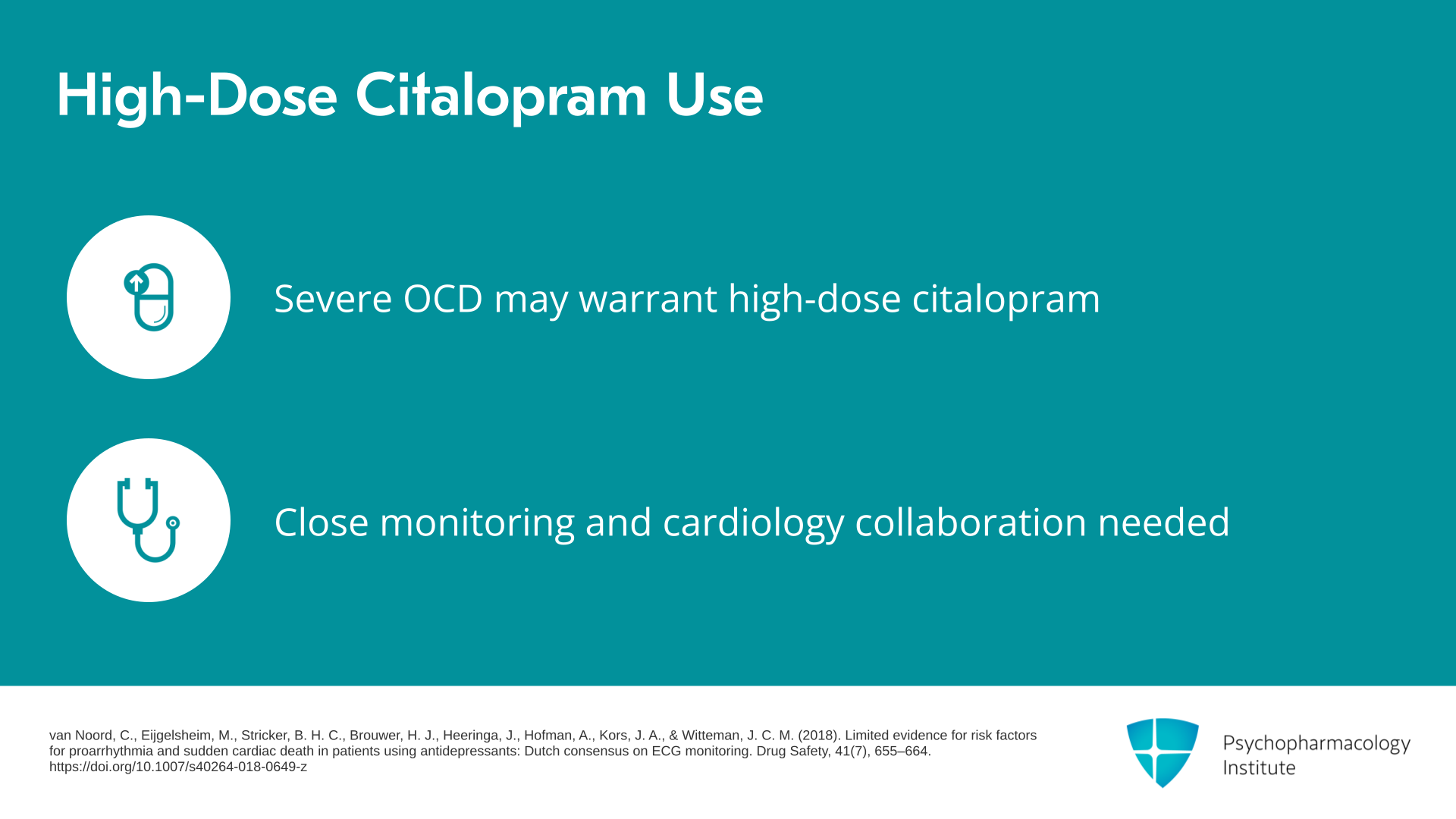
For example, a patient with severe OCD that has only ever responded to high-dose citalopram who has been tried on other agents may be a reasonable candidate for high-dose citalopram even in the presence of risk factors but they’re going to require close monitoring and a possible collaboration with Cardiology.
References:
- van Noord, C., Eijgelsheim, M., Stricker, B. H. C., Brouwer, H. J., Heeringa, J., Hofman, A., Kors, J. A., & Witteman, J. C. M. (2018). Limited evidence for risk factors for proarrhythmia and sudden cardiac death in patients using antidepressants: Dutch consensus on ECG monitoring. Drug Safety, 41(7), 655–664. https://doi.org/10.1007/s40264-018-0649-z
Free Files
Download PDF and other files
Success!
Check your inbox, we sent you all the materials there.
Slide 25 of 27
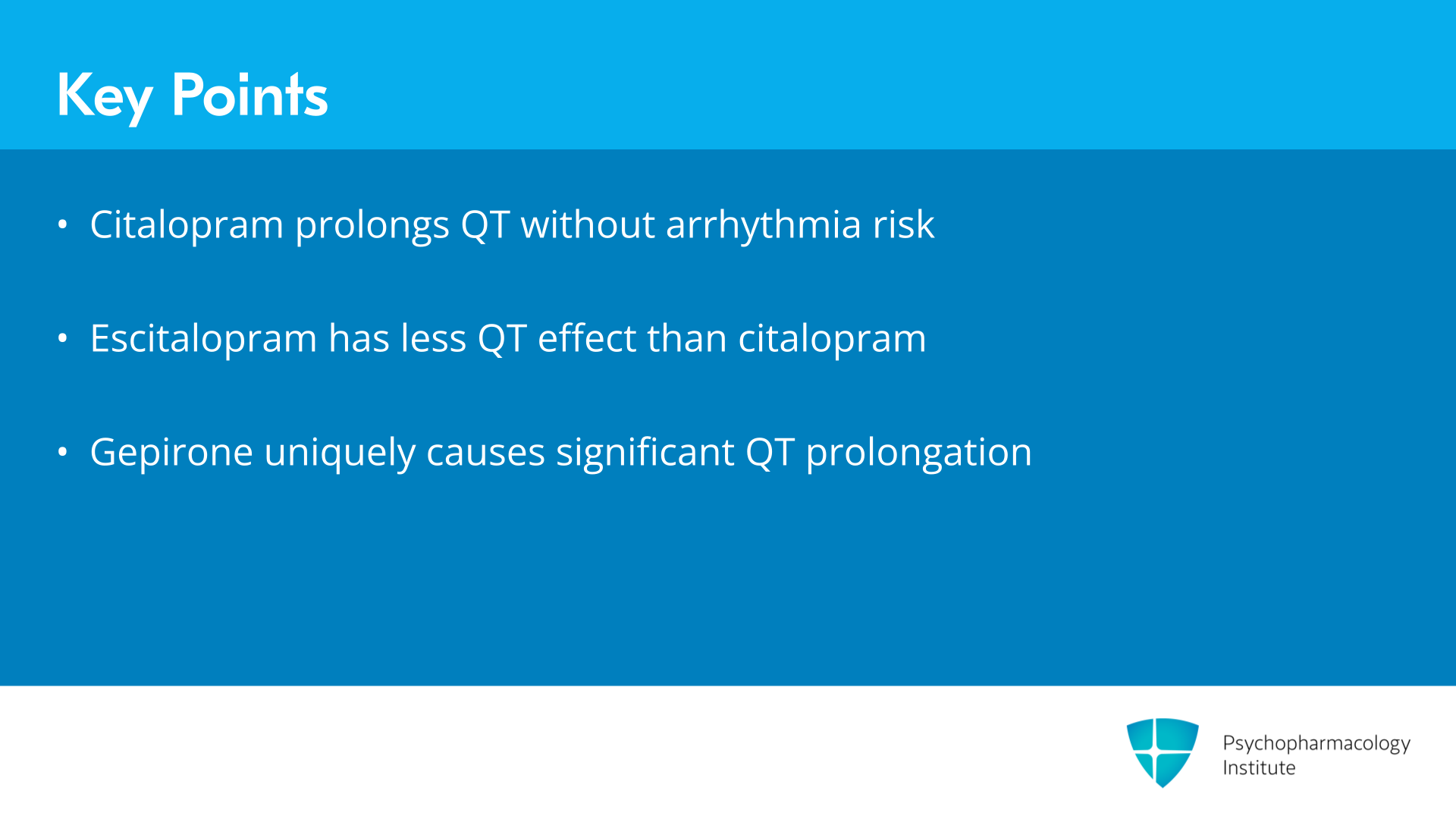
To summarize some key points for this section: Citalopram consistently increases the QT by about 5 to 15 ms but has no signal for an increased risk of torsade, ventricular arrhythmia or sudden cardiac death. Although escitalopram is commonly grouped with citalopram, the extent of QT prolongation is less and unlikely to be clinically significant. Among newer antidepressants, there are very few reports of QT prolongation for duloxetine, vilazodone, desvenlafaxine, vortioxetine or levomilnacipran, whereas gepirone causes significant QT prolongation.
Slide 26 of 27
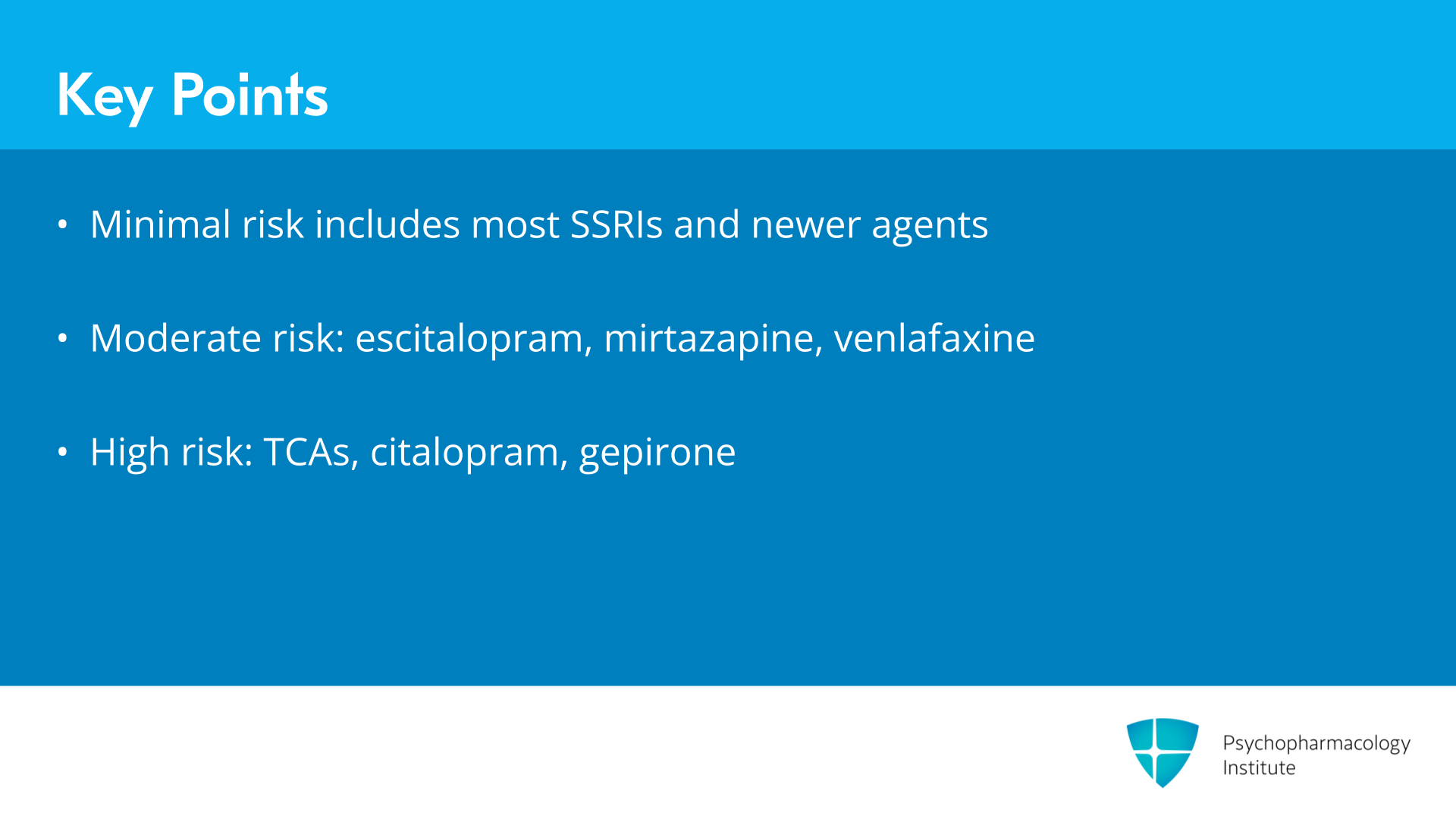
My best guess at risk stratification for antidepressants right now is minimal risk includes most SSRIs, bupropion, duloxetine, vilazodone, desvenlafaxine, vortioxetine, levomilnacipran and agomelatine. Moderate-risk antidepressants include escitalopram, mirtazapine and venlafaxine. High-risk antidepressants include tricyclics, citalopram and gepirone.
Free Files
Download PDF and other files
Success!
Check your inbox, we sent you all the materials there.
Slide 27 of 27
There is no indication for baseline EKG with all antidepressant initiations but you might consider a baseline EKG for patients with significant risk factors who are being started on a minimal or moderate risk antidepressant. Similarly, you should consider a baseline EKG for patients being started on a high-risk antidepressant even if they don’t have any risk factors and you should consider either EKG monitoring or a cardiology consult when starting a high-risk antidepressant in a patient with significant risk factors.