



Text version
SINO Trial: Seven Antipsychotics for Acute Schizophrenia
For this Quick Take today, we will be discussing a large clinical trial that compared several antipsychotics head-to-head for the acute treatment of schizophrenia. The trial goes by the name of SINO (Schizophrenia in Non-Occidental Participants).
Why is this trial newsworthy? For one, it comes to us from the non-Western world (or as the authors call it, the non-occidental world) specifically from China. This is important because the vast majority of our knowledge base from clinical trials stems from Canada, the United States, or Europe, which limits generalizability to other cultures.
Apart from that, SINO represents the largest clinical trial that directly compared several antipsychotics head-to-head for the acute treatment of schizophrenia conducted without industry funding. It is a large comparative trial with randomized treatment and, while not double-blind, with blinding of the assessors. This truly adds to our evidence base as we finally have a randomized head-to-head comparison between a fairly large number of antipsychotics to make judgments about their comparative effectiveness.
Download PDF and other files
What We Already Knew
You may say, wait — don’t we know this already? Well, you’re not completely wrong. We have comparative efficacy data from meta-analyses and from seminal randomized trials from the US and Europe such as CATIE (Clinical Antipsychotic Trials of Intervention Effectiveness) or EUFEST (European First Episode Schizophrenia Trial).
You may remember CATIE because it was a large non-industry effort to compare the second-generation antipsychotics available at the time with perphenazine as a first-generation comparator; essentially showing that those newer antipsychotics were not substantially superior compared to older ones. It was a big deal when it was published two decades ago.
However, both CATIE and EUFEST had limitations: CATIE was done in chronic, not very symptomatic patients and EUFEST was done in first-episode patients, so neither captured the full range of acutely ill individuals you encounter in clinical practice.
Trial Design and Patient Selection
The SINO trial compared seven antipsychotics head-to-head in patients with acute schizophrenia.
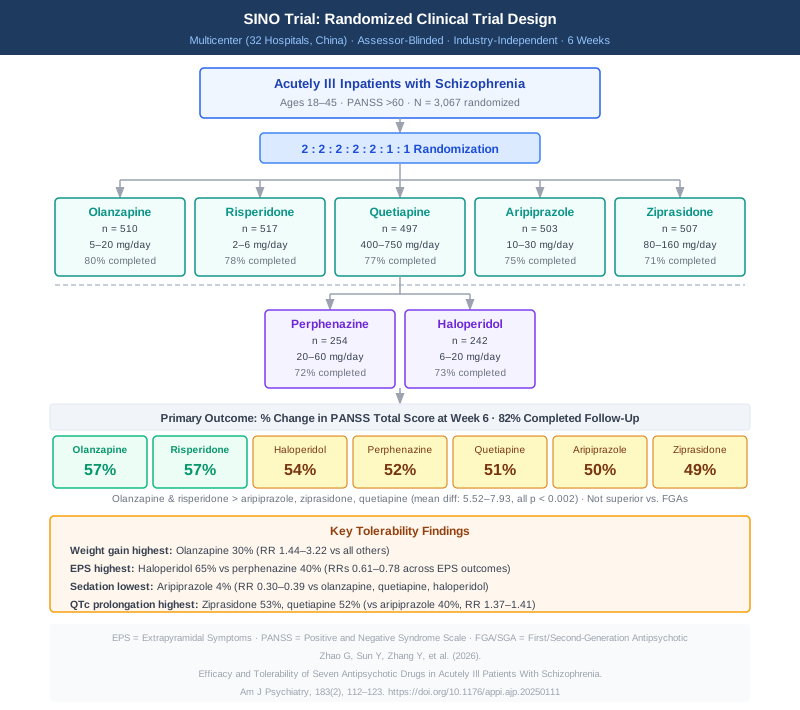
For the first-generation group:
- Haloperidol
- Perphenazine
For the second-generation antipsychotic group:
- Aripiprazole
- Olanzapine
- Quetiapine
- Risperidone
- Ziprasidone.
Some people, by the way, would consider aripiprazole a third-generation antipsychotic given its partial agonist properties. Let me note that even this large study did not include all available antipsychotics, in part because it was originally designed and conducted over a decade ago as a biomarker study, the results of which were published a few years ago.
The design was straightforward: a six-week trial in which patients were randomly assigned to one of seven antipsychotics. Patients had to be:
- Acutely ill and psychiatrically hospitalized
- Between the ages of 18 to 45, to avoid issues of chronicity
- Enrolled from one of 32 hospitals across China
The primary outcome was the percent change in psychopathology as measured by the PANSS score, the standard rating scale for schizophrenia trials. Many other variables were examined, including standard measures of side effects.
The trial was a recruitment success, with over 3,000 patients randomized (approximately 500 per arm for the second-generation antipsychotics and 250 per arm for haloperidol and perphenazine, which was intentional to minimize exposure to first-generation agents). The cohort had a mean age of approximately 31 years, a roughly 50-50 male-to-female ratio, and about a third were in their first episode of psychosis.
Download PDF and other files
Four Key Results to Know
Here are my four main results to take away from this comparison of seven antipsychotics for the acute treatment of schizophrenia:
- Effectiveness was best for olanzapine and risperidone, with greater symptom reduction compared to aripiprazole, quetiapine, or ziprasidone, but not when compared with haloperidol or perphenazine.
- Side effects differed greatly between drugs, with weight gain and metabolic problems highest for olanzapine and lowest for ziprasidone and aripiprazole.
- Haloperidol had the highest rate of extrapyramidal symptoms of all antipsychotics, including when directly compared with perphenazine.
- Aripiprazole had only 4% sedation, the lowest of all antipsychotics, which is a novel finding not previously reported using a good measure of sedation.
Clinical Interpretation: No Surprises
This trial largely confirms in one large randomized study what we already knew from CATIE, EUFEST, and numerous meta-analyses. There are indeed efficacy differences between antipsychotics, and the agents differ greatly in their side effect profiles. The good news is that there were no surprises.
Olanzapine was quite effective but also caused the most weight gain. Aripiprazole was perhaps slightly less effective but was well tolerated with regard to weight gain and was the best in terms of sedation. Ziprasidone and quetiapine carried a higher risk for QTc prolongation. Haloperidol caused the most EPS but was also quite effective.
Download PDF and other files
SINO and Current Guidelines
The authors suggest that this trial will influence guidelines. I’m not so sure about that. Most guidelines, unless they are really old, already acknowledge that olanzapine is among the more effective first-line antipsychotics (including for aggression) but that it comes with substantial metabolic risk that has to be managed.
Risperidone is often recommended as a good first-line choice given its established efficacy and reasonable tolerability. The most recent international INTEGRATE consensus schizophrenia guidelines suggest considering aripiprazole as a first choice because of its well-recognized balance between efficacy and tolerability. That recommendation is now supported by SINO, where aripiprazole was maybe not quite as effective as olanzapine or risperidone but was well tolerated with regard to weight gain and sedation, important considerations for long-term adherence.
What SINO Doesn’t Answer
SINO does not address several important clinical considerations. When should you turn to clozapine? How does clozapine fit in for patients with some degree of treatment resistance? And what about choosing an antipsychotic available as a long-acting injectable, given recent emphasis on wider routine use of LAIs to improve outcomes in schizophrenia?
The biggest limitation in my mind, however — and this is not really the researchers’ fault — is that the study could not include the newly approved antipsychotic xanomeline-trospium (KarXT, brand name Cobenfy in the United States), which has a novel cholinergic mechanism of action.
In a way, SINO is answering questions that clinicians practicing in the United States may no longer necessarily have, and it is not answering the one they do have: where does KarXT fit in with regard to comparative efficacy?
Download PDF and other files
Bottom Line: Findings Complement, Don’t Replace Clinical Judgment
In the end, I’m not convinced that relative efficacy differences between antipsychotics in patients who are not treatment resistant is usually the main variable driving clinical decision making. All antipsychotics on the market are approved because they are effective compared to placebo, and small differences between them may not be so important — particularly since they represent group differences. What matters for the patient in front of you is not a group finding but how well a particular medicine works for them individually.
The SINO results complement previous trials and meta-analyses, basically confirming what we have pieced together from various other sources and our clinical experience. SINO showed that antipsychotics are not all equal with regard to efficacy, we can create an efficacy hierarchy, although the differences are small. Not surprisingly, SINO confirmed that agents have important side effect differences that clinicians definitely need to take into account when selecting an antipsychotic in collaboration with their patients.
In the end, the findings from SINO cannot replace your clinical judgment and the work you do with your patient to find the best antipsychotic for their particular situation and preference. We do not have biomarkers to help us choose the best antipsychotic for a given patient. You still need sequential trials of antipsychotics to figure out which agent represents the best compromise between efficacy and tolerability for the individual in front of you. And the best antipsychotic for your patient may unfortunately be one not studied in SINO.
Abstract
Efficacy and Tolerability of Seven Antipsychotic Drugs in Acutely Ill Patients With Schizophrenia: A Randomized, Multicenter, Assessor-Blinded Trial
Guorui Zhao, B.Med., Yaoyao Sun, Ph.D., Yuyanan Zhang, Ph.D., Tianlan Lu, B.S., Zhe Lu, M.D., Zhewei Kang, M.D., Johannes Schneider-Thoma, M.D., Wuxiang Xie, Ph.D., Yang Yang, Ph.D., Jing Guo, M.Ed., Yunqing Zhu, M.Sc., Rui Yuan, B.Med., Junyuan Sun, M.Med., Xiaoyang Feng, M.D., Yundan Liao, M.D., Dongxue Chen, M.S.Sc., Lingjiang Li, M.D., Tao Li, M.D., Fude Yang, M.D., Chuanyue Wang, M.D., Dai Zhang, M.D., Hao Yan, M.D., Stefan Leucht, M.D., and Weihua Yue, M.D.
Objective:
Antipsychotic drugs are the mainstay of schizophrenia treatment; yet, controversy persists regarding their relative efficacy and side effects, and guideline recommendations on efficacy differences are particularly vague. The aim of this trial was to compare seven antipsychotics in acutely ill patients with schizophrenia.
Methods:
The authors performed a multicenter (32 hospitals), industry-independent, parallel, assessor-blinded, flexible-dosage randomized trial (Schizophrenia in Non-Occidental Participants). Eligible inpatients 18–45 years of age with schizophrenia experiencing acute exacerbation were recruited and randomized to 6 weeks of monotherapy with one of seven antipsychotic drugs: olanzapine, risperidone, quetiapine, aripiprazole, ziprasidone, perphenazine, and haloperidol.
Results:
A total of 3,067 patients were randomized, of whom 82% completed follow-up. The mixed model indicated significant differences in the primary outcome percentage change in Positive and Negative Syndrome Scale (PANSS) score between the antipsychotics. At week 6, olanzapine and risperidone showed a significantly higher percentage change in PANSS score than aripiprazole, ziprasidone, and quetiapine (mean differences: 5.52–7.93) but not haloperidol or perphenazine. Olanzapine was associated with the highest risk of weight gain (relative risk: 1.44–3.22). Aripiprazole was associated with lower risk of hyperprolactinemia than all the other drugs (relative risks: 0.11–0.21). Ziprasidone and aripiprazole were associated with lower risks of weight gain and metabolic side effects. Haloperidol was associated with a higher risk of extrapyramidal symptoms than all other drugs (relative risks: 0.13–0.61). Aripiprazole was least sedating (relative risks: 0.30–0.39). Olanzapine and risperidone showed lower all-cause discontinuation rates than ziprasidone and haloperidol (hazard ratios: 0.61–0.73).
Conclusions:
This trial fills important knowledge gaps in acute antipsychotic treatment of schizophrenia. It confirms hierarchies in efficacy and side effects of antipsychotics from related evidence.
Download PDF and other files
Reference
Zhao, G.; Sun, Y.; Zhang, Y.; Lu, T.; Lu, Z.; Kang, Z. et al. (2026). Efficacy and Tolerability of Seven Antipsychotic Drugs in Acutely Ill Patients With Schizophrenia: A Randomized, Multicenter, Assessor-Blinded Trial. American Journal of Psychiatry; 183(2):112-123.
