Slides and Transcript
Slide 1 of 11
Section 9: Addressing Cardiac Side Effects of Antipsychotic Treatment. For this section I’ll talk about QTc prolongation and myocarditis.
Slide 2 of 11
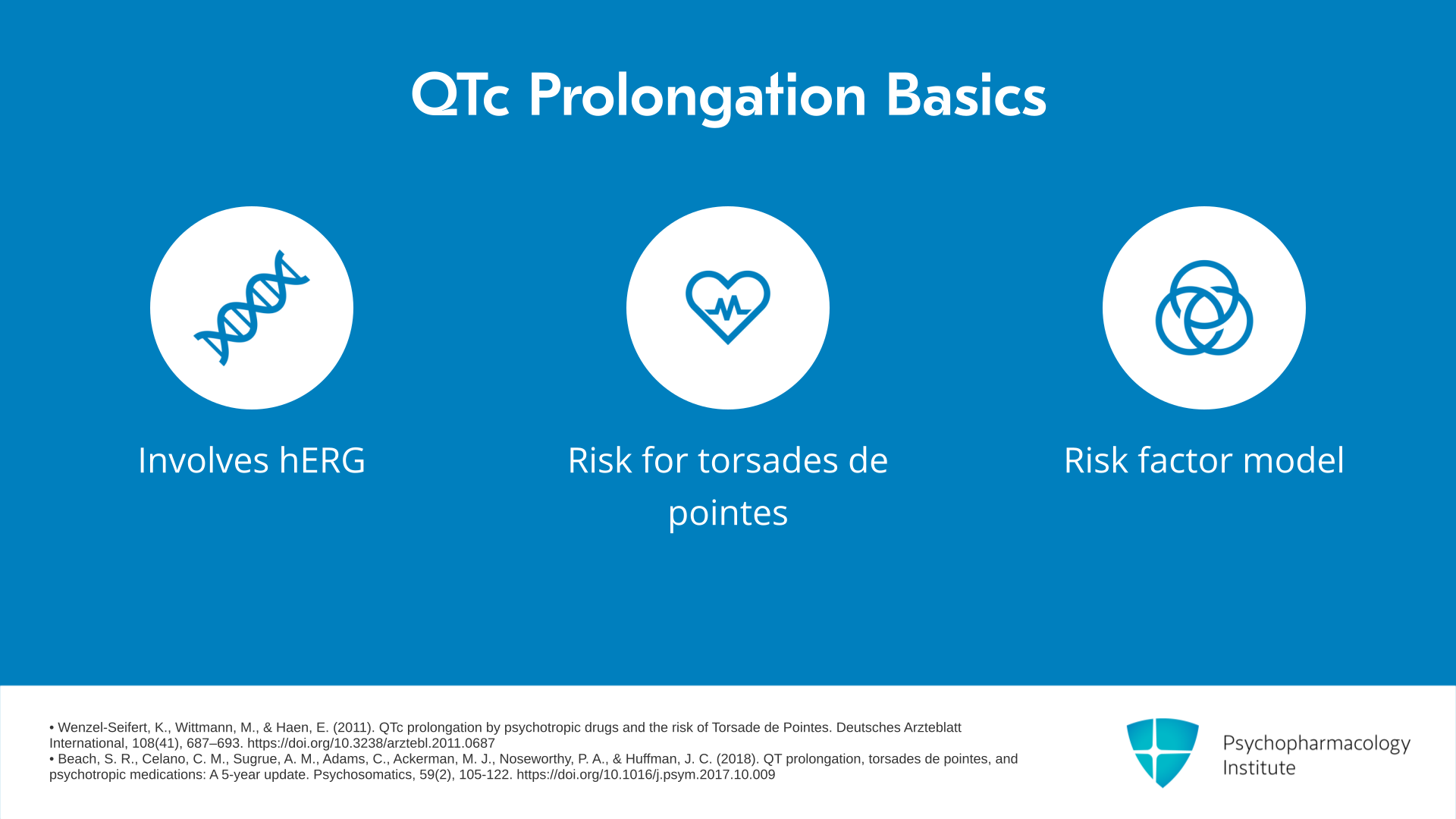
QTc prolongation is pretty well understood at the molecular level. The mechanism has to do with the human ether-a-go-go related gene that regulates potassium ion channel repolarization currents and QTc prolongation increases the risk for torsades de pointes, one of a potentially life-threatening arrhythmia. It’s good to think about QTc prolongation as a risk factor model. It really is just one thing although there are some genetic long QTc syndromes that in and of themselves can cause torsades. But usually, it will be a combination of things like genetic risk, medication that increases QTc and maybe a low potassium level, for example.
References:
- Wenzel-Seifert, K., Wittmann, M., & Haen, E. (2011). QTc prolongation by psychotropic drugs and the risk of Torsade de Pointes. Deutsches Arzteblatt International, 108(41), 687–693. https://doi.org/10.3238/arztebl.2011.0687
- Beach, S. R., Celano, C. M., Sugrue, A. M., Adams, C., Ackerman, M. J., Noseworthy, P. A., & Huffman, J. C. (2018). QT prolongation, torsades de pointes, and psychotropic medications: A 5-year update. Psychosomatics, 59(2), 105-122. https://doi.org/10.1016/j.psym.2017.10.009
Free Files
Download PDF and other files
Success!
Check your inbox, we sent you all the materials there.
Slide 3 of 11
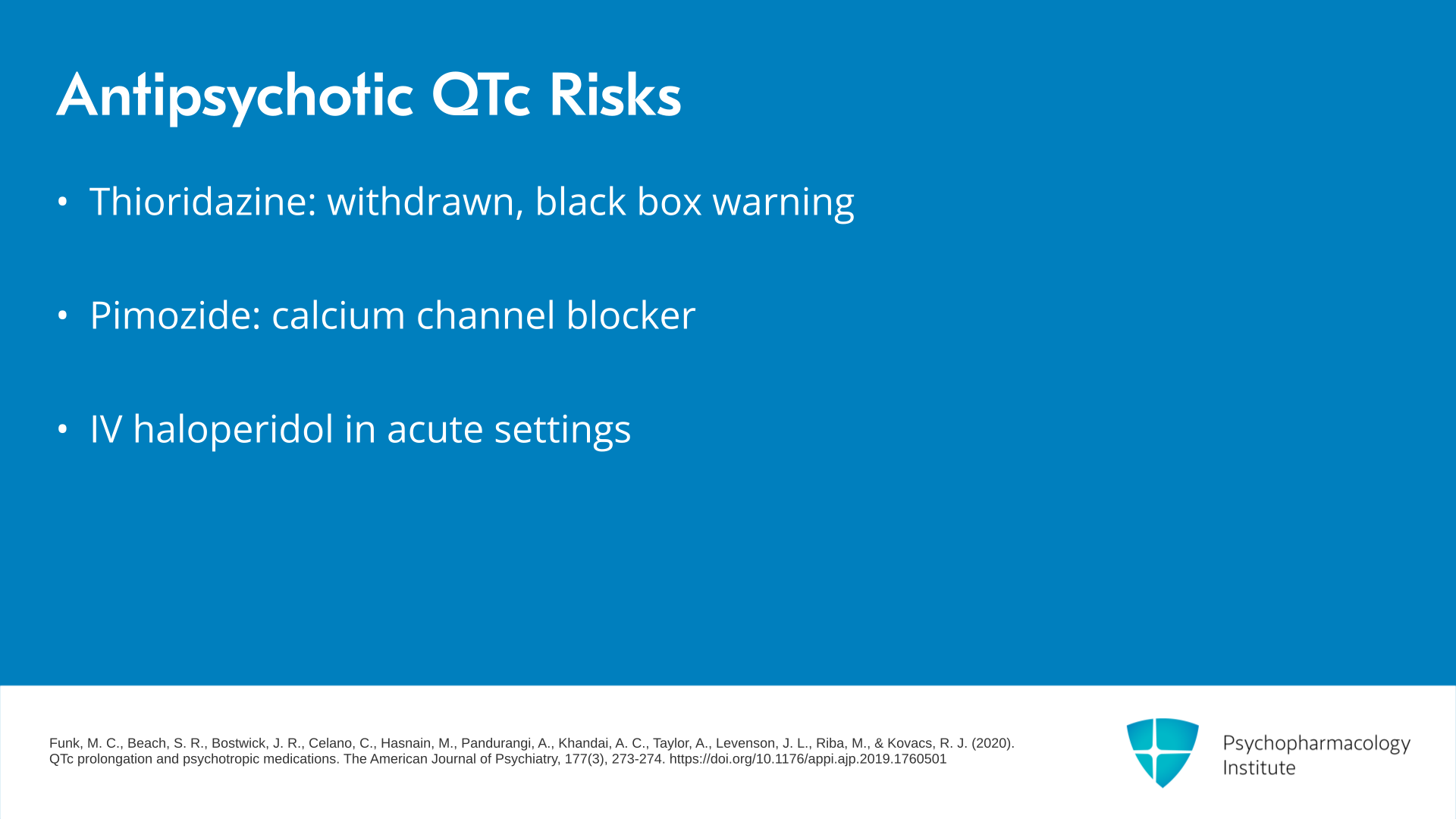
You can rank antipsychotics based on risk. Thioridazine, for example, now withdrawn, used to have a black box warning for it. Pimozide is a calcium channel blocker in addition to blocking dopamine and there you should not prescribe citalopram and escitalopram because of QTc issues. IV haloperidol if you use it in your acute setting in addition to other risk factors probably is a risk factor.
References:
- Funk, M. C., Beach, S. R., Bostwick, J. R., Celano, C., Hasnain, M., Pandurangi, A., Khandai, A. C., Taylor, A., Levenson, J. L., Riba, M., & Kovacs, R. J. (2020). QTc prolongation and psychotropic medications. The American Journal of Psychiatry, 177(3), 273-274. https://doi.org/10.1176/appi.ajp.2019.1760501
Slide 4 of 11
Iloperidone has a similar QTc prolongation concern to ziprasidone. Ziprasidone and QTc prolongation is really a case study in drug development and what happens when a drug comes to market. QTc became an area of interest at that time when ziprasidone was developed and as a result when it was brought to market people were concerned about its QTc prolonging properties.
References:
- Funk, M. C., Beach, S. R., Bostwick, J. R., Celano, C., Hasnain, M., Pandurangi, A., Khandai, A. C., Taylor, A., Levenson, J. L., Riba, M., & Kovacs, R. J. (2020). QTc prolongation and psychotropic medications. The American Journal of Psychiatry, 177(3), 273-274. https://doi.org/10.1176/appi.ajp.2019.1760501
- Potkin, S. G., Preskorn, S., Hochfeld, M., & Meng, X. (2013). A thorough QTc study of 3 doses of iloperidone including metabolic inhibition via CYP2D6 and/or CYP3A4 and a comparison to quetiapine and ziprasidone. Journal of Clinical Psychopharmacology, 33(1), 3–10. https://doi.org/10.1097/JCP.0b013e31827c0314
Free Files
Download PDF and other files
Success!
Check your inbox, we sent you all the materials there.
Slide 5 of 11
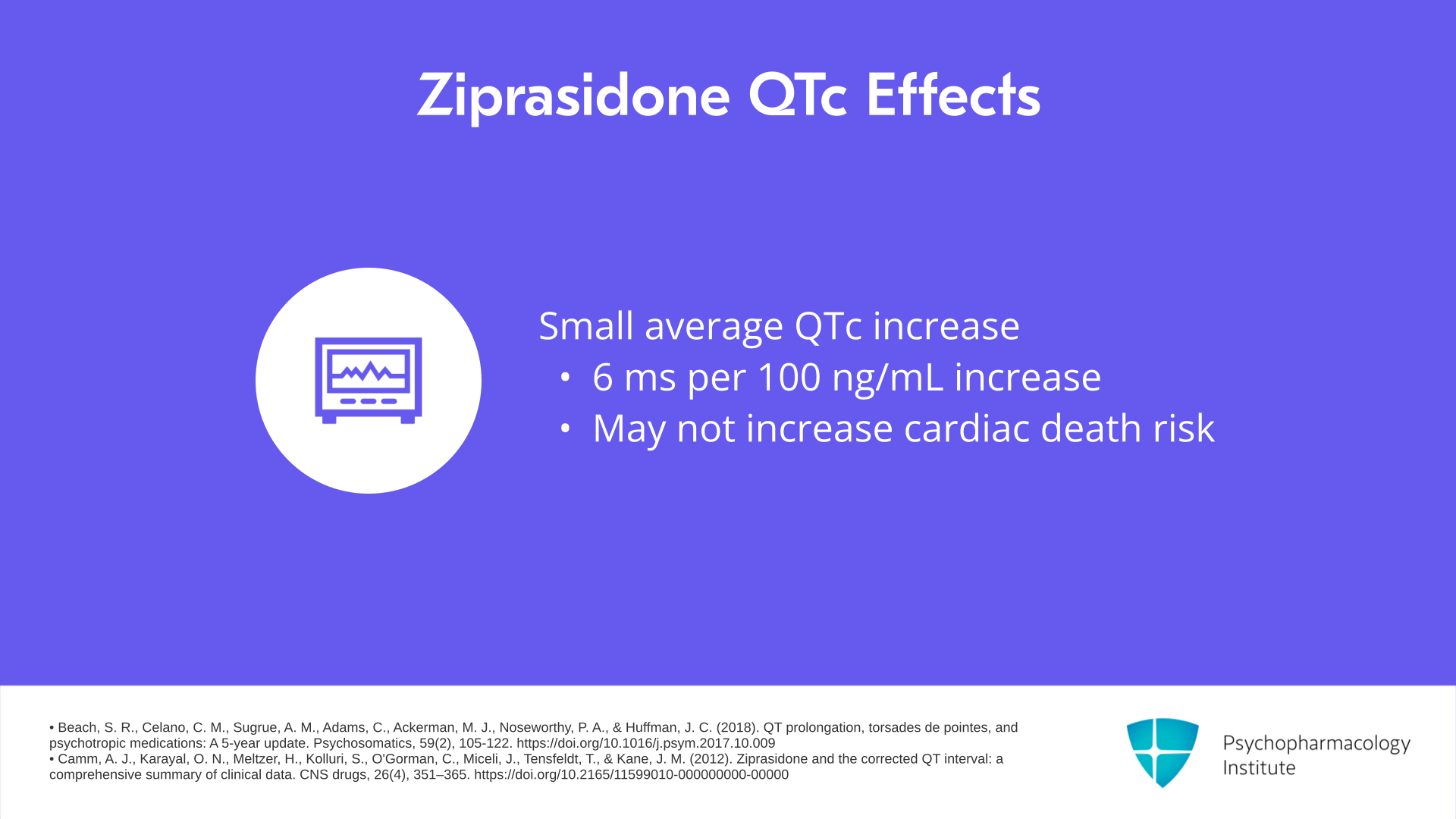
The average increase of QTc from ziprasidone is actually very small, in one study only 6 ms for each 100 ng/mL increase in ziprasidone blood levels. The drug company has been plagued by this problem that there is some increase in QTc when you prescribe ziprasidone but it may actually not lead to an increased risk of ziprasidone-associated cardiac deaths.
References:
- Beach, S. R., Celano, C. M., Sugrue, A. M., Adams, C., Ackerman, M. J., Noseworthy, P. A., & Huffman, J. C. (2018). QT prolongation, torsades de pointes, and psychotropic medications: A 5-year update. Psychosomatics, 59(2), 105-122. https://doi.org/10.1016/j.psym.2017.10.009
- Camm, A. J., Karayal, O. N., Meltzer, H., Kolluri, S., O'Gorman, C., Miceli, J., Tensfeldt, T., & Kane, J. M. (2012). Ziprasidone and the corrected QT interval: a comprehensive summary of clinical data. CNS drugs, 26(4), 351–365. https://doi.org/10.2165/11599010-000000000-00000
Slide 6 of 11
And they did a study, the ZODIAC study standing for Ziprasidone Observational Study of Cardiac Outcomes that showed exactly that – no signal for an increased risk of ziprasidone-associated cardiac death. So that leaves you with a clinical dilemma that there’s really minimal evidence about the real-world relevance for this small QTc prolongation. But there’s a medical-legal aspect of managing the QTc risk.
References:
- Strom, B. L., Eng, S. M., Faich, G., Reynolds, R. F., D'Agostino, R. B., Ruskin, J., & Kane, J. M. (2011). Comparative mortality associated with ziprasidone and olanzapine in real-world use among 18,154 patients with schizophrenia: The Ziprasidone Observational Study of Cardiac Outcomes (ZODIAC). American Journal of Psychiatry, 168(2), 193-201. https://doi.org/10.1176/appi.ajp.2010.08040484
Free Files
Download PDF and other files
Success!
Check your inbox, we sent you all the materials there.
Slide 7 of 11
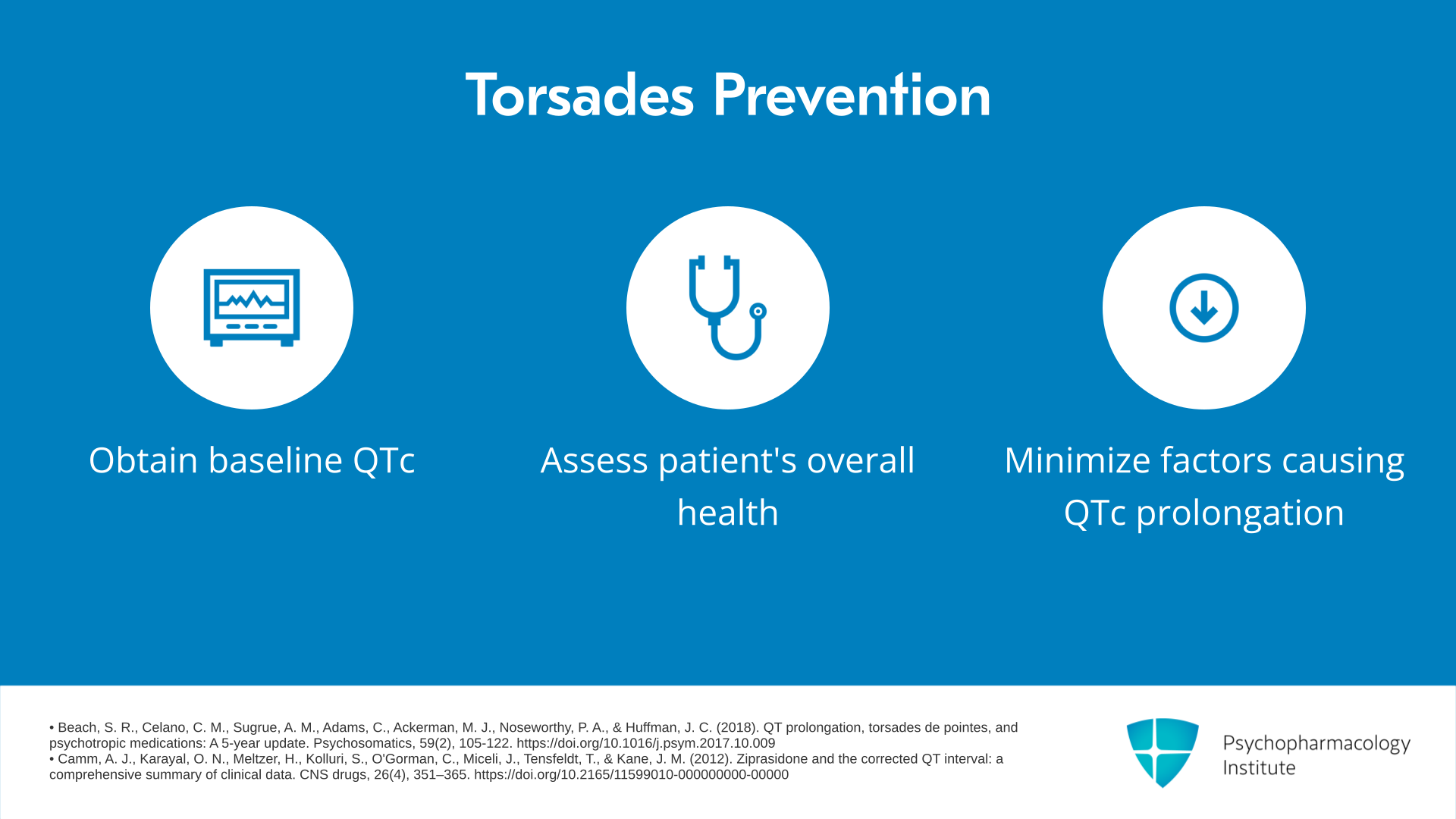
And I think just clinically you want to view antipsychotics as a component cause for developing of torsades. And what it means specifically you may want to consider obtaining a QTc at baseline just to make sure you’re not dealing with an unusual situation like a long QTc syndrome but then also look at overall your patient’s medical health, look at electrolytes and do minimize other factors that could collectively lead to QTc prolongation above a threshold that then would lead to torsades.
References:
- Beach, S. R., Celano, C. M., Sugrue, A. M., Adams, C., Ackerman, M. J., Noseworthy, P. A., & Huffman, J. C. (2018). QT prolongation, torsades de pointes, and psychotropic medications: A 5-year update. Psychosomatics, 59(2), 105-122. https://doi.org/10.1016/j.psym.2017.10.009
- Camm, A. J., Karayal, O. N., Meltzer, H., Kolluri, S., O'Gorman, C., Miceli, J., Tensfeldt, T., & Kane, J. M. (2012). Ziprasidone and the corrected QT interval: a comprehensive summary of clinical data. CNS drugs, 26(4), 351–365. https://doi.org/10.2165/11599010-000000000-00000
Slide 8 of 11
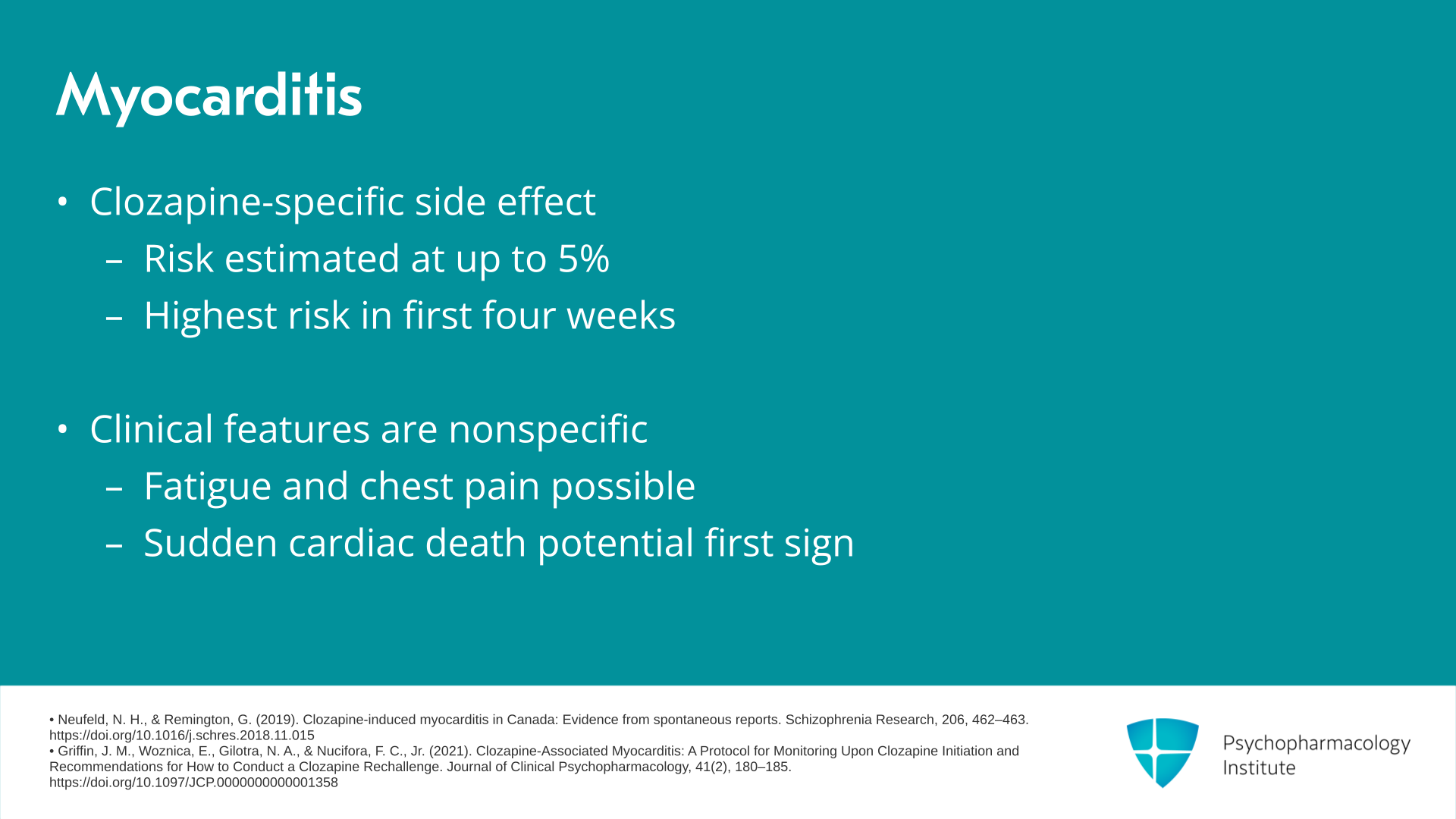
A clozapine-specific side effect is myocarditis that is really not seen when you use other antipsychotics. The myocarditis risk is fairly high probably, some suggest as high as 5% of patients. And the problem with this particular side effect is that its clinical features are nonspecific. So you need to have a high index of suspicion for it. People may be fatigued. They may have a little bit of chest pain but unfortunately the first sign of myocarditis could actually be sudden cardiac death. The highest risk period is in the first four weeks.
References:
- Neufeld, N. H., & Remington, G. (2019). Clozapine-induced myocarditis in Canada: Evidence from spontaneous reports. Schizophrenia Research, 206, 462–463. https://doi.org/10.1016/j.schres.2018.11.015
- Griffin, J. M., Woznica, E., Gilotra, N. A., & Nucifora, F. C., Jr. (2021). Clozapine-Associated Myocarditis: A Protocol for Monitoring Upon Clozapine Initiation and Recommendations for How to Conduct a Clozapine Rechallenge. Journal of Clinical Psychopharmacology, 41(2), 180–185. https://doi.org/10.1097/JCP.0000000000001358
Free Files
Download PDF and other files
Success!
Check your inbox, we sent you all the materials there.
Slide 9 of 11
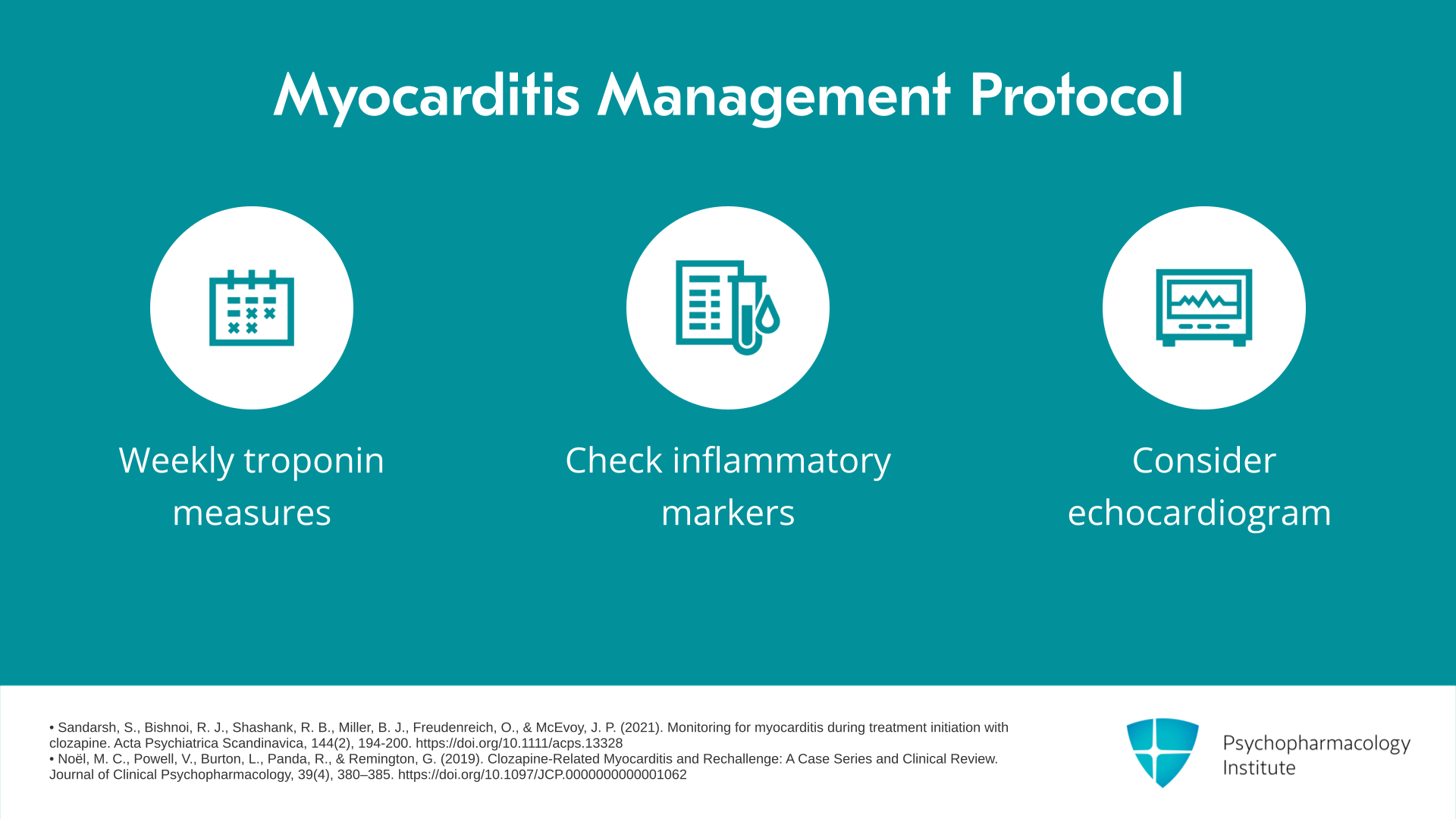
And in order to manage this safely, we need to have some monitoring schedule for myocarditis. At a minimum, look for weekly troponin measures to detect an increase in troponin in addition to some inflammatory markers which unfortunately are not sensitive enough or nonspecific. Do this for four to six weeks but I think at this point we’re doing it for eight weeks in our own clinic. In some countries, an echocardiogram is actually suggested before we start people on clozapine.
References:
- Sandarsh, S., Bishnoi, R. J., Shashank, R. B., Miller, B. J., Freudenreich, O., & McEvoy, J. P. (2021). Monitoring for myocarditis during treatment initiation with clozapine. Acta Psychiatrica Scandinavica, 144(2), 194-200. https://doi.org/10.1111/acps.13328
- Noël, M. C., Powell, V., Burton, L., Panda, R., & Remington, G. (2019). Clozapine-Related Myocarditis and Rechallenge: A Case Series and Clinical Review. Journal of Clinical Psychopharmacology, 39(4), 380–385. https://doi.org/10.1097/JCP.0000000000001062
Slide 10 of 11
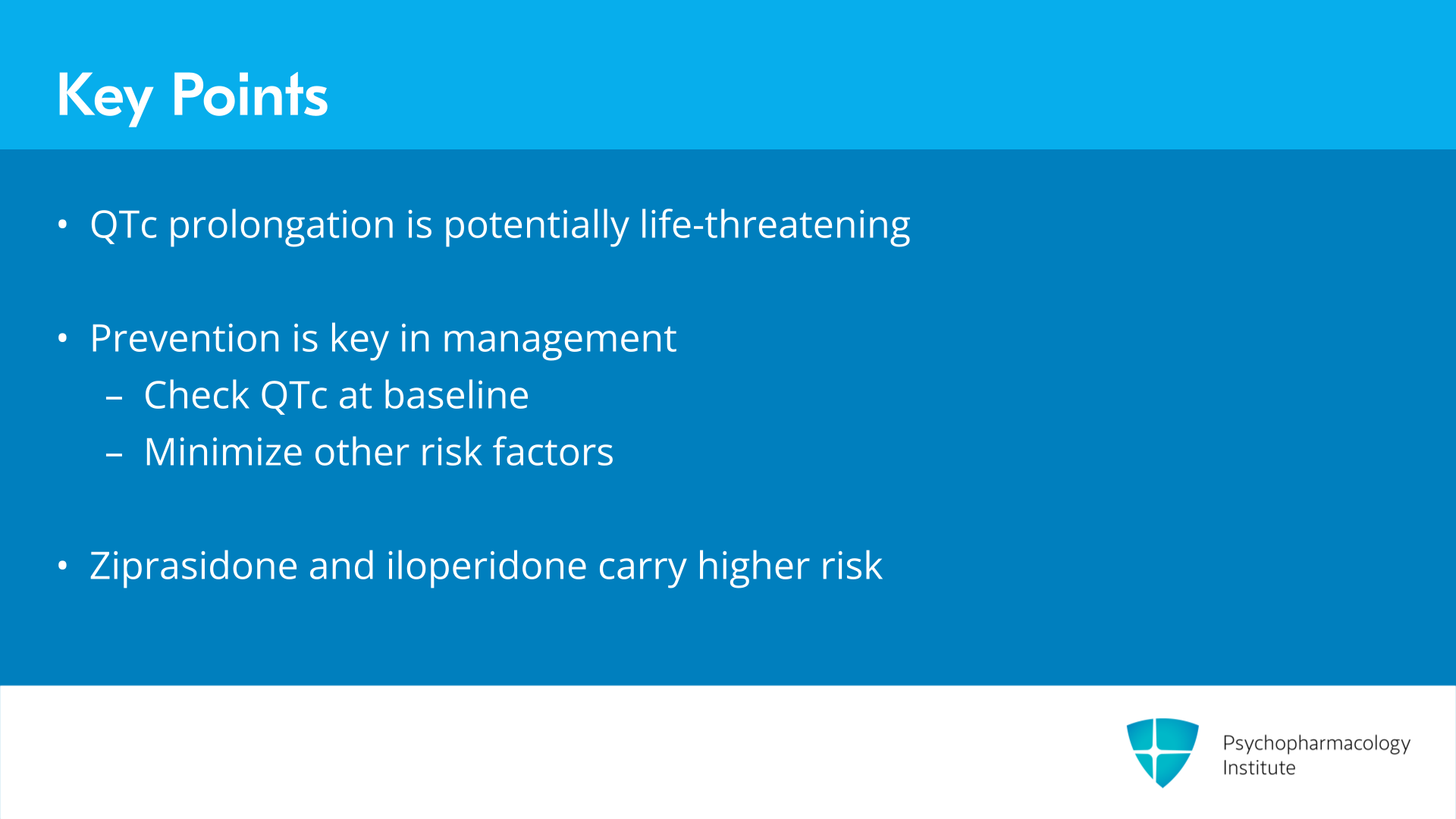
Key points. A potentially life-threatening side effect is QTc prolongation which requires an EKG to detect. QTc prolongation is potentially dangerous as it is associated with torsades, a life-threatening cardiac arrhythmia. The best management/prevention is checking a QTc at baseline and minimizing other factors that are risk factors for QTc prolongation such as a low potassium. In most cases, an antipsychotic alone is not sufficient to cause dangerous QTc prolongation and torsades but ziprasidone and iloperidone are associated with a higher degree of QTc prolongation compared to other antipsychotics.
Free Files
Download PDF and other files
Success!
Check your inbox, we sent you all the materials there.
Slide 11 of 11
Myocarditis is a unique cardiac side effect associated with clozapine. It occurs acutely within the first month of treatment initiation and needs to be managed with troponin monitoring during treatment initiation.