Slides and Transcript
Slide 1 of 7
Slide 2 of 7
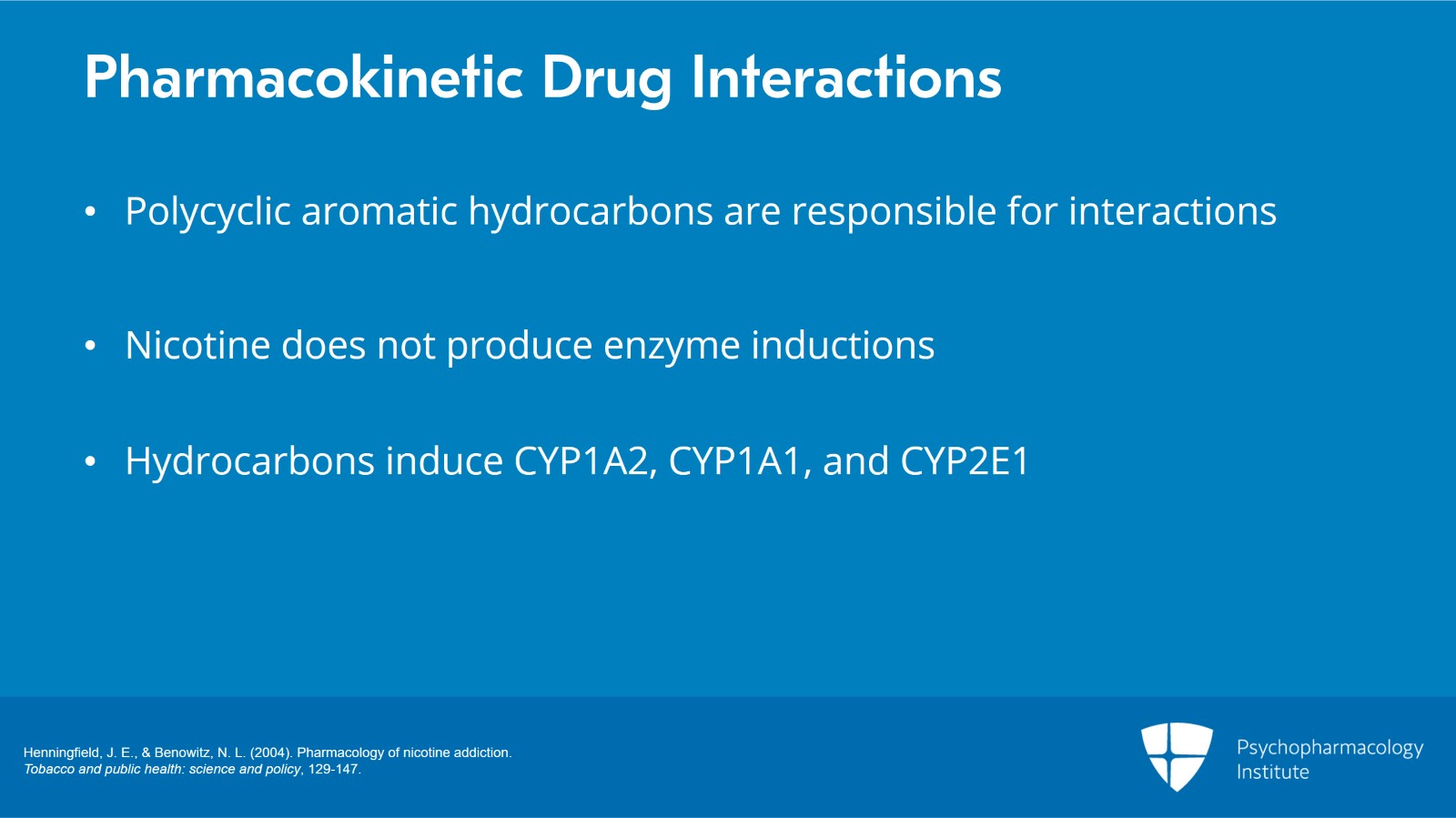
So let me briefly talk about the pharmacokinetic drug interactions. So this refers to the changes in the metabolism of different drugs because of smoking. And this is an important point to point out, is that tobacco use leading to pharmacokinetic drug interactions is through the polycyclic aromatic hydrocarbons in the tobacco produced by the burning of the tobacco products or the compounds other than nicotine. Nicotine itself does not produce the enzyme inductions that I'm going to be talking about. It's really about the use of tobacco products predominantly smoked tobacco that burns the organic matter producing these hydrocarbons. And these hydrocarbons lead to the induction of certain cytochrome p450 enzymes notably CYP1A2 predominantly but also CYP1A1 and also CYP2E1 or other major enzymes that are induced by tobacco.
References:
- Henningfield, J. E., & Benowitz, N. L. (2004). Pharmacology of nicotine addiction. Tobacco and public health: science and policy, 129-147.
Free Files
Download PDF and other files
Success!
Check your inbox, we sent you all the materials there.
Slide 3 of 7
And so the reason why this becomes very critical is that as somebody becomes a regular smoker and this happens within the first few days of smoking is that this will lead to the increased clearance of a variety of pharmacologic agents that are used especially in psychiatric populations. And the most important ones to remember are antipsychotics and then one of the antidepressants specifically fluvoxamine. When it comes to antipsychotics, clozapine and olanzapine are probably the most important ones to remember but also haloperidol and chlorpromazine could be affected as well. But for antidepressants, it's really fluvoxamine that's going to be mostly affected. And what this means is that while the person is actively smoking cigarettes, the clearance of these medications is increased probably anywhere from 20% to 50% or sometimes even more. And so what this means is those individuals may require higher doses than usual. Also, in addition to antipsychotics and the antidepressant I mentioned, caffeine and theophylline are also pretty strongly influenced by the hepatic enzyme induction and will lead to increased clearance levels. And so the individual may need to use higher doses of those to get the same effect.
References:
- Henningfield, J. E., & Benowitz, N. L. (2004). Pharmacology of nicotine addiction. Tobacco and public health: science and policy, 129-147.

Slide 4 of 7
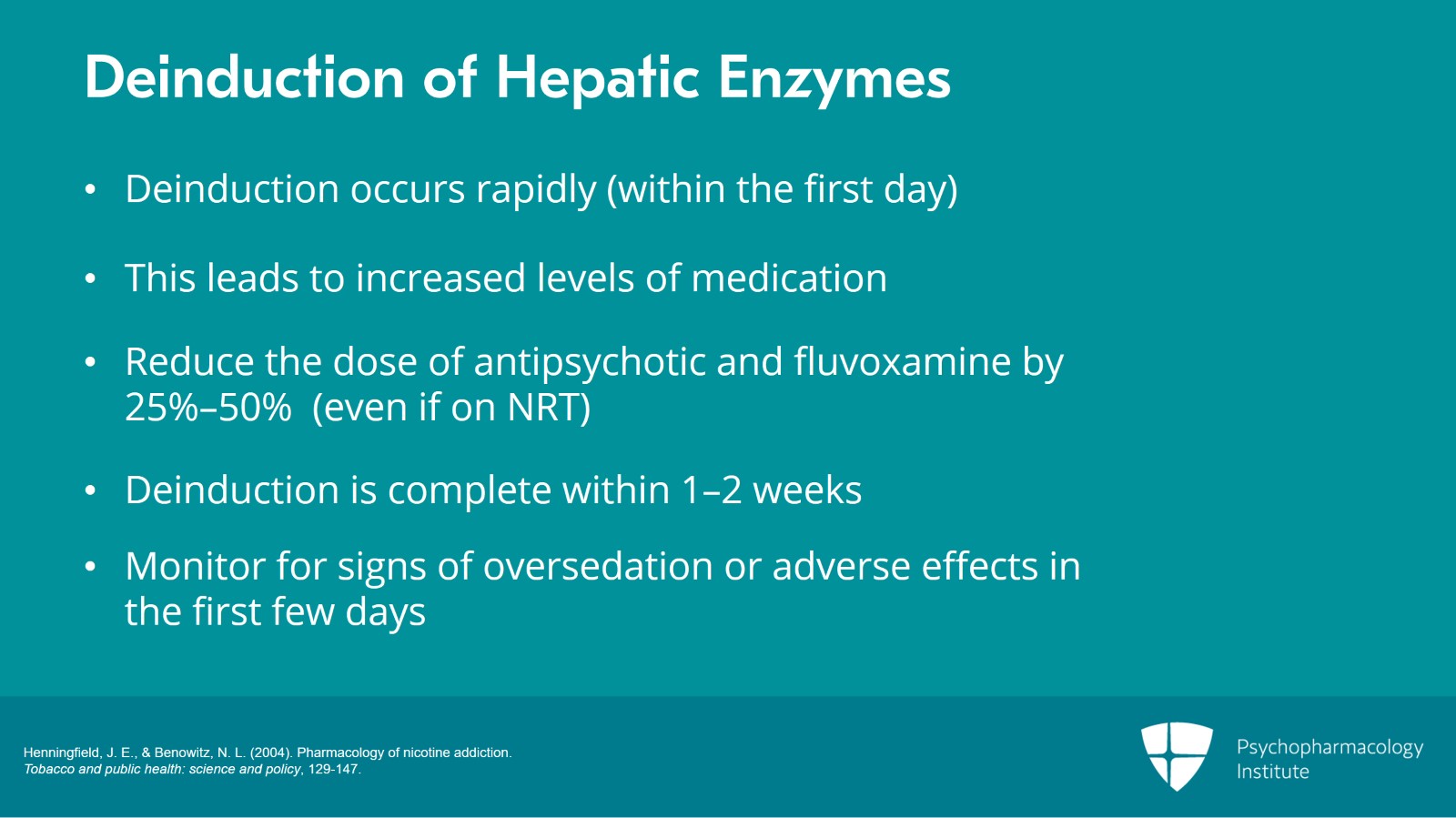
Now, this becomes critically important when a psychiatric patient on these medications are now suddenly in a situation where they're not able to smoke cigarettes whether that's in inpatient treatment, in a hospital or other facilities where smoking may not be permitted. Even if a person is placed on a nicotine replacement therapy, that will not prevent the deinduction of the hepatic enzymes leading to changes in the blood levels. So an individual who is let's say taking clozapine is admitted to an inpatient unit or a general hospital and is not able to smoke. The deinduction will begin pretty rapidly within the first day even leading to increased levels because of the decreased clearance of that medication. And so this can lead to a very dangerous situation with something like clozapine where increased serum levels can lead to significant side effects. And so the current recommendation is to reduce the dose of the antipsychotics as well as fluvoxamine by 25% to 50% as soon as the person is unable to smoke even if they're taking NRT. And about a week or so, a week or two, the deinduction really is probably fully complete. So during those first few days, it's very critically important to monitor for any signs of oversedation or adverse effects from these medications.
References:
- Henningfield, J. E., & Benowitz, N. L. (2004). Pharmacology of nicotine addiction. Tobacco and public health: science and policy, 129-147.
Free Files
Download PDF and other files
Success!
Check your inbox, we sent you all the materials there.
Slide 5 of 7
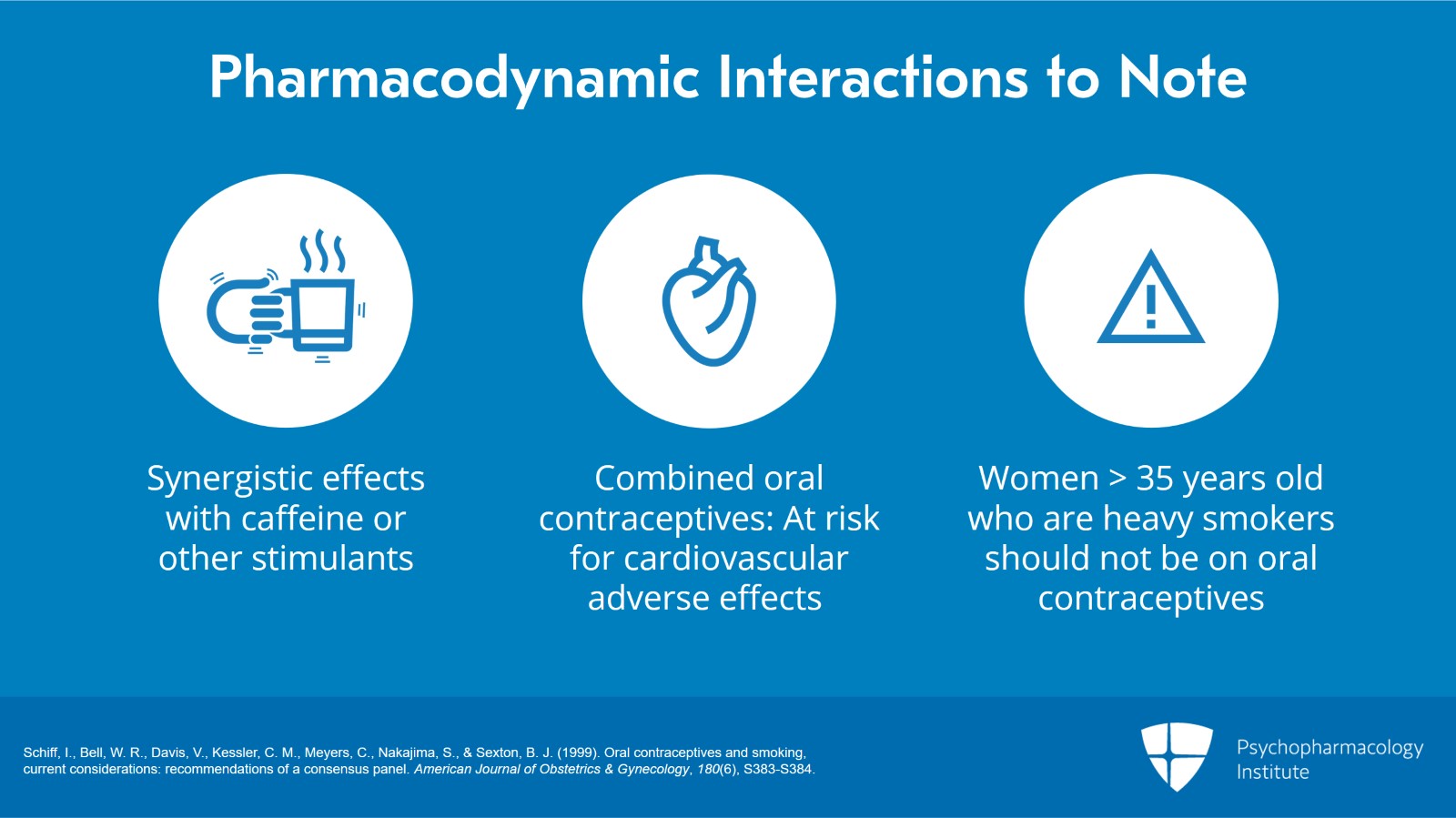
Now, in addition to pharmacokinetic interactions, there are some pharmacodynamic interactions that should be noted. For the most part, there are no major pharmacodynamic interactions between nicotine and other drugs other than to say that there could be some synergistic stimulant effects with things like caffeine or other stimulants. But the most important one is actually going to be combined oral contraceptives that contain both estrogen and progestin because smokers who use oral contraceptives have an increased risk for serious cardiovascular adverse effects such as strokes, myocardial infarction and thromboembolic events. And so what this means is that women above the age 35 who are pretty heavy smokers as defined by smoking more than 15 cigarettes per day generally are not recommended to be started on oral contraceptives for this very reason.
References:
- Schiff, I., Bell, W. R., Davis, V., Kessler, C. M., Meyers, C., Nakajima, S., & Sexton, B. J. (1999). Oral contraceptives and smoking, current considerations: recommendations of a consensus panel. American Journal of Obstetrics & Gynecology, 180(6), S383-S384.
Slide 6 of 7
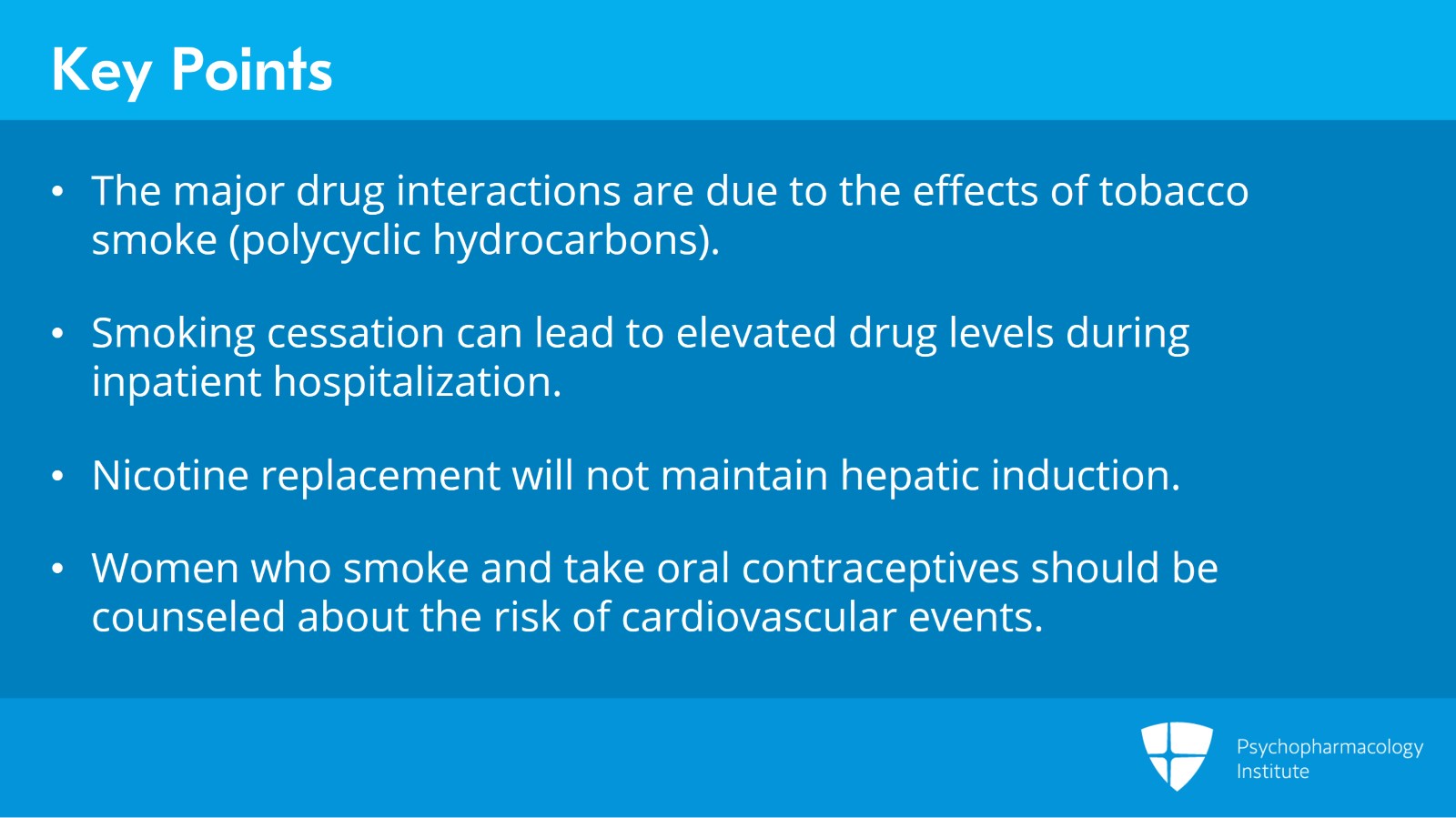
So the major pharmacokinetic interactions are due to the effects of smoking tobacco, not nicotine. And the smoke contains a myriad of polycyclic hydrocarbons. Psychiatrists need to be aware that smoking cessation can lead to elevated drug levels such as during inpatient hospitalization when smoking may not be permitted. Nicotine replacement will not maintain the hepatic induction. Now, female smokers on oral contraceptives should be counseled about the potential for cardiovascular adverse effects of the interaction between smoking and estrogen and progesterone.
Free Files
Download PDF and other files
Success!
Check your inbox, we sent you all the materials there.
Slide 7 of 7