



Slides and Transcript
Slide 1 of 8
So now, let's talk about E-Cigarettes: Are E-Cigarettes Justified?

Slide 2 of 8
So the e-cigarettes really emerged within the last decade or so. It has evolved very dramatically and changed quite a bit. The first-generation e-cigarettes were very simple, limited functionality, inefficient nicotine delivery with very short charge time but single voltage. But then there are second-generation e-cigs that had larger batteries, refillable cartridges, more efficient nicotine delivery, longer charge time but adjustable voltage. And then finally, we are at a stage of the third-generation e-cigarettes which are very advanced personal vaporizers and the nicotine delivery matches that of conventional cigarettes and these are very customizable, adjustable and refillable devices and have really become quite popular.
References:
- Wagener, T. L., Floyd, E. L., Stepanov, I., Driskill, L. M., Frank, S. G., Meier, E., … & Queimado, L. (2017). Have combustible cigarettes met their match? The nicotine delivery profiles and harmful constituent exposures of second-generation and third-generation electronic cigarette users. Tobacco control, 26(e1), e23-e28.

Free Files
Download PDF and other files
Success!
Check your inbox, we sent you all the materials there.
Slide 3 of 8
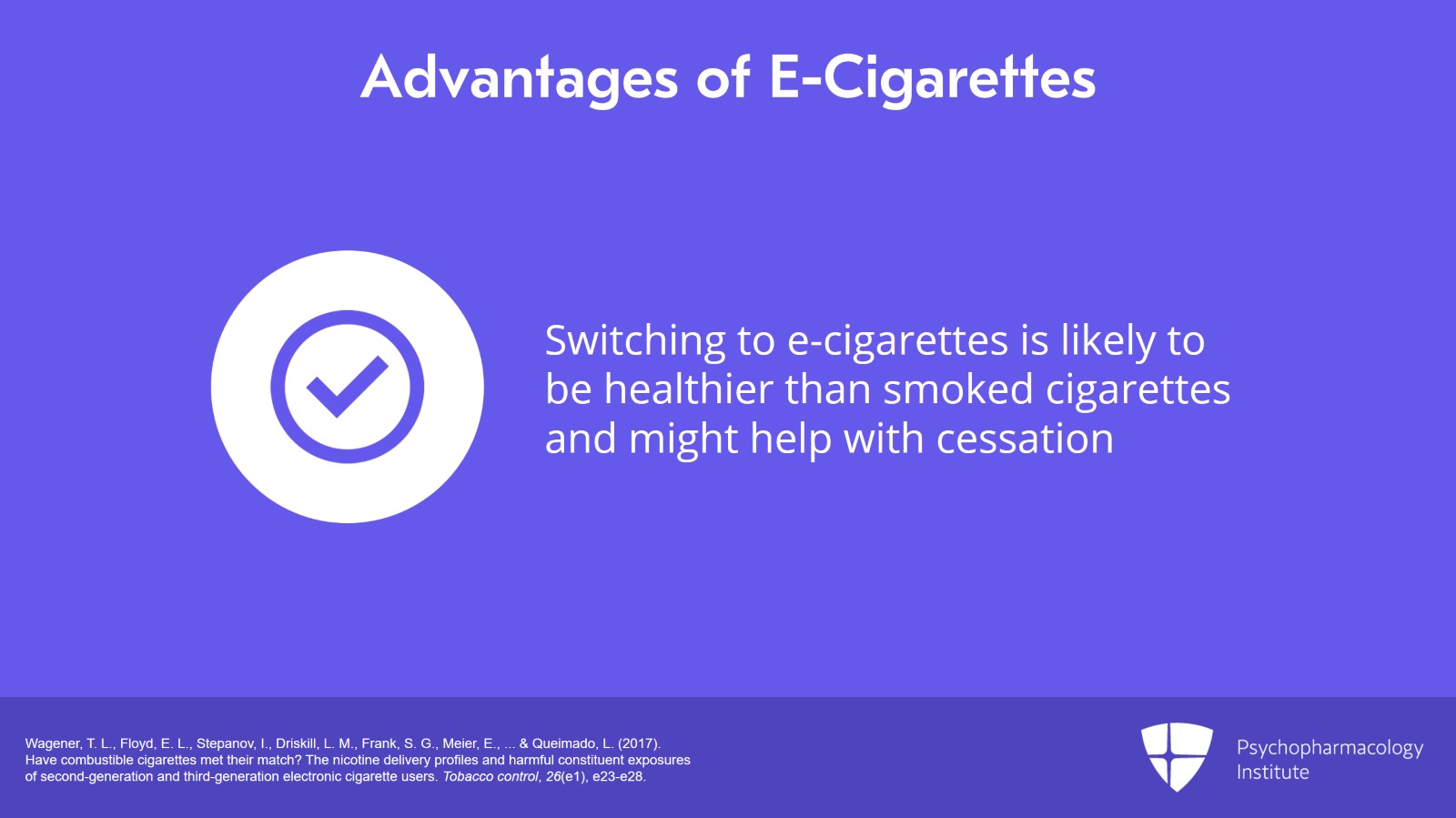
Now, from the perspective of smoking cessation, e-cigarettes do provide some advantages. It is considered an acceptable substitute to smoking tobacco cigarettes. And the director of the Office on Smoking and Health for the CDC in the United States stated that there's enough evidence to say that switching to electronic cigarettes from tobacco, you know, smoked cigarettes would likely be healthier and that there is some evidence that suggests that it can help in cessation.
References:
- Wagener, T. L., Floyd, E. L., Stepanov, I., Driskill, L. M., Frank, S. G., Meier, E., … & Queimado, L. (2017). Have combustible cigarettes met their match? The nicotine delivery profiles and harmful constituent exposures of second-generation and third-generation electronic cigarette users. Tobacco control, 26(e1), e23-e28
Slide 4 of 8
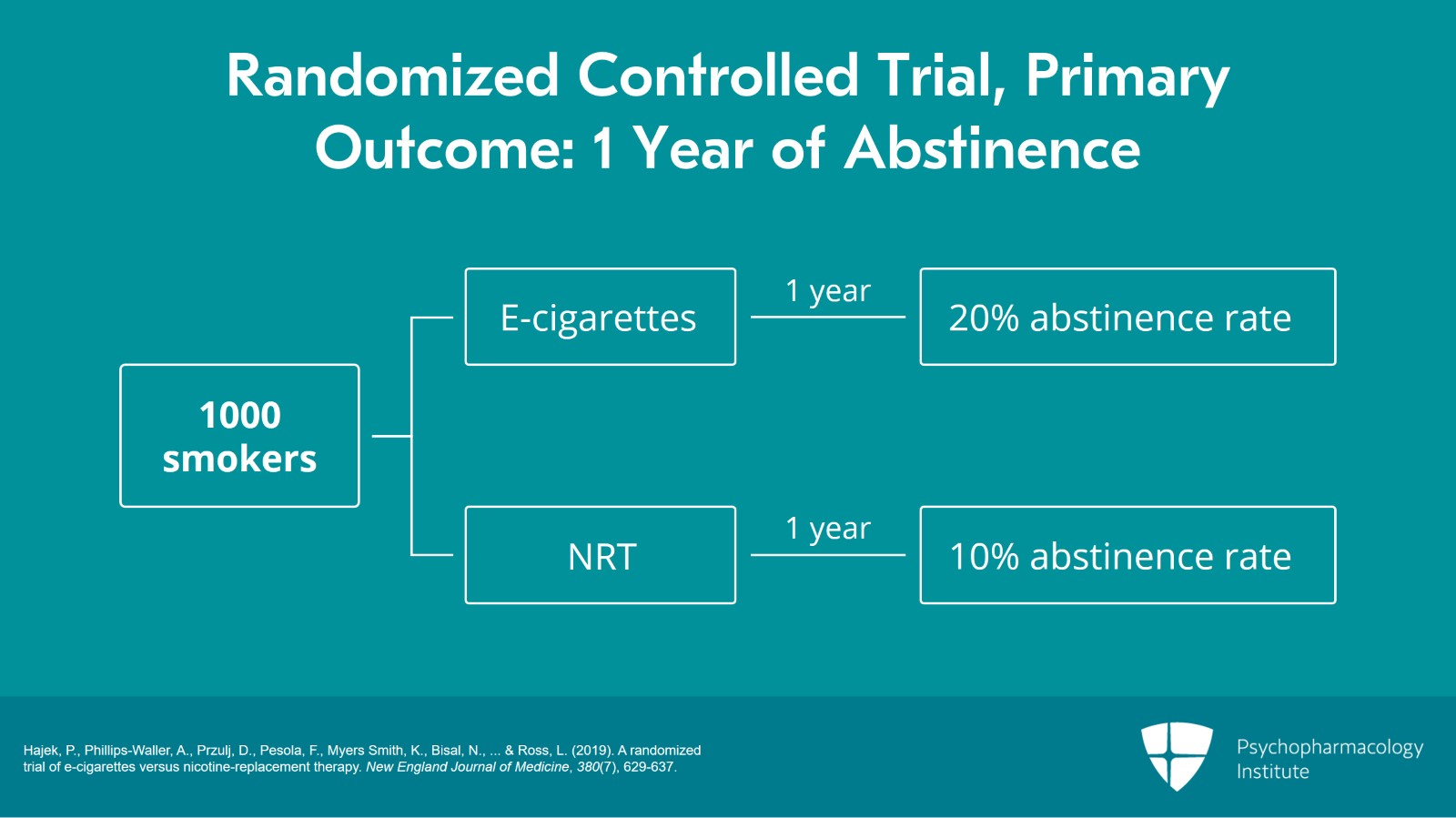
The best randomized trial published to date came out in the New England Journal of Medicine in 2019. It was a randomized controlled trial of almost 1000 smokers in the UK and they were given either e-cigarettes or a nicotine replacement therapy with the outcome being one year of abstinence with biochemical validation. And those who were randomized to the e-cigarette group had twice the one-year abstinence rate than the nicotine replacement. So about 20% success rate in the e-cigarette group and about 10% in the NRT group. And no difference in the incidence of wheezing or other respiratory problems or other ailments associated with e-cigarettes at all.
References:
- Hajek, P., Phillips-Waller, A., Przulj, D., Pesola, F., Myers Smith, K., Bisal, N., … & Ross, L. (2019). A randomized trial of e-cigarettes versus nicotine-replacement therapy. New England Journal of Medicine, 380(7), 629-637.
Free Files
Download PDF and other files
Success!
Check your inbox, we sent you all the materials there.
Slide 5 of 8
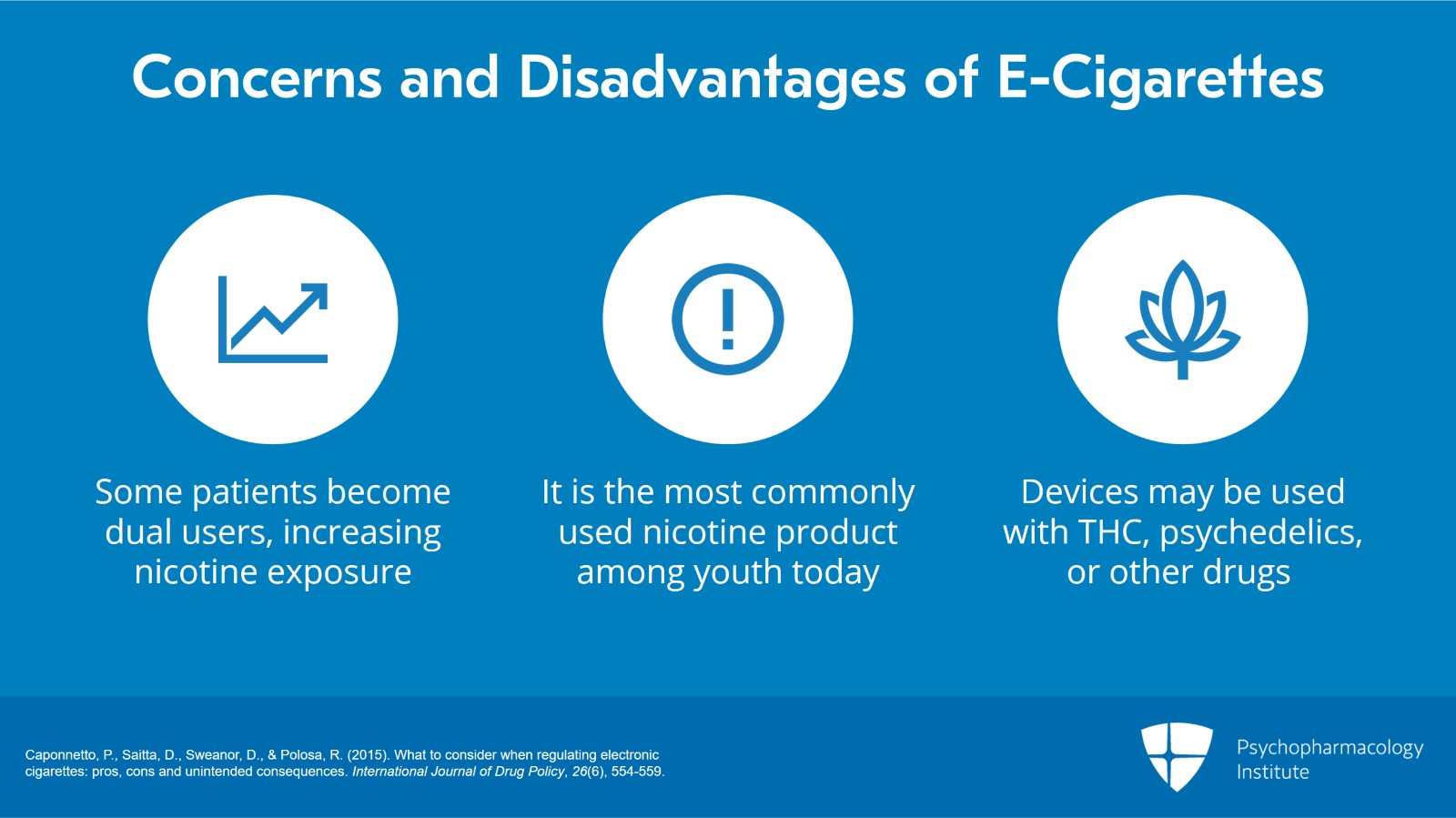
Now that said, there are some concerns and disadvantages with e-cigarettes. Now, there are lots of people who do utilize e-cigarettes but it does not help them to quit. And in fact, this can create a problem where they become dual users, meaning these individuals will keep continuing to smoke their tobacco and utilize e-cigarettes when they're not able to smoke their tobacco. So the net effect is actually increased nicotine exposure without any reduction in tobacco exposure which actually probably may be worse. And these devices can also be modified to deliver other types of substances like THC, for example, or psychedelics or other drugs of misuse. And these devices may be utilized by youth and that's probably the biggest concern that we have at this point, is that the prevalence of vaping, e-cigarette use among the youth has skyrocketed in the last five to 10 years. And in fact, e-cigarette is the most commonly utilized tobacco product or nicotine product among the youth today.
References:
- Caponnetto, P., Saitta, D., Sweanor, D., & Polosa, R. (2015). What to consider when regulating electronic cigarettes: pros, cons and unintended consequences. International Journal of Drug Policy, 26(6), 554-559.
Slide 6 of 8
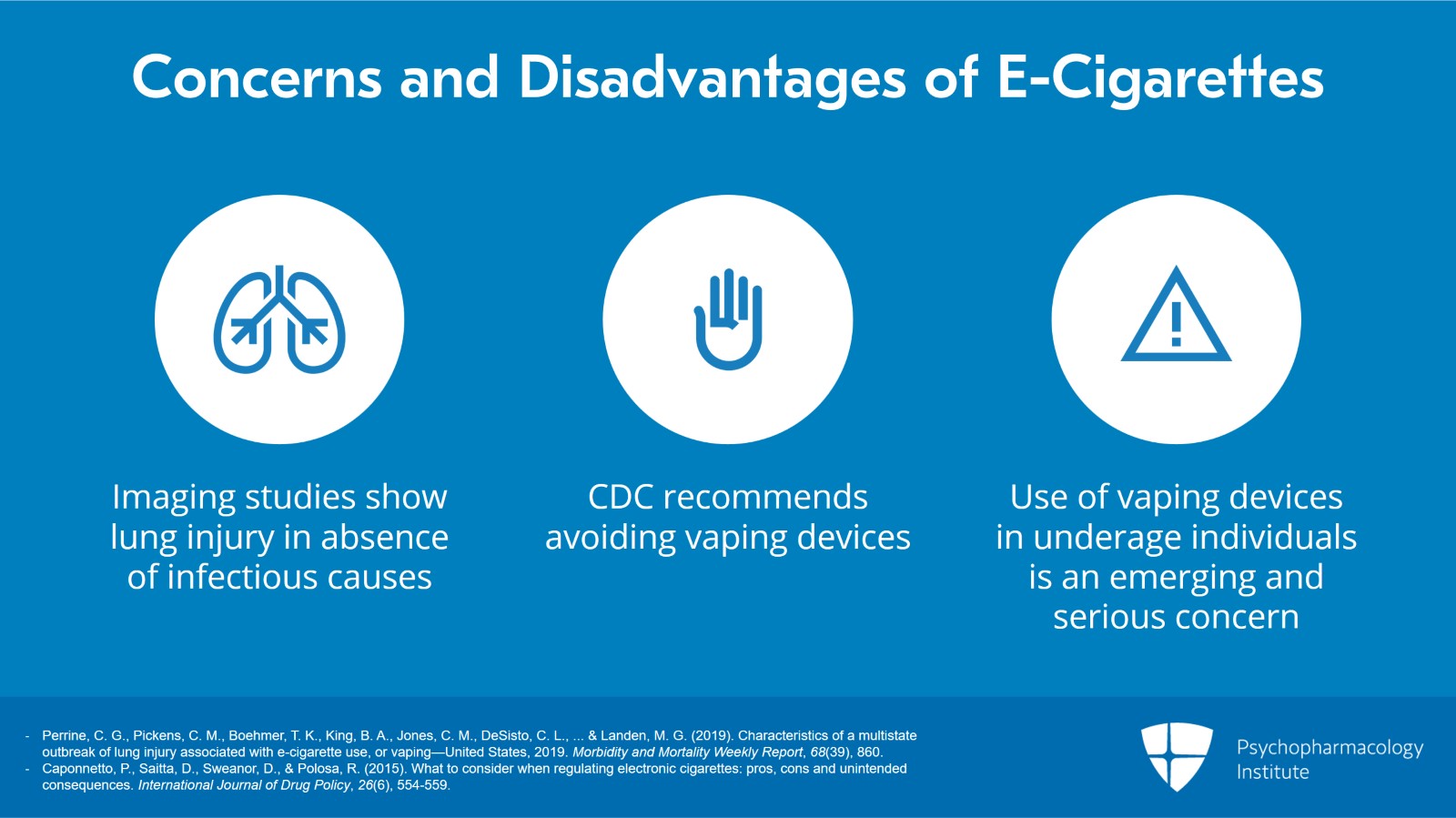
And now in addition to that, there had been increasing reports of vaping-related lung injuries. Now, these are typically in the context of whether it's illicitly produced vaping products particularly those containing THC but at this point, it's unclear exactly what's causing it. But individuals with this illness report using e-cigarettes by vaping or dabbing with imaging studies showing lung injury with the absence of any evidence for infectious causes that lead to these injuries and then the absence of any alternative possible diagnoses. And the current recommendation by the CDC is to avoid utilizing these products completely. Some states have resorted to banning flavoring agents that are utilized in these products which is thought to be the culprit for the vaping-related injury. So the recommendation for now is for people to avoid it if necessary and certainly the flavoring agents that are added should be avoided at all costs. And so it may be a helpful device to stop smoking or reduce smoking but in adolescents and youth, the data very strongly suggest that if individuals initiate vaping with e-cigarettes, they have a higher likelihood of picking up tobacco smoking later in life. So this is completely going in the opposite direction of the success that we've had with reducing tobacco smoking in the United States but the introduction of vaping may actually begin to reverse that. Now, the data from CDC suggest that currently 12th graders in the United States, probably over a third of them endorse having vaped within the past year. And for among 8th graders, it might be as much as one in five may have tried vaping in the past year. So this is an emerging problem and a serious concern.
References:
- Perrine, C. G., Pickens, C. M., Boehmer, T. K., King, B. A., Jones, C. M., DeSisto, C. L., … & Landen, M. G. (2019). Characteristics of a multistate outbreak of lung injury associated with e-cigarette use, or vaping—United States, 2019. Morbidity and Mortality Weekly Report, 68(39), 860.
- Caponnetto, P., Saitta, D., Sweanor, D., & Polosa, R. (2015). What to consider when regulating electronic cigarettes: pros, cons and unintended consequences. International Journal of Drug Policy, 26(6), 554-559.
Free Files
Download PDF and other files
Success!
Check your inbox, we sent you all the materials there.
Slide 7 of 8
So key points. E-cigarettes from a legitimate manufacturer may be safer than cigarette smoking but they are not risk free. And clinicians and patients need to be educated by the emergence of vaping-related lung disease. And e-cigarettes may be a viable smoking cessation strategy compared to NRT.

Slide 8 of 8

Free Files
Download PDF and other files
Success!
Check your inbox, we sent you all the materials there.
