Close Banner
Section Free  - Video Lectures

06. Types of Antipsychotic Switching: Between PO Agents and From PO to LAI

Published on March 1, 2022 Expired on April 1, 2025

Brian Miller, M.D., Ph.D., M.P.H.

Professor - Augusta University

Key Points

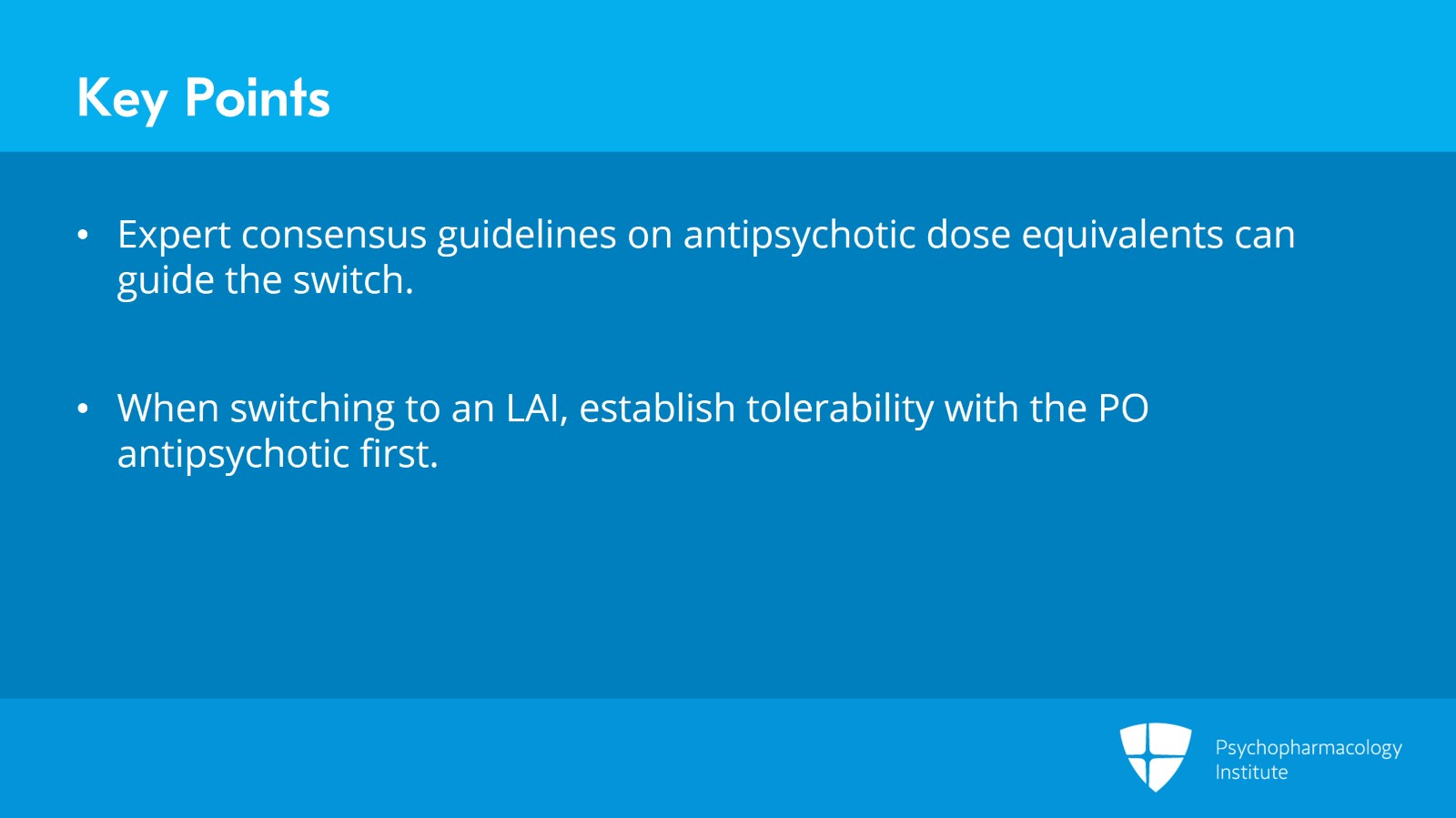
  • Expert consensus guidelines on antipsychotic dose equivalents can guide the switch.
  • When switching to an LAI, establish tolerability with the PO antipsychotic first.
  • A period of PO antipsychotic supplementation is required after the first injection.

Free Downloads for Offline Access

  • Free Download Presentation File (PPTX)
  • Free Download Audio File (MP3)
  • Free Download Video (MP4)

Slides and Transcript
Slide 1 of 22

So now, we’re going to talk about specific types of antipsychotic switching. In particular, in this section, we’re going to talk about switching between different oral agents as well as switching from an oral agent to a long-acting injectable antipsychotic.

Slide 2 of 22

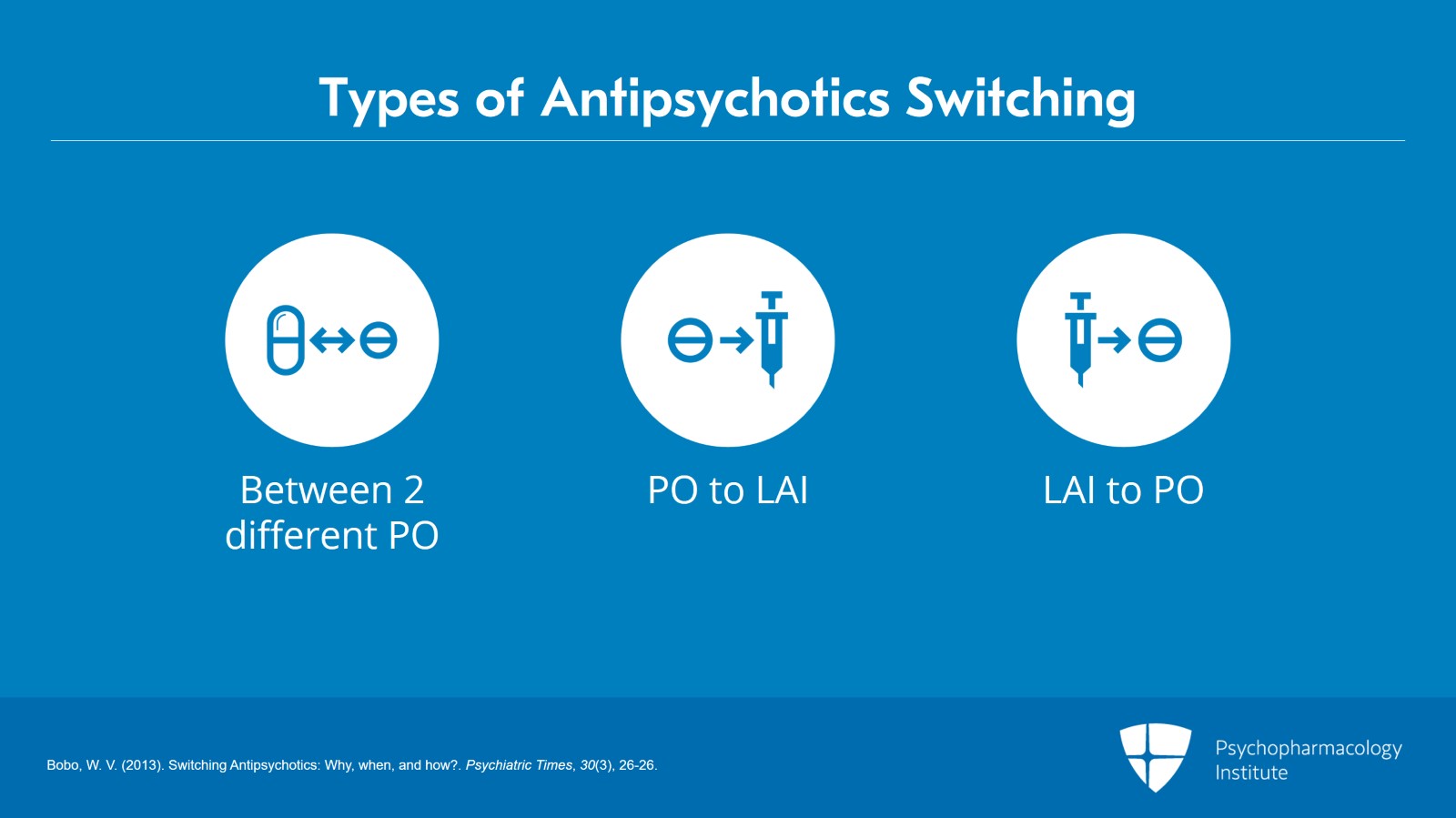
Different types of antipsychotic switching include switching between two different oral agents, going from oral to long-acting injectable antipsychotics, how do we switch from long-acting injectable to oral agents.
References:
  • Bobo, W. V. (2013). Switching Antipsychotics: Why, when, and how?. Psychiatric Times, 30(3), 26-26.
Free Files
Success!
Check your inbox, we sent you all the materials there.

Slide 3 of 22

Or just between two different long-acting injectables and then a special case would be switching to clozapine.
References:
  • Bobo, W. V. (2013). Switching Antipsychotics: Why, when, and how?. Psychiatric Times, 30(3), 26-26.

Slide 4 of 22

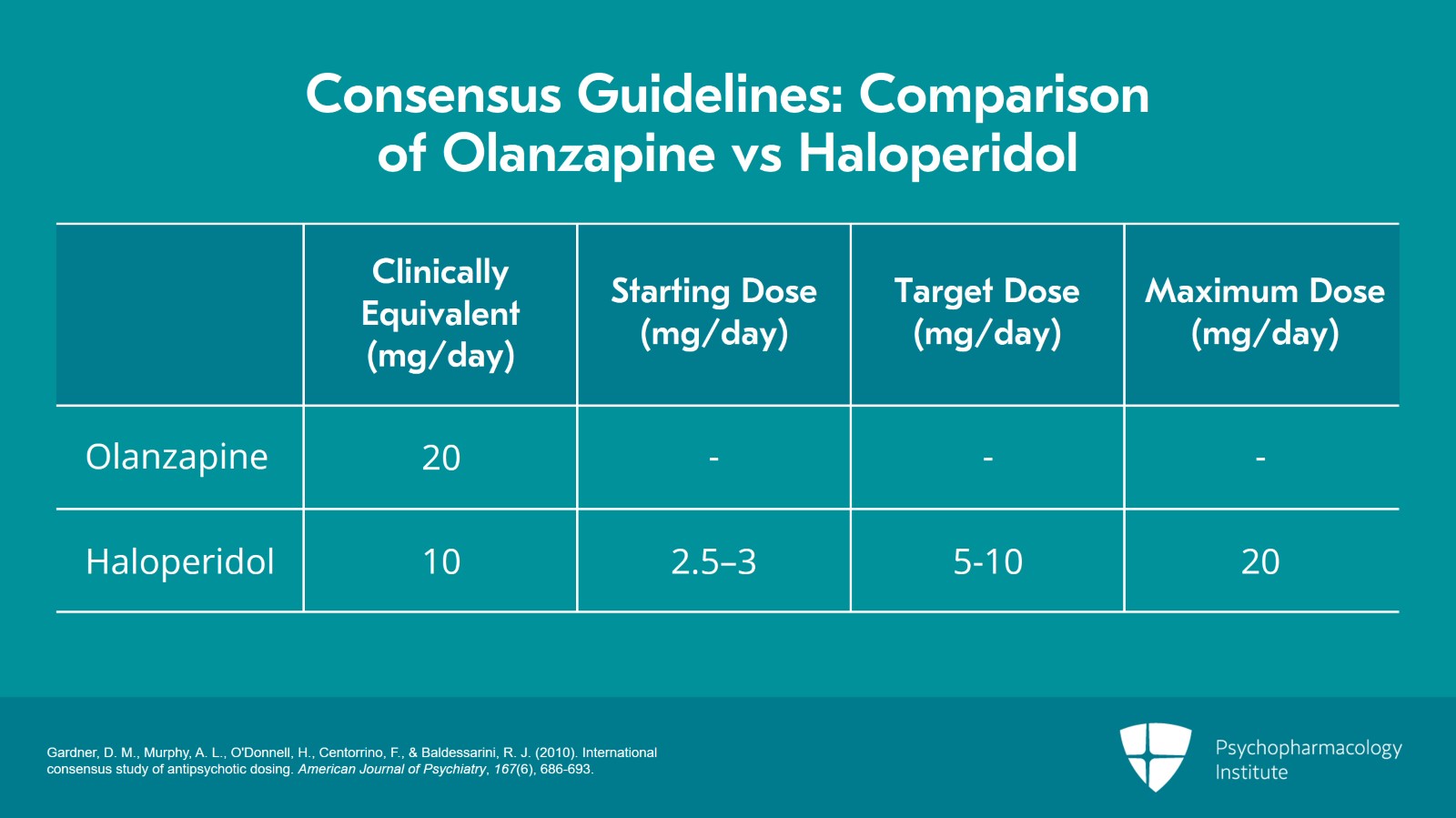
So when we talk about switching between two different oral agents, we often rely on expert consensus guidelines regarding dose equivalents and what dose do you start at, what is the target dose, and what is the maximum dose. Some patients are going to require lower than the projected dose equivalents and some patients may require a little higher than the projected dose equivalents and that’s okay but these values kind of give us a guide to aim for as we’re making the switch.
References:
  • Gardner, D. M., Murphy, A. L., O'Donnell, H., Centorrino, F., & Baldessarini, R. J. (2010). International consensus study of antipsychotic dosing. American Journal of Psychiatry, 167(6), 686-693.
Free Files
Success!
Check your inbox, we sent you all the materials there.
Slide 5 of 22

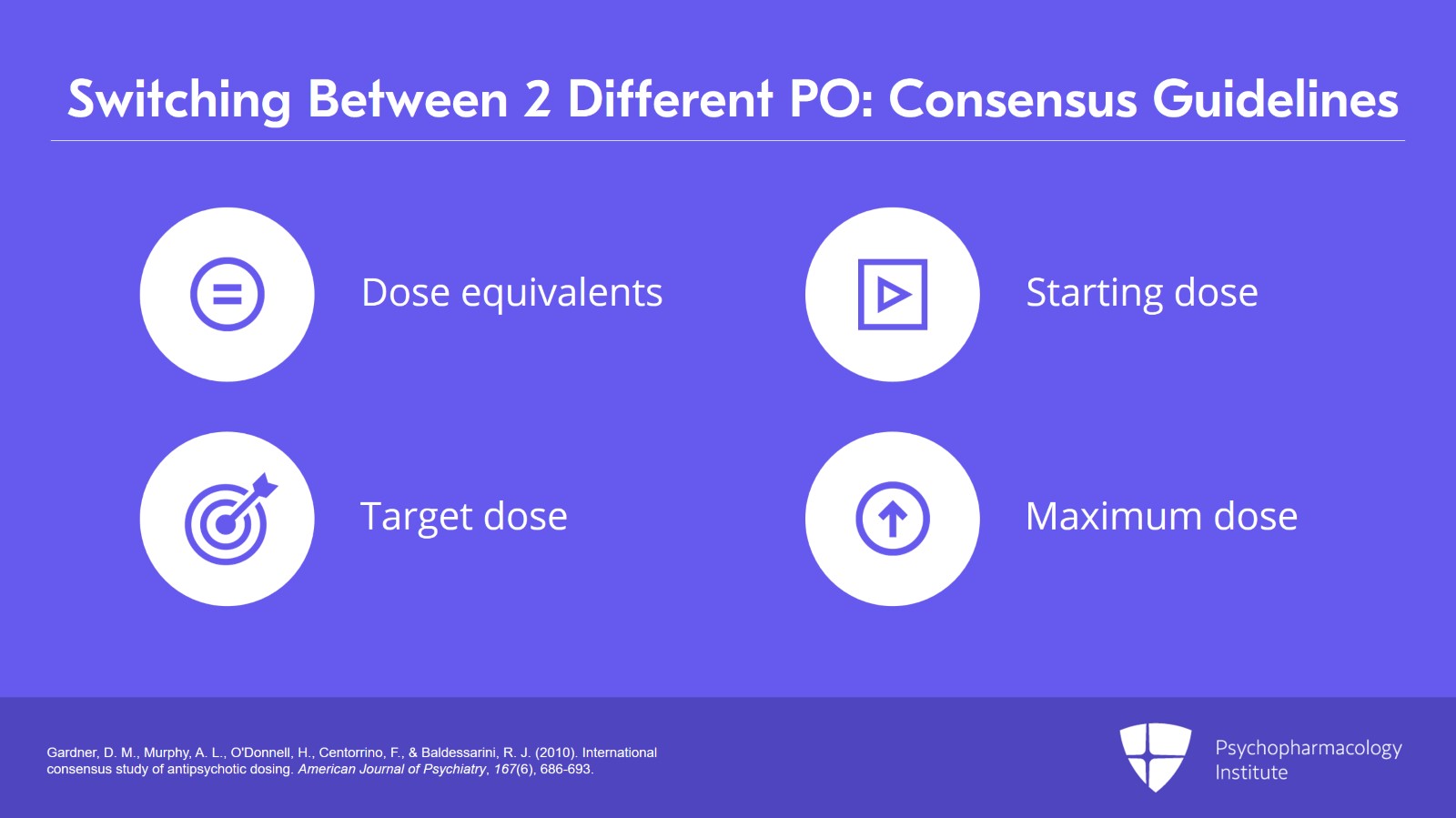
So drawing from these expert consensus guidelines, you’ll see a table here that shows a comparison with 20 mg of olanzapine. So for example, expert consensus guidelines would say that 10 mg of haloperidol is clinically equivalent to 20 mg of olanzapine suggesting a starting dose of 2.5 mg to 3 mg of haloperidol with a target dose in the range of 5 mg to 10 mg, and a maximum dose of 20 mg of haloperidol daily.
References:
  • Gardner, D. M., Murphy, A. L., O'Donnell, H., Centorrino, F., & Baldessarini, R. J. (2010). International consensus study of antipsychotic dosing. American Journal of Psychiatry, 167(6), 686-693.

Slide 6 of 22

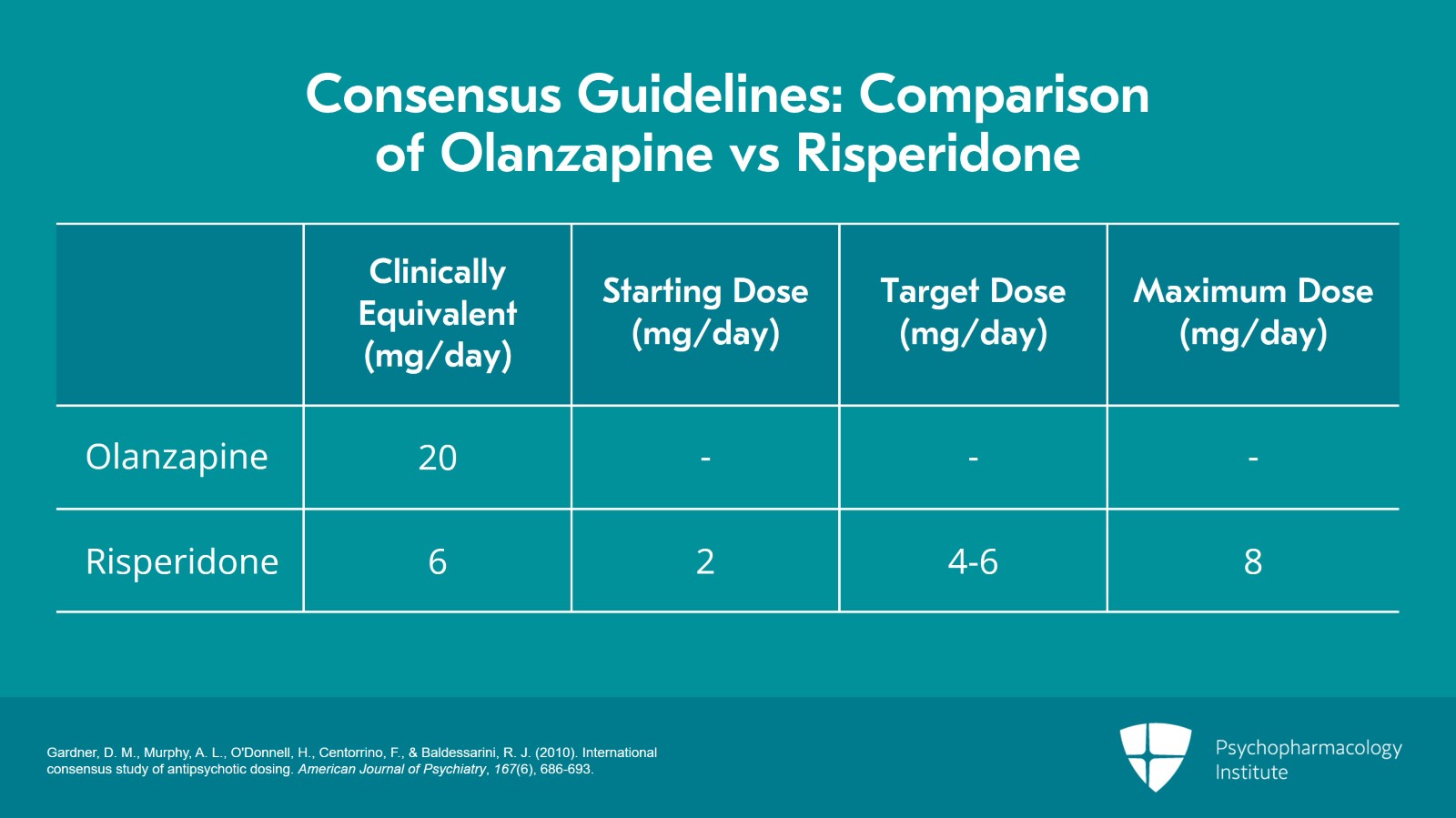
Similarly, these expert consensus guidelines exist for switching from between different second-generation or atypical antipsychotics. So for example, again, with the comparison to 20 mg of olanzapine, experts would say that that’s equivalent to about 6 mg of risperidone, with a starting dose of 2 mg, a target dose of 4 mg to 6 mg daily, and a maximum dose of 8 mg.  
References:
  • Gardner, D. M., Murphy, A. L., O'Donnell, H., Centorrino, F., & Baldessarini, R. J. (2010). International consensus study of antipsychotic dosing. American Journal of Psychiatry, 167(6), 686-693.
Free Files
Success!
Check your inbox, we sent you all the materials there.
Slide 7 of 22

So we often kind of rely on these tables when we’re making a switch between different oral agents but again these are just a guide and we’re going to titrate based on the tolerability and symptomatic response of the individual patients.
References:
  • Gardner, D. M., Murphy, A. L., O'Donnell, H., Centorrino, F., & Baldessarini, R. J. (2010). International consensus study of antipsychotic dosing. American Journal of Psychiatry, 167(6), 686-693.

Slide 8 of 22

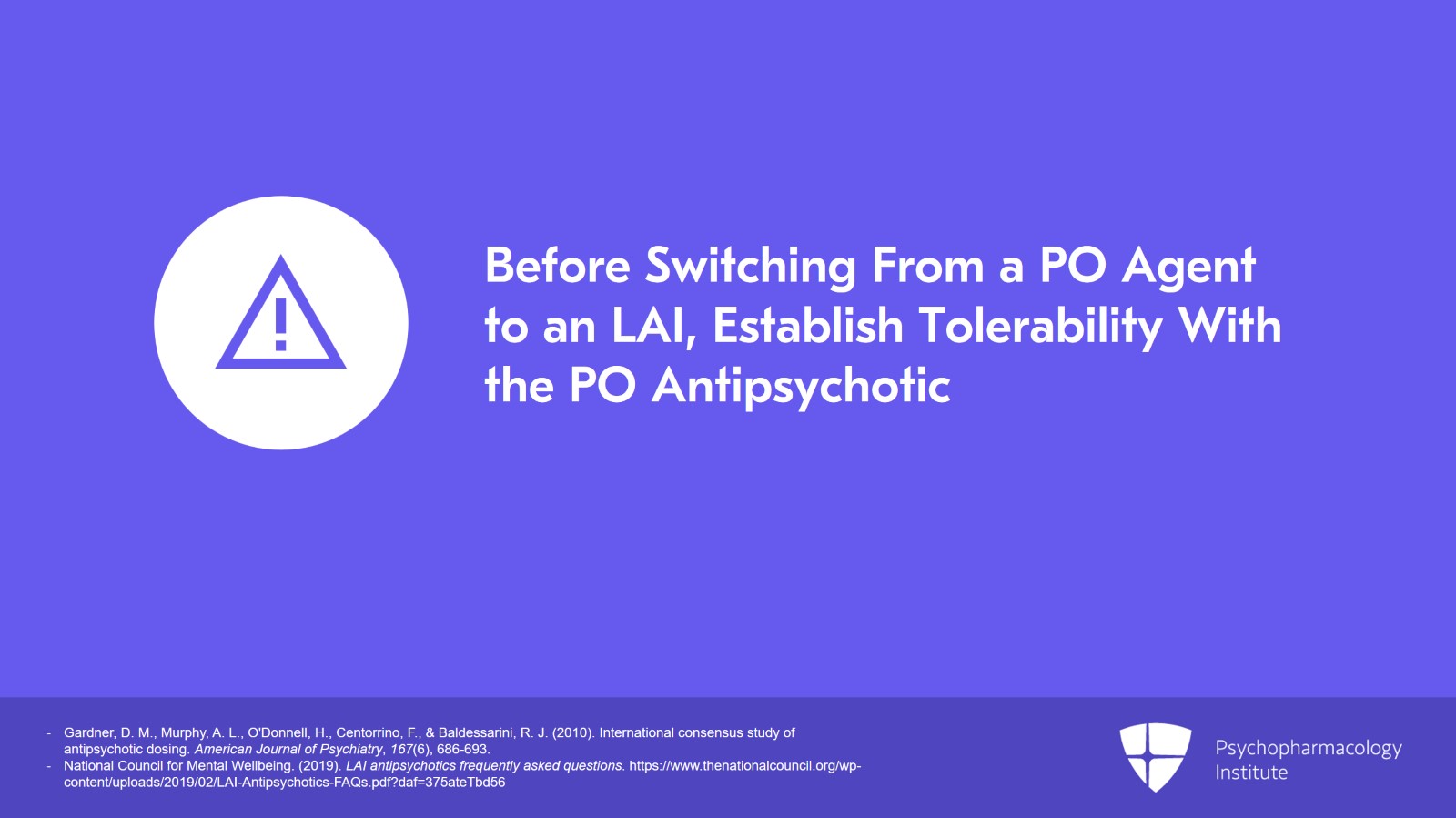
Similar guidance exists when we are switching patients from an oral agent to a long-acting injectable antipsychotic. It’s important to emphasize that when switching from an oral agent to a long-acting injectable that clinicians need to establish tolerability with the antipsychotic in its oral form before being administered as a long-acting injectable.
References:
  • Gardner, D. M., Murphy, A. L., O'Donnell, H., Centorrino, F., & Baldessarini, R. J. (2010). International consensus study of antipsychotic dosing. American Journal of Psychiatry, 167(6), 686-693.
  • National Council for Mental Wellbeing. (2019). LAI antipsychotics frequently asked questions. https://www.thenationalcouncil.org/wp-content/uploads/2019/02/LAI-Antipsychotics-FAQs.pdf?daf=375ateTbd56
Free Files
Success!
Check your inbox, we sent you all the materials there.
Slide 9 of 22

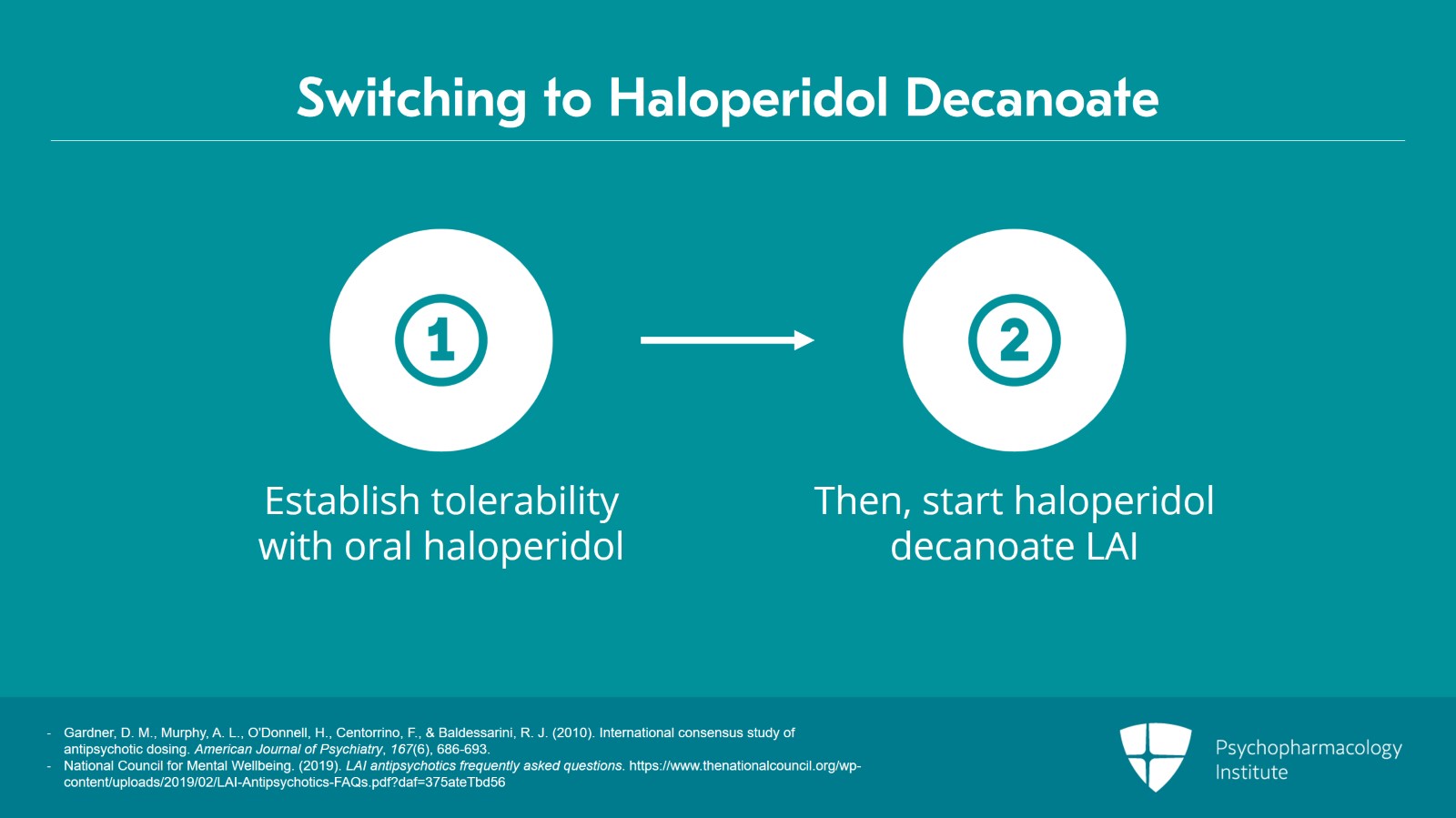
So for example, if we’re switching a patient to haloperidol decanoate, we’d want to make sure that the patient has established tolerability with oral haloperidol before giving them the first injection of haloperidol decanoate long-acting injectable.
References:
  • Gardner, D. M., Murphy, A. L., O'Donnell, H., Centorrino, F., & Baldessarini, R. J. (2010). International consensus study of antipsychotic dosing. American Journal of Psychiatry, 167(6), 686-693.
  • National Council for Mental Wellbeing. (2019). LAI antipsychotics frequently asked questions. https://www.thenationalcouncil.org/wp-content/uploads/2019/02/LAI-Antipsychotics-FAQs.pdf?daf=375ateTbd56

Slide 10 of 22

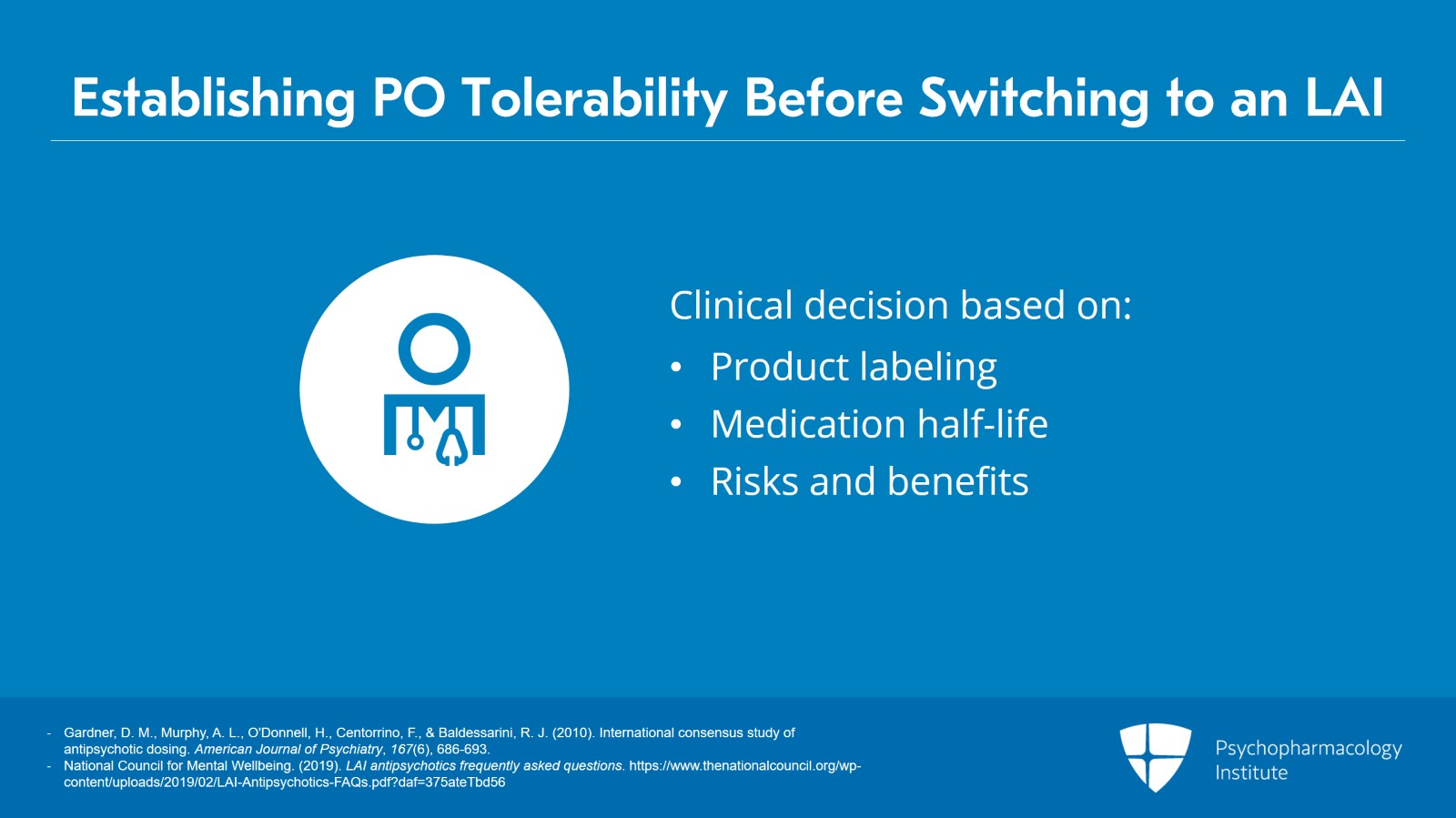
So this is a clinical decision that’s based on product labeling, the half-life of the medicine, and risks and benefits but this may range from as short as just one to two test doses all the way up to two weeks of treatment with the oral form before switching to long-acting injectable.
References:
  • Gardner, D. M., Murphy, A. L., O'Donnell, H., Centorrino, F., & Baldessarini, R. J. (2010). International consensus study of antipsychotic dosing. American Journal of Psychiatry, 167(6), 686-693.
  • National Council for Mental Wellbeing. (2019). LAI antipsychotics frequently asked questions. https://www.thenationalcouncil.org/wp-content/uploads/2019/02/LAI-Antipsychotics-FAQs.pdf?daf=375ateTbd56
Free Files
Success!
Check your inbox, we sent you all the materials there.

Slide 11 of 22

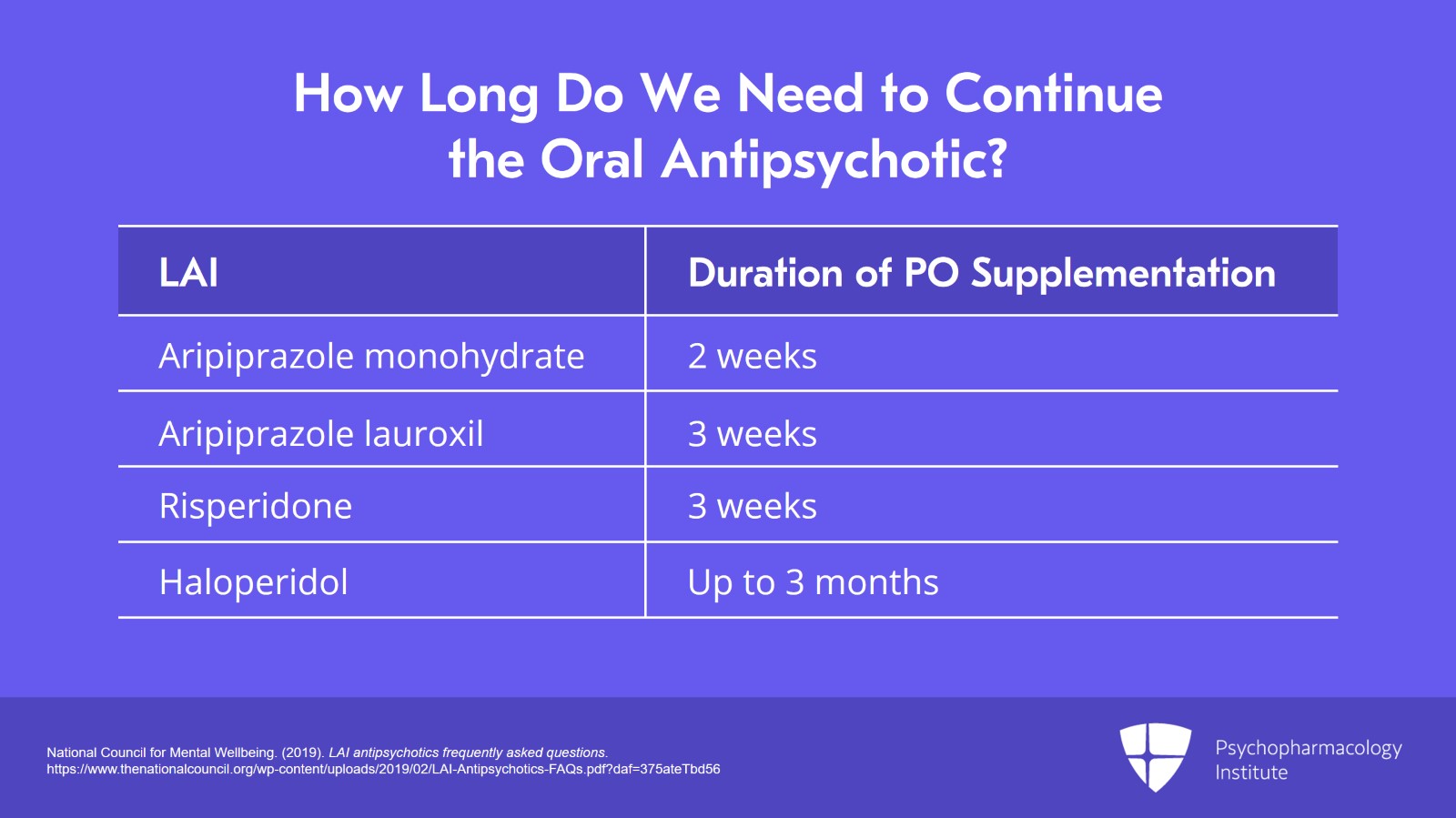
So an important question clinically when we make this particular switch from an oral antipsychotic to long-acting injectable is how long do I need to continue the oral antipsychotic after the patients received the first dose of their long-acting injectable. And so the table here below gives some guidelines. For aripiprazole monohydrate, it’s recommended that the patient gets two weeks of oral supplementation. For aripiprazole lauroxil, it’s actually three weeks that are recommended. For risperidone, three weeks of P.O. supplementation is recommended. For haloperidol, it could be up to three months if there’s no loading dose.
References:
  • National Council for Mental Wellbeing. (2019). LAI antipsychotics frequently asked questions. https://www.thenationalcouncil.org/wp-content/uploads/2019/02/LAI-Antipsychotics-FAQs.pdf?daf=375ateTbd56

Slide 12 of 22

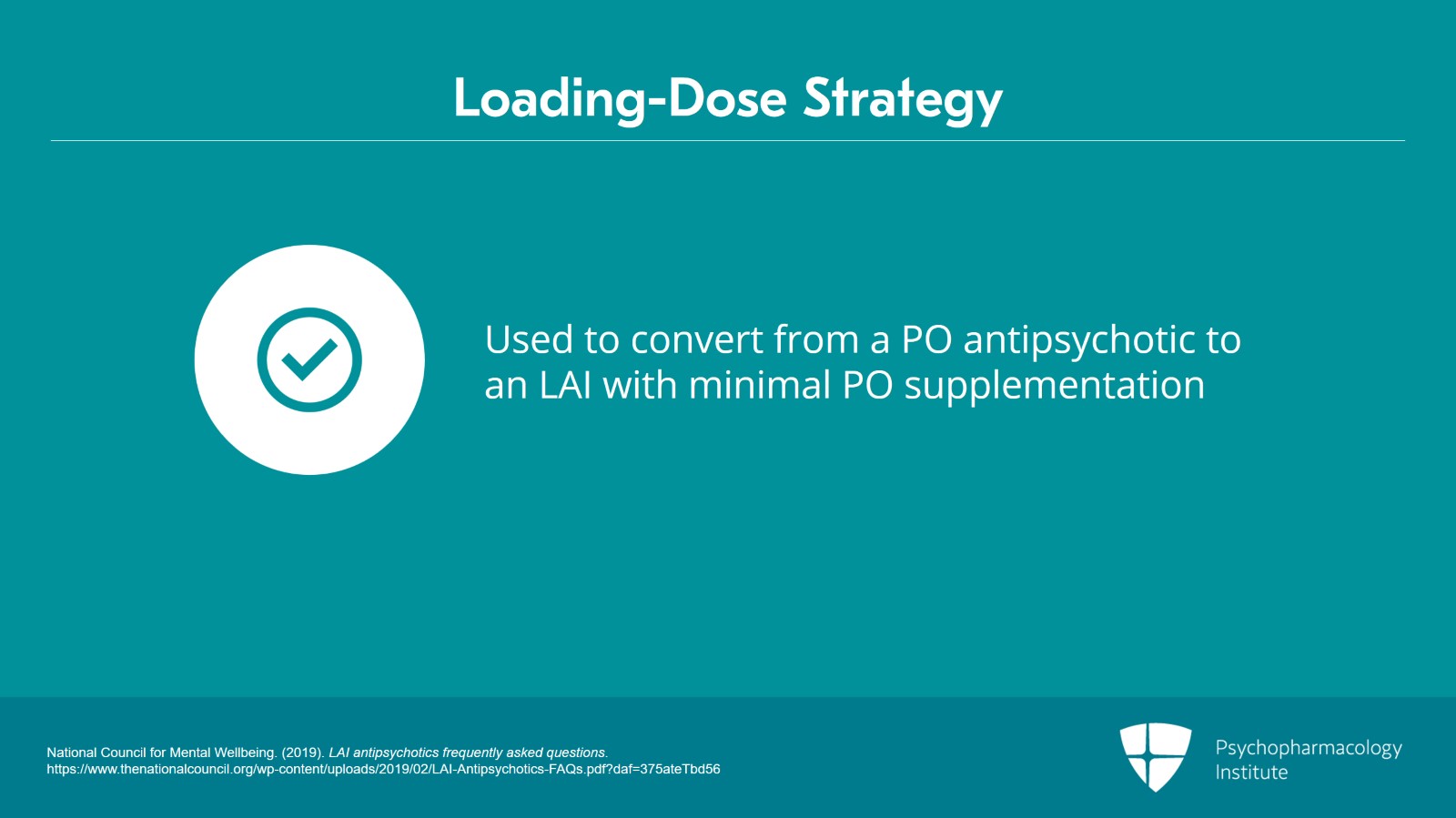
And so by loading dose, what I mean is that’s a strategy to more rapidly convert the patient from an oral antipsychotic to the maintenance dose of the long-acting injectable form with minimal need for oral supplementation.
References:
  • National Council for Mental Wellbeing. (2019). LAI antipsychotics frequently asked questions. https://www.thenationalcouncil.org/wp-content/uploads/2019/02/LAI-Antipsychotics-FAQs.pdf?daf=375ateTbd56
Free Files
Success!
Check your inbox, we sent you all the materials there.
Slide 13 of 22

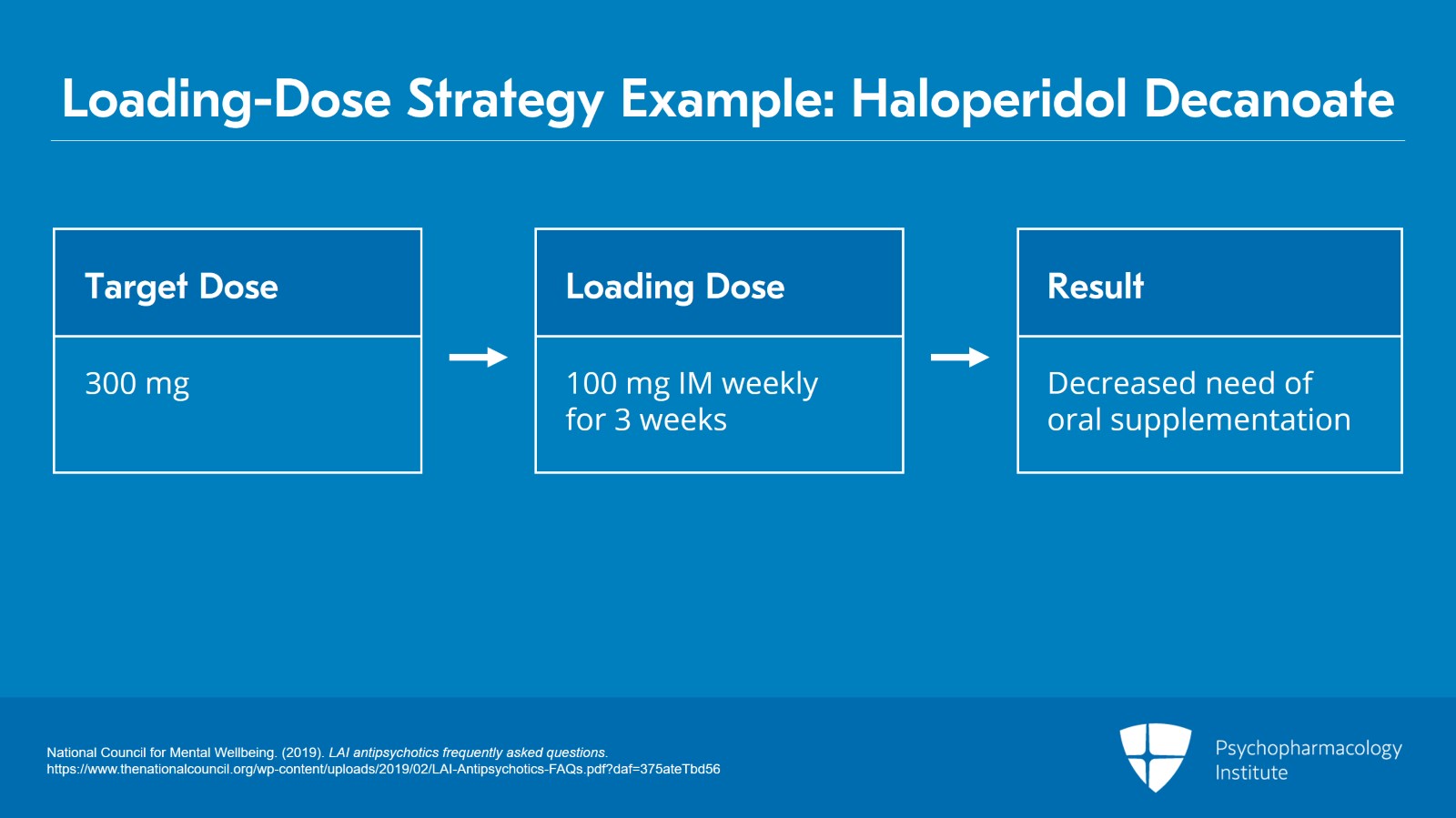
So for example, if your target dose of haloperidol decanoate is 300 mg, the patient may be loaded with 100 mg IM haloperidol decanoate weekly for three weeks and this can decrease the need for oral supplementation.
References:
  • National Council for Mental Wellbeing. (2019). LAI antipsychotics frequently asked questions. https://www.thenationalcouncil.org/wp-content/uploads/2019/02/LAI-Antipsychotics-FAQs.pdf?daf=375ateTbd56

Slide 14 of 22

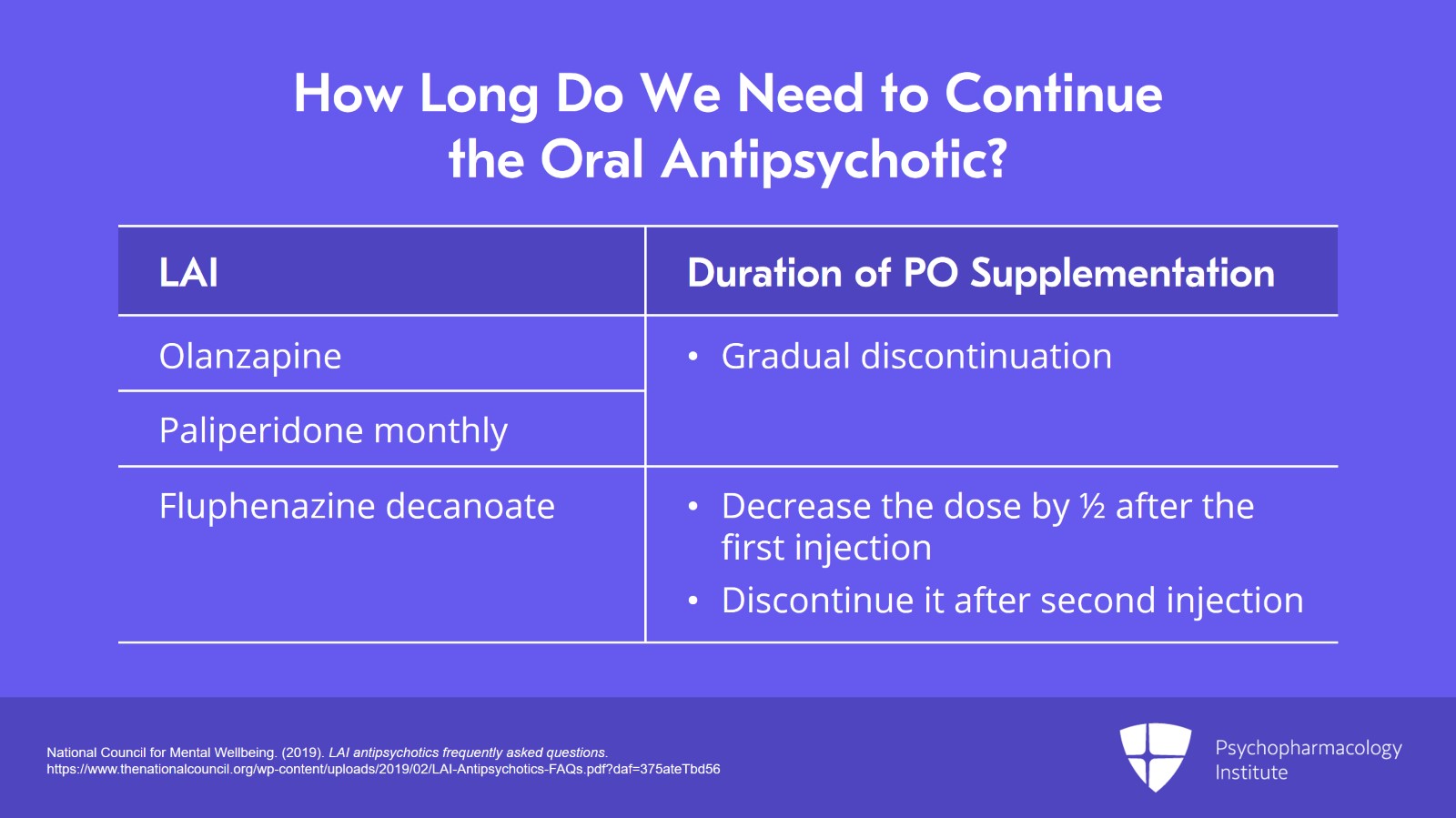
With olanzapine, the labeling suggests gradual discontinuation and we’ll discuss this in a vignette of sorts. Gradual discontinuation refers to just tapering the patient off of the pre-switch antipsychotic, so a brief taper off of the oral agent after switching. That’s also recommended for paliperidone monthly. And then with fluphenazine decanoate, the dose is decreased by half after the first injection and then can be discontinued after the second long-acting injectable.
References:
  • National Council for Mental Wellbeing. (2019). LAI antipsychotics frequently asked questions. https://www.thenationalcouncil.org/wp-content/uploads/2019/02/LAI-Antipsychotics-FAQs.pdf?daf=375ateTbd56
Free Files
Success!
Check your inbox, we sent you all the materials there.
Slide 15 of 22

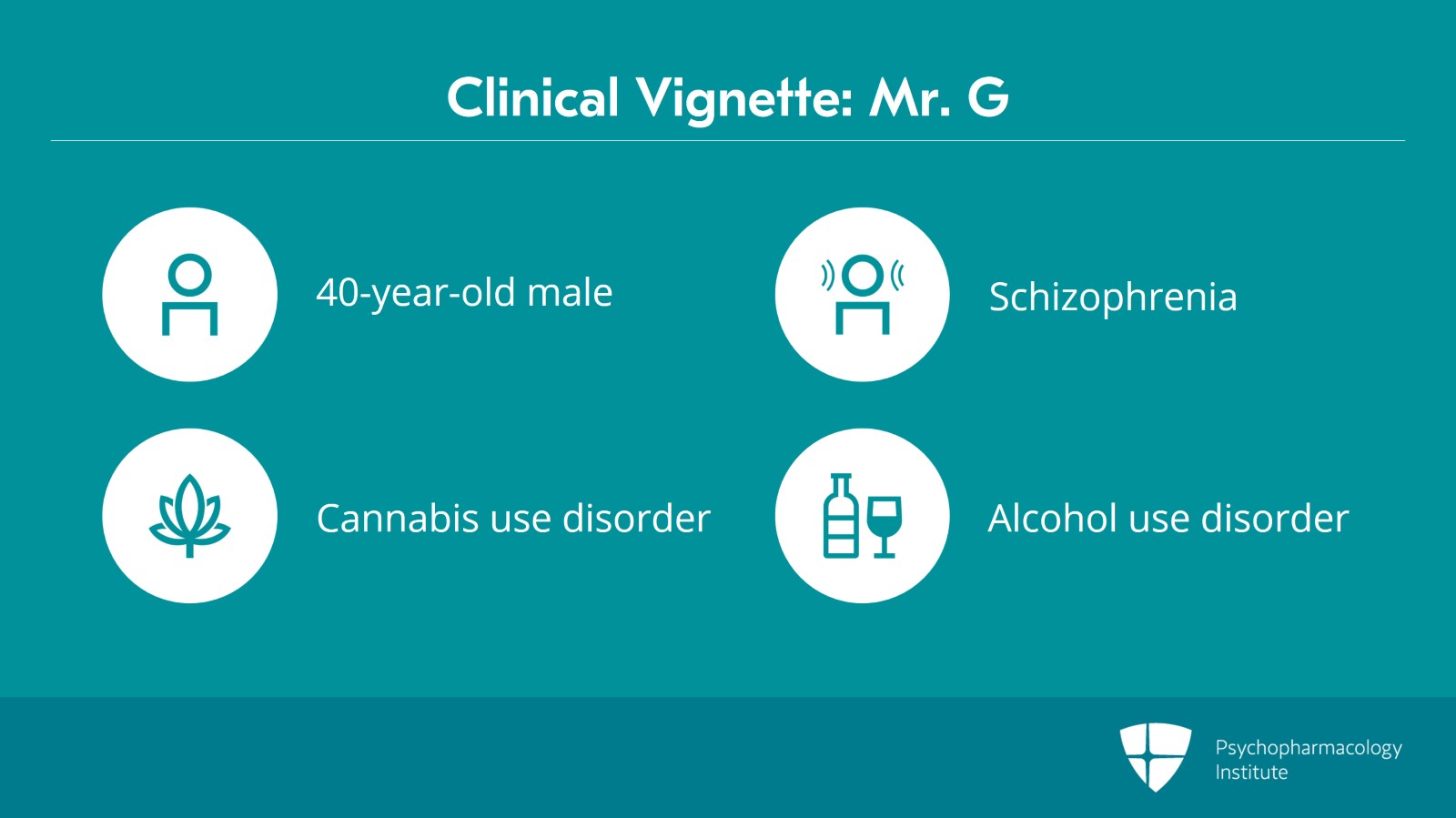
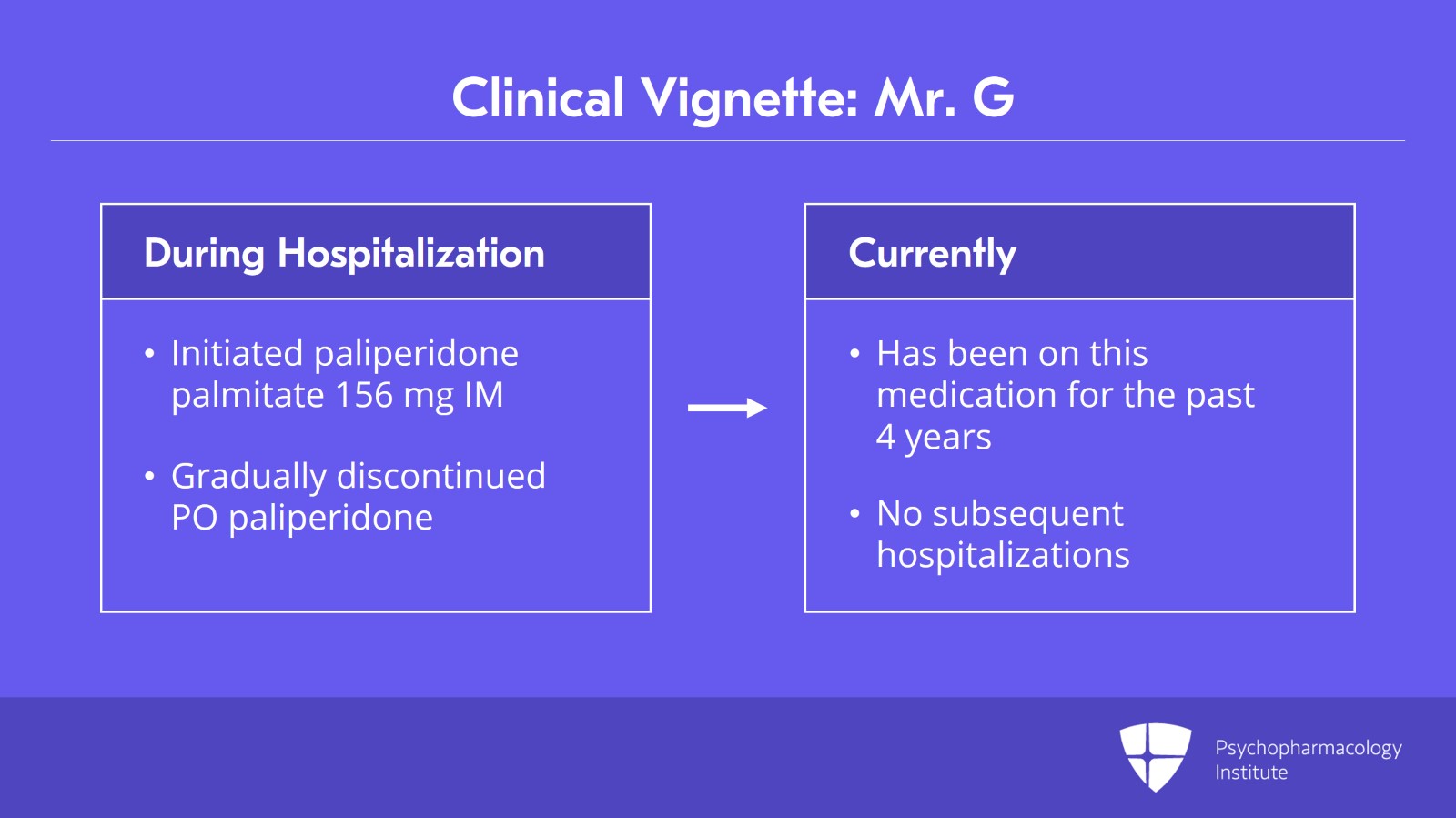
So as a clinical vignette here, let me give you the example of Mr. G who’s a 40-year-old African American male with a history of chronic schizophrenia, cannabis use disorder, and alcohol use disorder.

Slide 16 of 22

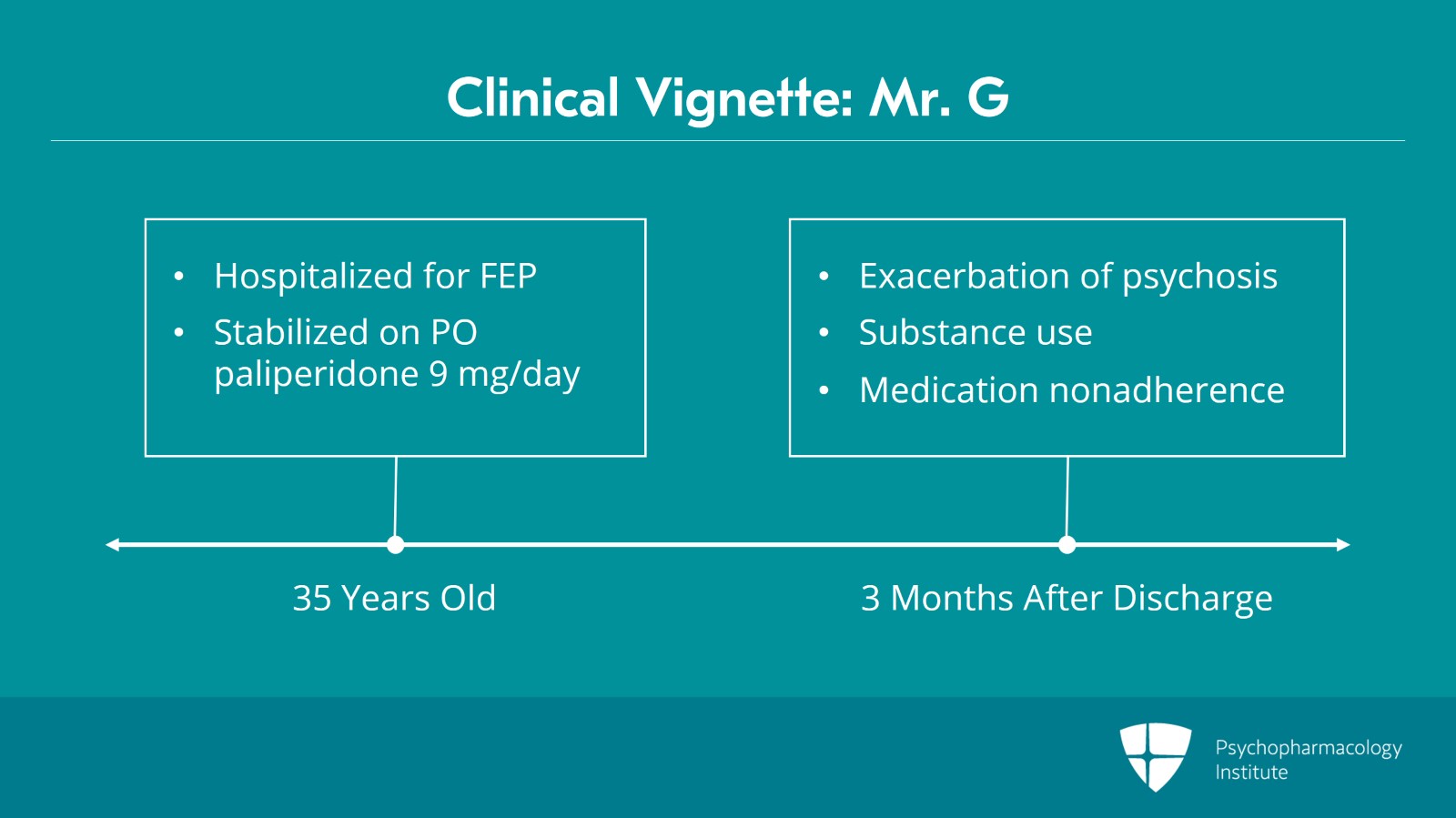
And he was hospitalized for a first episode of psychosis when he was 35 and he was stabilized on oral paliperidone at 9 mg daily. However, three months after he was discharged from the hospital, Mr. G had an acute exacerbation of psychosis that occurred in the context of substance use and medication nonadherence for which he required another hospitalization. 16
Free Files
Success!
Check your inbox, we sent you all the materials there.
Slide 17 of 22

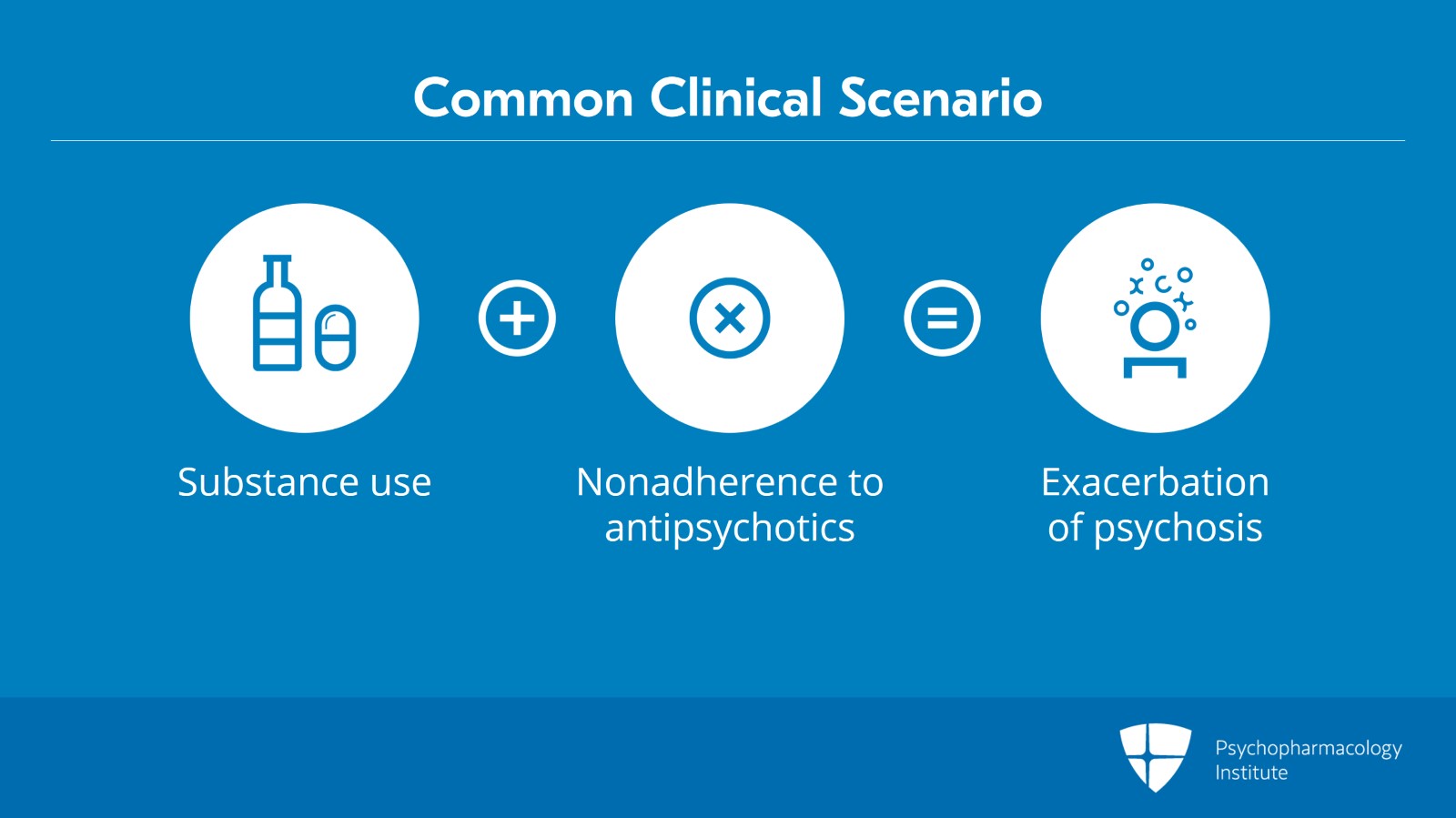
You know, this is an extremely common clinical scenario. We have patients who go out and use substance, they’re nonadherent with their antipsychotic and they subsequently have a relapse exacerbation of psychosis.

Slide 18 of 22

But during the hospitalization, the patient was agreeable to a trial of paliperidone palmitate 156 mg IM. And so his oral paliperidone at 9 mg was gradually discontinued. So he got 9 mg daily for the first week after he got his injection, then 6 mg daily for the next week, that was tapered to 3 mg daily on the third week, and then it was stopped. And Mr. G was fortunate to have an adequate therapeutic response to the paliperidone palmitate long-acting injectable and he’s actually been on this medication for the past four years without any subsequent need for psychiatric hospitalization.
Free Files
Success!
Check your inbox, we sent you all the materials there.
Slide 19 of 22

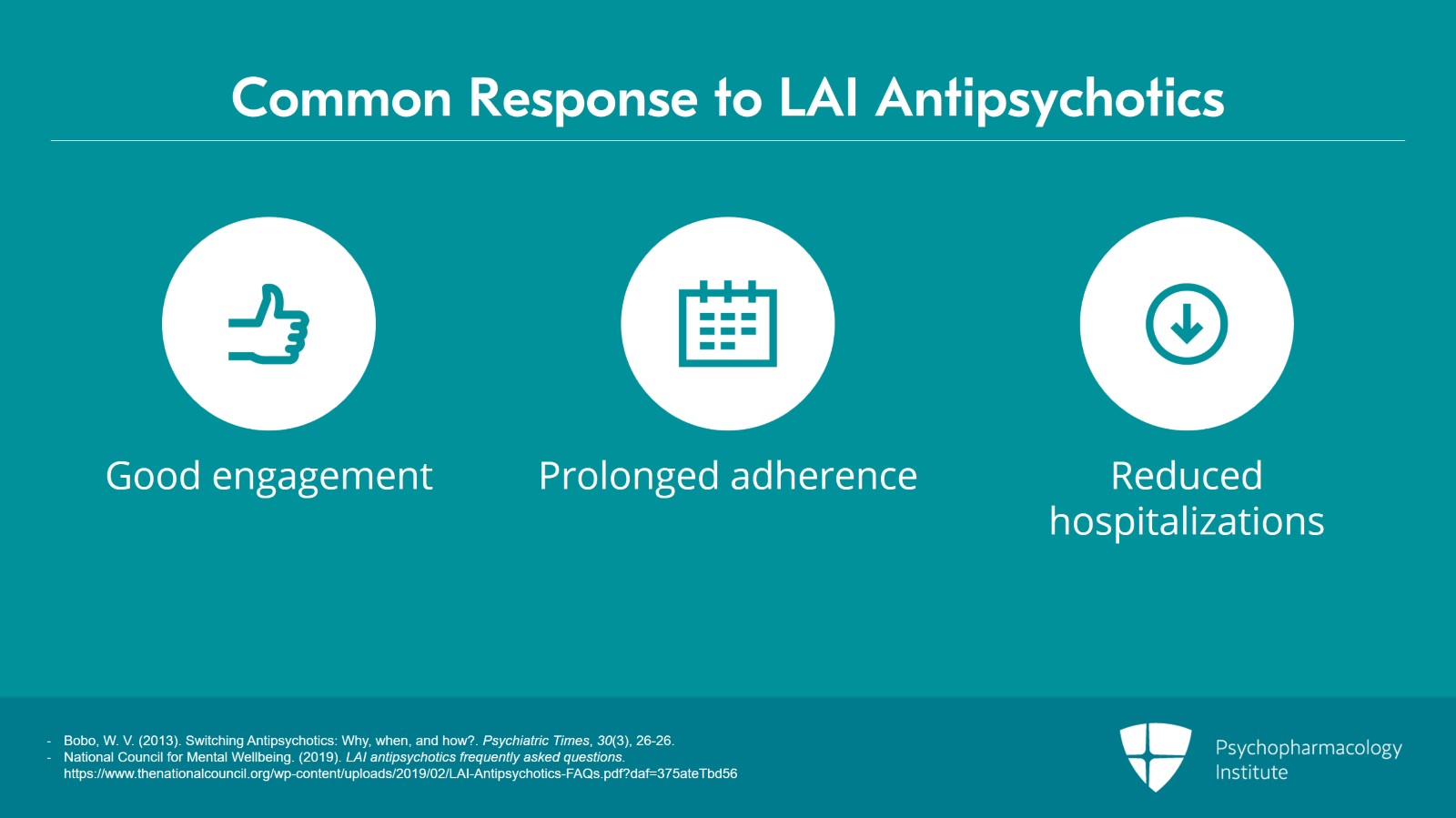
And just as it’s common that our patients are nonadherent with oral agents, go out and use substance and have exacerbation, this kind of a response to long-acting injectable antipsychotics. I think, is also quite common where we do see folks who engage well with this treatment approach and are able to stay on these agents for a prolonged period of time without the need for psychiatric hospitalization.
References:
  • Bobo, W. V. (2013). Switching Antipsychotics: Why, when, and how?. Psychiatric Times, 30(3), 26-26.
  • National Council for Mental Wellbeing. (2019). LAI antipsychotics frequently asked questions. https://www.thenationalcouncil.org/wp-content/uploads/2019/02/LAI-Antipsychotics-FAQs.pdf?daf=375ateTbd56

Slide 20 of 22

So key points for this section. Expert consensus guidelines on antipsychotic dose equivalents can help us guide the switch. And if we’re switching to a long-acting injectable, we need to establish tolerability with the oral antipsychotic first.
Free Files
Success!
Check your inbox, we sent you all the materials there.
Slide 21 of 22

Some period of oral antipsychotic supplementation is often required after the first injection.

Slide 22 of 22

Free Files
Success!
Check your inbox, we sent you all the materials there.
Learning Objectives:

After completing this activity, the learner will be able to:

  1. Describe the indications and contraindications to antipsychotic switching.
  2. Recognize and utilize the different strategies to make a successful antipsychotic switch.
  3. Identify and manage the different problems that can occur during antipsychotic switching.

Original Release Date: 03/01/2022

Review and Re-release Date: 03/01/2024

Expiration Date: 04/01/2025

Expert: Brian Miller, M.D.

Medical Editor: Paz Badía, M.D.

Relevant Financial Disclosures:

The following planners, faculty, and reviewers have the following relevant financial relationships with commercial interests to disclose:

Dr. Miller has disclosed the following relationships:

  • NIMH: Investigator
  • Stanley Medical Research Institute: Investigator
  • Brain & Behavior Research Institute: Investigator
  • Augusta University: Faculty
  • Boehringer Ingelheim: Advisory Board
  • Psychiatric Times: Consulting
  • ClearView: Consulting
  • Atheneum: Consulting

All of the relevant financial relationships listed for these individuals have been mitigated.

Contact Information: For questions regarding the content or access to this activity, contact us at support@psychopharmacologyinstitute.com

Instructions for Participation and Credit:

Participants must complete the activity online during the valid credit period that is noted above.

Follow these steps to earn CME credit:

  1. View the required educational content provided on this course page.
  2. Complete the Post Activity Evaluation for providing the necessary feedback for continuing accreditation purposes and for the development of future activities. NOTE: Completing the Post Activity Evaluation after the quiz is required to receive the earned credit.
  3. Download your certificate.

Accreditation Statement

This activity has been planned and implemented in accordance with the accreditation requirements and policies of the Accreditation Council for Continuing Medical Education through the joint providership of Medical Academy LLC and the Psychopharmacology Institute. Medical Academy is accredited by the ACCME to provide continuing medical education for physicians.

Credit Designation Statement

Medical Academy designates this enduring activity for a maximum of 1.00 AMA PRA Category 1 credit(s). Physicians should claim only the credit commensurate with the extent of their participation in the activity.

Free Files
Success!
Check your inbox, we sent you all the materials there.
Continue in the website
Instant access modal

Become a Bronze, Silver, Gold, Bronze extended, Silver extended or Gold extended Member.

2025–26 Psychopharmacology CME Program

Unlock up to 155 CME Credits, including 40 SA CME Credits.