Close Banner
Section Free  - Video Lectures

04. Treating Depressive Disorders in Patients With Cancer

Published on May 1, 2023 Certification expiration date: May 1, 2026

Jaroslava Salman, M.D.

Southern California Kaiser Permanente Medical Group - City of Hope Helford Clinical Research Hospital

Key Points

  • Antidepressants are the first-line treatment.
  • Favorable side effects should be taken into consideration when selecting an antidepressant.
  • Stimulants can be used safely and effectively as an augmentation of antidepressant treatment.

Free Downloads for Offline Access

  • Free Download Presentation File (PPTX)
  • Free Download Video (MP4)
  • Free Download Audio File (MP3)

Slides and Transcript

Slide 1 of 28

How can we treat depressive disorders in patients with cancer?

Slide 2 of 28

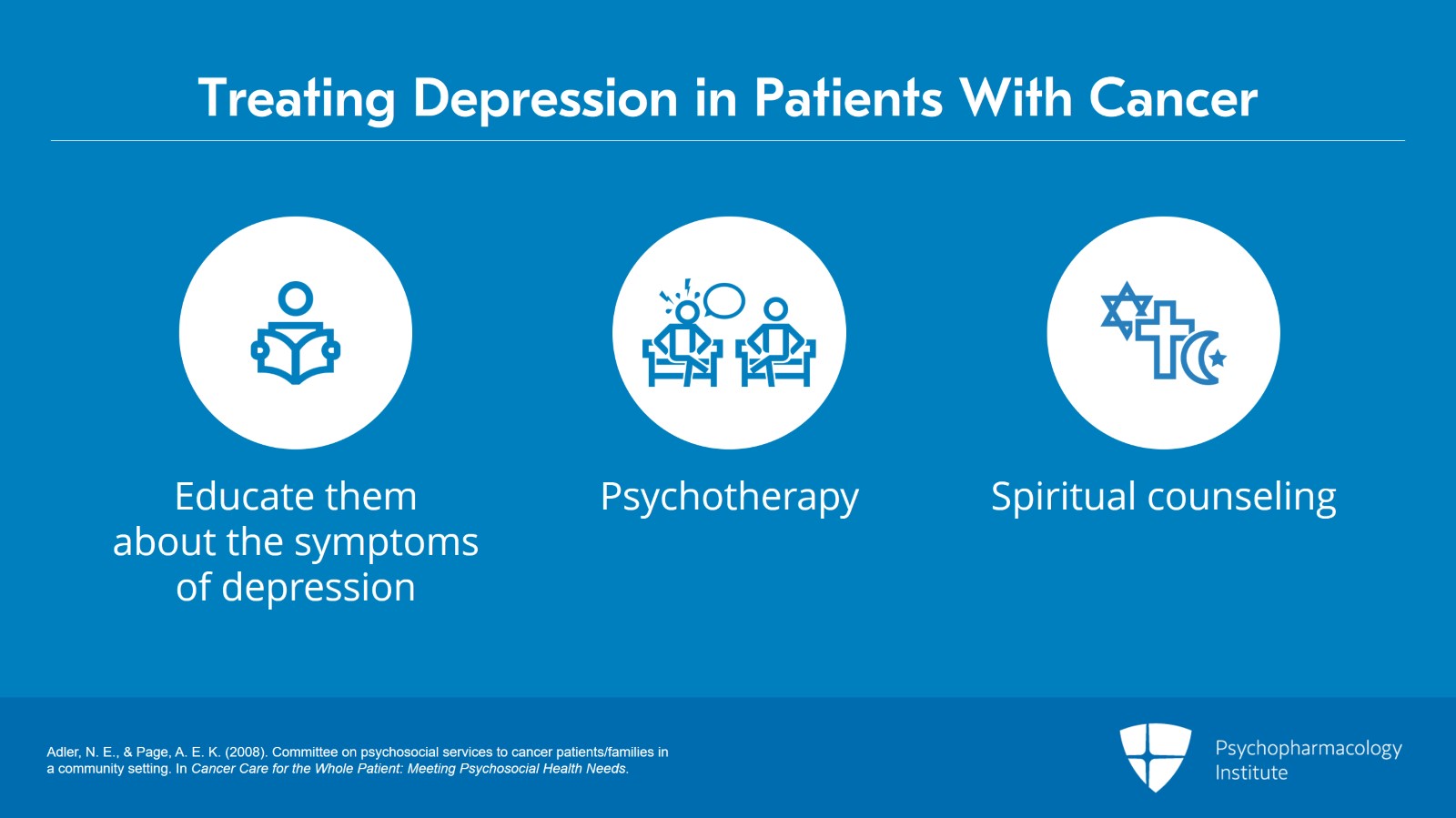
Well, similarly to treating depression in other patients, we do want to make sure that we educate patients, about the symptoms of depression, the diagnosis and the forms of treatment. Sometimes, just the education itself can have a therapeutic effect and provide the patient with the relief of understanding of what's going on with them and why they're feeling the way they're feeling. Some patients may opt just for psychotherapy and there are different forms of psychotherapy including cognitive behavioral therapy, mindfulness-based therapies or meaning-centered psychotherapy, whatever is appropriate and the best fit for a particular patient. Some patients may prefer spiritual counseling.
References:
  • Adler, N. E., & Page, A. E. K. (2008). Committee on psychosocial services to cancer patients/families in a community setting. In Cancer Care for the Whole Patient: Meeting Psychosocial Health Needs.
Free Files
Success!
Check your inbox, we sent you all the materials there.
Slide 3 of 28

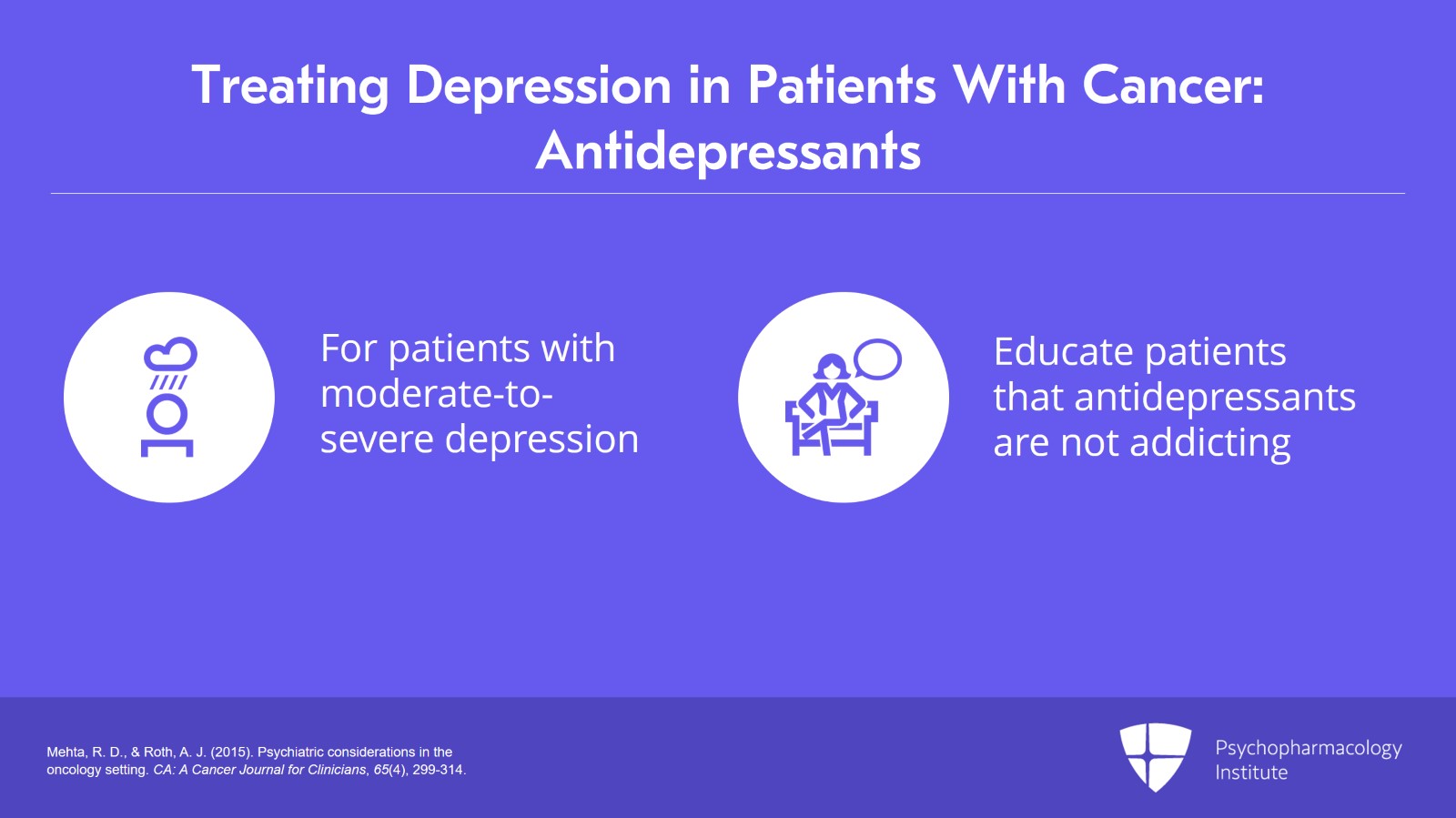
In addition to these therapeutic modalities, there will be a subset of patients that can benefit from an antidepressant, usually patients who have depression at a moderate to severe level. We want to educate patients that antidepressants are not addicting. That's one of the most common fears that patients have and one of the most common barriers to them accepting the treatment.

References:
  • Mehta, R. D., & Roth, A. J. (2015). Psychiatric considerations in the oncology setting. CA: A Cancer Journal for Clinicians, 65(4), 299-314.

Slide 4 of 28

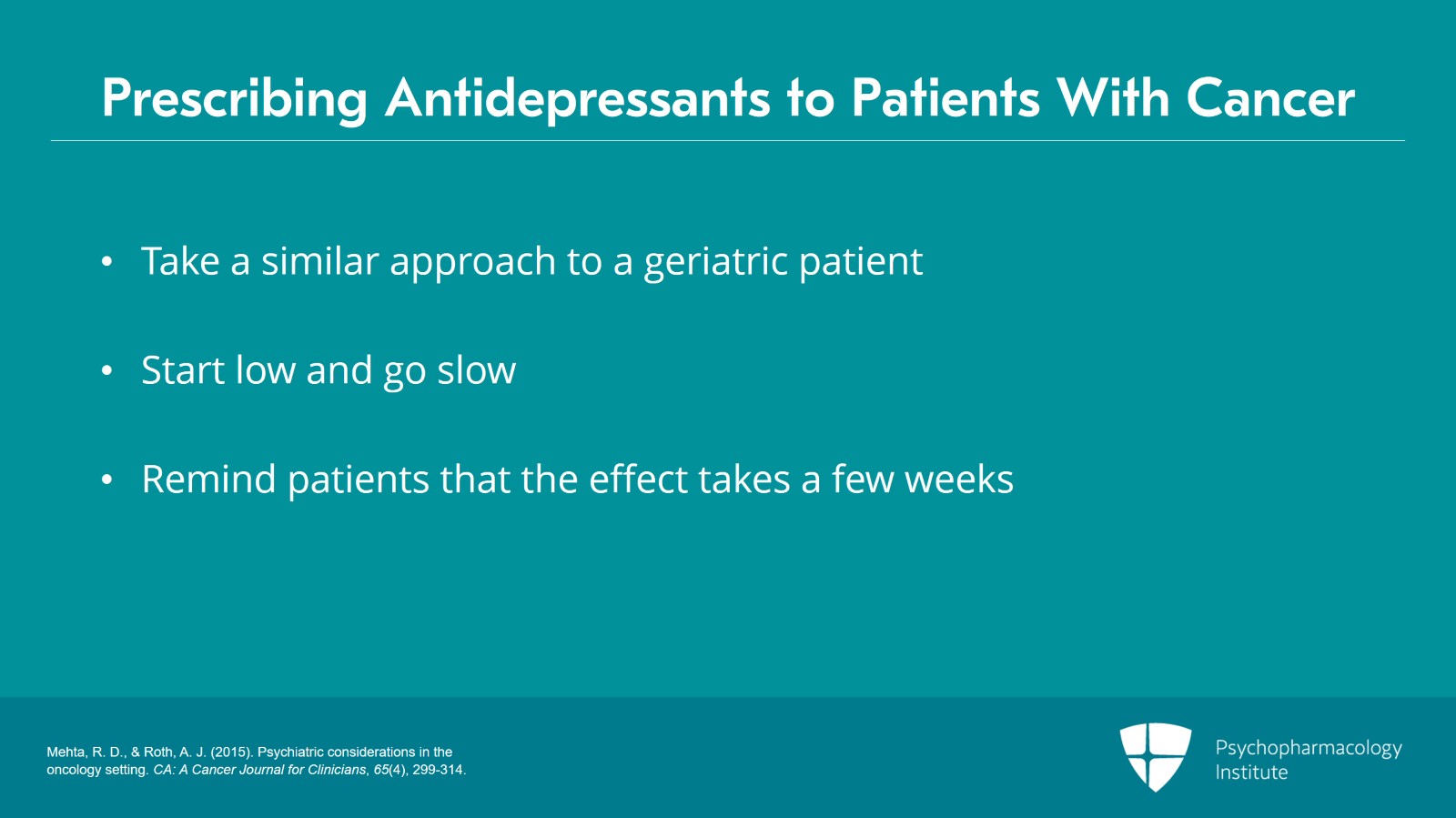
I'll talk a little more about the antidepressants and what are the general principles of prescribing antidepressants in patients with cancer. I would suggest that you take a similar approach one would take to a geriatric patient, so start low and go slow. Obviously, if you have a patient where going slow is not appropriate and you need to be a little more aggressive with your titration, perhaps it's a younger patient who can handle that, then absolutely that is appropriate to do but overall we do want to be careful. We want to remind the patients that the effect of the medications takes a few weeks.
References:
  • Mehta, R. D., & Roth, A. J. (2015). Psychiatric considerations in the oncology setting. CA: A Cancer Journal for Clinicians, 65(4), 299-314.
Free Files
Success!
Check your inbox, we sent you all the materials there.
Slide 5 of 28

It is important to provide the patient with a regular follow-up whether it's a phone call or office follow-up. As we know patients sometimes self-discontinue medication if they experience side effects that they don't understand, or they feel that they cannot tolerate, or some of them may not feel better right away and they stop the medication assuming that it's not working. So we want to follow up with the patient and we want to keep an eye on them and titrate the medication further up as appropriate. 
References:
  • Mehta, R. D., & Roth, A. J. (2015). Psychiatric considerations in the oncology setting. CA: A Cancer Journal for Clinicians, 65(4), 299-314.

Slide 6 of 28

Once the symptoms have remitted or at least most of them remitted, so we have at least a 50% remission and improvement, we want the patient to continue on the antidepressant for some time. I generally counsel patients they should stay on the antidepressant for at least a year.
References:
  • Mehta, R. D., & Roth, A. J. (2015). Psychiatric considerations in the oncology setting. CA: A Cancer Journal for Clinicians, 65(4), 299-314.
Free Files
Success!
Check your inbox, we sent you all the materials there.

Slide 7 of 28

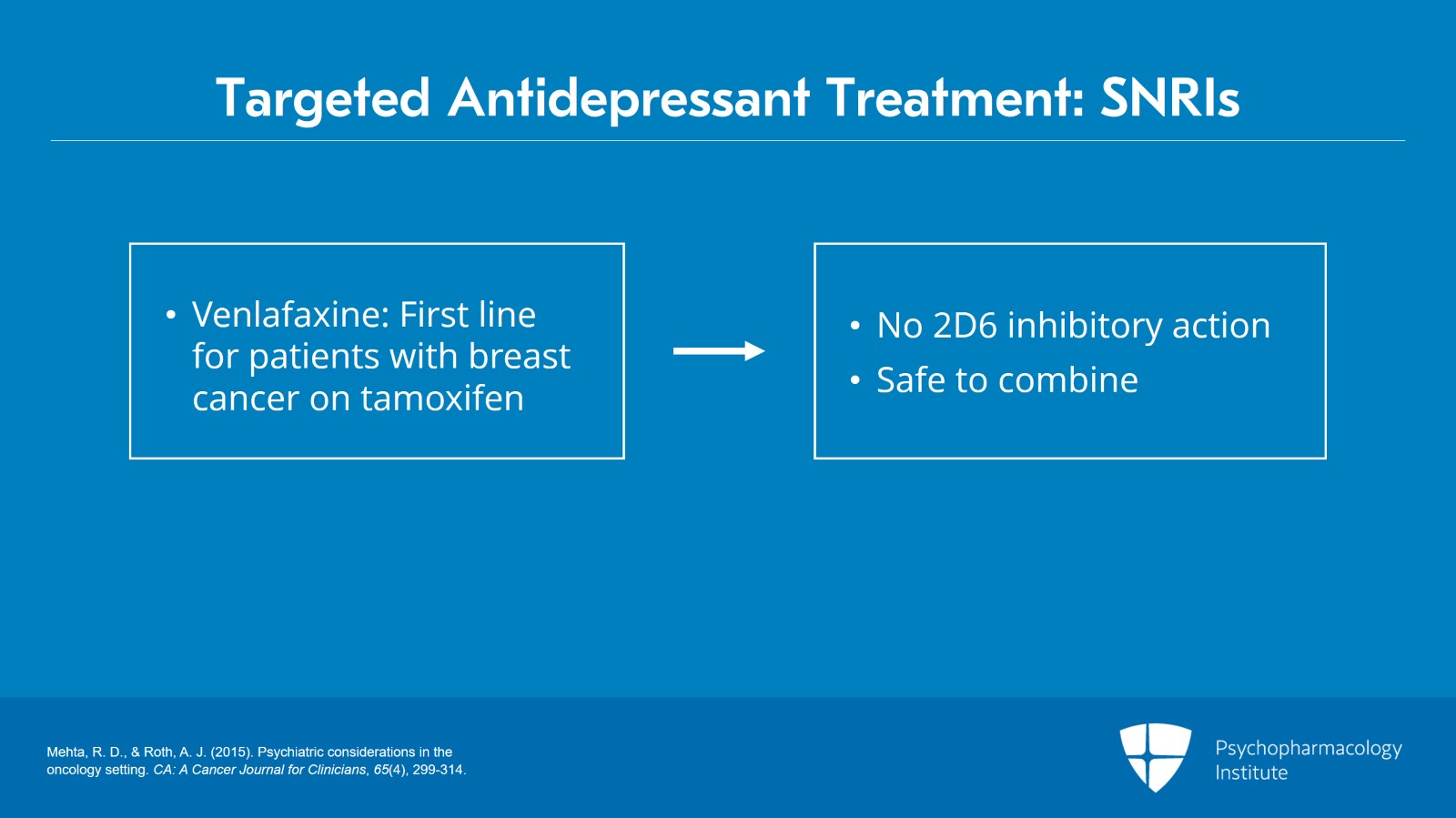
If they have never had an episode of major depressive disorder before, then at one year of treatment we can evaluate whether they want to continue or see how they do without the antidepressant. For patients who've had prior episodes of major depressive disorder, their chances of having another one are pretty high, so I may recommend that they continue on the antidepressant indefinitely as long as it's effective for them.
References:
  • Mehta, R. D., & Roth, A. J. (2015). Psychiatric considerations in the oncology setting. CA: A Cancer Journal for Clinicians, 65(4), 299-314.

Slide 8 of 28

If the patient does not respond sufficiently to one antidepressant, we should not give up and we should try another agent even within the same class. Sometimes, we can combine different agents from different classes, for example, an SSRI with bupropion, or an SNRI with bupropion. 
References:
  • Mehta, R. D., & Roth, A. J. (2015). Psychiatric considerations in the oncology setting. CA: A Cancer Journal for Clinicians, 65(4), 299-314.
Free Files
Success!
Check your inbox, we sent you all the materials there.

Slide 9 of 28

Bupropion is a norepinephrine and dopamine reuptake inhibitor, particularly helpful in patients who struggle with fatigue and a lot of apathy. For patients who are smokers and would like to stop smoking, this again may be a good agent to start with. 
References:
  • Mehta, R. D., & Roth, A. J. (2015). Psychiatric considerations in the oncology setting. CA: A Cancer Journal for Clinicians, 65(4), 299-314.

Slide 10 of 28

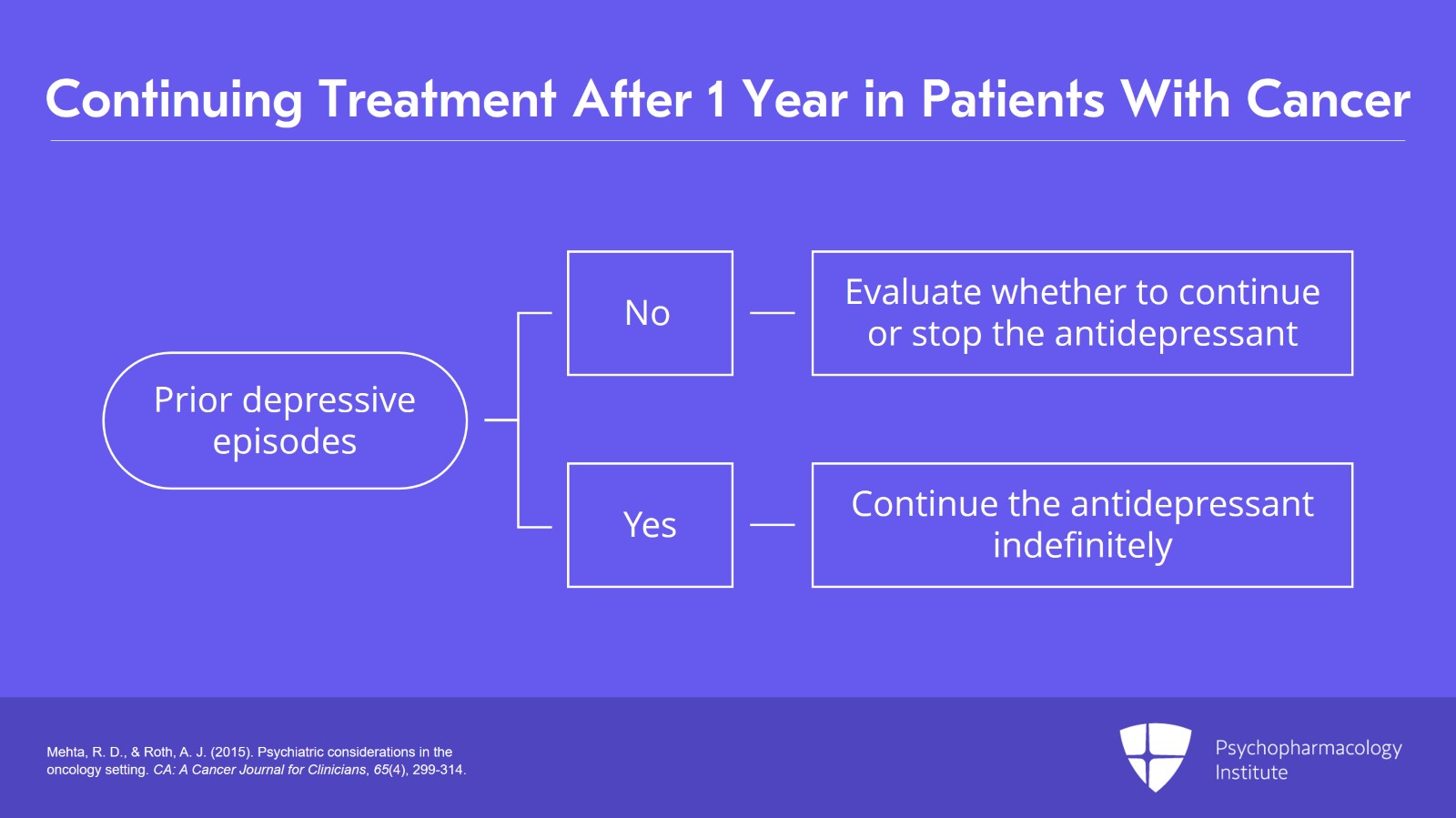
As we know, it's not an antidepressant that treats anxiety and, in fact, anxiety can be one of its side effects so we want to keep that in mind. If we have a patient who has depression but also a lot of anxiety, this may not be the best first-line choice. And we also need to keep in mind the potential for a lower seizure threshold, particularly at higher doses. So patients who have brain tumors or history of alcohol use and are at risk of alcohol withdrawal, for those this medication also would not be the best choice. 
References:
  • Costa, R., Oliveira, N. G., & Dinis-Oliveira, R. J. (2019). Pharmacokinetic and pharmacodynamic of bupropion: integrative overview of relevant clinical and forensic aspects. Drug Metabolism Reviews, 51(3), 293-313.
Free Files
Success!
Check your inbox, we sent you all the materials there.
Slide 11 of 28

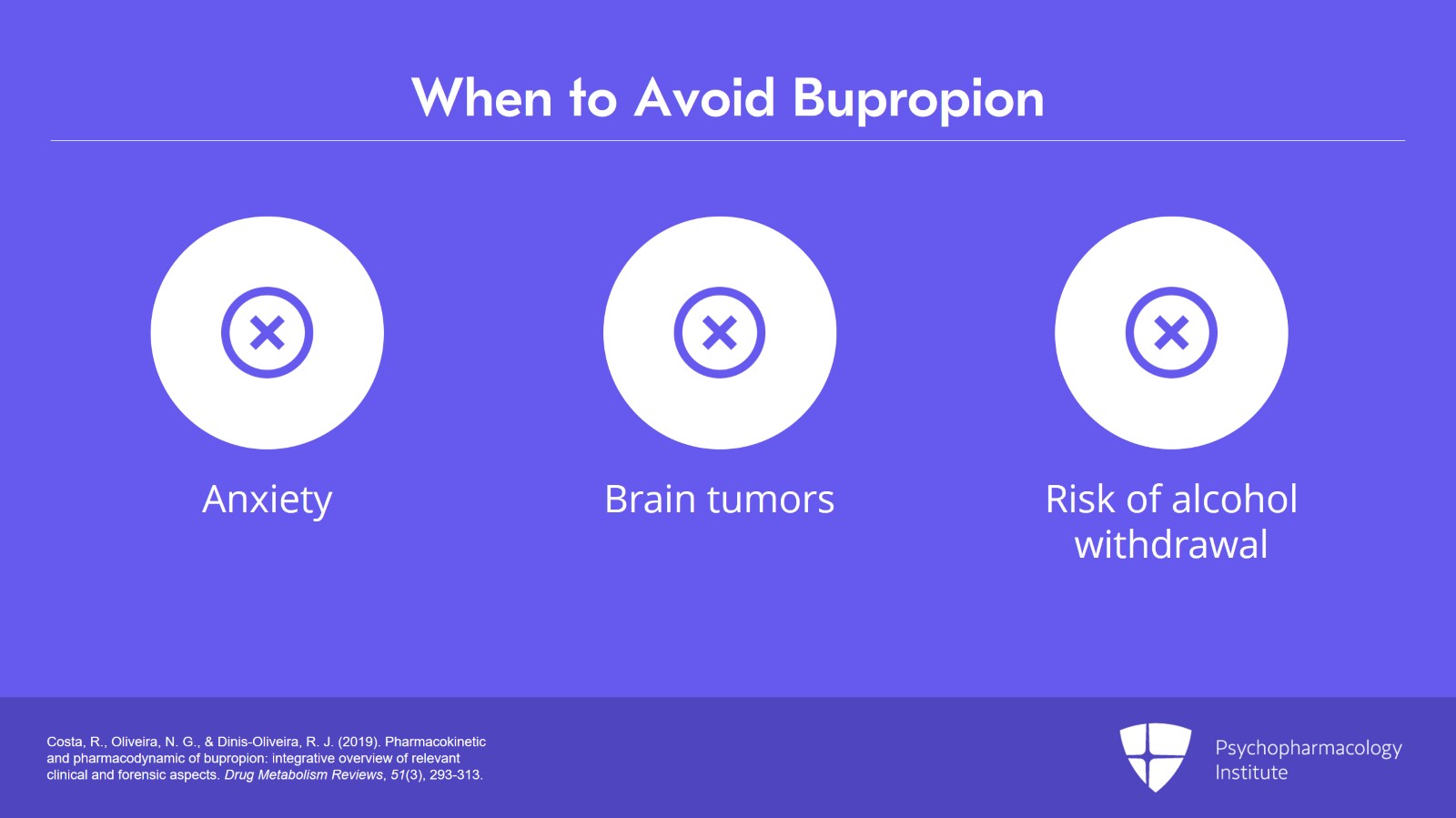
Fluoxetine may be appropriate for some patients who, for example, are NPO or have an intermittent bowel obstruction because it is the longest-acting SSRI and can be administered once a week. Some of the dose formulations may be preferable and determine which antidepressant one chooses to use so, for example, pill versus liquid.
References:
  • Mehta, R. D., & Roth, A. J. (2015). Psychiatric considerations in the oncology setting. CA: A Cancer Journal for Clinicians, 65(4), 299-314.

Slide 12 of 28

SNRIs are commonly used, especially in patients who have comorbid neuropathy which is a very common problem as a result of chemotherapy. SNRIs are a reasonable choice for depressed cancer patients with pain that is not completely responsive to opioids, as SNRIs can help with the perception of pain and may have a potential co-analgesic benefit.
References:
  • Mehta, R. D., & Roth, A. J. (2015). Psychiatric considerations in the oncology setting. CA: A Cancer Journal for Clinicians, 65(4), 299-314.
Free Files
Success!
Check your inbox, we sent you all the materials there.

Slide 13 of 28

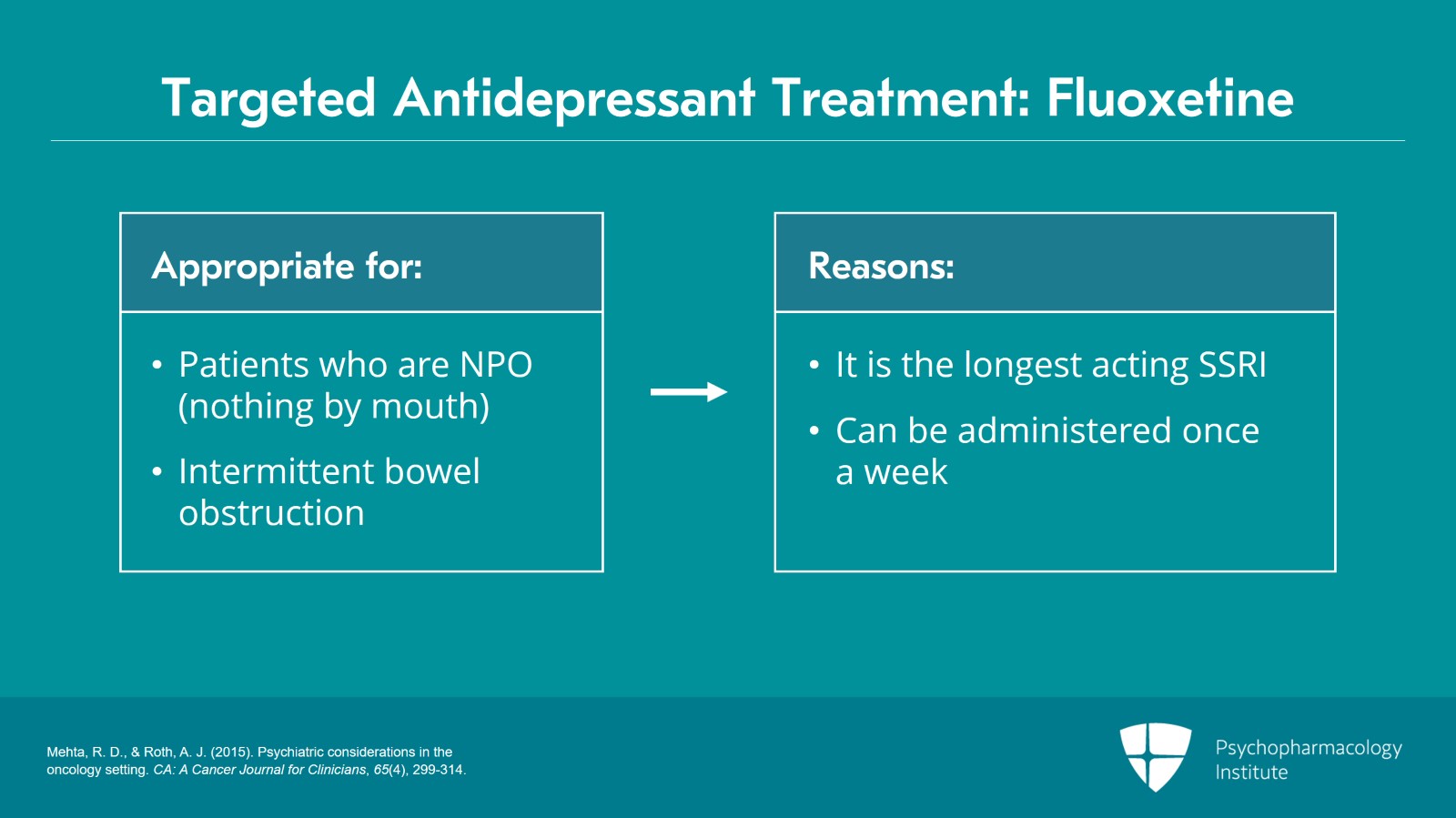
So, duloxetine, or venlafaxine, or desvenlafaxine are the most commonly used antidepressants from this category. Venlafaxine is a first-line choice for patients with breast cancer who are on tamoxifen maintenance as venlafaxine does not have any 2D6 inhibitory action and therefore it is safe to combine. You could say the same about desvenlafaxine.
References:
  • Mehta, R. D., & Roth, A. J. (2015). Psychiatric considerations in the oncology setting. CA: A Cancer Journal for Clinicians, 65(4), 299-314.

Slide 14 of 28

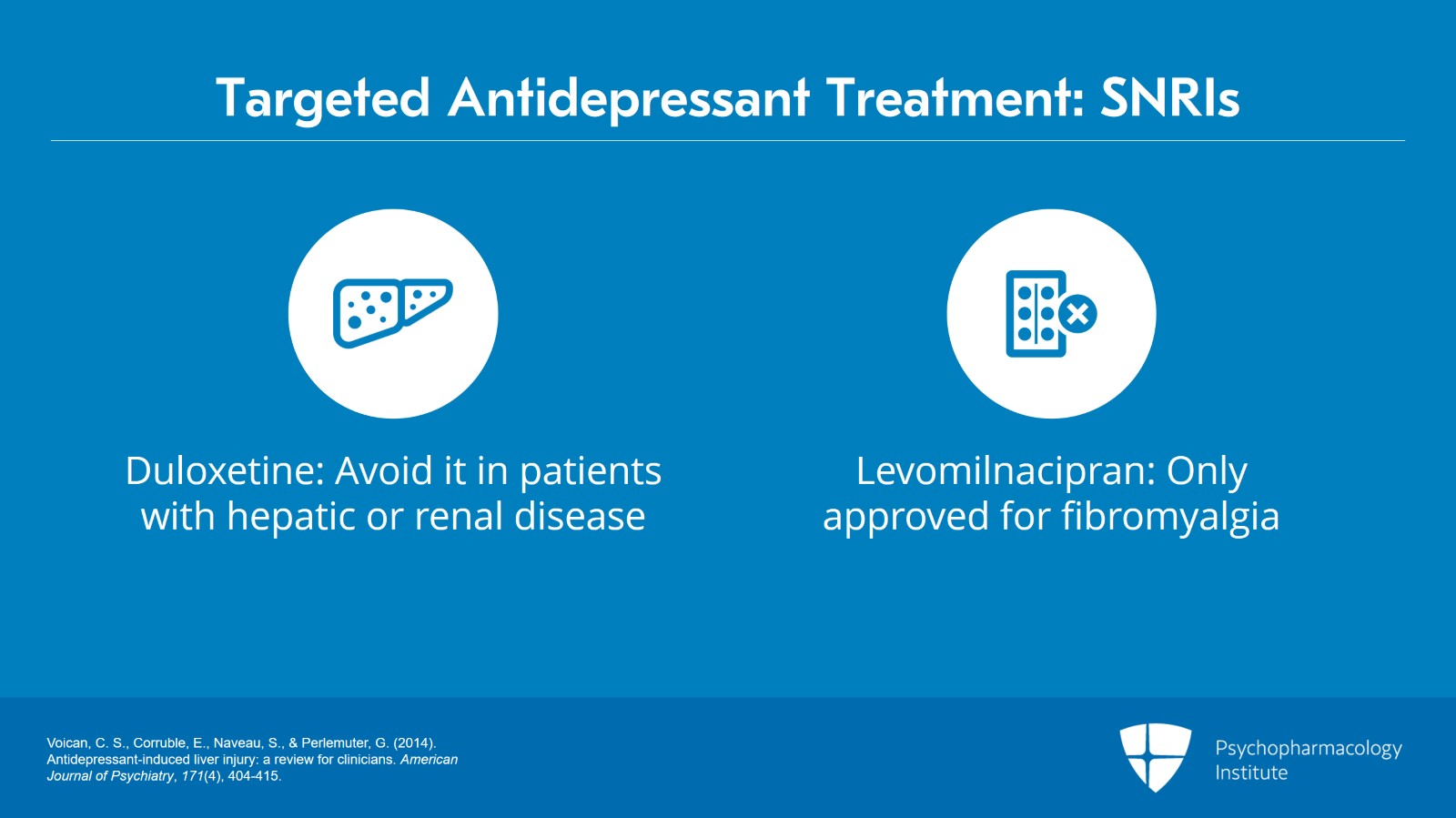
We want to avoid duloxetine in patients who have hepatic or renal disease. Levomilnacipran has been used as an antidepressant in Europe, but in the United States it's only indicated or approved for fibromyalgia.
References:
  • Voican, C. S., Corruble, E., Naveau, S., & Perlemuter, G. (2014). Antidepressant-induced liver injury: a review for clinicians. American Journal of Psychiatry, 171(4), 404-415.
Free Files
Success!
Check your inbox, we sent you all the materials there.

Slide 15 of 28

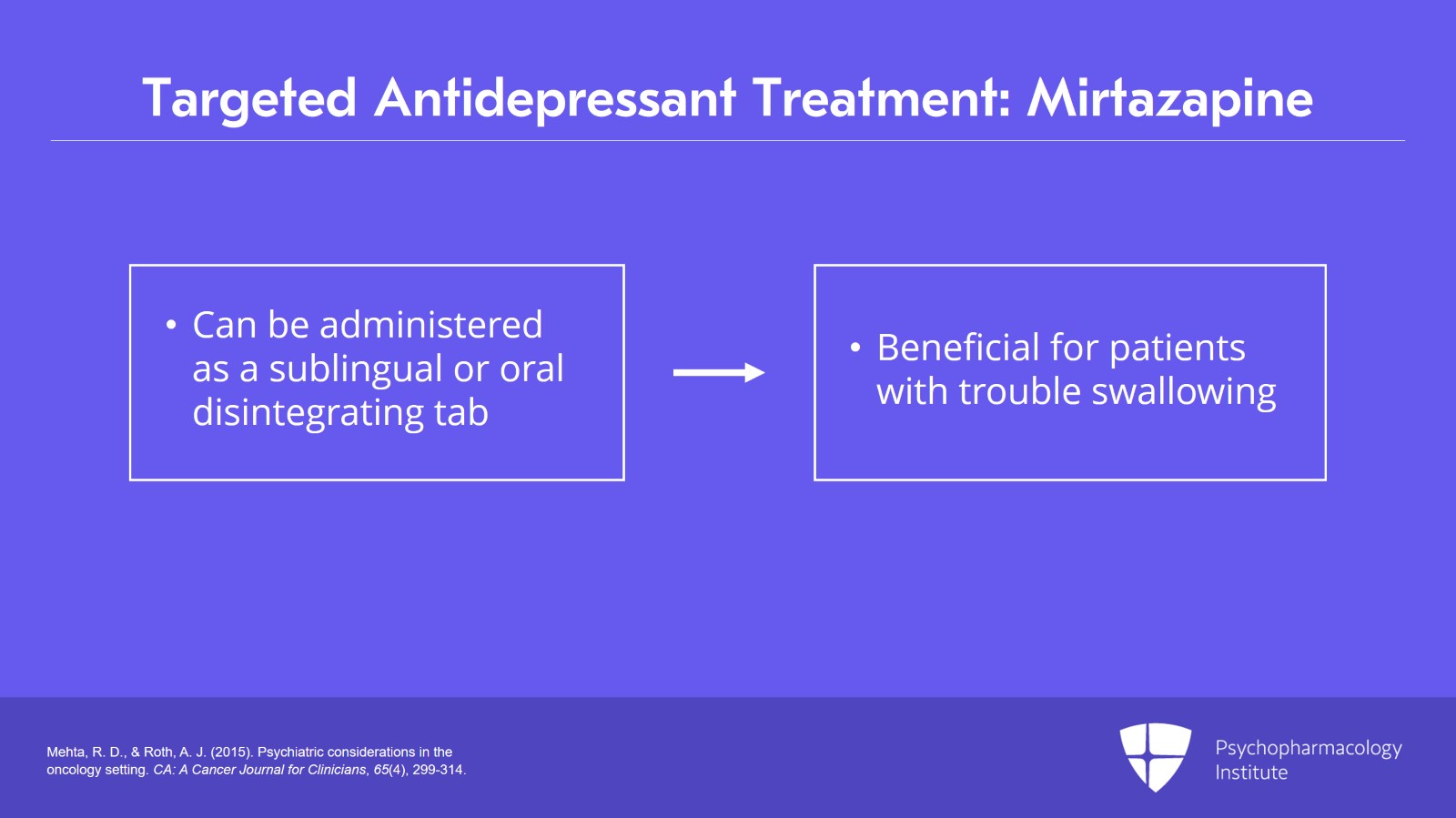
Another very commonly used antidepressant in patients with cancer is mirtazapine. Mirtazapine is a, a serotonin and norepinephrine increasing antidepressant that is also possible to administer as a sublingual orally disintegrating tab which can be very beneficial for patients who have trouble swallowing, for example, due to painful mouth sores.
References:
  • Mehta, R. D., & Roth, A. J. (2015). Psychiatric considerations in the oncology setting. CA: A Cancer Journal for Clinicians, 65(4), 299-314.

Slide 16 of 28

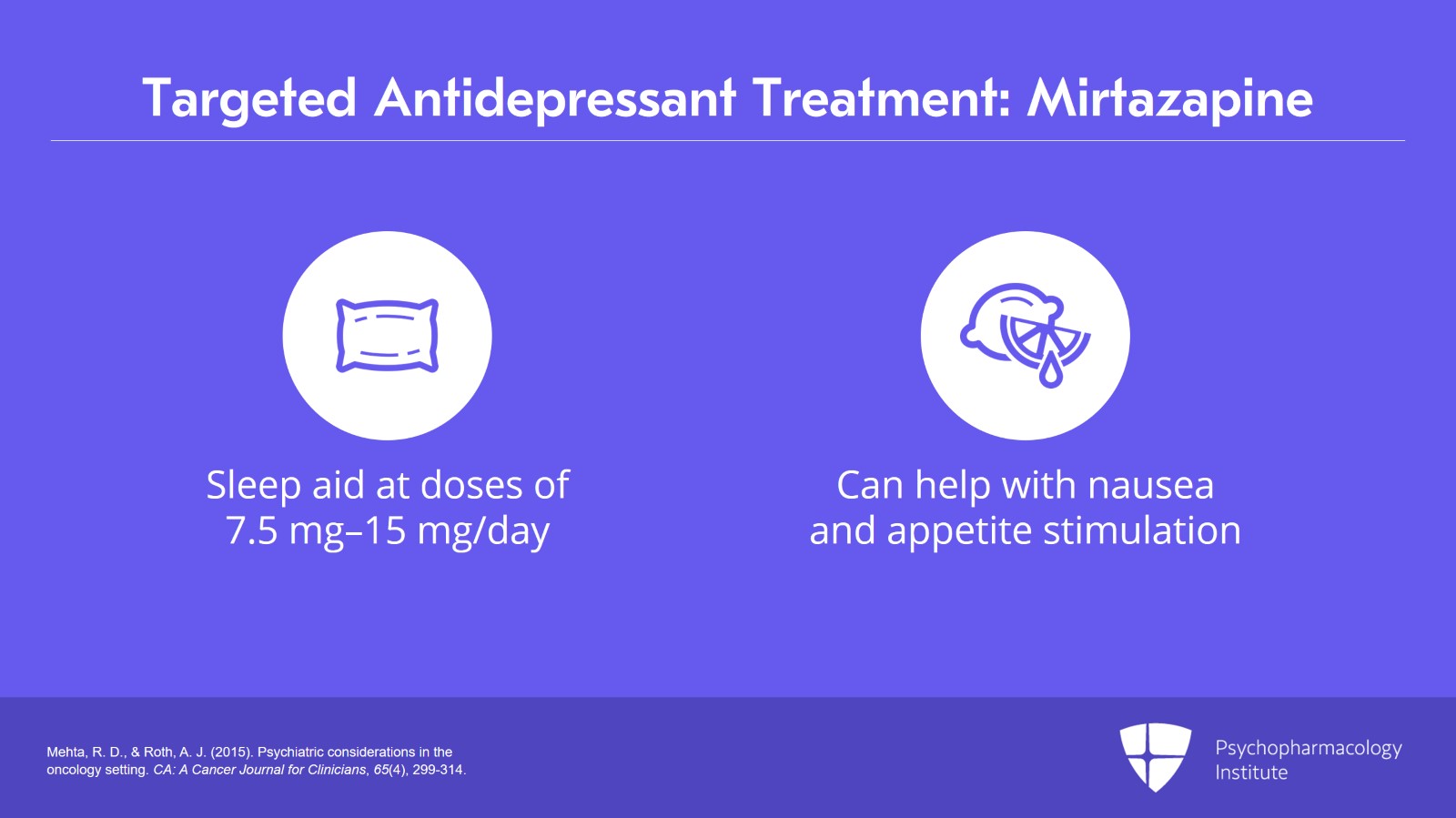
It is a pretty sedating antidepressant, so we use it also as a sleep aid for some of our patients at 7.5 or 15 mg. I prefer to use mirtazapine or trazodone for sleep rather than a benzodiazepine or other so-called Z-drugs because of the lack of addiction potential. Mirtazapine can also help some patients with nausea and appetite stimulation.
References:
  • Mehta, R. D., & Roth, A. J. (2015). Psychiatric considerations in the oncology setting. CA: A Cancer Journal for Clinicians, 65(4), 299-314.
Free Files
Success!
Check your inbox, we sent you all the materials there.
Slide 17 of 28

One thing to keep in mind is that there have been case reports of neutropenia with mirtazapine.
References:
  • Kasper, S., Praschak-Rieder, N., Tauscher, J., & Wolf, R. (1997). A risk-benefit assessment of mirtazapine in the treatment of depression. Drug Safety, 17, 251-264.

Slide 18 of 28

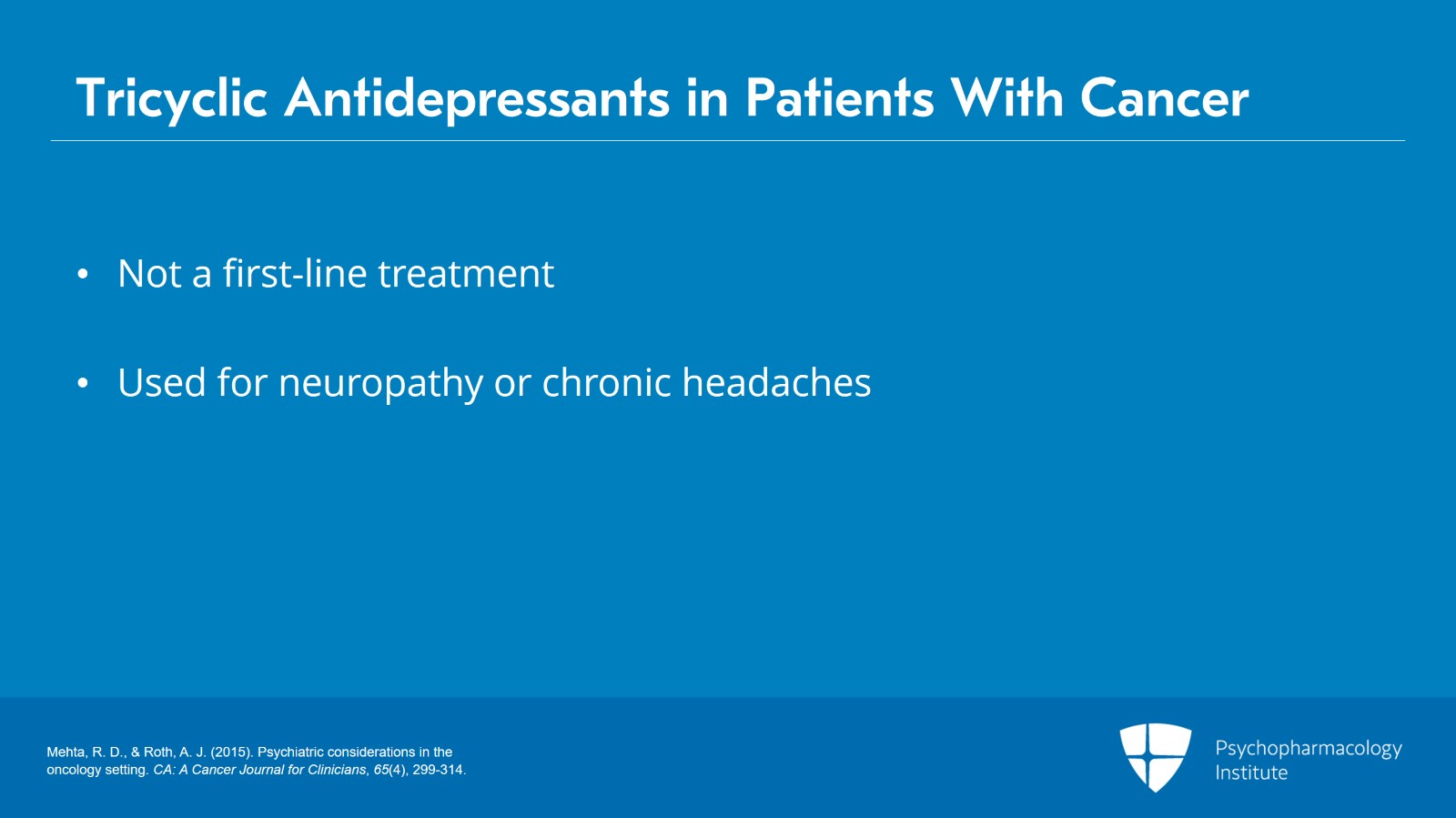
Some of the older antidepressants like tricyclic antidepressants – amitriptyline, nortriptyline – are generally not used as first-line treatment of depression or anxiety in patients but you may still see them used by our colleagues in Neurology or Supportive Medicine for management of neuropathy or chronic headaches.
References:
  • Mehta, R. D., & Roth, A. J. (2015). Psychiatric considerations in the oncology setting. CA: A Cancer Journal for Clinicians, 65(4), 299-314.
Free Files
Success!
Check your inbox, we sent you all the materials there.
Slide 19 of 28

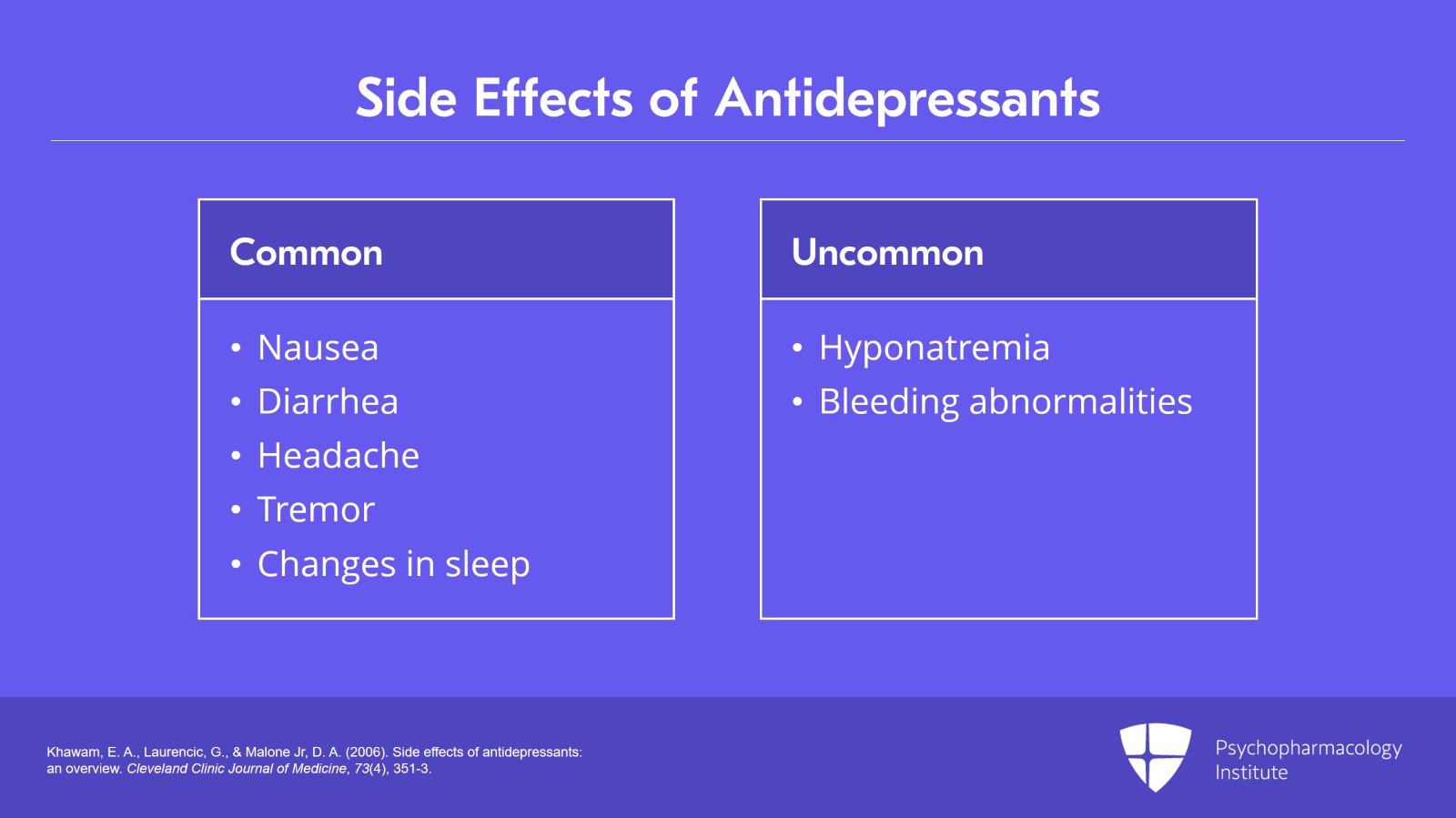
Some of the most common side effects particularly initially in treatment include nausea, diarrhea, headache, tremor, changes in sleep. For some patients, it can be sleepiness or for others it can be insomnia. Hyponatremia or bleeding abnormalities are relatively uncommon.
References:
  • Khawam, E. A., Laurencic, G., & Malone Jr, D. A. (2006). Side effects of antidepressants: an overview. Cleveland Clinic Journal of Medicine, 73(4), 351-3.

Slide 20 of 28

We want to keep in mind possible drug-drug interactions. SSRIs in general have low drug-drug interaction potential with the exception of paroxetine and fluoxetine, which are both potent 2D6 inhibitors. As we know, citalopram has a warning about QTc prolongation. Escitalopram is a similar medication which does not carry the same warning.
References:
  • Shelton, R. C. (2019). Serotonin and norepinephrine reuptake inhibitors. Antidepressants: From Biogenic Amines to New Mechanisms of Action, 145-180.
Free Files
Success!
Check your inbox, we sent you all the materials there.

Slide 21 of 28

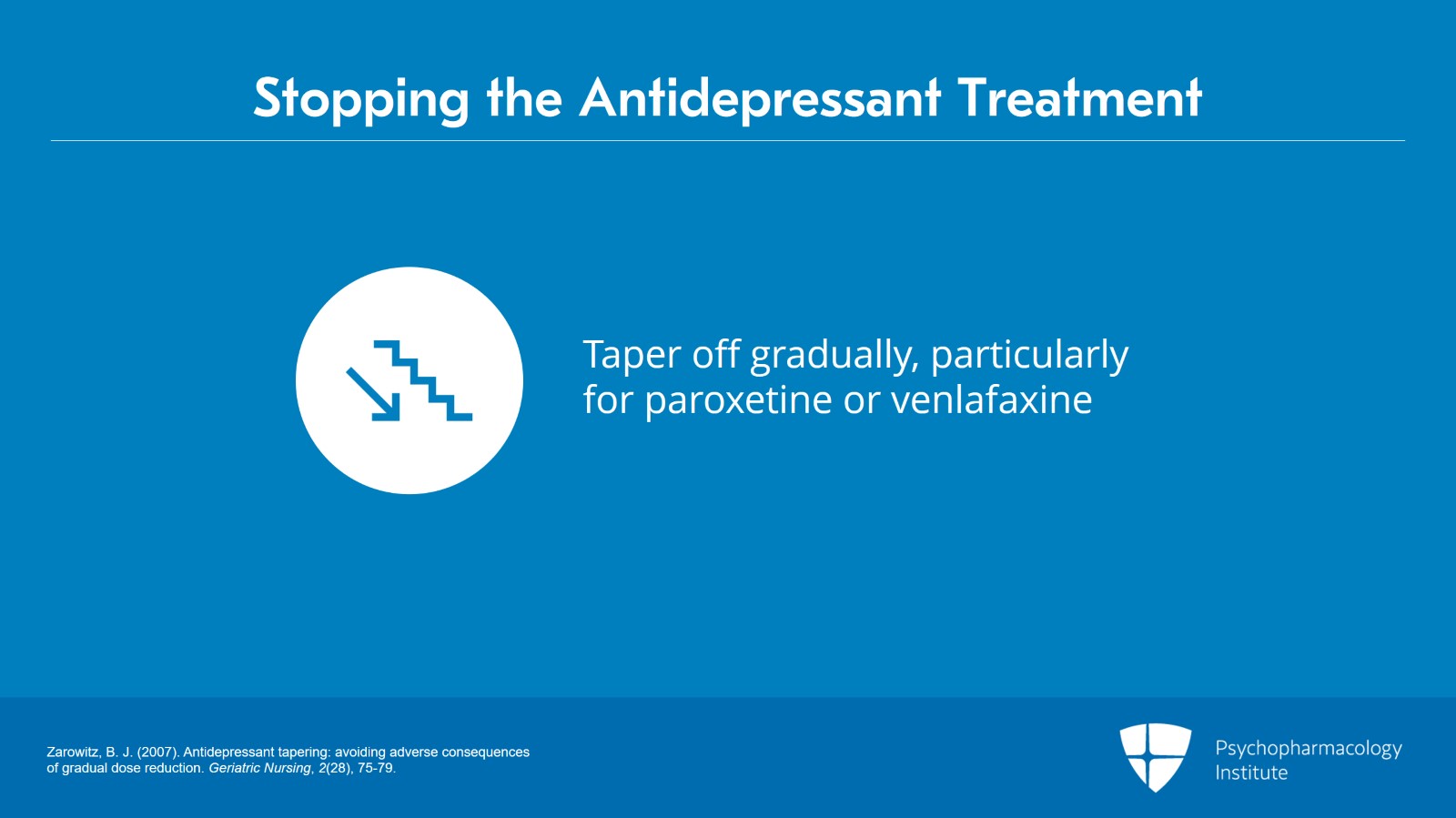
If the patient wants to stop the antidepressant, it's always better to taper it off gradually particularly antidepressants like paroxetine or venlafaxine.
References:
  • Zarowitz, B. J. (2007). Antidepressant tapering: avoiding adverse consequences of gradual dose reduction. Geriatric Nursing, 2(28), 75-79.

Slide 22 of 28

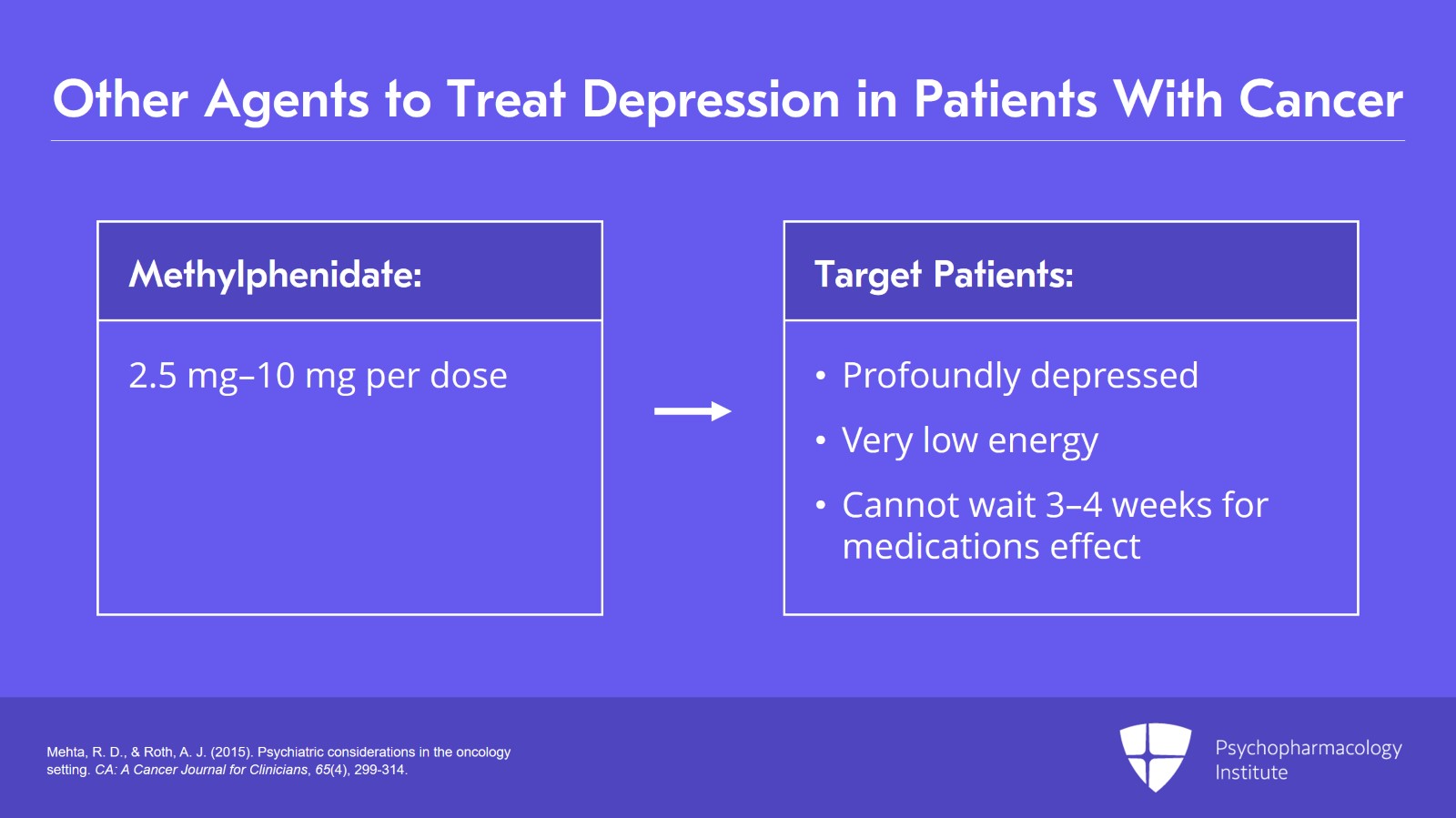
Some of the other agents to consider include medications like stimulants. So for example, methylphenidate at doses between 2.5 to 10 mg per dose can be very helpful for patients who are profoundly depressed, very low energy. You really need them to start engaging with physical therapy, occupational therapy, and you cannot wait those three or four weeks for the SSRI or SNRI to kick in. For those kinds of patients, adding a low dose of stimulant may be very helpful.
References:
  • Mehta, R. D., & Roth, A. J. (2015). Psychiatric considerations in the oncology setting. CA: A Cancer Journal for Clinicians, 65(4), 299-314.
Free Files
Success!
Check your inbox, we sent you all the materials there.
Slide 23 of 28

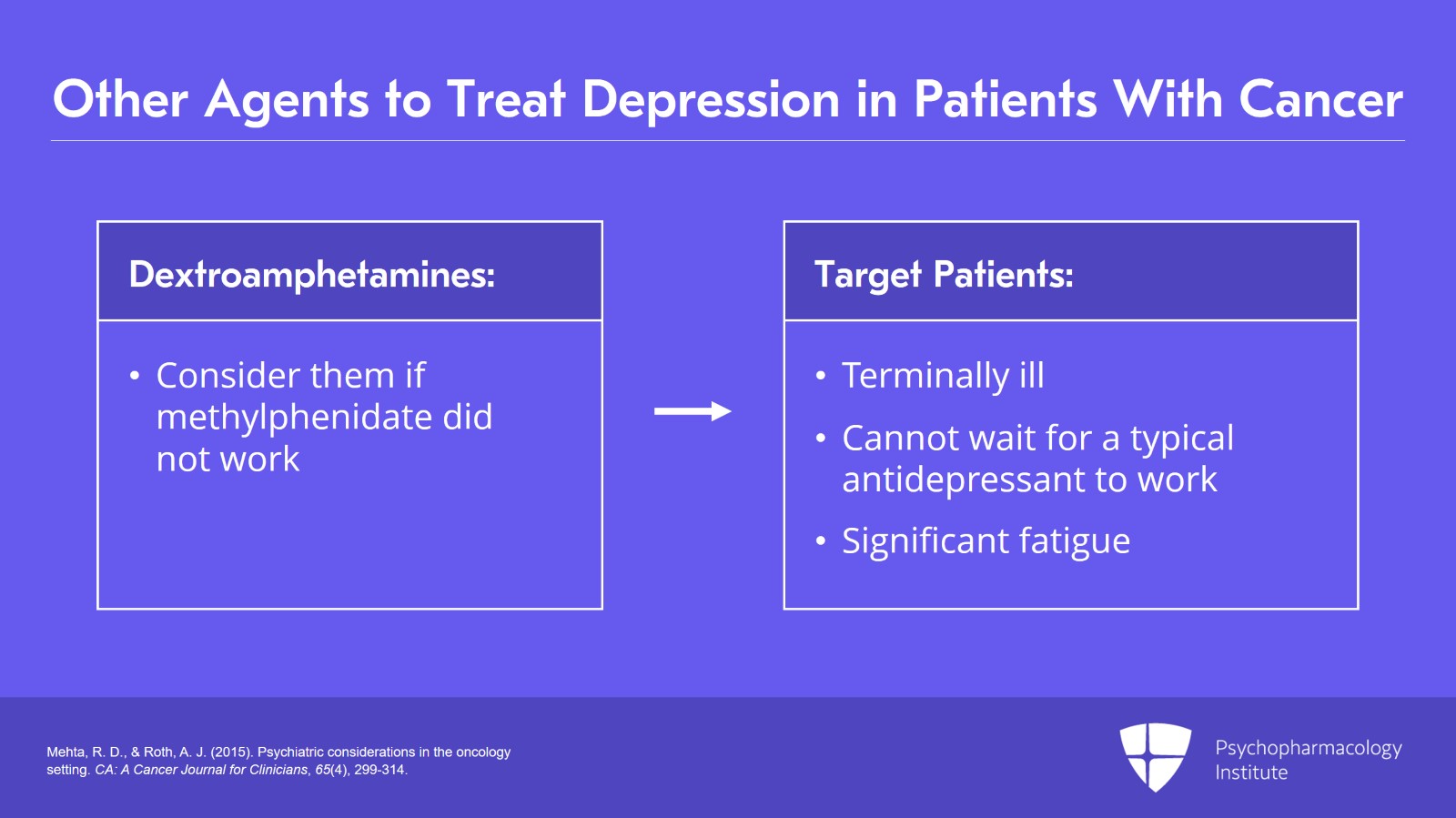
If methylphenidate is not doing the job, you can try other stimulants, for example, from the group of dextroamphetamines. All of these medications are really rapidly acting for fatigue, apathy and mood and may actually be a good choice for patients who are terminally ill, who cannot really afford the time to wait for a typical antidepressant to work as stimulants may really improve their mood much more rapidly. I do have patients who don't necessarily struggle with depression but do struggle with significant fatigue for whom I would use a low dose of stimulant for that purpose.
References:
  • Mehta, R. D., & Roth, A. J. (2015). Psychiatric considerations in the oncology setting. CA: A Cancer Journal for Clinicians, 65(4), 299-314.

Slide 24 of 28

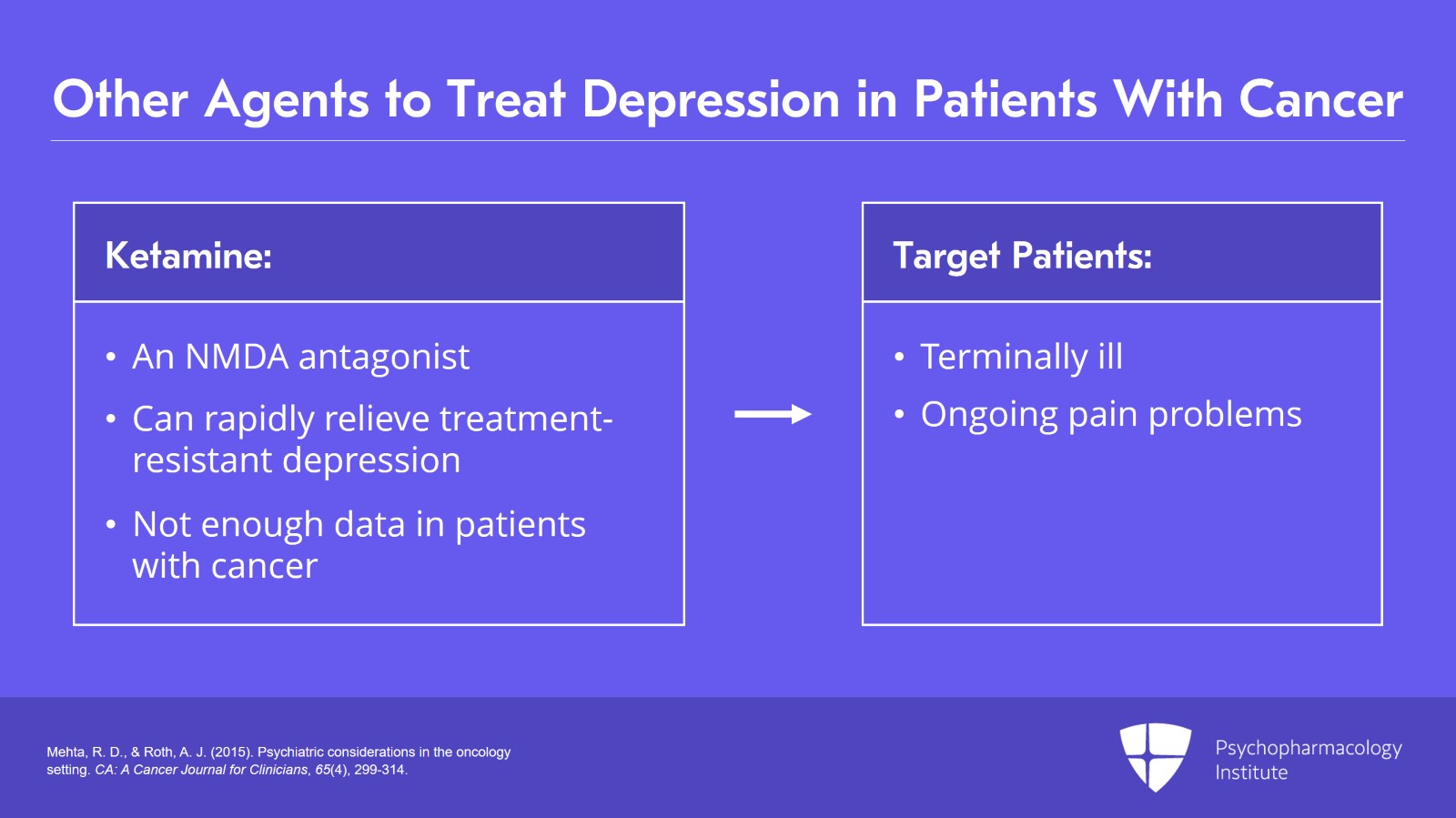
Ketamine has become more and more popular in treatment of depression in the general population. It is a drug that has been used in general anesthesia. It's an NMDA antagonist and at a low dose IV administration can actually rapidly relieve treatment-resistant depression. However, the duration of the effect can vary widely and the doses often need to be repeated. In patients with cancer, we don't really have a lot of data on the use of ketamine but there are certainly patients for whom this may be an appropriate alternative, for example patients who are terminally ill or patients who have ongoing pain issues where ketamine could help them with both pain and depressive symptoms.
References:
  • Mehta, R. D., & Roth, A. J. (2015). Psychiatric considerations in the oncology setting. CA: A Cancer Journal for Clinicians, 65(4), 299-314.
Free Files
Success!
Check your inbox, we sent you all the materials there.
Slide 25 of 28

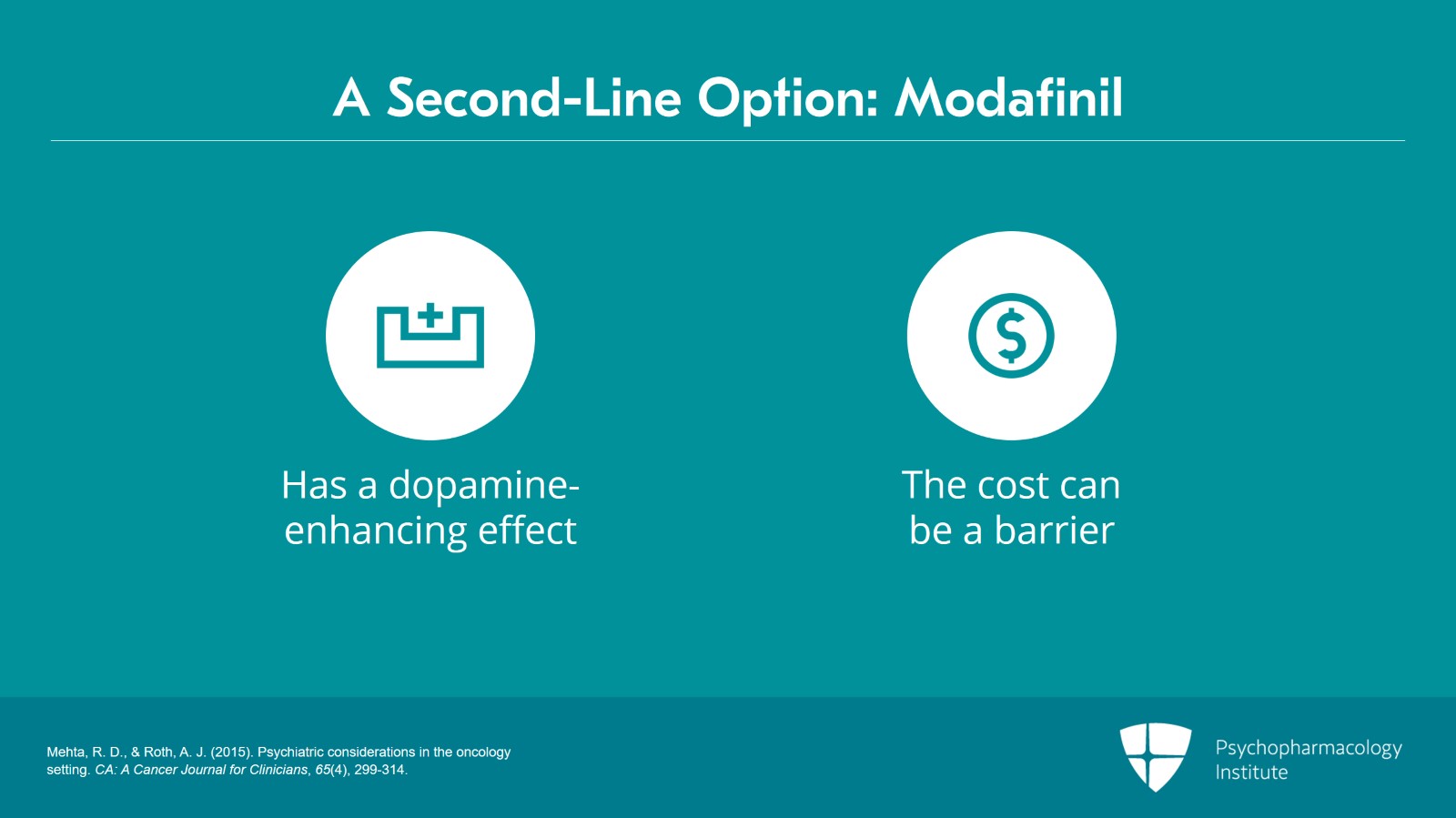
As a second line, I would think about modafinil, which is a medication with dopamine-enhancing effect. Sometimes, the cost of the medication can be a barrier for patients to use it.
References:
  • Mehta, R. D., & Roth, A. J. (2015). Psychiatric considerations in the oncology setting. CA: A Cancer Journal for Clinicians, 65(4), 299-314.

Slide 26 of 28

In summary: Antidepressants are the first-line treatment particularly for moderate to severe forms of depression. Favorable side effects and possible effectiveness for other symptoms, for example hot flashes or pain, should also be taken into consideration when we are selecting an antidepressant.
Free Files
Success!
Check your inbox, we sent you all the materials there.
Slide 27 of 28

Some non-antidepressant agents such as stimulants can often be used safely and effectively as an augmentation of antidepressant treatment, especially in the first weeks of starting an antidepressant, or for patients who have chronic significant fatigue, or chemotherapy-induced cognitive issues such as difficulties with focus.

Slide 28 of 28

Free Files
Success!
Check your inbox, we sent you all the materials there.
Learning Objectives:

After completing this activity, the learner will be able to:

  • Tactfully approach patients with cancer who require psychiatric expertise.
  • Make a correct differential diagnosis between psychological, psychiatric, and medical etiologies.
  • Confidently recommend the best approach or treatment for each case.

Original Release Date: May 1, 2023

Review and Re-release Date: March 1, 2024

Expiration Date: May 1, 2026

Expert: Jaroslava Salman, M.D.

Medical Editor: Horia Batranu, M.D.

Relevant Financial Disclosures: 

None of the faculty, planners, and reviewers for this educational activity have relevant financial relationships to disclose during the last 24 months with ineligible companies whose primary business is producing, marketing, selling, re-selling, or distributing healthcare products used by or on patients.

Contact Information: For questions regarding the content or access to this activity, contact us at support@psychopharmacologyinstitute.com

Instructions for Participation and Credit:

Participants must complete the activity online during the valid credit period that is noted above.

Follow these steps to earn CME credit:

  1. View the required educational content provided on this course page.

  2. Complete the Post Activity Evaluation for providing the necessary feedback for continuing accreditation purposes and for the development of future activities. NOTE: Completing the Post Activity Evaluation after the quiz is required to receive the earned credit.

  3. Download your certificate.

Accreditation Statement

This activity has been planned and implemented in accordance with the accreditation requirements and policies of the Accreditation Council for Continuing Medical Education through the joint providership of Medical Academy LLC and the Psychopharmacology Institute. Medical Academy is accredited by the ACCME to provide continuing medical education for physicians.

Credit Designation Statement

Medical Academy designates this enduring activity for a maximum of 1.25 AMA PRA Category 1 credit(s)™. Physicians should claim only the credit commensurate with the extent of their participation in the activity.

Free Files
Success!
Check your inbox, we sent you all the materials there.
Continue in the website
Instant access modal

Become a Bronze, Silver, Gold, Bronze extended, Silver extended or Gold extended Member.

2025–26 Psychopharmacology CME Program

Unlock up to 155 CME Credits, including 40 SA CME Credits.