



Transcript
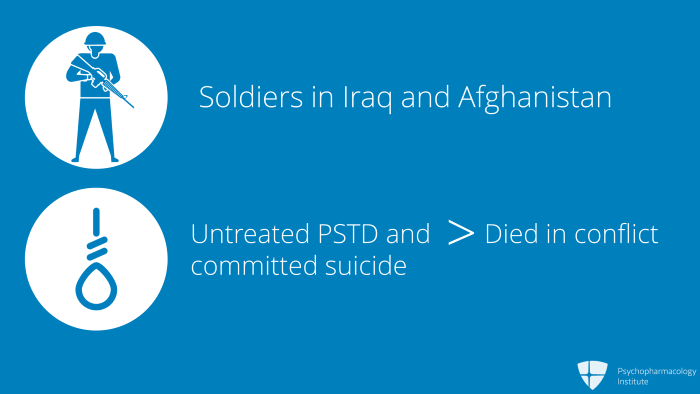
We’re going to move on now to the use of MDMA for posttraumatic stress disorder. And PTSD is becoming one of the great problems of our time. We know that in the United States Military the incidence of PTSD in people returning from Iraq was as high as 18%. And in fact, more soldiers returning from Iraq and Afghanistan have committed suicide from untreated PTSD than actually died in the conflict.
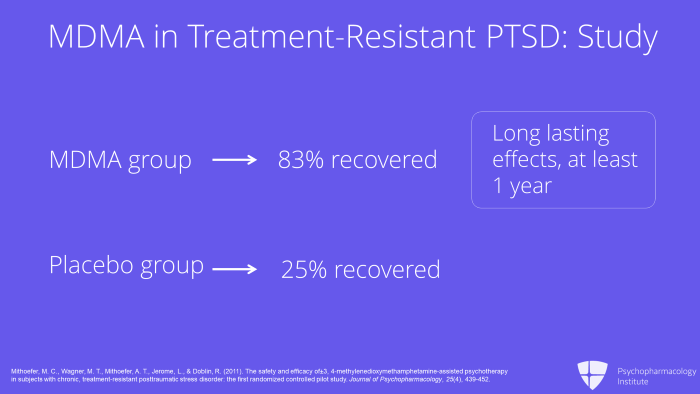
The first pointer to MDMA being useful in the treatment of PTSD came from the work of Mithoefer or the two Mithoefers. And the slide here shows that when MDMA was used in a two-session psychotherapeutic treatment regime, almost all of the people who had previously treatment resistant PTSD recovered. Whereas, in the placebo group, only one recovered. And not only did the MDMA produce a profound improvement in the symptoms of PTSD but the effects lasted and people stayed well for at least a year. Many are now well three or four years after the treatment
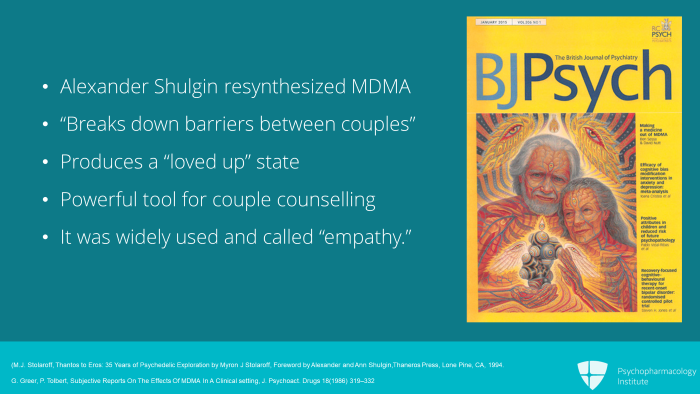
The efficacy of this particular study and the long-term value encouraged us to write a paper about this on Psychiatry. And you can see the front page of that journal. There you can see – the man there is Alexander Shulgin and there’s his wife. And he was the guy that re-synthesized MDMA. MDMA was first made back in the 1900s. But he re-synthesized it for the Drug Enforcement Agency in the States and realized it was very, very different to other drugs he tested. And he tested more drugs than anyone in the world probably. His wife who was a therapist took it as well. And she said this drug has a particularly beneficial effect in that it helps break down the barriers that build up between couples. It makes people love each other again. And of course, that’s why MDMA when it’s used as ecstasy produces a state which people called loved up. But by breaking down those hostilities that build up over the years, MDMA proved to be a very powerful tool for couple counseling, couple psychotherapy. And it was widely used. And then it was called empathy. No one had any worries about it.
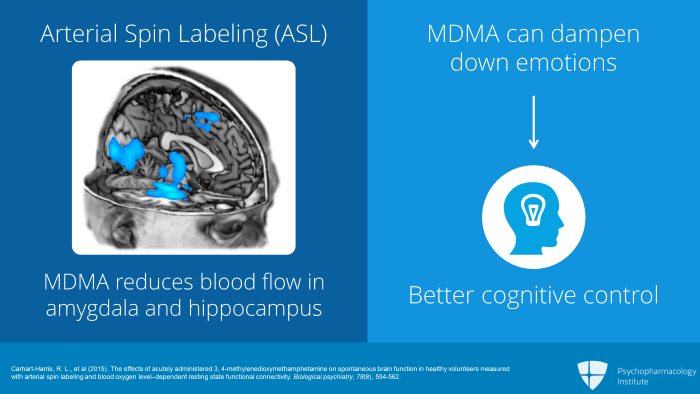
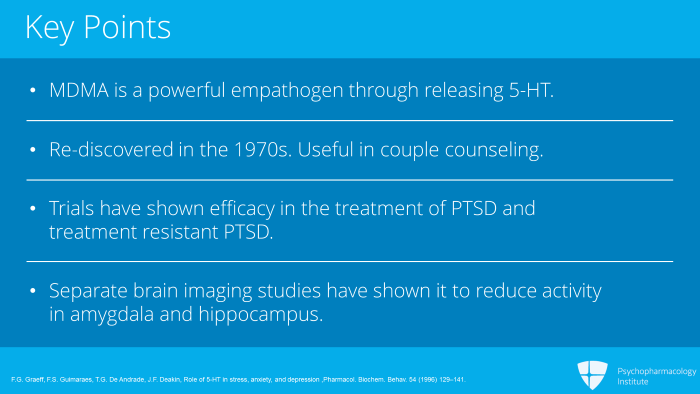
So the key points for MDMA in the treatment of PTSD. The first one is MDMA is a powerful empathogen. It makes people more sympathetic to each other and it works through releasing 5-HT. Although it was first made in the early 1900s, it was re-discovered in the 1970s and found to be a useful drug to break down anger and hostility in couple counseling. However, when it started to be used in the rave scene, its name was changed to ecstasy and it was made illegal. In recent years, several trials have shown it to have a special efficacy in the treatment of PTSD and PTSD that has proven resistant to conventional treatments. In the PTSD therapy, it’s used on two occasions usually two weeks apart in a strong psychotherapeutic setting usually with two co-therapists. And then it can produce very long-lasting improvement in symptoms. Separate brain imaging studies have shown it to reduce activity in amygdala and hippocampus which may explain how it helps patients overcome the emotional reliving of traumatic memories.
References
- Mithoefer, M. C., Wagner, M. T., Mithoefer, A. T., Jerome, L., & Doblin, R. (2011). The safety and efficacy of±3, 4-methylenedioxymethamphetamine-assisted psychotherapy in subjects with chronic, treatment-resistant posttraumatic stress disorder: the first randomized controlled pilot study . Journal of Psychopharmacology, 25(4), 439-452.
- M.J. Stolaroff, Thantos to Eros: 35 Years of Psychedelic Exploration by Myron J Stolaroff, Foreword by Alexander and Ann Shulgin,Thaneros Press, Lone Pine, CA, 1994.
- G. Greer, P. Tolbert, Subjective Reports On The Effects Of MDMA In A Clinical setting , J. Psychoact. Drugs 18(1986) 319–332
- Carhart-Harris, R. L., et al (2015). The effects of acutely administered 3, 4-methylenedioxymethamphetamine on spontaneous brain function in healthy volunteers measured with arterial spin labeling and blood oxygen level–dependent resting state functional connectivity . Biological psychiatry , 78 (8), 554-562.
- F.G. Graeff, F.S. Guimaraes, T.G. De Andrade, J.F. Deakin, Role of 5-HT in stress, anxiety, and depression ,Pharmacol . Biochem. Behav. 54 (1996) 129–141.
