Close Banner
Section Free  - Video Lectures

06. The Importance of Child-Pugh Classification for Staging Hepatic Impairment

Published on April 1, 2021 Expired on April 1, 2025

Jonathan M. Meyer, M.D.

Assistant Clinical Professor - University of California San Diego

Key Points

  • The Child-Pugh classification is the best proxy for changes in the ability to metabolize medications.
  • Modern packages insert in Section 8 (Hepatic Impairment) comments on whether the medication has been studied in Child-Pugh B or C.
  • In some instances, the medication has not been studied in patients with hepatic impairment.
  • In those circumstances, other choices might be needed.

Free Downloads for Offline Access

  • Free Download Video (MP4)
  • Free Download Audio File (MP3)
  • Free Download Presentation File (PPTX)

Slides and Transcript

Slide 1 of 10

So, how did we end up with Child-Pugh as being the best correlate of the stage of cirrhosis?

Slide 2 of 10

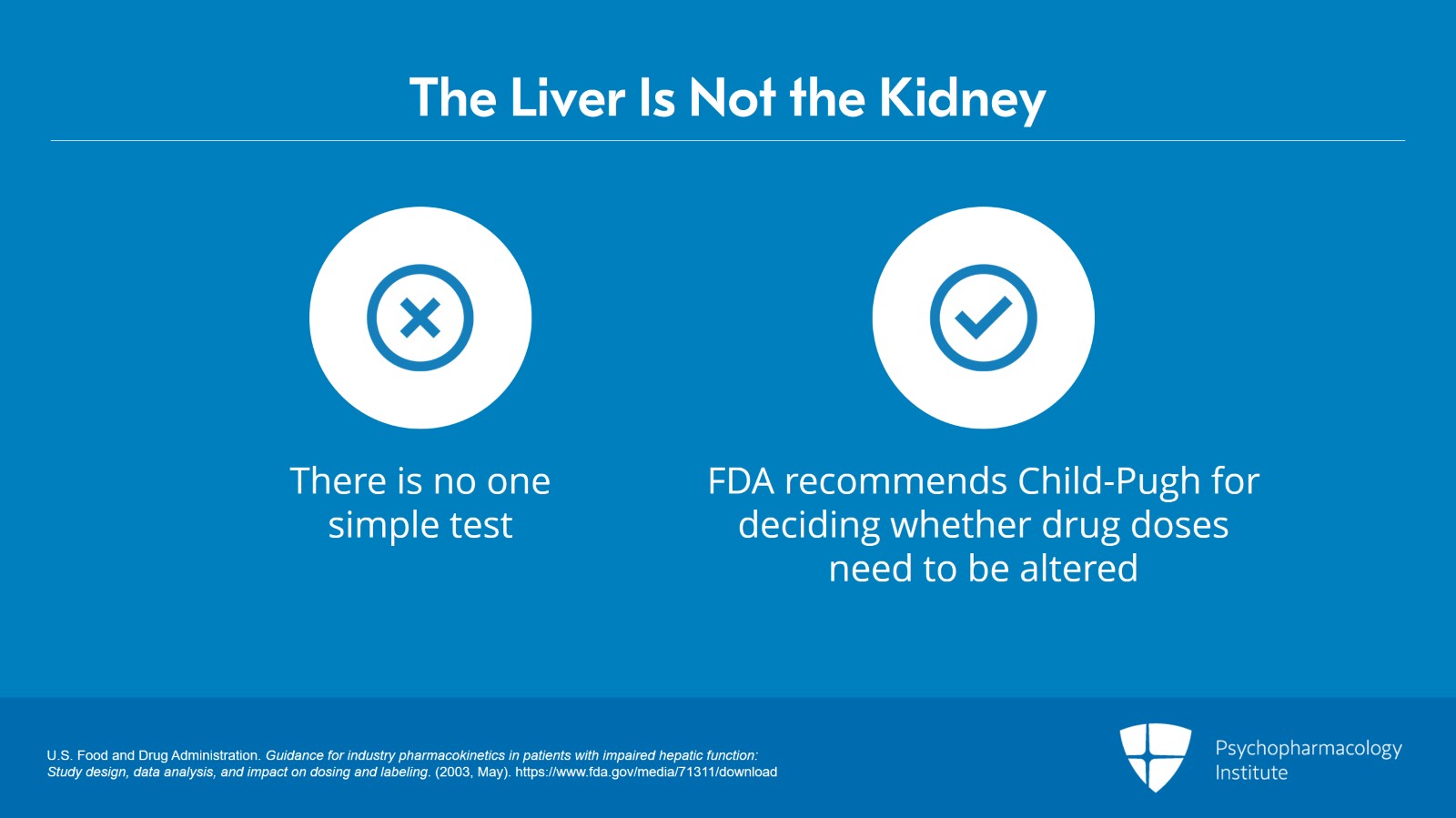
So importantly, we have more difficulty in trying to figure out what the liver is doing for a particular drug in a way that's not true for the kidney. You know, I can get an estimated GFR from simple labs. You know, one lab and I can pretty much figure out what the person's renal function is. But the liver is not the kidney. There is no one simple test. As I've mentioned, AST and ALT are actually the wrong tests in this context. So how did the FDA end up recommending Child-Pugh as the best way to decide if drug doses need to be altered for new medication starts?
References:
  • U.S. Food and Drug Administration. Guidance for industry pharmacokinetics in patients with impaired hepatic function: Study design, data analysis, and impact on dosing and labeling. (2003, May). https://www.fda.gov/media/71311/download
Free Files
Success!
Check your inbox, we sent you all the materials there.

Slide 3 of 10

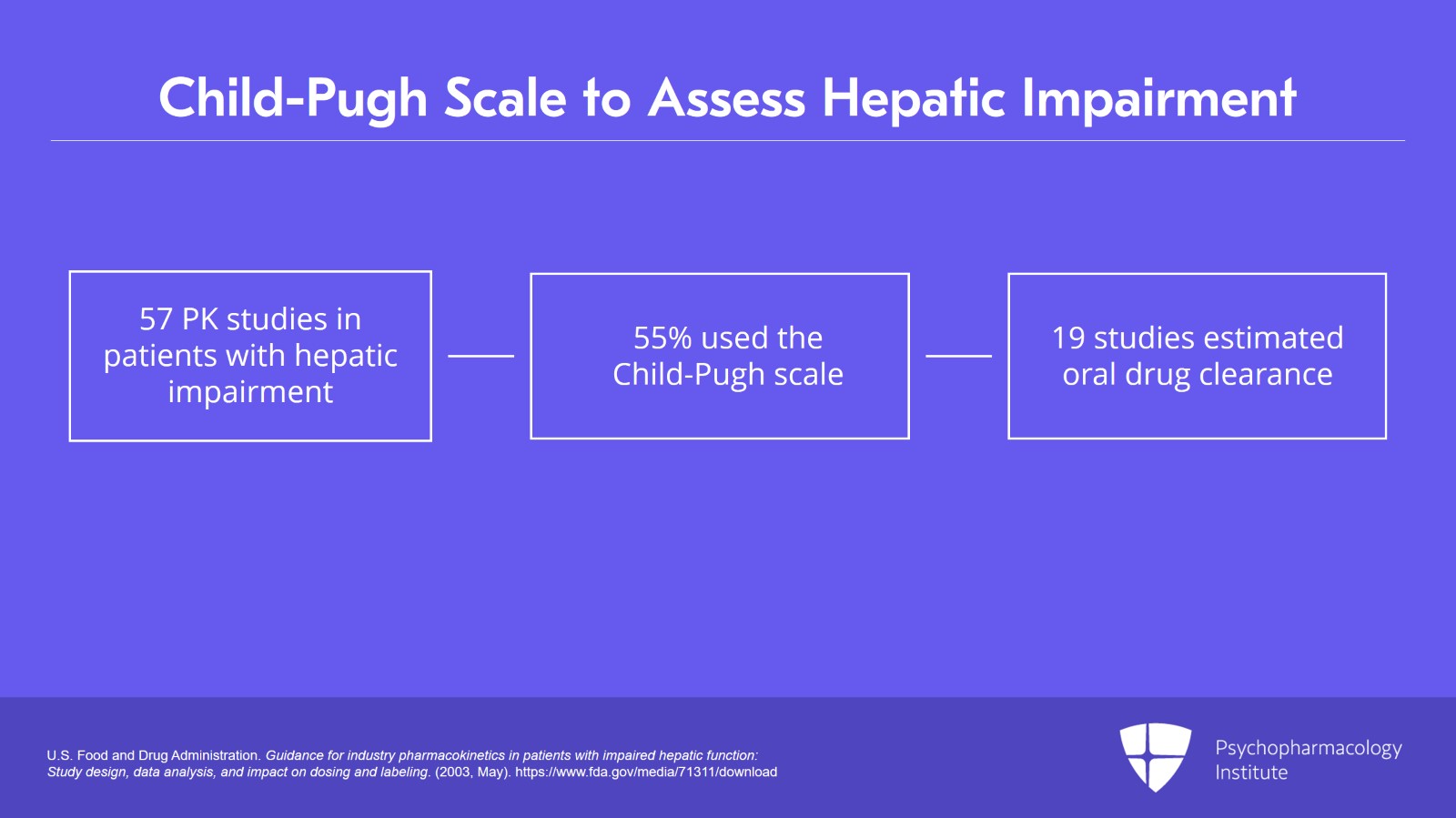
Well, the FDA reviewed 57 pharmacokinetic studies in patients with hepatic impairment of varying degrees among new drug applications in the mid '90s. They found that 55% of those applications used the Child-Pugh scale to assess hepatic impairment. Of those studies surveyed, 19 also had estimated oral drug clearance in normals and in patients with more than one Child-Pugh category.
References:
  • U.S. Food and Drug Administration. Guidance for industry pharmacokinetics in patients with impaired hepatic function: Study design, data analysis, and impact on dosing and labeling. (2003, May). https://www.fda.gov/media/71311/download

Slide 4 of 10

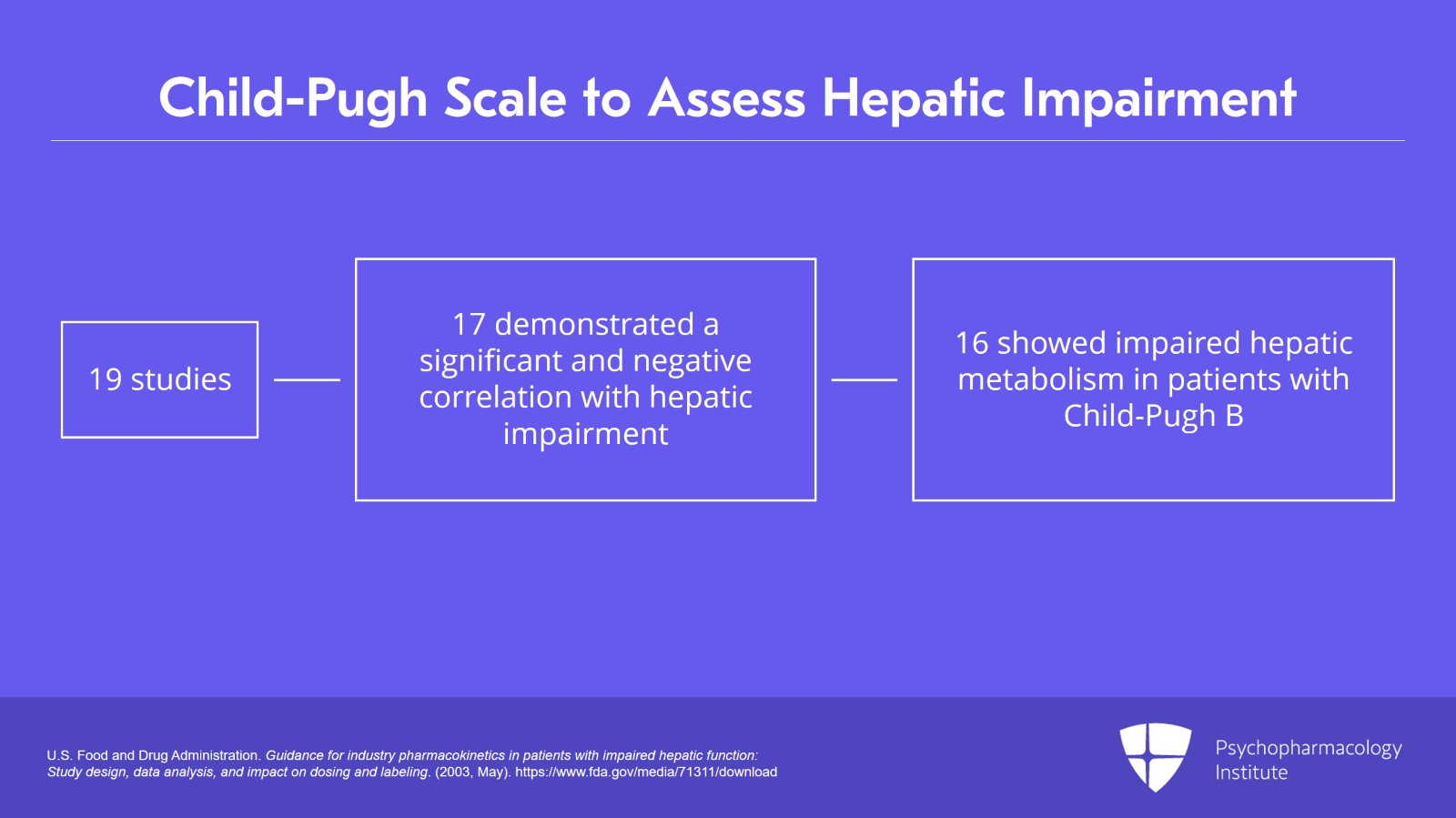
Among those 19 studies, 17 demonstrated a significant and negative correlation with a correlation coefficient between 0.5 and 1 between oral drug clearance and hepatic impairment as defined by Child-Pugh. Most importantly, 16 of the 17 studies showed impaired hepatic metabolism in patients with the moderate Child-Pugh category which is Child-Pugh B.
References:
  • U.S. Food and Drug Administration. Guidance for industry pharmacokinetics in patients with impaired hepatic function: Study design, data analysis, and impact on dosing and labeling. (2003, May). https://www.fda.gov/media/71311/download
Free Files
Success!
Check your inbox, we sent you all the materials there.

Slide 5 of 10

From this, the FDA concluded that yes, there may be other approaches to assess varying degrees of hepatic impairment, but a Child-Pugh categorization should still be included for each patient as part of a new drug application. Meaning, if you want to have language about the use of your medication in hepatic impairment, you have to do studies for people who are Child-Pugh A, Child-Pugh B and Child-Pugh C. The Child-Pugh classification is the best and easiest way for any clinician to stage somebody's severity of cirrhosis and therefore decide if they need to alter initial drug dosages. *References*
References:
  • Verbeeck, R. K. (2008). Pharmacokinetics and dosage adjustment in patients with hepatic dysfunction. European Journal of Clinical Pharmacology, 64(12), 1147-1161.

Slide 6 of 10

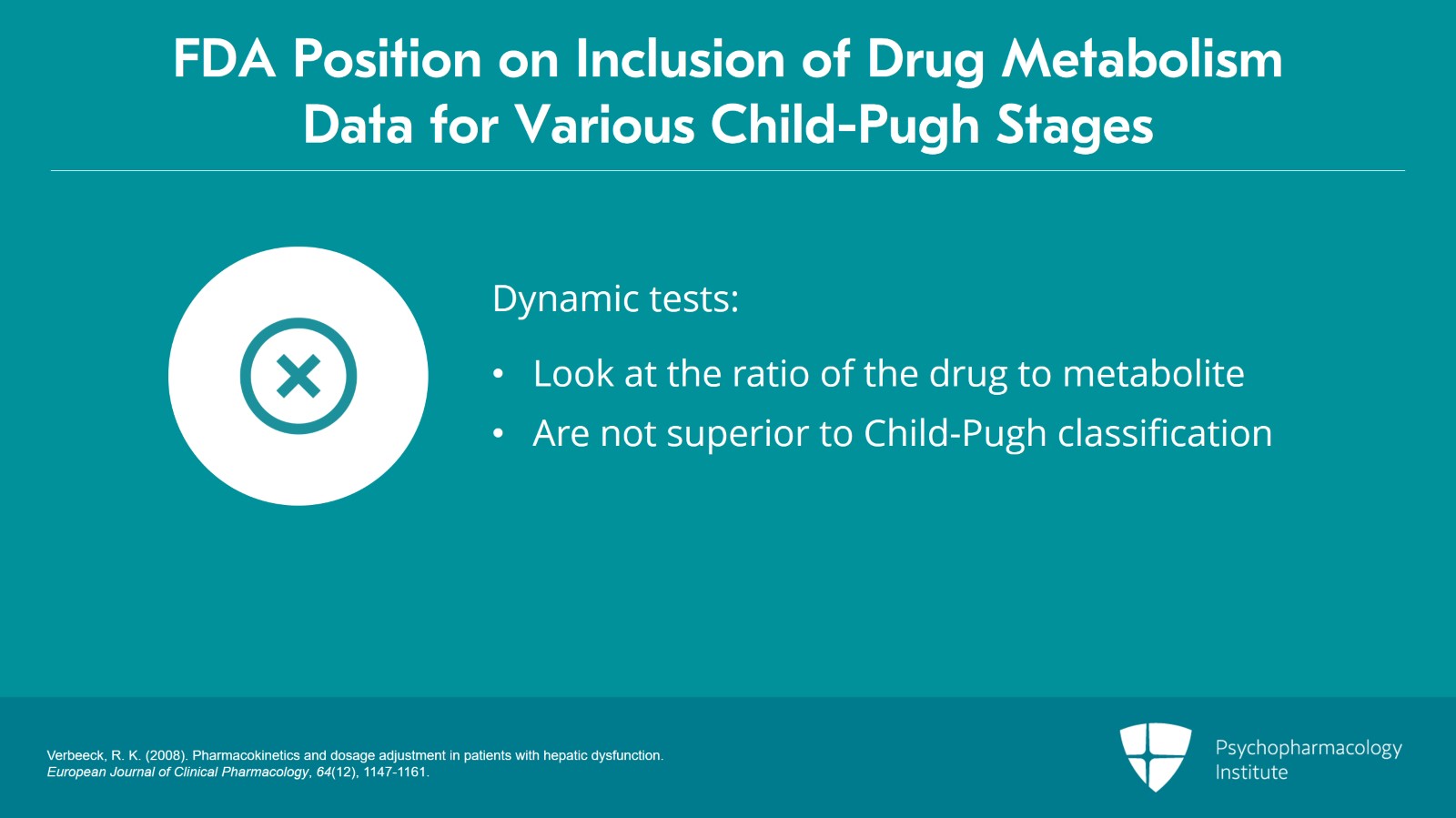
There are things done for research purposes only, what we call dynamic tests where we actually would inject people with drugs and look at the ratio of the drug to metabolite. But the FDA said, look, we've looked at those and they're actually not superior to the Child-Pugh classification. *References*
References:
  • Verbeeck, R. K. (2008). Pharmacokinetics and dosage adjustment in patients with hepatic dysfunction. European Journal of Clinical Pharmacology, 64(12), 1147-1161.
Free Files
Success!
Check your inbox, we sent you all the materials there.

Slide 7 of 10

Again, I've said it numerous times but it's cirrhosis which predicts changes in drug kinetics, not inflammation.
References:
  • Verbeeck, R. K. (2008). Pharmacokinetics and dosage adjustment in patients with hepatic dysfunction. European Journal of Clinical Pharmacology, 64(12), 1147-1161.

Slide 8 of 10

And now, as of 2021, the Child-Pugh classification is the best proxy for changes in the ability to metabolize medications. All modern package inserts have been standardized. And in section 8 which is on hepatic impairment, look at that subsection and it will comment on whether the medication has been studied in Child-Pugh B or C patients and if so whether there is a dose adjustment or whether the medication is permitted at all.
Free Files
Success!
Check your inbox, we sent you all the materials there.

Slide 9 of 10

In some instances, the manufacturer simply did not do the studies. The medication was never studied in people with hepatic impairment and there will be language to the extent that it is contraindicated in patients with hepatic impairment simply due to the absence of data. In those circumstances, other choices might be needed. Or for example, like paliperidone, it was very clear that there are no data for people with severe hepatic impairment. So, if you had somebody who's Child-Pugh C, you would have to find an antipsychotic for which that type of data is in the package insert.

Slide 10 of 10

Free Files
Success!
Check your inbox, we sent you all the materials there.

Learning Objectives:

After completing this activity, the learner will be able to:

  1. Discuss the safety of psychotropics in patients with hepatic issues. 
  2.  Assess liver function with laboratory tests and the Child-Pugh scale to make the best clinical decisions.

Original Release Date: 04/01/2021

Review and Re-release Date: 03/01/2024

Expiration Date: 04/01/2025

Expert: Jonathan Meyer, M.D.

Medical Editor: Lorena Rodriguez, M.D

Relevant Financial Disclosures:

The following planners, faculty, and reviewers have the following relevant financial relationships with commercial interests to disclose:

Dr. Meyer has disclosed the following relationships:

  • Acadia Pharmaceuticals: Advisory committee, speaking
  • Alkermes: Advisory committee, speaking
  • Abbvie: Advisory committee
  • Intra-Cellular Therapies: Advisory committee, speaking
  • Neurocrine: Advisory committee, speaking
  • Otsuka America, Inc.: Speaking
  • Sunovion Pharmaceuticals: Speaking
  • Teca: Speaking

All of the relevant financial relationships listed for these individuals have been mitigated.

Contact Information: For questions regarding the content or access to this activity, contact us at support@psychopharmacologyinstitute.com

Instructions for Participation and Credit:

Participants must complete the activity online during the valid credit period that is noted above.

Follow these steps to earn CME credit:

  1. View the required educational content provided on this course page.
  2. Complete the Post Activity Evaluation for providing the necessary feedback for continuing accreditation purposes and for the development of future activities. NOTE: Completing the Post Activity Evaluation after the quiz is required to receive the earned credit.
  3. Download your certificate.

Accreditation Statement

This activity has been planned and implemented in accordance with the accreditation requirements and policies of the Accreditation Council for Continuing Medical Education through the joint providership of Medical Academy LLC and the Psychopharmacology Institute. Medical Academy is accredited by the ACCME to provide continuing medical education for physicians.

Credit Designation Statement

Medical Academy designates this enduring activity for a maximum of 1.00 AMA PRA Category 1 credit(s). Physicians should claim only the credit commensurate with the extent of their participation in the activity.


Free Files
Success!
Check your inbox, we sent you all the materials there.
Continue in the website
Instant access modal

Become a Bronze, Silver, Gold, Bronze extended, Silver extended or Gold extended Member.

2025–26 Psychopharmacology CME Program

Unlock up to 155 CME Credits, including 40 SA CME Credits.