Close Banner
Section Free  - Video Lectures

07. Strategies for Safe Usage and Proper Monitoring of Lamotrigine

Published on February 1, 2024 Certification expiration date: February 1, 2027

Scott R. Beach, M.D.

Associate Professor of Psychiatry - Harvard Medical School - Massachusetts General Hospital

Key Points

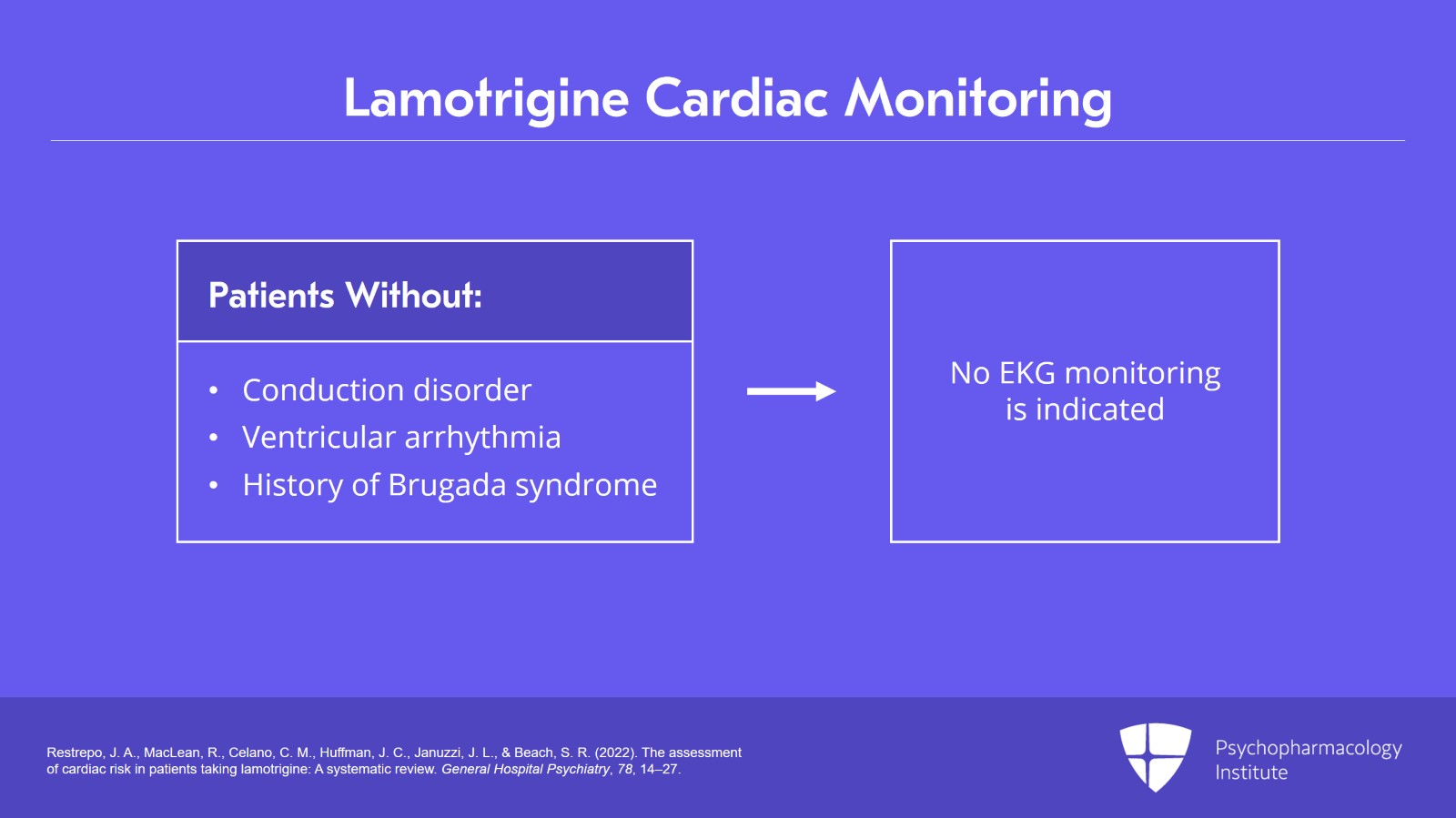
  • For patients without a history of conduction disorder, ventricular arrhythmia, or Brugada syndrome, no EKG monitoring is indicated.
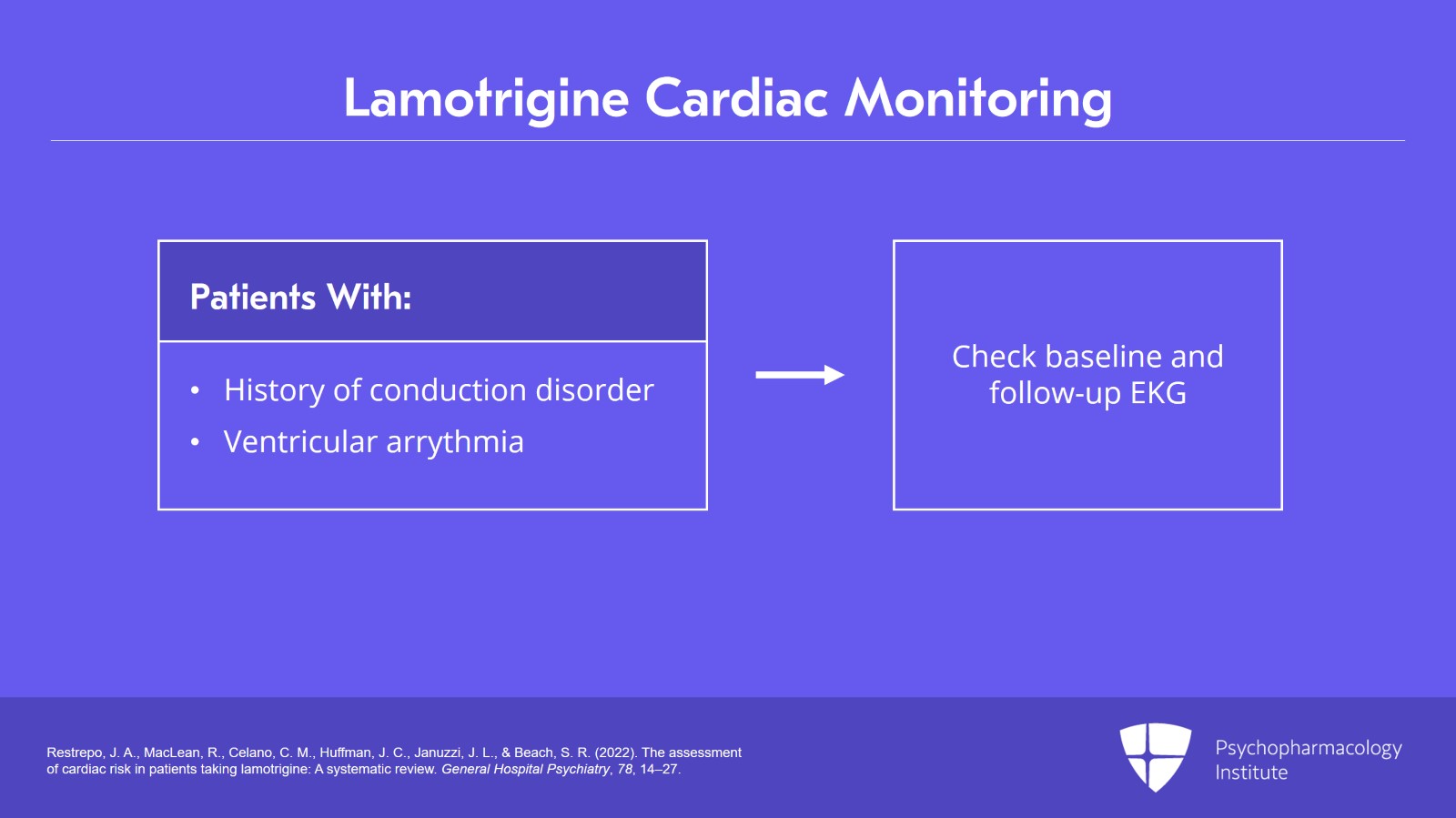
  • For patients with a history of conduction disorder or ventricular arrhythmia, check a baseline and follow-up EKG.
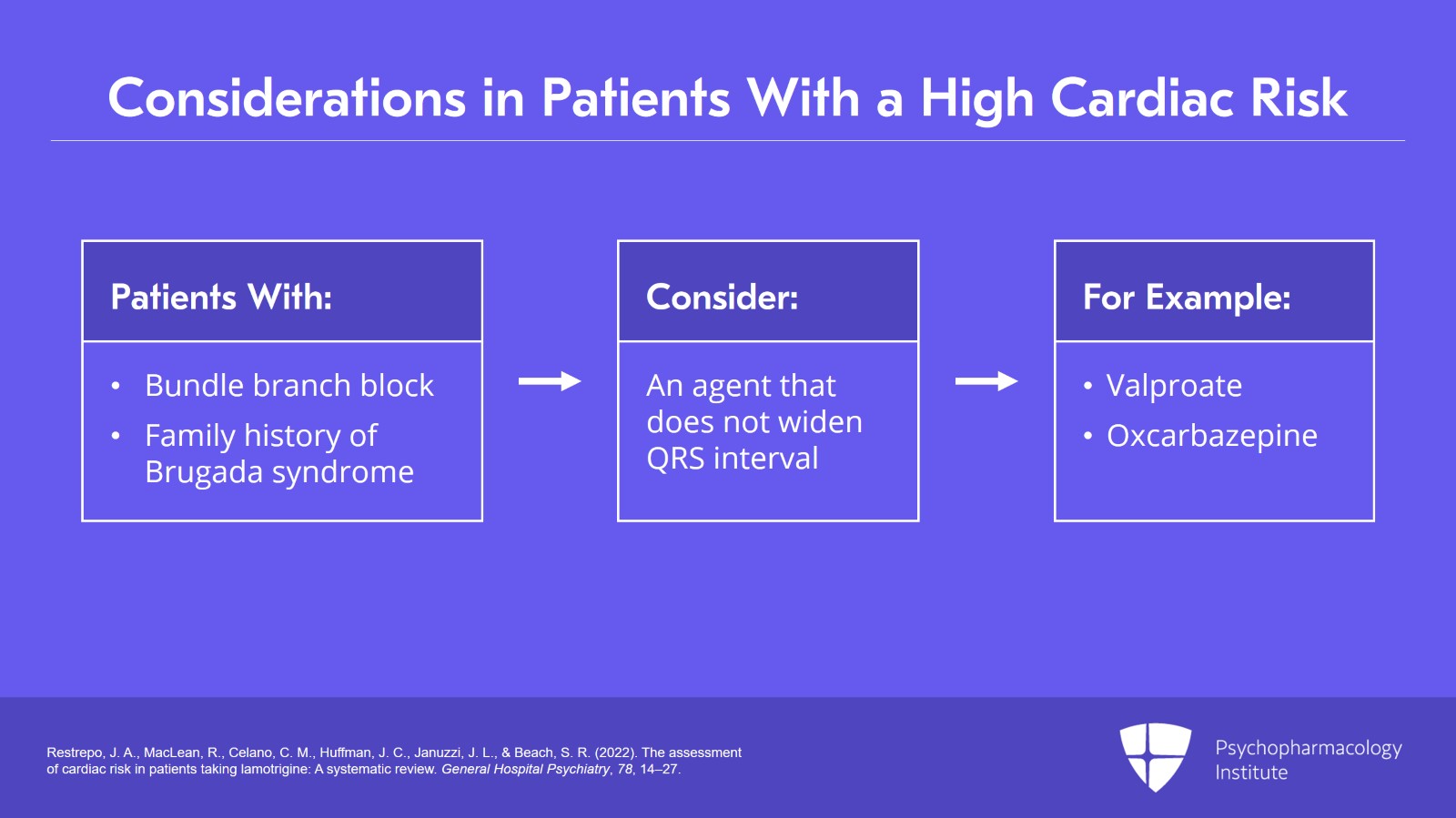
  • For patients with a known bundle branch block or a family history of Brugada syndrome, consider agents that do not widen the QRS interval.
  • Do not use lamotrigine in patients with Brugada syndrome.

Free Downloads for Offline Access

  • Free Download Video (MP4)
  • Free Download Audio File (MP3)
  • Free Download Presentation File (PPTX)

Slides and Transcript

Slide 1 of 12

In this video, we're going to talk about some strategies for safe use and proper monitoring of lamotrigine given all these concerns about potential cardiac issues and given the FDA warning.

Slide 2 of 12

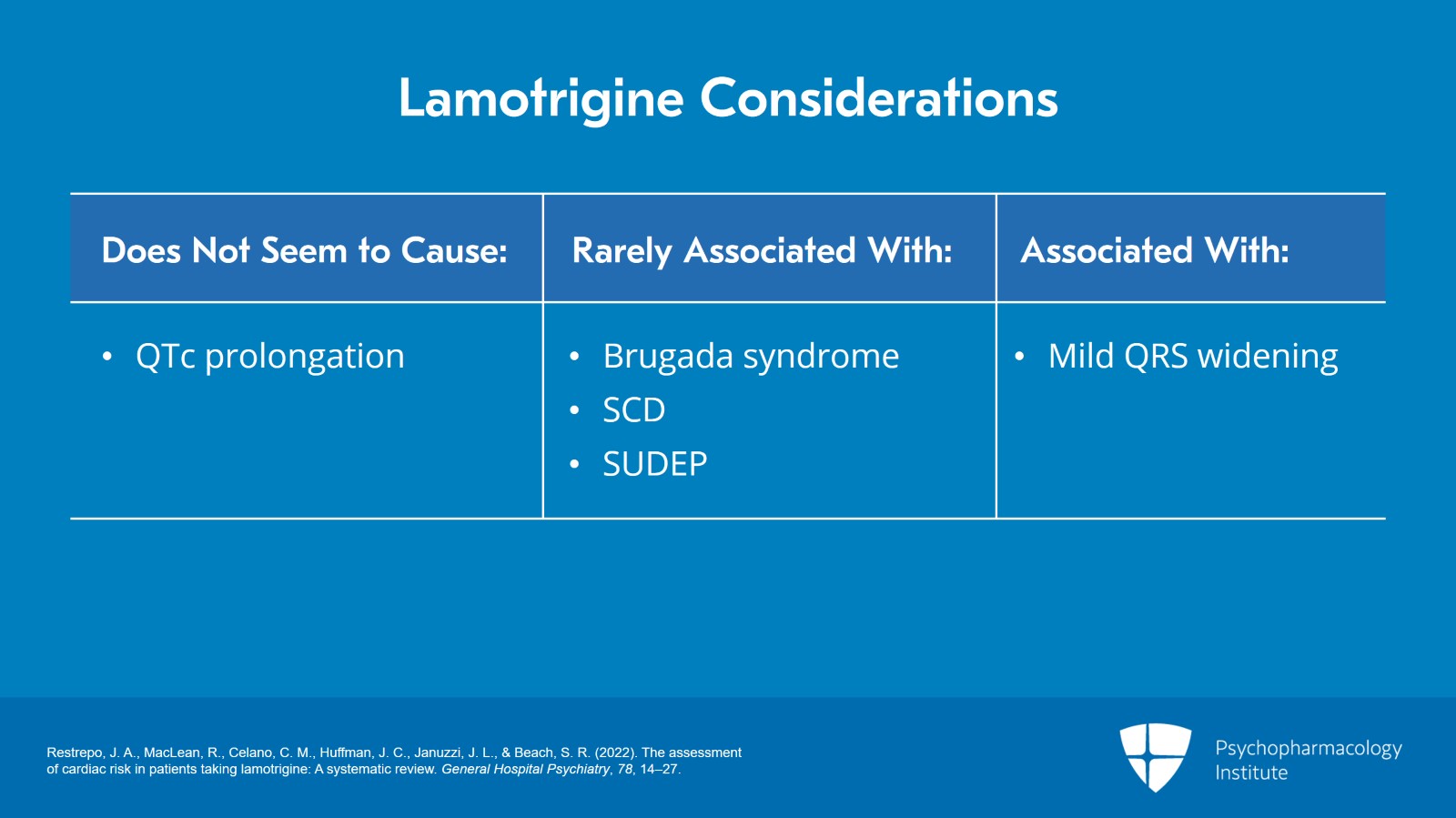
So as a reminder to summarize, lamotrigine does not seem to cause any QTc prolongation. It's been rarely associated with Brugada syndrome, sudden cardiac death, and sudden unexpected death in epilepsy, and it is associated with some mild QRS widening.
References:
  • Restrepo, J. A., MacLean, R., Celano, C. M., Huffman, J. C., Januzzi, J. L., & Beach, S. R. (2022). The assessment of cardiac risk in patients taking lamotrigine: A systematic review. General Hospital Psychiatry, 78, 14–27.
Free Files
Success!
Check your inbox, we sent you all the materials there.

Slide 3 of 12

So how should you think about this for your patients? Well, for patients without a history of any conduction disorder, ventricular arrhythmia or a personal or family history of Brugada syndrome, no EKG monitoring is indicated. You really do not need to worry about additional monitoring for patients who don't have significant risk factors.
References:
  • Restrepo, J. A., MacLean, R., Celano, C. M., Huffman, J. C., Januzzi, J. L., & Beach, S. R. (2022). The assessment of cardiac risk in patients taking lamotrigine: A systematic review. General Hospital Psychiatry, 78, 14–27.

Slide 4 of 12

Now, for patients with a history of a conduction disorder or a ventricular arrhythmia, then it probably makes sense to check a baseline EKG and a follow-up EKG once steady-state dosing is reached, if you're in a setting where that's feasible. The risk remains low.
References:
  • Restrepo, J. A., MacLean, R., Celano, C. M., Huffman, J. C., Januzzi, J. L., & Beach, S. R. (2022). The assessment of cardiac risk in patients taking lamotrigine: A systematic review. General Hospital Psychiatry, 78, 14–27.
Free Files
Success!
Check your inbox, we sent you all the materials there.

Slide 5 of 12

For patients with a known bundle branch block or patients who have a family history of Brugada syndrome, those are both situations where the risk is increased a little bit. And for those patients, I might consider an agent that doesn't widen the QRS interval at all so that could be something like valproate or oxcarbazepine.
References:
  • Restrepo, J. A., MacLean, R., Celano, C. M., Huffman, J. C., Januzzi, J. L., & Beach, S. R. (2022). The assessment of cardiac risk in patients taking lamotrigine: A systematic review. General Hospital Psychiatry, 78, 14–27.

Slide 6 of 12

An important caveat is that for patients with a known history of Brugada syndrome, I think lamotrigine is probably contraindicated and I would not use it in those patients.
References:
  • Restrepo, J. A., MacLean, R., Celano, C. M., Huffman, J. C., Januzzi, J. L., & Beach, S. R. (2022). The assessment of cardiac risk in patients taking lamotrigine: A systematic review. General Hospital Psychiatry, 78, 14–27.
Free Files
Success!
Check your inbox, we sent you all the materials there.

Slide 7 of 12

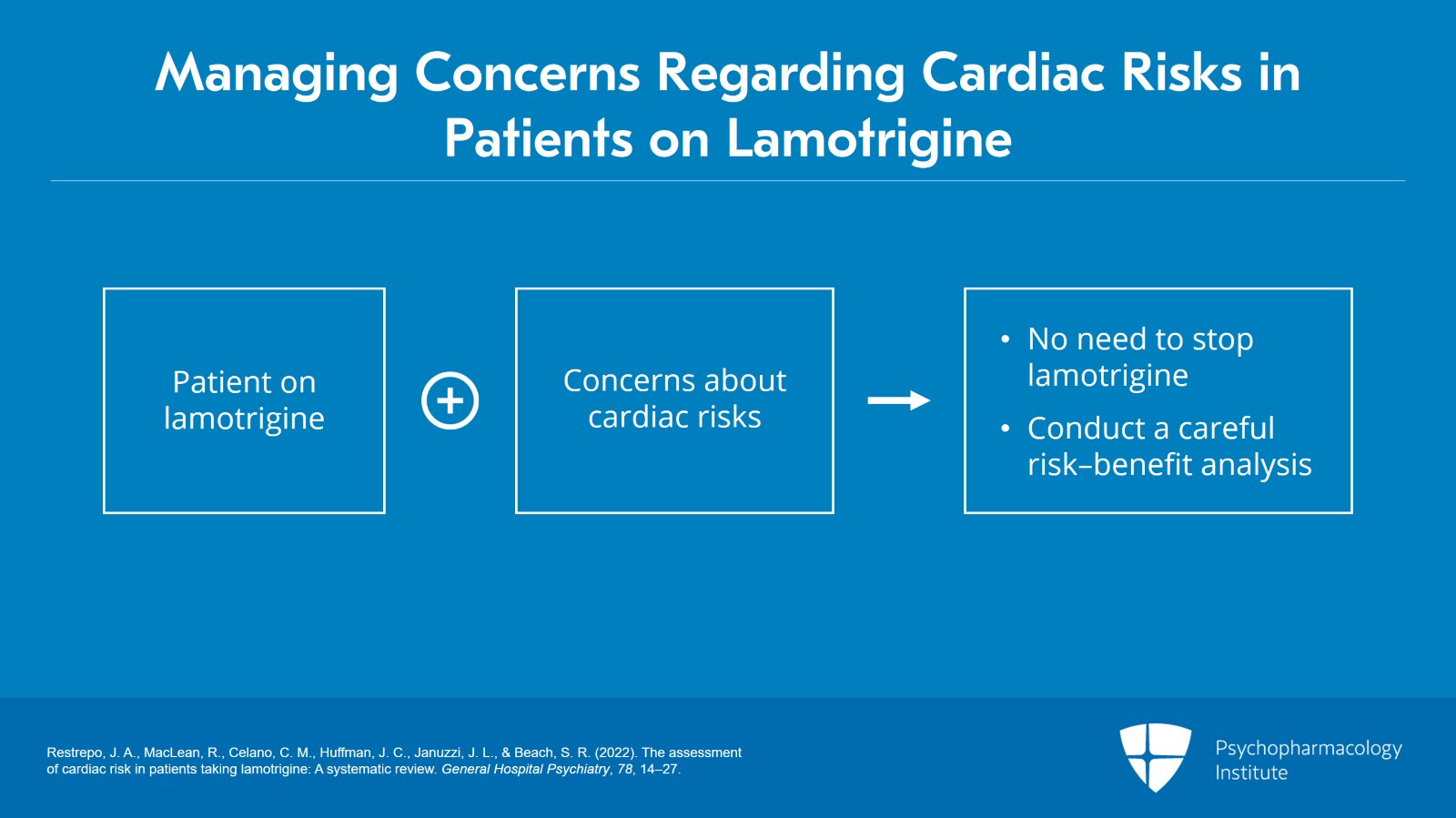
What if you have somebody who's already on lamotrigine but now that patient is concerned about cardiac risks or maybe you're concerned about cardiac risks? The most important message here is to not reflexively stop the lamotrigine due to theoretical concerns. You want to conduct a really careful risk-benefit analysis. You want to think about the risks of destabilization if you were to stop or attempt to switch the lamotrigine.
References:
  • Restrepo, J. A., MacLean, R., Celano, C. M., Huffman, J. C., Januzzi, J. L., & Beach, S. R. (2022). The assessment of cardiac risk in patients taking lamotrigine: A systematic review. General Hospital Psychiatry, 78, 14–27.

Slide 8 of 12

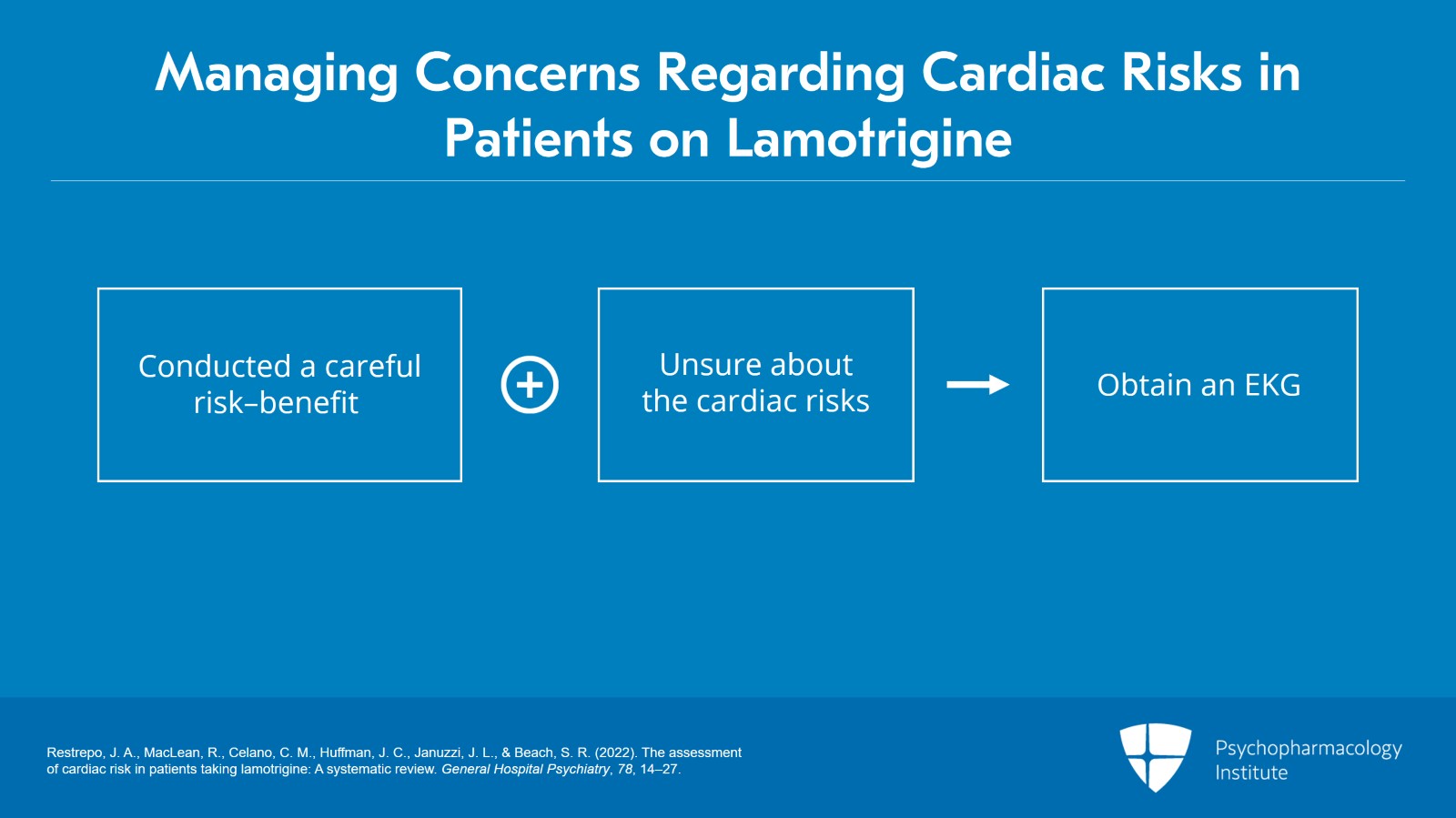
And if you conduct a really careful risk-benefit analysis and you're really unsure, then I would obtain an EKG and determine if any QRS widening exists. If not, and again, if the patient does not have other significant risk factors, then your best course of action is probably to continue the lamotrigine.
References:
  • Restrepo, J. A., MacLean, R., Celano, C. M., Huffman, J. C., Januzzi, J. L., & Beach, S. R. (2022). The assessment of cardiac risk in patients taking lamotrigine: A systematic review. General Hospital Psychiatry, 78, 14–27.
Free Files
Success!
Check your inbox, we sent you all the materials there.

Slide 9 of 12

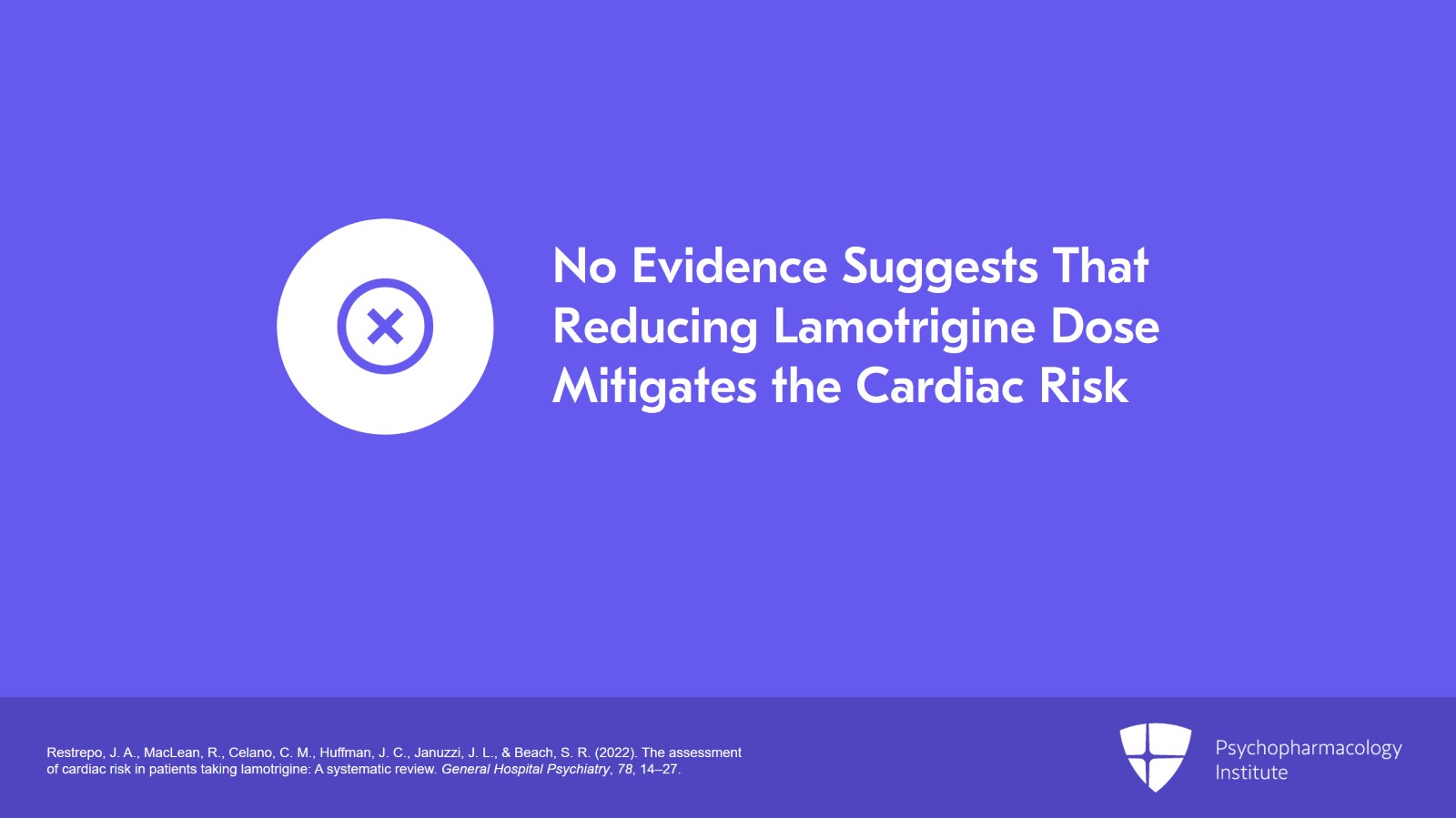
Remember that there's no evidence to suggest that reducing the dose of lamotrigine will mitigate the cardiac risk so you don't want to bump somebody down in dose as a reflexive safety mechanism because it's not clear that that actually is going to protect them anymore and it will likely increase their risk for other adverse psychiatric outcomes.
References:
  • Restrepo, J. A., MacLean, R., Celano, C. M., Huffman, J. C., Januzzi, J. L., & Beach, S. R. (2022). The assessment of cardiac risk in patients taking lamotrigine: A systematic review. General Hospital Psychiatry, 78, 14–27.

Slide 10 of 12

So to summarize some key points in this section, for patients without a history of any conduction disorder, ventricular arrhythmia or any personal or family history of Brugada syndrome, no EKG monitoring is indicated. For patients who do have a history of a conduction disorder or a ventricular arrhythmia, then it would be reasonable to check a baseline EKG and a followup EKG once steady-state dosing is reached, if you're in a setting where that's feasible.
Free Files
Success!
Check your inbox, we sent you all the materials there.

Slide 11 of 12

For patients with a known bundle branch block or a family history of Brugada syndrome, you should probably be more cautious. You might consider agents that don't widen the QRS interval, things like valproate or oxcarbazepine. And finally, we don't recommend using lamotrigine in patients with known Brugada syndrome. That should be considered a contraindication.

Slide 12 of 12

Free Files
Success!
Check your inbox, we sent you all the materials there.

Learning Objectives:

After completing this activity, the learner will be able to:

  1. Comprehend the mechanism of action and clinical indications of lamotrigine.
  2. Implement titration techniques for the optimal administration of lamotrigine.
  3. Utilize evidence-based monitoring and management strategies to ensure the safety of patients with cardiac risk factors when prescribing lamotrigine.

Original Release Date: February 1, 2024

Review and Re-release Date: March 1, 2024

Expiration Date: February 1, 2027

Expert: Scott Beach, M.D.

Medical Editor: Paz Badía, M.D. 

Relevant Financial Disclosures: 

None of the faculty, planners, and reviewers for this educational activity have relevant financial relationships to disclose during the last 24 months with ineligible companies whose primary business is producing, marketing, selling, re-selling, or distributing healthcare products used by or on patients.

Contact Information: For questions regarding the content or access to this activity, contact us at support@psychopharmacologyinstitute.com

Instructions for Participation and Credit:

Participants must complete the activity online during the valid credit period that is noted above.

Follow these steps to earn CME credit:

  1. View the required educational content provided on this course page.

  2. Complete the Post Activity Evaluation for providing the necessary feedback for continuing accreditation purposes and for the development of future activities. NOTE: Completing the Post Activity Evaluation after the quiz is required to receive the earned credit.

  3. Download your certificate.

Accreditation Statement

This activity has been planned and implemented in accordance with the accreditation requirements and policies of the Accreditation Council for Continuing Medical Education through the joint providership of Medical Academy LLC and the Psychopharmacology Institute. Medical Academy is accredited by the ACCME to provide continuing medical education for physicians.

Credit Designation Statement

Medical Academy designates this enduring activity for a maximum of 0.5 AMA PRA Category 1 credit(s)™. Physicians should claim only the credit commensurate with the extent of their participation in the activity.


Free Files
Success!
Check your inbox, we sent you all the materials there.
Continue in the website
Instant access modal

Become a Bronze, Silver, Gold, Bronze extended, Silver extended or Gold extended Member.

2025–26 Psychopharmacology CME Program

Unlock up to 155 CME Credits, including 40 SA CME Credits.