



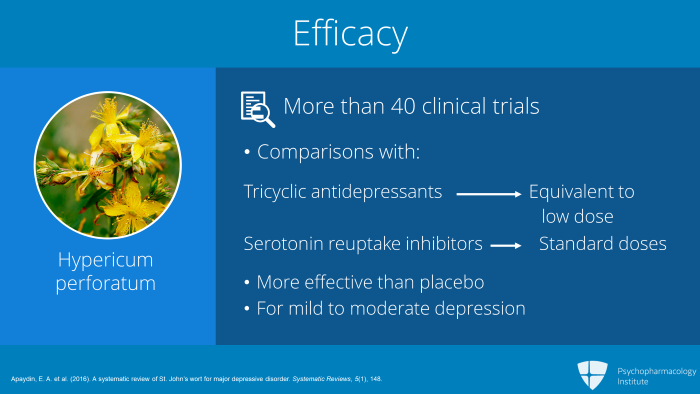
It’s also known as Hypericum perforatum. It’s a pretty yellow flower that blooms every spring around the day of St. John. St. John’s wort is very well studied as far as natural remedies go. There are more than 40 published clinical trials on this remedy. This includes comparisons with tricyclic antidepressants and serotonin reuptake inhibitors. There have also been various systematic reviews and meta-analyses published. Overall, the results of this body of work suggest that St. John’s wort is more effective than placebo and about equivalent to low dose tricyclic antidepressants or to standard doses of SSRIs. This is particularly true for mild to moderate depression.
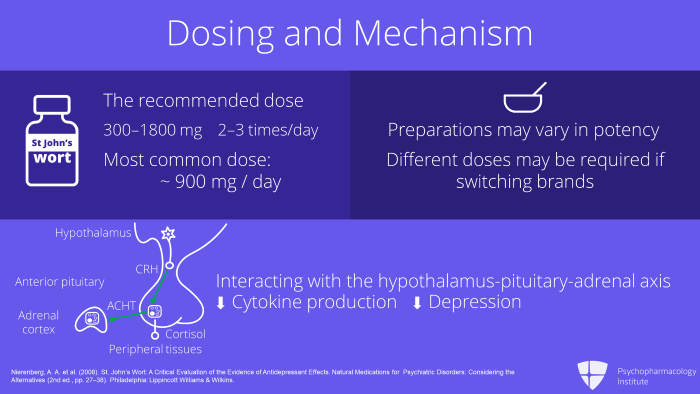
The recommended dose of St. John’s wort runs between 300 and 1800 mg a day. Typically, it’s dosed on a two- or three-times-a-day basis and the most common dose used is about 900 mg a day. The practitioner and the consumer should keep in mind that different preparations of St. John’s wort may vary with regard to potency depending on how they are manufactured. So different doses may be required if switching from one brand to another. St. John’s wort is thought to work by interacting with the hypothalamus-pituitary-adrenal axis with an effect of reducing cytokine production which in turn may dampen depression.
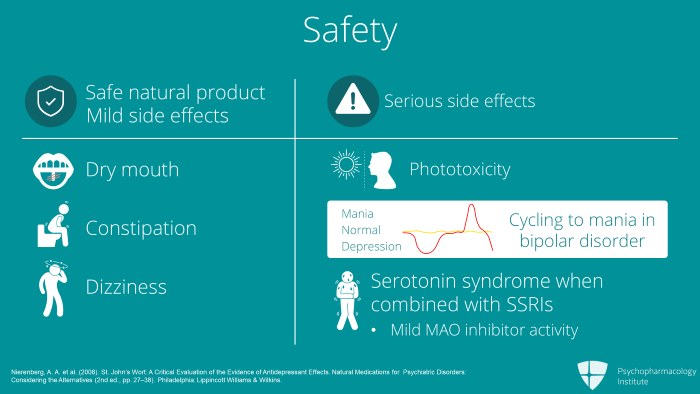
St. John’s wort is thought to be a very safe natural product. Its side effects tend to be mild. Most commonly, we’ll see dry mouth, dizziness, and constipation. However, there are some more serious side effects that may occur, for example, phototoxicity which is extreme sensitivity to sunlight and also cycling to mania in patients with bipolar disorder. Serotonin syndrome has been found to occur when St. John’s wort is combined with SSRIs like fluoxetine or sertraline. This is because St. John’s wort has a very mild monoamine oxidase inhibitor activity.
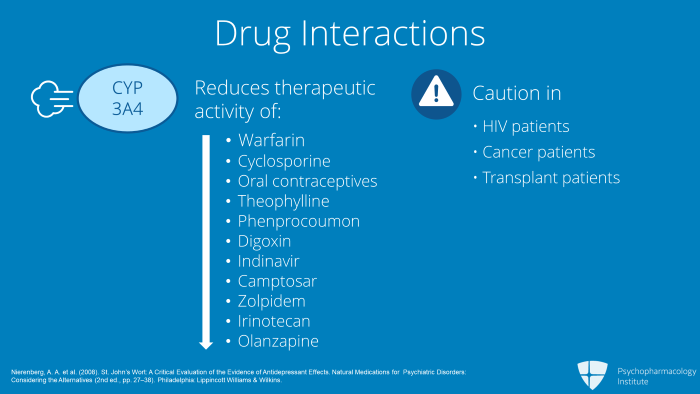
Another concern about St. John’s wort is that it can interact with other drugs. St. John’s wort induces the enzyme cytochrome P3A4 and this increased activity of the enzyme can reduce therapeutic activity of other drugs. Among the drugs that are affected by St. John’s wort include warfarin, cyclosporine, oral contraceptives, theophylline, phenprocoumon, digoxin, indinavir, Camptosar, zolpidem, irinotecan, olanzapine, and maybe others. For this reason, we need to be cautious, for example, in patients with HIV or patients who have cancer or who have undergone transplants because the addition of St. John’s wort could affect the medications that these patients are taking.
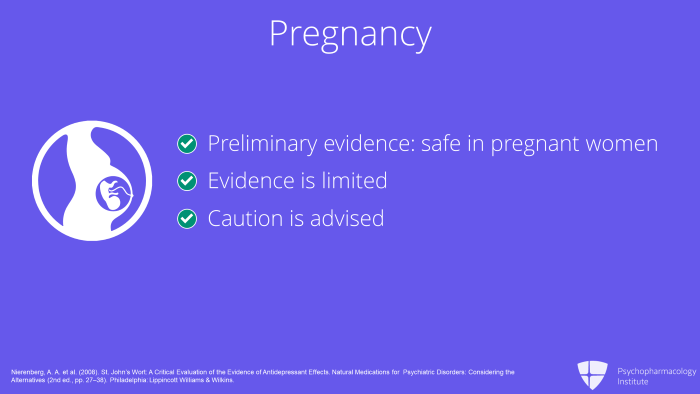
With regard to pregnancy, preliminary evidence suggests that St. John’s wort is safe in pregnant women. However, the evidence is limited and therefore, caution is advised in pregnant women.
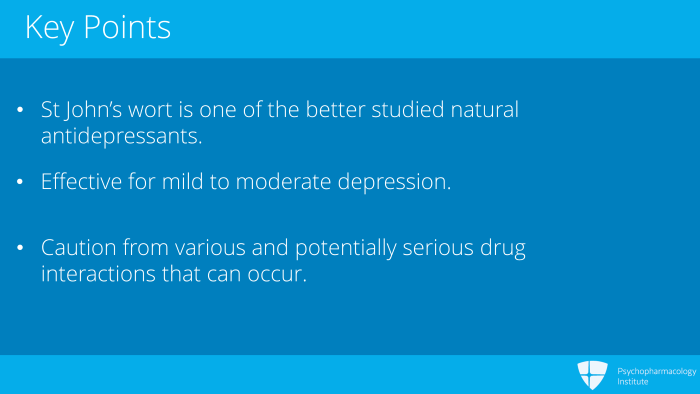
Let me summarize a few key points on St. John’s wort. It is one of the better studied natural antidepressants. It appears to be effective for mild to moderate forms of depression but caution should be used with it because there may be various and potentially serious urban drug interactions that can occur.
References
- Apaydin, E. A. et al. (2016). A systematic review of St. John’s wort for major depressive disorder . Systematic Reviews, 5(1), 148.
- Nierenberg, A. A. et al. (2008). St. John’s Wort: A Critical Evaluation of the Evidence of Antidepressant Effects. Natural Medications for Psychiatric Disorders: Considering the Alternatives (2nd ed., pp. 27–38). Philadelphia: Lippincott Williams & Wilkins.
