Slides and Transcript
Slide 1 of 22
Let’s turn to video four, St. John’s wort and valerian: Potential indication in children and adolescents.
And St. John’s wort in particular has received a whole lot of publicity, been in the news media and for a while was thought that it could potentially replace the antidepressants. There were exciting reports from Europe. So far, the proof is in the pudding and the actual role for St. John’s wort seems diminished. Valerian also is intriguing but there are issues with it as well as we’ll discuss.
Slide 2 of 22
Let’s start with St. John’s wort’s.
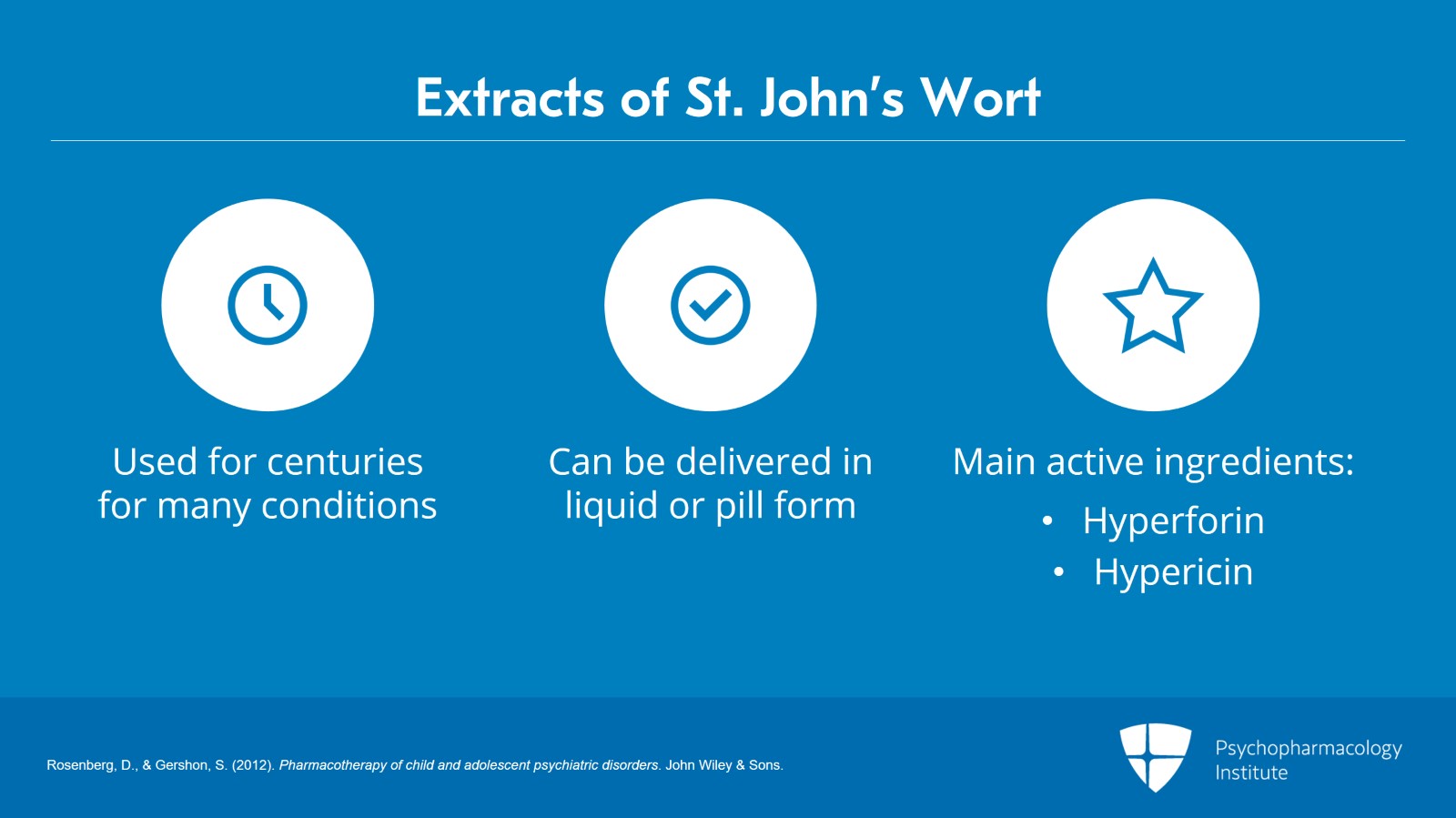
Extracts of the St. John’s wort, hypericum plant have been used for centuries for a whole host of indications including anxiety, depression, skin inflammation, asthma, wounds, burns.
St. John’s wort is in fact an invasive weed that can be made into an extract from the leaf, flower, or fruit of the plant and can be delivered in liquid or pill form.
The main active ingredients of St. John’s wort are hyperforin and hypericin.
References:
- Rosenberg, D., & Gershon, S. (2012). Pharmacotherapy of child and adolescent psychiatric disorders. John Wiley & Sons.
Free Files
Download PDF and other files
Success!
Check your inbox, we sent you all the materials there.
Slide 3 of 22
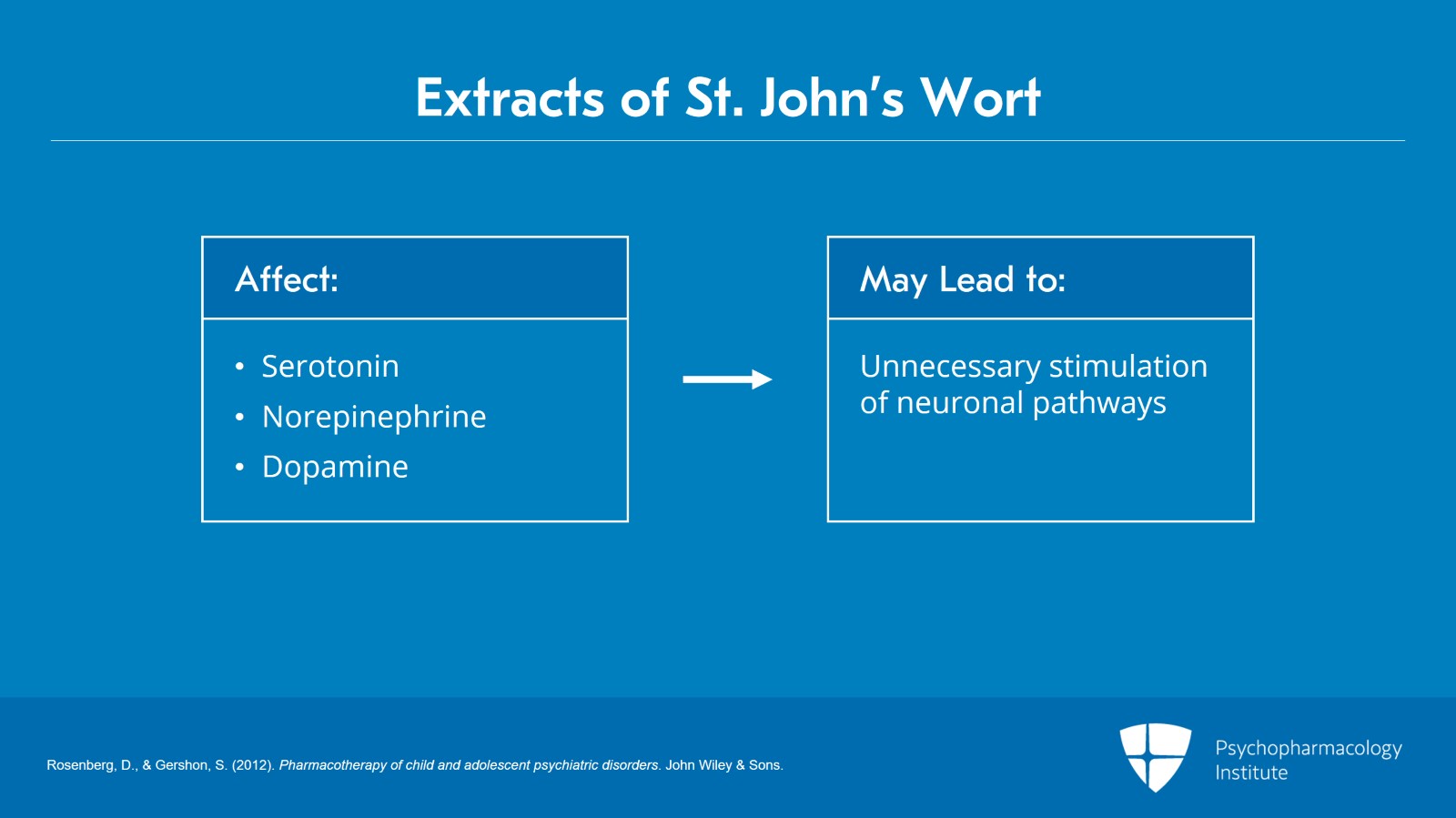
These extracts, however, contain various chemical constituents that have differing pharmacologic effects on serotonin, norepinephrine, dopamine, and other neurotransmitters.
Although St. John’s wort can enhance the effects of three different neurotransmitter systems at least, this is also potentially problematic given that unnecessary neuronal pathways may be variably stimulated.
References:
- Rosenberg, D., & Gershon, S. (2012). Pharmacotherapy of child and adolescent psychiatric disorders. John Wiley & Sons.
Slide 4 of 22
Commercial extracts of St. John’s wort are also unregulated, and each batch contains highly variable amounts of hyperforin and hypericin.
This variability further complicates the reproducibility and the reliability of its effects even within different batches of the same brand.
References:
- Rosenberg, D., & Gershon, S. (2012). Pharmacotherapy of child and adolescent psychiatric disorders. John Wiley & Sons.
Free Files
Download PDF and other files
Success!
Check your inbox, we sent you all the materials there.
Slide 5 of 22
St. John’s wort also contains several other neurochemically active agents with poorly characterized properties.
Thus, for clinical use, St. John’s wort is considered to be a dirty antidepressant especially in comparison to other single agent pharmaceuticals.
References:
- Rosenberg, D., & Gershon, S. (2012). Pharmacotherapy of child and adolescent psychiatric disorders. John Wiley & Sons.
- Haller, H., Anheyer, D., Cramer, H., & Dobos, G. (2019). Complementary therapies for clinical depression: An overview of systematic reviews. BMJ Open, 9(8), e028527.
Slide 6 of 22
Let’s look at potential indications.
Major depressive disorder.
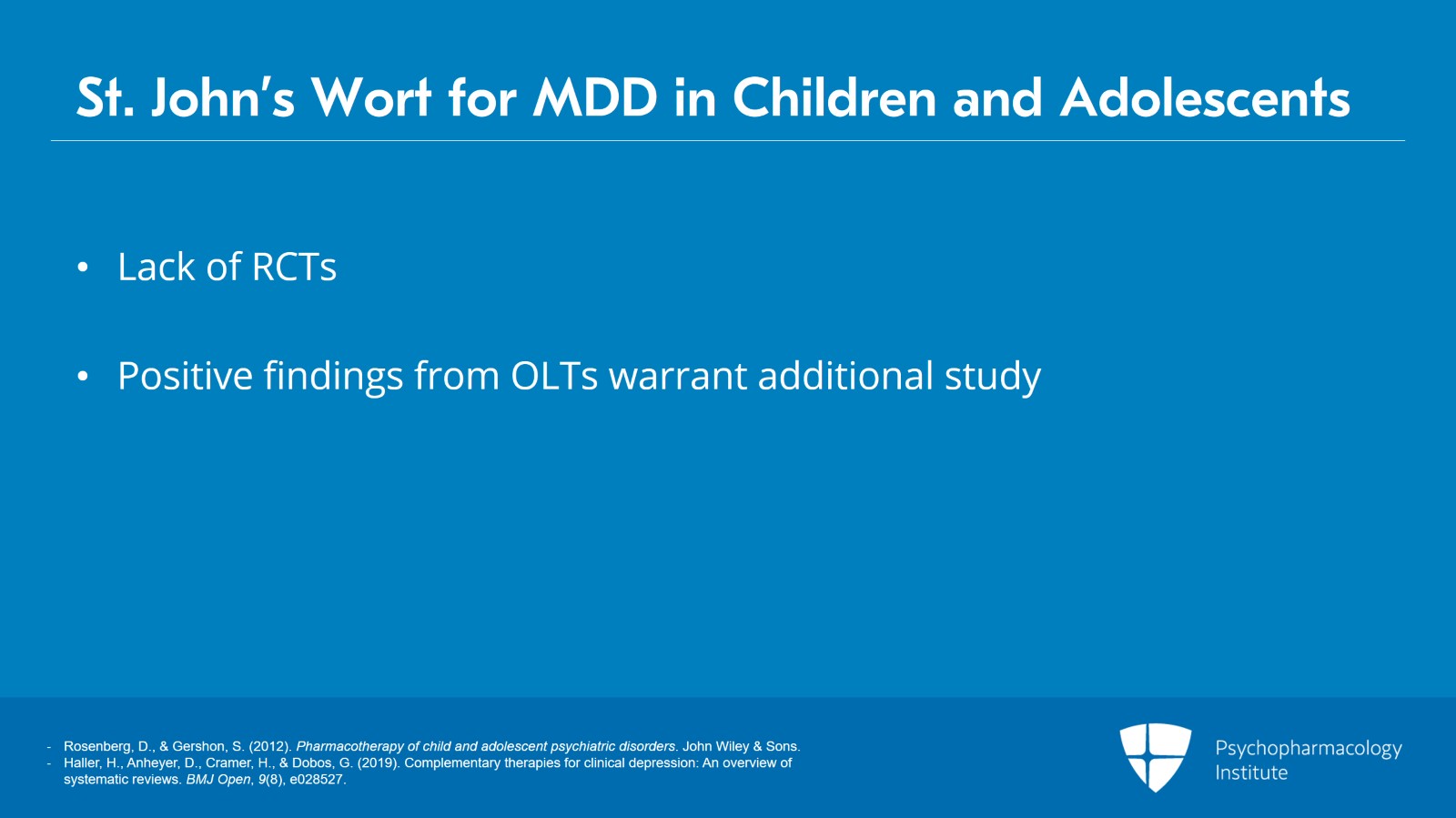
There are currently no published randomized controlled trials of St. John’s wort for the treatment of depression in children and adolescents.
However, positive albeit somewhat mixed findings from three small open-label trials suggest additional study is warranted.
References:
- Rosenberg, D., & Gershon, S. (2012). Pharmacotherapy of child and adolescent psychiatric disorders. John Wiley & Sons.
- Haller, H., Anheyer, D., Cramer, H., & Dobos, G. (2019). Complementary therapies for clinical depression: An overview of systematic reviews. BMJ Open, 9(8), e028527.
Free Files
Download PDF and other files
Success!
Check your inbox, we sent you all the materials there.
Slide 7 of 22
Results from an open-label trial in youth with moderate or severe major depressive disorder found that St. John’s wort appeared to have a strong antidepressant effect including a rapid response at one week. Dropout rates for this study were also low.
In all three open-label trials in youth with major depressive disorder, impressive clinical changes were noted after only one to two weeks of treatment. However, dropout rates for the other two open-label trials were much higher, 25% and 57%, which limited the overall response rates for these studies and made full interpretation problematic.
References:
- Rosenberg, D., & Gershon, S. (2012). Pharmacotherapy of child and adolescent psychiatric disorders. John Wiley & Sons.
- Haller, H., Anheyer, D., Cramer, H., & Dobos, G. (2019). Complementary therapies for clinical depression: An overview of systematic reviews. BMJ Open, 9(8), e028527.
Slide 8 of 22
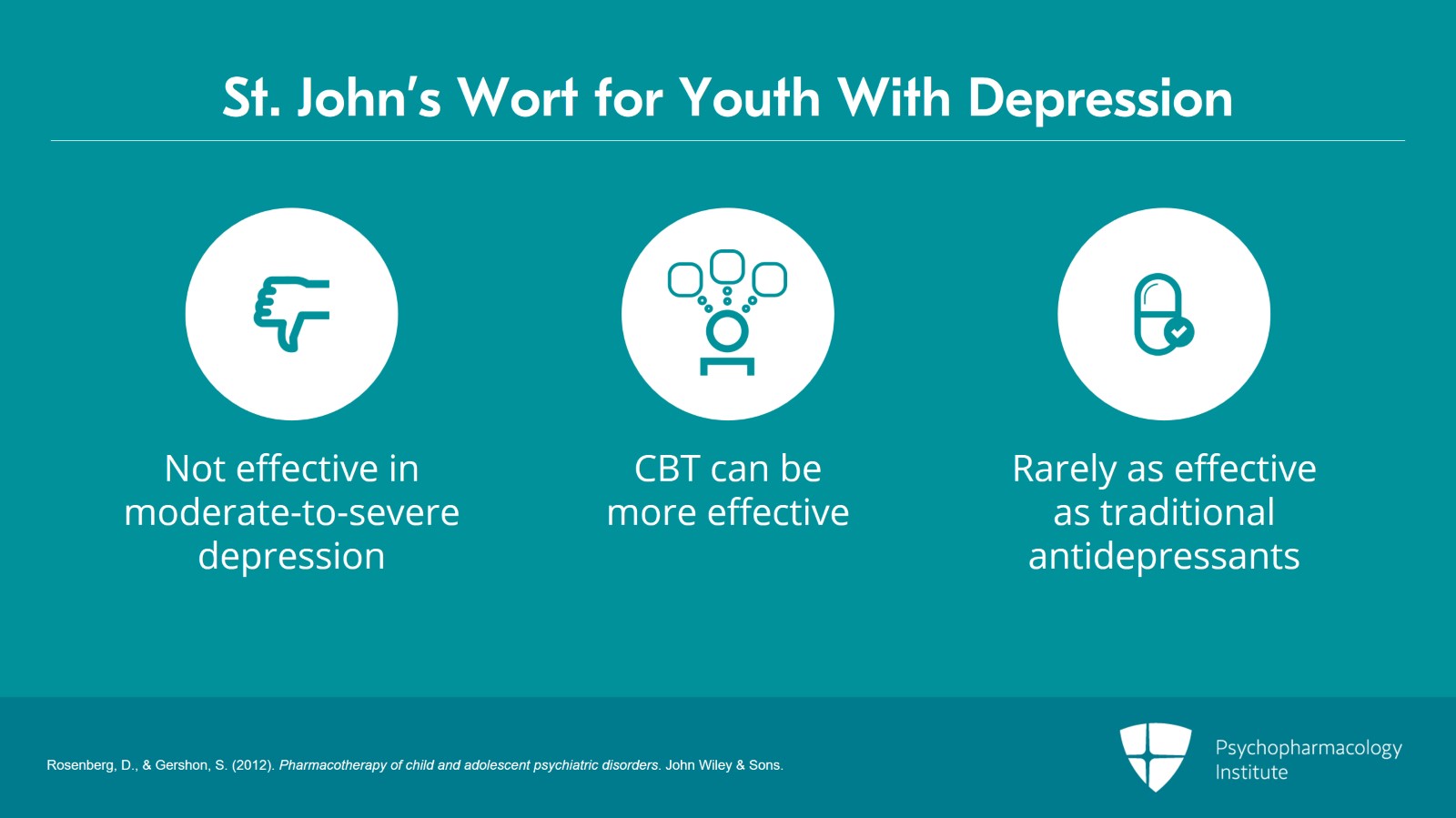
My experience using St. John’s wort is that it’s not particularly effective in moderate to severely depressed children and adolescents. It has been reported to be effective in mild depression but my own experience with this compound does not suggest real efficacy.
Frankly, I find that good cognitive behavior therapy, good psychotherapy can often be more effective and it’s rarely, if ever, as effective as the traditional antidepressants, the SSRIs, other like anti-depression.
References:
- Rosenberg, D., & Gershon, S. (2012). Pharmacotherapy of child and adolescent psychiatric disorders. John Wiley & Sons.
Free Files
Download PDF and other files
Success!
Check your inbox, we sent you all the materials there.
Slide 9 of 22
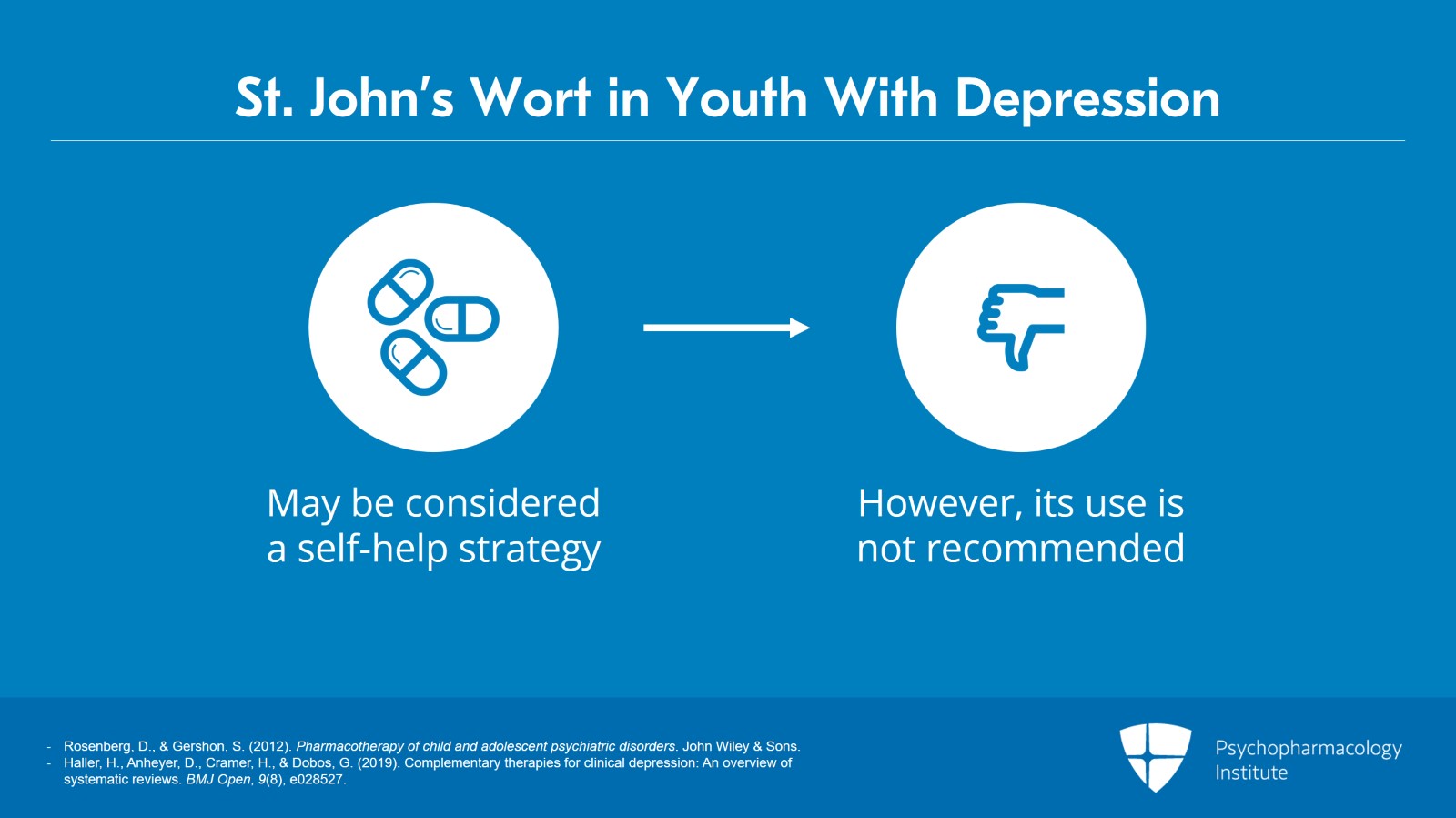
Due to its low cost and availability, St. John’s wort may be considered as a self-help strategy in the management of depression in young people.
However, current recommendations do not recommend the use of St. John’s wort for the treatment of depression in children and young people.
References:
- Rosenberg, D., & Gershon, S. (2012). Pharmacotherapy of child and adolescent psychiatric disorders. John Wiley & Sons.
- Haller, H., Anheyer, D., Cramer, H., & Dobos, G. (2019). Complementary therapies for clinical depression: An overview of systematic reviews. BMJ Open, 9(8), e028527.
Slide 10 of 22
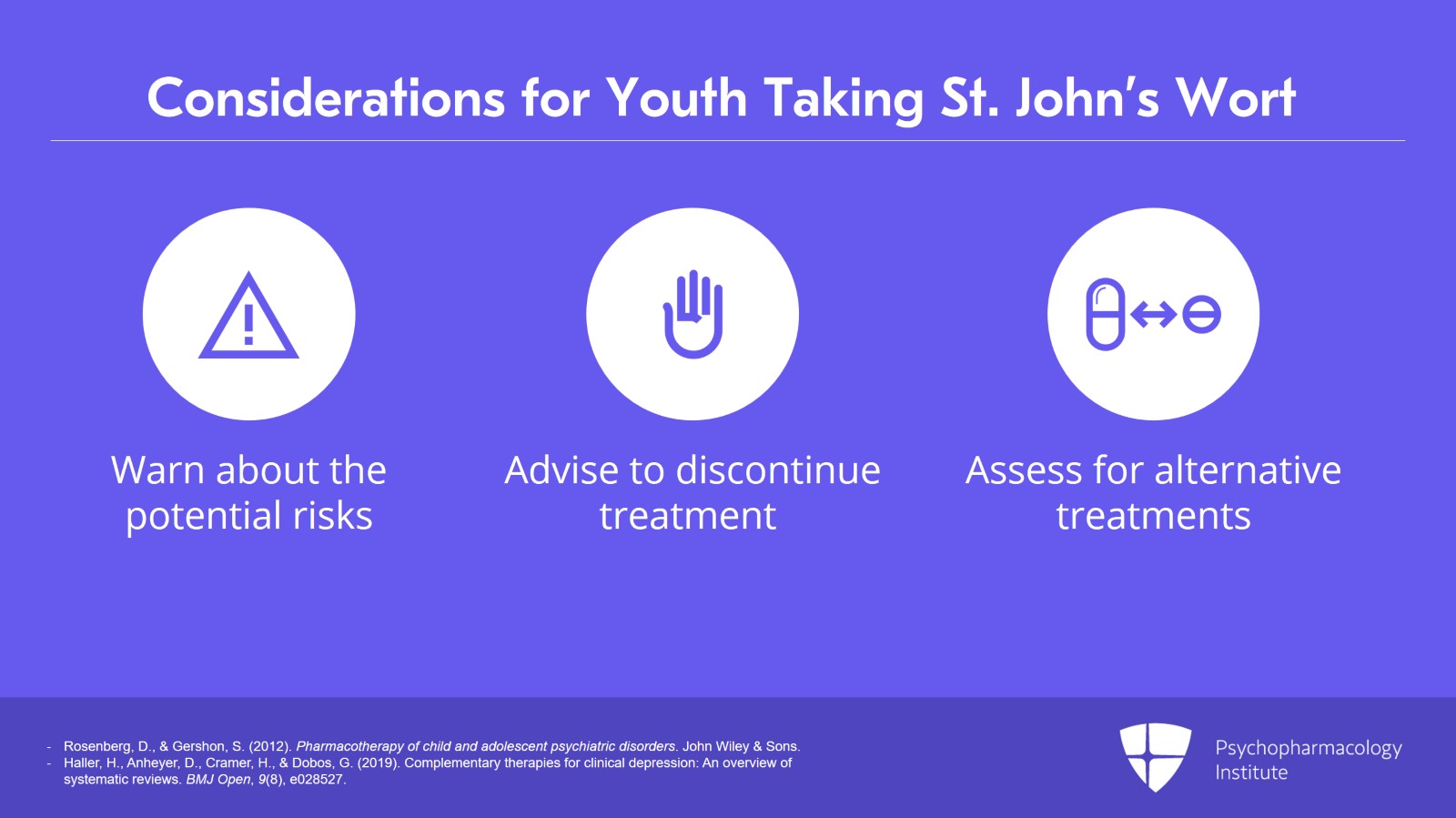
Additionally, any young person who is taking St. John’s wort needs to be warned of the potential risks, advised to discontinue treatment, and then assessed for alternative treatments.
References:
- Rosenberg, D., & Gershon, S. (2012). Pharmacotherapy of child and adolescent psychiatric disorders. John Wiley & Sons.
- Haller, H., Anheyer, D., Cramer, H., & Dobos, G. (2019). Complementary therapies for clinical depression: An overview of systematic reviews. BMJ Open, 9(8), e028527.
Free Files
Download PDF and other files
Success!
Check your inbox, we sent you all the materials there.
Slide 11 of 22
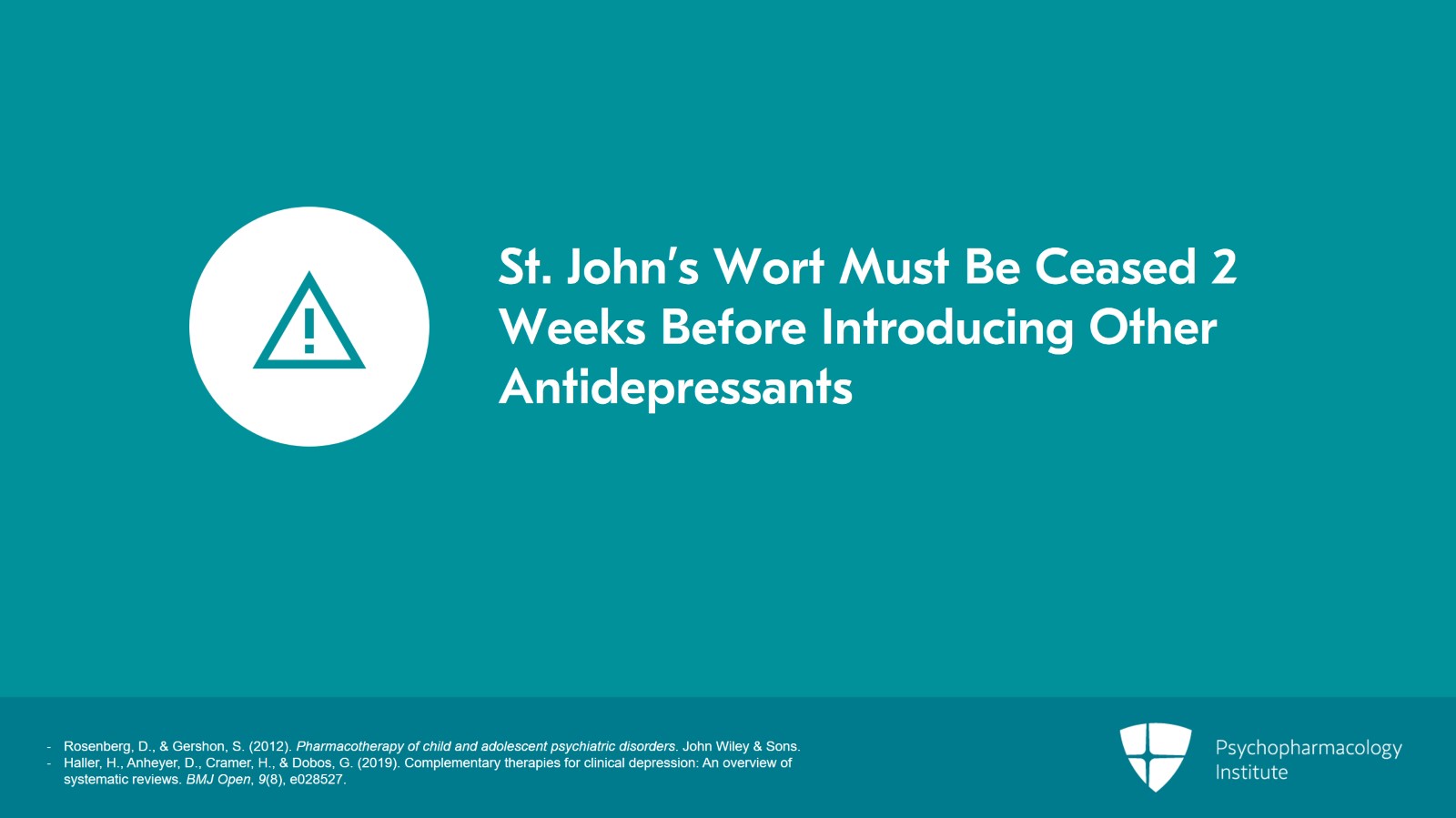
St. John’s wort must also be ceased two weeks prior to the introduction of other serotonergically active antidepressant medications due to potentially very serious interaction.
References:
- Rosenberg, D., & Gershon, S. (2012). Pharmacotherapy of child and adolescent psychiatric disorders. John Wiley & Sons.
- Haller, H., Anheyer, D., Cramer, H., & Dobos, G. (2019). Complementary therapies for clinical depression: An overview of systematic reviews. BMJ Open, 9(8), e028527.
Slide 12 of 22
Let’s turn to valerian.
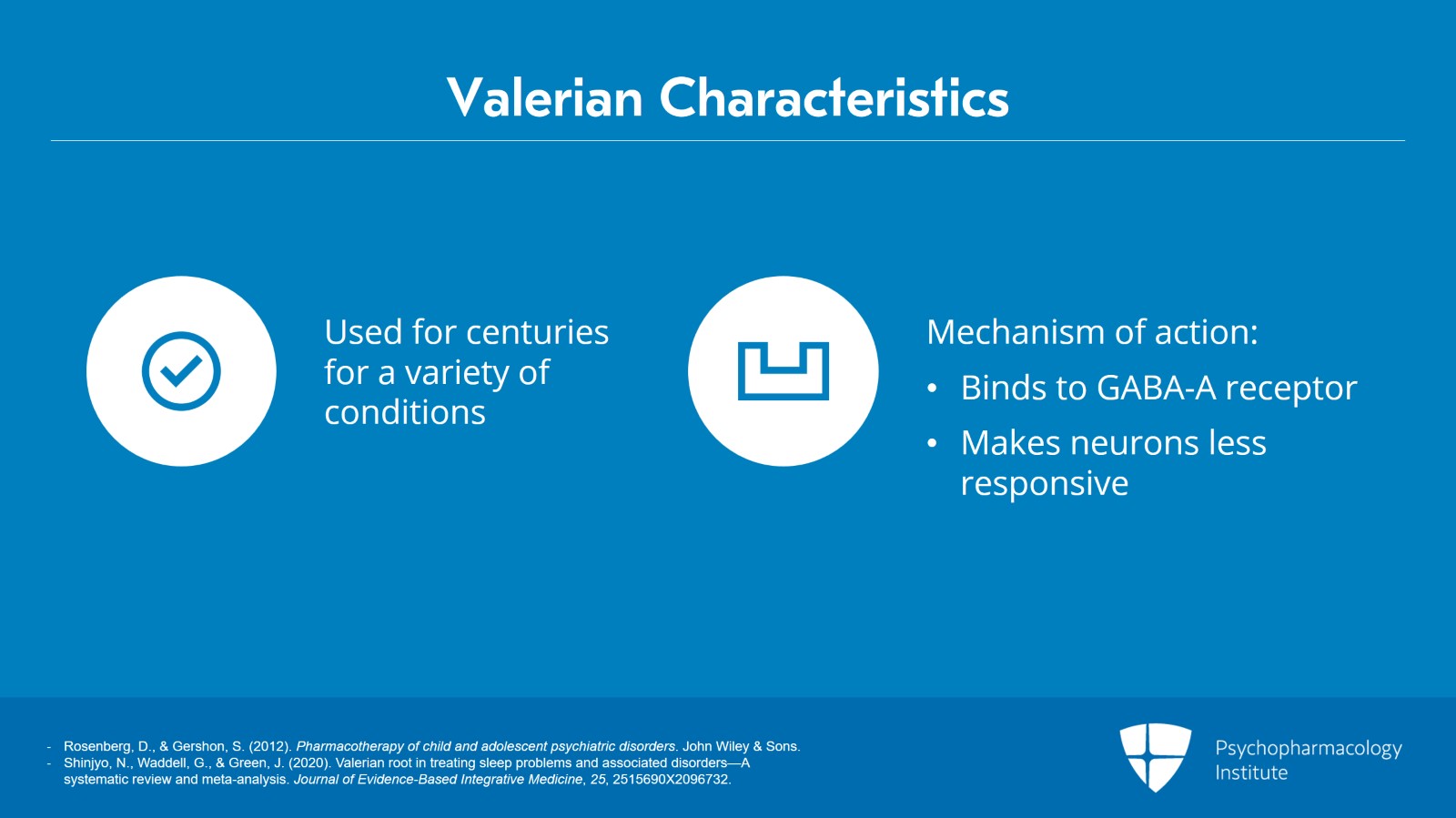
Valerian root has been used for centuries as a treatment for insomnia, nervous conditions, headaches, stress, epilepsy, colic, a variety of other conditions.
The exact mechanism remains elusive and unknown. However, similar to the action of benzodiazepine, it appears likely that valerian binds to the beta subunit on the GABA-A receptor which allows GABA to bind to the alpha subunit more effectively.
GABA binding to the GABA-A receptor also allows greater movement of chloride into the neuron and hyperpolarizes the neuron to make it less responsive to stimulation and suppress the central nervous system.
References:
- Rosenberg, D., & Gershon, S. (2012). Pharmacotherapy of child and adolescent psychiatric disorders. John Wiley & Sons.
- Shinjyo, N., Waddell, G., & Green, J. (2020). Valerian root in treating sleep problems and associated disorders—A systematic review and meta-analysis. Journal of Evidence-Based Integrative Medicine, 25, 2515690X2096732.
Free Files
Download PDF and other files
Success!
Check your inbox, we sent you all the materials there.
Slide 13 of 22
Potential indications for valerian.
The first and foremost that’s been used really for centuries is sleep disorders.
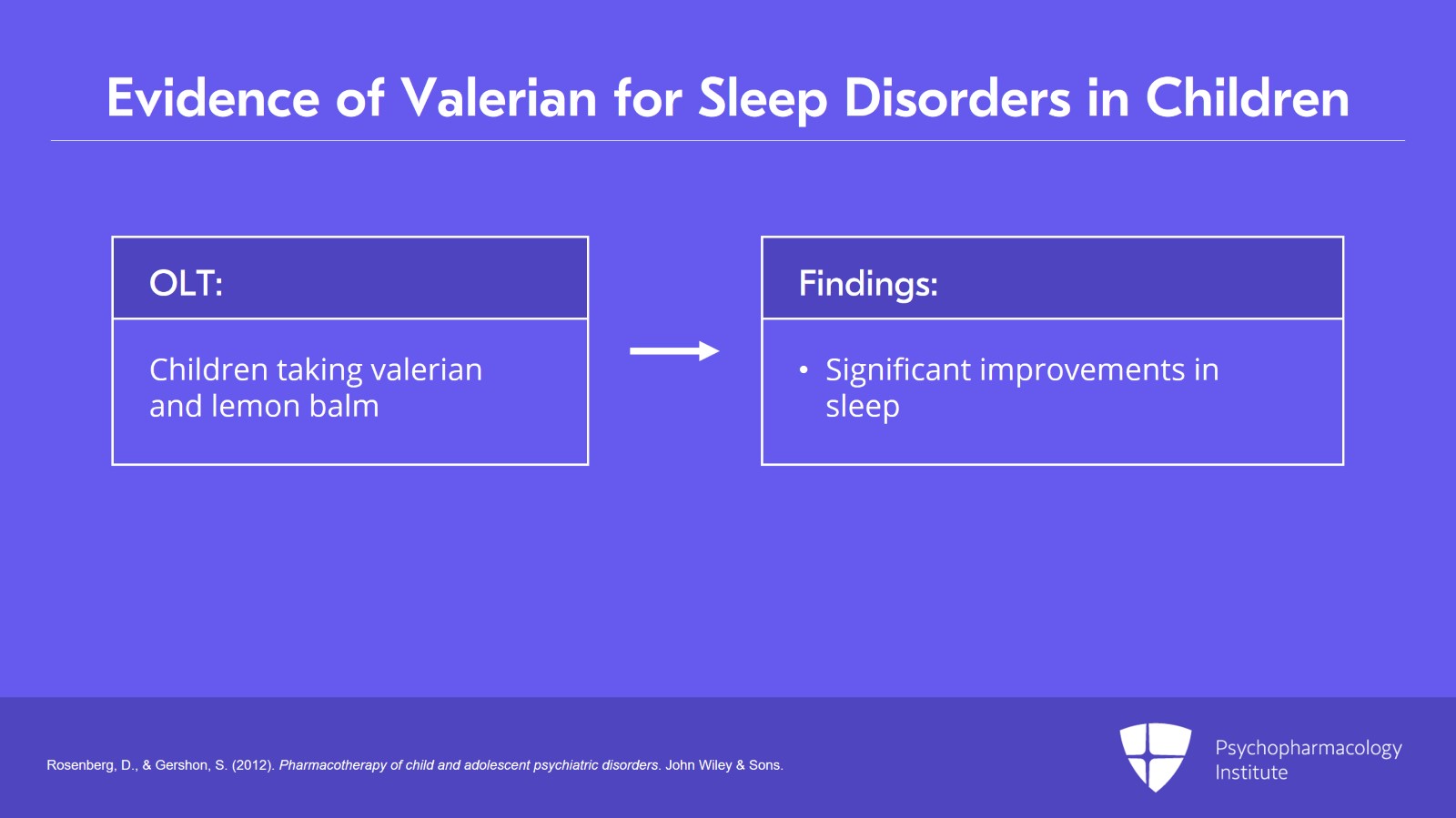
An open-label trial of over 900 children taking a blend of valerian and lemon balm for the treatment of dyssomnia and restlessness reported significant improvements in sleep for the majority of children.
References:
- Rosenberg, D., & Gershon, S. (2012). Pharmacotherapy of child and adolescent psychiatric disorders. John Wiley & Sons.
Slide 14 of 22
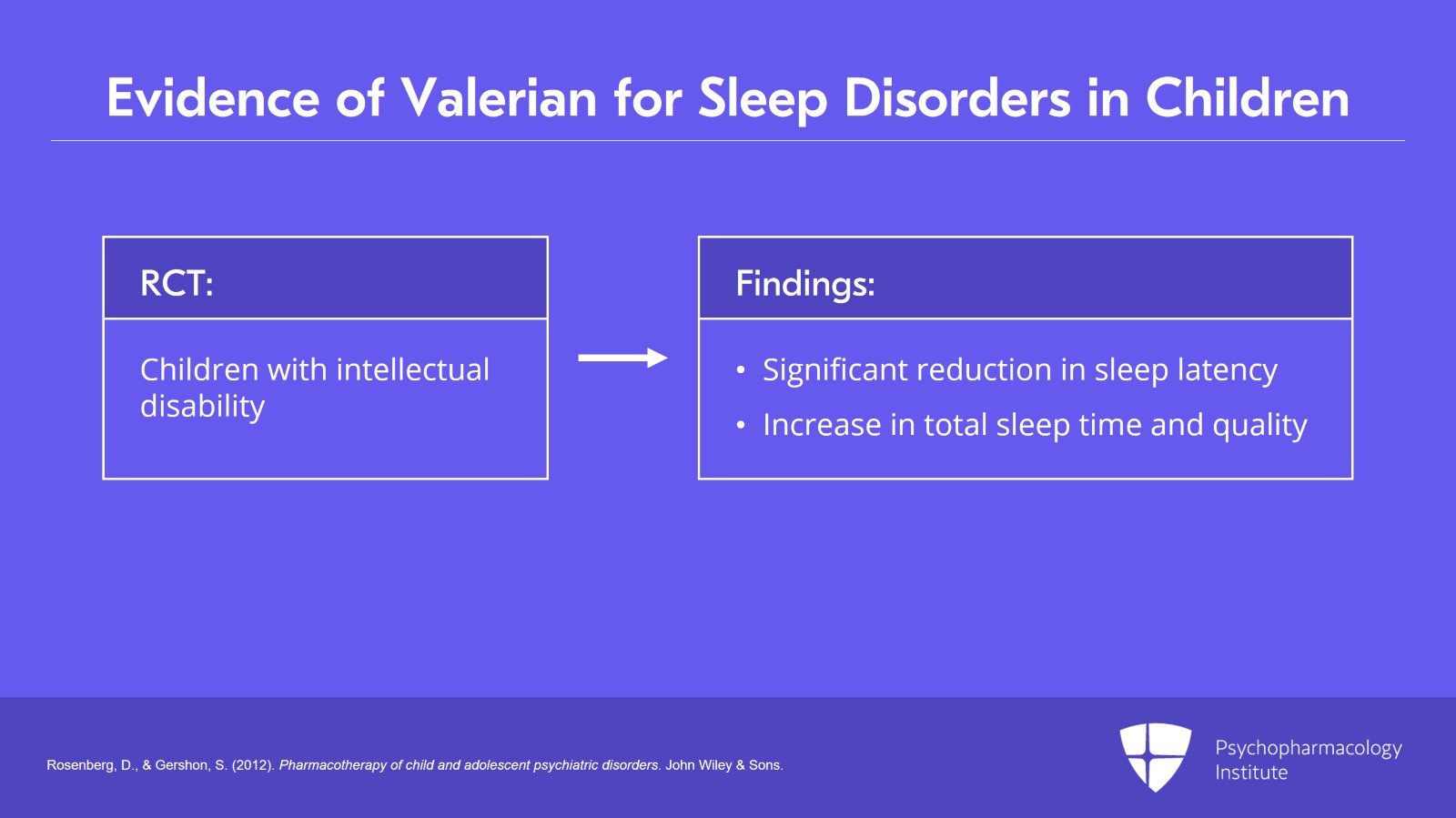
An additional small randomized controlled trial of only five children with intellectual disability found that valerian led to significant reduction in sleep latency and increases in total sleep time, sleep quality especially in patients with comorbid hyperactivity.
References:
- Rosenberg, D., & Gershon, S. (2012). Pharmacotherapy of child and adolescent psychiatric disorders. John Wiley & Sons.
Free Files
Download PDF and other files
Success!
Check your inbox, we sent you all the materials there.
Slide 15 of 22
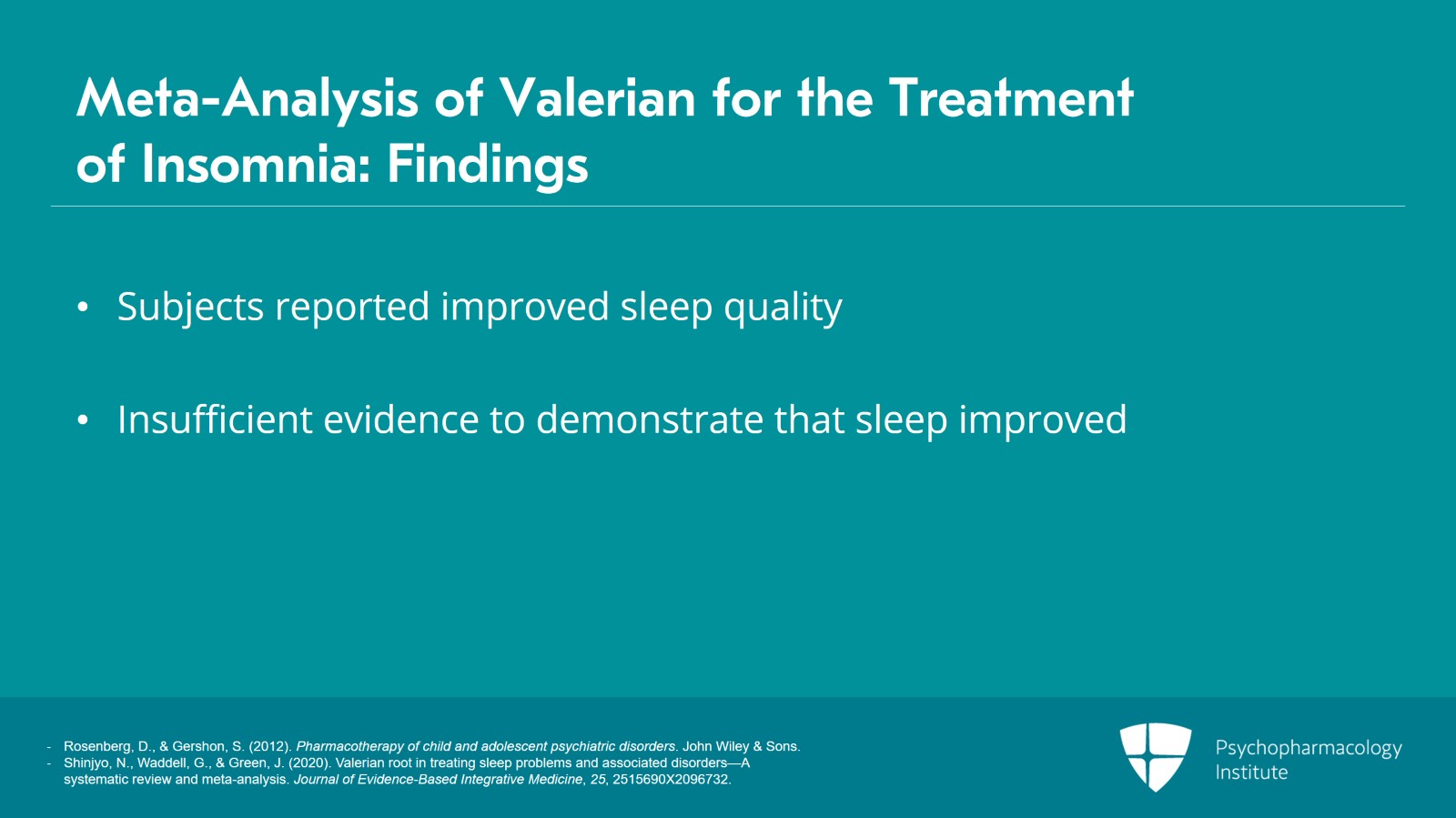
A recent meta-analysis of 18 randomized controlled trials of valerian for the treatment of insomnia found that subjects generally reported improved sleep quality.
However, there was insufficient evidence from these studies to demonstrate that sleep had actually improved or been lengthened.
References:
- Rosenberg, D., & Gershon, S. (2012). Pharmacotherapy of child and adolescent psychiatric disorders. John Wiley & Sons.
- Shinjyo, N., Waddell, G., & Green, J. (2020). Valerian root in treating sleep problems and associated disorders—A systematic review and meta-analysis. Journal of Evidence-Based Integrative Medicine, 25, 2515690X2096732.
Slide 16 of 22
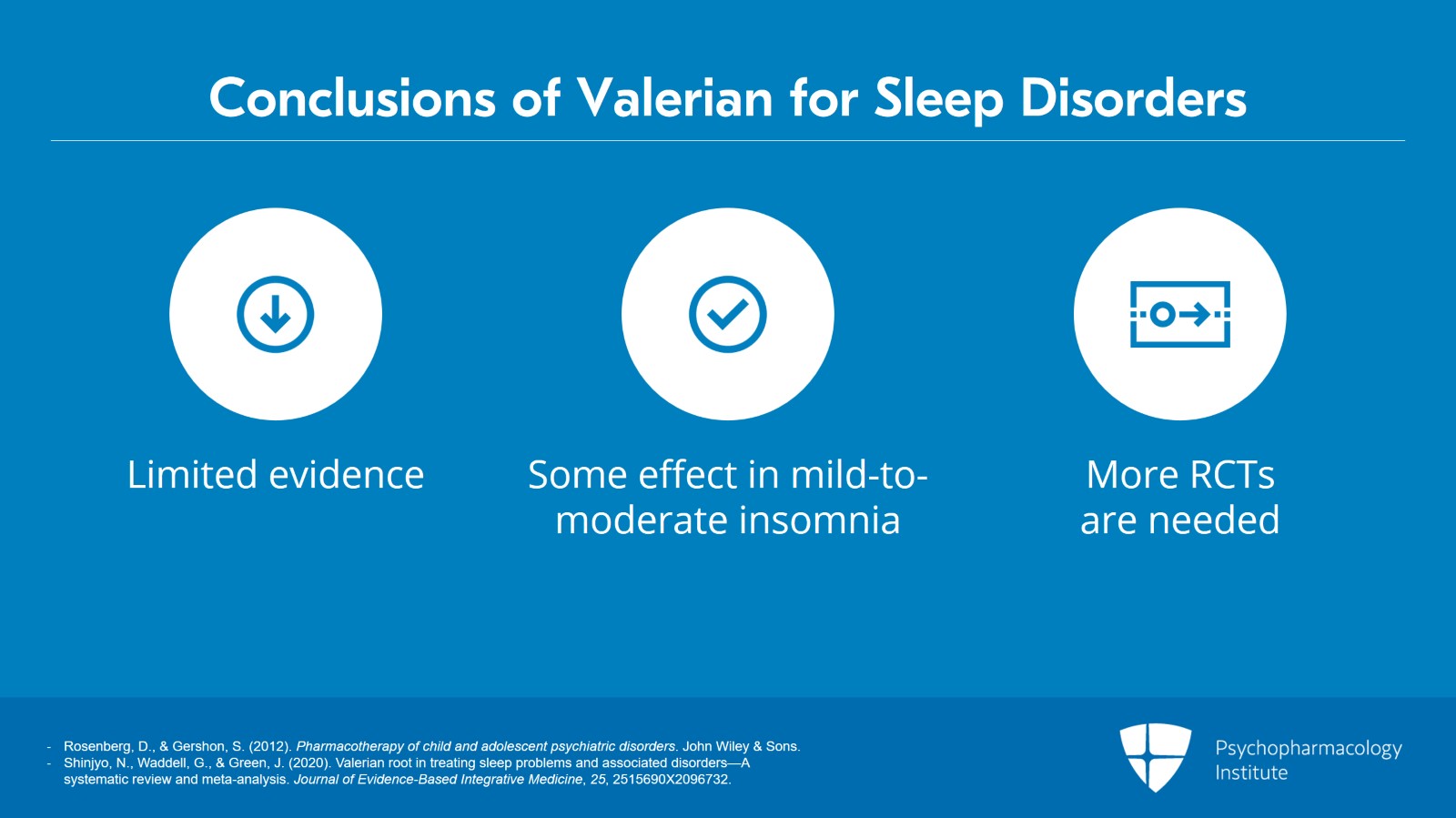
Overall, the evidence for the use of valerian for sleep disorders is limited by contradictory results and methodologic concerns.
However, valerian does appear to have some effect in mild-to-moderate insomnia and is a relatively safe substance with very few side effects.
More randomized controlled trials are needed with larger samples, standardization of measures used to assess quality of sleep and levels of anxiety and standardization of dose, type of preparation of valerian used and the time for its use.
References:
- Rosenberg, D., & Gershon, S. (2012). Pharmacotherapy of child and adolescent psychiatric disorders. John Wiley & Sons.
- Shinjyo, N., Waddell, G., & Green, J. (2020). Valerian root in treating sleep problems and associated disorders—A systematic review and meta-analysis. Journal of Evidence-Based Integrative Medicine, 25, 2515690X2096732.
Free Files
Download PDF and other files
Success!
Check your inbox, we sent you all the materials there.
Slide 17 of 22
Let’s look at indications for valerian for anxiety disorders and depression.
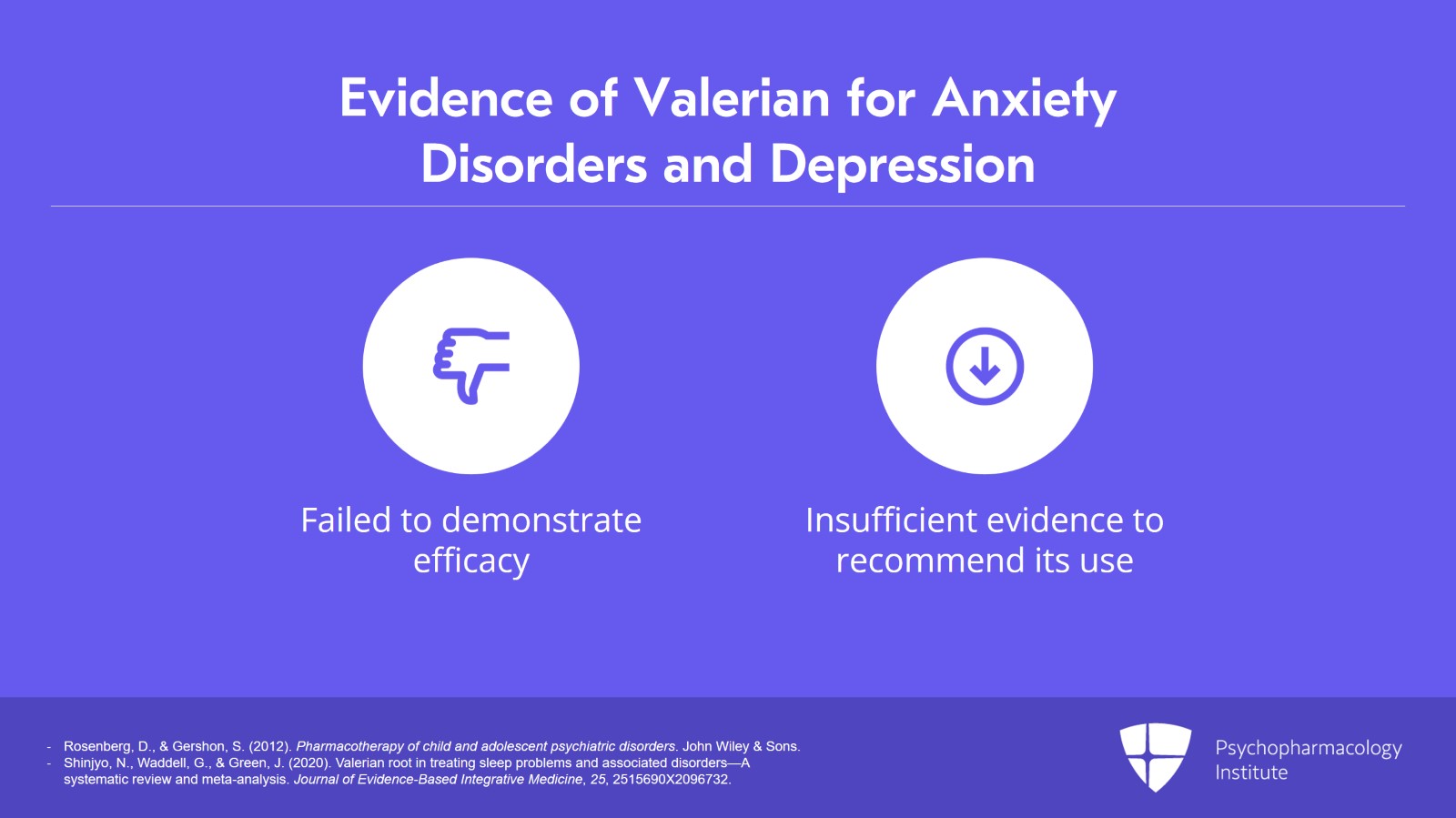
Two small studies including one randomized controlled trial which compared valerian to diazepam and placebo in generalized anxiety disorder as well as another open-label trial that combined St. John’s wort with valerian for the treatment of anxiety and depression both failed to demonstrate valerian’s efficacy.
Two systematic reviews also noted that current evidence is insufficient to recommend the use of valerian for the treatment of anxiety disorders.
References:
- Rosenberg, D., & Gershon, S. (2012). Pharmacotherapy of child and adolescent psychiatric disorders. John Wiley & Sons.
- Shinjyo, N., Waddell, G., & Green, J. (2020). Valerian root in treating sleep problems and associated disorders—A systematic review and meta-analysis. Journal of Evidence-Based Integrative Medicine, 25, 2515690X2096732.
Slide 18 of 22
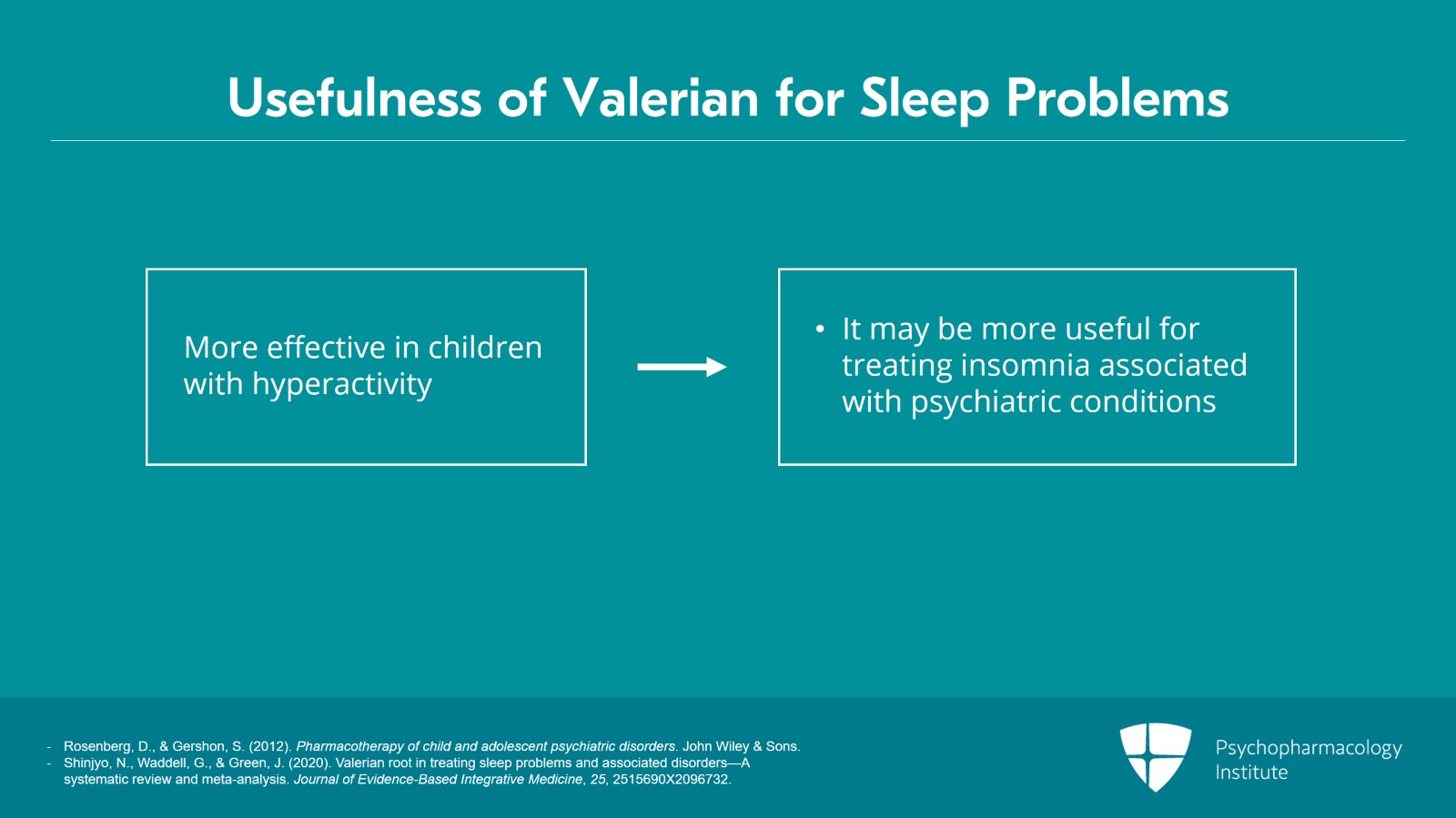
It’s been observed, however, that valerian reduce sleep problems most effectively in children with hyperactivity. Therefore, it’s possible that valerian is more useful in treating insomnia associated with certain psychiatric conditions and subtypes such as anxiety.
That being said, additional randomized controls involving larger samples and which compare valerian with placebo or other treatments for anxiety disorders such as the antidepressants, other behavioral treatments such as desensitization, for example, are needed.
References:
- Rosenberg, D., & Gershon, S. (2012). Pharmacotherapy of child and adolescent psychiatric disorders. John Wiley & Sons.
- Shinjyo, N., Waddell, G., & Green, J. (2020). Valerian root in treating sleep problems and associated disorders—A systematic review and meta-analysis. Journal of Evidence-Based Integrative Medicine, 25, 2515690X2096732.
Free Files
Download PDF and other files
Success!
Check your inbox, we sent you all the materials there.
Slide 19 of 22
So the key take-home points.
St. John’s wort may be considered as a self-help strategy in the management of depression in young people due to its low cost and availability.
However, current results don’t yet support the use of St. John’s wort for the treatment of depression in children and young people.
Slide 20 of 22
Additionally, any young person who is taking St. John’s wort needs to be warned of the potential risks, advised to discontinue treatment, and then assessed for alternative treatments.
Free Files
Download PDF and other files
Success!
Check your inbox, we sent you all the materials there.
Slide 21 of 22
Valerian does appear to have some effect in mild to moderate insomnia and is a relatively safe substance with few side effects.
However, more randomized controlled trials are needed with larger samples, standardization of measures used to assess quality of sleep and levels of anxiety.
Free Files
Download PDF and other files
Success!
Check your inbox, we sent you all the materials there.