Close Banner
Free Section  - Video Lectures

08. Risks of Using Antipsychotics During Pregnancy

Published on September 1, 2023 Certification expiration date: September 1, 2026

Vivien K. Burt, M.D., Ph.D.

Professor Emeritus of Psychiatry - UCLA

Key Points

  • First-trimester use of atypical antipsychotics is not associated with an increased risk of major congenital malformations.
  • Following delivery, there is a risk of extrapyramidal side effects in the neonate.
  • Consider using atypical antipsychotics in pregnant women with serious psychiatric illness.

Free Downloads for Offline Access

  • Free Download Presentation File (PPTX)
  • Free Download Audio File (MP3)
  • Free Download Video (MP4)

Slides and Transcript

Slide 1 of 10

Now, what we'd like to do is review the atypical antipsychotics and the risk of using these agents during pregnancy.

Slide 2 of 10

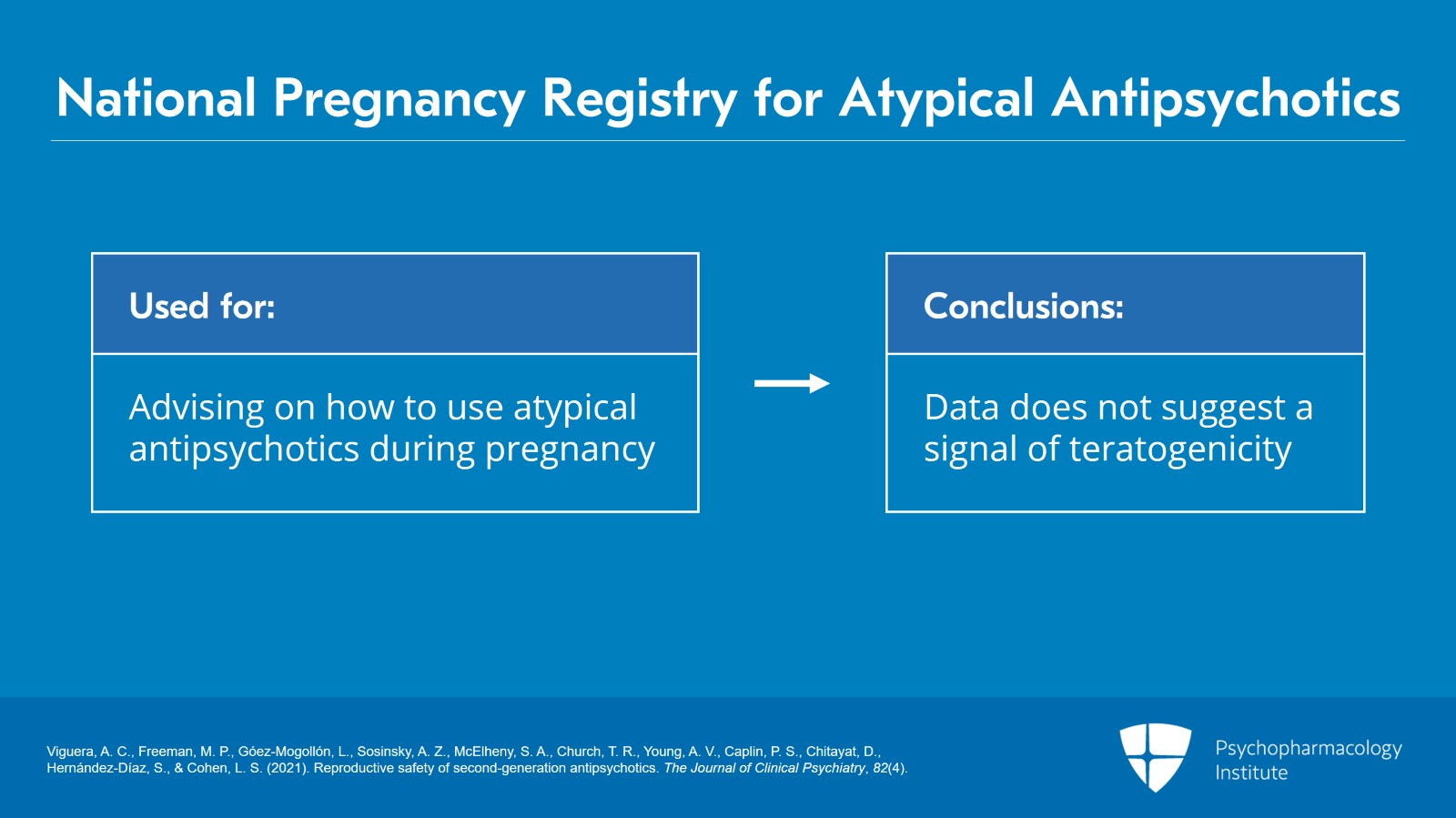
And here, I'd like to talk to you about two substantial studies, one of which is ongoing now and that is the National Pregnancy Registry for Atypical Antipsychotics that is run by the Massachusetts General Hospital. And this is data that actually is used and continues to be accumulated by the FDA in terms of advising patients and professional caregivers about how to use atypical antipsychotics during pregnancy. Here, the conclusions regard the reproductive safety of these agents and it looks like currently available data does not suggest a signal of teratogenicity.
References:
  • Viguera, A. C., Freeman, M. P., Góez-Mogollón, L., Sosinsky, A. Z., McElheny, S. A., Church, T. R., Young, A. V., Caplin, P. S., Chitayat, D., Hernández-Díaz, S., & Cohen, L. S. (2021). Reproductive safety of second-generation antipsychotics. The Journal of Clinical Psychiatry, 82(4).
Free Files
Success!
Check your inbox, we sent you all the materials there.

Slide 3 of 10

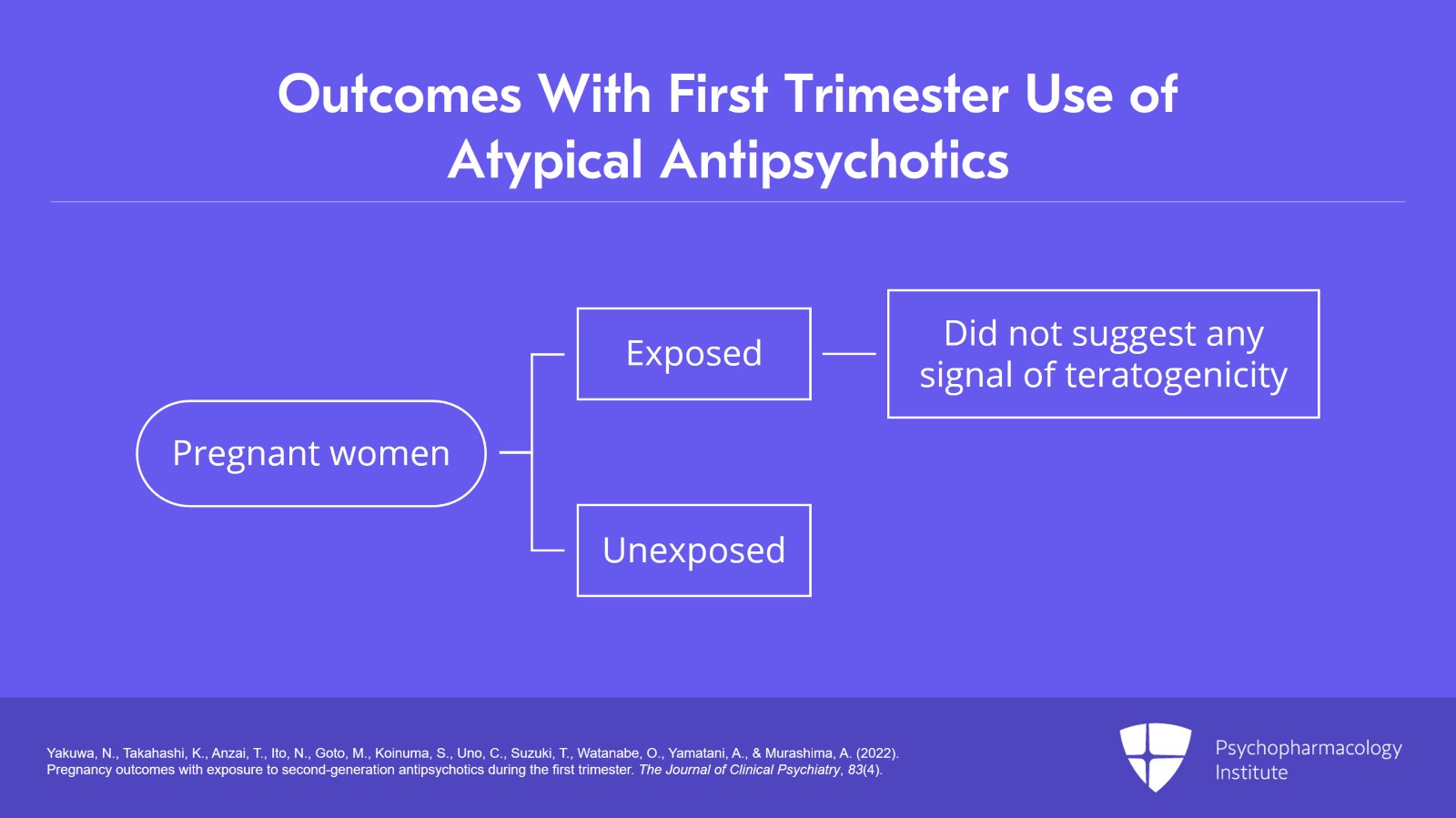
There is also another large prospective cohort study from which we have data of first trimester use of atypical antipsychotics. This is a Japanese study that compared exposed versus unexposed pregnant women and that data substantiates the data from the National Pregnancy Registry of Mass General. And currently available data from that study also does not suggest any signal of teratogenicity or any pattern of malformations in exposed women.
References:
  • Yakuwa, N., Takahashi, K., Anzai, T., Ito, N., Goto, M., Koinuma, S., Uno, C., Suzuki, T., Watanabe, O., Yamatani, A., & Murashima, A. (2022). Pregnancy outcomes with exposure to second-generation antipsychotics during the first trimester. The Journal of Clinical Psychiatry, 83(4).

Slide 4 of 10

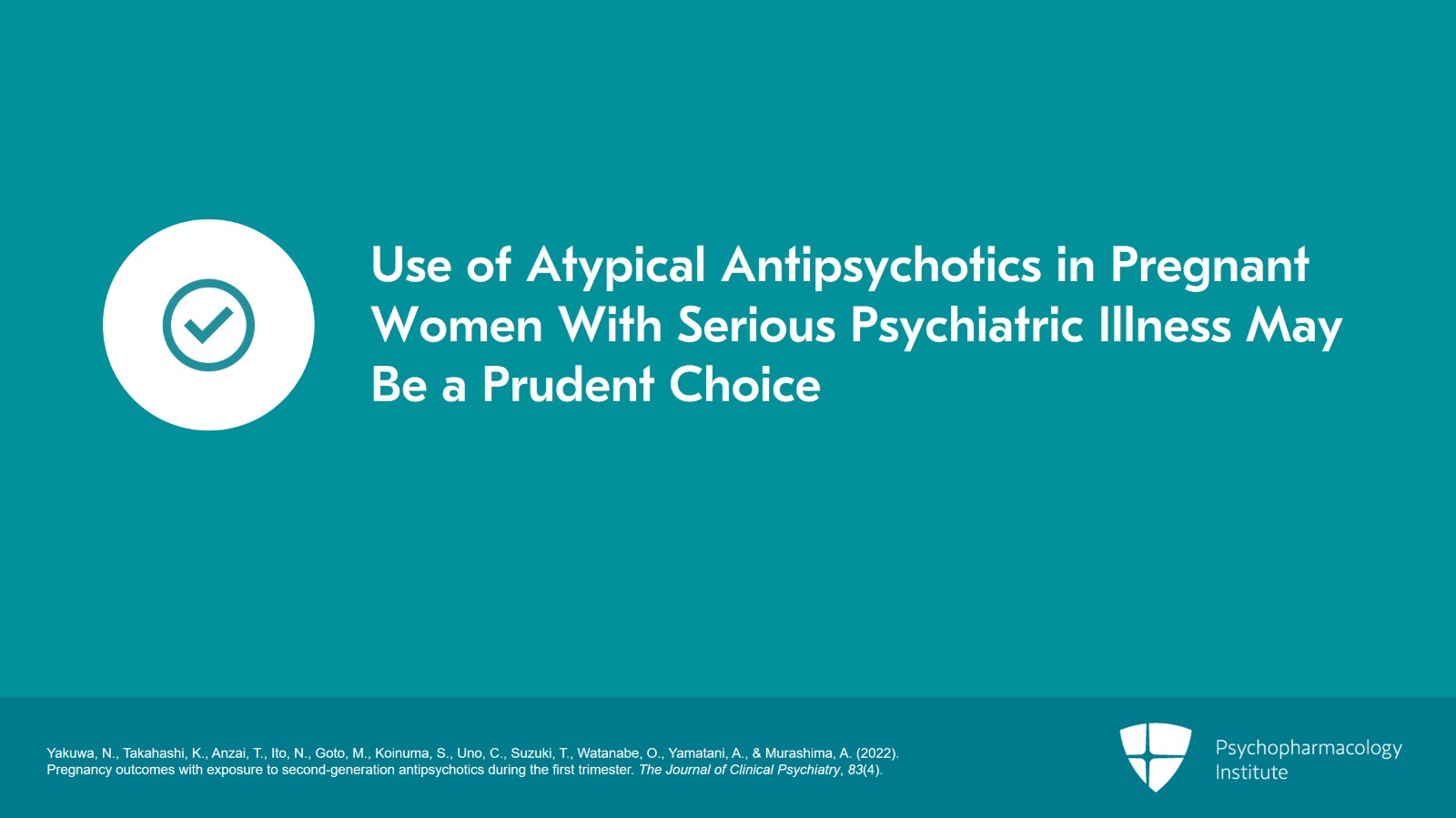
The results suggest that the use of atypical antipsychotics in pregnant women with serious psychiatric illness may in fact be a prudent choice.
References:
  • Yakuwa, N., Takahashi, K., Anzai, T., Ito, N., Goto, M., Koinuma, S., Uno, C., Suzuki, T., Watanabe, O., Yamatani, A., & Murashima, A. (2022). Pregnancy outcomes with exposure to second-generation antipsychotics during the first trimester. The Journal of Clinical Psychiatry, 83(4).
Free Files
Success!
Check your inbox, we sent you all the materials there.

Slide 5 of 10

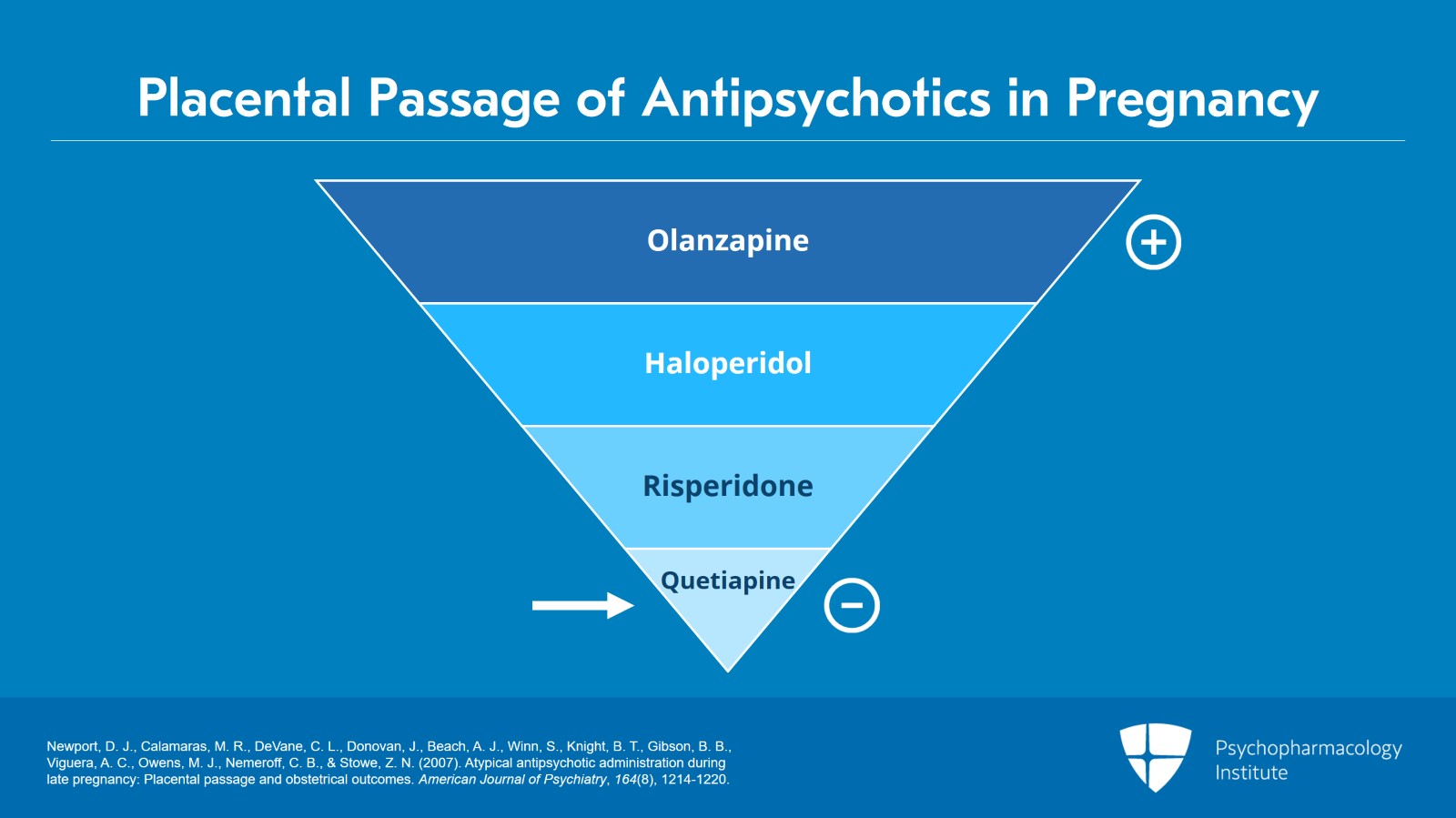
I should add that when we look at placental passage of antipsychotics in pregnancy, olanzapine is found at the highest level compared to haloperidol which is somewhat less compared to risperidone which is somewhat less again compared to quetiapine. So the antipsychotic that has the the lowest level in maternal serum, of those four, is quetiapine. And this is data that comes from Newport 2007, the American Journal of Psychiatry.
References:
  • Newport, D. J., Calamaras, M. R., DeVane, C. L., Donovan, J., Beach, A. J., Winn, S., Knight, B. T., Gibson, B. B., Viguera, A. C., Owens, M. J., Nemeroff, C. B., & Stowe, Z. N. (2007). Atypical antipsychotic administration during late pregnancy: Placental passage and obstetrical outcomes. American Journal of Psychiatry, 164(8), 1214-1220.

Slide 6 of 10

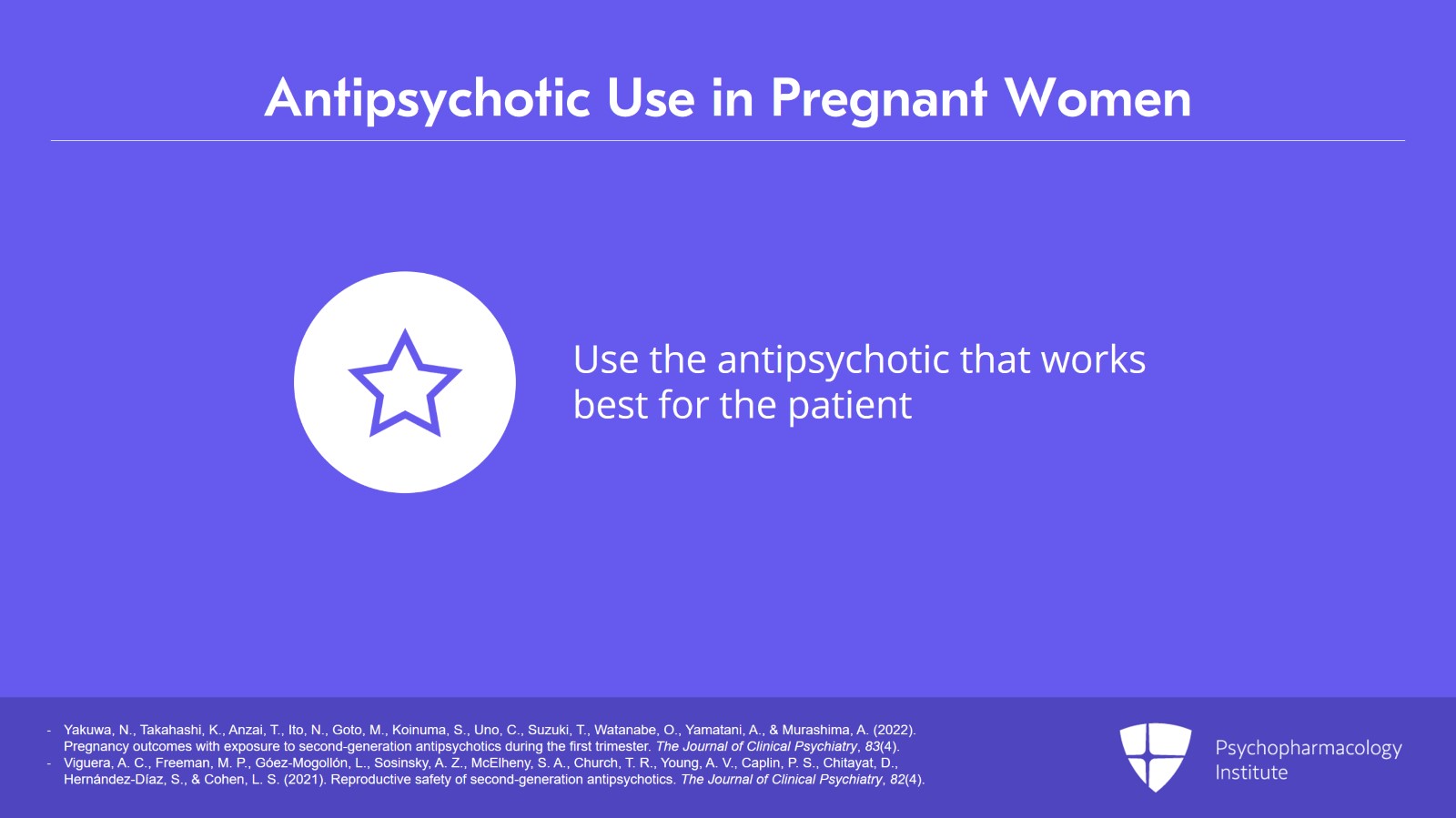
But we still recommend using the antipsychotic that works the best for the patient and that's because of our data that we have from the Mass General and the Japanese study I mentioned.
References:
  • Yakuwa, N., Takahashi, K., Anzai, T., Ito, N., Goto, M., Koinuma, S., Uno, C., Suzuki, T., Watanabe, O., Yamatani, A., & Murashima, A. (2022). Pregnancy outcomes with exposure to second-generation antipsychotics during the first trimester. The Journal of Clinical Psychiatry, 83(4).
  • Viguera, A. C., Freeman, M. P., Góez-Mogollón, L., Sosinsky, A. Z., McElheny, S. A., Church, T. R., Young, A. V., Caplin, P. S., Chitayat, D., Hernández-Díaz, S., & Cohen, L. S. (2021). Reproductive safety of second-generation antipsychotics. The Journal of Clinical Psychiatry, 82(4).
Free Files
Success!
Check your inbox, we sent you all the materials there.

Slide 7 of 10

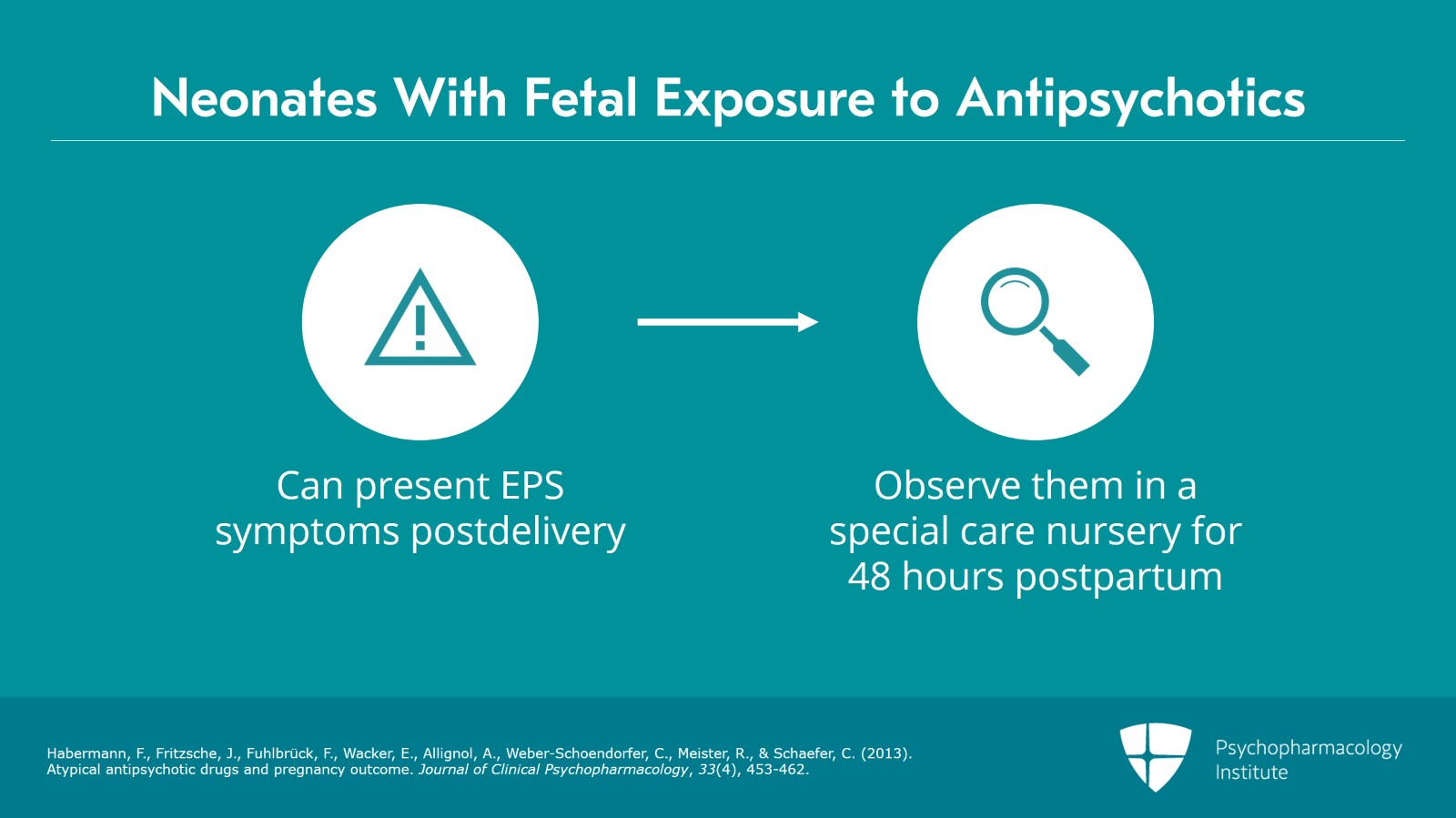
At the same time, the FDA labeling does suggest and this includes all typical and atypical antipsychotics that there are some EPS symptoms in neonates post delivery and these symptoms include agitation, increased or decreased muscle tone and tremors, sleepiness, breathing, and feeding difficulties. So the suggestion is to observe these babies in a special care nursery for about 48 hours postpartum.
References:
  • Habermann, F., Fritzsche, J., Fuhlbrück, F., Wacker, E., Allignol, A., Weber-Schoendorfer, C., Meister, R., & Schaefer, C. (2013). Atypical antipsychotic drugs and pregnancy outcome. Journal of Clinical Psychopharmacology, 33(4), 453-462.

Slide 8 of 10

Key points here then are current data, which is accumulating, suggests that first trimester use of atypical antipsychotics is not associated with an increased risk of major congenital malformations. Following delivery, there is a risk of extrapyramidal side effects in the neonate.
Free Files
Success!
Check your inbox, we sent you all the materials there.

Slide 9 of 10

Nevertheless, for pregnant women with serious psychiatric illness such as bipolar disorder, the use of atypical antipsychotics should strongly be considered.

Slide 10 of 10

Free Files
Success!
Check your inbox, we sent you all the materials there.

Learning Objectives:

After completing this activity, the learner will be able to:

  1. Recognize the complexities and risks of treating bipolar disorder during the perinatal period.
  2. Utilize the recommended management strategies for the perinatal treatment of bipolar disorder.
  3. Provide safe treatment options for pregnant women with bipolar disorder.

Original Release Date: September 1, 2023

Review and Re-release Date: March 1, 2024

Expiration Date: September 1, 2026

Expert: Vivien Burt, M.D.

Medical Editor: Paz Badía, M.D.

Relevant Financial Disclosures: 

Vivien K. Burt MD PhD declares the following interests:

- SAGE Therapeutics:  Speaker

All of the relevant financial relationships listed above have been mitigated by Medical Academy and the Psychopharmacology Institute.

None of the other planners, and reviewers for this educational activity have relevant financial relationships to disclose during the last 24 months with ineligible companies whose primary business is producing, marketing, selling, re-selling, or distributing healthcare products used by or on patients.

Contact Information: For questions regarding the content or access to this activity, contact us at support@psychopharmacologyinstitute.com

Instructions for Participation and Credit:

Participants must complete the activity online during the valid credit period that is noted above.

Follow these steps to earn CME credit:

  1. View the required educational content provided on this course page.

  2. Complete the Post Activity Evaluation for providing the necessary feedback for continuing accreditation purposes and for the development of future activities. NOTE: Completing the Post Activity Evaluation after the quiz is required to receive the earned credit.

  3. Download your certificate.

Accreditation Statement

This activity has been planned and implemented in accordance with the accreditation requirements and policies of the Accreditation Council for Continuing Medical Education through the joint providership of Medical Academy LLC and the Psychopharmacology Institute. Medical Academy is accredited by the ACCME to provide continuing medical education for physicians

Credit Designation Statement

Medical Academy designates this enduring activity for a maximum of 1 AMA PRA Category 1 credit(s)™. Physicians should claim only the credit commensurate with the extent of their participation in the activity.


Free Files
Success!
Check your inbox, we sent you all the materials there.
Continue in the website
Instant access modal

Become a Bronze, Silver, Gold, Bronze extended, Silver extended or Gold extended Member.

2025–26 Psychopharmacology CME Program

Unlock up to 155 CME Credits, including 40 SA CME Credits.