Close Banner
Section Free  - Video Lectures

03. Relative Contraindications to Antipsychotic Switching

Published on March 1, 2022 Expired on April 1, 2025

Brian Miller, M.D., Ph.D., M.P.H.

Professor - Augusta University

Key Points

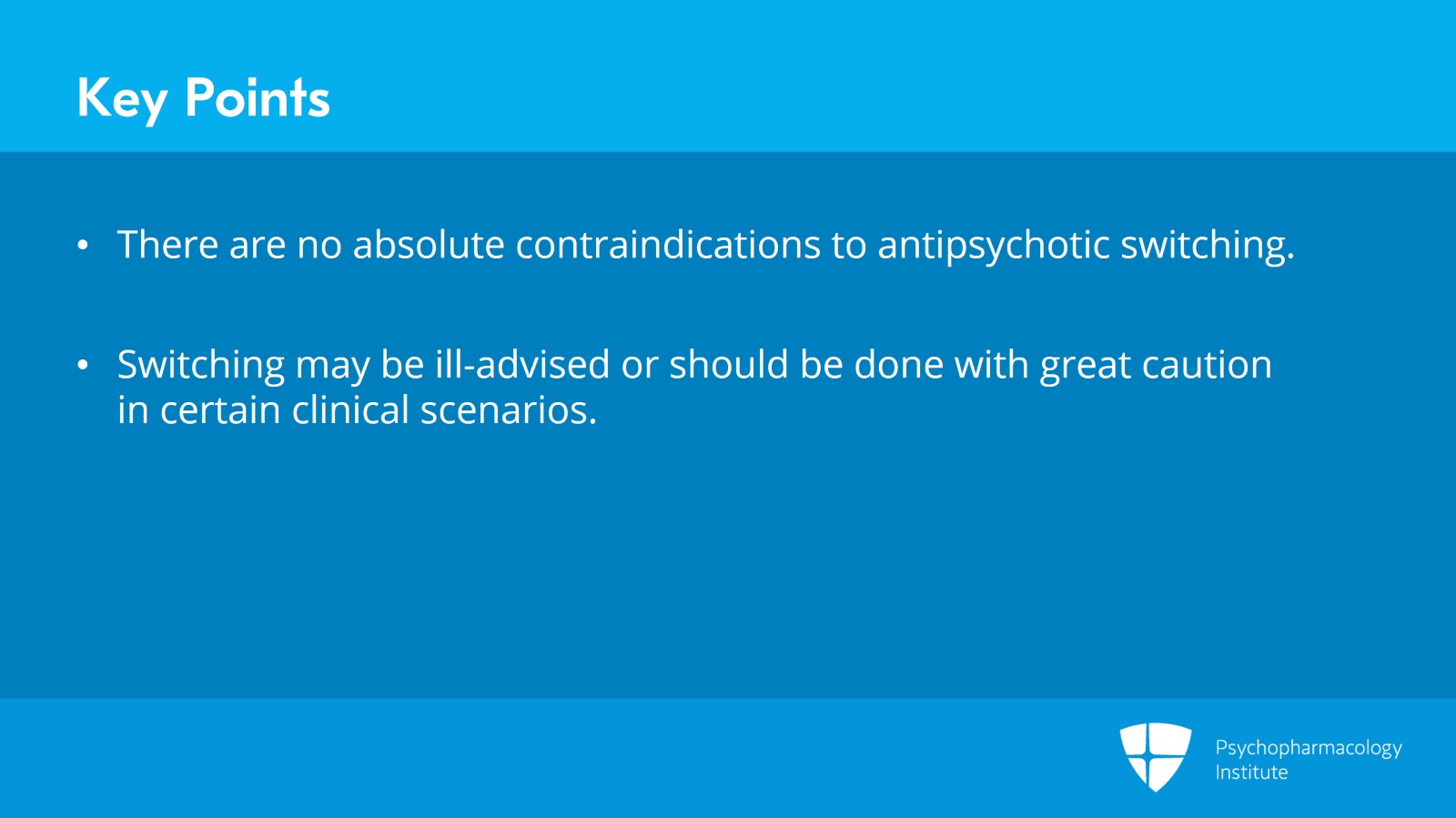
  • There are no absolute contraindications to antipsychotic switching.
  • Switching may be ill-advised or should be done with great caution in certain clinical scenarios.

Free Downloads for Offline Access

  • Free Download Presentation File (PPTX)
  • Free Download Audio File (MP3)
  • Free Download Video (MP4)

Slides and Transcript

Slide 1 of 9

Now, we’re going to talk about the contraindications to antipsychotic switching.

Slide 2 of 9

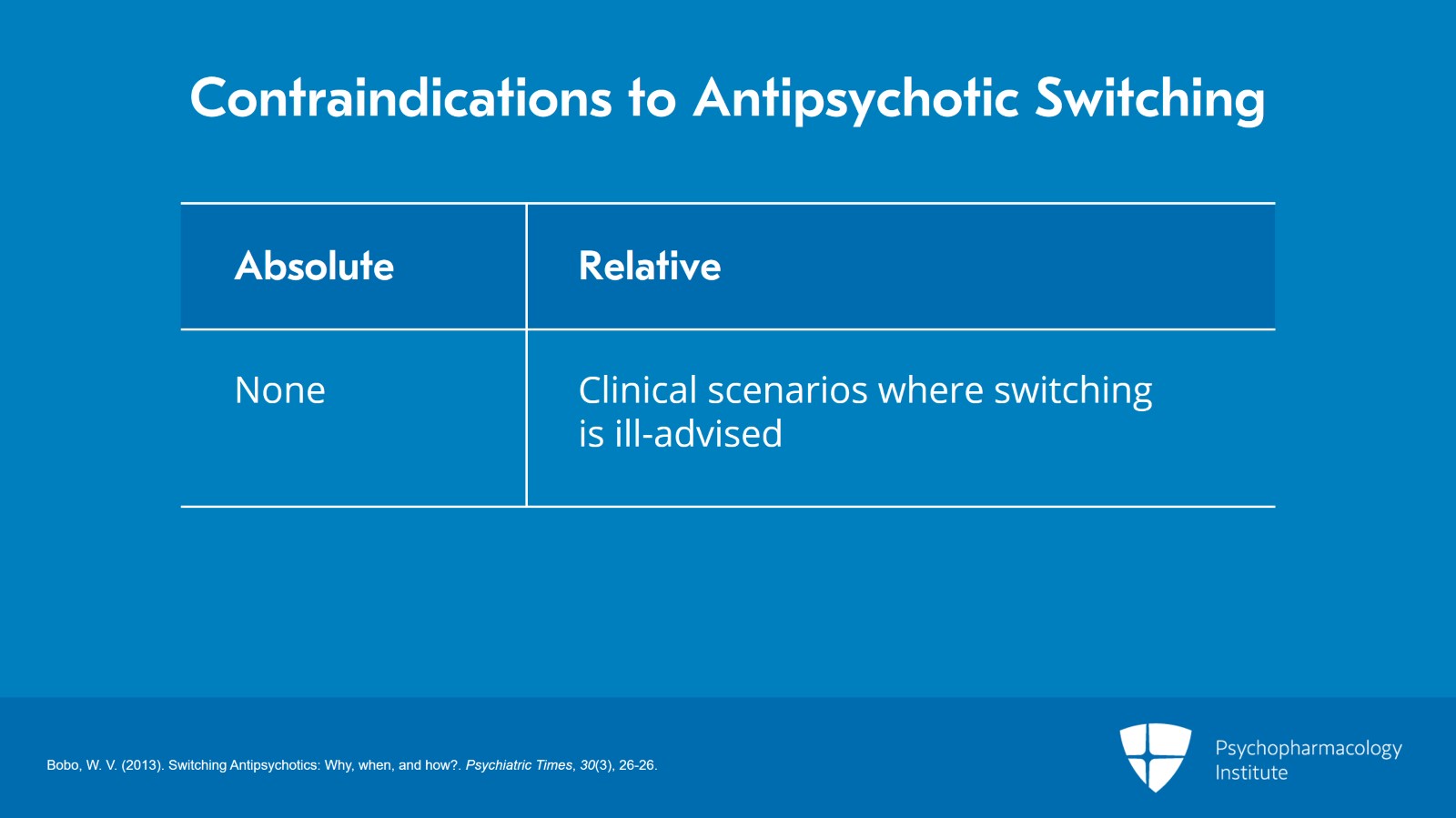
I would emphasize here that there aren’t any absolute contraindications to antipsychotic switching. However, there are several what I would call relative contraindications, that is, certain clinical scenarios where switching medications might be ill-advised or really should only be done with great caution.
References:
  • Bobo, W. V. (2013). Switching Antipsychotics: Why, when, and how?. Psychiatric Times, 30(3), 26-26.
Free Files
Success!
Check your inbox, we sent you all the materials there.

Slide 3 of 9

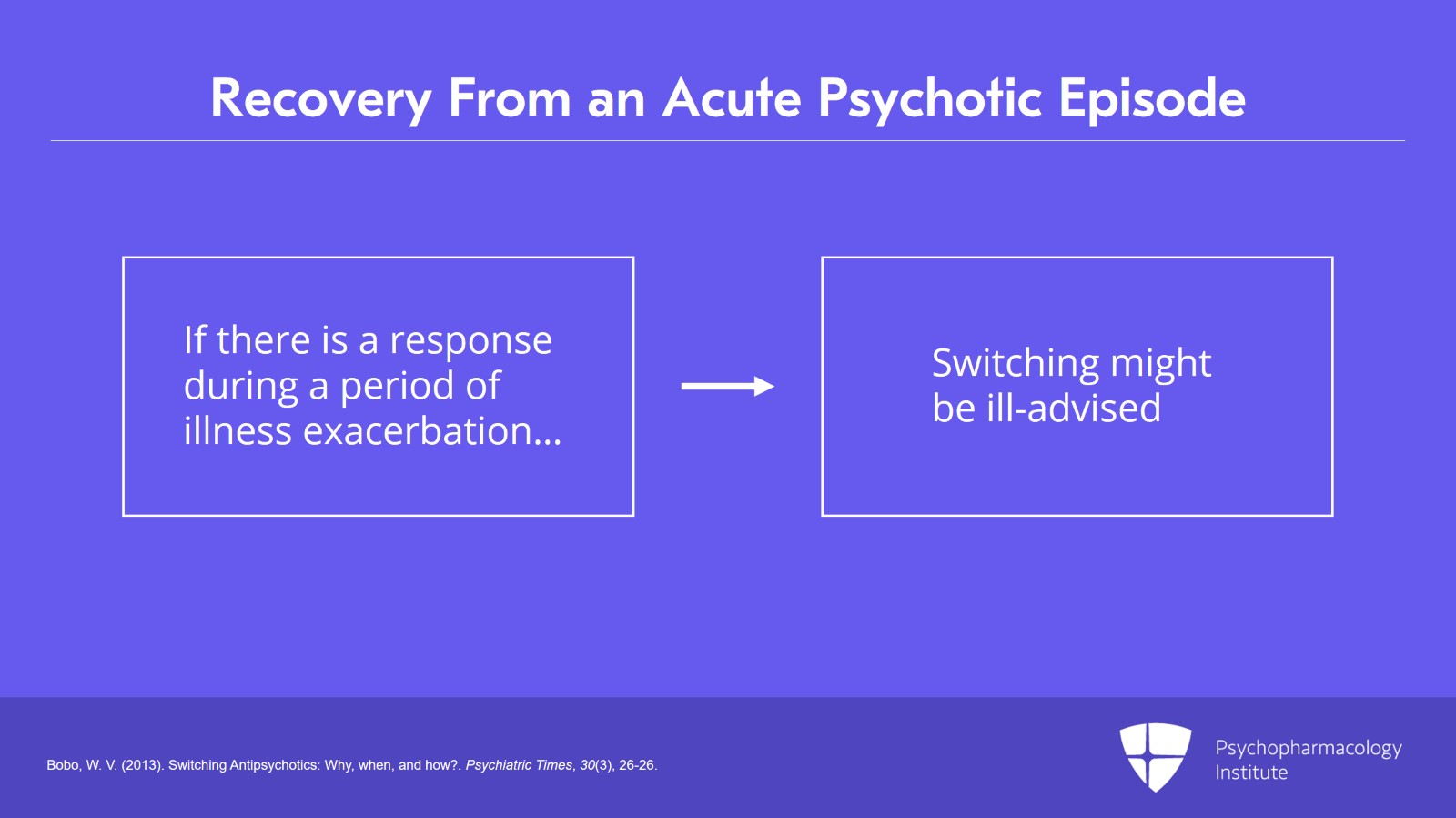
So one of those situations would be patients who’ve recently recovered from an episode of acute psychosis and they’re taking the antipsychotic to which they responded during the period of illness exacerbation. So a patient is hospitalized for acute psychosis. They were stabilized on risperidone. They’ve been discharged from the hospital. You’re seeing them one week, two weeks, a month after hospital discharge and they’ve recovered. That would be a time when a switch might be particularly ill-advised as they’re recovering from that acute illness episode.
References:
  • Bobo, W. V. (2013). Switching Antipsychotics: Why, when, and how?. Psychiatric Times, 30(3), 26-26.

Slide 4 of 9

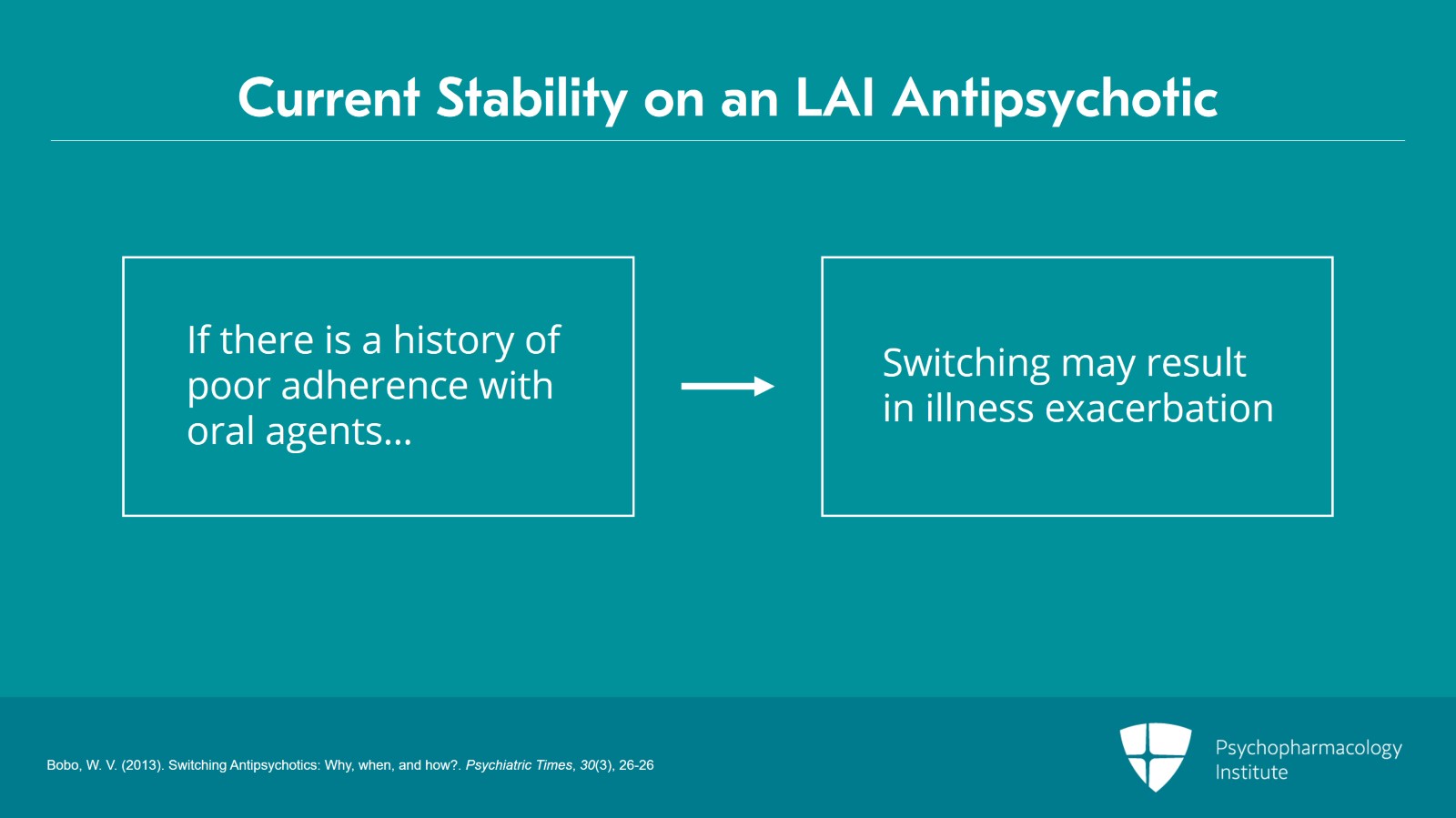
A second relative contraindication would be patients who are currently stable on a long-acting injectable antipsychotic medication, and they have a history of poor adherence with oral agents that have resulted in illness exacerbation.
References:
  • Bobo, W. V. (2013). Switching Antipsychotics: Why, when, and how?. Psychiatric Times, 30(3), 26-26
Free Files
Success!
Check your inbox, we sent you all the materials there.

Slide 5 of 9

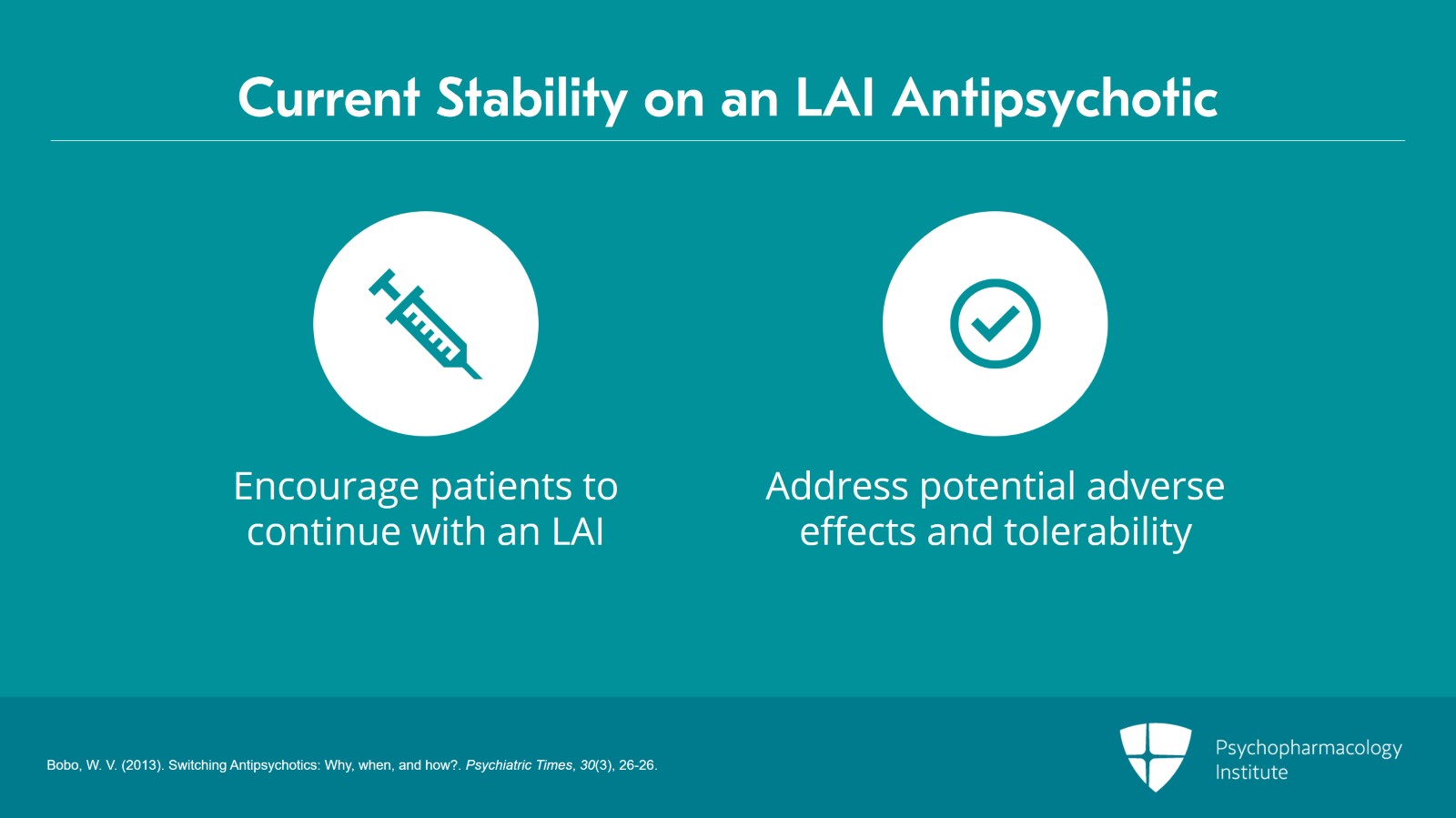
And so if we’ve got a patient who’s not done well on oral agents and they’re stable on an LAI, you know, I think it makes a lot of sense to try to encourage the patient to continue with the long-acting injectable medication and address potential adverse effects, tolerability, other concerns prior to initiating a switch.
References:
  • Bobo, W. V. (2013). Switching Antipsychotics: Why, when, and how?. Psychiatric Times, 30(3), 26-26.

Slide 6 of 9

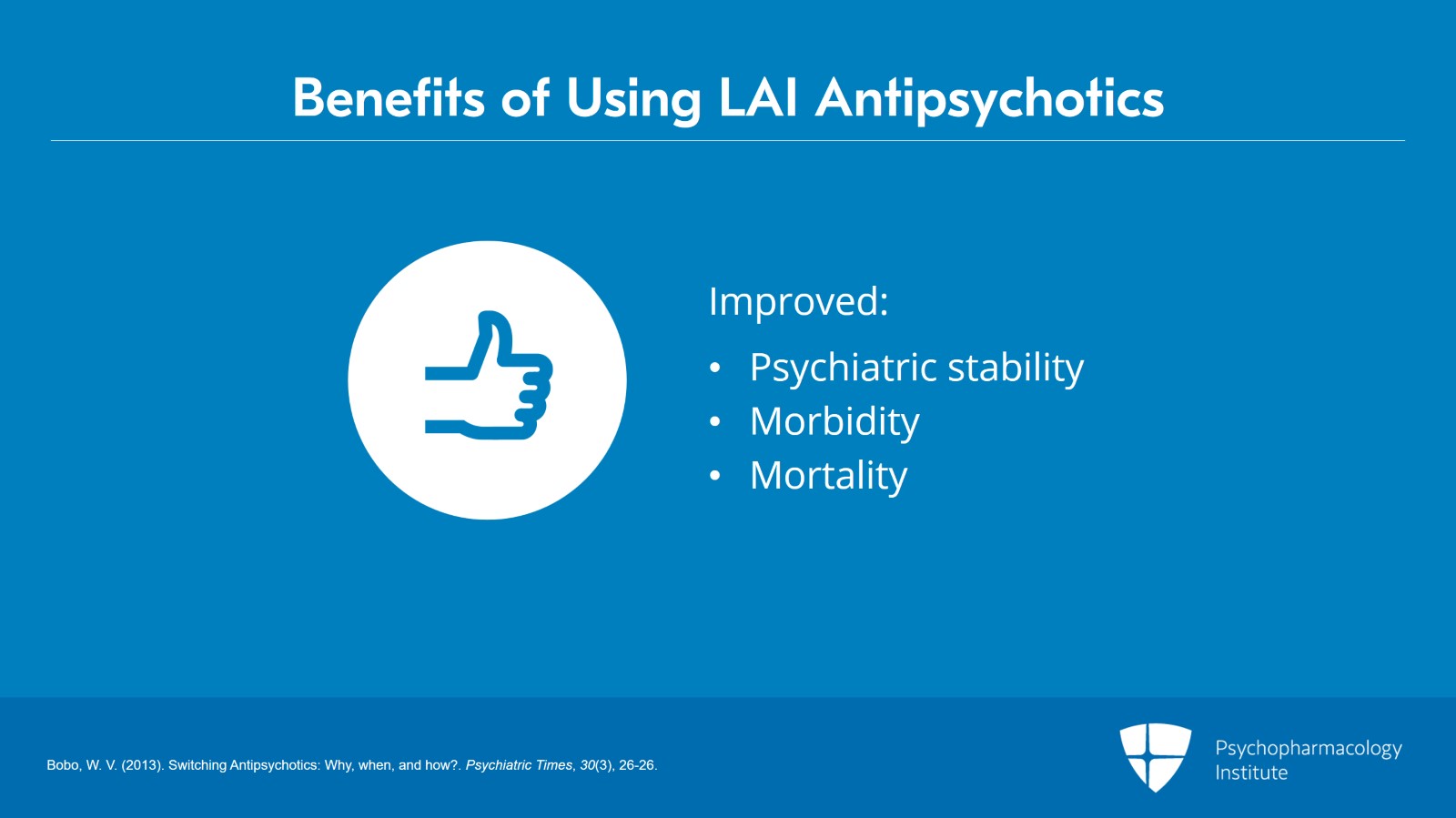
We know that there’s a broad literature suggesting a host of improved outcomes in terms of psychiatric stability and even issues related to morbidity and mortality for patients who are willing to accept long-acting injectable antipsychotic medications.
References:
  • Bobo, W. V. (2013). Switching Antipsychotics: Why, when, and how?. Psychiatric Times, 30(3), 26-26.
Free Files
Success!
Check your inbox, we sent you all the materials there.

Slide 7 of 9

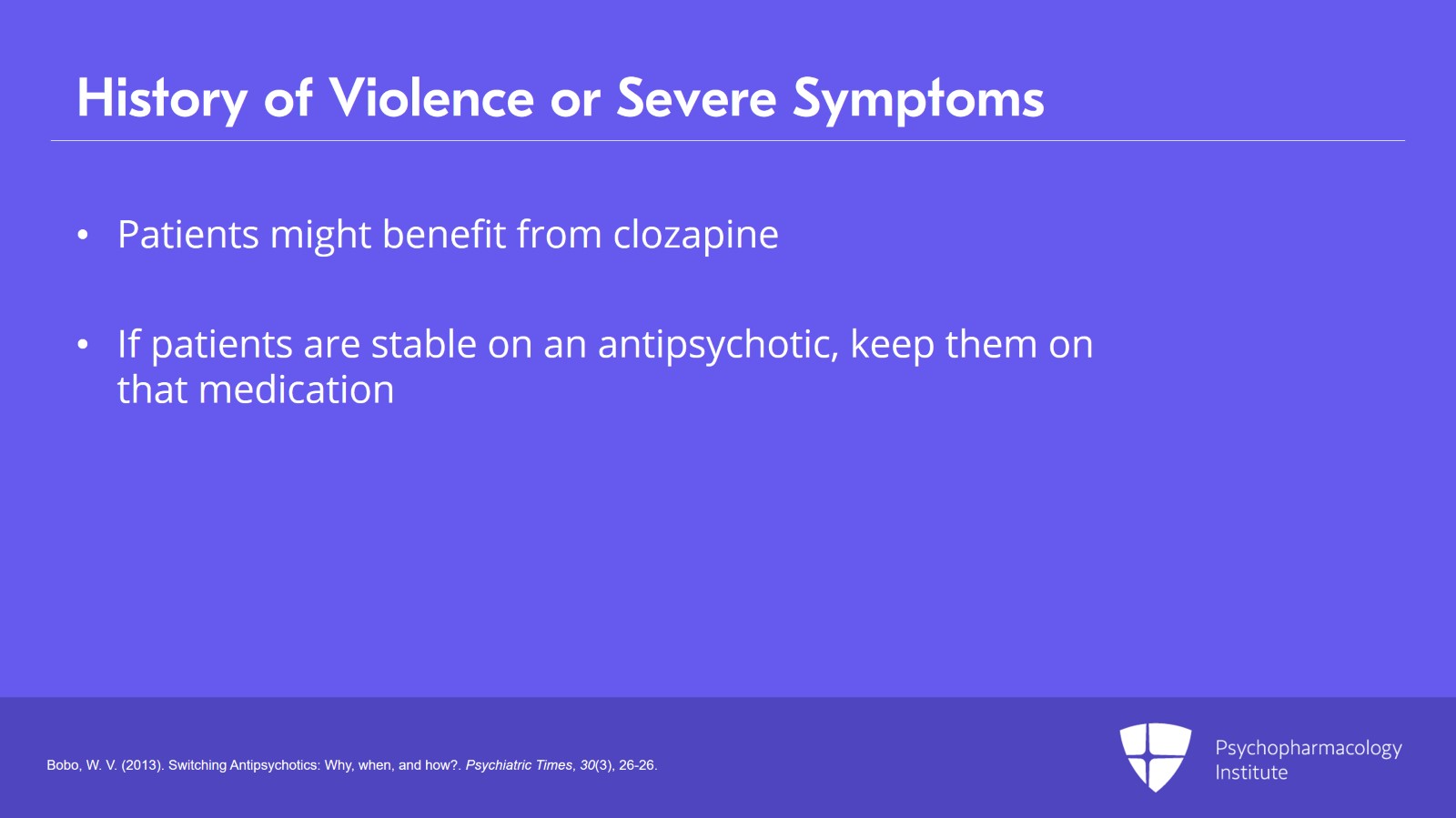
And then a third relative contraindication would be patients who are currently stable on an antipsychotic and they have a history of significant violence to themselves or others or just extremely severe symptoms during illness exacerbation. This scenario makes me think of patients who might particularly benefit from treatment with clozapine which is known to improve outcomes related to suicide and violence. And so if we had a patient who’s stable on such an antipsychotic, they have this history of suicidal/homicidal ideation and behavior or just severe illness and they’re stable, we want to do everything we can to keep them on that particular medication.
References:
  • Bobo, W. V. (2013). Switching Antipsychotics: Why, when, and how?. Psychiatric Times, 30(3), 26-26.

Slide 8 of 9

So the key points here. Number one, there are no absolute contraindications to antipsychotic switching. However, switching may be ill-advised or should be done with great caution in certain clinical scenarios, such as patients who’ve recovered from an episode of acute psychosis, those who are stable on long-acting injectable medicines with a history of poor oral antipsychotic adherence, and stable patients with a history of significant violence or severe symptoms.
Free Files
Success!
Check your inbox, we sent you all the materials there.

Slide 9 of 9

Learning Objectives:

After completing this activity, the learner will be able to:

  1. Describe the indications and contraindications to antipsychotic switching.
  2. Recognize and utilize the different strategies to make a successful antipsychotic switch.
  3. Identify and manage the different problems that can occur during antipsychotic switching.

Original Release Date: 03/01/2022

Review and Re-release Date: 03/01/2024

Expiration Date: 04/01/2025

Expert: Brian Miller, M.D.

Medical Editor: Paz Badía, M.D.

Relevant Financial Disclosures:

The following planners, faculty, and reviewers have the following relevant financial relationships with commercial interests to disclose:

Dr. Miller has disclosed the following relationships:

  • NIMH: Investigator
  • Stanley Medical Research Institute: Investigator
  • Brain & Behavior Research Institute: Investigator
  • Augusta University: Faculty
  • Boehringer Ingelheim: Advisory Board
  • Psychiatric Times: Consulting
  • ClearView: Consulting
  • Atheneum: Consulting

All of the relevant financial relationships listed for these individuals have been mitigated.

Contact Information: For questions regarding the content or access to this activity, contact us at support@psychopharmacologyinstitute.com

Instructions for Participation and Credit:

Participants must complete the activity online during the valid credit period that is noted above.

Follow these steps to earn CME credit:

  1. View the required educational content provided on this course page.
  2. Complete the Post Activity Evaluation for providing the necessary feedback for continuing accreditation purposes and for the development of future activities. NOTE: Completing the Post Activity Evaluation after the quiz is required to receive the earned credit.
  3. Download your certificate.

Accreditation Statement

This activity has been planned and implemented in accordance with the accreditation requirements and policies of the Accreditation Council for Continuing Medical Education through the joint providership of Medical Academy LLC and the Psychopharmacology Institute. Medical Academy is accredited by the ACCME to provide continuing medical education for physicians.

Credit Designation Statement

Medical Academy designates this enduring activity for a maximum of 1.00 AMA PRA Category 1 credit(s). Physicians should claim only the credit commensurate with the extent of their participation in the activity.


Free Files
Success!
Check your inbox, we sent you all the materials there.
Continue in the website
Instant access modal

Become a Bronze, Silver, Gold, Bronze extended, Silver extended or Gold extended Member.

2025–26 Psychopharmacology CME Program

Unlock up to 155 CME Credits, including 40 SA CME Credits.