Slides and Transcript
Slide 1 of 22
So in this video, we're going to talk about psychotherapy skills in everyday practice or what I would consider to be a kind of ordinary medical psychotherapy.
Slide 2 of 22
And I think the basic point is that certainly as psychiatrists and I think for nurse practitioners this is also true, there is a degree of psychotherapy training in residency and actually in residency there is a considerable amount of psychotherapy training. And those skills that we learned as psychotherapists can and, I will argue, should be integrated into the ways that we provide pharmacotherapy because it really has the potential to enhance outcomes.
References:
- Blagys, M. D., & Hilsenroth, M. J. (2000). Distinctive features of short-term psychodynamic-interpersonal psychotherapy: A review of the comparative psychotherapy process literature. Clinical Psychology: Science and Practice, 7(2), 167-188.
Free Files
Download PDF and other files
Success!
Check your inbox, we sent you all the materials there.
Slide 3 of 22
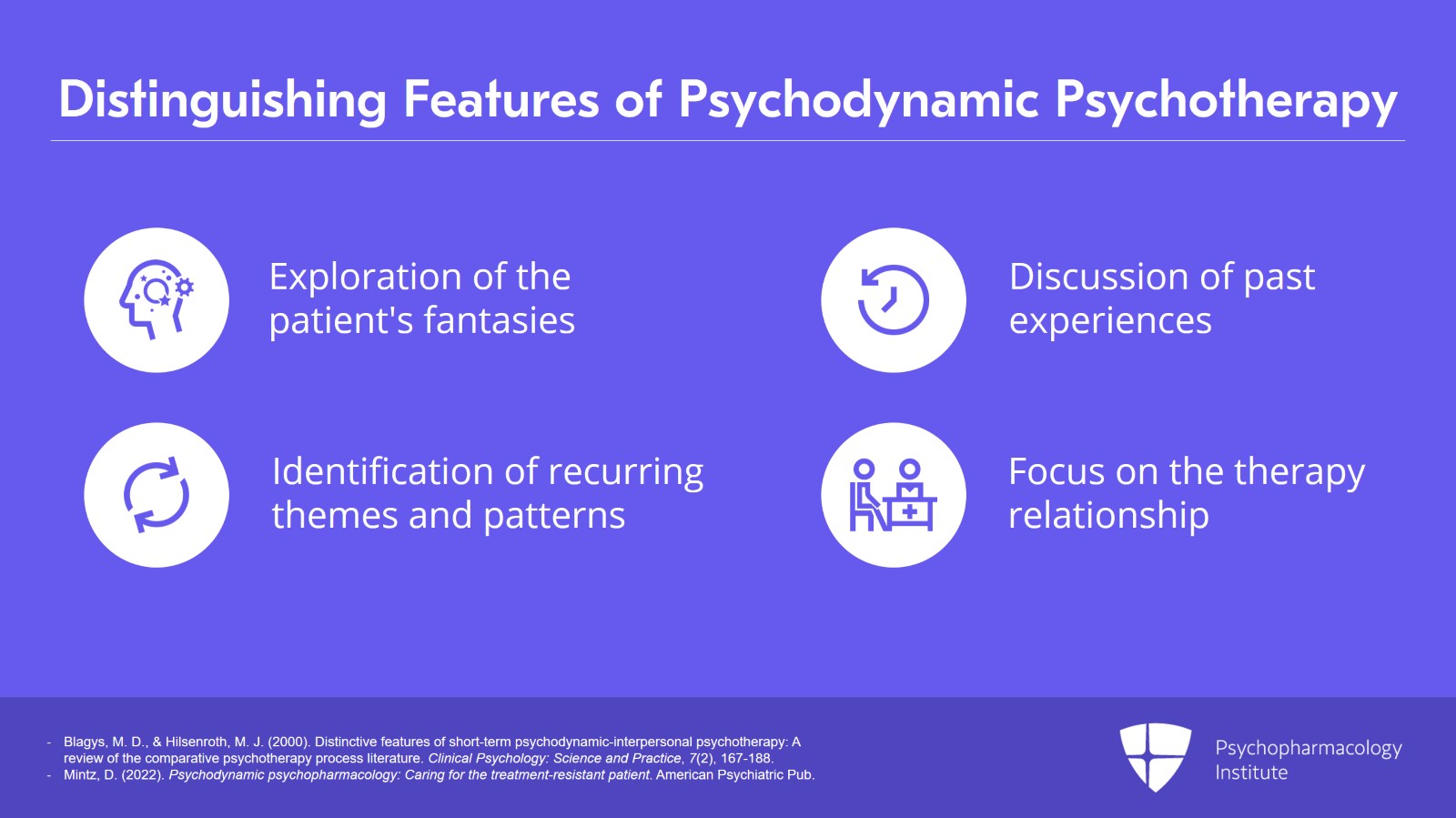
And I'm going to talk about this from a psychodynamic perspective and looking through the lens of the research of Blagys and Hilsenroth in 2000. And what Blagys and Hilsenroth did was they looked at psychodynamic treatments and they looked at cognitive behavioral treatments and they identified seven distinguishing features of psychodynamic psychotherapy which included the exploration of the patient's fantasies, discussion of past experiences or the patient's developmental context, identifying recurring themes and patterns, focusing on the therapy relationship.
References:
- Blagys, M. D., & Hilsenroth, M. J. (2000). Distinctive features of short-term psychodynamic-interpersonal psychotherapy: A review of the comparative psychotherapy process literature. Clinical Psychology: Science and Practice, 7(2), 167-188.
- Mintz, D. (2022). Psychodynamic psychopharmacology: Caring for the treatment-resistant patient. American Psychiatric Pub.
Slide 4 of 22
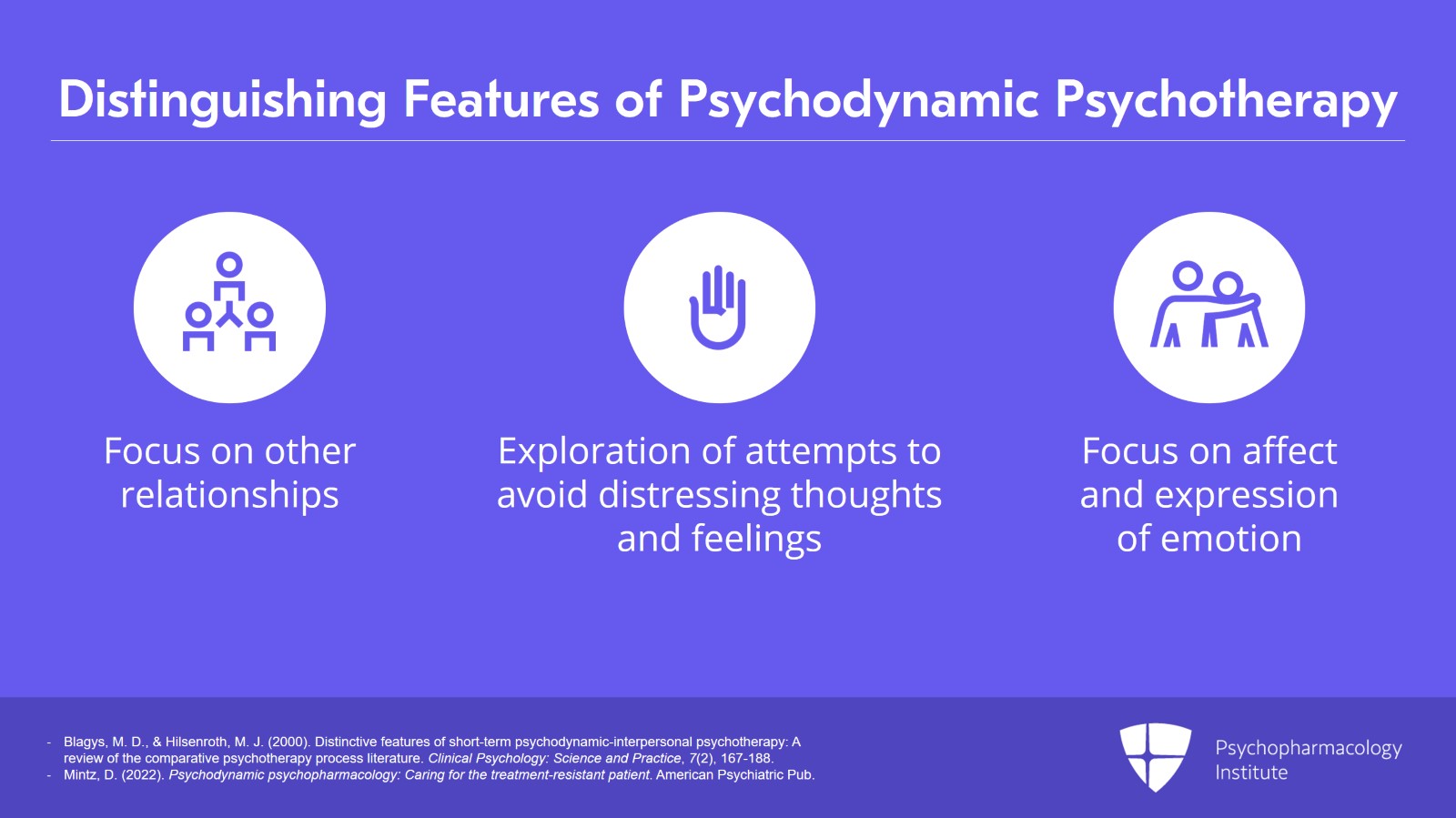
Focusing on other relationships, exploration of attempts to avoid distressing thoughts and feelings, which equates to addressing resistance and focusing on affect and the expression of emotion. What I want to talk about is ways that these seven features of psychodynamic psychotherapy can and should be integrated into routine pharmacotherapy.
References:
- Blagys, M. D., & Hilsenroth, M. J. (2000). Distinctive features of short-term psychodynamic-interpersonal psychotherapy: A review of the comparative psychotherapy process literature. Clinical Psychology: Science and Practice, 7(2), 167-188.
- Mintz, D. (2022). Psychodynamic psychopharmacology: Caring for the treatment-resistant patient. American Psychiatric Pub.
Free Files
Download PDF and other files
Success!
Check your inbox, we sent you all the materials there.
Slide 5 of 22
And we're going to start with the first of those, the exploration of fantasies. Now, this is not the way you would do as a SIT therapist, you know, the patient's broader fantasies, their, you know, those kinds of things but things that are more specifically related to the patient's understanding of their illness and the ways they understand and relate to medications.
References:
- Mintz, D. (2022). Psychodynamic psychopharmacology: Caring for the treatment-resistant patient. American Psychiatric Pub.
Slide 6 of 22
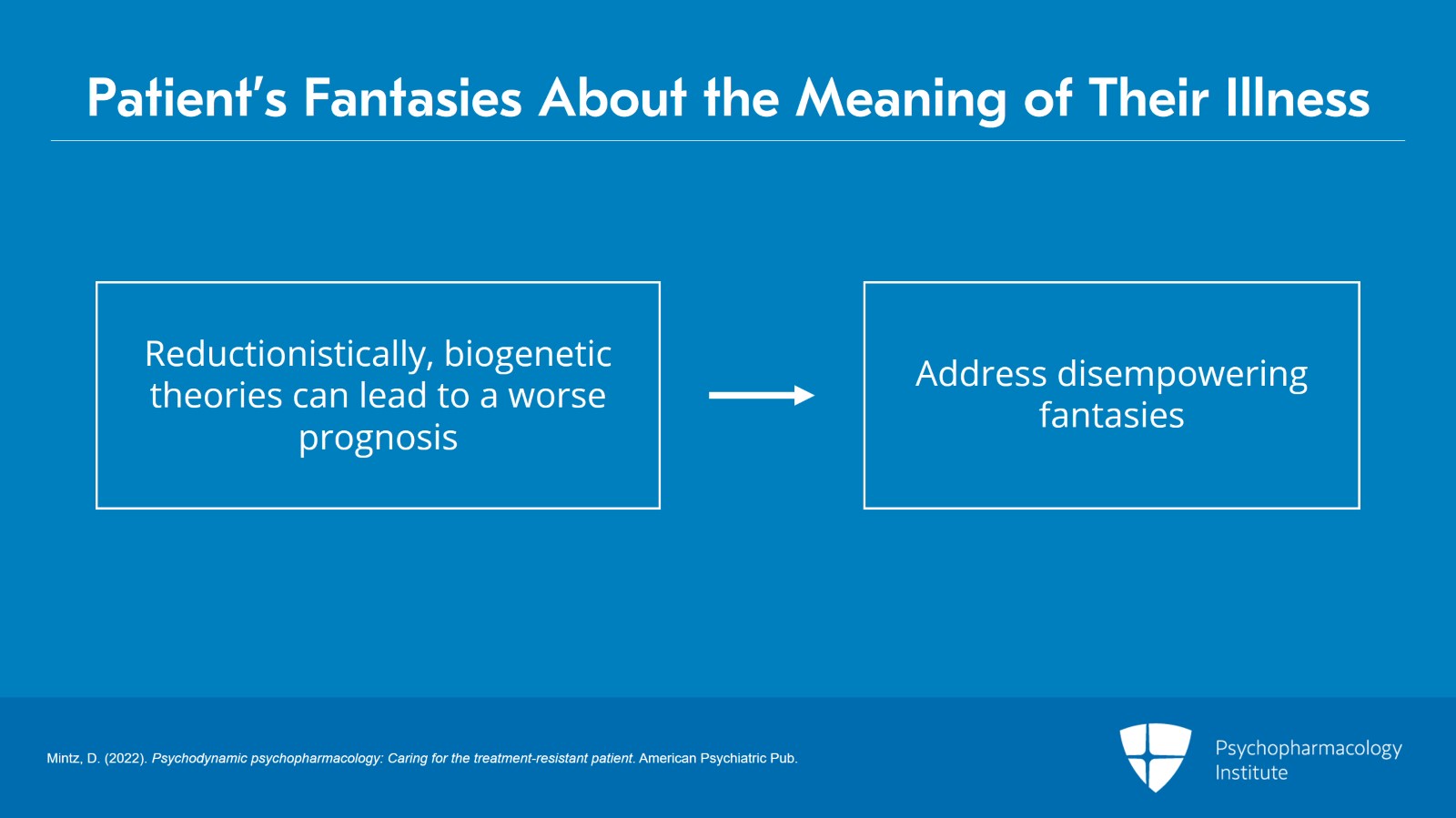
So again, we may want to assess, get a sense of the patient's fantasy about what their illness means, how they got their illness. And as I said in a previous talk, when patients have reductionistically biogenetic theories of illness, this tends to lead to worse prognosis. So if we determine the patient has some disempowering assumptions or fantasies, we may address those.
References:
- Mintz, D. (2022). Psychodynamic psychopharmacology: Caring for the treatment-resistant patient. American Psychiatric Pub.
Free Files
Download PDF and other files
Success!
Check your inbox, we sent you all the materials there.
Slide 7 of 22
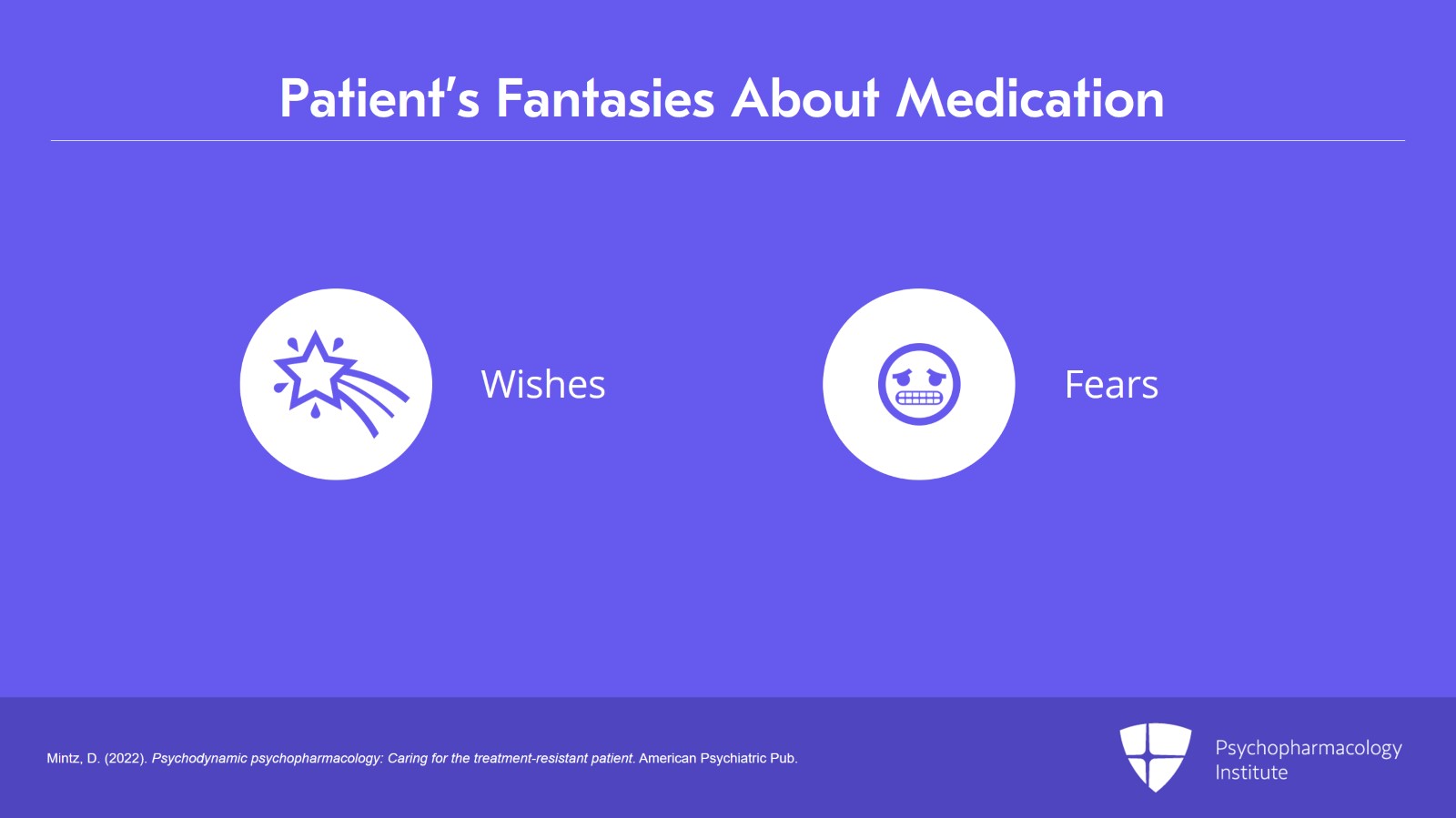
Similarly, we probably want to understand something about the patient's fantasies about medications, their wishes for medications and their fears for medications. So probably helpful to articulate something about patient's fears so those can be addressed in the course of your work as a prescribing clinician.
References:
- Mintz, D. (2022). Psychodynamic psychopharmacology: Caring for the treatment-resistant patient. American Psychiatric Pub.
Slide 8 of 22
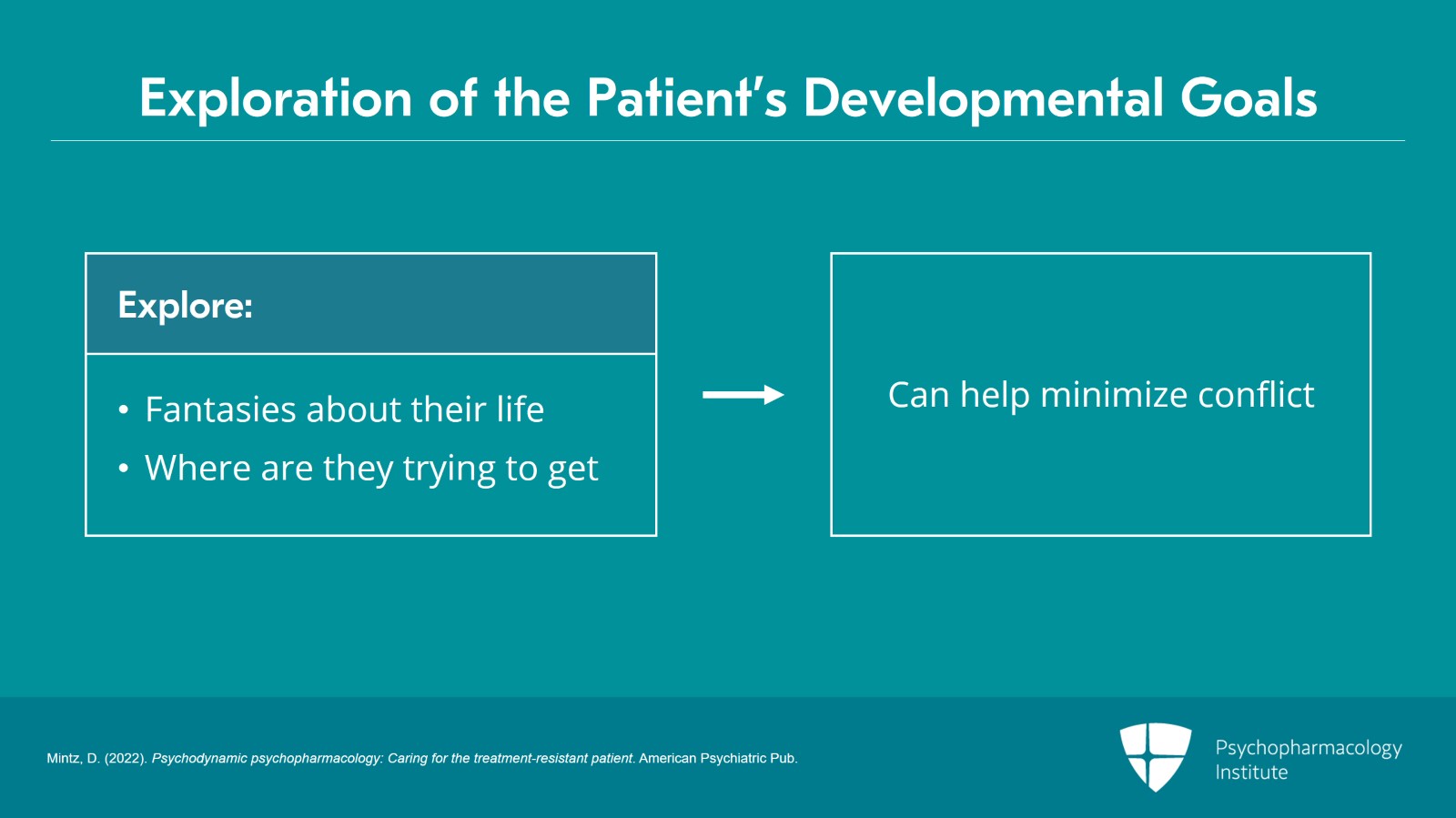
In terms of fantasies, one might also want to understand and explore the patient's broader developmental goals. So you know, what are their fantasies about their life, where are they trying to get and this helps us understand something about the patient's relationship to health and helps us position ourselves in a way that may minimize conflict.
References:
- Mintz, D. (2022). Psychodynamic psychopharmacology: Caring for the treatment-resistant patient. American Psychiatric Pub.
Free Files
Download PDF and other files
Success!
Check your inbox, we sent you all the materials there.
Slide 9 of 22
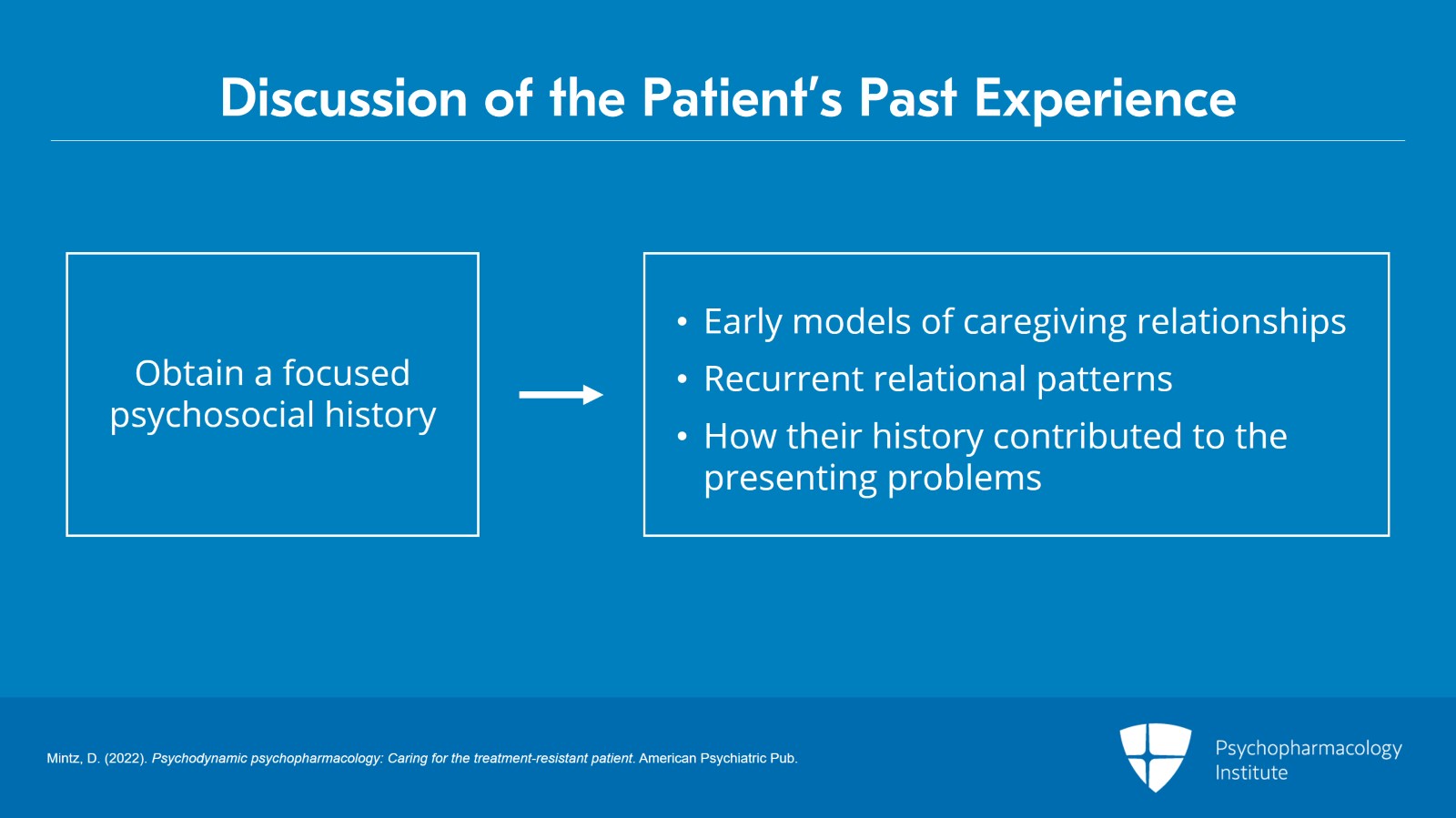
In terms of a discussion of past experience or the patient's developmental context, we may in our initial assessments want to obtain a focused psychosocial history which focuses on a few things, early models of caregiving relationships. If there are recurrent relational patterns, patients, for example, who are terrified of dependency and so start to blow up relationships when they feel dependent, one can imagine that that would be likely to be recreated in the pharmacotherapy relationship where the patient starts to feel dependent on their medications and then becomes frightened and wants to stop their medicine. We may want to understand as well patient's understanding of how their life history contributed to the presenting problems which keeps things complicated, helps the patient have a more complicated model in mind and not simply a biogenetic model.
References:
- Mintz, D. (2022). Psychodynamic psychopharmacology: Caring for the treatment-resistant patient. American Psychiatric Pub.
Slide 10 of 22
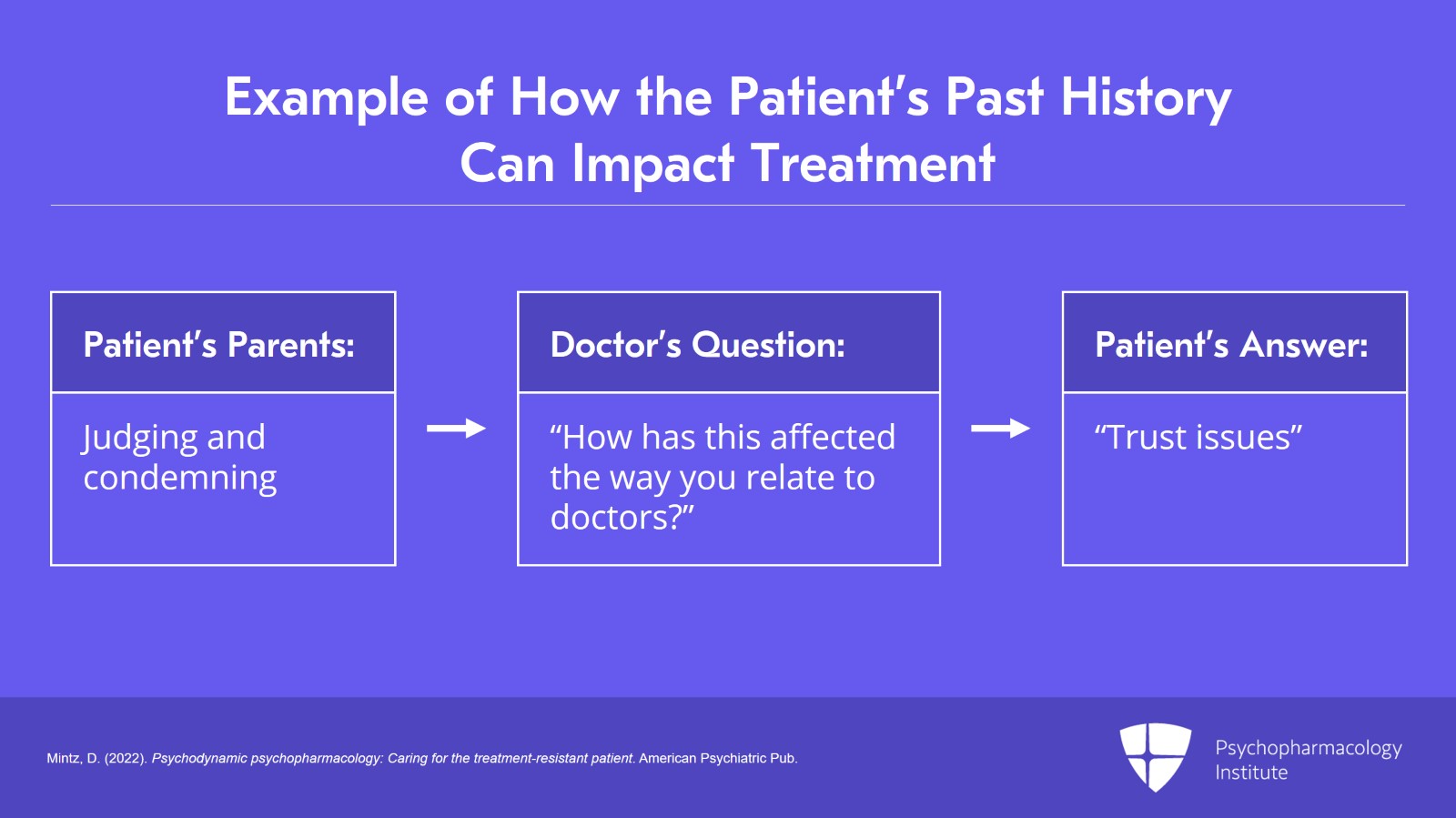
And this gives us ways to consider and address how the patient's past history is impacting their current treatments. So for example, if a patient has told you that their parents were judging and condemning and hurtful, a simple question again you might ask is how has this affected the way you relate to doctors? And the patient may lay it out for you right there, you know, the kinds of problems that you're likely to have and then that also gives you something when it does come up later in treatment where you can refer back to, oh, you remember we talked about how, early on how, you know, your trust issues come up, I wonder if that's what's happening now. And it puts you in a better position to be able to work through those kinds of things.
References:
- Mintz, D. (2022). Psychodynamic psychopharmacology: Caring for the treatment-resistant patient. American Psychiatric Pub.
Free Files
Download PDF and other files
Success!
Check your inbox, we sent you all the materials there.
Slide 11 of 22
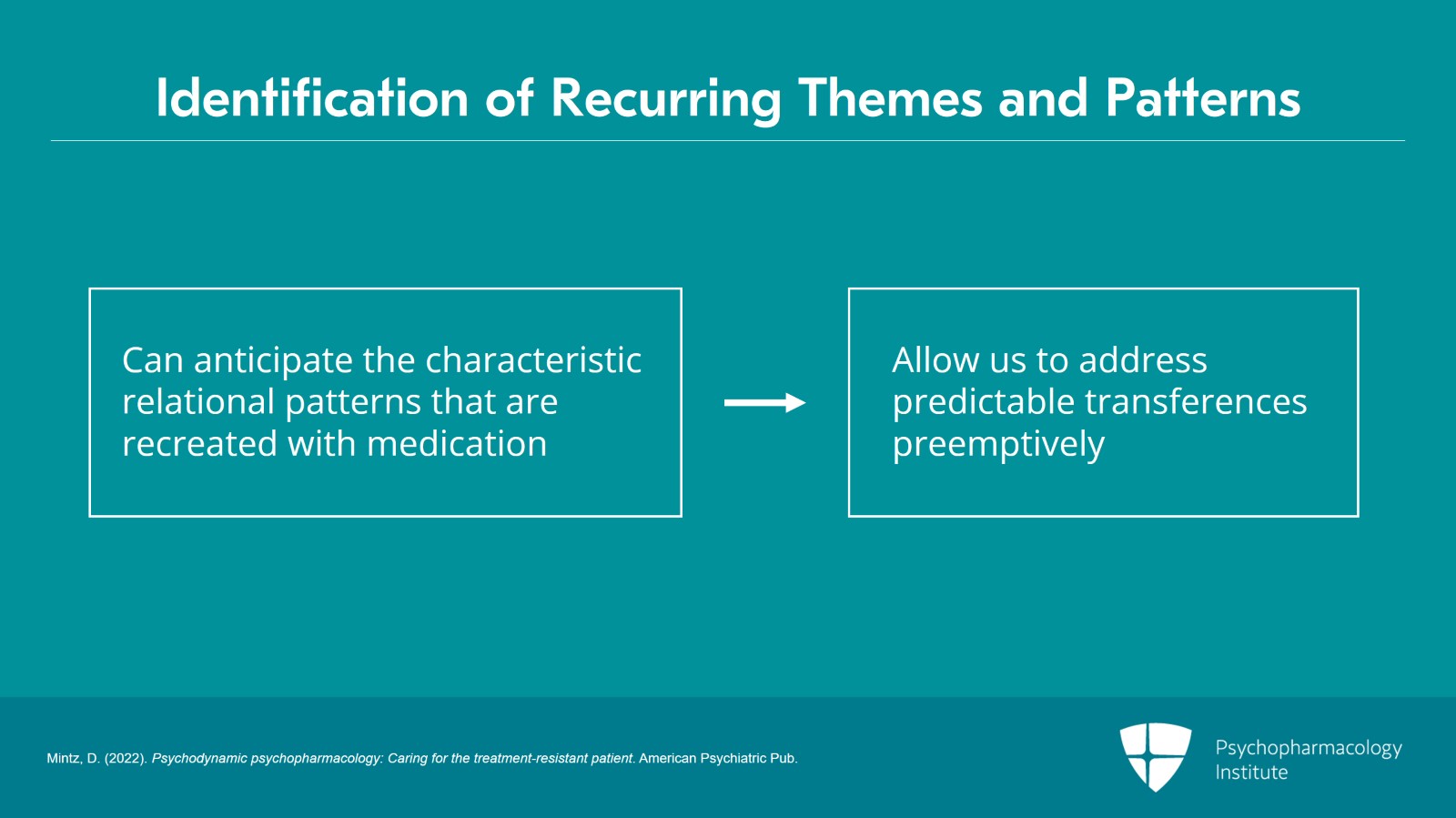
Another distinguishing feature of psychodynamic treatment is the identification of recurring themes and patterns and as I was suggesting the developmental history really gives us a baseline for identifying those recurring themes and patterns and we can anticipate as I said the characteristic relational patterns are recreated with medications oftentimes. The patients with disordered relationships with caregiving authority will bring this into the work. And knowing something about this ahead of time allows us to either preemptively or at least more effectively in the moment address these somewhat predictable transferences before they manifest or become a real problem in treatment.
References:
- Mintz, D. (2022). Psychodynamic psychopharmacology: Caring for the treatment-resistant patient. American Psychiatric Pub.
Slide 12 of 22
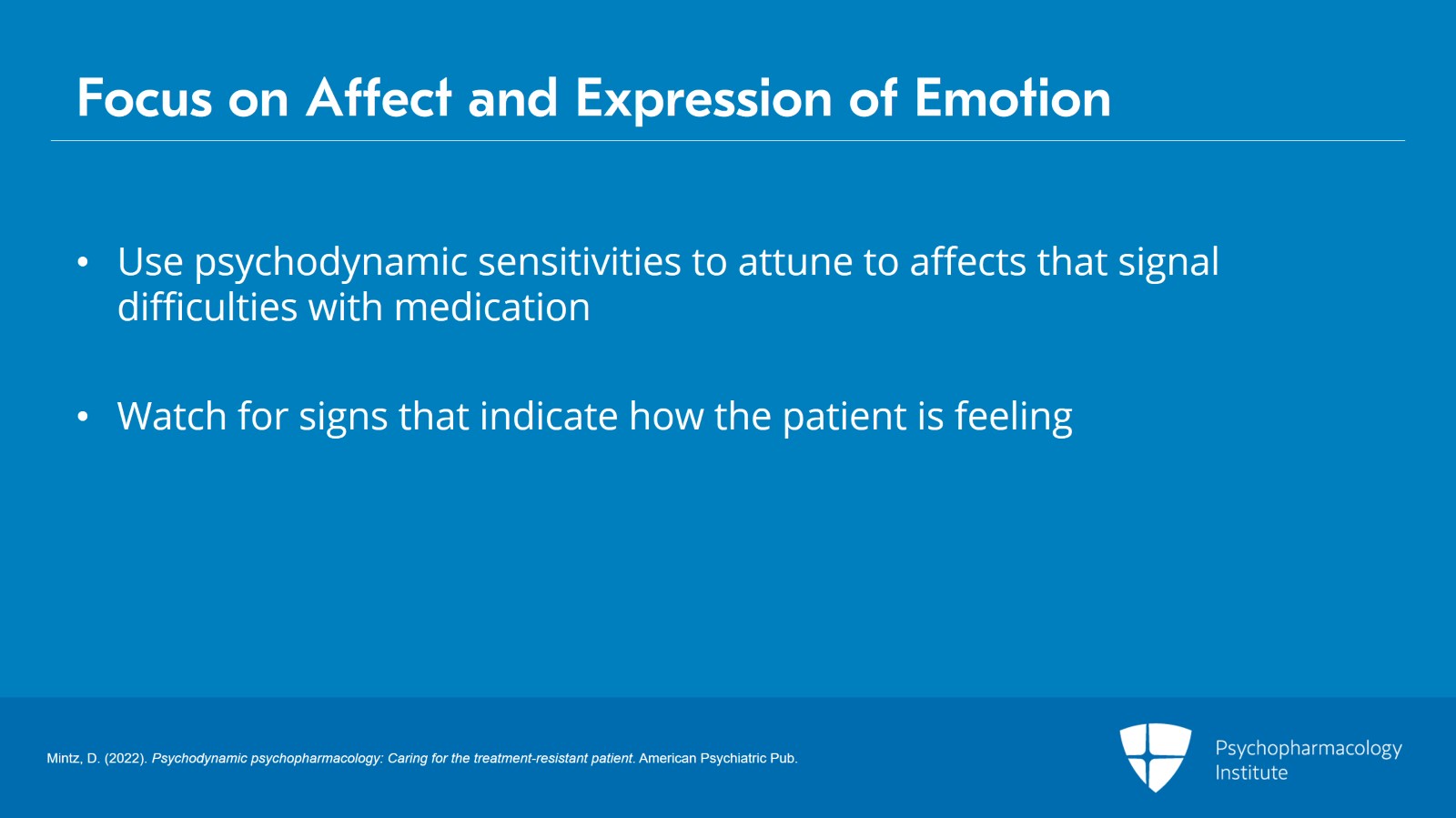
Another distinguishing characteristic of psychodynamic treatments is a focus on affect and expression of emotion. And I'm not talking here about the way you might really try to help the patients connect with their feelings and express their feelings in psychodynamic treatment but more, you know, so not the release of emotion as much as the use of our psychodynamic sensitivities to attune to affects that might signal difficulties with our medication. So certainly, as a psychotherapist, clinician, you know, you're watching for little signs that the patient is feeling sad or that they're feeling anxious or they're feeling angry and then, you know, aiding the patient in identifying affects that might be, provide useful information about the prescribing process.
References:
- Mintz, D. (2022). Psychodynamic psychopharmacology: Caring for the treatment-resistant patient. American Psychiatric Pub.
Free Files
Download PDF and other files
Success!
Check your inbox, we sent you all the materials there.
Slide 13 of 22
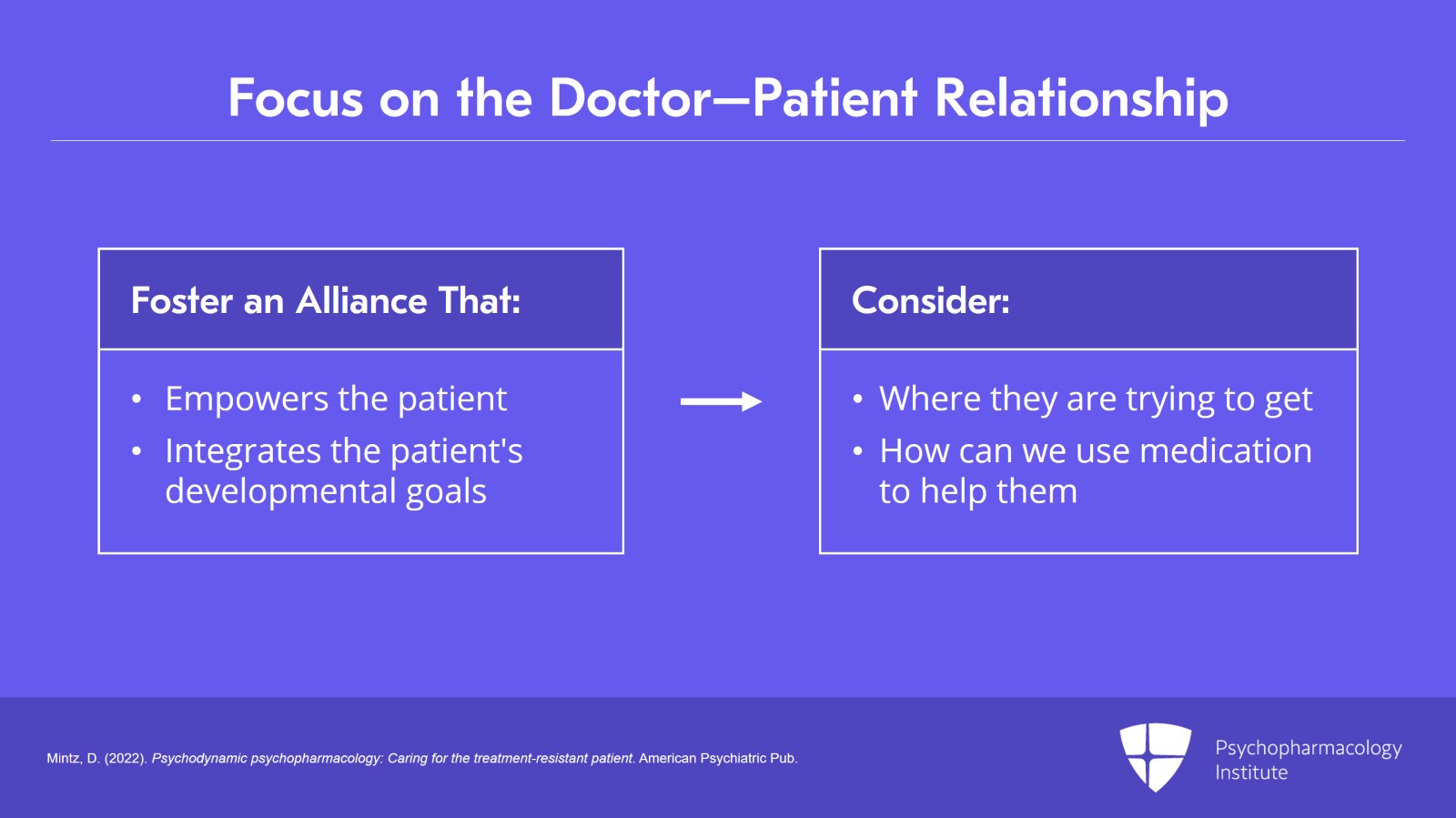
Another distinguishing feature of psychodynamic treatments is the focus on the doctor-patient relationship and as I've already said the alliance is more important and potent than the active ingredients in antidepressants probably. And so we really want to focus on fostering alliance that empowers the patient as a partner, that integrates the patient's developmental goals. So we're not just thinking about getting rid of the patient's illness but also thinking where they're trying to get and how can we use medications to help them obtain their goals as a person which I think puts us in a better patient, human to human for good alliance.
References:
- Mintz, D. (2022). Psychodynamic psychopharmacology: Caring for the treatment-resistant patient. American Psychiatric Pub.
Slide 14 of 22
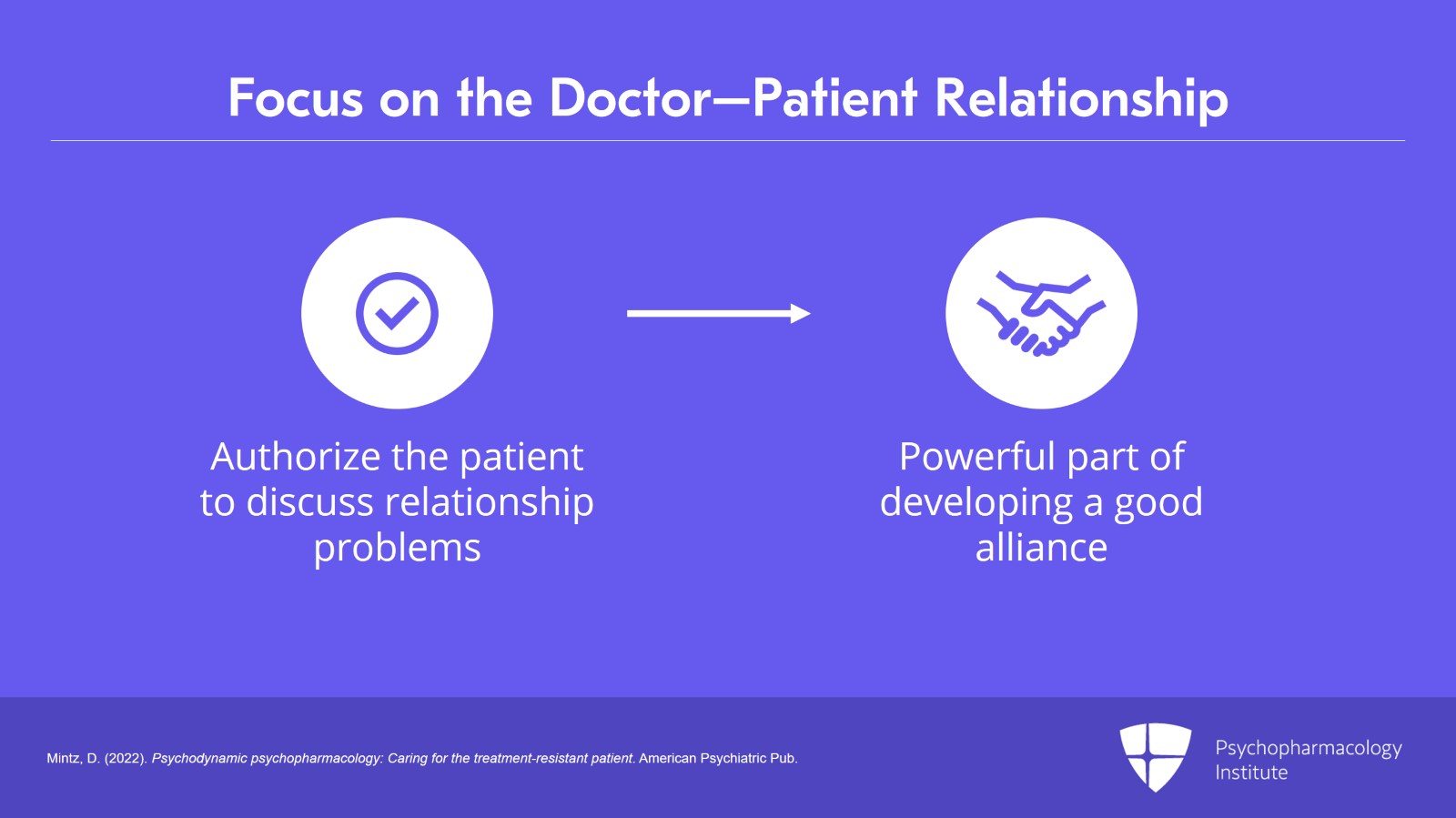
And I think something else we can do is explicitly authorize the patient to discuss relationship problems. So I will tell my patients that given what we know about the impact of alliance on treatment outcomes, not only do I want them to tell me if I'm doing something they don't like but I need them to tell me that. And you know, you'll talk to patient, when you do this, you'll talk to patients who tell you they've been doing treatment for, you know, sometimes decades and, and a doctor has not so explicitly authorized them to express their concerns or be critical. And it's actually a powerful and important part of developing a good alliance.
References:
- Mintz, D. (2022). Psychodynamic psychopharmacology: Caring for the treatment-resistant patient. American Psychiatric Pub.
Free Files
Download PDF and other files
Success!
Check your inbox, we sent you all the materials there.
Slide 15 of 22
In terms of focusing on the pharmacotherapy relationship, you know, we should be mindful that our act of prescribing can evoke a host of negative transferences and primitive anxieties.
References:
- Mintz, D. (2022). Psychodynamic psychopharmacology: Caring for the treatment-resistant patient. American Psychiatric Pub.
Slide 16 of 22
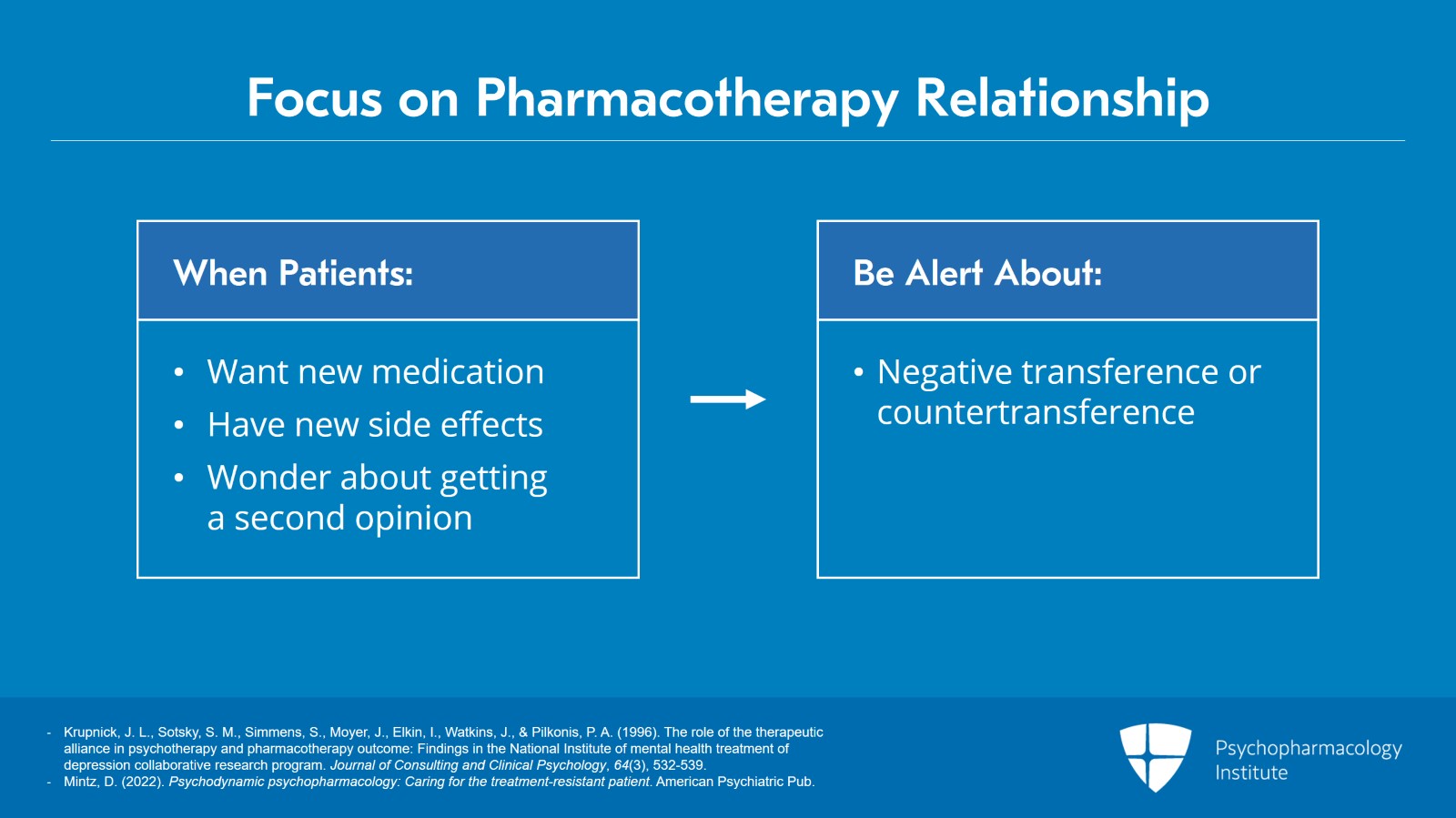
Another thing to hold in mind is that when patients want new medications, when suddenly there are new side effects they hadn't had, when you or the patients start wondering, you know, should we get another opinion, all of these things should alert you or at least raise a question about whether there is some kind of negative transference or countertransference happening.
References:
- Krupnick, J. L., Sotsky, S. M., Simmens, S., Moyer, J., Elkin, I., Watkins, J., & Pilkonis, P. A. (1996). The role of the therapeutic alliance in psychotherapy and pharmacotherapy outcome: Findings in the National Institute of mental health treatment of depression collaborative research program. Journal of Consulting and Clinical Psychology, 64(3), 532-539.
- Mintz, D. (2022). Psychodynamic psychopharmacology: Caring for the treatment-resistant patient. American Psychiatric Pub.
Free Files
Download PDF and other files
Success!
Check your inbox, we sent you all the materials there.
Slide 17 of 22
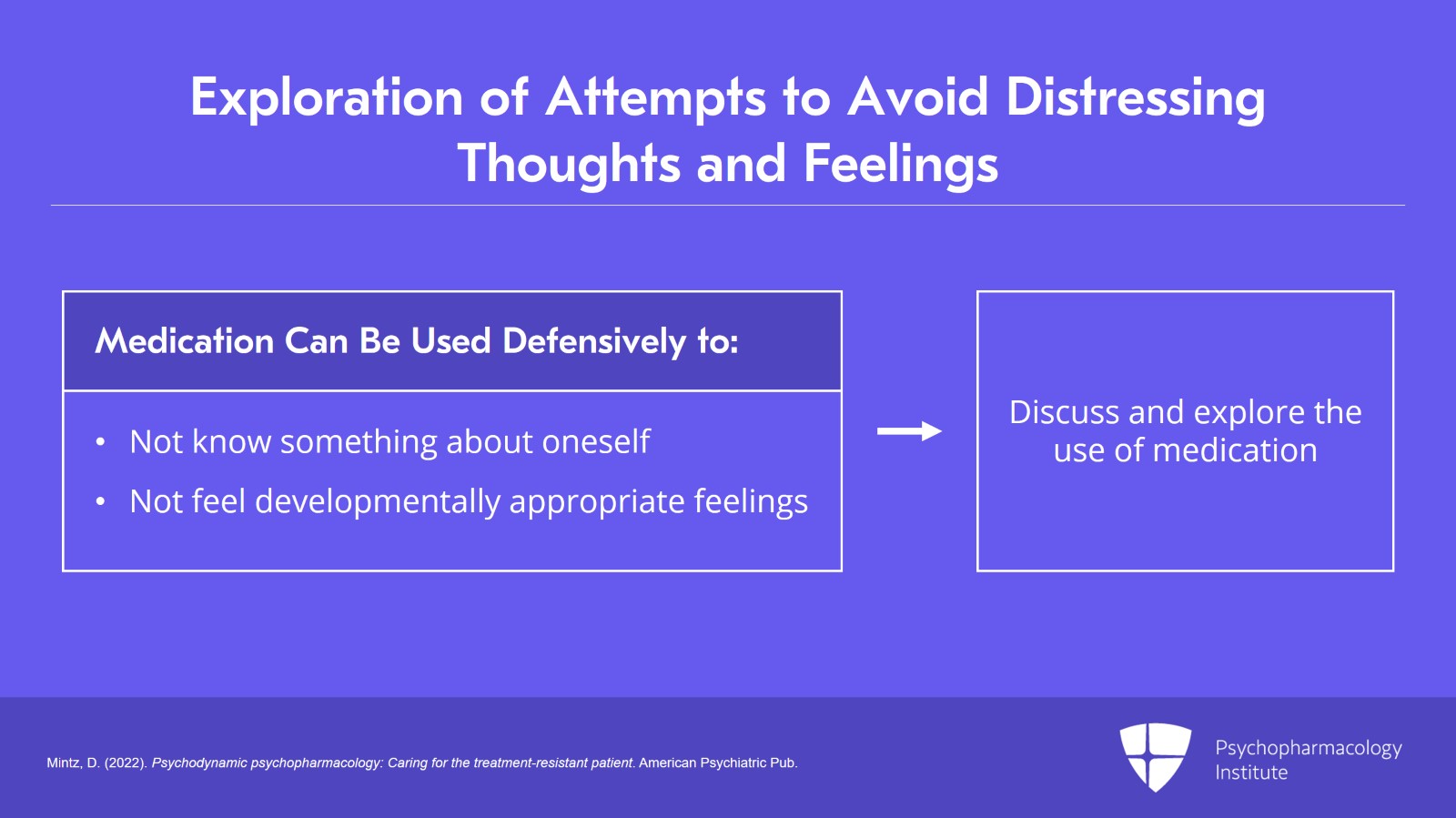
Another and I guess the final, you know, well, another way that medications or psychodynamics can be involved in pharmacotherapy is in our, our exploration of attempts to avoid distressing thoughts and feelings or addressing resistance. And you know, in previous lectures, we've talked about ways that medications can be used defensively to not know something about oneself or defensively to not feel feelings that are developmentally appropriate. So when we determine that patients are using medications in ways that serve unhelpfully defensive ends that we might want to begin to discuss and explore that with our patients.
References:
- Mintz, D. (2022). Psychodynamic psychopharmacology: Caring for the treatment-resistant patient. American Psychiatric Pub.
Slide 18 of 22
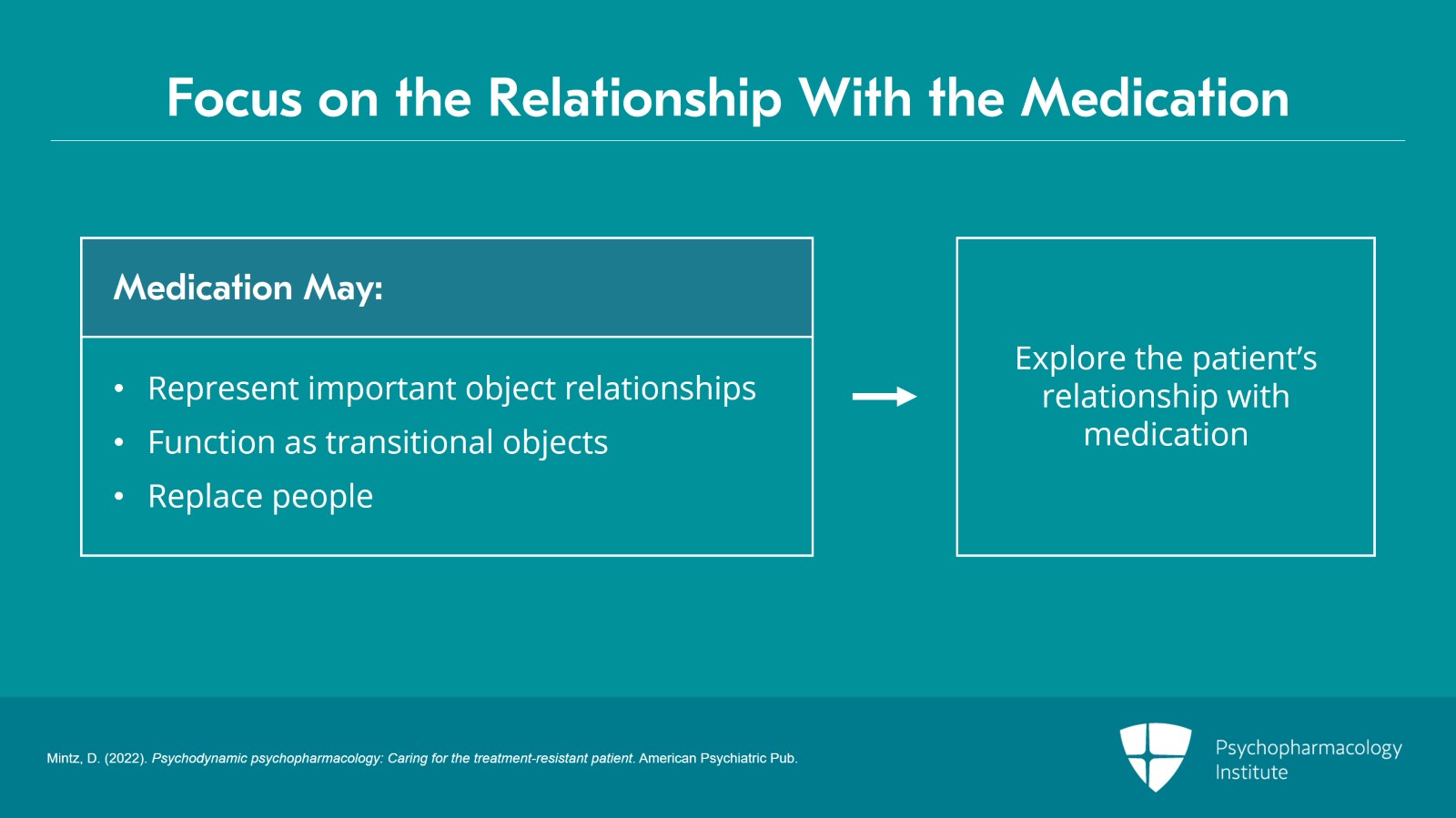
And lastly, you know, that we should be thinking about focusing on interpersonal relationships but the interpersonal relationship in this case is the relationship with the medication. And I will highlight that medications, for many of our patients, they represent important object relationships. And for some of our patients, in my experience, their relationship with their medication is more important to them than any relationship in their life, right? Those medications may function as transitional objects, you know, kind of like the teddy bear or the pacifier or the blankie where just having it helps the patient feel better. Medications may also in some worst case scenarios have replaced people. Like our patients have learned early on that people can't be counted on when you go to them for help. You may get help but you may get something you really don't want. So in that case, we really want to understand the relationship with medications.
References:
- Mintz, D. (2022). Psychodynamic psychopharmacology: Caring for the treatment-resistant patient. American Psychiatric Pub.
Free Files
Download PDF and other files
Success!
Check your inbox, we sent you all the materials there.
Slide 19 of 22
As Alicia Powell demonstrated in her paper on The Medication Life in 2001, if you explore the patient's relationship to medications you can learn a whole lot just about how the patients relate not just to medications but people in the world. And so it's a rich source of understanding on conscious material as well.
References:
- Powell A. D. (2001). The medication life. The Journal of Psychotherapy Practice and Research, 10(4), 217–222.
Slide 20 of 22
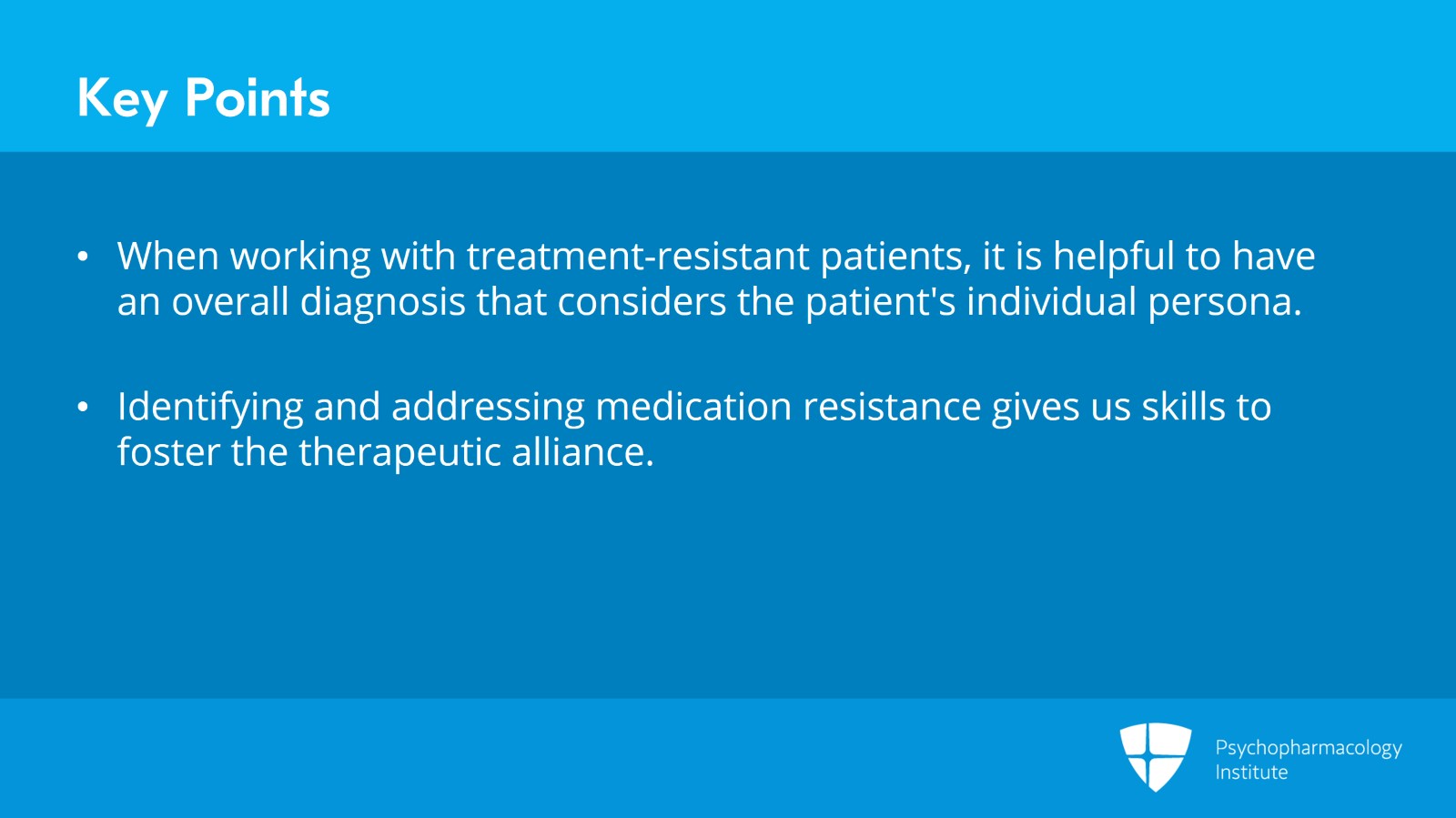
So to recap, when we're working with complex treatment-resistant patients, it is helpful to have an overall diagnosis that takes into account the person of the patient in addition to an understanding of the illness itself. Identifying and addressing resistances to taking medications give us the skills needed to foster therapeutic alliance that can make all the difference between treatments that work and treatments that don’t.
Free Files
Download PDF and other files
Success!
Check your inbox, we sent you all the materials there.
Slide 21 of 22
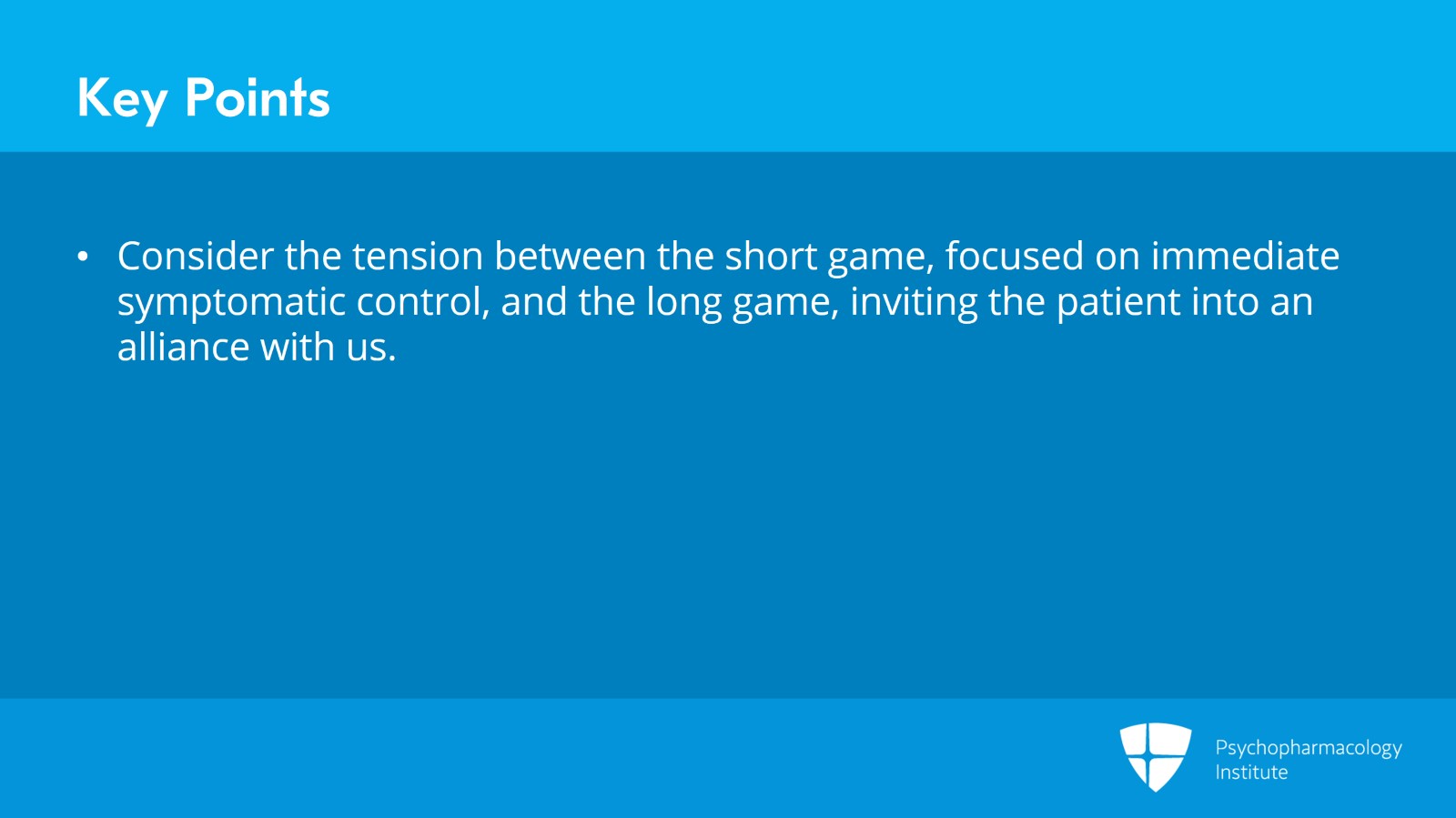
Oftentimes we also have to consider the tension between the short game where we're concerned with immediate symptomatic control and the long game which where we really invite the patient into an alliance with us where there is more experimentation, more shared-decision making, and an increased possibility.
Free Files
Download PDF and other files
Success!
Check your inbox, we sent you all the materials there.