Slides and Transcript
Slide 1 of 12
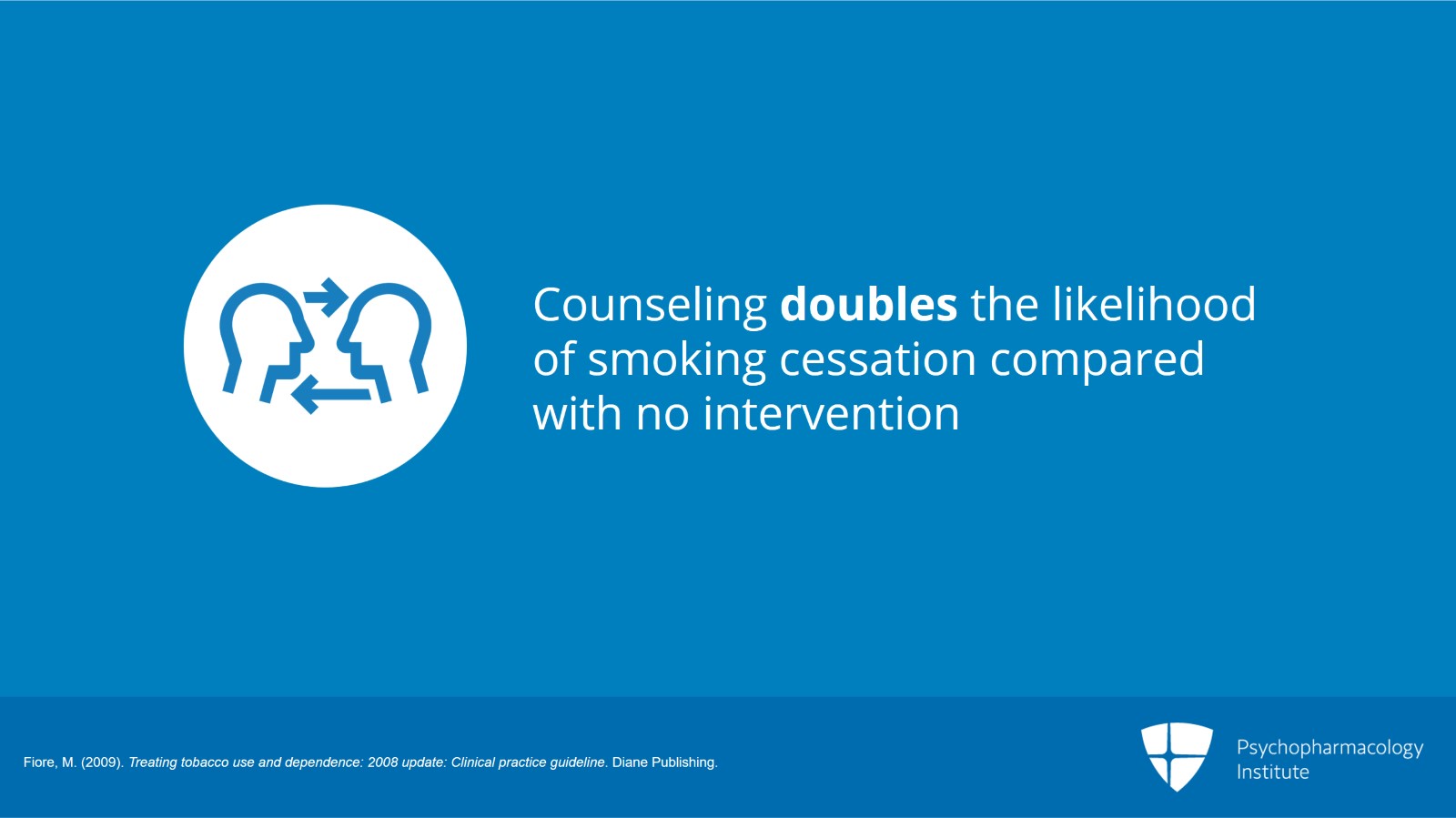
As I alluded to in the previous session section, psychosocial interventions like counseling actually are quite effective in helping patients stop or reduce their smoking.
Slide 2 of 12
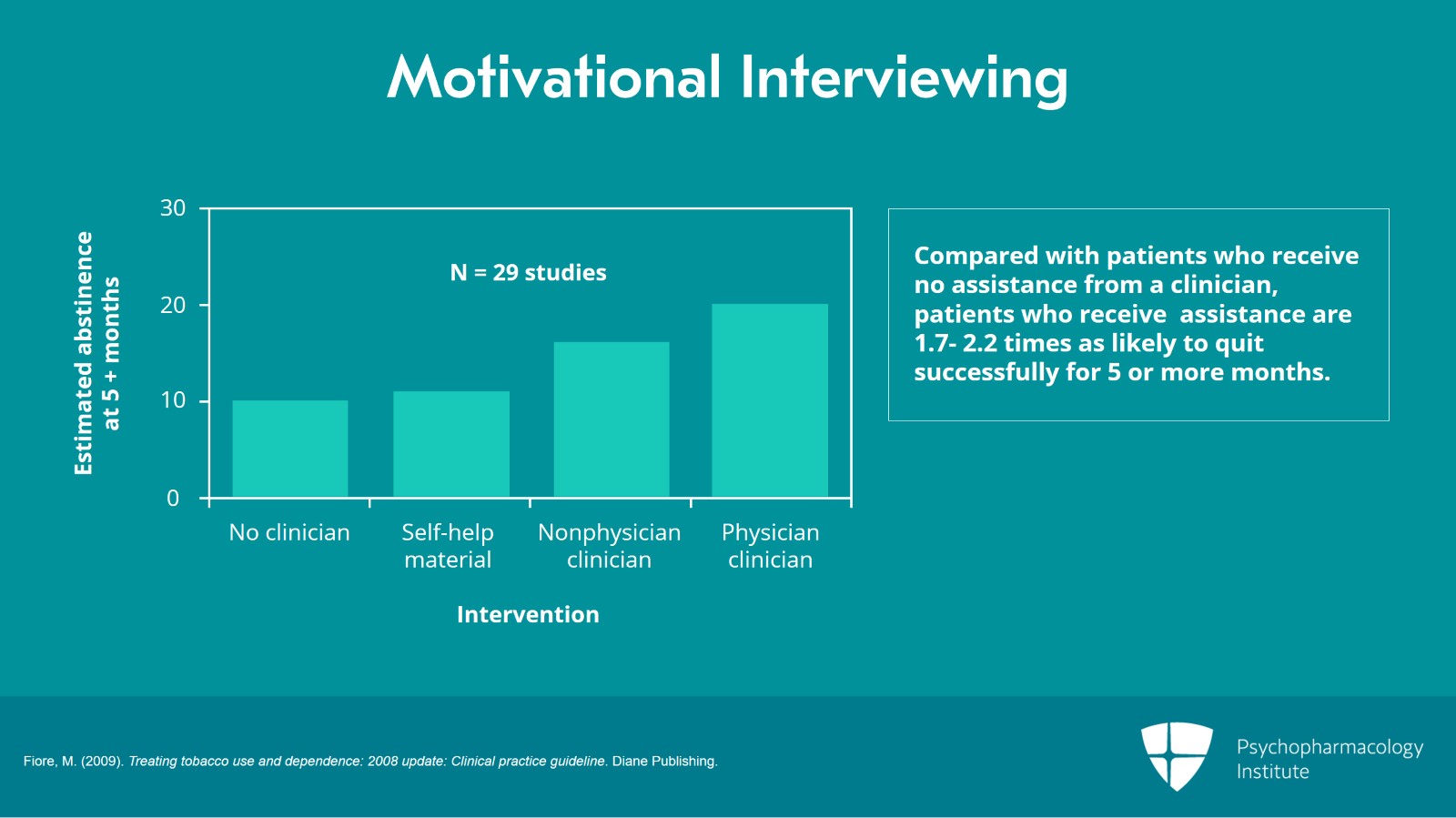
And compared to let’s say, you know, no clinician involvement, some kind of in-person counseling whether that’s a physician or even a non-physician actually dramatically improves the likelihood of the quit attempt by as much as, you know, twice the success rate by having either a physician or a non-physician counsel patients about their smoking cessation.
So I think physicians and psychiatrists should remember that we can actually have a big impact on our patient outcomes. And one of probably the most important things we can do is help facilitate our patients to cut back or quit smoking. And so I think psychiatrists are in a very powerful position to help facilitate that.
References:
- Fiore, M. (2009). Treating tobacco use and dependence: 2008 update: Clinical practice guideline. Diane Publishing.
Free Files
Download PDF and other files
Success!
Check your inbox, we sent you all the materials there.
Slide 3 of 12
And this is supported by numerous systemic reviews and a meta-analysis of 29 studies that determined that interventions by physicians actually improve outcomes compared to no clinician involvement or even non-clinicians.
References:
- Fiore, M. (2009). Treating tobacco use and dependence: 2008 update: Clinical practice guideline. Diane Publishing.
Slide 4 of 12
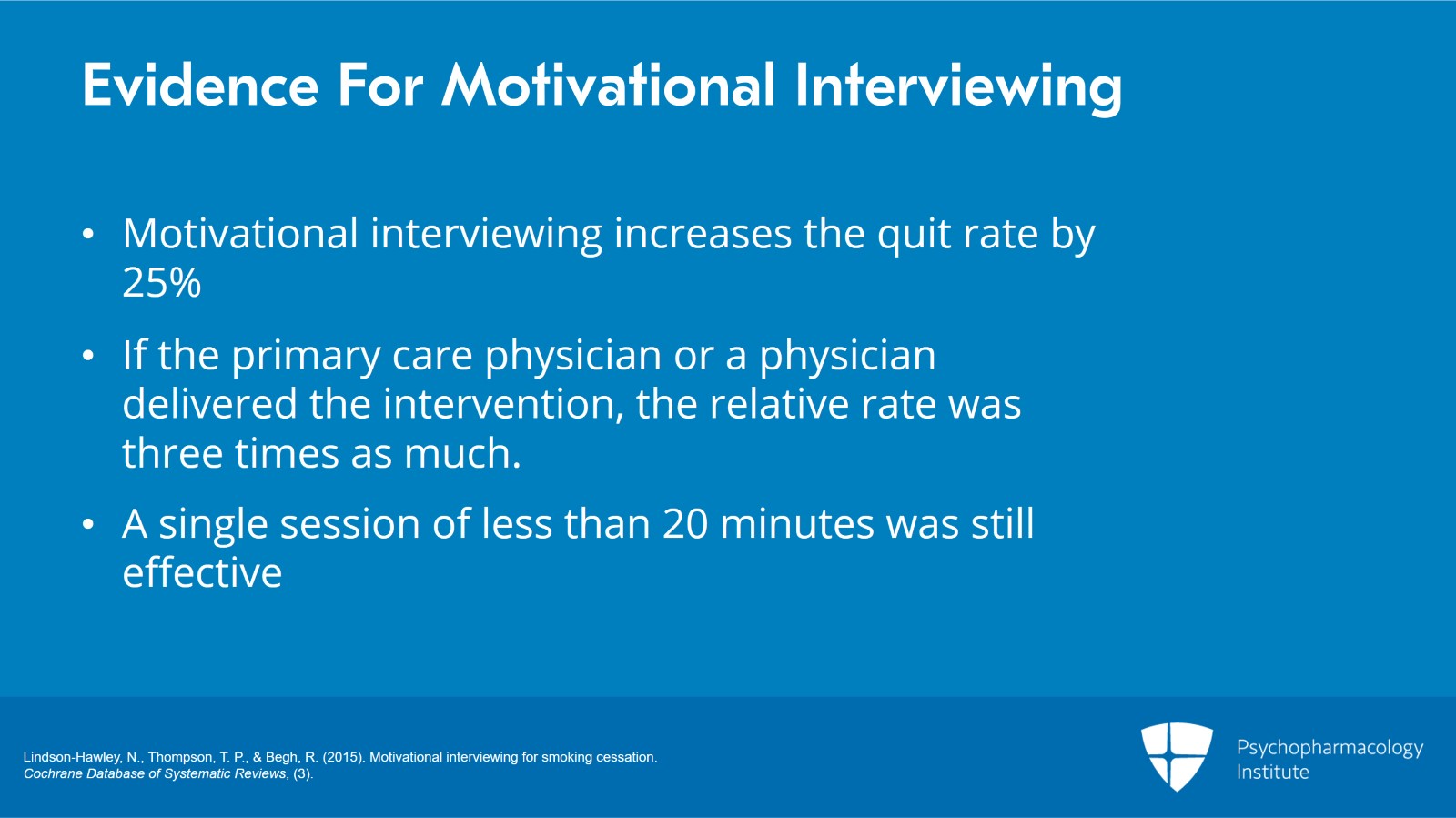
And compared to just simply giving advice on quitting smoking, motivational interviewing increases the quit rate by probably 25%. And indeed if the primary care physician or a physician delivered the intervention, the relative rate was three times as much. So that’s 300% more likelihood of being successful in the quit attempt. So this shows that the motivational interviewing approach is very effective. And single sessions of less than 20 minutes were still effective. So even with a time limit, a limited intervention, this can be pretty powerful.
References:
- Lindson‐Hawley, N., Thompson, T. P., & Begh, R. (2015). Motivational interviewing for smoking cessation. Cochrane Database of Systematic Reviews, (3).
Free Files
Download PDF and other files
Success!
Check your inbox, we sent you all the materials there.
Slide 5 of 12
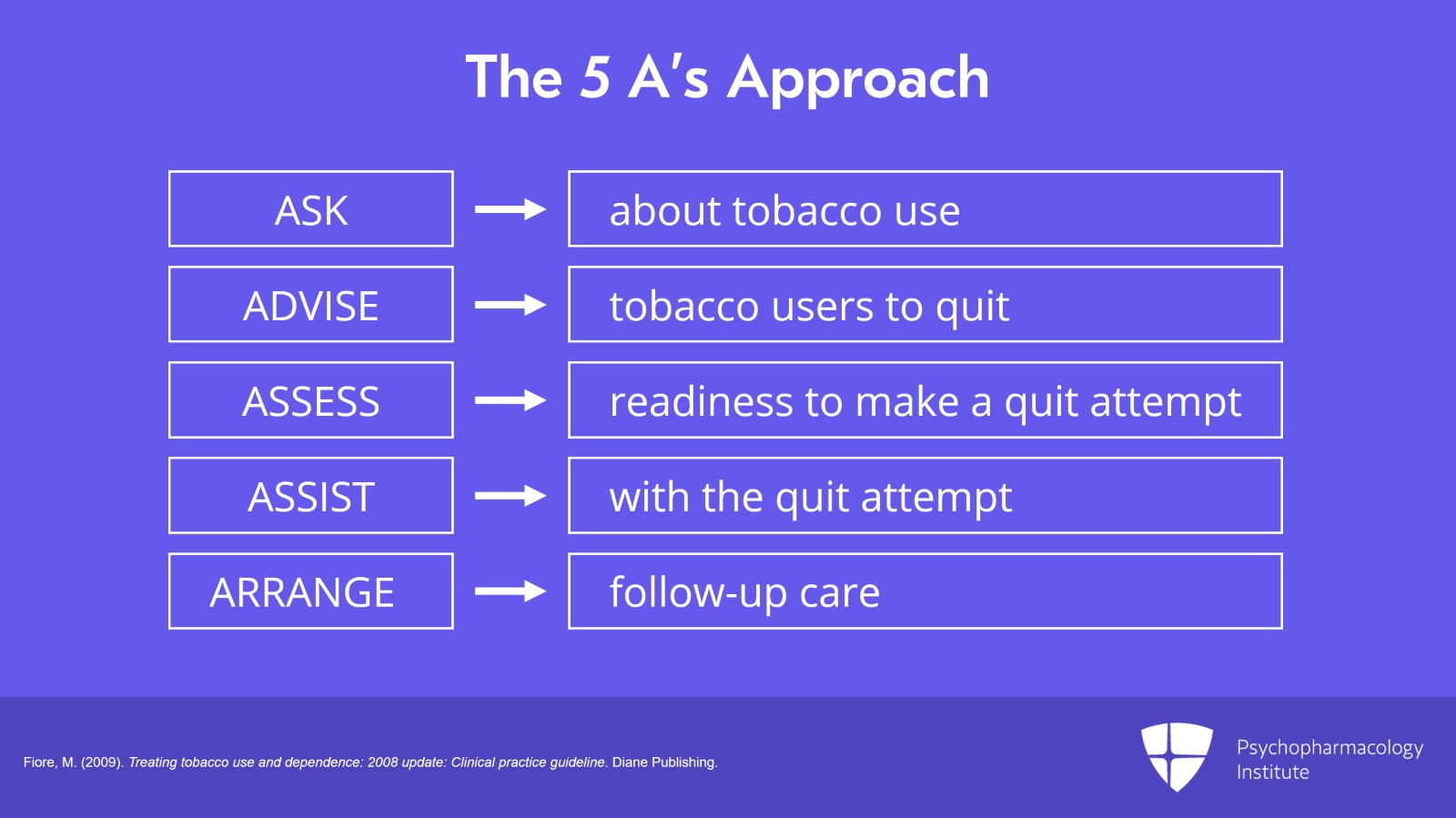
Now, there are several approaches that are currently described on how to have this conversation. One of the older approaches identified by the National Cancer Institute is the five A’s approach. And this is not a bad approach and I think this should be sort of a quick way to sort of think about how to actually approach this conversation.
And the 5 A’s refer to ask, advise, assess, assist and arrange. And the ask simply is to raise the issue and ask the patient about the tobacco use. And then to advise the patient that they should cut back or quit. And to assess their readiness for quitting or engaging in a change behavior. And then assisting them in that attempt. And then arranging for some kind of followup care or some kind of accountability. And so it’s sort of a nice way to remember sort of the basic elements required in this conversation.
References:
- Fiore, M. (2009). Treating tobacco use and dependence: 2008 update: Clinical practice guideline. Diane Publishing.
Slide 6 of 12
Now, if you were to do something a little bit more sophisticated, actually the recommended approach is motivational interviewing. Motivational interviewing is a guiding style of communication that focuses on the language of change and really prioritizes evoking from the patient his or her own reasons for wanting to change.
References:
- Lindson‐Hawley, N., Thompson, T. P., & Begh, R. (2015). Motivational interviewing for smoking cessation. Cochrane Database of Systematic Reviews, (3).
- Fiore, M. (2009). Treating tobacco use and dependence: 2008 update: Clinical practice guideline. Diane Publishing.
Free Files
Download PDF and other files
Success!
Check your inbox, we sent you all the materials there.
Slide 7 of 12
And of course, discussing the approach of motivational interviewing is completely beyond the scope of this webinar. But if you were to conduct a very brief motivational interviewing session, it may look something like this.
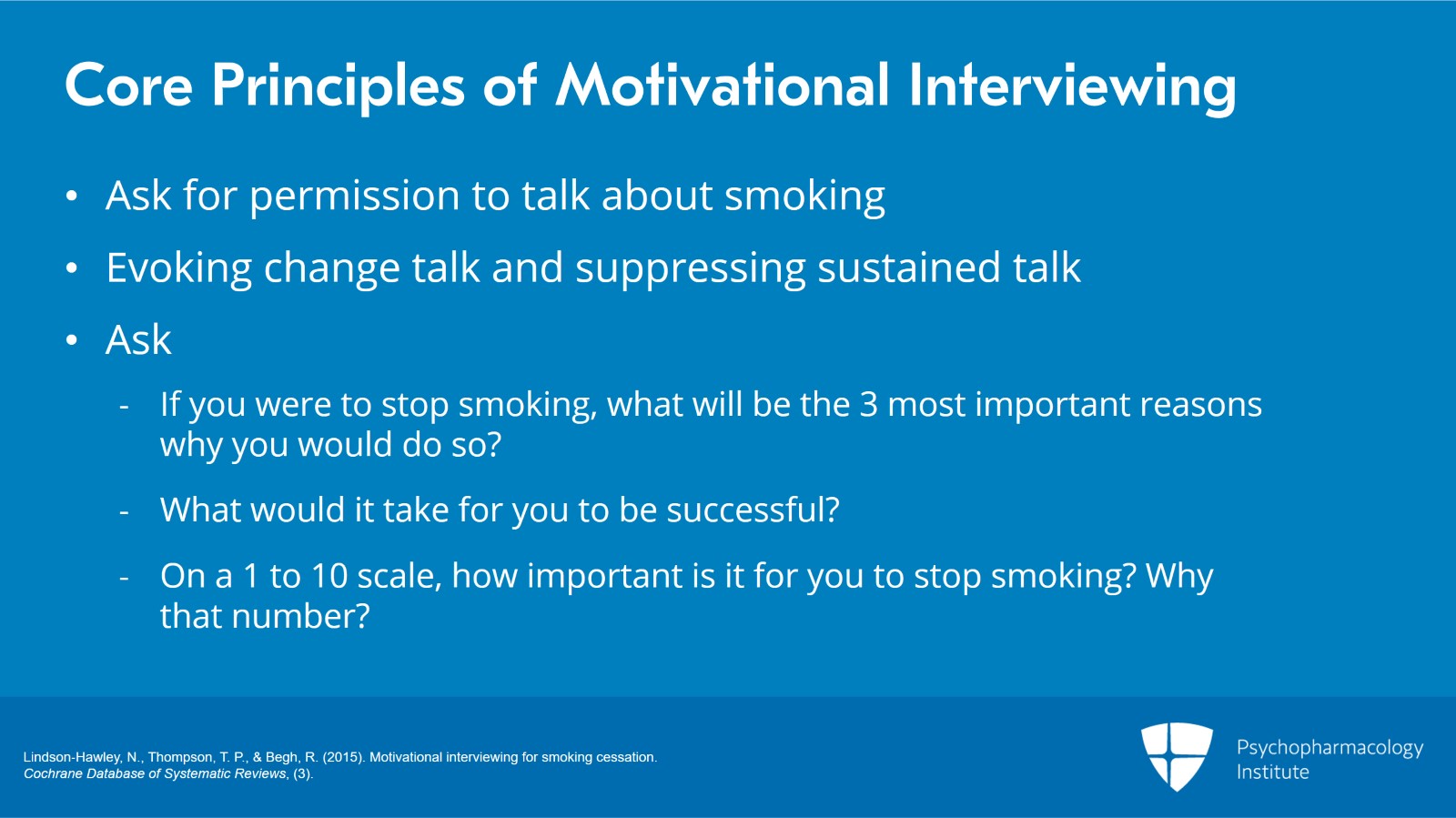
You could first ask permission to talk about smoking by asking something like, would it be okay if we spend a few minutes talking about your smoking? And the reason why asking permission may be important is that this is one of the important principles of motivational interviewing is that we try to respect patient autonomy. And by asking permission, it actually implies that the patient can say no. But because they’re being asked, patients actually feel like they’re given some control over the conversation.
And then you can proceed to actually trying to evoke what we call change talk. This is language that indicates movement towards change. The opposite we call sustained talk which is language that indicates maintaining the status quo or not changing. And so the goal of motivational interviewing is actually to evoke change talk at the same time suppressing sustained talk. And so one quick way that you could try to evoke change talk is use what we call the taste of MI questions.
And the three questions go like this. Something like,
if you were to stop smoking, what will be the three most important reasons why you would do so?
And what would it take for you to be successful?
And then on a scale of 0 to 10, 0 being not at all important, 10 being completely important, how important is it for you to stop smoking?
And then follow up that question with, okay, you gave me a 5. Why did you give me that number and not a lower number?
And so these three questions when asked, the answer to these questions actually is change talk. And so we’re trying to evoke from the patient his or her own reasons for wanting to change and not the clinician to be the one arguing for change.
References:
- Lindson‐Hawley, N., Thompson, T. P., & Begh, R. (2015). Motivational interviewing for smoking cessation. Cochrane Database of Systematic Reviews, (3).
Slide 8 of 12
Now, once you evoke this change talk, you can sort of then transition to the planning phase by giving first what’s called a change talk bouquet and then combining that with a key question.
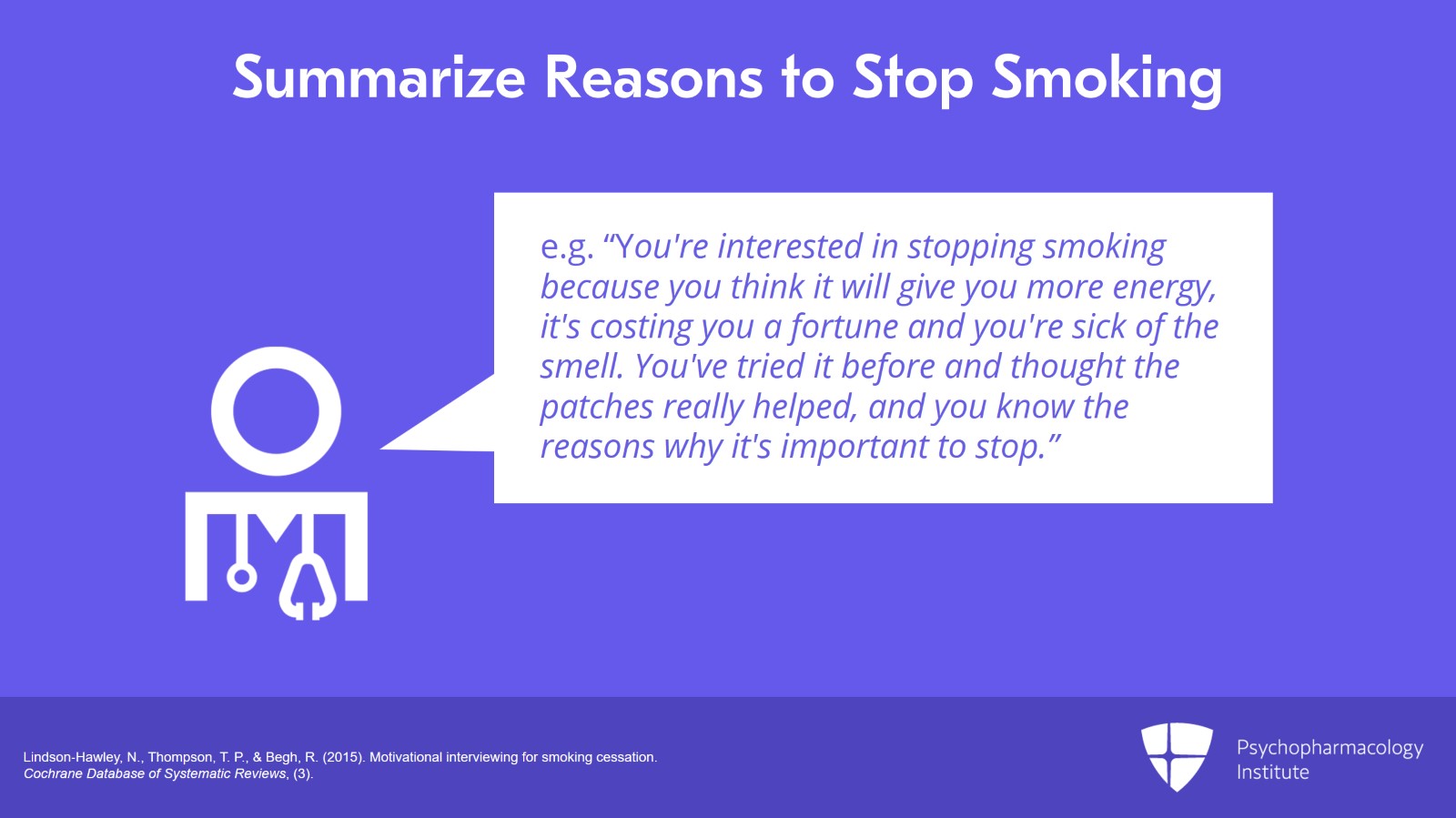
So based on what the patient may have said to these questions, you can summarize that into a bouquet of change talk. For example, you’re interested in stopping smoking because you think it will give you more energy, it’s costing you a fortune and you’re sick of the smell. You’ve tried it before and thought the patches really helped and you know the reasons why it’s important to stop.
References:
- Lindson‐Hawley, N., Thompson, T. P., & Begh, R. (2015). Motivational interviewing for smoking cessation. Cochrane Database of Systematic Reviews, (3).
Free Files
Download PDF and other files
Success!
Check your inbox, we sent you all the materials there.
Slide 9 of 12
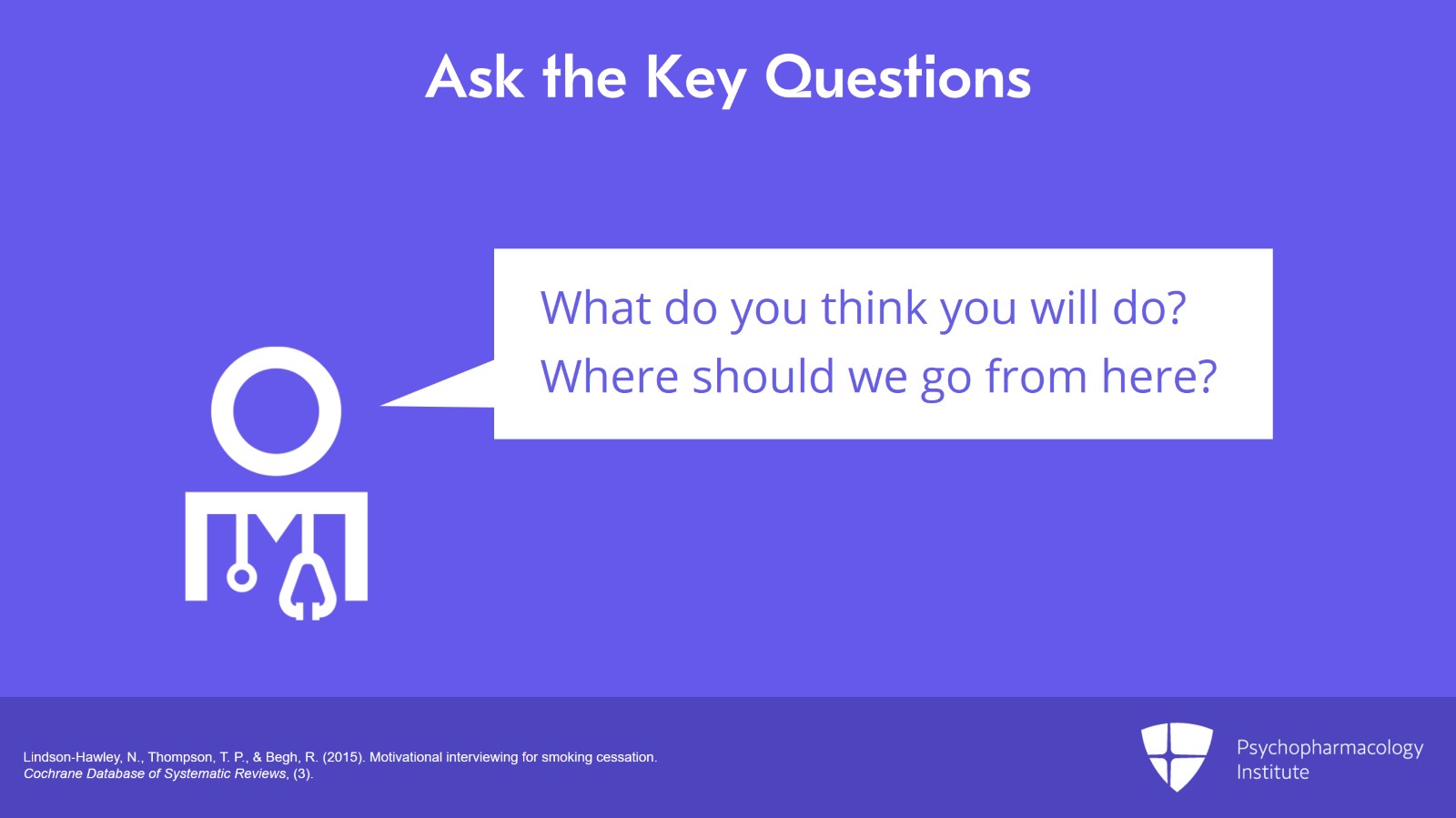
And then you can combine that change talk bouquet with a key question, something like, so what do you think you will do? Or you know, where should we go from here. Or what will you do? And so the basic idea here is we want to evoke from the patient his or her own reason for wanting to change and then summarize that back for the patient and ask, what are they going to do about it? And so this is a basic, you know, sort of a quick recommendation of what a motivational interviewing conversation may look like.
References:
- Lindson‐Hawley, N., Thompson, T. P., & Begh, R. (2015). Motivational interviewing for smoking cessation. Cochrane Database of Systematic Reviews, (3).
Slide 10 of 12
Every state in the United States actually has access to a free 1-800 tobacco quit line. And it’s 1-800-QUIT-NOW. This is available at no cost to all states in the United States, available in English and many other languages. They offer counseling, advice, self-help materials, free or discounted medications and referrals. Unfortunately, utilization remains low because of limited awareness. But I strongly recommend that clinicians utilize this as an adjunct to the different psychosocial interventions that are offered.
Free Files
Download PDF and other files
Success!
Check your inbox, we sent you all the materials there.
Slide 11 of 12
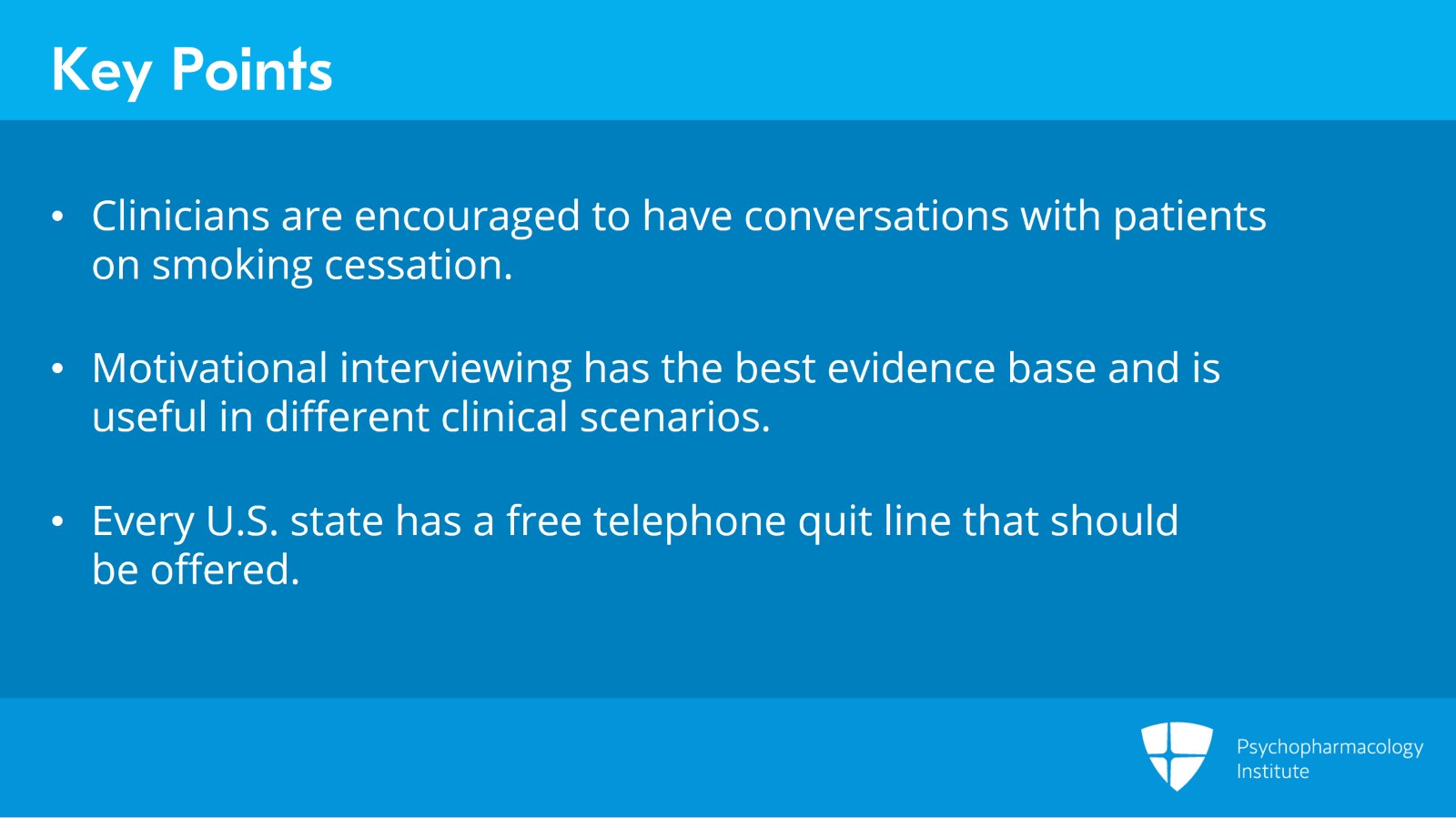
So key points. Physician counseling has an impact on rates of successful cessation and therefore, psychiatrists should be encouraged to engage in this conversation with their patients.
A variety of approaches of counseling can be used but motivational interviewing has the best evidence base and the skill is useful in a wide range of clinical scenarios and target behaviors. And every state has a free telephone quit line that should be offered to anyone interested.
Free Files
Download PDF and other files
Success!
Check your inbox, we sent you all the materials there.